What Is a Forex Prop Firm? How Prop Trading Works for Forex

Forex prop firms let you trade the firm’s capital instead of your own. You pass an evaluation, follow risk rules, and earn a profit split. Most firms use “challenge” accounts with hard limits on daily loss, max drawdown, and leverage. Fees often fund payouts and platform costs.
This guide explains how forex prop trading works in practice. You will learn the common account models, how evaluations and funded stages work, what rules matter most, how payouts get calculated, and which red flags to check before you pay a fee. If you want to compare prop trading with following someone else, see forex copy trading.
Key Takeaways
In het kort:
- A forex prop firm gives you access to its capital after you prove you can follow its rules.
- You usually start with an evaluation, then move to a funded stage if you hit a profit target without breaking risk limits.
- Your results matter less than your risk control. Daily loss limit, max drawdown, and leverage define what you can do.
- You pay a fee for the evaluation. Firms use it to cover payouts, platform costs, and operations.
- Payouts depend on your profit split and the firm’s payout rules, including minimum trading days and withdrawal schedules.
- Red flags include unclear rules, moving goalposts, weak execution, and payout restrictions that only show up after you pass.
- Compare account types, rules, and reliability before you pay, see best forex prop firms.
What Is a Forex Prop Firm? (Definition and Core Concept)
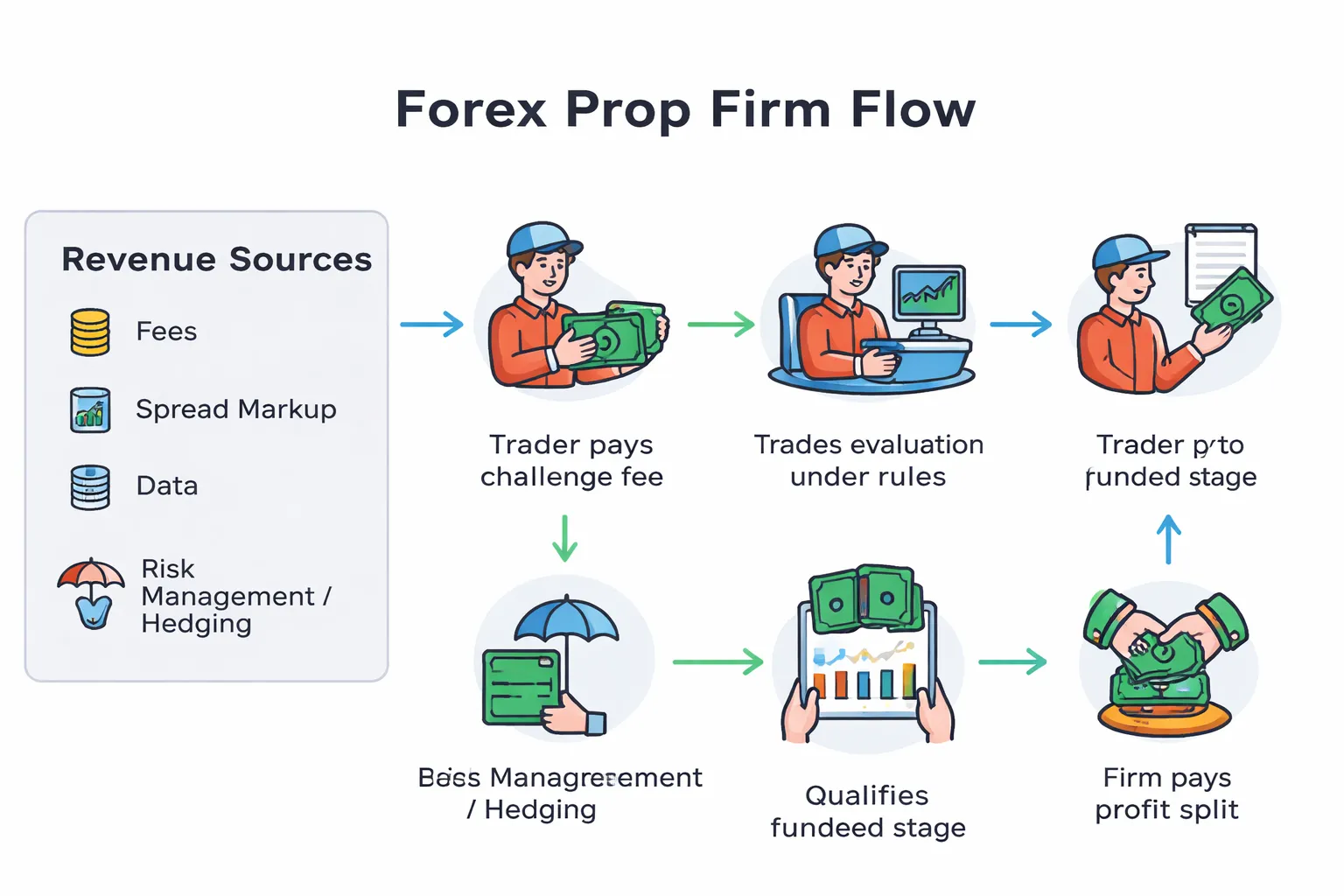
Proprietary trading in plain English
A forex prop firm gives you access to a trading account and sets the rules. You trade their program and aim to generate profit. If you meet the targets and follow the risk limits, you earn a share of the profits.
Most firms gate access through a challenge. You pay a fee, trade under strict drawdown and consistency rules, then qualify for a funded stage. Rule details matter because most failures come from risk limits, not bad entries.
If you want a rule-by-rule breakdown, read the forex prop firm challenge explained.
How a forex prop firm differs from a retail broker
- Who funds the account: A retail broker holds your deposit. A prop firm gives you a program account with set limits.
- How you get paid: With a broker, you keep 100 percent of your profits and withdraw your own money. With a prop firm, you withdraw a profit split under payout rules.
- What you buy: With a broker, you buy market access and execution. With a prop firm, you buy an evaluation and a payout agreement.
- How risk works: With a broker, you control your risk until you blow your account. With a prop firm, you must stay inside hard daily and max drawdown limits.
Real funded vs simulated funded accounts, and why it matters
Some “funded” accounts route your trades to the real market. Many do not. Many firms run funded stages on a simulator and pay you from internal revenue.
- Real funded: Your orders can hit a liquidity provider, an ECN, or a broker feed. Execution quality, slippage, and news conditions can match live trading. The firm still controls risk and may copy trade or hedge.
- Sim funded: Your trades stay internal. The firm can still pay you, but it can also tighten rules, reject strategies, or change execution settings because no external counterparty exists.
This matters for three reasons. First, fills and spreads can differ from live conditions. Second, some firms ban behavior they label as “sim exploiting,” like latency tactics or certain scalps. Third, payout security depends on the firm’s cash flow and governance, not on segregated client funds.
Where prop firms make money
Bottom line. A forex prop firm sells a structured path to payouts under strict risk limits. Your edge must survive the rules, the costs, and the execution model.
Traditional vs Retail Forex Prop Firms: What’s the Difference?
Institutional desk prop firms
Traditional prop firms sit inside financial institutions or specialist trading shops. You apply like you would for any job. They screen your background, process, and risk discipline.
- Recruiting: They hire graduates, experienced traders, and quantitative profiles. Expect interviews, tests, and references.
- Training: Many run structured programs. You learn the firm’s playbook, tools, and risk rules before you touch meaningful size.
- Capital allocation: You start small. You earn more risk as you show consistent performance and clean execution.
- Pay model: Many roles pay a salary plus bonus or a profit split. The firm controls the risk, the seat, and the technology stack.
- Supervision: Risk managers watch positions and limits. Breaches trigger immediate intervention.
Retail, online “challenge-based” prop firms
Retail forex prop firms sell you access to a funded account program. You usually work as an independent contractor. You pay for an evaluation. You trade under preset limits.
- Entry: You buy an evaluation, then hit a profit target without breaking drawdown rules.
- Scaling: You earn a larger notional account after payouts or consistent months. Rules vary by firm.
- Payouts: You earn a profit split on “simulated” or internalized trading, depending on the firm’s model.
- What you manage: Your edge, your discipline, and rule compliance. The firm manages exposure and payout risk.
If you want the rule details that decide whether you pass or fail, read challenge rules explained.
Regulation and oversight differences
Do not assume a “prop firm” equals a regulated broker. These are different businesses.
- Broker: Takes deposits, routes trades, and must meet licensing and client money rules in many jurisdictions.
- Institutional prop desk: Operates under a regulated entity’s umbrella or within a supervised trading firm structure.
- Retail prop firm: Often does not take client deposits for trading. It sells evaluations and pays performance-based compensation. Oversight varies by country and by how the firm structures its product.
- Educator: Sells courses, coaching, or signals. No capital allocation. No payouts tied to your trading results.
Practical takeaway. You must verify the legal entity, the contract terms, where disputes get handled, and what trading is actually happening behind the platform.
Common misconceptions: “job” vs “product”
Traditional prop trading is closer to employment. Retail prop trading is closer to a product purchase.
- Institutional model: You earn a seat. The firm invests in you. You may get salary, benefits, and supervision.
- Retail model: You buy an evaluation with rules. You pay fees. You can lose the account by breaking limits even if your strategy makes sense long term.
- What you are buying: A chance to qualify for payouts under specific constraints. You are not buying guaranteed funding, employment, or a stable income stream.
- Core risk for you: Rule friction. Targets, drawdown math, news rules, and minimum trading days can block a profitable approach.
How Forex Prop Trading Works Step by Step

1) Choose an account size and rule set
You pick a plan like $10,000, $50,000, or $100,000. Bigger accounts cost more. They also create bigger position sizes for the same risk percent.
Before you pay, map the rules to your strategy. Most firms define the same core limits.
- Profit target. A fixed percent you must hit in the evaluation, often in the 6 to 10 percent range.
- Maximum daily drawdown. A loss limit per day, often 3 to 5 percent. Some firms calculate it from start-of-day balance, others from equity high water mark.
- Maximum total drawdown. A hard floor, often 6 to 12 percent. This usually ends the account if you touch it.
- Time limit. Some plans require you to pass within a set number of days. Others allow unlimited time.
- Minimum trading days. You may need to place trades on 3 to 10 separate days, even if you hit target sooner.
- News and weekend rules. Some firms ban holding through major releases or over the weekend.
- Instrument and lot limits. Some plans cap symbols, leverage, or position size.
Rule math matters. A 10 percent target with a 5 percent daily loss limit forces tighter risk and fewer recovery attempts than most retail accounts.
2) Trade the evaluation or challenge phase
You start on a demo or simulated environment. Your job is to hit the target without breaking limits.
Pass or fail comes from the platform logs. The firm checks your equity curve, not your intent.
- You pass when your account hits the profit target and you meet minimum days and any consistency rule.
- You fail if you hit a daily loss limit, total drawdown limit, restricted trading rule, or prohibited behavior rule.
- You may also fail from execution patterns the firm flags, like latency arbitrage or trading during banned news windows.
3) Complete verification in two-step models
Many firms use two steps. Step one sets a higher target. Step two sets a lower target with the same or slightly tighter drawdowns.
This stage tests repeatability. Firms often add a consistency layer.
- Daily profit cap. A single day cannot make up more than a set share of your total profits.
- Minimum days. You must spread performance across more sessions.
- Risk controls. Some firms require stop losses or cap lot size by balance.
Trade smaller than you think you need. Consistency filters punish one large win followed by flat days.
4) Trade the funded stage
After you pass, you get a funded account. It may still run on a simulated backend with real payouts. You now trade under live monitoring.
- Risk rules stay. Daily and total drawdown limits still apply. One breach can end the account.
- Condition changes. Leverage, spreads, commissions, and slippage can differ from the evaluation.
- Payout rules apply. You follow a schedule, a profit split, and a minimum withdrawal threshold.
- Monitoring increases. The firm reviews trade frequency, holding time, and prohibited tactics.
Plan around worst-case fills. If your system needs perfect entries to survive drawdown rules, it breaks under funded conditions.
If you rely on third-party execution, understand the added risk of copying and signal tools before you commit. Read Copy Trading Forex Explained.
5) Use scaling plans to increase buying power
Scaling increases your account size after you hit profit and risk milestones. Each firm sets its own ladder.
- You trade for a set period, often 1 to 3 months.
- You hit a profit threshold while staying within drawdowns.
- You request scaling, or the firm applies it automatically.
- Your max loss limits rise with the new balance, but the same percent rules usually remain.
Scaling rewards low drawdown more than high variance. If you keep hovering near limits, you rarely qualify for upgrades.
Key Rules and Risk Limits You Must Understand
Max Daily Loss vs Max Overall Loss
Most forex prop firms enforce two hard stops. Max daily loss and max overall loss.
- Max daily loss, limits how much you can lose in one trading day. Some firms reset at broker server midnight. Others reset 24 hours after your first trade of the day.
- Max overall loss, limits total drawdown from your starting balance or from your peak equity, depending on the model.
You must know whether limits use balance or equity.
- Balance-based, counts closed trades only. Floating loss does not count until you close.
- Equity-based, counts open profit and loss in real time. A fast spike against you can fail the account even if you planned to hold.
Read the rule wording. If it says equity, assume floating drawdown triggers breaches.
Trailing Drawdown Mechanics
Trailing drawdown surprises traders because the stop line can move up as you profit.
- You start with a fixed buffer, for example 10 percent.
- As your equity hits new highs, the allowed drawdown level moves up.
- If you give back gains, you can violate the limit even while you stay above your starting balance.
Two details matter.
- Trail on equity or balance. Equity trailing reacts to floating profit. Balance trailing reacts after you close winners.
- When it stops trailing. Some firms stop trailing at breakeven. Others trail until a specific threshold, or keep trailing forever.
Track your high-water mark. Keep a buffer. Do not size trades so one normal pullback hits the moving limit.
Lot Size Limits, Leverage Caps, and Exposure Restrictions
Firms limit risk through position sizing and exposure rules.
- Lot size caps, a maximum per trade or per symbol. This blocks oversized entries even if you stay under drawdown limits.
- Leverage caps, often lower than retail. Common ranges sit around 1:10 to 1:100. Lower leverage forces smaller position sizes for the same stop distance.
- Exposure limits, a maximum total lots, a maximum total margin, or a maximum risk across open positions.
- Correlation rules, limits on similar pairs. Long EURUSD and long GBPUSD can count as one combined USD exposure.
Plan your portfolio risk. Treat correlated pairs as one trade when you size.
News Trading, Weekend Holding, and Restricted Instruments
Many firms restrict when and what you trade.
- News rules, some firms ban opening or closing trades within a window around major events. Others allow it but void profits from trades opened inside the window.
- Weekend holding, some firms require you to close before the market shuts. Others allow holding but tighten margin or exclude certain symbols.
- Restricted instruments, allowed markets vary by firm. Forex majors often qualify. Exotics, metals, indices, crypto, and oil may have separate rules or higher margin.
If your strategy depends on volatility spikes, check event rules first. If you swing trade, confirm weekend policy before you enter.
Copy Trading, EAs, VPS Use, and Prohibited Strategies
Automation and mirroring can trigger violations even when your risk stays low.
- Copy trading, many firms allow it only if you copy your own accounts. Some ban third-party signal copying. If you plan to mirror trades, read the firm definition of copy trading and account sharing. For a deeper setup and risk review, see forex copy trading explained.
- EAs and bots, some firms allow them with limits. Others ban them in evaluations. Some require you to disclose the EA.
- VPS use, usually allowed and often recommended for stability. Some firms require approved IP regions or consistent device access.
- Prohibited strategies, commonly include latency arbitrage, tick scalping designed to exploit price feed delays, reverse arbitrage between brokers, order flooding, and any attempt to manipulate execution.
Assume the firm monitors execution patterns. If your edge depends on speed advantages or feed differences, you risk a denial of payout or account closure.
Payouts, Profit Splits, and Trader Compensation
Typical profit split ranges and what impacts them
Most forex prop firms pay you a percentage of net profits. Common ranges sit between 70% to 90%. Some start you at 50% to 70% and increase after payouts.
Your split usually depends on these factors.
- Account type and size. Larger funded accounts may offer higher splits, but stricter rules.
- Payout track record. Firms often raise your split after one or more approved payouts.
- Risk limits. Tighter daily loss limits and trailing drawdowns often come with better splits.
- Add-ons. “Higher split” options may require a higher fee or lower drawdown.
- Instrument and execution costs. Higher commissions and spreads reduce net profit, even if the split stays the same.
Payout schedules, on-demand vs monthly or biweekly, and minimum trading days
Firms use two payout models.
- On-demand payouts. You request a payout after you meet eligibility rules. Typical gating rules include minimum profit, no rule violations, and a minimum number of trading days.
- Fixed-cycle payouts. You get paid monthly or biweekly if you stay eligible through the cycle.
Many firms require 5 to 10 trading days before your first payout. Some require the same for every payout cycle. A “trading day” may mean any day you place at least one trade. Some firms also require you to hold trades for a minimum time, or they flag very short holding periods.
Check the fine print on payout eligibility. Firms often deny payouts for rule breaks that do not show up as a hard breach, such as restricted strategies, copy trading violations, or execution pattern flags. If you want a deeper rule breakdown, see our forex prop firm challenge rules guide.
Fees, refunds, and hidden costs
You pay more than the headline challenge fee. Your real cost includes trading costs and payout costs.
- Evaluation fees. One-time or monthly. Some firms refund the fee after your first funded payout. Others refund only part, or refund as “credits.”
- Reset and retry fees. If you fail, you often pay again. Some firms sell discounted retries. Some offer free retries only if you followed risk rules.
- Platform fees. Some firms charge for MT4, MT5, cTrader, or proprietary platforms. Others bundle it into the fee.
- Data fees. Less common in spot FX, more common when the product includes futures data or specific feeds.
- Commissions and spreads. Many “raw” accounts charge per lot plus spread. Your split applies to net profit after these costs.
- Swap and financing. Holding overnight can create a steady drag, or a credit, depending on pairs and rates.
- Withdrawal fees. Bank wires, crypto rails, and some payment processors add fixed fees. Some firms also set minimum payout amounts.
- Currency conversion. If your account is in USD and you withdraw in another currency, conversion spreads can matter.
| Cost item | Where it hits you | What to confirm |
|---|---|---|
| Evaluation fee | Upfront cost | Refund terms, timing, and conditions |
| Commissions and spreads | Every trade | Per-lot commission, average spread, slippage policy |
| Platform and data | Monthly or bundled | Any recurring charges after funding |
| Swap | Overnight holds | Swap schedule, triple-swap day, exemptions |
| Withdrawals | Each payout | Fees, minimum payout, processing time, method limits |
Taxes and accounting considerations for payouts
Payouts are usually taxable income. The details depend on your country, your legal setup, and how the firm classifies you.
- Classification. Some firms treat you as an independent contractor. Others treat payouts as performance-based compensation. The paperwork varies.
- Records. Save payout confirmations, invoices, fee receipts, and account statements. Track dates, amounts, and exchange rates if you receive funds in a different currency.
- Expense treatment. Evaluation fees, resets, platforms, and data may qualify as business expenses in some jurisdictions.
- Withholding and forms. Some firms collect tax forms and may apply withholding in certain cases.
Use a local tax professional if you scale payouts. Cross-border payments and contractor income rules can change what you owe.
What happens after a loss, resets, retries, and account reactivation policies
After a loss limit breach, the firm usually disables the account. Your next step depends on the program.
- Evaluation failure. You typically buy a new challenge or a reset. Some firms let you restart at the same stage, others send you back to step one.
- Funded account breach. Many firms close the funded account. Some offer a paid reset, others require you to re-qualify through an evaluation.
- Soft breaches. Strategy violations can trigger payout denial without a drawdown breach. Firms may also terminate accounts for execution pattern flags.
- Reactivation terms. Check whether you keep your profit split level, payout schedule, and scaling status after a reset.
- Cooldowns. Some firms impose waiting periods after failures or suspicious activity reviews.
Before you pay for a reset, confirm the new account starts with clean eligibility for payouts. If a firm carries forward a prior flag, you can trade for weeks and still lose the payout.
Pros and Cons of Using a Forex Prop Firm
Advantages
- Access to more capital. You can trade larger notional size than a typical retail account. This can lift your dollar returns if your edge holds and your payouts stay consistent.
- Defined risk framework. Most firms force hard limits, for example daily loss caps and max drawdown. This can protect you from one bad session turning into a blown account.
- Potential scalability. Many firms scale funding after a set number of payout cycles or profit milestones. If you trade within the rules, you may earn a higher allocation and sometimes a better profit split.
Trade-offs
- Rule pressure. You trade with constant constraints. Daily loss limits can force you to stop mid day even when your setup appears later. Breach the rule, you fail, even if the account is net profitable.
- Limited discretion. You can lose flexibility around holding trades through news, widening stops, or averaging. Many firms treat these as violations or add conditions that reduce your ability to manage risk your way.
- Strategy constraints. Common restrictions include minimum trading days, max lot size, prohibited EAs, no martingale, no arbitrage, and limits on weekend holds. These can break strategies that rely on longer holding periods, high frequency execution, or event driven volatility.
Who prop trading fits best
- Experienced traders with a tested edge. You already know your win rate, average loss, average win, and worst drawdown from a large sample.
- Rule-driven operators. You can follow a checklist, stop on limits, and keep position sizing fixed.
- Traders who want structured risk. You prefer hard guardrails over discretionary decision making.
- Traders who can execute consistently. You can repeat the same process across weeks, not just on high confidence days.
Who should avoid it
- Inconsistent traders. If your results swing based on mood, recent wins, or revenge trades, firm rules will amplify failures.
- Gamblers. If you rely on oversized positions, recovery trades, or hoping for a reversal, you will hit daily loss or drawdown limits fast.
- Under-tested strategies. If you do not have forward testing across different market regimes, you risk failing due to normal variance, not a broken system.
- Traders who need full control. If you want to hold through major news, scale in freely, or trade any instrument at any time, a prop rulebook will clash with your approach.
If you want a rule-based plan for sizing, pacing, and avoiding common violations, read how to pass a forex prop firm challenge.
How to Choose a Legit Forex Prop Firm (Due Diligence Checklist)
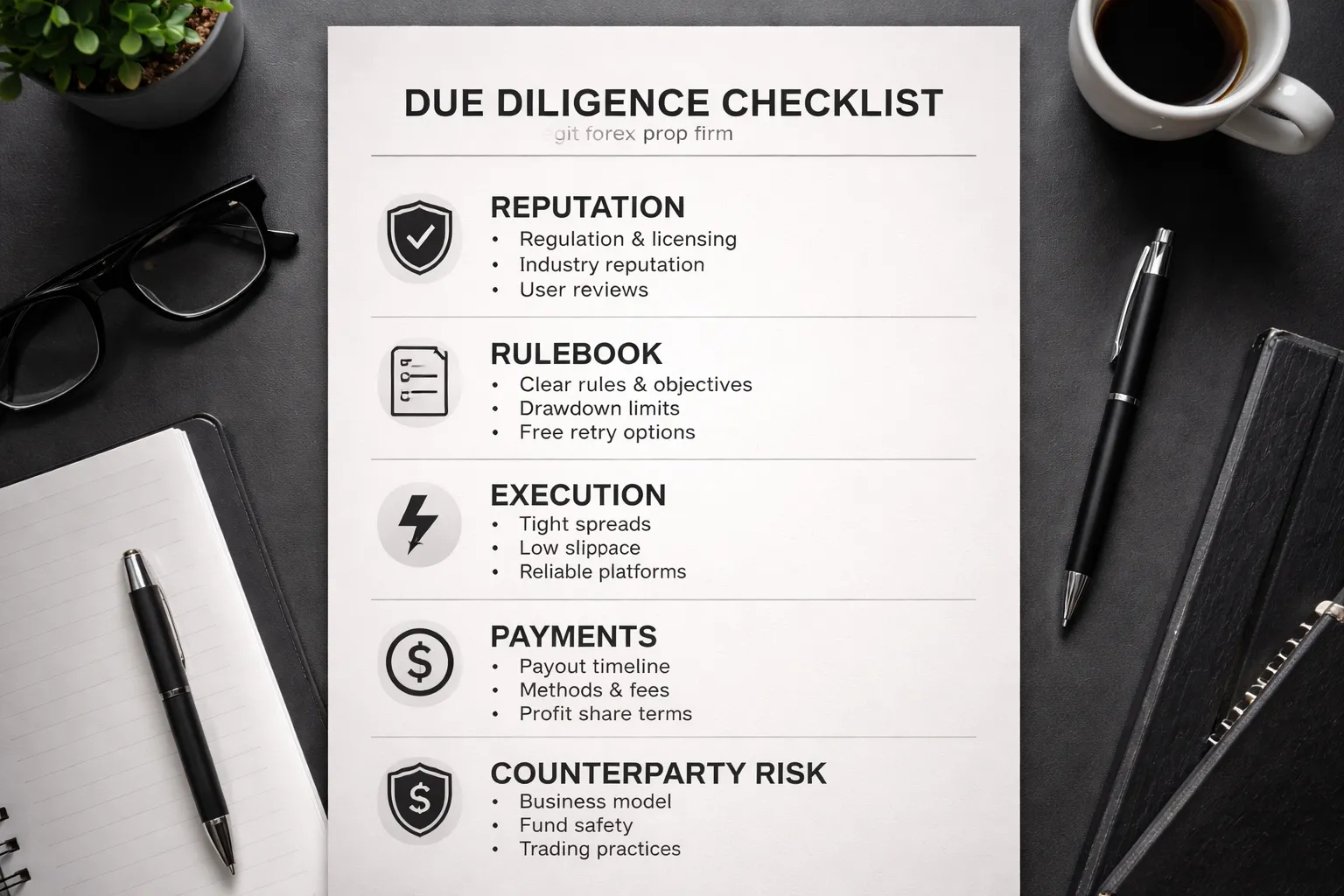
Reputation Signals, Track Record, Transparency, Third Party Feedback
Start with proof, not marketing.
- Company identity: Find the legal entity name, jurisdiction, and registration number. Match it to the site footer, invoices, and payout records.
- Operating history: Prefer firms with a multi year track record under the same brand and ownership. Watch for frequent rebrands.
- Public rule and fee history: Check if old rules and pricing stay accessible. Silent rule edits often precede payout disputes.
- Third party feedback quality: Ignore one line praise. Look for detailed posts with screenshots of dashboards, payout confirmations, and support tickets. Discount affiliate sites that earn per signup.
- Support responsiveness: Ask one precise question about a rule edge case. Time the reply. Save the transcript.
Rulebook Clarity, Clauses That Block Payouts
A legit firm writes rules you can test. A shady firm writes rules you can lose to.
- Max daily loss definition: Confirm if it uses equity or balance, and if it includes open trades. Equity based limits trigger during normal drawdowns.
- Trailing drawdown mechanics: Confirm whether it trails on equity highs, balance highs, or closed profit. Ask when it stops trailing, if ever.
- Profit target and consistency rules: Watch for vague language like “abnormal trading” or “gambling.” Demand exact thresholds, examples, and enforcement logic.
- News and weekend rules: Check what counts as “major news,” how close you can trade to releases, and whether holding is allowed. Look for broker time zone details.
- Strategy restrictions: Confirm rules on scalping, latency, HFT style trading, grid, martingale, hedging, and trade copiers. If they ban common methods, they should define them.
- Account resets and retries: Read pricing, timing, and whether resets erase your best day or payout eligibility.
- Termination and payout denial clause: If they can deny payout for “any reason” or “at sole discretion,” you carry the full risk.
Execution and Trading Environment, Spreads, Slippage, Commissions, Stability
Your edge can disappear inside costs and bad fills. Measure the environment before you commit.
- Account type: Identify whether it is demo, simulated, or live. If it is simulated, treat payouts as discretionary unless proven otherwise.
- Broker and liquidity: Ask which broker or liquidity setup they use. If they refuse to say anything, assume you cannot verify execution quality.
- Total trading cost: Calculate spread plus commission in pips for your main pairs. Compare to your strategy’s average trade size and target.
- Slippage behavior: Track a sample of entries and exits during liquid hours and around session opens. Watch for one way slippage that always hurts you.
- Platform reliability: Confirm platform, server time, and history uptime. Search for reports of freezes during high impact events and London or New York open.
- Order rules: Check minimum stop distance, max lot size, max orders, and partial close support. Hidden limits create violations.
Payments and Proof of Payout, Methods, Timelines, Disputes
Payout terms matter more than split percentages.
- Payout schedule: Confirm the first payout wait, payout window, and processing time in business days. Avoid firms that can delay without a hard deadline.
- Methods and fees: List the available rails, typical fees, and who pays them. Confirm supported countries and name matching rules.
- Payout eligibility rules: Check minimum trading days, max withdrawal frequency, and any profit cap per period.
- Proof of payout: Look for redacted receipts, transaction IDs, and consistent community reports over time. One screenshot proves little.
- Dispute process: Identify the exact channel for disputes, required evidence, and response timeline. Save all trade logs and platform statements.
- Chargeback and refund policy: Know when you can refund an evaluation. Avoid unclear “no refunds” language tied to subjective reasons.
Counterparty Risk, Business Model, Funding Source, Continuity Planning
You trade their rules. You also depend on their solvency.
- Revenue model: Many firms rely on challenge fees. That model can work, but it raises payout risk when growth slows. Favor firms that show a clear path to live capital allocation.
- Risk management approach: Ask how they hedge or offset trader exposure, and when they move traders to live accounts. Evasive answers signal a fragile setup.
- Concentration risk: Check if they depend on one payment processor, one platform, or one broker. Single points of failure cause payout freezes.
- Policy change risk: Track how often they change rules and pricing. Frequent changes increase the chance you get trapped mid cycle.
- Continuity planning: Look for clear terms on what happens if the firm pauses operations, changes liquidity provider, or migrates servers. You need a written commitment on open positions and balances.
- Data access: Confirm you can export statements and trade logs. If you cannot pull records, you cannot defend a dispute.
If you want an external benchmark for credibility checks, use the same filters you use to evaluate forex signal providers, proof, track record, and incentive alignment.
How to Pass a Forex Prop Firm Challenge (Practical Strategy Framework)
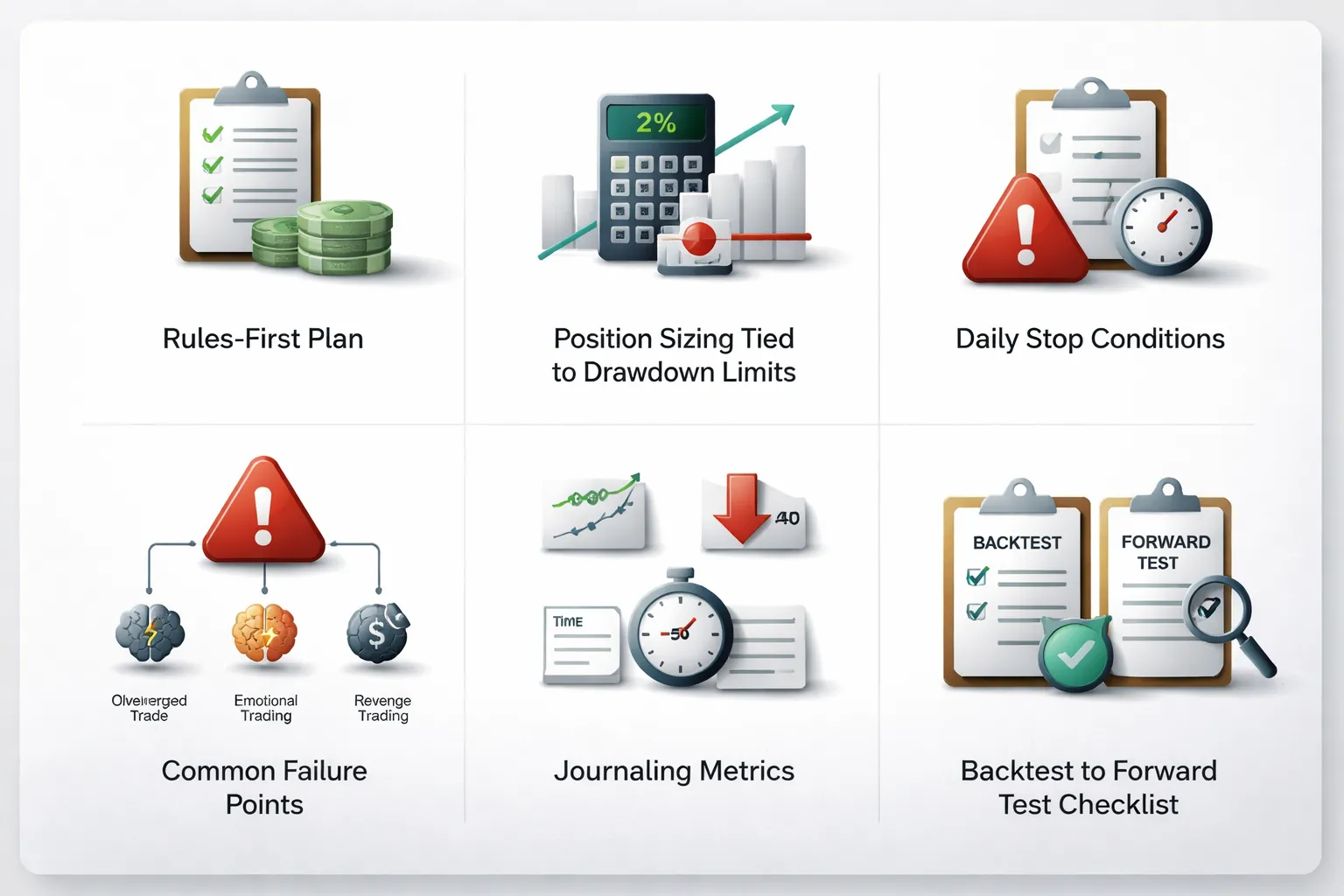
Build a rules-first trading plan
Your edge does not pass the challenge, your risk rules do. Write your rules before you trade. Treat them as hard constraints.
- Risk per trade: Set 0.25% to 0.75% of account balance. Most challenge failures come from 1% plus sizing during a losing streak.
- Max trades per day: Cap at 2 to 5. Fewer trades means fewer chances to violate daily loss limits.
- Daily stop condition: Stop for the day at 50% to 70% of the firm’s daily drawdown limit, or after 2 consecutive losses, whichever comes first.
- Weekly stop condition: Stop for the week at 60% to 80% of total drawdown used, or after 4 to 6 net losing trades.
- News rule: No new positions 5 to 15 minutes before high impact releases, unless your plan trades news and you tested it.
- Time rule: Trade one or two sessions only. Avoid random hours with thin liquidity and wide spreads.
Position sizing for drawdown limits
Most challenges use a daily loss limit and a max loss limit. You size positions so a normal losing streak cannot breach either limit. Use fixed fractional sizing and add guardrails.
- Fixed fractional formula: Position risk = Balance x Risk%. Lot size = Position risk / (Stop loss pips x pip value).
- Hard cap per trade: Never risk more than 1.0x your average spread-adjusted stop. If spreads widen, cut size.
- Correlation cap: If trades share the same base currency theme, treat them as one position. Split risk across them or take only one.
- Loss-streak reducer: After 2 losses in a row, cut risk by 30% to 50% until you recover to breakeven for the week.
| Challenge constraint | Practical sizing rule | Why it works |
|---|---|---|
| Daily drawdown limit | Risk 0.5% per trade, max 2 losses per day | Keeps you under most 4% to 5% daily caps, even with slippage |
| Max loss limit | Stop trading if you use 60% to 80% of max loss | Prevents the late-stage spiral that breaks the account |
| Minimum trading days | Plan small, clean trades early, avoid forcing size to finish | Reduces target chasing and rule breaks |
Use your stop loss distance to drive size, not your profit target. If your stop has to widen, your size must drop.
Avoiding common failure points
- Overtrading: Your fix is a trade quota and a session window. When you hit the quota, you stop. When your session ends, you stop.
- Revenge trading: Your fix is a forced cool-off. After any loss, wait 10 to 20 minutes before the next entry. After 2 losses, you stop for the day.
- Target chasing: Your fix is a process target. You aim to execute your plan, not to hit a daily profit number. If you push size to reach the profit target, you will violate drawdown rules first.
Most firms design rules so one bad hour can end your attempt. Build your day to make that hour impossible.
Journal and metrics to track
You need a journal that produces numbers. Notes alone do not help. Track these on every trade.
- Expectancy: Expectancy = (Win rate x Avg win) minus (Loss rate x Avg loss). Use R multiples, not pips. You want positive expectancy over at least 50 trades.
- Max adverse excursion (MAE): Record worst unrealized loss in R before exit. If MAE often exceeds your stop, your entries are late or your stop is too tight.
- Time-in-trade: Track minutes or hours held. If your average hold time grows during drawdown, you likely avoid taking losses and you drift into rule violations.
- Rule compliance rate: Mark any trade that breaks your plan. If compliance drops below 95%, you are not ready for a challenge.
Backtesting and forward testing: what evidence is enough
Do not pay for a challenge until your data supports it. Your goal is not perfect results. Your goal is stable behavior under the same constraints.
- Backtest scope: 6 to 12 months per pair and session, or at least 200 trades. Include spread assumptions and realistic fills.
- Forward test: 20 to 40 trades on the same platform type the firm uses, with the same risk rules and daily stops.
- Stress test: Simulate 5 to 8 consecutive losses and confirm you stay inside daily and max drawdown limits.
- Challenge rehearsal: Run a 10 to 20 trading day “mock challenge” on demo with the exact drawdown and target rules. Track breaches, not profit.
When your forward test shows positive expectancy, low rule breaks, and drawdown staying well inside limits, you can attempt the challenge. For a rule-by-rule breakdown, see our Forex prop firm challenge rules guide.
Common Red Flags, Scams, and Misleading Marketing Claims
“Guaranteed funding” and other unrealistic promises
Prop firms sell a dream. You pay for a challenge, pass, and “get funded.” Some marketing turns this into a guarantee.
- “Guaranteed pass” services. If someone claims they can pass for you, assume rule violations, copied trades, or account sharing. Firms can void payouts for this.
- “No risk” claims. You can lose the fee. You can also lose time on rules that make your edge unusable.
- “Instant funding” hype. Read what “instant” means. Many plans still use trailing drawdown or tight daily loss limits that function like a hidden challenge.
- Unreal payout numbers. High split percentages mean little if the firm rejects trades, delays payouts, or caps lot sizes.
Bait-and-switch rules
The biggest trap is a rule set that shifts after you start. You need stable definitions, written in the FAQ and in the account dashboard.
- Drawdown definition changes. “Max drawdown” can mean balance-based, equity-based, or trailing. These behave very differently in live markets.
- New restrictions after purchase. Added limits on news trading, holding over the weekend, EA use, copy trading, or scalping.
- Hidden consistency rules. Rules like “max 30 percent of profit in one day” can block payouts even when you follow drawdown limits.
- Ambiguous language. If the firm can interpret a rule two ways, they will pick the one that protects them.
Before you pay, screenshot the rules page and the FAQ. Compare it to the client portal wording. If they differ, walk away. For the key definitions, see our Forex prop firm challenge rules guide.
Impossible economics, ultra-tight rules with aggressive targets
Some offers fail basic math. They pair low drawdown with high targets, then add constraints that block normal risk management.
- Targets that force leverage. A 10 percent target with a 5 percent max loss pushes many traders into oversized risk.
- Daily loss limits that choke recovery. A small daily limit can stop you from trading through normal variance, even if your max loss is larger.
- Trailing drawdown that punishes winners. If the stop line trails your equity high, one normal pullback can fail you after you build profit.
- Time pressure. Short evaluation windows push overtrading. Overtrading blows accounts.
Use your backtest and forward test stats. If your strategy needs breathing room, avoid rule sets that remove it.
Manipulated conditions, abnormal spreads, slippage patterns, and outages
Execution quality decides whether your edge survives. Some firms run conditions that look fine on a calm chart, then break during real volatility.
- Spreads that spike around session opens. Watch London open and New York open. If spreads widen far beyond normal, your stops become easier to hit.
- One-sided slippage. You get slipped on entries and stops, but rarely get positive slippage on limit orders. Track this in a journal.
- Platform freezes near news. If charts stall, orders delay, or the server disconnects during volatility, your risk controls fail.
- Price feed differences. Compare the firm’s quotes to a major broker at the same timestamp. Large, frequent gaps matter.
Test with a small account first. Log spread at entry, slippage in pips, and any rejected orders. Data beats complaints.
Understanding the sales funnel, trials, discounts, upsells, and affiliate-driven hype
Many firms run like marketing companies. The product is challenge fees. The funnel pushes you to keep paying.
- Perpetual discounts. “Limited time” coupons that never end signal a volume sales model, not trader success.
- Trial accounts that hide real conditions. Trials can use different spreads, latency, or rules. Treat them as demos, not proof.
- Add-ons that change the deal. “Higher leverage,” “no time limit,” or “news trading allowed” often come as paid upgrades. Price them into your expected value.
- Affiliate noise. If most reviews come from referral links, you read ads, not analysis. Look for payout proof, rule clarity, and execution data.
Assume every upsell exists because most traders fail. Buy only what your strategy needs, and ignore the hype.
Forex Prop Firm Alternatives (If You Don’t Want the Challenge Model)
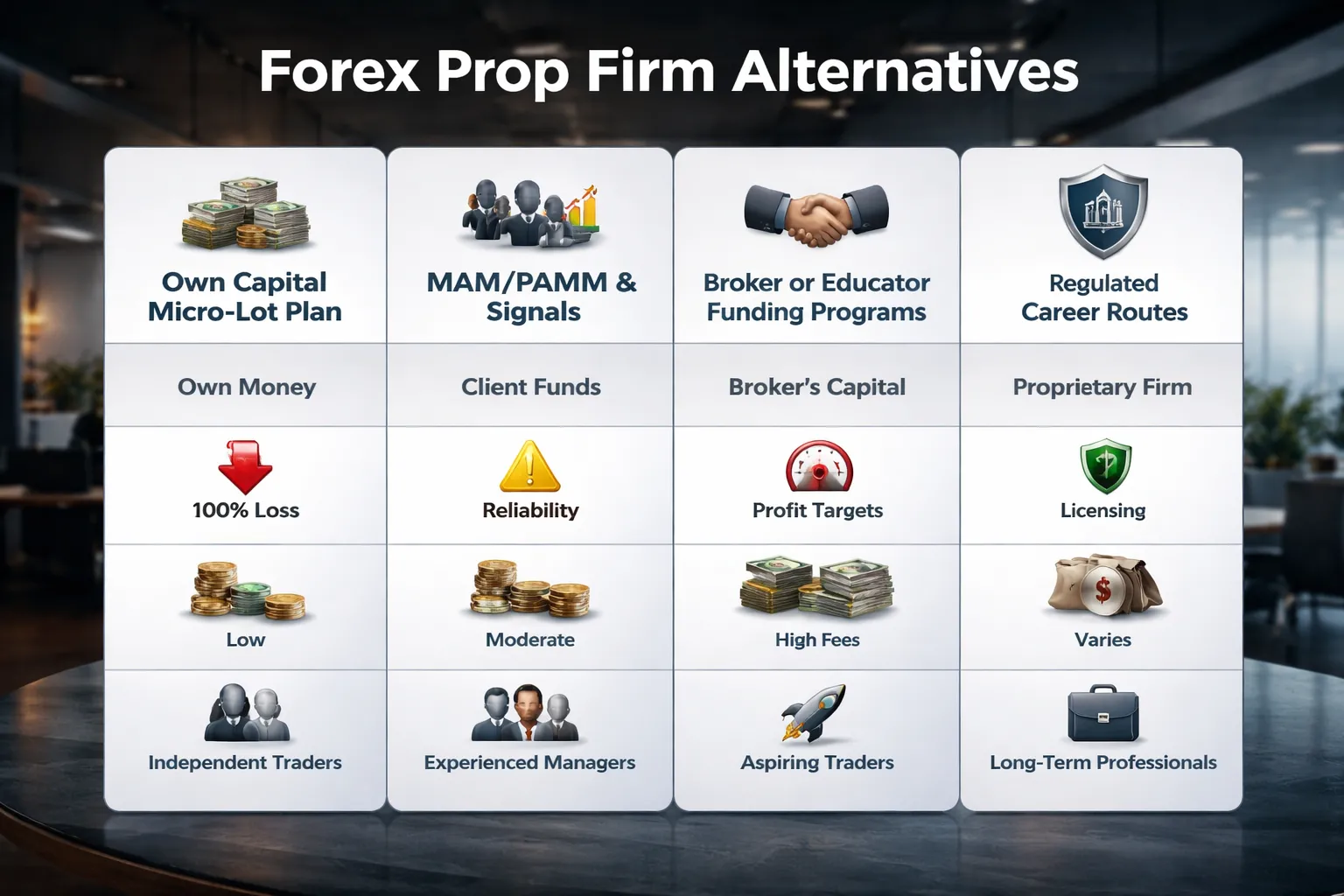
Trading Your Own Capital With Strict Risk Management
You do not need a challenge to trade with rules. You need a plan you can follow when you lose.
Use a micro-lot progression plan. Treat it like a paid test. You scale only after you prove consistency over enough trades.
- Step 1, set risk per trade. Start at 0.25% to 0.50% of your account. Cap total open risk at 1%.
- Step 2, cap daily damage. Stop for the day at 1% to 2% drawdown. No exceptions.
- Step 3, cap weekly damage. Stop for the week at 3% to 5% drawdown. Review and reduce size.
- Step 4, trade a fixed sample size. Run 50 to 100 trades with the same rules and position sizing.
- Step 5, scale by small steps. Increase risk by 10% to 25% only if you stayed inside all limits and your execution stayed clean.
- Step 6, track the only numbers that matter. Expectancy, max drawdown, win rate, average win to average loss, and slippage on stops.
This approach removes challenge pressure. It also forces real accountability. Your account will not forgive rule breaks.
MAM, PAMM, or Signal-Based Models
If you can trade, you can manage other people’s capital without a challenge. You can do it through allocation accounts or by selling signals. Each path has tradeoffs.
- MAM, PAMM. You trade one master account, the system allocates trades across investor accounts.
- Signals, copy trading. You publish trades, followers mirror them in their own accounts.
Pros
- Scaling can beat retail challenge math if you keep investors and performance.
- You can trade your strategy without artificial profit targets.
- Investors often care more about drawdown control than monthly returns.
Cons
- You take reputation risk. One bad month can kill inflows.
- Followers create execution drag. Slippage and different spreads can distort results.
- Compliance and platform rules vary by jurisdiction. Some setups can cross into regulated activity.
- Customer support becomes part of your job.
Ethical considerations
- Use real, verifiable results. Show time period, max drawdown, and whether returns include open trades.
- Do not hide risk with martingale, grid, or extreme leverage. If you use them, disclose it in plain language.
- Align incentives. Performance fees with high-water marks reduce pressure to gamble after losses.
- Protect followers. Put clear risk settings in your signal notes and refuse to advise on account sizes you cannot justify.
Before you follow or publish signals, read Forex Copy Trading Explained and learn the cost and risk mechanics.
Funded Trader Programs From Brokers or Educator Communities
Some brokers and education groups offer funding without the standard retail challenge format. Terms vary, and many programs function as marketing funnels. You must vet them like a counterparty.
- Check who holds the money. Identify the legal entity, regulator, and where client funds sit. Do not accept vague answers.
- Verify execution conditions. Ask for typical spreads, commissions, and swap policy on your pairs. Check if they widen spreads around news.
- Demand rule clarity. Get drawdown definitions in writing. Confirm whether drawdown is equity-based, balance-based, or trailing.
- Validate payouts. Look for proof of payouts that includes dates, amounts, and method. One screenshot proves nothing.
- Audit restrictions. News trading, holding over weekend, trade copying, and EA rules should match your strategy.
- Test support. Ask two specific questions before you pay. Measure response time and quality.
- Model the economics. Add fees, platform costs, data fees, and profit split. Compare against trading your own account with the same risk.
If the offer relies on hype, vague rules, or hidden upgrades, you should treat it as a sales program, not a trading opportunity.
Career Routes, Regulated Firms, Internships, Analyst Roles
If you want stability and a real professional track, aim for regulated environments. The pay may start lower, but the structure is clearer.
- Proprietary trading firms, regulated. Many focus on futures, options, or market making. They care about risk control and process.
- Internships and graduate programs. Look for roles in trading support, execution, risk, or research. These build the skills that get you on a desk.
- Trading analyst roles. You can start in strategy research, performance analytics, or risk monitoring. You learn how real drawdown limits work.
What helps you get hired stays consistent.
- Show a track record. Use a verified statement or an audited journal, with drawdown and risk per trade.
- Show process. Document your setup, risk model, and review routine. Keep it simple and repeatable.
- Show basic competence. Market microstructure, order types, slippage, and execution costs matter more than chart patterns.
- Show you can take feedback. Most desks train you to follow risk first.
The challenge model sells speed. Careers reward control.
FAQ
What is a forex prop firm?
A forex prop firm funds you to trade FX with its capital. You trade under firm rules, usually with strict drawdown limits and position sizing. You keep a profit split. You do not own the account balance. You risk losing access if you break rules.
How does a forex prop firm challenge work?
You trade a demo account to hit a profit target without breaking risk rules. Most challenges set daily and total drawdown caps and limit news trading or holding over weekends. After you pass, you move to a funded stage with the same constraints.
How do prop firms make money?
Most retail prop firms earn from challenge and reset fees. Some also earn from data, platforms, and spreads or commissions via their brokers. A smaller group pays traders from internal risk pools or external hedging. Read the firm’s payout and fee disclosures.
Are forex prop firms legit?
Some are. Many are not. Check the legal entity, terms, payout history, and support responsiveness. Confirm how they handle slippage, off quotes, and disputes. Avoid firms that change rules mid cycle, refuse withdrawals, or block accounts without clear logs.
How do payouts work?
You receive a percentage of net profits on a schedule, often biweekly or monthly. You must stay within drawdown limits until the payout is approved. Many firms cap maximum withdrawal size early. Some require minimum trading days before your first payout.
What rules matter most?
Max daily loss, max overall loss, and how the firm calculates drawdown. Also check lot size limits, consistency rules, minimum trading days, and news restrictions. Read a full breakdown in challenge rules.
What is drawdown and how is it calculated?
Firms use balance based, equity based, or trailing drawdown. Equity based counts open losses. Trailing drawdown moves up as your equity peaks. The method changes your real risk per trade. Treat trailing models as tighter than fixed loss limits.
Can you hold trades over the weekend or during news?
It depends on the firm. Some allow weekend holds and news trading, others block them or void trades. Check the restricted events list and server time. If you trade around NFP or CPI, confirm how they handle spread widening and slippage.
Can you use an EA, copier, or signals?
Some firms allow EAs and trade copiers, others ban them or require approval. Copying public signals can trigger account closure if the firm flags “group trading.” If you use signals, vet providers and execution costs. See our guide on forex signal providers.
What leverage do prop firms offer?
Common leverage ranges from 1:10 to 1:100, sometimes higher. Higher leverage does not reduce risk rules. Drawdown limits set your true ceiling. Focus on position sizing and stop distance, not headline leverage.
What happens if you break a rule?
You fail the phase or lose the funded account. The firm usually closes positions and disables trading. Most firms do not refund fees after a breach. Keep a checklist before each order, including lot size, stop loss, and remaining drawdown.
Do you pay taxes on prop firm income?
Yes, in most countries. You usually earn contractor income, not capital gains, because you trade the firm’s account. Keep payout records and invoices. Ask a tax professional how your local rules treat foreign payments and platform statements.
What is a realistic risk per trade for prop accounts?
Many profitable prop traders risk 0.25% to 0.75% per trade, sometimes less on trailing drawdown. Your size must fit worst case slippage. If your strategy needs 2% risk to work, the rules will likely break it.
Conclusion
A forex prop firm gives you access to firm capital under strict rules. You earn a split if you perform. You fail if you break drawdown, lot caps, or time and news limits.
Prop trading works when you treat rules as the strategy. Pick one setup. Define risk in fractions of a percent. Track peak to trough equity, not just win rate. Keep your execution clean. Avoid overtrading after a payout.
- Read the rulebook first. Model worst case slippage, spreads, and news spikes against drawdown.
- Size for the account, not your ego. Keep typical risk at 0.25% to 0.75% per trade. Use smaller risk on trailing drawdown.
- Plan payouts and taxes. Save statements, invoices, and proof of transfers.
Final tip. Choose a firm only after you can explain its drawdown math and payout terms in one page. Use a shortlist and compare rules side by side with this guide to best forex prop firms.
-
Best Forex Copy Trading Platforms (Features, Fees & Safety Compared)
7 months ago -
Forex Prop Firm Challenge Rules Explained (Drawdown, Targets, Payouts)
7 months ago -
Best Forex Prop Firms (Top Firms Compared)
7 months ago -
Copy Trading Forex Explained: How It Works, Pros, Cons & Risks
7 months ago -
Forex Signals: Are They Worth It? (What to Know Before You Buy)
7 months ago
-
-
- Reputation Signals, Track Record, Transparency, Third Party Feedback
- Rulebook Clarity, Clauses That Block Payouts
- Execution and Trading Environment, Spreads, Slippage, Commissions, Stability
- Payments and Proof of Payout, Methods, Timelines, Disputes
- Counterparty Risk, Business Model, Funding Source, Continuity Planning
-
- What is a forex prop firm?
- How does a forex prop firm challenge work?
- How do prop firms make money?
- Are forex prop firms legit?
- How do payouts work?
- What rules matter most?
- What is drawdown and how is it calculated?
- Can you hold trades over the weekend or during news?
- Can you use an EA, copier, or signals?
- What leverage do prop firms offer?
- What happens if you break a rule?
- Do you pay taxes on prop firm income?
- What is a realistic risk per trade for prop accounts?
-
-
-
- Reputation Signals, Track Record, Transparency, Third Party Feedback
- Rulebook Clarity, Clauses That Block Payouts
- Execution and Trading Environment, Spreads, Slippage, Commissions, Stability
- Payments and Proof of Payout, Methods, Timelines, Disputes
- Counterparty Risk, Business Model, Funding Source, Continuity Planning
-
- What is a forex prop firm?
- How does a forex prop firm challenge work?
- How do prop firms make money?
- Are forex prop firms legit?
- How do payouts work?
- What rules matter most?
- What is drawdown and how is it calculated?
- Can you hold trades over the weekend or during news?
- Can you use an EA, copier, or signals?
- What leverage do prop firms offer?
- What happens if you break a rule?
- Do you pay taxes on prop firm income?
- What is a realistic risk per trade for prop accounts?
-
-
How to Place a Forex Trade Step by Step (Your First Trade Explained)
5 months ago -
Forex Trading vs Crypto Trading: Which Market Is Better for Beginners?
5 months ago -
Forex Lot Size Calculator: How to Use It to Size Trades Correctly
7 months ago -
How to Calculate Position Size in Forex (Position Sizing Formula + Examples)
7 months ago -
Forex Leverage Explained: How It Works, Pros, Cons & Examples
7 months ago
-
Forex Trading Platforms Comparison: MetaTrader vs cTrader vs TradingView
7 months ago -
Stop Loss vs Take Profit: Differences, Examples & Best Practices
7 months ago -
Is Forex Trading Legal in the United States? Rules, Regulators & What to Know
7 months ago -
Forex Leverage Explained: How It Works, Pros, Cons & Examples
7 months ago -
Forex Market Hours & Trading Sessions Explained (Best Times to Trade)
7 months ago