What Is Spread in Forex? Spreads Explained for Beginners

The spread is the gap between the bid price and the ask price. It is your first trading cost in forex. You pay it every time you enter a trade, and you pay it again when you exit. Small spreads can save you money. Wide spreads can erase small profits and trigger stops.
In this guide, you will learn how spreads work, how brokers quote them in pips, and how to calculate the real cost of a trade. You will also learn the difference between fixed and variable spreads, why spreads widen during news and low liquidity, and what a good spread looks like for beginners. If you need a quick refresher on how forex quotes work, start with what forex trading is.
Key Takeaways
Key Takeaways
- In het kort: The spread is the gap between the bid and ask price, it is your first trading cost.
- You pay the spread when you enter a trade, your position starts negative by the spread size.
- Brokers quote spreads in pips, or in fractional pips on tighter pairs.
- Your spread cost depends on position size and pip value, not just the pip number you see.
- Fixed spreads stay stable, variable spreads move with liquidity and volatility.
- Spreads often widen during major news releases, market opens, and low liquidity periods.
- Wide spreads can trigger stop losses and raise your break-even point.
- Compare brokers using typical spreads and total cost, spread plus commissions, not minimum spreads.
- Trade during liquid sessions to reduce spread risk, use this guide to plan your timing with forex market hours.
What is spread in forex (definition and why it matters)
Bid vs ask, the two prices every forex quote contains
Every forex pair shows two prices.
- Bid, the price you can sell at.
- Ask, the price you can buy at.
Spread is the gap between them.
Example. EUR/USD bid 1.08500, ask 1.08508. The spread is 0.00008, or 0.8 pips.
You usually enter at the ask when you buy, and at the bid when you sell. That gap is your first hurdle on every trade.
Spread as an implicit fee, how brokers and liquidity providers get paid
The spread is a built-in trading cost. You pay it when you open a position.
In many accounts, the broker marks up the spread or routes your order to liquidity providers who quote the bid and ask. Either way, the spread functions like a fee.
Tight spreads reduce your cost per trade. Wide spreads increase it. This matters most when you trade often or you use tight stops.
Why beginners feel it immediately, break-even point and trade expectancy
Your trade starts negative by the size of the spread.
Your break-even move equals the spread, plus any commission.
| Pair | Spread | Break-even move needed |
|---|---|---|
| EUR/USD | 0.8 pips | 0.8 pips, plus commissions if charged |
| GBP/JPY | 2.5 pips | 2.5 pips, plus commissions if charged |
Spread also hits your expectancy. If your average win is small, the spread can erase it. If you scalp for 3 to 5 pips, a 1.5 pip spread can cut your edge in half. If you target 100 pips, the same spread matters less.
Spread vs commission vs swap, separating the three main cost types
- Spread, the bid-ask gap. You pay it on entry, and you see it in the price difference.
- Commission, a stated fee per lot or per side. Common on ECN or raw spread accounts.
- Swap, the overnight financing cost or credit when you hold past rollover time. Learn the details in this guide to forex swap fees.
When you compare brokers, add them up. Your real cost is spread plus commission per trade, plus swap if you hold overnight.
How forex spreads are quoted and measured
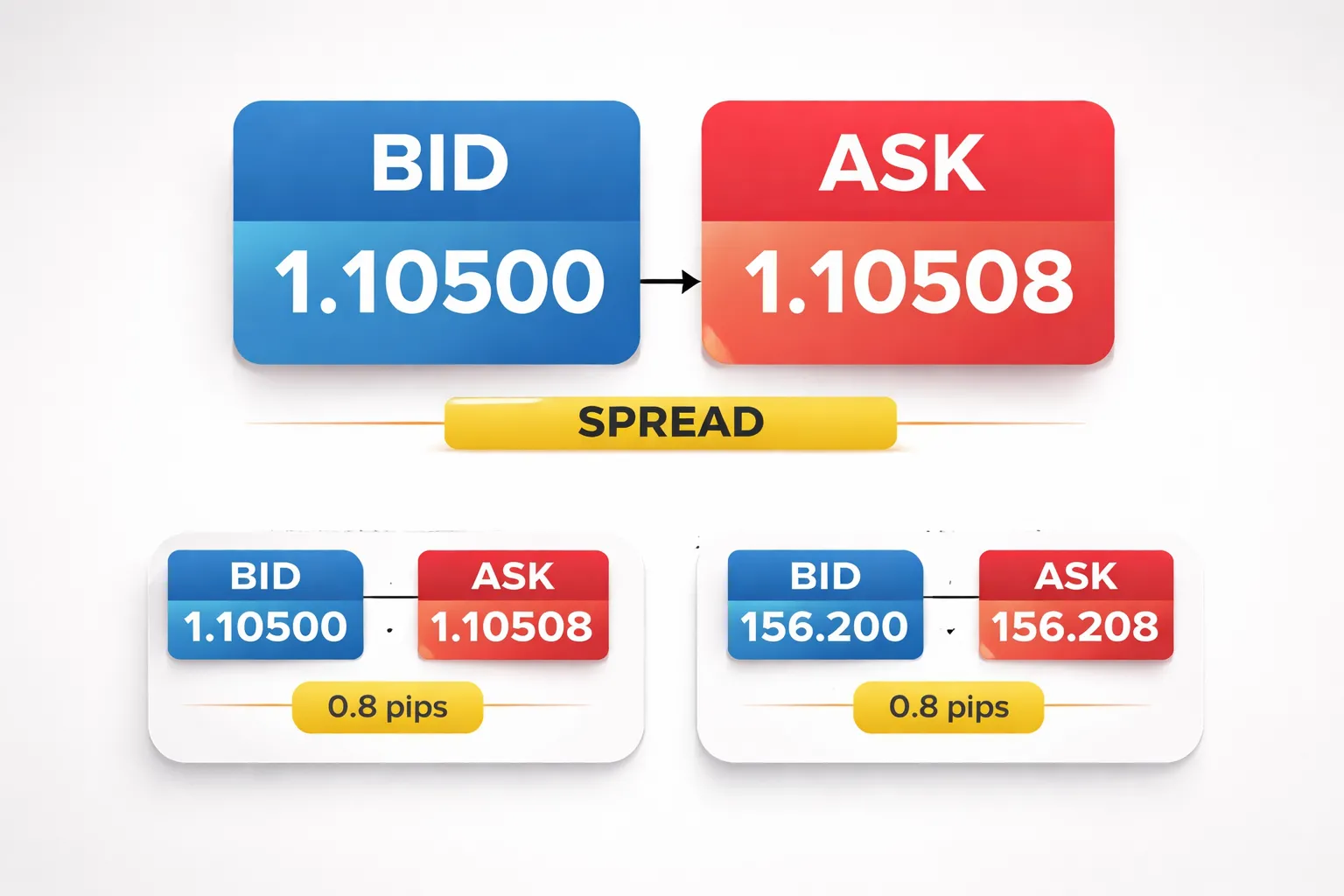
Pips and pipettes, the unit behind the spread
Most forex pairs quote to 4 decimal places. The fourth decimal place is 1 pip.
- EUR/USD from 1.1050 to 1.1051, that move is 1 pip.
- If your broker shows 5 decimals, the fifth decimal place is a pipette, also called a fractional pip.
- EUR/USD from 1.10500 to 1.10507, that move is 0.7 pips or 7 pipettes.
JPY pairs usually quote to 2 decimals. The second decimal place is 1 pip.
- USD/JPY from 156.20 to 156.21, that move is 1 pip.
- If your broker shows 3 decimals, the third decimal place is a pipette.
- USD/JPY from 156.200 to 156.207, that move is 0.7 pips or 7 pipettes.
To convert a spread into money, you need pip value for your lot size and pair. Use a pip value calculator if you want the exact cost in your account currency.
What “points” mean on trading platforms
Some platforms display spread in points. A point is the smallest quoted price step on your platform.
- On 5 digit quotes for non-JPY pairs, 10 points = 1 pip.
- On 3 digit quotes for JPY pairs, 10 points = 1 pip.
- On 4 digit quotes for non-JPY pairs, 1 point = 1 pip.
- On 2 digit quotes for JPY pairs, 1 point = 1 pip.
Typical quote formats for non-JPY vs JPY pairs
| Pair type | Common quote (standard) | Common quote (fractional) | 1 pip location |
|---|---|---|---|
| Non-JPY, example EUR/USD | 1.1050 | 1.10500 | 4th decimal |
| JPY, example USD/JPY | 156.20 | 156.200 | 2nd decimal |
How to read the spread directly on MT4 and MT5
You can read the spread in MetaTrader two ways.
- Market Watch, enable the spread column.
- Chart, show Ask line and compare it to Bid.
MT4: Open Market Watch, right click inside the list, select Spread. The value usually shows in points. Convert to pips using the point rules above.
MT5: Open Market Watch, right click the headers, select Spread. MT5 may show spread in points as well, depending on the broker feed.
Quick check on the chart, Bid is the price line you see, Ask is above it. The distance between them is the spread.
How to read the spread on cTrader
cTrader shows Bid and Ask clearly.
- Watchlists show Bid and Ask. The difference is the spread.
- In many layouts, cTrader also shows the spread value near the symbol or in the order ticket.
If your cTrader displays spread in pips, you can use it directly. If it displays in points, apply the same point conversion rules.
How to read the spread on web platforms
Most web terminals show Bid and Ask side by side.
- Look for Bid and Ask in the quote panel or watchlist.
- Some brokers add a Spread column. It may show in pips or points.
- If the platform only shows one price on the chart, open the order ticket to see both Bid and Ask.
Always confirm the unit. If the platform says points, convert to pips before you compare brokers or strategies.
How to calculate spread cost (step-by-step)
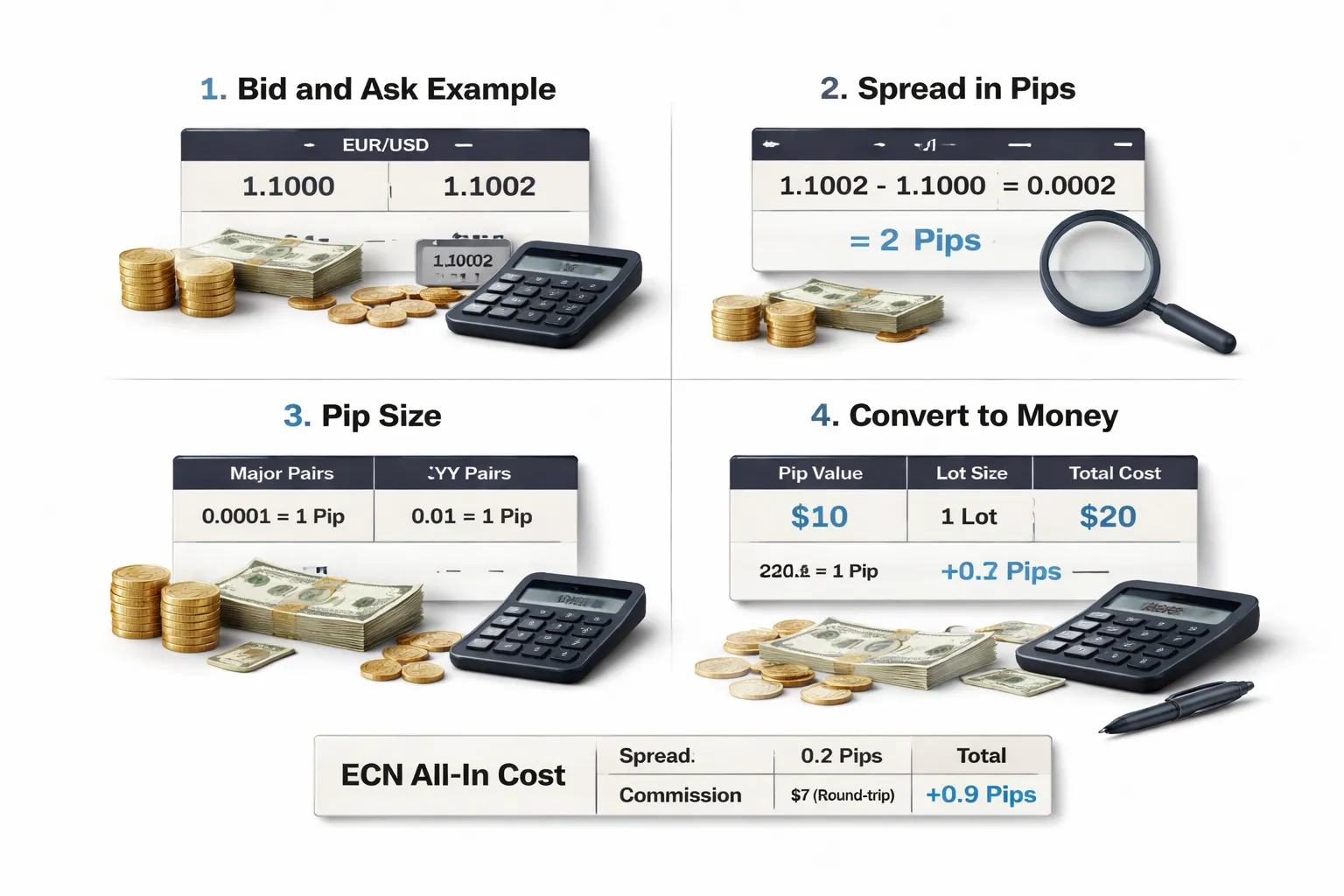
1) Get the spread from the quote
You need two prices.
- Bid, the price you can sell at.
- Ask, the price you can buy at.
Spread (in price) = Ask minus Bid.
Spread (in pips) = (Ask minus Bid) divided by pip size.
- Most major FX pairs, pip size = 0.0001.
- JPY pairs, pip size = 0.01.
- Gold and indices often use different point sizes, confirm in your platform.
2) Convert pips to money using lot size and pip value
The spread becomes a cost the moment you enter a trade. You start negative by the spread.
Spread cost (money) = Spread (pips) multiplied by pip value (per lot) multiplied by lot size.
Typical pip values on a USD account:
- 1.00 lot on EUR/USD, about $10 per pip.
- 0.10 lot, about $1 per pip.
- 0.01 lot, about $0.10 per pip.
If you need a refresher on pip size and pip value, read what pips are in forex.
3) Worked example: EUR/USD
Assume:
- Bid = 1.10500
- Ask = 1.10512
Step 1, spread in price:
1.10512 minus 1.10500 = 0.00012
Step 2, convert to pips (pip size 0.0001):
0.00012 divided by 0.0001 = 1.2 pips
Step 3, convert to money (1.00 lot, about $10 per pip):
1.2 pips multiplied by $10 = $12
4) Worked example: GBP/JPY
Assume:
- Bid = 189.40
- Ask = 189.46
Step 1, spread in price:
189.46 minus 189.40 = 0.06
Step 2, convert to pips (pip size 0.01):
0.06 divided by 0.01 = 6 pips
Step 3, convert to money:
- For JPY pairs, pip value in USD changes with price and the USD/JPY rate.
- Your platform usually shows the pip value in the order ticket.
Example with an estimated pip value of $6.70 per pip for 1.00 lot:
6 pips multiplied by $6.70 = $40.20
5) Worked example: XAU/USD (gold)
Gold quotes vary by broker. Many platforms treat:
- $0.01 as 1 point.
- $0.10 as 1 pip.
Assume your platform uses $0.10 as 1 pip, and you see:
- Bid = 2030.10
- Ask = 2030.40
Step 1, spread in price:
2030.40 minus 2030.10 = 0.30
Step 2, convert to pips (pip size $0.10):
0.30 divided by 0.10 = 3 pips
Step 3, convert to money:
- On many brokers, 1.00 lot XAU/USD = 100 oz, so a $0.10 move equals $10.
So the spread cost is:
3 pips multiplied by $10 = $30
6) Estimate your monthly spread cost
Use your average spread, average lot size, and trade count.
Monthly spread cost = Spread cost per trade multiplied by number of trades.
Example:
- Average spread cost per trade = $4.50
- Trades per month = 120
$4.50 multiplied by 120 = $540 per month
If you scale position size up, your spread cost scales up in direct proportion.
7) All-in cost on ECN accounts: spread plus commission
Many ECN or raw-spread accounts charge a low spread plus a commission.
All-in cost (money) = Spread cost (money) plus commission (round turn).
To compare accounts in pips, convert commission to a pip equivalent:
Commission in pips = Round-turn commission divided by pip value per lot.
| Account type | Example spread | Example commission | All-in on 1.00 lot EUR/USD |
|---|---|---|---|
| Standard | 1.2 pips | $0 | 1.2 pips, about $12 |
| ECN | 0.2 pips | $7 round turn | 0.2 pips + (7 divided by 10) = 0.9 pips, about $9 |
Compare using the same pair, the same session, and the same lot size. Otherwise you will compare noise, not cost.
Types of spreads in forex
Fixed spreads
A fixed spread stays the same most of the time. The broker sets it. Your cost per trade stays predictable.
You usually see fixed spreads on dealing desk, market maker, or some “standard” accounts. Brokers offer them when they can internalize flow and manage their own risk.
- When you will see them: Smaller brokers, beginner accounts, or brokers that bundle cost into the spread.
- What to watch: Fixed does not mean guaranteed. Many brokers reserve the right to widen spreads during major news, thin liquidity hours, or market gaps.
- Practical use: If you trade small size and want stable cost estimates, fixed spreads can simplify planning.
Variable (floating) spreads
A variable spread moves with the market. It reflects real-time liquidity and volatility.
When liquidity is deep, spreads tighten. When liquidity drops, spreads widen. You see this around session opens, rollovers, and high impact news.
- When spreads tighten: Major pairs during London and New York overlap.
- When spreads widen: Late Friday, around daily rollover, during data releases, and in fast moves.
- Practical use: Track the spread at your trade times, not a broker’s “from 0.x pips” ad.
Raw spreads and “zero spread” marketing
Raw spread accounts show you the tightest bid-ask pricing the broker can source. You then pay a separate commission. Your true cost is spread plus commission.
“Zero spread” usually means the quoted spread can hit 0.0 pips at times, on a few major pairs, in liquid sessions. It does not mean your trade is free.
- What it typically means: Raw pricing plus commission, or a spread that can print 0.0 but averages higher.
- What to check: The round-turn commission per lot, the average spread during your trading hours, and whether the broker charges extra fees on certain symbols.
- Practical rule: Convert commission into pips and add it to the average spread. Compare that all-in number across brokers.
Exotic-pair spreads
Exotic pairs have structurally higher spreads than majors. Liquidity is thinner. Risk is higher. Hedging costs more.
- Why they cost more: Fewer market makers, wider pricing bands, higher volatility, and higher funding and carry risk.
- What you will notice: Bigger spread swings, more slippage, and wider spreads outside local market hours.
- Practical impact: You need larger targets and wider stops to offset spread. Wider spreads also increase the chance of hitting key levels earlier than expected, which can contribute to forced exits under pressure. See margin call vs stop out.
What causes spreads to widen or narrow
Liquidity and market depth
Spreads track how easy it is to match buyers and sellers at each price level.
High liquidity narrows spreads. Low liquidity widens them.
- Majors stay tighter because they trade the most. EUR/USD, USD/JPY, and GBP/USD usually show the deepest order flow and the most competition between liquidity providers.
- Crosses and exotics widen faster because fewer quotes sit near the current price. A modest market order can push through multiple price levels.
- Market depth matters more than headline volume. If quotes disappear near the top of book, your spread can widen even if the market still trades.
Volatility spikes during news releases and data surprises
Spreads widen when price moves fast and dealers cannot hold a stable two way quote.
- Scheduled events like CPI, jobs data, and rate decisions often trigger spread expansion seconds before and after the release.
- Surprises widen spreads more than expected prints. Liquidity providers pull quotes first, then reprice.
- Wider spread plus slippage can hit your stop sooner than your chart level suggests. Plan stops with spread expansion in mind, not the “normal” spread you see in calm markets.
Trading sessions and overlaps
Spreads change with who is active and how much inventory flows through the market.
- London session often brings tighter spreads as liquidity returns after Asia.
- London and New York overlap often produces the tightest spreads because volume and competition peak at the same time.
- Asia session can show wider spreads on some pairs, especially non JPY pairs, because fewer banks quote aggressively.
- Outside local market hours you often see thinner books, faster spread jumps, and more stop sensitivity.
Rollover and end-of-day effects
Spreads can widen around daily rollover when brokers process swap and banks reset risk books.
- Late evening liquidity drops in many time zones. Fewer quotes sit near the market, so spreads widen.
- Rollover timing varies by broker, but many use the 5 pm New York cutoff for the forex trading day.
- Common impact includes sudden spread spikes on otherwise quiet charts. If you hold positions or place tight stops through rollover, you raise the odds of a forced exit.
Risk management by brokers and liquidity providers during extreme events
During stress, spreads widen because quote makers protect themselves from gaps and one sided flow.
- Liquidity providers widen or pause quotes when they cannot hedge fast enough or when correlated markets break.
- Brokers may add a markup or apply protective settings when underlying spreads jump. You feel this as a wider all in spread.
- Extreme events like flash crashes, surprise pegs, election shocks, and emergency rate moves can produce outsized spread expansion and execution gaps.
- Your takeaway is simple. Reduce size, widen risk buffers, and avoid tight stop placement in high risk windows. Learn how pricing and execution actually work in the forex market in how the forex market works.
Fixed vs variable spreads: advantages, disadvantages, and who each suits
Predictability vs potential savings, the core trade-off
Fixed spreads stay the same most of the time. Variable spreads change with liquidity and volatility.
Your trade-off is simple. Fixed spreads give you cost predictability. Variable spreads can give you lower average costs in calm markets, but they can spike when conditions turn.
In liquid sessions, variable spreads on major pairs often run tight. Around news, rollovers, and thin hours, they can widen fast. That widening hits your entries, exits, and stop losses.
| Spread type | Best benefit | Main cost | What can surprise you |
|---|---|---|---|
| Fixed | Stable planning for per-trade cost | Usually wider than the best variable quotes | Broker can re-quote or restrict fills in fast markets |
| Variable | Potentially lower costs in liquid conditions | Unstable costs when volatility rises | Spread spikes, slippage, partial fills |
Best fit by strategy: scalping, day trading, swing trading, and position trading
- Scalping: You need the tightest all-in costs and fast execution. Variable spreads on a high-liquidity pair usually fit better. You must avoid news and thin sessions. A fixed spread that stays wider can kill expectancy.
- Day trading: Variable spreads often fit if you trade liquid hours and major pairs. Fixed spreads can work if you value stable cost inputs for rules based on exact tick distances, but watch re-quotes and execution rules.
- Swing trading: Spread matters less than swap, slippage, and stop distance. Either spread type can work. Prioritize clean execution and predictable rollover costs.
- Position trading: Spreads have the smallest impact relative to target size. Focus on financing, market access, and execution quality during rollovers and macro events.
If you trade tight stops, spreads matter more. If you trade wider stops and longer holds, financing and gap risk matter more. Spread spikes still hurt around news. They also hit during weekend opens.
When “fixed” isn’t truly fixed: contract terms and exceptional conditions to watch
Many brokers market fixed spreads, but add exceptions in the fine print. You need to check the terms before you rely on them.
- Market disruption clauses: The broker can widen the spread or switch to variable pricing during abnormal volatility.
- Execution method: Some fixed spread accounts use instant execution. You can see re-quotes, order rejects, or fill delays when price moves fast.
- Trading hour limits: Some fixed pricing applies only during core market hours. Spreads can change at rollover and around session transitions.
- Pair coverage: Fixed spreads often apply to a small set of majors. Minors and exotics can stay wide or become variable.
- Stop and limit constraints: Some accounts enforce minimum distances for stops and limits. That can break tight strategies.
Even if the quote stays fixed, your real cost can rise through execution effects. Read more in what is slippage in forex.
Decision checklist: volatility tolerance, trade timing, and account type
- Your strategy edge: If your average win is small, you need the lowest typical spread. Variable spreads on majors usually win.
- Your volatility tolerance: If you cannot handle cost spikes and slippage around news, reduce exposure or avoid those windows. A fixed spread does not remove event risk.
- Your trade timing: Trade during liquid hours for tighter variable spreads. Avoid late US session, pre-open gaps, and rollover if you rely on tight pricing.
- Your pairs: Majors suit variable spreads. Minors and exotics often punish you with wide spreads on any account type.
- Your account model: Compare spread-only vs raw spread plus commission. Judge the all-in cost in pips for your lot size.
- Your execution needs: If you need consistent fills with minimal re-quotes, test execution on a demo and small live size before scaling.
What is a good forex spread (benchmarks beginners can use)
Benchmarks beginners can use
A good spread depends on the pair, the session, and your account model. Use these ranges as quick checks. Track the average, not the marketing number.
| Pair type | Typical good average spread (pips) | When you should expect wider |
|---|---|---|
| Majors (EUR/USD, USD/JPY, GBP/USD) | 0.6 to 1.5 on spread-only accounts 0.0 to 0.3 raw spread, then add commission |
News, rollover, illiquid hours |
| Minors (EUR/GBP, AUD/JPY, NZD/JPY) | 1.2 to 3.0 | Off-peak session, volatile moves |
| Exotics (USD/TRY, USD/ZAR, EUR/SEK) | 3.0 to 10+, often higher | Most of the time, especially outside local hours |
Judge cost in pips so you can compare any account type. If you need a refresher on pip values and pricing, read what pips are in forex.
Major vs minor vs exotic ranges
- Majors should stay tight during active sessions. If you trade them, you can demand better pricing.
- Minors often look fine on the quote, then widen fast when liquidity drops.
- Exotics can turn a small market move into a large cost. Treat wide spreads as the default, not the exception.
Compare brokers fairly, average vs minimum
- Ignore minimum spread claims. They often show the best tick in perfect conditions.
- Use the broker’s average spread for the pair and session you trade.
- Convert everything into an all-in spread. Raw spread plus commission, expressed in pips.
- Check at least two time windows, the London and New York overlap, and your usual trading hours.
Execution quality can matter as much as the posted spread
- A tight spread with poor fills can cost you more than a wider spread with clean execution.
- Track slippage on market orders. Note what happens around news and at rollover.
- Watch for frequent re-quotes or order delays. They often show up when spreads look “good” on paper.
- Test on demo, then small live size. Spreads and fills can differ.
Red flags to avoid
- Consistently wide spreads on majors during normal hours, such as 2.0 pips plus on EUR/USD on a standard account.
- Pricing pages with no averages, no time period, and no commission examples for raw accounts.
- Vague “from 0.0” claims with no all-in cost shown per lot.
- Missing swap, commission, and execution details. If you cannot verify total costs fast, skip the broker.
Practical tips to reduce spread costs
Trade the most liquid times of day and avoid thin markets
Spreads shrink when liquidity is high and competition between quotes is strong. Spreads widen when fewer traders provide bids and offers.
- Focus on the London session and the London to New York overlap for the tightest spreads on major pairs.
- Avoid the rollover window and the minutes around the daily close, spreads often spike.
- Avoid late Friday and the Sunday open, spreads can stay wide until liquidity returns.
- Prefer major pairs over minors and exotics if you care about spread cost.
If you need a session plan, use this guide to forex market hours and trading sessions.
Plan around high-impact news if you’re spread-sensitive
High-impact news can widen spreads fast. Your trade may trigger at a worse price than you expect, even if the chart looks clean.
- Check the economic calendar before you trade.
- If your edge does not depend on news, avoid opening new positions 5 to 15 minutes before major releases.
- Reduce position size or widen your stop if you must hold through news. Your all-in risk rises when spread expands.
- Watch CPI, NFP, central bank rate decisions, and press conferences. These events often cause the biggest spread jumps.
Use limit orders strategically (and understand fill risks)
Market orders pay the current spread. Limit orders can reduce spread cost, but they introduce execution risk.
- Use buy limit below the current ask and sell limit above the current bid to avoid crossing the spread.
- Expect missed fills in fast markets. Price can touch your level and move away before you get filled.
- Expect partial fills on some platforms. Your average entry can end up worse than your limit.
- Do not assume you can always avoid spread. During news and gaps, limits may not protect you from slippage.
Choose the right account type, standard vs raw/commission accounts
Your total cost equals spread plus commissions plus any execution slippage. A raw account shows tight spreads but charges a separate commission. A standard account bakes the cost into a wider spread.
| Account type | How costs show up | Best fit |
|---|---|---|
| Standard | Wider spread, usually no separate commission | Lower frequency trading, simple cost tracking |
| Raw plus commission | Tighter spread plus commission per trade | Active trading, scalping, spread-sensitive strategies |
Compare accounts using all-in cost, not the headline spread. Convert commission to pips and add it to the average spread for your pair and trade size.
Track your real average spread and all-in cost in a trading journal
Broker marketing uses best-case spreads. Your results come from what you actually pay at your trading times.
- Log the pair, time, session, order type, spread at entry, and spread at exit.
- Record commissions and swap, then compute all-in cost per round trip.
- Track slippage separately. Slippage plus spread is often your real execution cost.
- Review by session and by event type. You will see where your costs spike and which trades become unprofitable.
A simple rule helps, if spread plus commission consumes a large share of your average target, your strategy will struggle. Cut trading during the worst windows first.
Spread in forex vs other markets (quick comparison)
Forex vs stocks, why stock spreads can be different
Forex trades on a dealer network. Liquidity concentrates in a few major pairs. That often keeps EUR/USD and USD/JPY spreads tight in active hours.
Stocks trade on centralized exchanges. Each stock has its own liquidity profile. Small caps and low volume names can show wide spreads even in normal conditions.
Tick size matters. A one tick spread in a $10 stock can be a larger percentage cost than one tick in a $200 stock.
Hours matter. Many forex pairs trade 24 hours on weekdays. Stocks trade in a set session. Spreads often widen at the open, the close, and outside regular hours.
- Forex: tightest spreads in major pairs during London and New York overlap.
- Stocks: spread depends on the single stock, venue, and time of day.
- Both: news and low liquidity widen spreads fast.
Forex vs CFDs and crypto, typical spread behavior and volatility effects
CFDs copy an underlying market, but your broker sets the dealing terms. You can see wider spreads than the underlying, especially during fast moves or thin hours.
Crypto spreads usually move with volatility and venue quality. They can look tight on top exchanges in calm markets, then blow out during spikes and liquidations. Weekend conditions can change liquidity and widen spreads.
Expect the biggest spread jumps when price moves fastest. Volatility pulls market makers back. They quote wider to manage risk.
| Market | Typical spread behavior | What widens it most |
|---|---|---|
| Forex (majors) | Often tight in peak sessions, can widen around rollover | Top tier news, session transitions, low liquidity hours |
| Stocks | Varies by ticker, wide on illiquid names | Open and close, earnings, low float, low volume |
| CFDs | Broker-driven, may include added markup | Underlying volatility, broker risk controls, off-hours pricing |
| Crypto | Can be tight on liquid pairs, unstable in stress | Volatility spikes, weekend liquidity shifts, venue outages |
Why the same symbol can have different spreads across brokers
Brokers do not share one spread. Your spread depends on how your broker sources prices and how it charges you.
- Liquidity sources: more providers usually means better competition and tighter quotes.
- Pricing model: some accounts charge low raw spreads plus commission. Others bundle cost into a wider spread.
- Execution method: dealing desk and last look practices can change what you get in fast markets.
- Risk settings: brokers widen spreads when their risk rises, such as around major news or illiquid hours.
- Minimum spread rules: some brokers enforce a floor, even when the market tightens.
- Session and rollover: spreads often widen near daily rollover, then normalize.
Do not compare brokers on the minimum spread. Compare the average spread by session, then add commission, then track slippage. Use pips consistently so your numbers stay comparable.
Beginner examples: interpreting spreads on real quotes
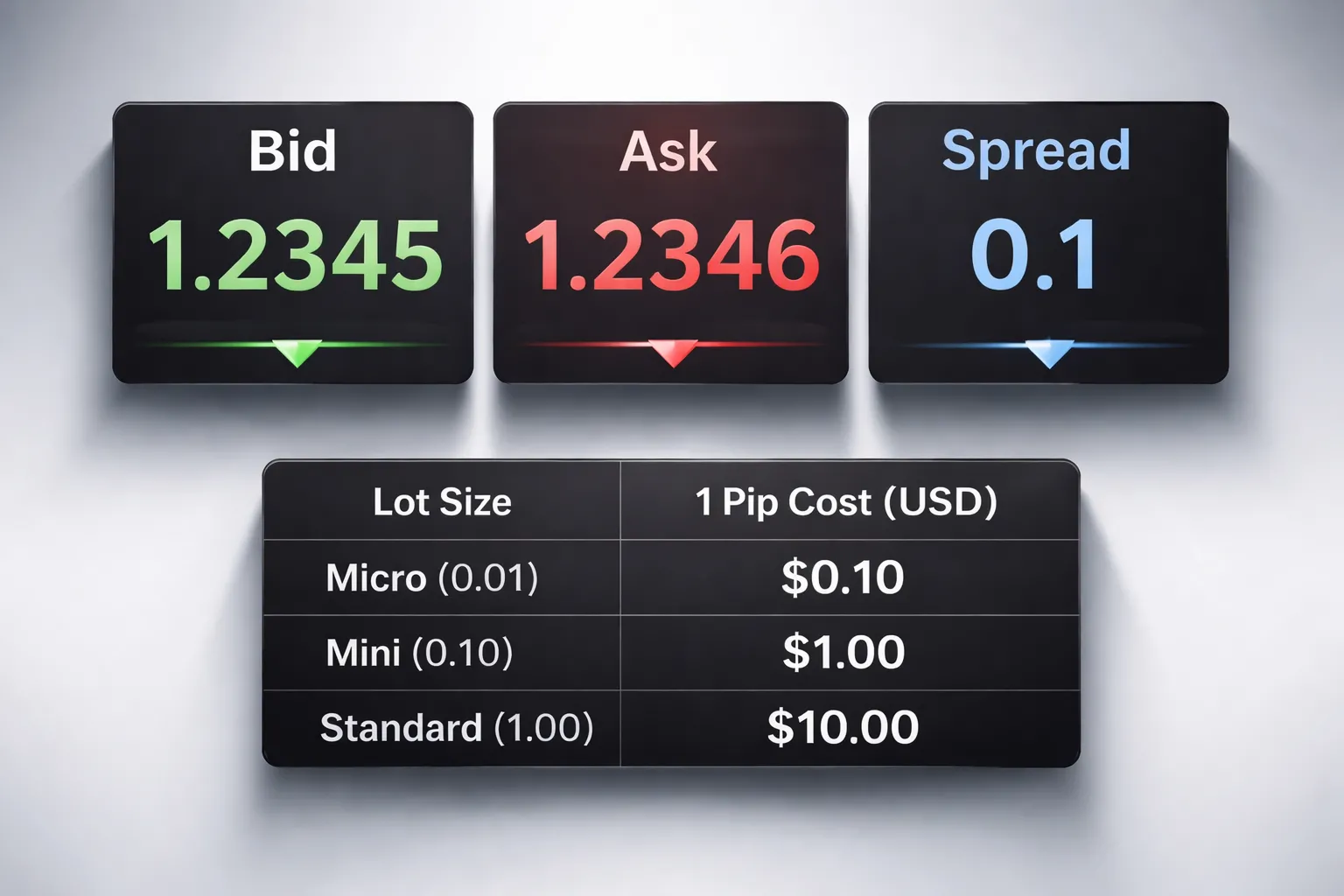
Example quote walkthrough, identify bid, ask, and spread fast
A forex quote shows two prices.
- Bid. The price you can sell at.
- Ask. The price you can buy at.
- Spread. Ask minus bid, measured in pips.
Example 1, EUR/USD: 1.08420 / 1.08433.
- Bid = 1.08420
- Ask = 1.08433
- Spread = 0.00013 = 1.3 pips because 1 pip on EUR/USD is 0.00010
Example 2, USD/JPY: 156.240 / 156.257.
- Bid = 156.240
- Ask = 156.257
- Spread = 0.017 = 1.7 pips because 1 pip on USD/JPY is 0.01
Example 3, XAU/USD (gold): 2034.10 / 2034.60.
- Bid = 2034.10
- Ask = 2034.60
- Spread = 0.50 points. Many platforms display gold in points, not pips. Your platform will still show the spread size directly.
What a 1 pip spread means in dollars, micro, mini, and standard lots
To convert a spread into dollars, you need two inputs, spread in pips and pip value for your lot size.
On EUR/USD, the pip value is simple when your account currency is USD.
- Micro lot (0.01, 1,000 units). About $0.10 per pip.
- Mini lot (0.10, 10,000 units). About $1.00 per pip.
- Standard lot (1.00, 100,000 units). About $10.00 per pip.
A 1 pip spread costs about:
- Micro lot: $0.10
- Mini lot: $1.00
- Standard lot: $10.00
A 1.3 pip spread costs about:
- Micro lot: $0.13
- Mini lot: $1.30
- Standard lot: $13.00
If you want a refresher on position sizing, use this guide on lot size.
Scenario, why your trade can start negative and how long to break even
You pay the spread when you enter. Your position shows a loss because you buy at the ask and you can only exit at the bid.
Example, EUR/USD quote: 1.08420 / 1.08433, spread 1.3 pips.
- You open a buy at 1.08433.
- The platform marks your position at the bid, 1.08420.
- Your starting P and L equals about -1.3 pips, plus any commission.
Break even happens when the bid moves up by the spread.
- If the spread stays 1.3 pips, price must move about +1.3 pips in your favor to reach zero.
- If the spread widens after you enter, break even moves farther away.
- If the spread tightens, break even moves closer.
Now add timing. Spreads can widen near daily rollover. If you hold through that window, your floating P and L can dip even if price does not move. Rollover can also add swap fees. Track both. Read swap fees and rollover if you hold trades past the end of day.
Mini quiz, 3 quick spread calculations
| Quiz | Quote | Your task | Answer |
|---|---|---|---|
| 1 | EUR/USD 1.10150 / 1.10162 | Find the spread in pips | 1.2 pips (0.00012) |
| 2 | USD/JPY 149.840 / 149.862 | Find the spread in pips | 2.2 pips (0.022) |
| 3 | EUR/USD spread 0.9 pips, trade size 0.10 lot | Convert spread cost to USD | $0.90 (0.9 pips x $1 per pip) |
FAQ
What is the spread in forex?
The spread is the gap between the bid price and the ask price. You buy at the ask and sell at the bid. The spread is your first trading cost. You must cover it before your trade can reach break even.
How do you calculate the spread in pips?
Subtract bid from ask. For most pairs, 1 pip equals 0.0001. For JPY pairs, 1 pip equals 0.01. Example: EUR/USD 1.10150 to 1.10162 equals 0.00012, or 1.2 pips.
How do you convert spread to dollars?
Spread cost equals spread in pips times your pip value. Pip value depends on pair and lot size. Example: 0.9 pips on 0.10 lot of EUR/USD equals $0.90 if your pip value is $1 per pip. See lot size.
What is a good spread in forex?
Lower is better, if execution stays reliable. On major pairs, many traders target about 0.5 to 1.5 pips in normal hours. Spreads often widen on news, rollovers, and thin sessions. Compare average spread, not the best-case minimum.
What makes spreads widen?
Low liquidity, fast price moves, and higher risk for the broker or liquidity provider. Common times include major news releases, market open and close, and the daily rollover. Wider spreads raise your break-even point and can trigger stops sooner.
Fixed vs variable spreads, what is the difference?
Fixed spreads stay near a set level, but brokers can add rules like trading limits during volatility. Variable spreads change with market liquidity. Variable spreads can be very tight in calm markets, then widen fast during news and thin hours.
Do spreads change by account type?
Yes. Standard accounts often bundle costs into a wider spread. Raw or ECN-style accounts often show tighter spreads, then charge a separate commission. Compare total cost per trade, spread plus commission, at your typical trade size.
Does spread matter more for scalping?
Yes. If you target small profits, the spread can consume most of your edge. A 1.5 pip spread is large if your take profit is 3 to 5 pips. Tight spreads and stable execution matter more as your time frame gets shorter.
Is spread the only trading cost?
No. You may also pay commission, swap or overnight financing, and slippage. Some brokers add markups on swaps. Slippage can beat the spread in fast markets. Track your all-in cost using your trade history, not broker marketing numbers.
Can spreads cause stop-outs or margin calls?
Yes. When the spread widens, the bid price can drop even if the mid price barely moves. That can hit your stop loss sooner. On high leverage, a spread spike can reduce free margin and push you toward a margin call.
Conclusion
Conclusion
The spread is your first trading cost. You pay it on entry and you earn it back only after price moves in your favor.
Do not judge a broker by the “from” spread. Judge your real cost. Include spread, commission, swaps, and slippage.
- Trade when spreads stay stable, usually during major session overlap.
- Avoid market orders in thin or fast conditions. Use limit orders when you need cost control.
- Size positions for spread spikes. Wider spreads can hit stops and free margin before the chart looks dangerous.
- Track average spread by pair and by hour from your trade history. Keep a simple log.
Your best tip. Build a rule that blocks trades when the live spread exceeds your normal range, then review it monthly and tighten it using your own data. If you want a deeper view of why spreads widen, read how the forex market works.
-
How Does the Forex Market Work? (Participants, Pricing & Execution)
6 days ago -
Forex Leverage Explained: How It Works, Pros, Cons & Examples
1 day ago -
What Is a Lot Size in Forex? Lot Types + Quick Examples
6 days ago -
What Are Pips in Forex? Definition, Examples & Why They Matter
6 days ago -
What Is Forex Trading? A Beginner’s Guide to How It Works
6 days ago
-
- Trade the most liquid times of day and avoid thin markets
- Plan around high-impact news if you’re spread-sensitive
- Use limit orders strategically (and understand fill risks)
- Choose the right account type, standard vs raw/commission accounts
- Track your real average spread and all-in cost in a trading journal
-
- What is the spread in forex?
- How do you calculate the spread in pips?
- How do you convert spread to dollars?
- What is a good spread in forex?
- What makes spreads widen?
- Fixed vs variable spreads, what is the difference?
- Do spreads change by account type?
- Does spread matter more for scalping?
- Is spread the only trading cost?
- Can spreads cause stop-outs or margin calls?
-
- Trade the most liquid times of day and avoid thin markets
- Plan around high-impact news if you’re spread-sensitive
- Use limit orders strategically (and understand fill risks)
- Choose the right account type, standard vs raw/commission accounts
- Track your real average spread and all-in cost in a trading journal
-
- What is the spread in forex?
- How do you calculate the spread in pips?
- How do you convert spread to dollars?
- What is a good spread in forex?
- What makes spreads widen?
- Fixed vs variable spreads, what is the difference?
- Do spreads change by account type?
- Does spread matter more for scalping?
- Is spread the only trading cost?
- Can spreads cause stop-outs or margin calls?
-
Forex Lot Size Calculator: How to Use It to Size Trades Correctly
1 day ago -
How to Calculate Position Size in Forex (Position Sizing Formula + Examples)
1 day ago -
Forex Leverage Explained: How It Works, Pros, Cons & Examples
1 day ago -
Margin vs Leverage in Forex: What’s the Difference?
1 day ago -
What Is Forex Trading? A Beginner’s Guide to How It Works
6 days ago
-
How Does the Forex Market Work? (Participants, Pricing & Execution)
6 days ago -
Forex Leverage Explained: How It Works, Pros, Cons & Examples
1 day ago -
Forex Lot Size Calculator: How to Use It to Size Trades Correctly
1 day ago -
What Is a Lot Size in Forex? Lot Types + Quick Examples
6 days ago -
What Are Pips in Forex? Definition, Examples & Why They Matter
6 days ago