What Are Pips in Forex? Definition, Examples & Why They Matter
A pip is the standard unit that measures price movement in forex. You use pips to track gains, losses, and trading costs across currency pairs. Most pairs quote pips as 0.0001. JPY pairs usually use 0.01. Some brokers also quote fractional pips, called pipettes.
This guide shows you what a pip is, how it works in real quotes, and how to convert pips into money based on your lot size and pair. You will also see how pips connect to spread, so you can spot the real cost of each trade. For a deeper breakdown of spread mechanics, see our spread in forex guide.
Key Takeaways
- Summary: A pip is the standard unit of price movement in forex. Most pairs move in 0.0001, JPY pairs move in 0.01.
- Some brokers show fractional pips, called pipettes. That is 0.00001 on most pairs, and 0.001 on JPY pairs.
- You measure profit and loss in pips, then convert pips into money using your position size and the pair you trade.
- Lot size drives pip value. Bigger lots mean more money per pip, and bigger swings in P and L.
- The spread is a real, built-in cost. You start a trade down by the spread in pips, before price moves in your favor.
- Pip size and typical spread differ by pair type. Majors often trade tighter than minors and exotics. See our major vs minor vs exotic currency pairs guide.
- Track pips per trade and per week. It gives you a clean way to compare results across pairs and position sizes.
What are pips in forex (definition and plain-English meaning)?
What “pip” stands for and why traders use it
Pip stands for percentage in point or price interest point. In plain English, a pip is the standard unit you use to measure how far a forex price moves.
Traders use pips because raw prices vary by pair. EUR/USD trades near 1.0. USD/JPY trades near 100 to 150. Quoting results in pips gives you one common yardstick across pairs, trades, and timeframes.
The standardized decimal-place rule for most currency pairs
For most forex pairs, 1 pip = 0.0001. That is the 4th decimal place in the quote.
For JPY pairs, 1 pip = 0.01. That is the 2nd decimal place in the quote.
| Pair type | Typical quote format | 1 pip equals | Example of a 1 pip move |
|---|---|---|---|
| Non-JPY pair | 1.2345 | 0.0001 | 1.2345 to 1.2346 |
| JPY pair | 123.45 | 0.01 | 123.45 to 123.46 |
Some platforms show an extra digit. That extra digit is a fraction of a pip, often called a pipette. If EUR/USD prints 1.23456, the last digit is tenths of a pip.
Why brokers, platforms, and educators quote moves in pips
- It standardizes performance. “+25 pips” means the same price movement no matter your lot size.
- It makes costs visible. Spreads and many stops and targets get quoted in pips, so you can compare pairs and sessions fast.
- It helps you manage risk. You set stop-loss distance in pips, then convert that distance into position size. That ties directly into margin and leverage, see what forex trading is and how it works.
- It keeps trade logs clean. Track pips per trade, per day, and per week. You can spot whether your edge comes from win rate, average win size, or avoiding large pip losses.
How pips work in real forex quotes (major pairs vs JPY pairs)
Reading a EUR/USD quote and identifying the pip digit
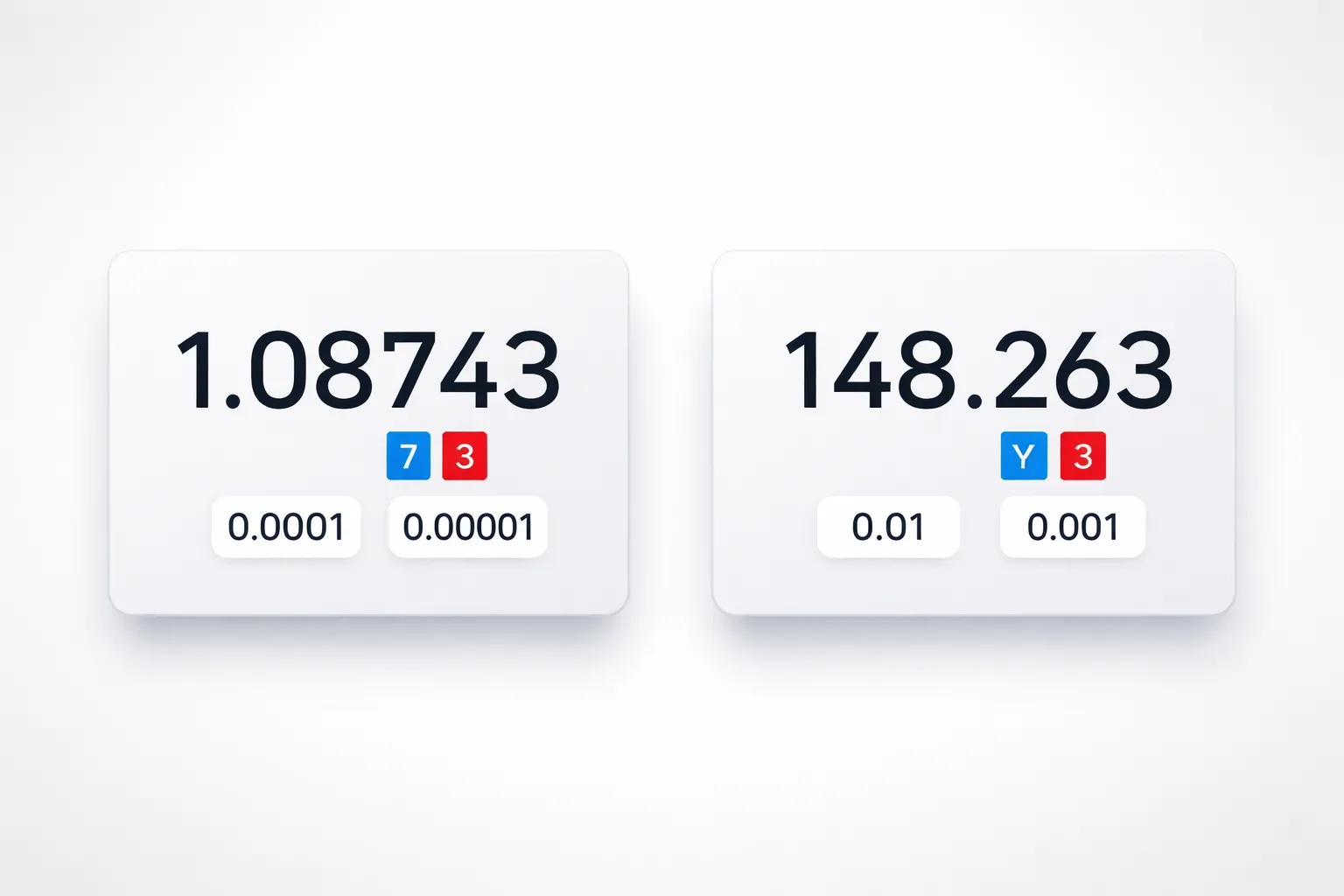
Most major pairs quote to 4 decimal places. Example, EUR/USD = 1.0874.
For these pairs, 1 pip = 0.0001. The pip is the 4th decimal place.
- EUR/USD moves from 1.0874 to 1.0875, that is +1 pip.
- EUR/USD moves from 1.0874 to 1.0884, that is +10 pips.
- EUR/USD moves from 1.0874 to 1.0869, that is -5 pips.
Many brokers show a 5th decimal place for tighter pricing, called a pipette. Example, EUR/USD = 1.08743. Here, 1 pipette = 0.00001, and 10 pipettes = 1 pip.
Reading a USD/JPY quote and identifying the pip digit
JPY pairs use a different quote convention. They quote to 2 decimal places. Example, USD/JPY = 148.26.
For JPY pairs, 1 pip = 0.01. The pip is the 2nd decimal place.
- USD/JPY moves from 148.26 to 148.27, that is +1 pip.
- USD/JPY moves from 148.26 to 148.76, that is +50 pips.
- USD/JPY moves from 148.26 to 148.10, that is -16 pips.
If your broker shows 3 decimals on JPY pairs, example 148.263, the last digit is a pipette. Here, 1 pipette = 0.001, and 10 pipettes = 1 pip.
What changes when pairs include a different quote convention
The rule stays simple. The pip sits at the standard quote precision.
- Most non-JPY pairs, pip = 0.0001.
- JPY pairs, pip = 0.01.
This matters when you do three things.
- Count movement fast. You read the right digit and you avoid off-by-10 errors from pipettes.
- Read spreads correctly. A spread like 0.8 on EUR/USD often means 0.8 pips, while a spread like 1.2 on USD/JPY means 1.2 pips. Your platform may show this in pips or price points, see what spreads mean in forex.
- Set stops and targets in the right units. 20 pips on EUR/USD is 0.0020. 20 pips on USD/JPY is 0.20. Same pip count, different price distance.
| Pair type | Example quote | Pip size | 1 pip move looks like |
|---|---|---|---|
| Major, non-JPY | EUR/USD 1.0874 | 0.0001 | 1.0874 to 1.0875 |
| JPY pair | USD/JPY 148.26 | 0.01 | 148.26 to 148.27 |
Pip vs pipette: the fractional unit brokers display
How 5-decimal pricing created pipettes
A pip is the standard quote step for most pairs.
For most non-JPY pairs, 1 pip = 0.0001. For JPY pairs, 1 pip = 0.01.
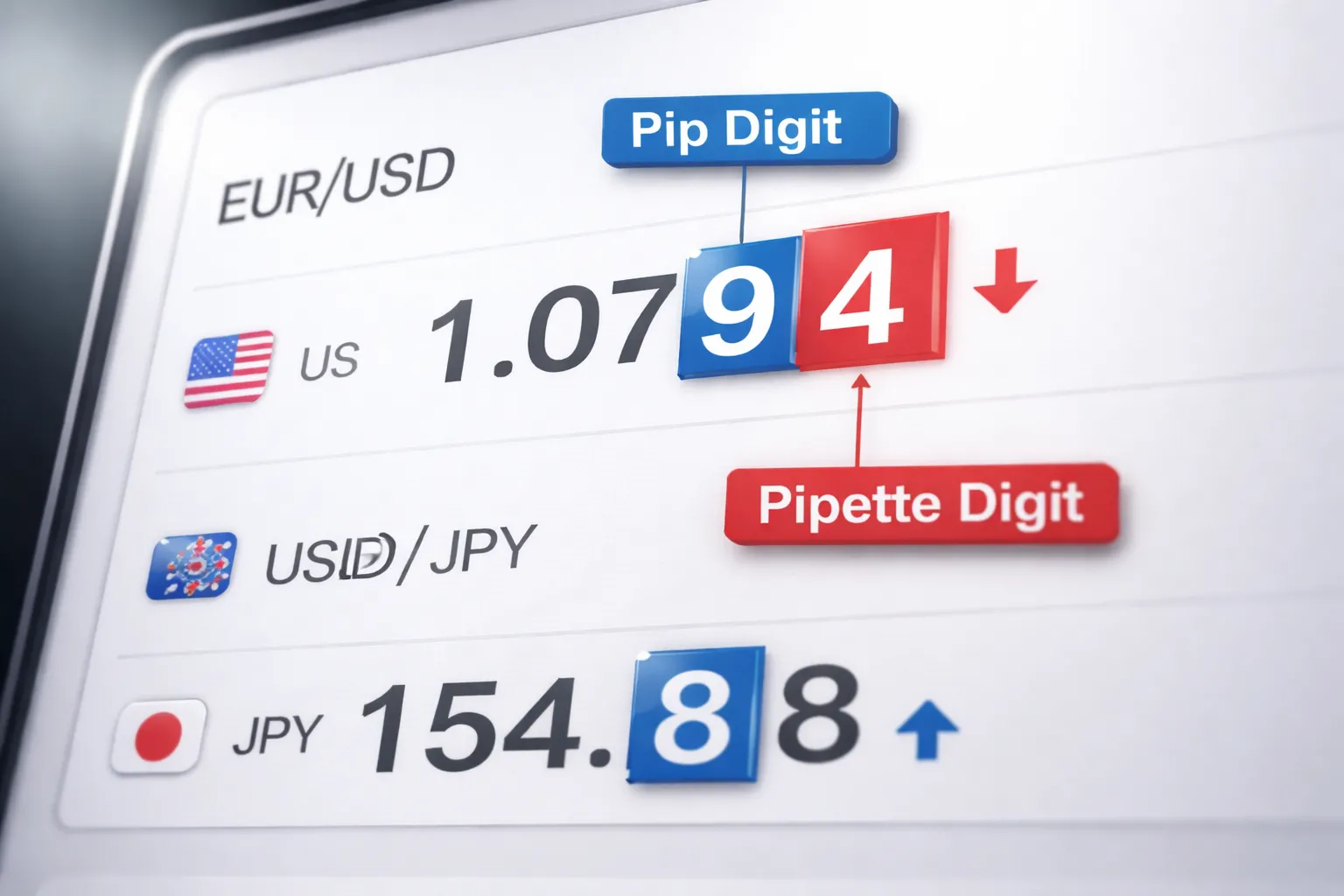
Many brokers quote one extra decimal place. This extra digit is a pipette. It equals one tenth of a pip.
| Pair type | Broker quote example | 1 pip | 1 pipette | 10 pipettes equals |
|---|---|---|---|---|
| Major, non-JPY | EUR/USD 1.08743 | 0.0001 | 0.00001 | 1 pip |
| JPY pair | USD/JPY 148.263 | 0.01 | 0.001 | 1 pip |
Convert pipettes to pips fast
Use a simple rule. On 5-digit and 3-digit quotes, the last digit is pipettes.
- Pips = pipettes ÷ 10.
- Pipettes = pips × 10.
Quick mental checks:
- EUR/USD from 1.08740 to 1.08755, that is 15 pipettes, or 1.5 pips.
- EUR/USD from 1.08743 to 1.08793, that is 50 pipettes, or 5 pips.
- USD/JPY from 148.260 to 148.310, that is 50 pipettes, or 5 pips.
Common beginner mistakes
- Counting pipettes as pips. A move from 1.08740 to 1.08750 is 1 pip, not 10 pips.
- Placing stops 10x too tight or too wide. If you want a 20 pip stop on EUR/USD, you need 200 pipettes on a 5-digit quote.
- Mixing JPY and non-JPY pip sizes. 20 pips on USD/JPY is 0.20. 20 pips on EUR/USD is 0.0020. Keep the pair type in mind before you set orders.
- Reading the spread in the wrong unit. A “1.2” spread on many platforms means 1.2 pips, which is 12 pipettes.
How to calculate pips on a trade (step-by-step)
The core pip calculation formula (most pairs)
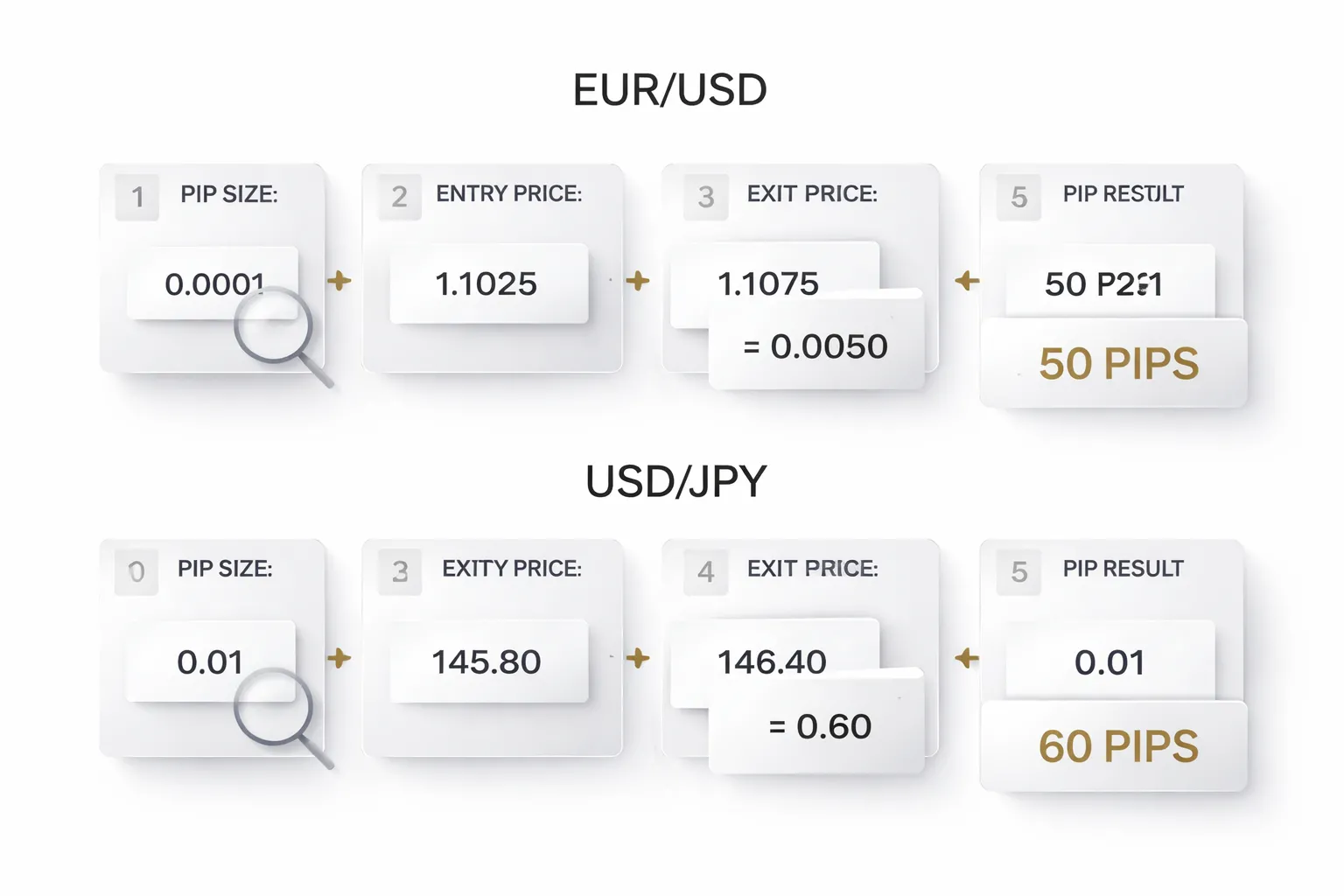
Start with the pip size.
- Most pairs (non-JPY): 1 pip = 0.0001
- If your platform shows 5 decimals: the last digit is a pipette (0.00001). 10 pipettes = 1 pip.
Use this formula.
- Pips moved = (Exit price − Entry price) ÷ 0.0001
Separate method for JPY pairs (2 decimals typical)
JPY pairs use a different pip size.
- JPY pairs: 1 pip = 0.01
- If your platform shows 3 decimals: the last digit is a pipette (0.001). 10 pipettes = 1 pip.
Use this formula.
- Pips moved = (Exit price − Entry price) ÷ 0.01
How to handle buys vs sells
Price direction changes the sign.
- Buy (long): pips = (Exit − Entry) ÷ pip size. Up is positive. Down is negative.
- Sell (short): pips = (Entry − Exit) ÷ pip size. Down is positive. Up is negative.
Use absolute pips when you size stops and targets. Use signed pips when you log performance.
Worked examples (realistic prices)
Example 1, EUR/USD long (non-JPY, 5-digit quote)
- Entry: 1.08420
- Exit: 1.08675
- Move: 1.08675 − 1.08420 = 0.00255
- Pips: 0.00255 ÷ 0.0001 = 25.5 pips (or 255 pipettes)
Example 2, EUR/USD short (non-JPY)
- Entry: 1.09210
- Exit: 1.08930
- Move: 1.09210 − 1.08930 = 0.00280
- Pips: 0.00280 ÷ 0.0001 = 28.0 pips
Example 3, USD/JPY long (JPY pair, 3-digit quote)
- Entry: 147.235
- Exit: 147.615
- Move: 147.615 − 147.235 = 0.380
- Pips: 0.380 ÷ 0.01 = 38.0 pips (or 380 pipettes)
Example 4, GBP/JPY short (JPY pair)
- Entry: 188.40
- Exit: 187.92
- Move: 188.40 − 187.92 = 0.48
- Pips: 0.48 ÷ 0.01 = 48 pips
How to calculate pip value in dollars (or your account currency)
Why pip value changes with position size (lots and units)
A pip is a price move. Pip value is the money impact of that move.
Pip value changes because your position size changes. Bigger size means each pip is worth more in your account currency.
- More units, higher pip value.
- Fewer units, lower pip value.
Core idea: your pip value in quote currency scales linearly with units.
Standard lot vs mini vs micro lot pip values explained
In spot forex, lot sizes usually mean:
- Standard lot, 100,000 units.
- Mini lot, 10,000 units.
- Micro lot, 1,000 units.
| Lot size | Units | Typical pip value when USD is the quote (EUR/USD) |
|---|---|---|
| Standard | 100,000 | $10 per pip |
| Mini | 10,000 | $1 per pip |
| Micro | 1,000 | $0.10 per pip |
Those numbers assume a 0.0001 pip size and USD as the quote currency.
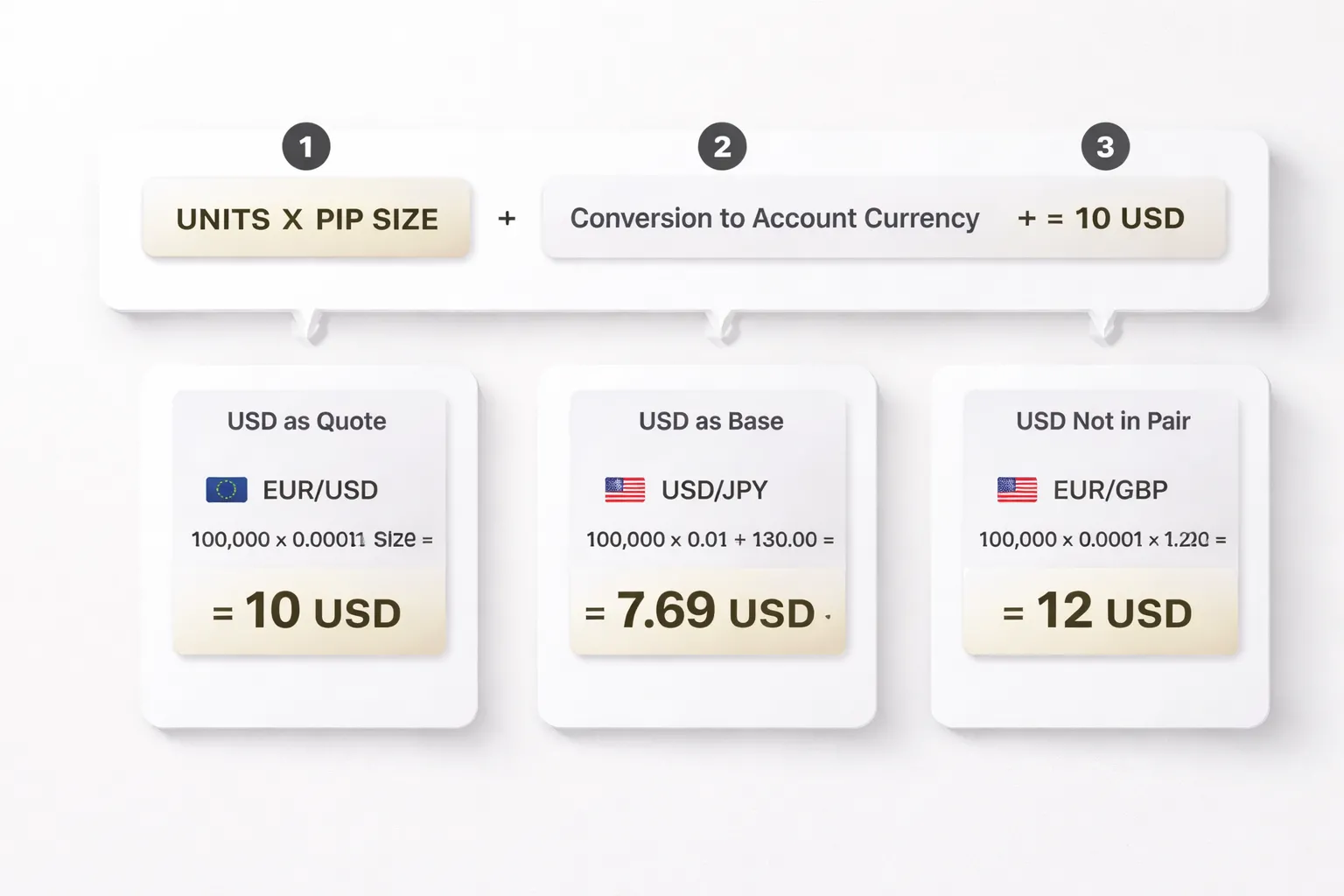
Pip value when USD is the quote currency (simple case)
Example pairs: EUR/USD, GBP/USD, AUD/USD.
Here the quote currency is USD, so you get pip value in dollars directly.
Formula:
Pip value (USD) = Units × Pip size
- Pip size is usually 0.0001 for non-JPY pairs.
Example, EUR/USD, 100,000 units:
100,000 × 0.0001 = $10 per pip
Example, EUR/USD, 10,000 units:
10,000 × 0.0001 = $1 per pip
Pip value when USD is the base currency (conversion required)
Example pairs: USD/JPY, USD/CHF, USD/CAD.
Your pip value first lands in the quote currency. Then you convert it to USD using the current price.
Step 1, get pip value in quote currency:
Pip value (quote) = Units × Pip size
For JPY pairs, pip size is 0.01.
Step 2, convert quote currency to USD:
Pip value (USD) = Pip value (quote) ÷ Current price
Example, USD/JPY at 147.50, 100,000 units:
- Pip value (JPY) = 100,000 × 0.01 = 1,000 JPY per pip
- Pip value (USD) = 1,000 ÷ 147.50 = $6.78 per pip (rounded)
This is why pip value on USD/JPY changes as price changes.
Pip value when USD is not in the pair (cross-currency conversion)
Example pairs: EUR/GBP, GBP/JPY, EUR/JPY.
You calculate pip value in the quote currency, then convert that quote currency into your account currency using a second rate.
Step 1, pip value in quote currency:
Pip value (quote) = Units × Pip size
Step 2, convert quote currency into your account currency:
Pip value (account) = Pip value (quote) × Conversion rate
Use the pair that converts quote currency into your account currency.
Example, EUR/GBP, 100,000 units, account in USD:
- Pip value (GBP) = 100,000 × 0.0001 = 10 GBP per pip
- If GBP/USD = 1.2700, pip value (USD) = 10 × 1.2700 = $12.70 per pip
Example, GBP/JPY, 100,000 units, account in USD:
- Pip value (JPY) = 100,000 × 0.01 = 1,000 JPY per pip
- If USD/JPY = 147.50, pip value (USD) = 1,000 ÷ 147.50 = $6.78 per pip
Execution factors can shift your realized dollars per pip on the fill, see slippage.
Using a pip value calculator vs doing it manually (pros and cons)
- Calculator pros, fast, fewer math errors, handles cross rates, updates with price.
- Calculator cons, you can miss assumptions like contract size, account currency, or whether it uses bid or ask.
- Manual pros, you understand your risk, you can sanity-check platform numbers, you can spot wrong settings.
- Manual cons, slower, easy to use the wrong pip size on JPY pairs, easy to forget the conversion step.
If you trade fixed sizes, memorize your common pip values. If you change size often, use a calculator and confirm the number once per trade.
Why pips matter in forex trading decisions
Understanding spread in pips and how it impacts break-even
The spread is your entry cost. Your trade starts negative by the spread size.
If EUR/USD shows a 1.2 pip spread, price must move at least 1.2 pips in your favor to reach break-even, before fees or swaps.
Spread changes your decision in three direct ways.
- Trade selection. High-spread pairs need bigger targets to justify the cost.
- Timing. Spreads often widen around news and rollovers. Your break-even moves farther away.
- Stop placement. A tight stop can get hit by spread alone on entry or exit if liquidity is thin.
Turning a stop-loss in pips into a defined dollar risk
Pips turn your stop into a fixed risk number. This keeps you from guessing.
Use this basic model.
- Dollar risk per trade = stop size in pips, times pip value, times position size.
- Position size = dollar risk, divided by stop size in pips, divided by pip value per unit.
Example. You risk $100. Your stop is 25 pips. On EUR/USD, a standard lot is about $10 per pip.
- 25 pips times $10 per pip = $250 risk per lot
- $100 divided by $250 = 0.40 lots
Now your risk stays stable even if you change setups. You adjust size, not discipline.
Setting take-profit levels using pips and market structure
Pips help you express targets, but structure should set them.
- Mark the nearest swing high or low, range edge, or key support and resistance level.
- Measure the distance from entry to that level in pips.
- Check if the target clears spread and gives enough reward for your stop size.
Example. Your stop is 30 pips. The next resistance sits 35 pips above entry. You have little room after spread and slippage. Pass the trade or wait for a better entry.
If the next clear level sits 90 pips away, your 30 pip stop gives a 3R structure-based target. That is a cleaner decision.
Comparing strategies and performance using pips vs percentages
Pips make strategy results comparable across different position sizes. Percent returns reflect your sizing and leverage choices.
Track both, but use pips to judge the edge.
- Pips per trade. Shows if your entries and exits work.
- Average win and average loss in pips. Shows payoff, independent of lot size.
- Expectancy in pips. Win rate times average win, minus loss rate times average loss.
Use percentages to manage account growth and drawdown. Use pips to compare two systems on the same pair and timeframe without distortion from different sizing rules. For sizing rules, see how to calculate position size in forex.
How volatility (ATR) relates to typical pip movement
ATR gives you a volatility baseline in pips. It tells you what the market tends to move, not what you hope it will move.
- If the daily ATR is 80 pips, a 10 pip target often sits inside normal noise.
- If the hourly ATR is 12 pips, a 60 pip stop may be oversized for that timeframe.
Use ATR to align your stop and target with current conditions.
- Set stops far enough to avoid normal fluctuations, then size down to keep risk fixed.
- Set targets that fit the pair’s typical movement for your holding period.
- When ATR expands, expect wider swings and larger pip ranges. When it contracts, tighten expectations.
Pips, spreads, and trading costs (what you actually pay)
Pips, spreads, and trading costs (what you actually pay)
Your pip gain is not your profit. Your costs sit between those two numbers.
Spread-only vs commission-plus-spread pricing
Brokers usually charge you one of two ways.
- Spread-only. You pay through a wider spread. No separate commission line item.
- Commission-plus-spread. You get a tighter spread, then pay a fixed commission per lot, per side.
Compare accounts in one unit. Convert both models into an all-in cost per trade in pips and money.
What a “1.2 pip spread” means in money terms
The spread is the gap between bid and ask. When you enter a market order, you start down by the spread.
Money cost equals spread in pips times pip value.
| Trade size | Pip value (USD) on most USD-quoted pairs | Cost of a 1.2 pip spread (USD) |
|---|---|---|
| 0.01 lot (1,000 units) | $0.10 per pip | $0.12 |
| 0.10 lot (10,000 units) | $1.00 per pip | $1.20 |
| 1.00 lot (100,000 units) | $10.00 per pip | $12.00 |
If your broker charges commission, convert it to pips and add it.
- Example: $7 round-turn commission on 1.00 lot. That equals 0.7 pips if your pip value is $10 per pip.
- If the raw spread averages 0.2 pips, your all-in average cost is about 0.9 pips.
Do this math before you set targets. A 6 pip target with a 1.5 pip all-in cost leaves less room for error than most traders expect.
Slippage and requotes: why filled price can change pip outcomes
The price you see is not always the price you get. Fast markets and thin liquidity create slippage.
- Negative slippage. You get filled worse than requested. Your entry costs more pips or your stop loses more pips.
- Positive slippage. You get filled better. It happens, but do not build your plan around it.
- Requotes. Some execution models reject your order and ask you to accept a new price. You lose time and often pips.
Expect more slippage around major news and during session transitions. If you trade those windows, widen your cost assumptions and reduce size. For timing context, see forex market hours and trading sessions.
Swap and rollover: the non-pip cost traders often overlook
Spreads and commission hit you when you enter and exit. Swap hits you while you hold.
- Swap is the daily financing adjustment on leveraged spot FX positions held past rollover.
- It can be a cost or a credit. It depends on the pair, direction, and broker rate.
- It compounds over time. A small daily swap can erase a tight pip target on multi-day trades.
Check swap before you hold overnight. Treat it like another line in your risk plan, especially if you trade small targets or hold for weeks.
Risk management using pips (practical frameworks)
Choosing a stop size based on market conditions, not feelings
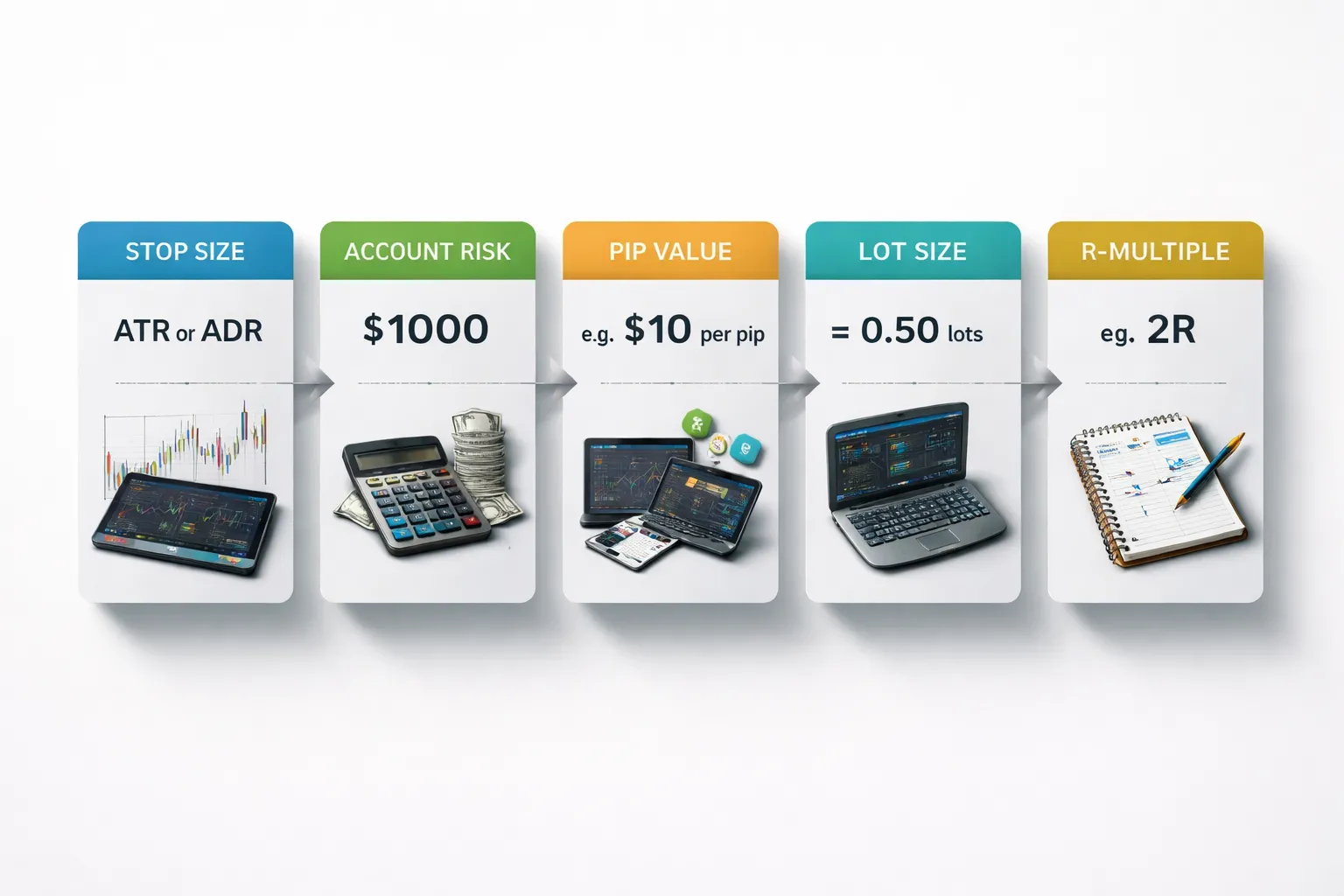
Set your stop in pips based on what the pair usually does, not what you hope it will do.
- Start with volatility: use the average daily range (ADR) or a 14-period ATR. Convert that range into pips.
- Match stop to timeframe: shorter timeframes need tighter stops, but only if the pair’s noise supports it. If price regularly swings 15 to 25 pips in a few minutes, a 10 pip stop is a coin flip.
- Use structure as the final filter: place the stop beyond a clear swing high or low, or beyond a breakout level. If that level sits 37 pips away and your plan allows 25 pips, skip the trade.
- Account for spread and slippage: add a buffer in pips. News, low liquidity, and market opens widen execution risk. Read what slippage is in Forex and how to reduce it.
Position sizing from a fixed risk per trade (pip-based method)
Decide your risk in money first. Then translate it into pips and lot size.
- Step 1: set a fixed risk per trade, like 0.5% or 1% of your account.
- Step 2: set your stop distance in pips based on volatility and structure.
- Step 3: compute position size using pip value.
Formula: Position size (lots) = Risk amount / (Stop pips × Pip value per lot).
Example: Account $10,000. Risk 1% = $100. Stop = 25 pips. Pip value = $10 per pip per standard lot.
Lot size: $100 / (25 × $10) = 0.40 lots. Your loss at the stop is about $100, before spreads and slippage.
Risk-to-reward in pips and why win rate alone is misleading
Track outcomes in pips. It keeps your review clean across pairs and position sizes.
- Define R in pips: R = your stop size in pips. If your stop is 25 pips, then 1R = 25 pips.
- Set targets in R: a 50 pip target with a 25 pip stop equals 2R.
- Use expectancy: Expectancy (in R) = (Win rate × Avg win in R) − (Loss rate × Avg loss in R).
Why win rate fails: A 70% win rate means little if you win 0.5R and lose 1R. You can win often and still bleed pips.
| System | Win rate | Avg win | Avg loss | Expectancy |
|---|---|---|---|---|
| A | 70% | 0.5R | 1.0R | -0.05R per trade |
| B | 40% | 2.0R | 1.0R | +0.20R per trade |
Common stop placement errors that inflate pip losses
- Stops based on round numbers: placing stops at obvious levels invites stop runs. Put the stop beyond the level, with a buffer.
- Stops inside normal noise: if the pair often retraces 20 pips during the move, a 12 pip stop turns a valid setup into repeated small losses.
- Same stop size for every pair: EUR/USD and GBP/JPY do not move the same. Use pip-based volatility measures per pair.
- Ignoring spread at the stop: your stop triggers on bid or ask. A wider spread can hit your stop without a true break. Build the spread into your stop distance.
- Moving the stop wider after entry: this converts a planned pip loss into an unplanned one. If your stop must change, treat it as a new trade with new sizing.
- No plan for news spikes: a 30 pip stop can become a 60 pip fill during fast markets. Reduce size, widen stops, or stay flat.
Pips in other markets and instruments (to avoid confusion)
Forex vs CFDs and spread betting, same price move, different labels
A pip is a forex term. It measures a currency pair move. Many CFD and spread betting platforms still show forex moves in pips because the underlying market is forex.
- Forex spot and forex CFD: price often matches the interbank quote, so a 0.0001 move in EUR/USD is still 1 pip.
- Spread betting: you bet a stake per point. Most platforms call that point a pip on forex pairs. Your P&L is stake multiplied by pips moved, adjusted for spread and any financing.
- Key risk: CFD and spread betting quotes can include a wider spread than a raw forex feed. Your trade can lose “pips” faster, even if the market barely moves.
Indices, commodities, and crypto, use points and ticks, “pip” gets misused
Outside forex, most markets do not use pips. They use points or ticks. Some brokers still show “pips” on everything, which creates confusion.
- Indices: moves are in index points. Example, US500 from 5,000.0 to 5,010.0 is +10 points. Calling that 10 pips is platform slang, not market language.
- Commodities: the minimum price step is a tick, and it differs by instrument. Example, WTI might move in $0.01 steps on a CFD quote, while exchange-traded futures have their own tick size and tick value.
- Crypto: moves are in dollars, cents, or “points” depending on the quote format. BTC/USD from 50,000 to 50,100 is +100. Some apps call those points “pips”, but there is no standard pip definition in crypto.
Why your platform shows “points” when traders say “pips”
Platforms standardize terms across products. They often use “points” as the smallest displayed price move, even for forex.
- 4-digit forex quotes: 1 pip equals 1 point if the platform shows 0.0001 steps.
- 5-digit forex quotes: the platform may call 0.00001 a point. Traders call 0.0001 a pip. That means 10 points equal 1 pip.
- JPY pairs: pip is usually 0.01, pipette is 0.001. On many platforms, 1 point equals the pipette, so 10 points equal 1 pip.
| Instrument | Common market term | Typical smallest displayed move | What some platforms call it |
|---|---|---|---|
| EUR/USD (5 digits) | Pip = 0.0001 | 0.00001 | Point (pipette) |
| USD/JPY (3 digits) | Pip = 0.01 | 0.001 | Point (pipette) |
| Equity indices | Point | 0.1 or 1.0 | Point |
| Commodities | Tick | Varies | Point or tick |
| Crypto | Price units | Varies | Point |
Before you size a trade, confirm what one “point” equals on your platform. Check the contract specs and the tick or point value. This avoids mistakes that trigger a margin call vs stop out faster than you expect.
Common pip mistakes beginners make (and how to fix them)
Mixing up decimals across pairs (4/5 digits vs 2/3 digits)
Platforms quote most majors to 5 decimals. The pip sits at the 4th decimal place. Example, EUR/USD 1.08420 to 1.08470 equals 5 pips, not 50.
JPY pairs often quote to 3 decimals. The pip sits at the 2nd decimal place. Example, USD/JPY 150.120 to 150.170 equals 5 pips.
- Fix: Mark your pip place before you trade. For non JPY pairs, 0.0001 is 1 pip. For JPY pairs, 0.01 is 1 pip.
- Fix: Treat the last digit on a 5 digit or 3 digit quote as a pipette. 10 pipettes equal 1 pip.
- Fix: Use the platform’s built in pip counter with a crosshair tool, then confirm it matches the decimal rule above.
Ignoring quote currency and miscalculating pip value
Pips measure price movement. Pip value measures money gained or lost. Pip value depends on your lot size and the pair’s quote currency.
If your account runs in USD, EUR/USD pip value differs from USD/JPY and GBP/CHF. The quote currency and current rate change the cash value of each pip.
- Fix: Check the pair format. In EUR/USD, USD is the quote currency. A pip converts cleanly to USD on most platforms.
- Fix: For pairs where your account currency is not the quote currency, convert. Your platform often shows pip value in the order ticket. Use that number, not a memorized rule.
- Fix: Confirm the contract spec for “pip value” or “tick value” before you place the trade.
Forgetting spread when counting ‘pips gained’
Your trade starts negative by the spread. If the spread is 1.2 pips, price must move 1.2 pips in your favor to reach breakeven.
Many beginners track pips from entry to exit and ignore spread and commissions. This overstates performance and understates risk.
- Fix: Track net pips. Net pips equal gross move minus spread, minus commissions expressed in pips.
- Fix: Record the spread at entry, not the “typical spread” from marketing pages. Spreads widen in news and low liquidity.
- Fix: If you scalp, treat spread as your main cost. Favor pairs with tight spreads and deep liquidity, see major vs minor vs exotic currency pairs.
Assuming pip value is constant across all pairs and lot sizes
Pip value scales with position size. 1 lot risks about 10 times more per pip than 0.1 lot. It also changes by pair and price level.
This mistake breaks risk control. Your stop loss in pips may stay the same, but your dollar risk can jump.
- Fix: Set risk in money first, then convert to lots using your stop in pips and the pip value shown in the ticket.
- Fix: Recheck pip value when you change pairs. Do not reuse the same “$10 per pip” assumption.
- Fix: Recheck pip value when price moves a lot on JPY pairs and crosses, since conversion effects can shift your per pip P and L.
Frequently Asked Questions
What is a pip in forex?
A pip is a standard unit of price movement. On most pairs, 1 pip equals 0.0001. On JPY pairs, 1 pip equals 0.01. Brokers use pips to show moves, spreads, and profit or loss in a consistent way.
What is a pipette?
A pipette is one tenth of a pip. It is the extra digit on 5 digit quotes. Example, EUR/USD 1.10503 to 1.10504 is 1 pipette, or 0.1 pip. It helps show tighter pricing.
How do you calculate pips on a trade?
Subtract entry from exit, then convert to pips. For non-JPY pairs, pip = 0.0001, so multiply the price change by 10,000. For JPY pairs, pip = 0.01, so multiply the price change by 100.
How much is 1 pip worth?
Pip value depends on pair, lot size, and your account currency. For a USD account, EUR/USD is about $10 per pip on a standard lot. On pairs where USD is not the quote currency, pip value changes with the exchange rate.
Why does pip value change on JPY pairs and crosses?
Your profit is first created in the quote currency. Your platform then converts it to your account currency. When that conversion rate moves, your pip value in dollars shifts. This shows up most on JPY pairs and cross pairs.
Is a pip the same as a point?
Platforms use terms differently. Many call the smallest displayed change a point, which is often a pipette on 5 digit pricing. Check the quote format. If you see five decimals, a point usually equals 0.1 pip.
Do all brokers use the same pip definition?
Yes for forex pricing. Most pairs use 0.0001 and JPY pairs use 0.01. What differs is the number of digits shown, the spread model, and how they label point versus pip in the ticket.
How do pips relate to spread and trading costs?
The spread is quoted in pips or points. You start down by the spread when you enter. A 1.2 pip spread means price must move 1.2 pips in your favor to break even, before commissions and swaps.
- spreads in forex set your baseline cost on every trade.
Can you compare performance in pips across different pairs?
You can compare trade quality in pips, but not risk in dollars. One pair may pay $10 per pip, another may pay $6 per pip for the same lot size. Use money risk and R multiple for clean comparisons.
What is the fastest way to get pip value?
Use your platform’s order ticket. It shows pip value for your pair, lot size, and account currency. Update it when you change pairs or lot size. Do not reuse a pip value from a different symbol.
Conclusion
Pips measure price movement. Pip value converts that movement into money. You need both to control risk.
- Know the unit: Most pairs move in 0.0001. JPY pairs move in 0.01. Some brokers quote pipettes, the extra digit.
- Know the payout: Pip value changes with the pair, lot size, and your account currency. Do not assume it stays the same.
- Trade in dollars: Set risk in money first. Then size the trade so your stop distance in pips matches that risk.
Final tip. Before every trade, open the order ticket, confirm pip value for that symbol and lot size, then run position size from your planned stop. If you want a repeatable method, use this position sizing formula and log the numbers.
-
Forex Leverage Explained: How It Works, Pros, Cons & Examples
1 month ago -
Forex Market Hours & Trading Sessions Explained (Best Times to Trade)
1 month ago -
What Is a Lot Size in Forex? Lot Types + Quick Examples
1 month ago -
How to Calculate Position Size in Forex (Position Sizing Formula + Examples)
1 month ago -
How Does the Forex Market Work? (Participants, Pricing & Execution)
1 month ago
-
-
- Why pip value changes with position size (lots and units)
- Standard lot vs mini vs micro lot pip values explained
- Pip value when USD is the quote currency (simple case)
- Pip value when USD is the base currency (conversion required)
- Pip value when USD is not in the pair (cross-currency conversion)
- Using a pip value calculator vs doing it manually (pros and cons)
-
- What is a pip in forex?
- What is a pipette?
- How do you calculate pips on a trade?
- How much is 1 pip worth?
- Why does pip value change on JPY pairs and crosses?
- Is a pip the same as a point?
- Do all brokers use the same pip definition?
- How do pips relate to spread and trading costs?
- Can you compare performance in pips across different pairs?
- What is the fastest way to get pip value?
-
-
-
- Why pip value changes with position size (lots and units)
- Standard lot vs mini vs micro lot pip values explained
- Pip value when USD is the quote currency (simple case)
- Pip value when USD is the base currency (conversion required)
- Pip value when USD is not in the pair (cross-currency conversion)
- Using a pip value calculator vs doing it manually (pros and cons)
-
- What is a pip in forex?
- What is a pipette?
- How do you calculate pips on a trade?
- How much is 1 pip worth?
- Why does pip value change on JPY pairs and crosses?
- Is a pip the same as a point?
- Do all brokers use the same pip definition?
- How do pips relate to spread and trading costs?
- Can you compare performance in pips across different pairs?
- What is the fastest way to get pip value?
-
-
Forex Lot Size Calculator: How to Use It to Size Trades Correctly
1 month ago -
How to Calculate Position Size in Forex (Position Sizing Formula + Examples)
1 month ago -
Forex Leverage Explained: How It Works, Pros, Cons & Examples
1 month ago -
Margin vs Leverage in Forex: What’s the Difference?
1 month ago -
What Is Forex Trading? A Beginner’s Guide to How It Works
1 month ago
-
Forex Leverage Explained: How It Works, Pros, Cons & Examples
1 month ago -
Forex Market Hours & Trading Sessions Explained (Best Times to Trade)
1 month ago -
Is Forex Trading Legal in the United States? Rules, Regulators & What to Know
1 month ago -
What Is a Lot Size in Forex? Lot Types + Quick Examples
1 month ago -
Forex Trading Platforms Comparison: MetaTrader vs cTrader vs TradingView
1 month ago