Margin vs Leverage in Forex: What’s the Difference?

Margin and leverage decide how much forex exposure you control with your account balance. Mix them up and you misread risk, position size, and liquidation levels.
Margin is the cash your broker locks as collateral to open and keep a trade. Leverage is the ratio that turns that margin into market exposure, such as 30:1. With 30:1 leverage, a 3.33% margin requirement controls 100% of a position value.
You will learn the exact difference between margin and leverage, how brokers calculate each, and how they affect your usable margin, required margin, and margin call risk. You will also see simple number examples you can apply before you place a trade, even if you are still learning how forex trading works.
Key Takeaways
- Summary: Leverage sets your maximum position size, margin is the cash your broker locks as collateral.
- Leverage is a ratio, like 30:1. It tells you how much exposure you can control per 1 unit of equity.
- Margin is a percentage or amount, like 3.33%. It tells you how much you must set aside to open and hold a trade.
- Margin requirement and leverage move together. Higher leverage means a lower margin requirement.
- Required margin depends on position value and margin rate. Bigger trade size means higher required margin.
- Usable margin equals equity minus used margin. Low usable margin raises margin call risk.
- Leverage does not create profit by itself. It multiplies both gains and losses because it increases your exposure.
- Track your lot size and position size before you enter. Use a clear position sizing process to control margin use and drawdown.
- Keep the math simple. Calculate your position size first, then check the required margin against your usable margin.
If you need a fast way to size trades and avoid overusing margin, follow this guide on how to calculate position size.
Margin vs Leverage in Forex: the core definitions (and why traders confuse them)
Margin in forex means collateral, not a fee
Margin is the amount of your account balance the broker locks as collateral to hold a position.
You do not pay margin. You post it.
If you close the trade, the broker releases that margin back to your usable balance, minus any profit or loss and trading costs.
Margin exists to cover potential losses while your trade stays open. It is part of risk control for the broker and a limit on your maximum position size.
Leverage in forex means amplified exposure, not extra money
Leverage is the multiplier between your account equity and the position size you control.
Leverage does not add cash to your account. It increases market exposure per dollar of margin.
Higher leverage lets you open larger positions with the same account size. It also magnifies gains and losses in the same way.
How brokers quote margin requirement (%) vs leverage (ratio)
Brokers often show the same concept in two formats.
- Margin requirement is shown as a percent, like 1%, 2%, or 5%.
- Leverage is shown as a ratio, like 100:1, 50:1, or 20:1.
They convert directly.
| Margin requirement | Equivalent leverage |
|---|---|
| 0.5% | 200:1 |
| 1% | 100:1 |
| 2% | 50:1 |
| 5% | 20:1 |
Core math:
- Required margin = Position size × Margin requirement
- Leverage = 1 ÷ Margin requirement
Why traders confuse margin and leverage
Both numbers change how big a position you can open.
Your platform often shows margin used, free margin, and margin level, but it shows leverage in account settings. That split hides the link between them.
Many traders treat margin like a cost. They see margin used go up and think they spent money. You did not. You reduced your usable collateral.
Many traders treat leverage like a loan. They think the broker gave them extra funds. The broker gave you permission to control a larger position with the same collateral.
This matters because your loss comes from position size, not from the margin number on the screen.
A quick mental model: collateral vs buying power
- Margin is your collateral tied up in open trades.
- Leverage is your buying power multiplier.
If you keep leverage high and position size small, margin use stays low. If you use large position sizes, margin use rises fast and you move closer to a margin call. For that risk chain, see margin call vs stop out.
How margin and leverage work together in a forex trade
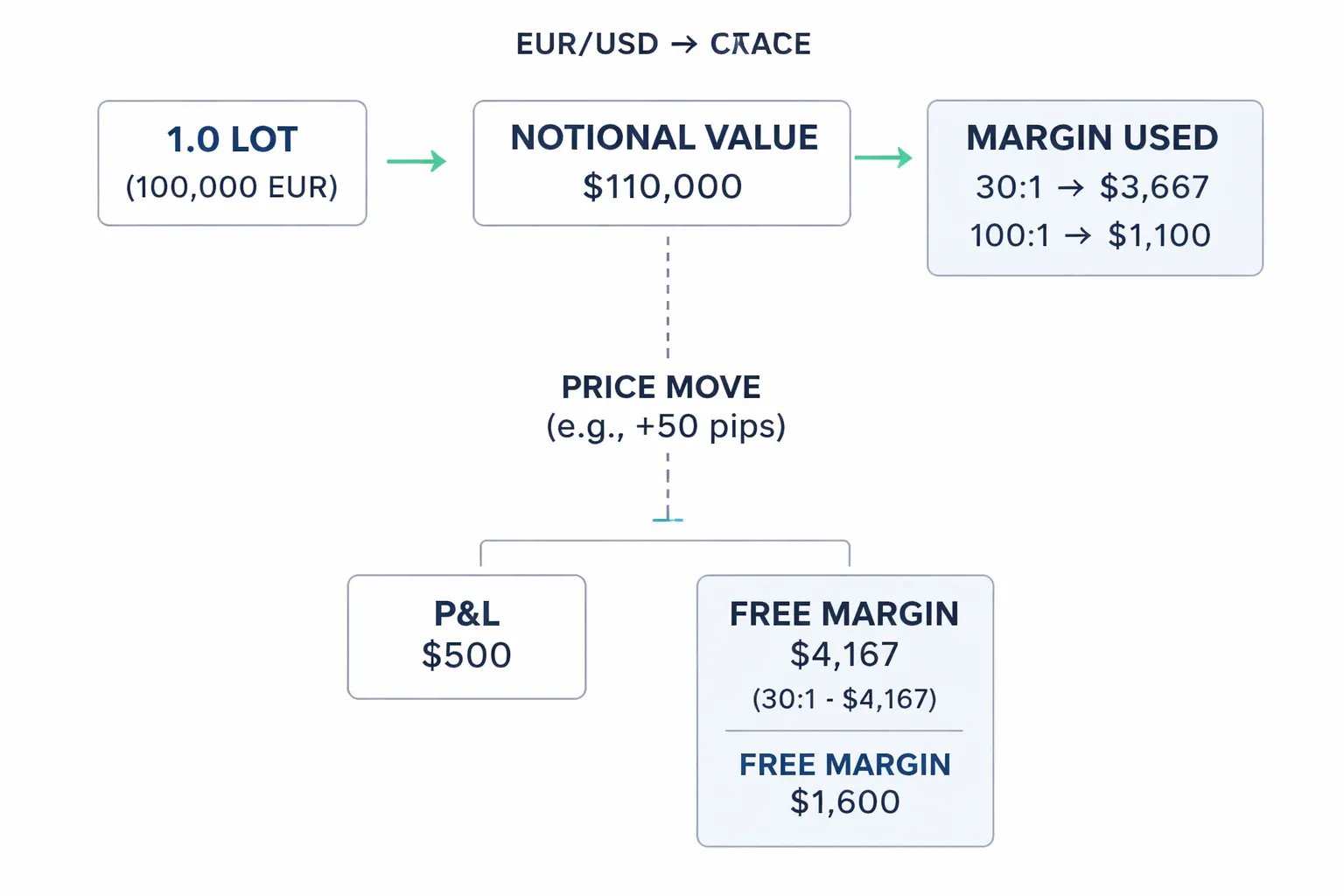
From lot size to notional value: what you’re actually controlling
In forex, your trade size sets your market exposure. Your margin just funds that exposure.
- Lot size defines how many base currency units you control.
- Notional value is the total position value in your account currency.
- Margin used is the deposit your broker locks to keep the position open.
Example lot sizes on most brokers:
- 1 standard lot = 100,000 units
- 1 mini lot = 10,000 units
- 1 micro lot = 1,000 units
The relationship formula: margin requirement, leverage ratio, and position value
These inputs tie together.
- Notional value = units traded × price
- Margin requirement = 1 ÷ leverage
- Margin used = notional value × margin requirement
- Leverage implied by a trade = notional value ÷ equity
Your account leverage sets the maximum. Your position size decides what you actually use.
Step-by-step trade walkthrough with numbers (1 standard lot EUR/USD)
Assume:
- Account currency: USD
- Equity: $10,000
- EUR/USD price: 1.1000
- Trade: buy 1 standard lot = 100,000 EUR
- Account leverage: 30:1 and 100:1 examples
Step 1, calculate notional value.
- Notional = 100,000 × 1.1000 = $110,000
Step 2, calculate margin used at different leverage.
- At 30:1, margin requirement = 1/30 = 3.33%.
- Margin used = $110,000 × 0.0333 = $3,667 (approx).
- At 100:1, margin requirement = 1%.
- Margin used = $110,000 × 0.01 = $1,100.
Step 3, compute free margin right after entry.
- Free margin = equity − margin used.
- With 30:1, free margin = $10,000 − $3,667 = $6,333.
- With 100:1, free margin = $10,000 − $1,100 = $8,900.
Step 4, see the leverage you are actually using.
- Trade leverage vs equity = $110,000 ÷ $10,000 = 11:1.
This is the number that drives risk. The account leverage only limits how big you can go.
How P&L hits equity and changes your usable margin in real time
Price movement changes your floating P&L. Floating P&L changes equity. Margin used stays mostly fixed per position, until price moves a lot or the broker recalculates margin by notional.
Continue the same EUR/USD trade. For 1 standard lot, a 1 pip move is about $10.
- If price drops 50 pips, floating P&L = 50 × $10 = −$500.
- New equity = $10,000 − $500 = $9,500.
Now recompute free margin.
- With 30:1, free margin = $9,500 − $3,667 = $5,833.
- With 100:1, free margin = $9,500 − $1,100 = $8,400.
If losses keep growing, free margin keeps shrinking. You lose room to hold the trade and to open new trades. That is how leverage and margin link in practice. Larger notional value creates larger pip P&L, which hits equity faster, which cuts free margin faster.
Pair choice affects this path because volatility and spread change how fast your equity swings. Stick to high-liquidity pairs if you want cleaner execution and tighter costs, see major vs minor vs exotic currency pairs.
Key account metrics you must understand (the ones that trigger liquidation)
Balance vs equity, why equity is the number that matters for risk
Balance is your account cash after you close trades. It does not move with the market.
Equity is balance plus your floating P&L. It moves tick by tick. Equity is what your broker uses to check if you can hold positions.
Liquidation risk tracks equity, not balance. A large open loss can wipe out equity while your balance still looks fine.
- Balance = closed P&L only.
- Equity = balance + floating P&L.
Used margin vs free margin, what’s reserved vs what’s available
Used margin is the collateral your broker locks to keep your open trades running. You cannot spend it on new positions while those trades stay open.
Free margin is what you have left to absorb losses or open new trades.
- Used margin = sum of margin requirements for open positions.
- Free margin = equity minus used margin.
When price moves against you, equity drops. Used margin usually stays similar. Free margin takes the hit first. When free margin approaches zero, you lose room to breathe.
Margin level (%) and how it predicts a margin call
Margin level is the key liquidation gauge. Brokers display it as a percent.
Margin level (%) = (equity / used margin) x 100.
| Metric | Example value | What it means |
|---|---|---|
| Balance | $1,000 | Cash after closed trades |
| Floating P&L | -$200 | Open loss |
| Equity | $800 | $1,000 - $200 |
| Used margin | $400 | Reserved collateral |
| Free margin | $400 | $800 - $400 |
| Margin level | 200% | ($800 / $400) x 100 |
As losses grow, equity drops, margin level falls. Your broker actions trigger at specific margin level thresholds, not at a specific pip count.
Margin call vs stop-out, what brokers typically do and when
Margin call is a warning state. Your broker blocks new trades, asks you to add funds, or pushes you to reduce exposure. Many platforms mark this when margin level falls to a set percent.
Stop-out is forced liquidation. Your broker closes positions to stop equity from falling further. Brokers usually close the largest losing position first or close positions in sequence until margin level recovers.
- Common setup: margin call at 100%, stop-out at 50%.
- Some brokers use different levels. Check your account terms.
- If you trade fast markets, slippage can push equity below the stop-out level before closures complete.
Keep your margin level well above the broker’s call level. That buffer is your real protection.
Why spreads and swaps can cause margin deterioration even without big price moves
Equity can fall even when price barely changes.
- Spread cost at entry puts you in a floating loss right away. Wider spreads cut equity and margin level instantly. This matters most around news, illiquid sessions, and on exotic pairs.
- Spread widening while you hold can reduce equity without a true price move. Your floating P&L marks to the bid or ask. When spread expands, your mark-to-market worsens.
- Swaps (rollover) hit equity each day you hold past the broker’s cut-off. Negative swap compounds. It can drag margin level down over time even in a flat market. See forex swap fees for how rollover charges work.
Track equity, free margin, and margin level during low-liquidity hours. That is when spread and swap effects show up fastest.
Practical examples: comparing outcomes at different leverage levels
Scenario A: low leverage and wider breathing room before margin stress
Assume you trade EUR/USD. Account balance is $1,000. Your broker uses 50% stop-out on margin level. You open 0.10 lots (10,000 units). Pip value is about $1 per pip.
At 10:1 leverage, required margin is about $100. Your free margin starts near $900. A 100 pip loss is about -$100. Equity drops to about $900. Margin level stays near 900% ($900 equity divided by $100 margin).
Even a 500 pip loss is about -$500. Equity is about $500. Margin level is about 500%. You feel the drawdown, but you do not hit liquidation fast.
Scenario B: high leverage and how a small move can force liquidation
Same account. Same pair. Same 0.10 lots position.
At 100:1 leverage, required margin is about $10. This looks safer because margin use is small. The trap is position sizing. High leverage makes it easy to open too big.
Now assume you use the higher leverage to open 1.00 lot (100,000 units). Pip value is about $10 per pip.
- Required margin at 100:1 is about $1,000.
- Your free margin starts near $0.
- A 10 pip loss is about -$100. Equity is about $900.
- Margin level is about 90% ($900 divided by $1,000).
If your broker stops you out at 50%, you have about $500 of room before liquidation. With a $10 pip value, that is about 50 pips against you. Spread widening can take a chunk of that instantly.
| Setup | Leverage | Lot size | Margin used | Pip value | Approx pips to 50% stop-out |
|---|---|---|---|---|---|
| $1,000 balance, EUR/USD | 10:1 | 0.10 | $100 | $1 | About 450 pips (equity from $1,000 to $50) |
| $1,000 balance, EUR/USD | 100:1 | 1.00 | $1,000 | $10 | About 50 pips (equity from $1,000 to $500) |
What changes (and what doesn’t) when you add more capital to the account
Adding capital changes your buffer. It does not change the pip value of your position.
- What changes: equity, free margin, and margin level. You can hold the same trade through larger swings without hitting margin rules.
- What does not: your risk per pip for a given lot size. If you trade 1.00 lot, you still risk about $10 per pip on EUR/USD.
Example. You keep 1.00 lot and increase balance from $1,000 to $5,000. Margin used stays near $1,000 at 100:1. Your stop-out room grows. At a 50% stop-out, you now have about $4,500 of room. That is about 450 pips. The trade still loses $10 per pip.
How volatility and news events magnify leverage risk
Volatility hits leveraged accounts through fast price moves and spread expansion. Both reduce equity. Both push margin level down.
- Gaps and slippage: your stop may fill worse than your price. Loss jumps. Margin level can drop below stop-out before you can react.
- Spread spikes: your position starts deeper in the red. The mark-to-market loss grows without any real price trend.
- Thin liquidity hours: the same lot size needs the same margin, but your equity swings more per tick. That drives faster margin calls.
If you want fewer spread shocks, stick to liquid pairs and active sessions. Use low-spread beginner forex pairs as a starting shortlist.
Pros and cons: margin trading vs higher leverage in forex
Potential advantages: capital efficiency and flexibility
Margin trading lets you control a larger position with less cash tied up. That improves capital efficiency. You can keep more free margin for risk buffers, or run smaller positions across more pairs.
Higher leverage increases that flexibility further. With the same account size, you can:
- Use smaller margin per trade and keep more free margin.
- Scale position size without adding funds.
- Hedge or run multiple positions at once.
In practice, the edge is operational. You can place trades without locking most of your equity into margin.
Primary downside: amplified losses and faster drawdowns
Leverage does not change pip value. Your lot size does. Higher leverage makes it easier to choose a lot size that is too large for your account.
That creates two problems:
- Amplified losses: a normal move against you becomes a large percentage hit to equity.
- Faster drawdowns: your usable margin shrinks quickly, so a small adverse move can trigger a margin call.
Margin requirements also change when volatility rises. Some brokers increase margin on news or around weekends. If you run tight free margin, you can face forced liquidation without adding any new trades.
Psychological traps: overtrading and false confidence from low margin requirements
Low margin per trade can make risk feel smaller than it is. You see plenty of free margin and assume you have room. Your exposure still stacks.
- Overtrading: you open more positions because margin looks cheap. Correlated pairs then act like one oversized trade.
- Stop widening: you move stops because “it is only a small margin hit”, but your equity loss keeps growing.
- Revenge sizing: you increase lot size after a loss because leverage allows it.
Fix this with position sizing based on account risk, not on available margin. Use a clear method from this guide on how to calculate position size in forex.
When lower leverage can outperform: survivability and consistency
Lower leverage can win because it forces restraint. You take smaller positions. You last longer through spread spikes, slippage, and streaks of losses.
- More room for normal volatility: you can hold through routine pullbacks without a margin call.
- Better decision quality: smaller equity swings reduce panic exits and impulsive entries.
- More consistent compounding: avoiding large drawdowns matters because recovery math is brutal. A 50% drawdown needs a 100% gain to break even.
| Choice | Main upside | Main risk | Best use |
|---|---|---|---|
| Margin trading (moderate leverage) | Capital efficiency without extreme exposure | Still vulnerable if you oversize lots | Accounts focused on steady risk per trade |
| Higher leverage | Maximum flexibility and lowest margin per lot | Easy to create oversized positions and fast margin calls | Experienced traders with strict sizing rules and wide free margin |
| Lower leverage | Higher survivability and smoother equity curve | Less ability to scale or hedge heavily | Beginners, swing traders, and anyone avoiding blowups |
Risk management playbook for using margin and leverage responsibly
Position sizing with pip value
Set risk per trade as a fixed percent of equity. Use 0.25 percent to 1 percent if you want staying power.
Calculate your position size from the stop distance and pip value, not from available margin.
- Step 1. Equity = $10,000. Risk = 0.5 percent. Dollar risk = $50.
- Step 2. Stop-loss = 25 pips.
- Step 3. For pairs quoted in USD, 1 standard lot is about $10 per pip. Your risk per 1 lot = 25 pips x $10 = $250.
- Step 4. Lot size = $50 / $250 = 0.20 lots.
If your pip value is not $10 per lot, calculate it first. Then size the trade. Use a position size calculator or follow a formula. See how to calculate position size.
Stop-loss placement vs lot size
Pick your stop based on the market, then adjust lot size to fit your risk cap.
- Set the stop where your trade idea fails, not where your margin feels comfortable.
- If the required stop is wide, reduce lots. Do not squeeze the stop to keep a large position.
- If the stop must be tight, reduce lots anyway. Tight stops raise stop-out frequency.
Adjust lot size first. Adjust the trade plan second. Avoid adjusting the stop just to increase leverage.
Set a personal maximum leverage
Your broker maximum is not your operating limit. Set your own cap based on total exposure.
- Track effective leverage, not account leverage. Effective leverage = total notional exposure / equity.
- Common guardrails: 1x to 3x for swing trading, 3x to 5x for active intraday, above 5x only with strict controls.
- Cut exposure after a drawdown. If equity drops 10 percent, reduce notional size by at least 10 percent.
Lower effective leverage reduces margin pressure and slows drawdowns.
Manage correlated pairs to avoid hidden concentration
Multiple trades can be the same trade in disguise. Correlation turns small risk into one large bet.
- Count exposure by currency. Example: long EURUSD and long GBPUSD both add USD short exposure.
- Treat highly correlated pairs as one position for risk. Cap combined risk across the cluster.
- Limit total risk across open trades. Example: 1 percent per trade, 3 percent total across all trades.
Check spreads and liquidity before stacking positions. Thin markets widen spreads and raise margin stress.
Monitor margin level and build a buffer
Margin calls happen when you run out of free margin. Build a buffer so normal costs do not force exits.
- Watch margin level. Margin level = equity / used margin x 100.
- Hold a buffer. Many traders target 300 percent to 1,000 percent margin level, depending on volatility and holding time.
- Account for spread at entry. You start negative by the spread. This reduces equity immediately.
- Account for swaps if you hold overnight. Negative swap compounds and can push margin level down over time.
- Plan for slippage on stops. Model worst case fill, not best case.
When margin level drops, reduce exposure fast. Close the weakest position first. Do not add to losing trades to “average” when free margin is thin.
Broker and regulation considerations that change real-world margin/leverage
Regulatory leverage caps change your maximum position size
Regulators cap leverage for retail clients. Your broker must apply these limits if you trade under that jurisdiction. Lower max leverage means higher required margin for the same trade size.
| Product (retail) | Typical UK or EU cap | What it means in practice |
|---|---|---|
| Major FX pairs | 30:1 | You post about 3.33% margin per position value. |
| Non-major FX pairs | 20:1 | You post about 5% margin, positions hit margin limits sooner. |
| Gold | 20:1 | Same margin rate as non-majors at many EU and UK brokers. |
| Indices | 20:1 | Margin changes your risk per point fast, check contract specs. |
| Oil | 10:1 | You post about 10% margin, smaller size or wider buffer. |
| Single stocks | 5:1 | You post about 20% margin, leverage drops hard. |
| Crypto CFDs | 2:1 | You post about 50% margin, little room for drawdown. |
Some brokers offer higher leverage under offshore entities or professional status. That changes your margin, but it can also remove protections like negative balance protection. Treat that as a risk decision, not a feature.
Dynamic margin can jump during news and volatility
Brokers can raise margin requirements when volatility spikes. They do it to reduce their own risk and to match liquidity conditions.
- Scheduled events: CPI, NFP, rate decisions, major elections. Margin can increase before the release and stay higher after.
- Market stress: flash moves, thin liquidity, widened spreads. Brokers can switch to higher margin without warning.
- Weekend and holiday risk: gaps risk. Some brokers lift margin before market close.
If margin increases, your used margin rises. Your free margin drops even if price has not moved. Your margin level can fall into margin call or stop-out territory fast. Keep a buffer and size positions so you survive a margin hike.
Margin rules vary by instrument, majors are not the same as exotics
Do not assume one leverage number applies to everything. Brokers often set different margin rates by symbol.
- Majors: tighter spreads and deeper liquidity. Brokers usually allow lower margin than on minor and exotic pairs.
- Minors: wider spreads and less depth. Margin often increases, especially around local news.
- Exotics: wide spreads, gap risk, and sharp re-pricing. Margin can be much higher, and execution can degrade.
- Metals, indices, energies: margin depends on contract size, trading hours, and volatility. Check symbol specs, not marketing pages.
Match your sizing to each instrument’s margin and pip or point value. Use a position sizing method that accounts for the symbol, not just your stop distance. See how to calculate position size.
Account currency and conversion affect margin and P&L
Your account currency changes how the platform calculates required margin and floating P&L. If your account currency differs from the quote or base currency of the pair, the platform converts values at the current rate. That adds a second source of fluctuation.
- Margin conversion: required margin can change as the conversion rate moves, even if the traded pair price stays flat.
- P&L conversion: your profit or loss can change in your account currency due to FX conversion swings.
- Funding and withdrawals: depositing in one currency and trading instruments priced in another can add hidden costs from conversion spreads.
If you run tight free margin, conversion moves can push your margin level down. Build extra buffer when you trade pairs that do not align with your account currency.
Broker terms you must read before you rely on margin
- Stop-out level: the margin level where the broker starts closing positions. Example, 50% means they close trades when equity falls to half of used margin.
- Margin call level: the warning threshold. It does not always force closures, but it signals you have little free margin left.
- Negative balance protection: limits losses to your deposit for retail clients in some jurisdictions. It may not apply to all clients or entities.
- Close-out policy: which positions the broker closes first, and whether they close the largest loss, largest margin user, or positions in order of opening time.
- Hedging margin rules: some brokers reduce margin on offsetting positions, some charge full margin on both legs. That changes real exposure and liquidation risk.
- Execution and re-quotes: poor fills increase drawdown and margin use. This matters most when margin is thin.
Read the product disclosure and symbol specification sheet. Those documents define your real-world margin and leverage, not the headline leverage number.
Common mistakes and misconceptions (and how to avoid them)
Confusing margin required with maximum loss
Margin required is a deposit. It is not a cap on your loss.
Your loss tracks the full position size. A 1 percent move against a 100,000 unit position can cost about 1,000 in the quote currency, even if the margin required was 200.
- Track exposure, not margin. Write down your notional size and what 1 pip equals in your account currency.
- Size for the stop distance. Decide the cash amount you can lose, then calculate lots from that number.
- Leave a margin buffer. Keep free margin high enough to absorb spread widening and slippage.
Assuming maximum leverage is “recommended” leverage
Max leverage is a ceiling. It exists to allow flexible sizing, not to push you into larger trades.
High leverage reduces required margin. It does not reduce volatility, drawdown, or gap risk.
- Set your own leverage cap. Use an exposure limit per trade and per currency, regardless of broker maximums.
- Use a simple stress test. Estimate loss at a 1 percent and 2 percent adverse move on each open position.
- Keep liquidation far away. If a normal swing can trigger a margin call, your sizing is wrong.
Ignoring spread widening around rollover and news releases
Spreads widen when liquidity drops. That increases used margin pressure through floating loss and can hit stops early.
This shows up most at rollover, during session transitions, and around high impact releases.
- Avoid thin windows. Do not open tight margin trades into rollover or scheduled news.
- Model the wider spread. Assume spreads can expand several times your normal average on that symbol.
- Use limit orders when you can. Market orders during a spike can fill far from your price.
- Learn how pricing and execution work. See how the forex market works.
Overlooking swap and financing costs in long-held leveraged positions
Swap hits your equity every day you hold a position past rollover. With leverage, swap becomes a larger percentage of your margin.
Small daily charges add up. They reduce free margin and move your margin call level closer even if price does nothing.
- Check the swap rate before you enter. Look up long and short swap for the exact symbol.
- Plan for triple swap days. Many brokers charge three days of swap on one weekday.
- Track swap as a weekly number. If swap exceeds your expected edge, do not hold.
Using hedging or multiple positions without understanding net exposure
Two trades can look diversified but still stack the same risk.
Long EURUSD and short USDCHF both create USD exposure. Long GBPJPY and long USDJPY both load JPY risk. Correlation can jump during stress.
Margin treatment also differs. Some brokers net hedges. Some charge margin on both legs.
- Calculate net exposure by currency. List each open trade and total your long and short amounts per currency.
- Do not assume a hedge reduces margin. Confirm the broker’s offset margin rules for that symbol.
- Limit the number of linked positions. Cap total risk across correlated pairs, not per trade.
- Watch your real liquidation risk. A “hedged” book can still get margin called if one leg gaps or spreads blow out.
FAQ
What is margin in forex?
Margin is the cash your broker sets aside as collateral to hold a position. It is a percentage of your notional exposure. It is not a fee and it is not the trade cost. Your free margin falls as required margin rises.
What is leverage in forex?
Leverage is the ratio between your account equity and the position size you control. Higher leverage lets you open larger positions with less margin. It also magnifies profit and loss. Losses hit your equity fast when leverage runs high.
How do margin and leverage differ?
Leverage describes position size versus equity. Margin describes the collateral your broker requires for that size. You choose your position size and your effective leverage. Your broker sets the margin rate and the maximum leverage for each symbol.
How do you calculate required margin?
Required margin equals notional value times the margin rate. Notional value equals position size times price, adjusted to your account currency. If the broker quotes leverage, margin rate equals 1 divided by that leverage.
What is free margin?
Free margin is equity minus used margin. You use free margin to open new trades and absorb floating losses. When free margin drops, you lose room to hold or add positions. Track it during news and high spread periods.
What triggers a margin call and stop out?
Your broker monitors margin level, equity divided by used margin. A margin call warns you when margin level hits a set threshold. A stop out closes positions when it falls further. Thresholds vary by broker and account type.
Does hedging reduce margin?
Sometimes, but you cannot assume it. Some brokers net margin on offsetting positions, others charge full margin on both legs. Rules can vary by symbol. Check the broker’s hedge margin policy before you build linked positions.
Does higher leverage always increase risk?
Higher maximum leverage increases your potential position size. Risk depends on your actual position size, stop distance, and exposure concentration. You can use high leverage and still trade small. Most blowups come from oversized positions.
How does lot size affect margin and leverage?
Bigger lot size raises notional value, which raises required margin and effective leverage. Small changes in lots can double exposure. Use a lot calculator and know your contract size. See lot size in forex for examples.
Can spreads and swaps affect margin?
Yes. Spreads hit your floating P and L at entry, which reduces equity and can lower margin level. Swaps add or subtract daily. During volatile periods, spreads can widen fast. That can trigger stop out even without a big price move.
What is the safest way to use margin?
Keep a buffer. Use small position sizes and avoid stacking correlated trades. Set a hard max for used margin, many traders cap it well below 50 percent of equity. Expect worse fills and wider spreads during news and market gaps.
Conclusion
Margin and leverage describe the same trade from two angles. Margin is the cash your broker locks as collateral. Leverage is the exposure you control with that collateral. Higher leverage means lower margin per lot, but the same market move hits a larger position. Your risk rises because your position size rises.
Keep the math simple. Focus on three numbers on every trade: account equity, position size, and stop distance. Margin does not protect you, only your stop and your sizing do. If you oversize, a small move plus spread widening can push margin level down and trigger a stop out.
- Cap used margin, many traders stay under 50 percent of equity.
- Size for the stop. Keep worst-case loss per trade small and fixed.
- Hold extra free margin for spreads, swaps, and gaps.
- Avoid stacking correlated positions that act like one big trade.
Final tip: set position size first, then check margin. If margin looks tight, reduce lot size. Use a calculator and follow a repeatable process, see how to calculate position size.
-
Forex Market Hours & Trading Sessions Explained (Best Times to Trade)
5 months ago -
Forex Leverage Explained: How It Works, Pros, Cons & Examples
5 months ago -
How to Calculate Position Size in Forex (Position Sizing Formula + Examples)
5 months ago -
What Is a Lot Size in Forex? Lot Types + Quick Examples
5 months ago -
What Are Pips in Forex? Definition, Examples & Why They Matter
5 months ago
-
-
- Balance vs equity, why equity is the number that matters for risk
- Used margin vs free margin, what’s reserved vs what’s available
- Margin level (%) and how it predicts a margin call
- Margin call vs stop-out, what brokers typically do and when
- Why spreads and swaps can cause margin deterioration even without big price moves
-
- What is margin in forex?
- What is leverage in forex?
- How do margin and leverage differ?
- How do you calculate required margin?
- What is free margin?
- What triggers a margin call and stop out?
- Does hedging reduce margin?
- Does higher leverage always increase risk?
- How does lot size affect margin and leverage?
- Can spreads and swaps affect margin?
- What is the safest way to use margin?
-
-
-
- Balance vs equity, why equity is the number that matters for risk
- Used margin vs free margin, what’s reserved vs what’s available
- Margin level (%) and how it predicts a margin call
- Margin call vs stop-out, what brokers typically do and when
- Why spreads and swaps can cause margin deterioration even without big price moves
-
- What is margin in forex?
- What is leverage in forex?
- How do margin and leverage differ?
- How do you calculate required margin?
- What is free margin?
- What triggers a margin call and stop out?
- Does hedging reduce margin?
- Does higher leverage always increase risk?
- How does lot size affect margin and leverage?
- Can spreads and swaps affect margin?
- What is the safest way to use margin?
-
-
How to Place a Forex Trade Step by Step (Your First Trade Explained)
3 months ago -
Forex Trading vs Crypto Trading: Which Market Is Better for Beginners?
3 months ago -
Forex Lot Size Calculator: How to Use It to Size Trades Correctly
5 months ago -
How to Calculate Position Size in Forex (Position Sizing Formula + Examples)
5 months ago -
Forex Leverage Explained: How It Works, Pros, Cons & Examples
5 months ago
-
Forex Trading Platforms Comparison: MetaTrader vs cTrader vs TradingView
5 months ago -
Is Forex Trading Legal in the United States? Rules, Regulators & What to Know
5 months ago -
Stop Loss vs Take Profit: Differences, Examples & Best Practices
5 months ago -
Forex Market Hours & Trading Sessions Explained (Best Times to Trade)
5 months ago -
Forex Leverage Explained: How It Works, Pros, Cons & Examples
5 months ago