What Is a Lot Size in Forex? Lot Types + Quick Examples

Lot size is the number of currency units you buy or sell in a forex trade. It sets your pip value, your profit and loss per price move, and how fast you can blow through your margin. Pick the wrong size and a small move can hit your account hard.
This guide breaks down the main lot types, standard, mini, micro, and nano. You will see how each one translates into real exposure. You will learn how to estimate pip value, how lot size interacts with leverage and margin, and how to size trades to match your risk. For a deeper leverage breakdown, see forex leverage explained.
Key Takeaways
- Summary: Lot size sets your position size in forex, it drives pip value, margin used, and how fast profit and loss move.
- Standard lot = 100,000 units. Mini = 10,000. Micro = 1,000. Nano = 100.
- Bigger lots mean bigger pip value. A small price move hits your account harder.
- Your lot size and your leverage decide your margin requirement. Higher leverage lowers margin, it does not lower risk.
- Pick lot size from risk first. Define stop loss distance, then size the trade so one loss stays within your limit.
- Always check pip value for the pair you trade. Quote currency and account currency can change the numbers.
- Use smaller lots when you test a strategy, trade volatile pairs, or trade higher timeframes with wider stops.
- If you mix up margin and leverage, fix that before you scale size. Read margin vs leverage.
What Is a Lot Size in Forex (Plain-English Definition)
What a lot size means
A lot size is the size of your forex trade.
It tells you how much of the base currency you buy or sell.
Bigger lots mean bigger price exposure. Your profit and loss per pip move up or down with lot size.
Lots vs units, what you are actually buying or selling
Forex uses lots as a standard way to express trade size.
You can think of a lot as a bundle of units of the base currency.
- 1 standard lot = 100,000 units of the base currency
- 1 mini lot = 10,000 units
- 1 micro lot = 1,000 units
- 1 nano lot = 100 units (only on some brokers)
Example: If you buy 0.10 lots of EUR/USD, you buy 10,000 EUR. You pay for it in USD at the current price.
Why lots exist, standardization and easier risk control
Lots standardize position size across brokers and platforms.
That makes pip value easier to estimate, compare, and control.
When you change lot size, you change the money at risk for the same stop loss distance.
That is why position sizing starts with risk per trade, then lot size.
Base currency, quote currency, and what a position represents
Every forex pair has two currencies.
- Base currency is the first currency in the pair. EUR in EUR/USD.
- Quote currency is the second currency. USD in EUR/USD.
A position is your open trade.
- If you go long EUR/USD, you buy EUR and sell USD.
- If you go short EUR/USD, you sell EUR and buy USD.
Your lot size sets how many units of the base currency sit in that position. Price movement then converts into profit or loss in the quote currency, then into your account currency if different.
Forex Lot Types (Standard, Mini, Micro, Nano) and Their Unit Values
Standard Lot, 100,000 Units
A standard lot equals 100,000 units of the base currency.
If you buy 1.00 lot of EUR/USD, your position holds 100,000 EUR. Your profit or loss tracks the EUR/USD price move, then shows in USD because USD is the quote currency.
Standard lots suit larger accounts and traders who need higher exposure per trade. They also magnify losses when price moves against you.
Mini Lot, 10,000 Units
A mini lot equals 10,000 units of the base currency.
If you buy 1.00 mini lot of EUR/USD, your position holds 10,000 EUR.
- You can scale in and out with less size than a standard lot.
- You can keep risk lower while still trading major pairs.
- Many retail traders use mini lots for swing trades and day trades.
Micro Lot, 1,000 Units
A micro lot equals 1,000 units of the base currency.
If you buy 1.00 micro lot of EUR/USD, your position holds 1,000 EUR.
- Useful for smaller accounts.
- Useful for testing a strategy in live conditions with limited risk.
- Lets you fine-tune position size instead of forcing a larger step.
Nano Lot, 100 Units
A nano lot equals 100 units of the base currency.
If you buy 1.00 nano lot of EUR/USD, your position holds 100 EUR.
- Availability varies by broker and account type.
- More common on platforms that support very small position sizing.
- Best for very small accounts and very tight risk limits.
Lot Type Table, Unit Values at a Glance
| Lot type | Lot size (lots) | Base currency units | Example on EUR/USD |
|---|---|---|---|
| Standard | 1.00 | 100,000 | 100,000 EUR |
| Mini | 1.00 | 10,000 | 10,000 EUR |
| Micro | 1.00 | 1,000 | 1,000 EUR |
| Nano | 1.00 | 100 | 100 EUR |
Fractional Lots, 0.37 Lots and Why It Matters
Most brokers let you trade fractional lots, like 0.37 lots. This gives you precise control over exposure.
- 0.37 standard lot equals 37,000 units of the base currency.
- 0.37 mini lot equals 3,700 units.
- 0.37 micro lot equals 370 units.
Fractional lots matter because your risk comes from position size. When you can set size in small steps, you can match your stop loss distance to a fixed dollar risk. You can also adjust size to account for costs like the spread.
How Lot Size Affects Pip Value, Profit, and Loss
What a pip is, and why pip value changes with position size
A pip is the standard price step a forex pair moves.
- Most pairs: 1 pip = 0.0001.
- JPY pairs: 1 pip = 0.01.
Pip value is the money you gain or lose when price moves 1 pip.
Your pip value changes with lot size because a bigger position controls more units. The same 1 pip move hits a larger number of units, so your profit and loss per pip rises.
For most USD-quoted pairs, you can estimate pip value with a simple rule.
- Standard lot (100,000 units): about $10 per pip.
- Mini lot (10,000 units): about $1 per pip.
- Micro lot (1,000 units): about $0.10 per pip.
Quick pip value examples for EUR/USD across lot types
EUR/USD has USD as the quote currency. Pip value is in dollars, with no conversion needed.
| Lot type | Units | Pip value (1 pip) | 10 pips | 50 pips |
|---|---|---|---|---|
| Standard | 100,000 | $10.00 | $100 | $500 |
| Mini | 10,000 | $1.00 | $10 | $50 |
| Micro | 1,000 | $0.10 | $1 | $5 |
If you trade 0.37 standard lot on EUR/USD, your pip value is about $3.70. A 25 pip loss equals about $92.50, plus spread and commissions.
JPY pairs, the pip decimal difference, and what that changes
JPY pairs quote to two decimal places. One pip is 0.01, not 0.0001.
This changes the pip value calculation because the pip size is 100 times larger, but the price level also differs. You still scale pip value linearly with your lot size.
Example for USD/JPY at 150.00.
- 1 standard lot: pip value is about $6.67 per pip. (1,000 JPY per pip, divided by 150)
- 1 mini lot: about $0.67 per pip.
- 1 micro lot: about $0.067 per pip.
Brokers may show fractional pip pricing on JPY pairs. A pipette is 0.001. Ten pipettes equal 1 pip. Your profit and loss still comes from your pip value times the number of pips moved.
Non-USD quote currencies, why pip value needs conversion
If USD is not the quote currency, your pip value is not naturally in USD. You must convert it to your account currency.
Example with EUR/GBP. The quote currency is GBP, so pip value is in GBP.
- 1 standard lot: 1 pip = 10 GBP.
- If GBP/USD is 1.25, then 10 GBP equals $12.50.
That conversion rate moves. Your USD profit and loss can change even if the pip move stays the same.
If you want a repeatable method, use the position sizing steps in how to calculate position size in forex.
Margin, Leverage, and Lot Size: What You Must Understand Before You Trade
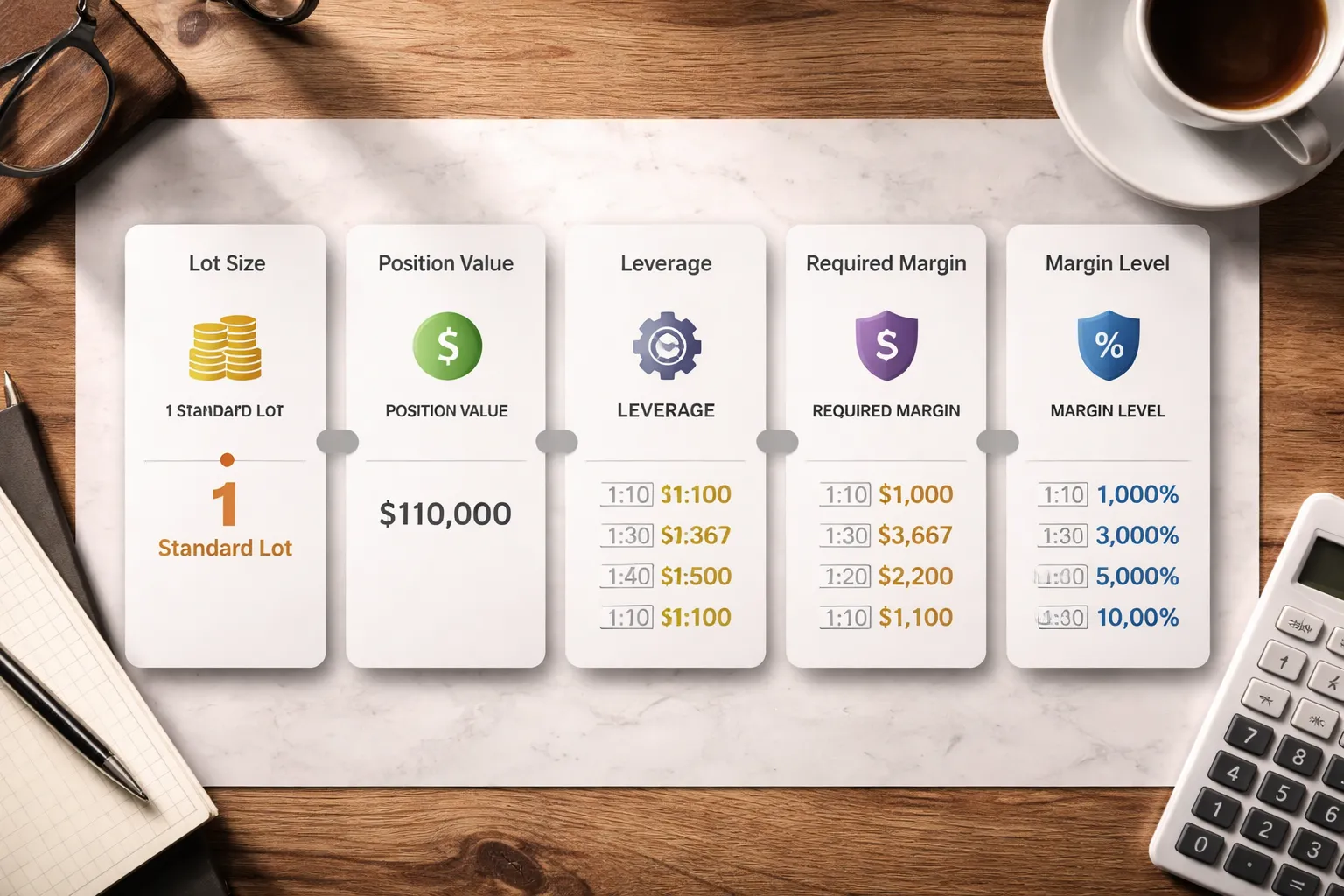
Margin requirement vs trade size, the core relationship
Lot size sets your position value. Margin is the cash your broker locks to hold that position.
Your required margin depends on two inputs.
- Position value, driven by lot size and price.
- Leverage, set by your broker and sometimes capped by regulation.
Use this base formula.
Required margin = Position value / Leverage
For most USD-quoted majors, you can estimate position value like this.
Position value ≈ Lot units × price
- 1 standard lot = 100,000 units.
- 1 mini lot = 10,000 units.
- 1 micro lot = 1,000 units.
Leverage explained without hype
Leverage does one thing. It lets you control a larger position with less margin.
Leverage does not change pip value. Lot size does.
- Lot size controls how much you make or lose per pip.
- Leverage controls how much margin you must post to carry that lot size.
Higher leverage lowers required margin. It also increases the chance you hit a margin call if price moves against you.
If you want the mechanics behind pricing, fills, and who sits on the other side, read how the forex market works.
Worked margin examples, same lot size, different leverage
Assume EUR/USD at 1.1000. You buy 1 standard lot, 100,000 EUR.
Position value in USD.
100,000 × 1.1000 = $110,000
| Leverage | Required margin | Math |
|---|---|---|
| 1:10 | $11,000 | $110,000 / 10 |
| 1:30 | $3,666.67 | $110,000 / 30 |
| 1:50 | $2,200 | $110,000 / 50 |
| 1:100 | $1,100 | $110,000 / 100 |
The lot size never changed. Your pip risk never changed. Only the margin requirement changed.
For EUR/USD, 1 standard lot is about $10 per pip. A 50 pip loss is about $500, no matter your leverage.
Why margin level and liquidation, stop-out can happen fast
Your broker tracks margin level in real time. Most use a version of this formula.
Margin level (%) = Equity / Used margin × 100
- Balance is your cash after closed trades.
- Equity is balance plus floating profit or loss.
- Used margin is the margin locked for open trades.
- Free margin is equity minus used margin.
As your trade goes against you, equity drops. Used margin stays about the same. Margin level falls fast.
Many brokers trigger actions at two levels.
- Margin call level, you cannot open new trades, you may need to add funds.
- Stop-out level, the broker closes positions to reduce used margin.
High leverage makes used margin small, so you can open bigger positions. That is the trap. A normal move can erase your free margin and push margin level into stop-out.
How to Calculate Lot Size (Position Sizing Formula + Steps)
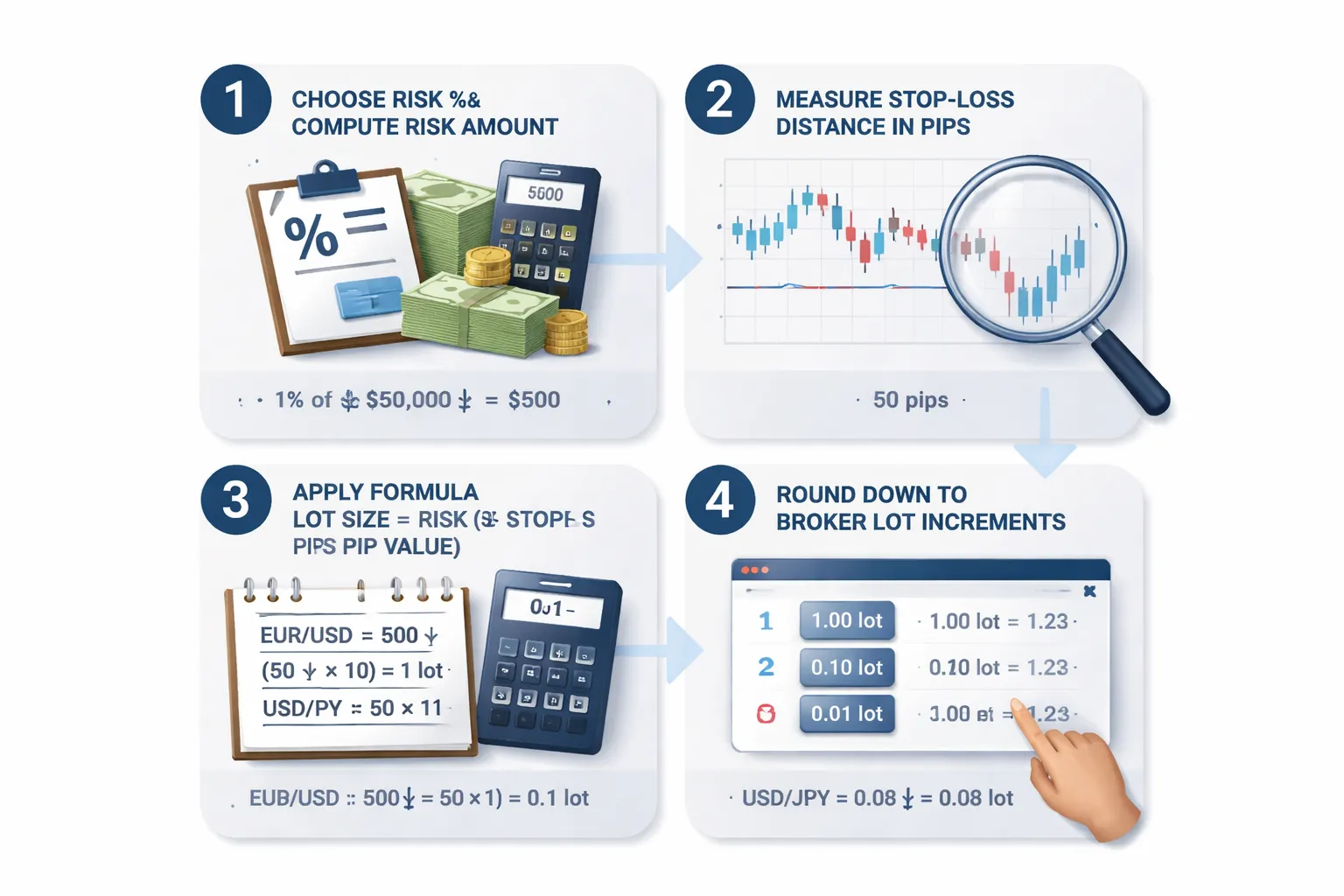
Choose Your Risk Per Trade (Fixed % Method)
Start with your account balance and a fixed risk percentage.
- Risk %: many traders use 0.5% to 2% per trade.
- Risk amount: account balance × risk %.
Example: $5,000 account. Risk 1%. Your risk amount is $50.
Set Stop-Loss Distance in Pips Based on the Chart
Pick a stop-loss level that makes sense on the chart. Then convert it to pips.
- For most pairs, 1 pip = 0.0001.
- For JPY pairs, 1 pip = 0.01.
Example: You place a stop 25 pips away. Your trade must fit that 25 pip risk.
Use the Lot Size Formula (Risk ÷ (Stop-Loss × Pip Value))
Use this position sizing formula:
Lot size = Risk amount ÷ (Stop-loss in pips × Pip value per 1.00 lot)
Steps you follow each time:
- Convert your risk % into a dollar amount.
- Measure your stop-loss in pips.
- Get pip value for 1.00 lot for your pair.
- Plug numbers into the formula.
- Quick rule: if the stop-loss doubles, your lot size should halve, if risk stays the same.
Adjust for Account Currency and Pair Type (USD Cases)
Pip value depends on where USD sits in the pair and what currency your account uses. Below assumes a USD account.
- USD is the quote currency (XXX/USD), example EUR/USD: pip value is fixed in USD.
- USD is the base currency (USD/XXX), example USD/JPY: pip value changes with price. Convert back to USD.
- Neither side is USD (crosses), example EUR/GBP: pip value is in the quote currency. Convert to USD using the current rate.
Common pip values for 1.00 standard lot (100,000 units):
- EUR/USD: 1 pip = $10 per 1.00 lot.
- GBP/USD: 1 pip = $10 per 1.00 lot.
- USD/JPY: 1 pip = 1,000 JPY per 1.00 lot, then divide by USD/JPY price to get USD.
Example 1, EUR/USD (USD is quote):
- Account: $5,000
- Risk: 1% = $50
- Stop-loss: 25 pips
- Pip value at 1.00 lot: $10
- Lot size = 50 ÷ (25 × 10) = 0.20 lots
Example 2, USD/JPY (USD is base):
- Account: $5,000
- Risk: 1% = $50
- Stop-loss: 30 pips
- USD/JPY price: 150.00
- Pip value at 1.00 lot = 1,000 JPY ÷ 150.00 = $6.67 per pip
- Lot size = 50 ÷ (30 × 6.67) = 0.25 lots
Example 3, EUR/GBP (USD is neither):
- Account: $5,000
- Risk: 1% = $50
- Stop-loss: 40 pips
- Pip value at 1.00 lot = 10 GBP per pip
- GBP/USD price: 1.25
- Converted pip value = 10 × 1.25 = $12.50 per pip
- Lot size = 50 ÷ (40 × 12.50) = 0.10 lots
If you trade majors, minors, and exotics, pip values can change fast. Use correct conversions for the exact pair type. See major vs minor vs exotic currency pairs for how pair categories affect spreads and typical pricing.
Rounding Rules: Minimum Lot Increments and Practical Adjustments
Your broker sets the smallest lot step. You must round down to stay inside your risk cap.
- Common minimums: 1.00, 0.10, or 0.01 lots.
- Rule: round down, then re-check the dollar risk.
- If you cannot size small enough: widen the stop only if the chart supports it, or skip the trade.
- If spread is large: add spread to your stop distance when you size the trade, especially on exotics.
Keep your lot size tied to your stop-loss. That protects your free margin and helps you avoid forced closures when margin level drops.
Quick Lot Size Examples (Beginner-Friendly Scenarios)
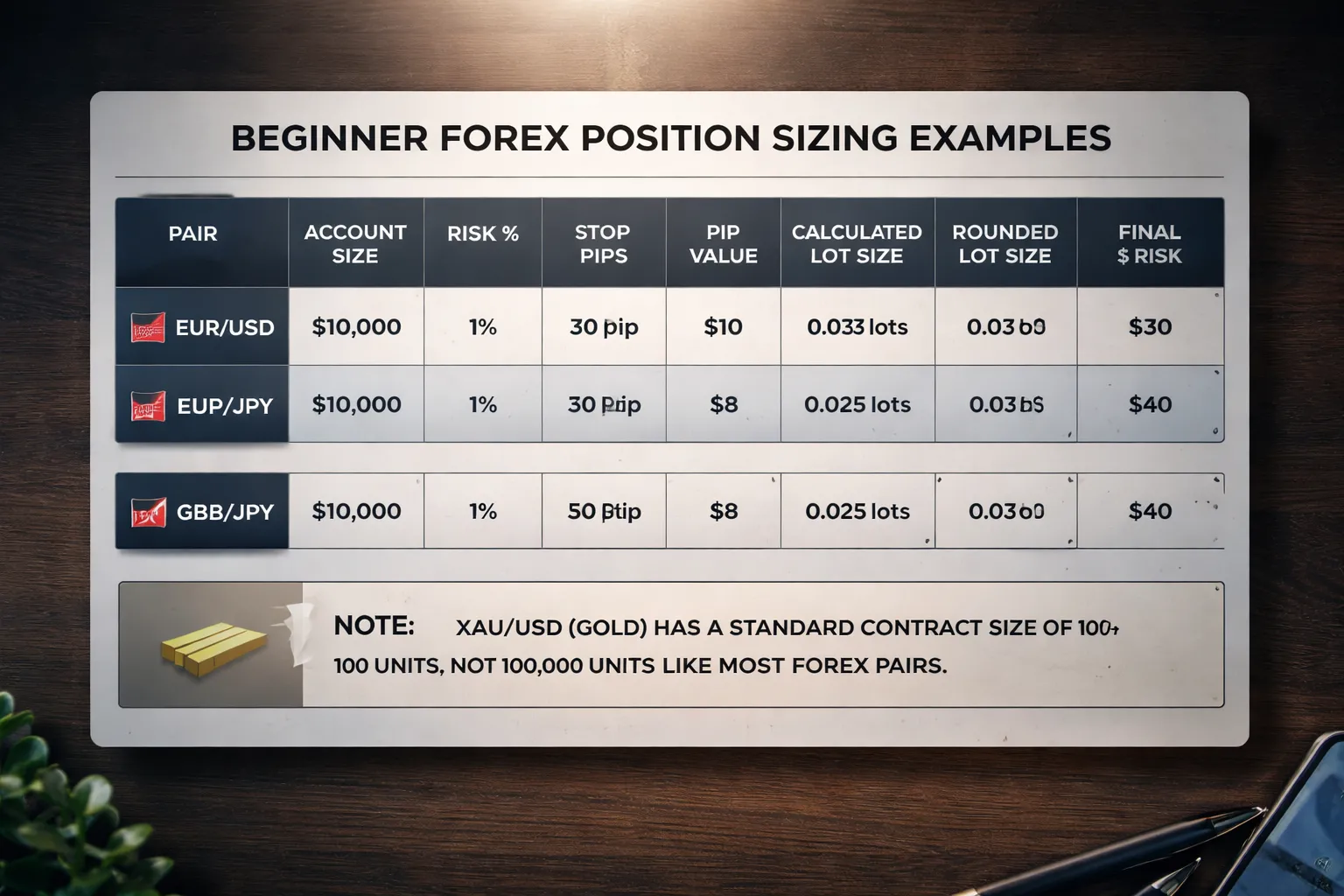
$500 account, risk 1%, 25-pip stop, EUR/USD
Assumptions: EUR/USD, account in USD, 1 pip on 1.00 lot is about $10.
- Account size: $500
- Risk: 1% = $5
- Stop-loss: 25 pips
- Pip value per 1.00 lot: ~$10 per pip
Lot size: $5 ÷ (25 pips × $10) = 0.02 lots.
- 0.01 lot pip value: ~$0.10 per pip
- 0.02 lot pip value: ~$0.20 per pip
- Dollar risk at 25 pips on 0.02 lots: 25 × $0.20 = $5
If your broker only allows 0.01 steps, you can place 0.02. If your platform forces bigger sizing, skip the trade.
$2,000 account, risk 2%, 60-pip stop, GBP/JPY
Key point: JPY pairs have a different pip value than EUR/USD. Your platform calculates it from price and contract specs. Do not guess.
- Account size: $2,000
- Risk: 2% = $40
- Stop-loss: 60 pips
Method: lot size = risk ÷ (stop pips × pip value per 1.00 lot).
Example using a typical pip value estimate: if 1.00 lot on GBP/JPY is about $9 per pip, then:
Lot size: $40 ÷ (60 × $9) = 0.074 lots, round down to 0.07 lots.
- Estimated dollar risk at 0.07 lots: 60 × ($9 × 0.07) = $37.80
- If you choose 0.08 lots: 60 × ($9 × 0.08) = $43.20
When pip value changes with price, re-check before you click buy or sell. This matters more on cross pairs and when USD is not the quote currency.
Gold (XAU/USD) vs forex lots, why contract specs differ
Forex lot sizes tend to follow a clean standard. Gold often does not.
- Forex standard lot is usually 100,000 units of the base currency.
- Gold contracts vary by broker. Many use 1.00 lot = 100 oz. Some use 1.00 lot = 1 oz, 10 oz, or a CFD unit.
- Gold “pips” also differ. Many platforms quote XAU/USD to 2 decimals, so $0.01 is the smallest move.
That is why 0.10 lots on EUR/USD and 0.10 lots on XAU/USD can have completely different dollar risk. Always confirm these two fields in your platform before sizing:
- Contract size for the symbol.
- Tick size and tick value (or pip value) for 1.00 lot.
If you switch between markets, keep your risk process the same. Only the contract specs change. This is one reason many beginners start with forex majors before branching out, or compare markets first, see forex trading vs crypto trading.
Copy, paste checklist to sanity-check before you enter
- Account currency: ______
- Symbol: ______
- Entry price: ______
- Stop price: ______
- Stop distance in pips or points: ______
- Planned risk percent: ______%
- Planned risk dollars: $______
- Pip or tick value per 1.00 lot (from platform): $______
- Calculated lot size: ______
- Rounded down lot size you will place: ______
- Expected dollar risk after rounding: $______
- Spread right now: ______
- Spread added to stop distance for sizing: yes or no
- Margin required at this lot size: $______
- Free margin after entry: $______
- Trade passes your rules: yes or no
Choosing the Right Lot Size for Your Strategy and Risk Tolerance
Match Lot Size to Volatility (ATR-Informed Sizing)
Volatility changes your real risk. Your lot size must change with it.
Use ATR to set a stop distance that fits current movement, then size the position from dollars-at-risk.
- Step 1: Check ATR on your trading timeframe. Use a fixed multiple, like 1.0x to 2.0x ATR, as your stop distance in pips.
- Step 2: Set your dollar risk per trade, for example $50 or 1% of your account.
- Step 3: Convert stop pips into dollar risk per 1.00 lot using your platform pip value.
- Step 4: Lot size = (dollar risk) / (stop pips x pip value per 1.00 lot).
- Step 5: Round down. Recheck margin and free margin before you place the order.
ATR rises, your stop widens, your lot size drops. ATR falls, your stop tightens, your lot size can rise. Your risk stays stable.
Scalping vs Swing Trading, Stop Size Drives Lot Size
Your strategy sets your typical stop distance. Stop distance sets your lot size.
- Scalping: Stops often sit in the 3 to 15 pip range on majors. That pushes lot size higher for the same dollar risk. Spread and slippage matter more because they take a bigger share of the stop.
- Day trading: Stops often sit around 10 to 40 pips, depending on session and pair. Lot sizes usually land in the middle.
- Swing trading: Stops often sit around 50 to 200 pips. That forces smaller lots, but you avoid getting shaken out by normal noise.
Do not copy a lot size from someone else. Copy the risk. Your stop and your pair decide the lot. Pair choice matters, majors usually show tighter spreads than many crosses and exotics. See major vs minor vs exotic pairs.
When Smaller Lots Outperform
Smaller lots can produce better results because they keep you in the game.
- More valid trades: You can take the clean setup without forcing a tight stop to “make the size work.”
- Cleaner execution: You reduce stress, mistakes, and revenge trades.
- Lower drawdowns: Smaller position sizes reduce equity swings. That protects your decision-making.
- More room for volatility: You can place stops where the setup fails, not where your risk limit forces them.
If your backtest edge is small, oversized lots can erase it through one bad streak. Smaller lots keep your equity curve smoother. That helps consistency.
Risk-of-Ruin Basics, “Too Big” Gets Expensive Fast
Risk-of-ruin rises nonlinearly when you risk too much per trade. A few losses can push you into a hole that needs a large gain to escape.
Keep these math facts in mind.
- A 10% drawdown needs an 11.1% gain to recover.
- A 25% drawdown needs a 33.3% gain to recover.
- A 50% drawdown needs a 100% gain to recover.
Large lot sizes create large drawdowns. Large drawdowns force you to take more risk to get back to even. That cycle kills accounts.
Practical rule. If you want survival through normal losing streaks, keep per-trade risk small. Many traders stay near 0.25% to 1% per trade. If you scalp with tight stops and high frequency, go smaller.
Your lot size is a control knob. Use it to keep risk stable, margin safe, and decision quality high.
Lot Size Tools: Calculators, MT4/MT5, and Broker Contract Specs
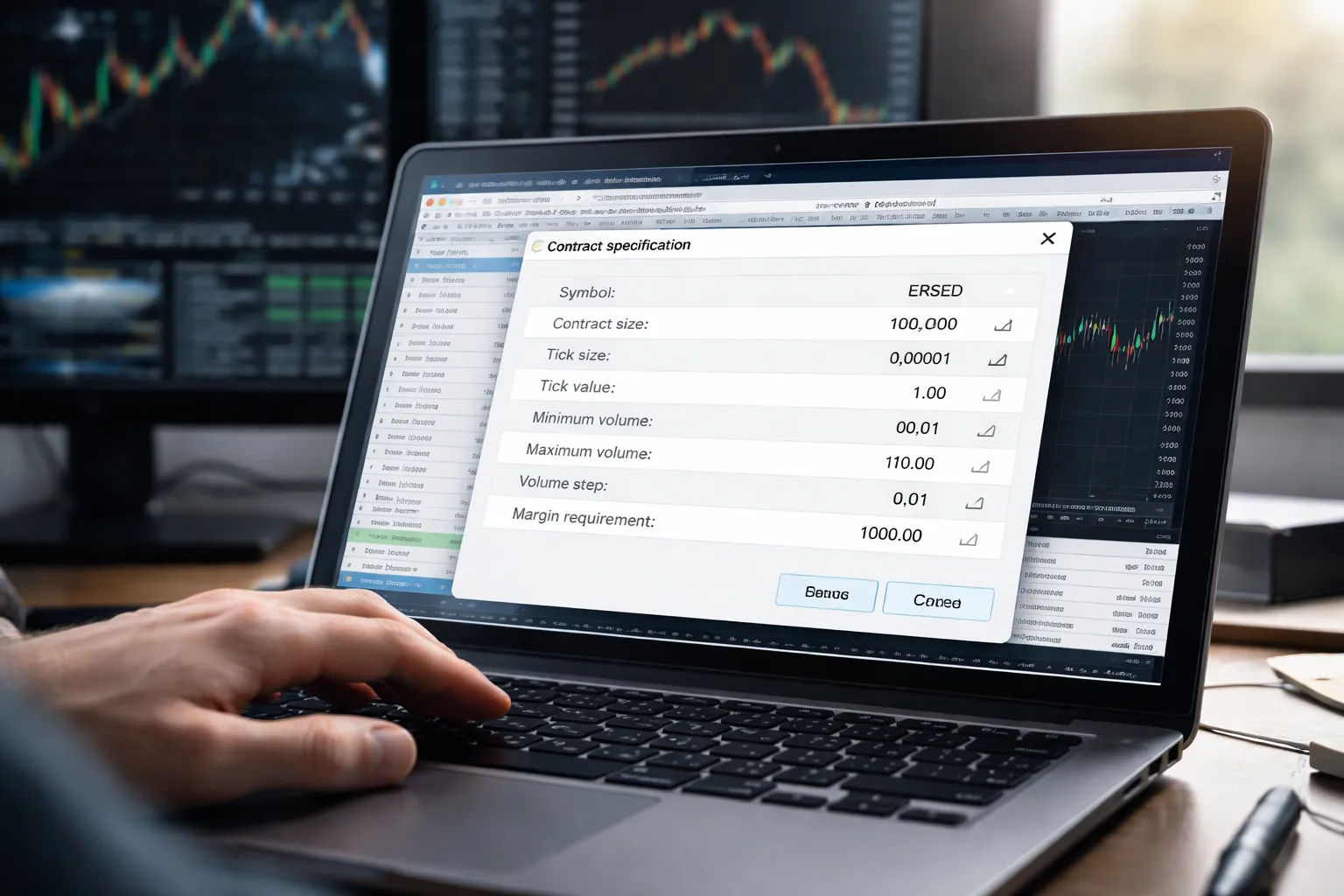
How to read contract specifications
Your broker defines what one lot means for each symbol. Check the contract spec page in your platform or broker site before you size a trade.
- Contract size (lot size). Often 100,000 units for 1.00 lot on major FX pairs, but it can differ on metals, indices, and crypto CFDs.
- Volume steps. Look for minimum volume and volume step, like min 0.01 and step 0.01. If the step is 0.10, you cannot place 0.03 lots.
- Tick size. The smallest price move. On many FX pairs a pip is 0.0001, but the tick shown can be 0.00001 on 5 digit pricing.
- Tick value. Your money gain or loss per tick for 1.00 lot. Some brokers show tick value in the quote currency, not your account currency.
- Margin requirement. Some brokers tie it to leverage, others set fixed margin per lot, or change it by symbol and time.
Do not assume the same rules across instruments. XAUUSD, US30, and BTCUSD often use different contract sizes and point values than EURUSD.
Using MT4 and MT5 to estimate margin and pip value
Use your platform first. It uses your broker’s contract settings.
- MT4. Right click the symbol, open Specification. You will see contract size, tick size, tick value, and margin info. Use the New Order window to test different volumes and watch required margin.
- MT5. Open Specification for the symbol. MT5 also shows more fields, including calculation mode for forex versus CFDs, and can display margin rates by direction.
- One more check. Watch the free margin change when you adjust volume. That delta is your real margin impact under current conditions.
If your account currency differs from the pair’s quote currency, pip value can shift with the exchange rate. The platform updates this in real time.
If you need a deeper refresher on margin and leverage mechanics, see forex leverage explained.
Lot size calculators: required inputs and common pitfalls
A lot size calculator works fast when you feed it clean inputs. Most tools need the same fields.
- Account size, or the exact dollar amount you want to risk.
- Risk per trade, as a percent or cash value.
- Stop loss distance, in pips or points. Use the correct unit for that symbol.
- Pair and account currency, so the tool can convert pip value.
- Leverage or margin rate, if you also want a margin estimate.
Common pitfalls:
- Wrong stop unit. Many indices use points that do not match FX pips. Metals often confuse traders too.
- Wrong pip definition. On 5 digit quotes, 1 pip is 10 points. Many tools ask for pips, not points.
- Ignoring conversion. If your account is in USD and you trade EURGBP, pip value depends on GBPUSD.
- Using idealized margin. A calculator may assume a fixed leverage, but your broker can apply higher margin on specific symbols, during news, or near weekends.
- Not rounding to volume step. Your final lot size must match min volume and step or the order will reject or round.
Demo vs live: verify pip value with a tiny test position
Before you scale size, verify the money per pip on your own account.
- Open a 0.01 lot position on the exact symbol you plan to trade.
- Use a tight stop or manual close. You only need a small move.
- Watch the floating P and L as price moves by about 1 pip. Note the change in account currency.
- Compare that to your calculator or platform spec. If it differs, trust the live platform numbers and adjust your sizing process.
Do this again after you change account currency, broker, symbol, or lot type. Small contract spec differences cause large risk errors at higher volume.
Common Lot Size Mistakes (and How to Avoid Them)
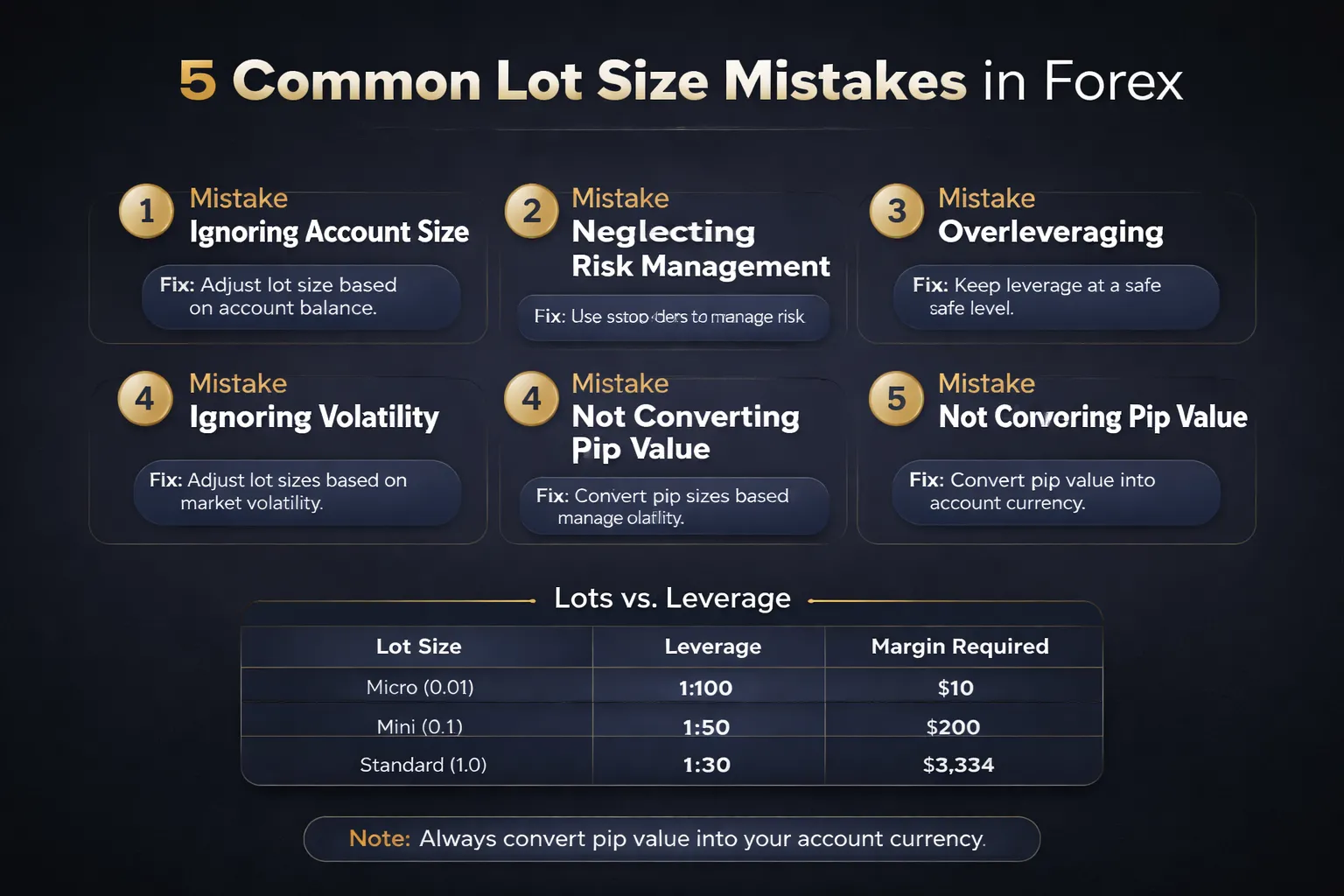
Confusing lots with leverage
Lots control position size. Leverage controls margin required.
If you mix them up, you risk two errors. You take a trade that is too large, or you think you have less risk because margin looks small.
- Fix: Set risk first. Choose stop-loss distance. Calculate lot size from risk and stop size. Then check margin last to confirm your account can open the trade.
- Rule: If changing leverage changes your pip risk, your sizing process is wrong.
For a clean breakdown, read margin vs leverage in forex.
Ignoring conversion when your account isn’t in USD
Pip value often comes quoted in USD. Your profit and loss settles in your account currency.
If your account is in EUR, GBP, or JPY, you need a conversion step. If you skip it, your real risk drifts. The drift grows with lot size.
- Fix: Always convert pip value into your account currency before you choose lots.
- Quick check: Open a tiny position, watch the P and L change on a 1 pip move, use that as your pip value reference.
Using a fixed lot size instead of fixed risk per trade
A fixed lot size gives variable risk. Volatility changes. Stop size changes. Your dollar risk changes with it.
This creates random drawdowns and uneven results.
- Fix: Use a fixed risk amount or fixed risk percent per trade. Then recalculate lot size each time based on stop-loss distance and pip value.
- Practical rule: If your stop-loss widens, your lot size must shrink.
Forgetting spreads and commission when calculating real risk
Your real risk is not just entry to stop. You also pay spread and commission.
On tight stops, costs can add a large percent to the trade risk.
- Fix: Add costs into your risk math. Treat spread as extra stop distance. Add commission as a cash cost.
- Practical rule: If your stop is 10 pips and spread is 1.5 pips, size the trade as if the stop is 11.5 pips.
Over-sizing after wins
After a win, you feel safe. You increase lots. Variance hits next, and your equity swings harder.
This is the fastest path to unstable results, even with a good strategy.
- Fix: Use a sizing rule you follow every trade. If you want to scale up, do it by a schedule, not by emotion.
- Simple guardrail: Keep your risk per trade constant. Increase risk only after a defined equity increase, and in small steps.
| Mistake | What happens | What to do instead |
|---|---|---|
| Lots and leverage treated as the same | Pip risk becomes unclear | Calculate lot size from risk, then check margin |
| No conversion to account currency | Risk is higher or lower than planned | Convert pip value into your deposit currency |
| Same lot size every trade | Random dollar risk | Size by fixed risk per trade |
| Costs ignored | Stops hit sooner in real terms | Add spread and commission to risk |
| Upsizing after wins | Equity swings and drawdowns spike | Use rules based on equity, not feelings |
FAQ
What is a lot size in forex?
A lot is the trade size. It sets how many units of the base currency you buy or sell. A standard lot equals 100,000 units. Your lot size drives pip value, profit, loss, and how fast your account equity moves.
What are the main lot types?
- Standard lot: 100,000 units
- Mini lot: 10,000 units
- Micro lot: 1,000 units
- Nano lot: 100 units, if your broker supports it
How do you calculate lot size from risk?
Use this: lot size = (risk in account currency) / (stop-loss pips x pip value per 1.00 lot). Pick your risk amount first, then your stop distance. Solve for the lot size that matches your planned loss.
How much is 1 pip worth per lot?
For most USD-quoted pairs, 1.00 lot is about $10 per pip, 0.10 lot is about $1, 0.01 lot is about $0.10. If USD is not the quote currency, pip value changes and you must convert to your deposit currency.
What is the difference between lot size and leverage?
Lot size is position size. Leverage is borrowed exposure. Leverage changes margin required, not pip value. Pip value comes from lot size and pair price movement. You can use high leverage and still trade small lots.
Does a bigger lot always mean higher risk?
Yes, if your stop-loss stays the same. Bigger lots increase pip value, so each pip against you costs more. You can keep risk constant by reducing lot size when your stop is wider, or by tightening the stop with the same lot.
Should you use the same lot size on every trade?
No. Your stop size changes by setup. Fixed lots create random dollar risk. Size each trade by fixed risk, like 0.5% to 2% of equity, then calculate the lot from your stop distance and pip value.
Do spread and commission affect your real risk?
Yes. Spread and commission increase your effective loss when your stop hits. Add them to your risk math, or widen the stop to keep the same real risk. Costs matter most on low timeframes and tight stops.
What if you get filled at a worse price than planned?
Slippage changes your entry or exit, so your real stop distance changes. That alters risk per trade. Reduce this by trading liquid pairs, avoiding news spikes, and using limit orders when possible. See slippage in forex.
What lot size should a beginner use?
Start small. Use micro lots, or the smallest your broker allows. Risk a fixed small percent per trade and focus on execution. Small size keeps drawdowns manageable while you learn spreads, stops, and position sizing.
Can you trade fractions of a lot?
Most brokers let you trade fractional lots, like 0.01 or 0.10. Some accounts support nano sizing. Check your platform’s minimum lot and lot step. Finer sizing helps you match risk precisely to your stop-loss.
Conclusion
A lot size sets your exposure. It controls your pip value, your margin use, and your risk per trade.
Keep it simple. Pick a risk limit per trade. Set your stop-loss first. Then choose the smallest lot that matches that risk.
- Standard lot: 100,000 units. High pip value. High margin.
- Mini lot: 10,000 units. Lower pip value. Easier risk control.
- Micro lot: 1,000 units. Best for practice with real spreads.
- Nano lot: 100 units. Only on some brokers. Tight sizing.
Final tip. Use fractional lots and a fixed percent risk so your position size stays consistent across different stop distances. If you struggle to fit size to your stop, review margin vs leverage and adjust your lot down before you adjust your stop.
-
Forex Leverage Explained: How It Works, Pros, Cons & Examples
1 month ago -
Forex Market Hours & Trading Sessions Explained (Best Times to Trade)
1 month ago -
How to Calculate Position Size in Forex (Position Sizing Formula + Examples)
1 month ago -
What Are Pips in Forex? Definition, Examples & Why They Matter
1 month ago -
How Does the Forex Market Work? (Participants, Pricing & Execution)
1 month ago
-
-
- What is a lot size in forex?
- What are the main lot types?
- How do you calculate lot size from risk?
- How much is 1 pip worth per lot?
- What is the difference between lot size and leverage?
- Does a bigger lot always mean higher risk?
- Should you use the same lot size on every trade?
- Do spread and commission affect your real risk?
- What if you get filled at a worse price than planned?
- What lot size should a beginner use?
- Can you trade fractions of a lot?
-
-
-
- What is a lot size in forex?
- What are the main lot types?
- How do you calculate lot size from risk?
- How much is 1 pip worth per lot?
- What is the difference between lot size and leverage?
- Does a bigger lot always mean higher risk?
- Should you use the same lot size on every trade?
- Do spread and commission affect your real risk?
- What if you get filled at a worse price than planned?
- What lot size should a beginner use?
- Can you trade fractions of a lot?
-
-
Forex Lot Size Calculator: How to Use It to Size Trades Correctly
1 month ago -
How to Calculate Position Size in Forex (Position Sizing Formula + Examples)
1 month ago -
Forex Leverage Explained: How It Works, Pros, Cons & Examples
1 month ago -
Margin vs Leverage in Forex: What’s the Difference?
1 month ago -
What Is Forex Trading? A Beginner’s Guide to How It Works
1 month ago
-
Forex Leverage Explained: How It Works, Pros, Cons & Examples
1 month ago -
Forex Market Hours & Trading Sessions Explained (Best Times to Trade)
1 month ago -
Is Forex Trading Legal in the United States? Rules, Regulators & What to Know
1 month ago -
Forex Trading Platforms Comparison: MetaTrader vs cTrader vs TradingView
1 month ago -
How to Calculate Position Size in Forex (Position Sizing Formula + Examples)
1 month ago