Is Forex Trading Halal? Islamic Finance Rules Explained

Forex trading can cross Sharia lines fast. Interest charges, leverage, and contract terms decide the ruling. This guide breaks forex down using core Islamic finance rules.
You will learn how riba applies to swap fees and rollover, how gharar and maysir show up in high risk setups, and why spot settlement matters. You will also learn what brokers mean by “Islamic” or “swap-free” accounts, what to verify in the fee schedule, and what red flags to avoid.
If you also need the legal side, read forex trading legal rules in the United States.
Key Takeaways
In het kort:
- Forex trading can be halal, but only when the trade setup avoids riba, gharar, and maysir.
- Swap fees and overnight rollover often trigger riba. You must remove interest based charges to stay compliant.
- Spot settlement matters. You should prefer spot FX with clear delivery terms and avoid structures that delay settlement without a valid reason.
- High leverage and short term gambling style entries increase maysir risk. You should trade with a defined plan, defined risk, and real analysis.
- “Islamic” or “swap free” accounts reduce one problem, but they do not guarantee compliance. You must check the broker’s full fee schedule.
- Watch for hidden substitutes for swaps, such as wider spreads, admin fees, markups, time based charges, or forced holding limits.
- Know what you trade. Avoid CFDs or products that copy FX price moves without clear ownership or settlement, if they add uncertainty or interest like charges.
- Document your process. Keep records of account terms, fee disclosures, and trade logs so you can verify what you paid and why.
- If you also need the legal and tax side, read forex taxes in the US.
What Forex Trading Is (and What You’re Actually Buying/Selling)
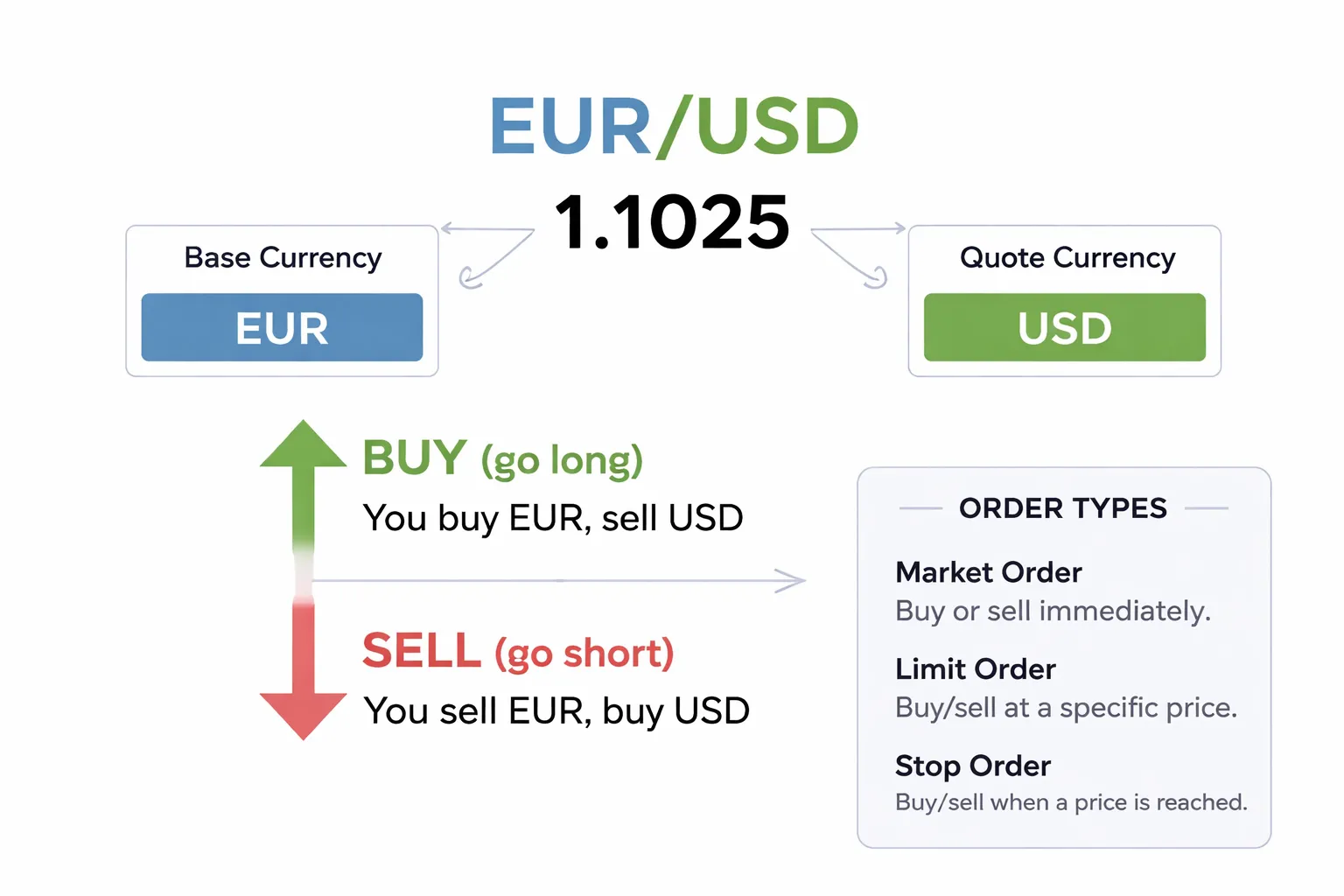
How currency pairs work and what a trade represents
Forex quotes come in pairs, like EUR/USD or USD/JPY.
The first currency is the base. The second is the quote.
EUR/USD at 1.0800 means 1 euro costs 1.08 US dollars.
- You buy the pair, you buy the base and sell the quote.
- You sell the pair, you sell the base and buy the quote.
Your profit or loss comes from the change in the exchange rate, measured in pips. Most platforms show it in your account currency.
Common ways retail traders access FX
Retail traders usually do not walk into a bank and exchange large amounts of currency. You access price exposure through a broker.
- CFDs. A contract that tracks a currency pair price. You do not own currency. Settlement is cash based. Many CFD accounts charge overnight funding. That can look like interest.
- Margin spot FX. The broker shows it as spot trading, but you trade on margin. You control a position larger than your cash deposit. Brokers often roll positions daily. That rollover can create swap or financing charges.
- Exchange traded FX futures and options. Standardized contracts on regulated exchanges. You trade a contract, not currency. Settlement is usually cash or delivery at expiry, depending on the contract.
In most retail setups, you trade a leveraged contract, not physical currency.
Key order types and how execution affects compliance
Orders control how you enter and exit. They also affect uncertainty and disputes over price.
- Market order. You accept the best available price now. You can get slippage in fast moves. You also face partial fills on some venues.
- Limit order. You set a price. You get filled at your price or better. You might not get filled at all.
- Stop order. You trigger a market order after price hits your stop level. Stops can slip in gaps, news spikes, or thin liquidity.
If your broker uses “instant execution” with requotes, or wide discretion over fills, you face higher execution uncertainty. That matters when you try to avoid avoidable gharar. You want clear order rules, timestamps, and trade confirmations.
Why “trading forex” may not always be true currency exchange in practice
Many brokers market it as currency exchange, but the mechanics often differ.
- You may trade a derivative that references FX prices.
- You may never receive base currency, or deliver quote currency.
- You may settle only the profit or loss in cash.
- You may pay or receive rollover based on interest rate differentials.
So the key question is simple. What contract did you enter, how does it settle, and what fees apply overnight. If the product adds interest-like charges, unclear ownership, or unclear settlement, “forex trading” can fail the real exchange test.
Use this as part of your broker vetting process, along with this guide on how to spot forex scams and fake gurus.
Islamic Finance Foundations That Determine Whether Forex Is Halal
Riba, where interest shows up in FX accounts
Riba includes interest and interest-like gains tied to time. In retail forex, it usually hides inside account mechanics, not the currency move.
- Swap or rollover: You hold a leveraged position past the broker’s daily cutoff. The broker applies a credit or a charge based on rate differentials and its own markup. A swap credit still counts as interest-like income.
- Financing embedded in price: Some brokers label the cost as “financing,” “tom-next,” or “administration.” If it tracks time held, it behaves like interest.
- Fees in disguise on swap-free accounts: A broker may remove swap, then add a fixed nightly fee, a widened spread after a set number of days, or a higher commission. If the fee increases with time and functions like funding cost, it can still fall under riba.
- Negative balance and debt terms: If your contract creates debt with interest, penalties, or compounding charges, you have a riba problem.
What to check in your broker documents. Swap schedule by symbol, daily cutoff time, “swap-free” conditions, and any charge triggered by holding time.
Gharar, uncertainty from unclear contracts and execution
Gharar means excessive uncertainty in the contract. In forex, it shows up when you cannot clearly know what you bought, how it fills, and what it will cost.
- Unclear product type: Spot, CFD, futures, and options do not share the same rules. If your broker markets “spot” but gives you a CFD with open-ended financing, you face contract ambiguity.
- Non-transparent pricing: If the broker controls the quote, widens spreads without rules, or shows prices that differ from the broader market with no explanation, your pricing becomes uncertain.
- Slippage and re-quotes without policy: Slippage can happen, but the rules must be clear. If you see frequent negative slippage, few positive fills, and vague “market conditions” language, execution risk becomes gharar.
- Opaque conflict of interest: Dealing desk models can be acceptable if disclosure is clear. Hidden B-booking, hidden last-look behavior, or unclear order routing adds uncertainty.
What to check. The exact contract you trade, order execution policy, slippage rules, spread history during news, and whether the broker discloses how it acts as principal or agent.
Maysir, when trading turns into gambling
Maysir covers games of chance and behavior built on chasing wins. Forex can drift into maysir when you trade like you pull a lever and hope.
- Pure chance entries: Random signals, copying unknown traders, or trading on rumors with no method makes outcomes closer to gambling than commerce.
- Over-leveraged bets: High leverage can turn small moves into all-or-nothing outcomes. When one trade can wipe the account, you stop managing risk.
- Addictive patterns: Revenge trading, overtrading, and “must win back losses” behavior signals maysir-like conduct.
- Bonus traps and competitions: Deposit bonuses with volume targets and trading contests push you toward churn and reckless sizing.
What to do. Use defined risk per trade, avoid martingale sizing, and set hard limits on daily loss and trade frequency.
Sarf rules for currency exchange, possession and immediacy
Currency exchange falls under sarf. It sets rules on how exchange must happen to avoid riba and gharar.
- Immediate exchange: Both sides of the exchange should settle without delay. In modern markets, scholars often discuss constructive possession and standard settlement practices. Your contract still needs clear, prompt settlement terms.
- Possession and ownership: You should gain valid ownership or constructive possession of the currency you buy. Many retail products are derivatives where you never own currency. That pushes the ruling back to the contract structure, not the marketing label.
- Equality rule by currency type: If you exchange the same currency for the same currency, the amounts must match and exchange must be immediate. With different currencies, equality does not apply, but immediacy still matters.
| Exchange type | Key sarf rule | Practical takeaway for your trade |
|---|---|---|
| Same currency for same currency | Equal amounts; immediate exchange | Any extra amount or delay can become riba |
| Different currencies | Immediate exchange | Pricing can vary; settlement terms must stay clear and prompt |
Niyyah and ethical conduct, intent plus discipline
Niyyah does not make a prohibited contract permissible. It still matters because it shapes how you trade.
- Trade with a real plan: Define your setup, your invalidation level, and your position size before entry.
- Avoid harm: Do not borrow in ways that create hardship, hide risks from family or partners, or trade money you cannot afford to lose.
- Seek clean income: Avoid strategies that depend on swap credits, referral schemes, or promoting brokers you have not vetted.
- Be honest in disclosure: If you manage funds or give signals, disclose risks, track record limits, and conflicts.
Use these foundations as a screening checklist. Then validate the broker and product details using this safety checklist for spotting forex scams and fake gurus.
Spot Forex Under Shariah: The Sarf Lens
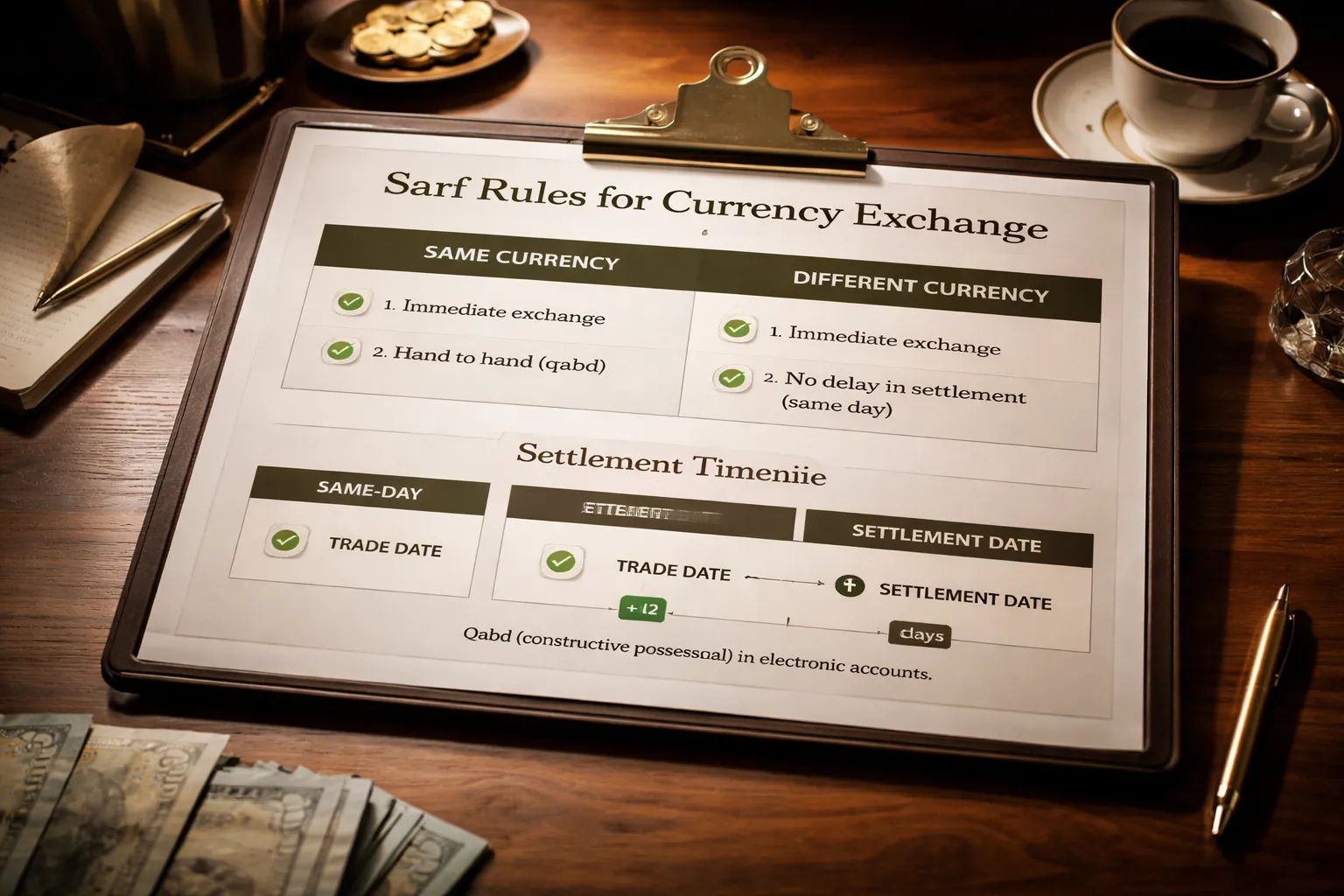
“Hand-to-hand” exchange today, what qabd means with electronic settlement
Spot FX falls under sarf, the Shariah rules for exchanging money.
In sarf, you need qabd, possession, in the same session. In modern markets, possession usually means constructive possession, not cash in your hand.
- Qabd haqiqi, physical possession. Cash or notes received.
- Qabd hukmi, constructive possession. Your account balance updates and you can use or transfer the funds under normal conditions.
For many contemporary scholars, a credit to your account that you can access counts as qabd hukmi. But restrictions matter. If the broker can delay, reverse, or block delivery without a clear trading reason, you do not control the asset. Your qabd becomes weak.
Settlement timing, T+2, same-day, and how scholars view modern clearing conventions
Interbank spot FX often settles on T+2, two business days after the trade date. Some pairs settle faster. Many retail platforms show instant trade execution while the broker nets flows internally and settles later.
Shariah discussions usually split into two practical views.
- Strict view, sarf requires exchange in the same session. A delayed settlement can fail the hand-to-hand requirement.
- Convention view, T+2 is a market necessity and a recognized custom. If the trade creates an enforceable right and standard settlement occurs without extra benefit or delay manipulation, some accept it as constructive delivery.
Your risk sits in the details. If your “spot” trade is really a rolling contract that extends every day and creates swap or financing entries, you have moved away from pure spot sarf.
Same-currency vs different-currency exchanges, and what “equality” means in practice
Sarf rules change based on whether you exchange the same currency or two different currencies.
- Same currency, USD for USD, EUR for EUR. You must keep equal amounts and exchange hand-to-hand. Any extra amount becomes riba.
- Different currencies, USD for EUR. You can trade at any agreed rate, but you still need exchange in the same session under sarf rules.
In practice, “equality” means you cannot structure a same-currency deal that pays you more units later, even if you label it a fee, bonus, or rebate tied to the exchange.
For different currencies, the rate can include a spread. The key issue is not the spread itself. The issue is whether the trade embeds interest-like financing, or turns into a debt for a debt through delayed delivery.
Practical compliance checklist for spot-like transactions
- Trade spot only, avoid forwards, futures, options, and CFDs if they prevent real delivery or create debt exchanges.
- Check settlement mechanics, ask how the broker handles value date, netting, and rollover. Get it in writing.
- Avoid rollover financing, if the position stays open past value date and triggers swap or “admin” credits or debits, treat it as a red flag.
- Demand clear qabd, your account statement should show the currency leg credited with the ability to withdraw or transfer under normal rules.
- Watch for synthetic exposure, if you only trade a price feed and never own either currency, you likely trade a derivative, not sarf.
- Avoid same-currency tricks, no bonuses, rebates, or guaranteed add-ons linked to exchanging the same currency.
- Document fees, pay explicit service fees if needed. Do not accept fees that scale with time outstanding like interest.
- Verify regulation and product terms, many “Islamic” labels hide standard rollover under new names. Use this safety checklist for spotting forex scams and unregulated brokers before you fund an account.
Margin, Leverage, and Rollover: The Biggest Halal vs Haram Fault Lines
Margin and leverage, why the structure looks like a loan
Most retail forex uses margin. You post a small deposit. The broker gives you buying power that exceeds your cash. This creates a loan-like relationship, even if the platform calls it a trading facility.
Sharia risk starts when that loan produces a benefit to the lender. In practice, the broker can benefit through interest-like charges, tied fees, or forced terms that only exist because you borrowed.
- Margin is your collateral.
- Leverage is the extra exposure you get on top of your cash.
- The fault line is any added return or time-based cost linked to that extra exposure.
Overnight rollover (swap), what it is and why it usually equals riba
Spot FX settles in two business days in the interbank market. Retail platforms keep positions open longer. They apply an overnight financing adjustment called rollover or swap.
Swap usually reflects the interest rate gap between the two currencies, plus a broker markup. It accrues with time. That time-based accrual is why many scholars classify standard swap as riba.
- If you hold a leveraged position past the broker cutoff time, the platform posts a swap charge or credit.
- Even if you receive swap on some pairs, the mechanism still ties money to time outstanding.
- If the broker labels it “financing” or “rollover,” treat it as swap unless you can prove otherwise in writing.
Swap-free or Islamic accounts, common models and red flags
Swap-free accounts try to remove overnight interest. Brokers implement them in a few ways. Some are closer to Sharia intent than others.
- True swap removal. No swap debit or credit. The broker charges a clear, fixed service fee that does not grow with days held.
- Wider spread model. The broker increases the bid-ask spread on Islamic accounts to replace swap revenue.
- Fixed nightly admin fee. The broker charges a set amount per lot per night. This often acts like interest by another name.
- Grace period then swap. Swap-free for a few days, then swap starts or a rising fee starts. This often fails substance tests.
Red flags you can check in the terms before you deposit.
- Admin fees that scale with time, per night, per week, or as a percentage of position size.
- Fees that vary by currency pair based on interest differentials.
- Swap-free only on some symbols, with unclear rules on excluded pairs.
- Forced closure rules after X days that push you into churn and extra costs.
- Marketing claims without a clear fee schedule and no written contract addendum.
When a “fee” can still be riba, substance-over-form checks
Islamic finance looks at the economic reality, not the label. A fee can still function like riba if it tracks time and borrowed amount.
- Time test. If the charge increases the longer you hold, it behaves like interest.
- Principal test. If the charge scales mainly with leveraged exposure, it behaves like interest on a loan.
- Benchmark test. If the fee changes when central bank rates change, it often mirrors swap economics.
- Optionality test. If you can avoid the fee by closing before cutoff, the fee targets financing time, not execution service.
- Documentation test. If the broker cannot show a stable, explicit schedule and rationale, assume the worst.
A clean structure uses transparent pricing. It charges for execution or account service, not for time outstanding on leveraged exposure.
Risk amplification, when leverage pushes trading toward maysir
Leverage changes your risk profile more than your analysis does. Small price moves create large profit or loss. High leverage can turn a trade into a near-binary outcome driven by noise.
This matters because maysir concerns rise when you rely on chance-like outcomes, extreme uncertainty, and impulse behavior. You can reduce that risk by controlling leverage and trade duration.
- Keep leverage low. Many retail blowups happen because traders use 50x to 500x leverage.
- Match position size to a fixed loss limit. Use hard stops and accept small losses.
- Avoid holding leveraged trades overnight if the only way to do so is through swap-like charges.
- Track drawdown and risk. If your account swings feel like gambling, your leverage is too high.
If you trade with a regulated broker, confirm which rules apply to margin, leverage caps, and disclosures. See US forex trading rules and regulators for the baseline framework.
Forex Instruments Compared: Spot vs Forwards, Futures, Options, and CFDs
Spot FX
Spot FX is an exchange of one currency for another at the current market price.
In wholesale FX, settlement usually happens in two business days. Many scholars focus on one rule, you should exchange currencies with immediate possession (qabd). If the trade creates a debt on both sides, you risk riba and gharar.
- Shariah friction point: delayed delivery. If neither side takes possession at the time of contract, scholars may treat it as an exchange of debts.
- What can make it workable: constructive possession, meaning your broker credits the currency to your account in a way you can use, withdraw, or deliver.
- What often breaks it: you trade on margin, you cannot take delivery, and you only get a cash P&L entry.
Forwards
A forward locks an exchange rate today for a currency exchange on a future date. It is a private contract.
- Core issue: deferment on both sides. Many jurists do not allow sarf (currency exchange) when delivery of both currencies happens later.
- When deferment becomes problematic: the contract creates an obligation to exchange two monies later, with no immediate possession and no actual delivery ability.
- Why some allow limited use: narrow hedging needs for a real business exposure, with strict structuring and documentation. Even then, many scholars still reject a classic forward for sarf.
Futures
A currency future is a standardized forward traded on an exchange. The exchange sets contract size, expiry dates, and margin rules.
- Standardization: you trade a template contract, not a bespoke agreement. This helps transparency, but it does not solve Shariah delivery rules for sarf.
- Margining: you post initial and variation margin, then your account debits and credits daily. Many traders close before delivery.
- Settlement concern: if you only settle price differences and never exchange currencies, scholars often treat it as a cash-settled wager on price.
- Delivery concern: even with physical delivery, the trade still starts as a deferred exchange of currencies, which many jurists do not accept.
Options
An FX option gives you the right, not the obligation, to exchange currencies at a fixed rate. You pay a premium.
- Common objection: gharar. The outcome depends on future price moves, and the traded item is a right that many scholars do not treat as valid property to sell in this form.
- Sale of what you do not own: in many option structures, the seller commits to deliver currencies they do not hold at the time of sale.
- Premium problem: some scholars see the premium as payment for uncertainty rather than payment for a tangible asset or service.
CFDs
A CFD is a contract where you and the broker exchange the difference in price between entry and exit. You do not buy or sell the underlying currency.
- Key issue: no ownership and no delivery. Your position is a promise to pay or receive money based on a price feed.
- Why the ruling changes for many scholars: without qabd and without real exchange, the contract looks like speculation on a number.
- Extra concerns: leverage, margin calls, and financing charges. Even if a broker labels an account swap-free, other fees can replicate interest.
Which instruments tend to sit closer to permissible, and why scholars differ
| Instrument | What you really trade | Main Shariah pressure points | Why opinions differ |
|---|---|---|---|
| Spot FX | Currency exchange | Qabd, settlement delay, margin mechanics | Some accept constructive possession through regulated account systems, others require stricter immediate exchange and deliverability |
| Forwards | Deferred currency exchange | Deferment on both sides in sarf | Some consider hedging necessity with special structuring, many reject the classic forward contract |
| Futures | Standardized deferred contract | Margining, net cash settlement, deferred exchange | Exchange rules add transparency, but do not fix the core sarf timing issues for many scholars |
| Options | Right to exchange later | Gharar, selling rights, delivery obligations | Some modern standards allow limited hedging constructs, many scholars still view vanilla options as impermissible |
| CFDs | Price difference contract | No ownership, no qabd, leverage and financing | Most scholars treat it as a derivative bet, a minority focus on intent and fee design but still face the ownership problem |
In practice, spot FX with real exchange, clear possession, and no interest-like charges sits closest to permissibility for many scholars. Forwards, futures, options, and CFDs face heavier objections because they delay exchange, trade rights, or replace delivery with cash differences. If you trade retail FX, read the fine print on swaps, markups, and margin terms, and compare them to the sarf rules explained in swap-free trading explained.
Speculation vs Legitimate Need: When Profit-Seeking Crosses the Line
Hedging vs speculation, where intent and structure split
Shariah scholars usually treat FX hedging as closer to need. You use it to reduce known currency risk tied to real activity. Pure speculation focuses on price movement with no underlying exposure. That shift raises gharar concerns, and often turns trading into a zero-sum bet.
- Traveler: You exchange money before a trip to pay for hotels and expenses. That is a clear need. You take possession of the currency. You avoid leverage and delayed settlement.
- Importer or exporter: Your business invoices in USD but pays costs in EUR. You hedge to protect cash flow. Many scholars still scrutinize forward-style contracts because they delay exchange. You should ask how the hedge settles, and whether it creates a debt for a debt.
- Investor with foreign assets: You hold overseas stocks or property. You hedge currency risk to protect the value of a real asset. This can look like risk management, not a stand-alone wager, but the contract form still matters.
Profit is not the problem by itself. Profit from a trade that meets sarf rules, avoids riba, and avoids excessive uncertainty can be permissible. Profit-seeking crosses the line when you chase movement with leverage, delays, or contracts that replace exchange with a cash difference.
High-frequency trading, scalping, and day trading, what triggers Shariah issues
Timeframe alone does not decide halal or haram. Structure and behavior do. Short-term styles often add three pressure points.
- Leverage and margin: Many day traders depend on high leverage. Leverage can bring interest-like charges, forced liquidation terms, and broker benefits tied to your borrowing. These raise riba and unjust enrichment concerns.
- No real exchange or possession: If your platform runs as a derivative or internal ledger with no delivery, you may not get qabd. Some brokers label this as “spot” while running it as a CFD-like product.
- Excessive uncertainty from micro-timeframes: Ultra-short trades often rely on noise, slippage, and execution latency. That can turn the transaction into high gharar, even if the contract looks clean on paper.
Scalping also increases the role of spreads, commissions, and execution games. If your edge depends on exploiting broker delays or platform glitches, your gain looks closer to wrongful taking than trade.
Market manipulation, misinformation, and impermissible earnings
Your conduct can make earnings impermissible even if the contract looks acceptable.
- Spreading false claims: Posting fake “insider” news, edited screenshots, or fabricated results to move price or attract followers counts as deception.
- Pump groups: Coordinated buying and selling to trap late entrants relies on harm. It violates basic Islamic rules against fraud and consuming wealth unjustly.
- Front-running signals: If you sell a position into your own paid audience after telling them to buy, you profit from information advantage created by your influence.
- Broker conflicts: Some venues profit more when you lose. If a broker runs a dealing desk that trades against you, you face a higher risk of unfair pricing and execution.
Keep records. Use regulated venues where possible. If you trade in the US, start with the legal and oversight basics in US forex trading rules and regulators.
A practical framework to test your strategy
| Check | What to ask | Red flags |
|---|---|---|
| Purpose | What risk or need does this trade serve, and can you explain it in one sentence | “I just want action”, trading for excitement, copying signals with no thesis |
| Contract | Is it true spot with immediate exchange, clear possession, and no interest-like charges | Forwards, options, futures, CFDs, cash-settled “spot”, swap fees renamed as “admin” |
| Risk | How much leverage do you use, and what happens in a margin call | High leverage, forced liquidation rules that favor the broker, negative balance traps |
| Conduct | Do you trade with honesty, avoid deception, and avoid harming others for gain | Manipulation, misinformation, front-running followers, exploiting platform errors |
If you cannot defend all four areas, treat the profit as suspicious. Tighten the structure before you scale size or frequency.
How to Make Forex Trading More Halal-Compliant (Actionable Checklist)
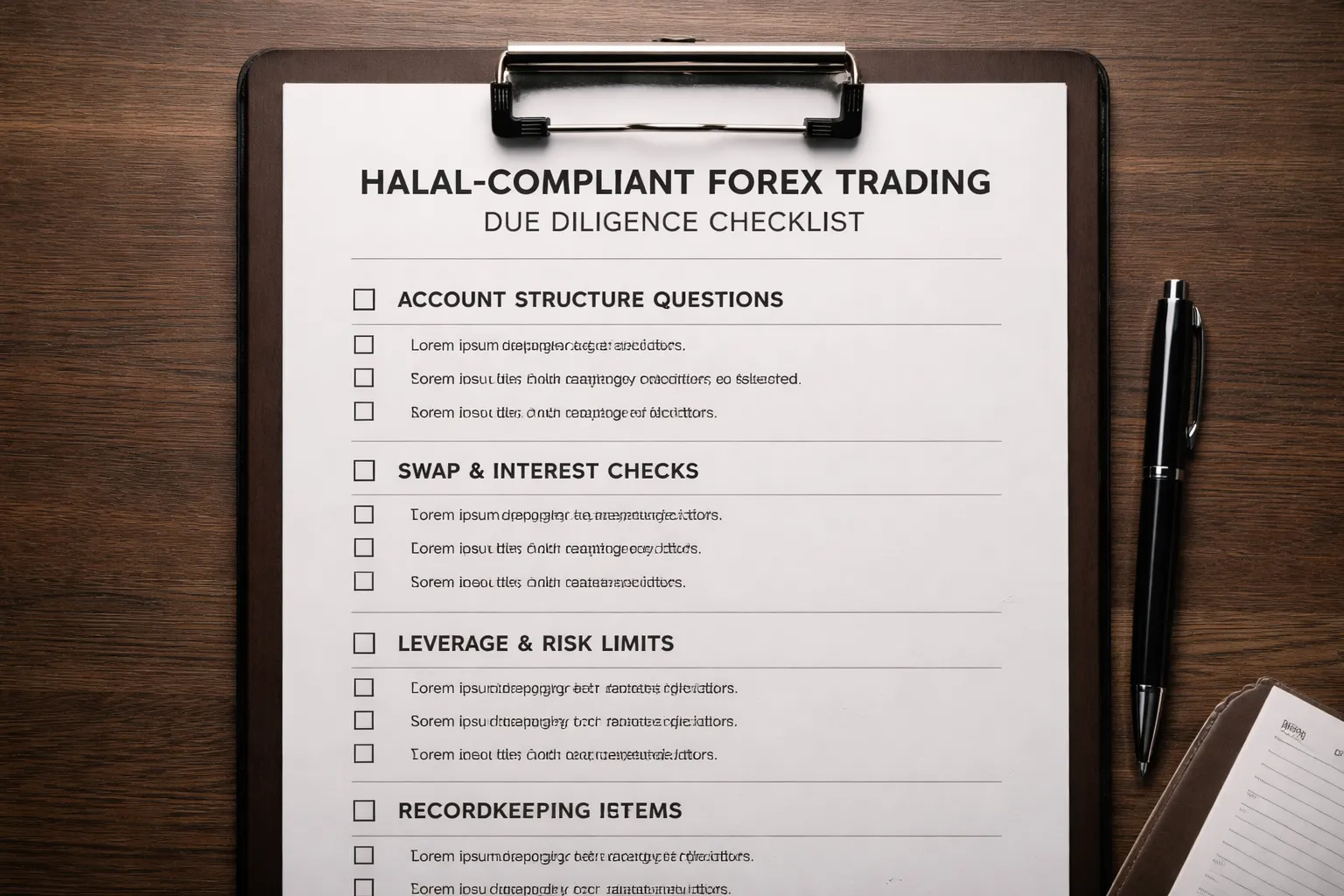
Choose the right account structure, what to ask brokers before opening an account
- Confirm your contract type. Ask if you trade spot FX with immediate settlement, or CFDs. Many retail platforms use CFDs.
- Ask who your counterparty is. Get a clear answer on whether the broker is your counterparty, or routes orders to external liquidity providers.
- Ask how the broker earns. Spread only, commission, markup, or a mix. Request the full fee schedule in writing.
- Ask for the Islamic account policy document. Do not rely on marketing pages. Request the actual terms that govern swaps, fees, and exclusions.
- Ask about hidden substitute fees. Some brokers remove swaps, then add administration fees, widened spreads, or time-based charges. Get examples with numbers for your typical pair and position size.
- Ask about eligibility limits. Some brokers restrict Islamic accounts by region, instrument, or holding period. Get the restrictions before funding.
Eliminate interest exposure, swaps, cash balances, and interest-bearing wallet features
- Turn off swaps at the account level. Verify that rollover shows 0.00 for long and short on the pairs you trade.
- Check Wednesday triple rollover rules. Confirm the platform applies no swap charges or credits on rollover days.
- Avoid interest credits. If the broker pays interest on free margin, idle cash, or wallet balances, disable it or move cash out.
- Avoid leveraged products that embed financing. Many CFDs and perpetual-style products price funding into the contract. Treat that as interest risk unless you can document otherwise.
- Review deposit and custody details. Ask where client funds sit and whether the broker sweeps balances into interest-bearing accounts. If you cannot get a clear answer, keep balances minimal.
Use lower leverage (or none) and define maximum risk per trade
- Set leverage low. Use the lowest available leverage that still lets you execute your plan. Lower leverage reduces forced liquidation risk and broker dependency.
- Cap risk per trade. Use a fixed rule, such as 0.25% to 1% of account equity at stop loss. Write the number down and follow it.
- Predefine invalidation. Place a stop loss at entry. Do not widen it to avoid realizing a loss.
- Avoid margin calls as a strategy. Plan position sizing so normal volatility does not push you into liquidation.
- Keep holding periods intentional. Even on swap-free accounts, long holds can trigger alternative fees. Match holding time to your method.
Avoid uncertain or opaque contracts, execution policy, requotes, and conflict-of-interest models
- Read the execution policy. Look for how the broker handles slippage, partial fills, and rejected orders.
- Check for requotes and dealer intervention. If the broker can reject prices during volatility, your outcomes depend on discretion.
- Prefer clear fee models. Transparent commission plus raw spread is easier to audit than wide variable spreads with unclear markup.
- Identify the conflict model. Market maker models can place the broker on the other side of your trade. If you accept this, limit size and demand strong execution disclosure.
- Test with data. Run a small live account test. Track average slippage, stop loss fills, and spread behavior during news.
- Watch for platform “errors” and giveaways. Do not exploit misquotes or latency glitches. If you cannot defend the trade as fair dealing, do not take it.
Recordkeeping for due diligence, trade logs, broker terms, and your compliance rationale
- Save broker documents. Download the Islamic account terms, fee schedule, execution policy, and client agreement. Store dated copies.
- Keep a trade log. Record date, pair, size, entry, stop, exit, holding time, and all fees charged. Include screenshots of the swap field showing 0.00.
- Write your compliance rationale. One page. State why you believe the structure avoids riba, reduces gharar, and avoids harmful conduct. Update it when you change brokers or methods.
- Audit monthly. Check statements for any swap, financing, or unexplained admin fees. If you find any, stop and resolve before you scale.
- Learn common deception patterns. Use this safety guide on how to spot forex scams and fake gurus before you follow signals, copy trades, or join paid groups.
How to Vet a ‘Halal’ or ‘Islamic’ Forex Broker (E-E-A-T Focus)
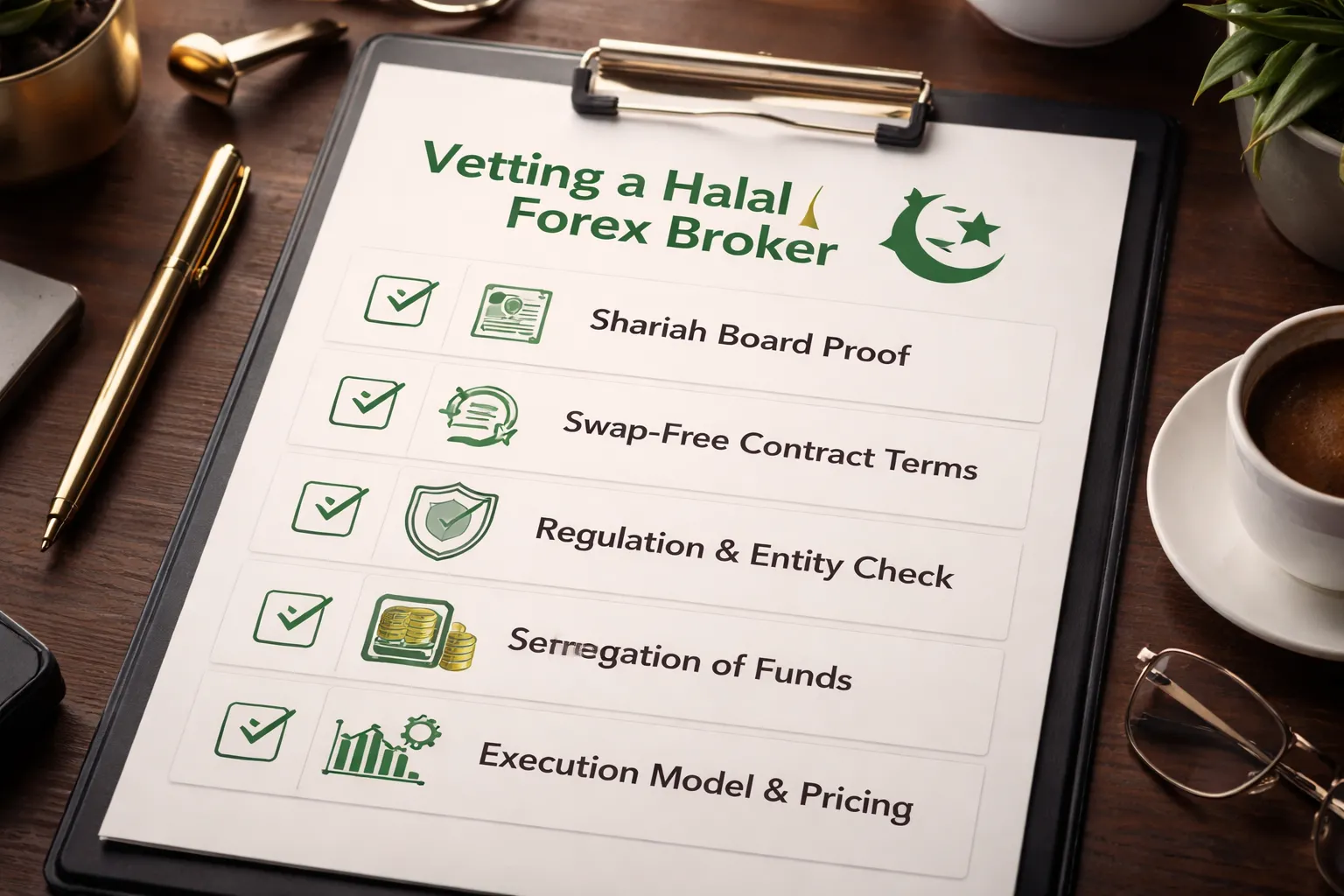
What Credible Shariah Supervision Looks Like
- Name the Shariah board. You should see full names, roles, and bios. No names, no trust.
- Check credentials. Look for formal training in fiqh al-muamalat and Islamic finance, plus real governance experience.
- Look for published standards. The broker should state what rules it follows, such as AAOIFI Shariah Standards or a clear internal Shariah policy.
- Demand audit details. A credible setup states audit frequency, scope, and who performs it. Annual is the minimum. Quarterly is stronger.
- Ask for documentation. You want a Shariah certificate or fatwa that covers forex margin trading, swap-free pricing, and how the broker earns revenue.
- Watch for vague language. “Shariah compliant” without documents usually means marketing, not governance.
Contract Transparency, Find the Swap-Free Terms Before You Deposit
- Locate the Islamic account addendum. Find it in the legal documents, not a blog post.
- Confirm the swap policy in writing. The terms should state that overnight swap or rollover interest equals zero.
- Identify replacement fees. Many brokers replace swaps with admin fees, markups, or widened spreads. You need the exact formula.
- Check which instruments qualify. Some brokers exclude exotics, metals, indices, crypto, or specific pairs.
- Check time limits. Some “swap-free” accounts apply only for a set number of days, then fees start.
- Read the dispute process. Find the complaints route, timelines, and escalation steps, including the regulator or ombudsman if available.
Regulation and Trust Signals That Matter
- Verify the license yourself. Use the regulator’s site, match the legal entity name, license number, and domain.
- Confirm client fund segregation. The broker should state where client money sits, how it segregates funds, and what protections apply.
- Check negative balance protection. It reduces account blowups in fast markets.
- Review enforcement and complaints history. Search the regulator register and public warnings. Pattern matters more than one incident.
- Avoid “license rental” games. Some brands show a top tier license on the homepage, but onboard you under an offshore entity.
- Learn the local rules that apply to you. Jurisdiction changes leverage limits, protections, and dispute rights.
Use this safety checklist on how to spot forex scams and unregulated brokers before you open an account or fund it.
Business Model Risks, Dealing Desk vs STP/ECN
- Know the model. A dealing desk market maker can sit on the other side of your trade. STP/ECN routes orders to liquidity providers.
- Understand the conflict. If the broker profits when you lose, it can affect execution quality.
- Ask how it earns. Commission, spread markup, or both. You need the exact pricing structure.
- Check execution disclosures. Look for rules on slippage, re-quotes, order rejection, and last look practices.
- Test with data. Run small trades across news and normal hours. Compare spreads, fill speed, and slippage on the same pair.
Questions to Ask Support, and Warning Sign Answers
- Question: “Is swap set to zero on all pairs and all days?”
- Warning sign: “Usually,” “most pairs,” or “it depends on market conditions.”
- Question: “Do you charge any admin fee, holding fee, or spread markup on Islamic accounts? Share the schedule and formula.”
- Warning sign: They refuse to put it in writing, or they say, “No fees,” but the terms mention adjustments.
- Question: “Is there a time limit for swap-free status?”
- Warning sign: They cannot confirm a clear number of days, or they say fees may apply later.
- Question: “Which legal entity will hold my account, and what regulator oversees it?”
- Warning sign: They only mention a brand name, not the regulated entity.
- Question: “Where are client funds held, and are they segregated?”
- Warning sign: They answer with general statements and no bank, no jurisdiction, no policy reference.
- Question: “If I dispute a swap or fee, what is the process and timeline?”
- Warning sign: “Email us and we will see,” with no formal escalation path.
- Question: “Will you confirm in writing that you do not pay or charge interest in any form on this account?”
- Warning sign: They avoid the word “interest” and repeat “swap-free” only.
| Check | What you want to see | Red flag |
|---|---|---|
| Shariah governance | Named scholars, published standards, audit frequency, written certificate | Generic claims, no documents, no audit details |
| Swap-free terms | Zero swap stated, fee schedule disclosed, instrument list, time limits stated | Hidden admin fees, unclear exclusions, “case by case” answers |
| Regulation | License verified on regulator site, clear entity and jurisdiction | Offshore onboarding, brand-level claims only |
| Client money | Segregation policy, protections stated, withdrawal process clear | Vague custody answers, slow withdrawals, unclear protections |
| Execution model | Clear STP/ECN or market maker disclosure, transparent pricing | Execution opacity, frequent re-quotes, inconsistent fills |
Scholarly Opinions and Why You’ll See Different Answers Online
Scholarly opinions and why you will see different answers online
You will see different rulings because scholars assess different products, different contracts, and different market plumbing. Many online answers skip these details. That creates contradictions.
Key areas of scholarly disagreement
- Qabd in digital settlement. Classical rules require possession in currency exchange. Some scholars accept “constructive possession” through immediate credit in your account and the ability to withdraw. Others reject it if the broker can delay, reverse, or net the trade internally.
- Deferment and settlement timing. Spot FX in the interbank market settles on T+2 for many pairs. Some scholars treat this as a standard market convention that still counts as spot. Others see it as delay in delivery that violates sarf rules, especially if your retail contract does not create real delivery rights.
- Margin and financing. Many retail accounts use leverage. Scholars disagree on whether the leverage structure is a loan that triggers riba when tied to trading conditions, spreads, or fees. Some accept structures that avoid explicit interest and separate any financing from the exchange. Others treat most margin models as non-compliant.
- Synthetic exposure. CFDs and some “FX” products do not exchange currencies. They track price. Many scholars classify these as non-permissible because you trade a reference price, not a real asset, and you often face gharar and maysir concerns.
- Netting and internalization. If the broker nets client trades and never routes to a market, scholars differ on whether you achieved valid exchange, or you only entered a wager-like contract with the broker.
Major contemporary standards bodies and how they approach FX
There is no single global authority. You will see guidance from standards bodies, regulators, and Sharia boards, and you must map their principles to your exact setup.
- AAOIFI. Sets widely used standards for Islamic finance contracts. It emphasizes sarf rules, avoidance of riba, and requirements around possession and delivery. Readers often apply AAOIFI’s framework to spot FX, margin, and “Islamic account” claims.
- OIC Fiqh Academy. Issues resolutions on modern financial questions. It tends to focus on core prohibitions, riba, gharar, and maysir, and how modern structures fit or fail those tests.
- National Sharia councils and bank Sharia boards. These bodies issue practical rulings tied to local law, common market practice, and available contract structures. You can see differences across jurisdictions because the underlying products differ.
Why fatwas differ by instrument, broker contract, and local practice
- Instrument type changes the ruling. Spot deliverable FX, FX forwards, options, futures, and CFDs do not share the same Sharia issues. A ruling on CFDs does not automatically apply to spot.
- Your broker contract matters. The client agreement defines what you own, when you own it, and what fees apply. Two brokers can market “Islamic accounts” while using different legal structures.
- Fees can recreate interest. A broker can remove “swap” but charge an admin fee that tracks holding time and position size. Some scholars treat that as disguised riba. Others accept fixed service fees that do not scale like interest.
- Execution and custody change qabd. If you cannot withdraw, cannot take delivery, or the broker can cancel fills, constructive possession becomes harder to claim.
- Local market norms influence ijtihad. Scholars sometimes accept settlement conventions that dominate regulated markets. Others refuse to treat convention as a substitute for the sarf conditions.
- Online summaries strip context. Many viral answers assume a specific product, usually leveraged retail CFD trading, then label “forex” as a whole. You end up with a verdict that does not match your actual account.
How to consult a scholar effectively
Bring documents. Bring specifics. Do not ask for a ruling on “forex” in general.
- Account opening agreement. Include all terms on margin, liquidation, and the broker’s right to adjust or cancel trades.
- “Islamic account” terms. Show the exact policy on swaps, rollover, admin fees, and how fees scale with time and size.
- Execution model disclosure. STP, ECN, market maker, or hybrid. Include any best execution policy and re-quote policy.
- Product specification. Clarify if you trade spot deliverable FX or CFDs. Provide the symbol specs, contract size, and settlement language.
- Deposit and withdrawal rules. Show funding methods, withdrawal timelines, and any restrictions. This affects constructive possession.
- Fee schedule. Spreads, commissions, inactivity fees, and any overnight charges described under another name.
- Regulatory status and entity name. Identify the exact licensed entity and jurisdiction, not the brand. Use the same details you would collect in a forex scams and unregulated brokers safety checklist.
- Your intended trading method. State whether you day trade, hold overnight, use high leverage, hedge, or trade news. The risk and uncertainty profile can change the analysis.
Common Scenarios: Quick Rulings-Style Analysis (Examples)
Trading EUR/USD on a swap-free account and closing positions same day
Likely ruling: Often closer to permissible, if you avoid interest and reduce uncertainty.
- What helps: You open and close within the same trading day. You avoid overnight swap. You keep the trade simple and transparent.
- Key checks: The broker must not charge or credit any interest under another label. You must know the exact account terms, including execution model and fees.
- Main risk area: Retail FX often uses CFDs with no delivery of currency. Some scholars view that as lacking valid possession. Others focus on avoiding riba and excessive gharar. Your scholar’s framework matters.
- Practical rule: If the broker’s “swap-free” setting still leads to time-based charges, you need to re-check the structure.
Holding trades overnight on an Islamic account with an added ‘admin fee’
Likely ruling: Depends on how the fee works. Many cases stay problematic.
- Fee can be acceptable if: It is a fixed service fee, disclosed upfront, and not tied to how long you hold the trade or to benchmark interest rates. It should not scale like swap in disguise.
- Fee becomes a red flag if: It changes by currency pair in a way that mirrors interest differentials, it increases per night, or it appears only when you hold past rollover.
- Action steps: Ask for the exact fee schedule. Ask how it is calculated. Compare the “admin fee” to normal swap values on the same instrument.
- Simple test: If the cost rises just because time passes, you likely face riba-like structure, even if the label says “admin.”
Using high leverage for short-term scalps based on news volatility
Likely ruling: Higher risk of impermissibility due to gharar and harm, even if you avoid explicit interest.
- Why it gets risky fast: News spikes widen spreads, increase slippage, and trigger stop losses far from your price. Your outcome can depend on broker execution more than your analysis.
- What to watch: Execution quality, re-quotes, negative balance protection, and margin call policy. High leverage can turn small moves into forced liquidation.
- Sharia angle: If the setup resembles gambling behavior, excessive uncertainty, or self-harm through reckless risk, it moves further from permissibility.
- Practical rule: The more your strategy relies on unpredictable spikes and extreme leverage, the weaker your case becomes.
Copy trading and signal services: agency, fee structures, and responsibility
Likely ruling: Can be structured to fit, but many retail setups fail on incentives and clarity.
- Agency model: If you appoint a trader or system as an agent to trade your account, you need clear permission limits. You still carry the outcome. You must understand the method and risks.
- Fee structures that fit better: A flat subscription for signals, or a clear service fee for execution support, if it does not link to interest or hidden financing costs.
- Fee structures that raise issues: “Guaranteed returns,” undisclosed markups, or performance fees with unclear loss treatment and no transparency on trades.
- Responsibility: You remain responsible for what gets traded in your account. You cannot outsource accountability.
- Due diligence: Verify the provider, results reporting, and marketing claims. Use the same mindset as a forex scams and fake gurus safety checklist.
Prop firm challenges and funded accounts: evaluation fees, profit splits, and contract clarity
Likely ruling: Mixed. Many structures look like paid trials with strict rules. Contract details decide the outcome.
- Evaluation fees: If you pay a fee for a chance to access capital, you must know what you buy. Is it training, platform access, and evaluation service, or a wager-like payoff?
- Profit splits: A clear split can resemble a partnership or wage-for-service model, but only if the agreement defines rights, duties, and risk clearly.
- Common problem: Terms allow the firm to void payouts for broad reasons, change rules mid-stream, or impose impossible constraints. That increases gharar.
- Another problem: If the model relies on simulated accounts with discretionary denial of profits, you may face uncertainty over whether the contract delivers what it promises.
- What to demand: A written contract with payout rules, breach rules, dispute process, and the exact legal entity. If the firm’s incentives depend on repeated challenge fees, treat it as high risk.
Risks, Ethics, and Responsible Wealth Building for Muslim Traders
Financial Risk Management as an Islamic Ethical Duty
In Islamic ethics, you must avoid harm to yourself and your dependents. Trading that risks ruin breaks that duty.
Set limits before you place a trade. Treat them as rules, not suggestions.
- Risk per trade: Keep it small. Many risk plans use 0.5% to 2% of account equity per trade.
- Hard stop loss: Place it when you enter. Do not widen it after price moves against you.
- Daily and weekly loss caps: Stop trading when you hit them. This prevents chasing losses.
- Leverage: Lower leverage cuts blowups. High leverage turns small moves into large losses.
- Position sizing: Size trades from your stop loss distance, not from your feelings.
- News risk: Reduce size or stay flat around major releases if spreads and slippage can spike.
- Segregate essentials: Never fund trading from rent, food, debt payments, or emergency savings.
Retail FX also carries structural risks. Spreads widen. Slippage happens. Some brokers run a dealing desk. Read the execution policy and complaint process. If you trade in the US, follow the regulator rules and broker requirements, see US forex trading rules and regulators.
Addiction, Overtrading, and Gambling-Like Traps
Forex can trigger patterns that look like gambling. Fast feedback, leverage, and constant access push you toward compulsive behavior.
- Revenge trading: You increase size after a loss to get it back.
- Overtrading: You take low quality setups because you feel you must trade.
- Risk escalation: You break your rules after a win because you feel untouchable.
- Screen addiction: You watch every tick and react instead of following a plan.
Use friction to protect yourself.
- Pre-trade checklist: If it fails one item, you do not enter.
- Scheduled sessions: Trade only at set times, then log off.
- Trade limit: Cap trades per day. Fewer trades forces selectivity.
- Cooling-off rule: After a large loss, stop for 24 hours.
- Accountability: Share your rules with someone you trust.
If you cannot follow limits, stop trading. Treat that as a safety decision, not a moral failure.
Zakat Considerations for FX Holdings and Profits
Zakat rules depend on your intent and your scholar’s view. This section stays high level. For personal guidance, ask a qualified zakat advisor with your records.
- If you trade as a business activity: Many scholars treat trading balances like trade inventory, zakat may apply to cash plus net liquid value at the zakat date.
- If you hold currency as savings: Zakat typically applies to cash and cash equivalents once you cross nisab and a lunar year passes.
- Profits: Profits generally join your zakatable wealth. Losses reduce it.
- Debts: Some approaches allow deducting certain near term liabilities. Rules vary.
Keep clean records. Save account statements, deposits, withdrawals, and open position value at your zakat date. Convert to your home currency at a reasonable spot rate on that date.
Halal Alternatives if Forex Feels Doubtful
If you cannot avoid riba, excessive gharar, or harmful behavior, you need other paths to wealth building.
- Long-term investing: Buy and hold diversified assets. Reduce turnover and speculation.
- Shariah-compliant funds and ETFs: Use screened equity funds that avoid prohibited sectors and keep leverage thresholds in check. Review the fund’s Shariah board and screening method.
- Sukuk and Islamic fixed income substitutes: Consider instruments structured to avoid interest, subject to availability and your jurisdiction.
- Real-economy businesses: Build income through trade, services, and products. Focus on clear contracts, real delivery, and fair risk sharing.
- Skill investing: Increase earning power. This often beats trading returns with lower risk.
Responsible wealth building in Islam emphasizes lawful income, clear contracts, and protection from ruin. If your trading setup conflicts with any of those, step away and choose a cleaner vehicle.
FAQ
Is forex trading halal in Islam?
It can be halal if you avoid riba, excessive gharar, and gambling behavior. Use real spot trading with clear pricing and execution. Avoid interest-based rollovers, unclear contracts, and leverage that turns trading into reckless risk.
What makes forex trading haram?
Riba from swaps or hidden interest, contracts built on uncertainty, and speculation that looks like gambling. You also cross the line when you trade without real ownership, ignore delivery rules, or take leverage that creates ruin-level risk.
Are swap-free Islamic accounts always halal?
No. Some brokers replace swaps with higher spreads, admin fees, or wider markups. If the fee mirrors interest and scales with time, treat it as suspect. Read the full schedule, then confirm with a qualified scholar if needed.
Is day trading forex more permissible than holding trades overnight?
It can reduce riba risk because you avoid swaps. It does not fix gharar or gambling behavior. You still need clear execution, transparent costs, and controlled risk. Your intent and your process both matter.
Is leverage halal in forex?
Leverage often creates two problems, interest charges and harmful risk. If leverage links to interest or forces you into margin calls, avoid it. Even without explicit interest, high leverage can turn trading into reckless exposure.
Does spot forex count as real delivery?
In institutional FX, settlement follows market conventions. In retail platforms, you often trade a contract with the broker, not currency delivery. Treat retail spot as permissible only if the contract is clear and you avoid interest and deception.
Can you trade gold and other commodities on forex platforms?
Many platforms offer CFDs, not spot ownership. That increases gharar and often blocks real delivery. If you trade gold, use products with clear ownership and compliant settlement. Avoid margin-based contracts with unclear underlying assets.
How do you check if a broker setup violates riba?
Look for swap charges, financing rates, rollover fees, and time-based admin fees. Check the contract and the fee table. Confirm if any charge increases with holding time. Keep screenshots and statements for review.
What risk rules support halal trading behavior?
Use small position sizes. Cap your account risk per trade. Avoid revenge trading and oversized leverage. Accept losses fast. If your method relies on luck, stop. A disciplined plan reduces gharar and protects your capital.
Where can you learn to judge performance and risk in a trading account?
Use independent tracking, then read the risk metrics, not just returns. Focus on drawdown, consistency, and exposure. See how to read Myfxbook results to spot hidden risk and misleading equity curves.
Conclusion
Conclusion
Forex trading can be halal, but only under strict conditions. You must avoid riba, avoid gharar, and trade a real exchange with clear ownership and delivery.
Skip products that build interest into the deal. Skip accounts that charge or pay swaps. Treat “Islamic account” as a claim you must verify, not a guarantee.
Trade like a risk manager, not a gambler. Use small position sizes. Keep leverage low. Use a stop loss. Cap your total exposure across pairs.
Track your results with independent data. Judge your account by drawdown, risk per trade, and time in the market, not by a lucky return. Use how to read Myfxbook results to spot hidden risk and fragile equity curves.
Final tip. Write a one page compliance checklist for your broker and your method. If one item fails, stop and change it before you place the next trade.
- Riba: no swap, no interest credits, no disguised financing charges.
- Gharar: no unclear terms, no “guaranteed profit,” no signal selling built on hype.
- Execution: transparent fees, clear contract type, reliable fills, no price games.
- Risk: fixed risk per trade, max drawdown limit, documented rules you follow.
-
-
- Margin and leverage, why the structure looks like a loan
- Overnight rollover (swap), what it is and why it usually equals riba
- Swap-free or Islamic accounts, common models and red flags
- When a “fee” can still be riba, substance-over-form checks
- Risk amplification, when leverage pushes trading toward maysir
-
- Choose the right account structure, what to ask brokers before opening an account
- Eliminate interest exposure, swaps, cash balances, and interest-bearing wallet features
- Use lower leverage (or none) and define maximum risk per trade
- Avoid uncertain or opaque contracts, execution policy, requotes, and conflict-of-interest models
- Recordkeeping for due diligence, trade logs, broker terms, and your compliance rationale
-
- Trading EUR/USD on a swap-free account and closing positions same day
- Holding trades overnight on an Islamic account with an added ‘admin fee’
- Using high leverage for short-term scalps based on news volatility
- Copy trading and signal services: agency, fee structures, and responsibility
- Prop firm challenges and funded accounts: evaluation fees, profit splits, and contract clarity
-
- Is forex trading halal in Islam?
- What makes forex trading haram?
- Are swap-free Islamic accounts always halal?
- Is day trading forex more permissible than holding trades overnight?
- Is leverage halal in forex?
- Does spot forex count as real delivery?
- Can you trade gold and other commodities on forex platforms?
- How do you check if a broker setup violates riba?
- What risk rules support halal trading behavior?
- Where can you learn to judge performance and risk in a trading account?
-
-
- Margin and leverage, why the structure looks like a loan
- Overnight rollover (swap), what it is and why it usually equals riba
- Swap-free or Islamic accounts, common models and red flags
- When a “fee” can still be riba, substance-over-form checks
- Risk amplification, when leverage pushes trading toward maysir
-
- Choose the right account structure, what to ask brokers before opening an account
- Eliminate interest exposure, swaps, cash balances, and interest-bearing wallet features
- Use lower leverage (or none) and define maximum risk per trade
- Avoid uncertain or opaque contracts, execution policy, requotes, and conflict-of-interest models
- Recordkeeping for due diligence, trade logs, broker terms, and your compliance rationale
-
- Trading EUR/USD on a swap-free account and closing positions same day
- Holding trades overnight on an Islamic account with an added ‘admin fee’
- Using high leverage for short-term scalps based on news volatility
- Copy trading and signal services: agency, fee structures, and responsibility
- Prop firm challenges and funded accounts: evaluation fees, profit splits, and contract clarity
-
- Is forex trading halal in Islam?
- What makes forex trading haram?
- Are swap-free Islamic accounts always halal?
- Is day trading forex more permissible than holding trades overnight?
- Is leverage halal in forex?
- Does spot forex count as real delivery?
- Can you trade gold and other commodities on forex platforms?
- How do you check if a broker setup violates riba?
- What risk rules support halal trading behavior?
- Where can you learn to judge performance and risk in a trading account?
-
How to Place a Forex Trade Step by Step (Your First Trade Explained)
2 months ago -
Forex Trading vs Crypto Trading: Which Market Is Better for Beginners?
2 months ago -
Forex Lot Size Calculator: How to Use It to Size Trades Correctly
4 months ago -
How to Calculate Position Size in Forex (Position Sizing Formula + Examples)
4 months ago -
Forex Leverage Explained: How It Works, Pros, Cons & Examples
4 months ago
-
Is Forex Trading Legal in the United States? Rules, Regulators & What to Know
4 months ago -
Forex Market Hours & Trading Sessions Explained (Best Times to Trade)
4 months ago -
Forex Trading Platforms Comparison: MetaTrader vs cTrader vs TradingView
4 months ago -
Forex Leverage Explained: How It Works, Pros, Cons & Examples
4 months ago -
What Is a Lot Size in Forex? Lot Types + Quick Examples
4 months ago