Best Forex Prop Firms (Top Firms Compared)

Forex prop firms let you trade a funded account after you pass a challenge. You pay a fee, follow risk rules, then earn a profit split if you perform. Terms vary by firm. Small differences in drawdown limits, payout rules, and scaling plans can change your expected outcome.
This guide compares the best forex prop firms using the numbers that matter. You will see challenge formats, profit splits, max daily and overall drawdown, minimum trading days, allowed strategies, platforms, fees, payout timing, and track record signals to watch. You will also learn how to spot red flags, like unclear rules, payout friction, and spread or commission traps.
If you need a baseline first, read what a forex prop firm is.
Key Takeaways
- In het kort: Pick firms by rules and numbers, not by marketing.
- In het kort: Your main constraint is drawdown. Check max daily drawdown and max overall drawdown first.
- In het kort: Profit split means little if payouts are slow or blocked. Verify payout timing and payout conditions.
- In het kort: Fees matter. Add challenge fees, platform fees, and hidden costs from spreads and commissions.
- In het kort: Challenge design changes your odds. Look at profit target, minimum trading days, time limits, and consistency rules.
- In het kort: Strategy rules can kill your edge. Confirm what they allow, news trading, EA use, copy trading, scaling, and holding over weekends.
- In het kort: Platforms and execution affect results. Confirm MT4 or MT5, broker setup, and typical spreads.
- In het kort: Track record signals beat hype. Favor firms with clear rulebooks, clean payouts, and stable terms.
Key takeaways:
- Start with risk limits. If the max daily drawdown is tight, you need smaller position sizes and fewer trades.
- Compare challenge formats side by side. A lower profit target can beat a higher profit split.
- Read the rulebook like a contract. One vague line can justify a denied payout.
- Model your true costs. Wide spreads and high commissions can turn a “good” profit split into a bad deal.
- Check payout friction. Look for minimum payout thresholds, profit caps, delayed cycles, and extra verification steps.
- Match rules to your style. If you trade news, hold overnight, or run EAs, confirm it in writing before you pay.
- Use red flags as filters. Avoid unclear drawdown math, shifting rules, and inconsistent payout reports.
- Get the baseline rules clear before you compare firms, use this prop firm challenge explained guide.
Best Forex Prop Firms: Top Picks Compared (Quick Overview)
How this list is curated
You do not need hype. You need rules you can trade.
- Rules: We check drawdown math, daily loss limits, lot and risk rules, news rules, weekend holding, and EA policies.
- Pricing: We compare entry fees, resets, and repeat costs. We also check if fees get refunded.
- Payouts: We look at payout splits, payout schedules, minimum payout thresholds, and the payout method options.
- Execution: We note platform stability, spreads, commissions, slippage complaints, and trade dispute handling.
- Reputation: We weigh track record, rule changes, and the pattern of payout reports, both positive and negative.
- Support: We test response time, clarity, and whether support solves rule questions before you pay.
Use this section to shortlist. Then verify details on each firm’s site before you buy. Rules change fast. This is normal in prop.
At-a-glance comparison table
| Firm | Account types | Profit split | Drawdown type | Time limits | Platforms | Instruments | Payouts |
|---|---|---|---|---|---|---|---|
| FTMO | Evaluation, funded | Up to 90% | Daily + max loss limits | Varies by model | MT4, MT5, cTrader | FX, indices, commodities, crypto, stocks (varies) | Regular schedule, model dependent |
| Topstep (FX via TopstepX) | Evaluation, funded | Split model varies | Trailing or fixed risk limits (program dependent) | Program dependent | TopstepX | FX (selection varies) | Rules-based payouts, schedule dependent |
| The5ers | Instant, evaluation, growth plans | Varies by plan | Max loss limits, plan dependent | Often no strict time cap on some plans | MT5 | FX, indices, metals (varies) | Cycle-based, plan dependent |
| Funding Pips | Evaluation, funded | Up to 90% (plan dependent) | Daily + max loss limits | Program dependent | MT5 | FX, indices, commodities, crypto (varies) | Schedule dependent |
| Blue Guardian | Evaluation, instant (varies) | Varies by plan | Daily + max loss limits | Program dependent | MT4, MT5 | FX, indices, commodities, crypto (varies) | Schedule dependent |
| Alpha Capital Group | Evaluation, funded | Up to 90% (plan dependent) | Daily + max loss limits | Program dependent | MT5 | FX, indices, commodities, crypto (varies) | Schedule dependent |
Do not treat the table as a contract. Confirm the exact drawdown formula, payout cycle, and restricted strategies on your specific plan. Use this prop firm challenge explained guide to verify each rule line by line.
Editor’s picks by trader type
- Beginner-friendly: FTMO. Clear rule docs, stable platforms, strong support history.
- Best conditions: FTMO or The5ers. Pick based on your spread and commission sensitivity and your holding style.
- Best scaling: The5ers. Growth plans suit traders who want size increases without constant re-buys.
- Best for MT5: The5ers or Alpha Capital Group. Both focus heavily on MT5 plans.
- Best for swing: The5ers. Often fits traders who hold longer, but you still must confirm weekend and news rules on your plan.
What Is a Forex Prop Firm and How Funded Accounts Work
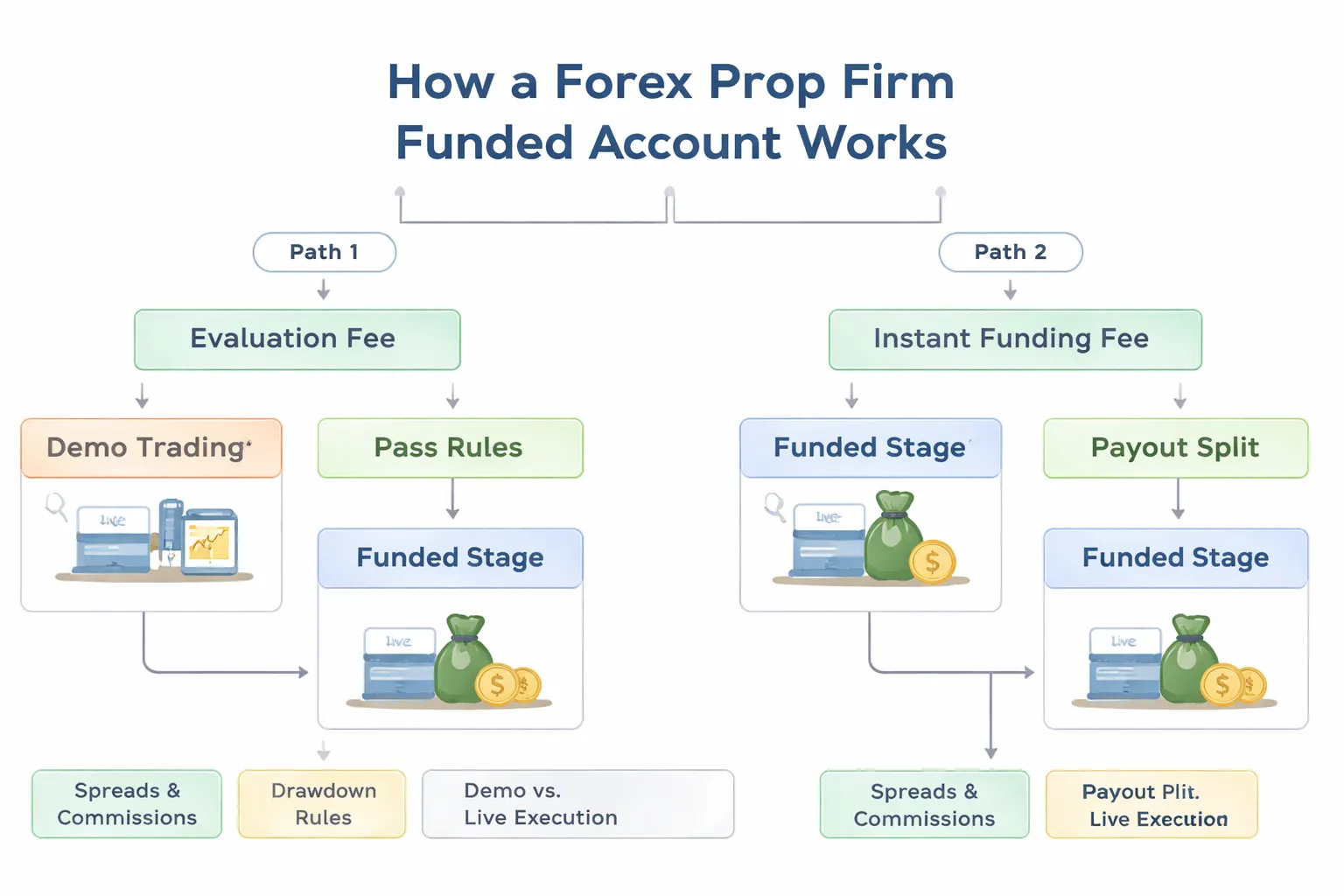
What a Forex Prop Firm Is
A forex prop firm gives you access to a funded trading account after you pass its rules. You trade the firm’s capital model, not your own retail margin account. You earn a profit split if you follow the risk limits.
Most firms run on a “sim-funded” setup first. You trade a demo environment with real pricing feeds and firm-defined rules. If you qualify, the firm may move you to a live-funded account or keep you on a demo account and mirror your risk.
Prop Firm vs. Broker vs. Trading Academy
- Prop firm: You pay a program fee, then trade under drawdown limits and payout rules. Your upside comes from profit splits.
- Broker: You deposit your own money. You control risk, but you also take full losses. Your costs are spread, commission, and swap.
- Trading academy: You pay for education. You get no capital and no execution. Results depend on you and the market.
Challenge or Evaluation vs. Instant Funding
Challenge or evaluation programs test you first. You must hit a profit target while staying inside limits like max daily loss, max overall drawdown, and trading restrictions. You usually get better pricing and higher splits after you pass.
Instant funding gives you a funded account faster. You still face drawdown rules, and the limits often sit tighter. Some instant models cap your lot size, restrict symbols, or use lower splits until you prove consistency.
| Model | What you do first | Typical tradeoff |
|---|---|---|
| Evaluation | Pass targets under strict rules | Lower upfront risk for the firm, more steps for you |
| Instant funding | Trade funded right away under limits | Higher upfront cost, tighter constraints, faster payouts at some firms |
Demo-Funded vs. Live-Funded, What It Changes for Execution
Demo-funded means your orders do not hit the real market. You still get spreads and quotes from a feed, but the fill logic can differ from live. You can see different slippage behavior, fewer requotes, and smoother fills during fast moves. That helps some high-frequency styles, and it hurts realism.
Live-funded means your trades route through a broker or liquidity setup. You face real execution. You get real slippage during news, worse fills in thin liquidity, and more spread expansion when the market spikes. If you scalp or trade news, live conditions matter more.
- Fills: Demo can fill at the quote more often. Live fills at available liquidity.
- Slippage: Live slippage increases during volatility. Demo slippage depends on the simulator settings.
- Execution speed: Platform speed and server location still matter, but live routing adds friction.
Typical Fees and What You Actually Pay For
You usually pay a one-time fee per account size for an evaluation or instant plan. Some firms add platform fees, data fees, or higher commissions. Refund rules vary. Many firms refund your fee only after your first payout, and only if you meet all terms.
- Program fee: Your entry cost for the rules and account access.
- Spread and commission: Your ongoing trading cost. This can outweigh the fee if you trade high volume.
- Swap or financing: Your holding cost if you keep positions overnight. Some firms mark this up.
- Reset or retry fees: Your cost to restart after a breach or timeout.
- Payout fees: Some payment methods add withdrawal costs or minimums.
If you want the full rule stack that drives these costs, read our Forex prop firm challenge explained.
How Prop Firms Make Money
- Fees: Evaluations and resets create steady revenue. This funds operations and marketing.
- Risk controls: Drawdown limits, daily loss caps, and rule filters reduce tail risk.
- Execution setup: Some firms keep you on demo and mirror exposure. Others place risk with a broker, internalize it, or hedge a portion. The firm decides when and how to take your flow to the market.
- Trading costs: Spreads, commissions, and swap markups can add margin even when you profit.
How to Choose the Best Forex Prop Firm (Buyer’s Criteria)
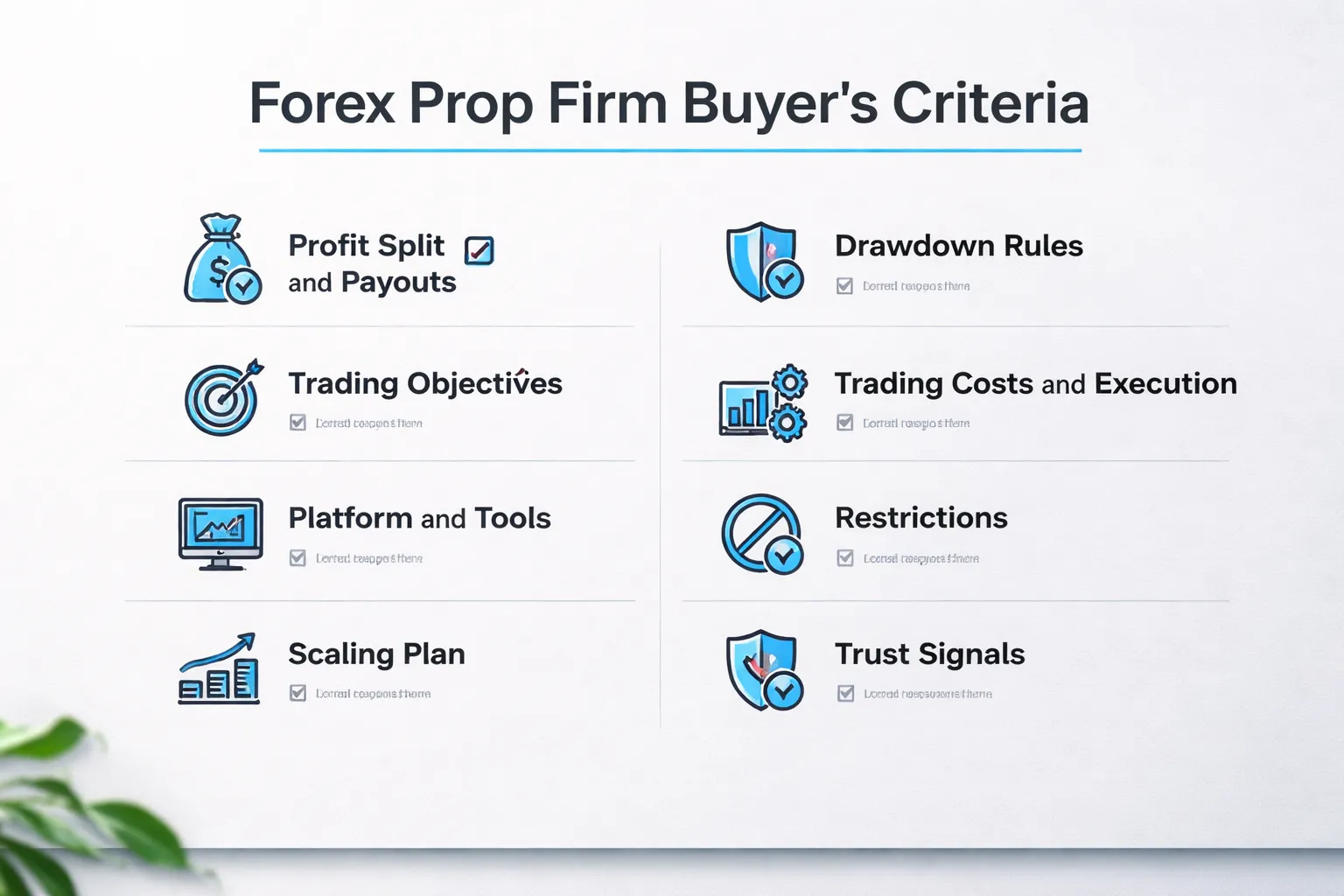
Profit split, payout frequency, and withdrawals
Start with the money path. You need to know what you keep, how fast you get it, and how you get it.
- Profit split: Compare the split on the funded stage, not the challenge stage. Check if it improves with scaling or resets after a rule break.
- Payout frequency: Look for clear payout cycles, weekly, biweekly, or monthly. Short cycles reduce your time at risk.
- Minimum payout and thresholds: Some firms require a minimum amount or a buffer above starting balance before you can withdraw.
- Withdrawal methods: Confirm bank transfer, card, and e-wallet options. Check country limits and fees.
- Processing time: “Up to X days” is vague. Look for typical processing times and cutoff dates.
- Chargebacks and reversals: Read what triggers payout cancellation, rule disputes, or profit adjustments.
Drawdown rules that decide if you survive
Most traders fail on drawdown rules, not on strategy. You must map the rules to your real risk per trade.
- Daily vs. overall drawdown: Daily limits punish volatility and news spikes. Overall limits punish slow bleed and grid style risk.
- Balance vs. equity drawdown: Balance tracks closed losses. Equity includes floating loss. Equity-based rules hit you faster during open drawdowns.
- Trailing vs. static drawdown: Trailing drawdown rises with your profits and can tighten your room if you give back gains. Static drawdown stays fixed from the start.
- Reset time: Some firms reset daily loss at server midnight, others use a rolling 24 hours. This changes how you manage late-day trades.
- Buffer math: Convert limits into dollars and pips. If daily loss is 5 percent and you risk 1 percent per trade, you only get a few clean attempts before you breach.
If you want a deeper breakdown of rule types and common traps, read our Forex prop firm challenge rules explained.
Trading objectives and challenge design
Firms set objectives to filter traders. Some filters make sense. Some exist to increase failure rates.
- Profit targets: High targets force leverage and overtrading. Lower targets allow cleaner risk control.
- Minimum trading days: This stops one lucky day passes. It can also force you to take low-quality setups to “log days.”
- Time limits: Tight deadlines push you to increase size. No time limit reduces pressure but may come with other restrictions.
- Consistency rules: Watch for limits on daily profit concentration, single-trade profit caps, or “soft breach” behavior checks.
- Allowed instruments: Some firms restrict symbols, indices, metals, crypto, or exotics. Restrictions change your edge and your costs.
Trading conditions that change your real expectancy
Challenge fees matter once. Trading conditions hit every trade.
- Spreads and commissions: Compare typical spreads during your session, not best-case spreads. Add commission to get all-in cost.
- Swaps and financing: Check swap rates and whether the firm adds a markup. If you swing trade, swaps can decide profitability.
- Execution speed: Slow fills turn good entries into chase entries. Ask for average execution stats if published.
- Slippage policy: Some firms pass positive and negative slippage. Others only pass negative. This matters for stop orders and news.
- Market hours and liquidity filters: Check restrictions around rollover, holidays, and thin liquidity periods.
Platform and tooling
Your platform dictates what you can trade and how you manage risk.
- MT4 and MT5: Best for common FX workflows and EAs. Check if the broker feed stays stable during volatility.
- cTrader: Strong for execution and order management. Verify symbol list and commission model.
- TradingView integration: Useful for charting and alerts. Confirm if you can execute from TradingView or only chart.
- VPS support: If you run EAs or trade during off-hours, a VPS reduces disconnect risk.
- API and algo support: Confirm rules for bots, bridging, latency tools, and custom integrations.
- Data exports: You want clean trade history exports for journaling, tax, and dispute resolution.
Risk controls and restrictions
Restrictions define your playbook. They also define what gets you disqualified.
- News rules: Some ban trading minutes before and after red news. Others allow it but flag suspicious fills. This affects spike strategies and tight stops.
- Weekend holding: If you hold trades over the weekend, confirm if the firm allows it and whether gap risk counts toward equity drawdown.
- EA rules: Many firms allow EAs but ban specific behaviors like latency arbitrage or order spam. Get the exact list.
- Hedging: Check if they allow internal hedging, multi-account hedging, or correlated exposure.
- Copy trading: Some allow copying from your own master account. Others ban any copying, even between your accounts.
- Account sharing: Most firms ban it. Confirm how they define it, device checks, IP rules, and travel allowances.
Account sizes, scaling plans, and capital progression
Choose a firm that can grow with your edge.
- Account sizes: Pick a size where your normal risk per trade fits inside the drawdown rules with room for variance.
- Scaling triggers: Look for clear requirements, profit amount, number of payouts, or months of consistency.
- Scaling speed: Some scale slowly in small steps. Others scale faster but tighten rules. Read both sides.
- Capital allocation limits: Check maximum total funding across accounts and across programs.
- Rule stability: Confirm if the firm can change drawdown, payout timing, or restrictions mid-program.
Trust signals that reduce counterparty risk
You trade well and still lose if the firm delays, disputes, or changes terms. Treat this as counterparty risk.
- Company background: Identify the legal entity, location, and how long it has operated under the same brand.
- Policy transparency: You need clear definitions for drawdown, news windows, payout criteria, and prohibited practices.
- Payout proof: Look for consistent proof over time, not one-off screenshots. Verify dates, amounts, and patterns.
- Support quality: Test support with a specific rules question. Measure response time and clarity.
- Dispute process: A credible firm explains how it investigates fills, rule breaches, and payout holds.
- Reputation signals: Separate real user reports from affiliate hype. Watch for repeated complaints about denied payouts or retroactive rule enforcement.
Top Forex Prop Firms Reviewed (Pros, Cons, Best For)
FTMO Review
Strengths
- Clear rules and a structured evaluation process.
- Strong track record and high brand recognition.
- Good tooling for account stats and rule tracking.
Drawbacks
- Rules can feel strict if your system needs wider daily swings.
- News and holding rules can limit some approaches. Check your plan against the fine print.
- Pricing can sit above newer discount-driven firms.
Best for
- Disciplined traders who want a known name and defined rules.
- Traders who track risk daily and can keep losses tight.
The 5%ers Review
Strengths
- Built for steady risk control and longer-term progression.
- Strong fit for swing-style behavior on many account types, depending on the program.
- Focus on consistency over jackpot trading.
Drawbacks
- Program structure can feel complex. You must map each rule to your system.
- Scaling terms vary by program. Read the upgrade path before you pay.
- Some strategies will feel constrained if they rely on aggressive sizing.
Best for
- Swing traders and low-leverage traders who prioritize longevity.
- Traders who want a slower ramp with tighter risk culture.
FundedNext Review
Strengths
- Good variety of evaluation styles and account sizes.
- Often competitive on promos and entry pricing.
- Simple onboarding and broad trader appeal.
Drawbacks
- Rule sets and conditions can change by program. You must confirm which version you buy.
- Execution quality depends on the account type and broker setup. Test on a small account first.
- Promo-driven pricing can hide weaker fit for your strategy.
Best for
- Traders who want multiple paths to funding and flexible account options.
- Traders who will read the rules page line by line before trading.
E8 Markets Review
Strengths
- Clean program design and straightforward rule presentation.
- Good fit for traders who want a modern dashboard and simple tracking.
- Often offers evaluation options that appeal to different risk styles.
Drawbacks
- As with most firms, execution and spreads can vary by market session. You must test during your trading hours.
- Some restrictions can affect news traders and high-frequency styles.
- Scaling and payout terms need a close read to avoid surprises.
Best for
- Traders who want simple rules and a clean user experience.
- Traders who keep a consistent schedule and trade liquid sessions.
The Forex Funder Review
Strengths
- Simple program choices that many traders can understand fast.
- Often attractive pricing and frequent discounts.
- Works well for traders who want a direct, no-frills evaluation.
Drawbacks
- Discount pricing increases signup volume, support can lag during peaks.
- Rule details matter. Small limits can break a strategy that uses stacking or partial hedges.
- Execution conditions can differ by instrument. Verify spreads on your pairs.
Best for
- Cost-sensitive traders who still want standard challenge structure.
- Traders with a simple system and tight risk controls.
Funded Trading Plus Review
Strengths
- Good range of account types, including options that can suit swing traders.
- Clear step-up paths on many programs.
- Good fit for traders who want room to trade at a steady pace.
Drawbacks
- Rules differ across programs. You must confirm drawdown method and daily limits.
- Some instruments carry higher costs. Check spreads and commissions before you commit.
- Scaling often ties to specific behavior. Plan for it, do not assume it.
Best for
- Traders who want multiple funding routes and a longer runway.
- Traders who prefer consistent position sizing over spikes in risk.
Axi Select Review
Strengths
- Broker-linked environment, which can improve clarity on execution and trade history.
- Can suit traders who prefer a more traditional path versus challenge-only models.
- Good fit if you value broker infrastructure and platform stability.
Drawbacks
- Program access and eligibility can depend on region and onboarding requirements.
- Progression metrics can feel different from typical prop challenges. You must learn the scoring and milestones.
- Costs and conditions depend on the trading account setup. Verify fees before scaling.
Best for
- Traders who want a broker-backed program and clear reporting.
- Traders who value structure and are fine with milestone-based progression.
Honorable Mentions and Niche Options
- Region-specific access: Some firms restrict countries or payment methods. Shortlist firms that support your residency, tax documents, and payouts.
- Platform-specific needs: If you require MT5, cTrader, or TradingView integration, filter first. Platform mismatch wastes time and increases execution errors.
- Strategy-specific fit: News trading, overnight holds, EAs, and high-frequency systems trigger most rule conflicts. Match your method to each rule set before you pay.
- Copy trading and signals: If you plan to follow external trades, confirm the firm rules on trade copying and third-party automation. Use this guide on how to choose a copy trading provider before you connect anything to a funded account.
- Fast execution focus: If you scalp, prioritize firms with consistent spreads in your session and transparent slippage handling. Test with small risk first.
Deep-Dive Comparison: Rules That Commonly Disqualify Traders
Minimum trading days and the consistency trap
Many firms require a minimum number of trading days. You can hit the profit target fast and still fail if you do not log enough active days.
- Typical rule: 3 to 10 trading days per phase. Some count only days with a closed trade, others count any executed order.
- Common disqualifier: You finish the target in 1 to 2 days, then you stop trading, then you fail the time window or minimum days rule.
- Consistency rule: Some firms cap how much of your total profit can come from a single day. Example, max 30 percent to 50 percent of profits in one day.
- Consistency trap: You take one large winner to reach the target, then the firm rejects the phase because the profit distribution breaks the cap.
- What to check: How the firm defines a trading day, whether partial closes count, and whether they calculate consistency from closed PnL only.
Max daily loss vs. max overall loss, real-world examples
Daily loss limits kill more accounts than total drawdown. You can run a low overall drawdown and still breach the daily limit during a choppy session.
- Max daily loss: Resets at a fixed server time or at your first trade of the day. A timezone mismatch can cause surprise breaches.
- Max overall loss: Usually based on starting balance or a trailing threshold, depending on the program.
| Scenario | Rule set | What happens |
|---|---|---|
| Intraday swing against you, then recovery | 5% daily loss, 10% overall loss | You float to -5.1% before recovering, you fail even if you close the day at -1%. |
| You scale size after a win | 5% daily loss | One losing trade can breach the day limit even if your overall drawdown stays under 10%. |
| You hold multiple correlated pairs | Daily loss counts open PnL | A USD spike hits all positions at once, you breach the daily rule in seconds. |
Check whether the daily loss includes floating loss, commissions, and swaps. Also check the reset time in platform server time.
Equity-based vs. balance-based calculations during floating drawdown
Firms enforce drawdown on either balance or equity. Equity-based rules are stricter if you hold open risk.
- Balance-based: The firm checks drawdown using closed trades only. Floating loss does not matter until you close.
- Equity-based: The firm checks drawdown using balance plus floating PnL. A temporary spike against your open trade can fail you.
- Where traders get disqualified: You size a position that stays within limits at close, but the intraday adverse move breaches equity drawdown.
- What to check: Whether limits apply per account equity, per symbol, or across all open positions, and whether the platform shows the same drawdown logic as the firm dashboard.
News trading and high-impact event restrictions
Some firms allow news trading, others restrict it by time window or execution type. This matters most for scalpers and breakout systems.
- Common restriction: No opening or closing trades X minutes before and after high-impact news. Typical windows range from 2 to 10 minutes, some longer.
- Hidden gotcha: Pending orders triggered inside the restricted window can count as a violation, even if you placed them earlier.
- Slippage clause: Firms may void profits if they label fills as “news spike” or “latency arbitrage”.
- What to check: Which calendar they use, which events count, whether it applies to all symbols or FX only, and whether closing trades is restricted.
Weekend holding, swap exposure, and gap risk policies
Weekend rules vary. Some firms allow holds, some force flat before close, some restrict specific symbols.
- Weekend holding ban: You must close all trades before a set cutoff time on Friday.
- Gap risk: If you hold through the weekend, a Monday gap can breach equity drawdown before you can act.
- Swap exposure: If you hold overnight, swaps can push you into a daily or overall loss breach, especially on leveraged positions and exotic pairs.
- What to check: Cutoff time, symbol exceptions, whether indices, commodities, or crypto have different rules, and whether swaps count toward loss limits.
Martingale, grid, DCA, and high-frequency constraints
Many firms ban strategies they link to account blowups or execution abuse. The definitions vary, so you need to read the fine print.
- Martingale and DCA: Some firms ban any lot increase after a loss, others ban only aggressive multipliers. Your recovery logic can trigger a violation.
- Grid: Placing layered orders at fixed intervals can qualify as grid trading, even if you use risk controls.
- High-frequency constraints: Limits on trade duration, order count per day, or “tick scalping” language can disqualify fast in and out systems.
- Execution abuse flags: Arbitrage, latency exploitation, or trading during illiquid spikes. Firms can cancel trades they classify this way.
- What to check: Minimum hold time, max lots per symbol, max orders, and whether they allow EAs for your approach.
Hedging across accounts, copy trading, and trade mirroring rules
Most firms allow hedging inside one account. Many ban hedging across multiple accounts or between different traders because it can neutralize risk and game objectives.
- Cross-account hedging: Long EURUSD in one account, short EURUSD in another. Firms may label this as risk circumvention and close accounts.
- Group trading detection: Similar entries, same symbols, same timing, same lot patterns across accounts can trigger mirroring flags.
- Copy trading and signals: Some firms allow it with restrictions, others ban any third-party signals or any trade copier.
- Trade mirroring: Even if you trade manually, repeating the same template trades across accounts can look like copying.
- What to check: Whether you can manage multiple accounts, whether household members can trade, whether you can use a copier, and how the firm defines “similar strategy”.
If you plan to use automation, read this guide on Copy Trading Forex explained before you connect any tool to a funded account.
Costs and Value: What You Pay vs. What You Get
Challenge fees, resets, retries, and refunds
Start with total cost to reach your first payout. Do not compare firms on entry fee alone.
- Entry fee: What you pay to start the evaluation.
- Reset fee: What you pay after you breach a rule or run out of time.
- Retry fee: What you pay to take the challenge again, sometimes called “rechallenge”.
- Refund: When you get the fee back, and under what conditions. Some firms refund at first payout only. Some never refund. Some refund only the last attempt.
Compare apples-to-apples with one number: your expected cost per funded attempt.
| What to calculate | How to calculate it | Why it matters |
|---|---|---|
| Total attempt cost | Entry fee + expected resets + expected retries | Shows what you really pay to get funded |
| Net cost to first payout | Total attempt cost minus any refund you expect to actually receive | Refund rules vary, timing matters |
| Cost per $1,000 of starting balance | Net cost to first payout / (account size in $1,000s) | Normalizes pricing across account sizes |
Read the refund line item in the contract. Some firms market “refundable” but delay payouts or require extra steps that reduce your chance of collecting it.
Spreads and commission impact on your strategy
Your fees do not stop at the checkout page. Trading costs hit every trade.
- Scalping: You pay the spread and commission more often. Small targets magnify costs. A slightly wider spread can erase your edge.
- Swing trading: You trade less, so raw spread matters less, but swap and weekend gaps matter more. Check if the firm charges swap and whether it differs by symbol.
Ask for the real cost structure on your main pairs. Look for:
- Commission per lot: Round turn cost matters. Some firms quote per side.
- Typical spread: Not “from 0.0”. Check average during London and New York, plus news.
- Symbol restrictions: Some firms price FX fine but penalize indices, gold, or crypto with higher spreads.
Slippage and execution, why cheap fees can be expensive
A low challenge fee can hide a high execution bill. Slippage turns good entries into break-even trades and break-even trades into losers.
- News trading: If the firm widens spreads or rejects fills, your plan breaks. Even if news is “allowed”, execution can make it untradeable.
- Stop placement: Fast markets can slip stops. That can push you into daily drawdown breaches.
- Partial fills and requotes: These change your risk per trade. Your position size math stops matching reality.
Check what the firm discloses about its broker, liquidity, and execution model. If it stays vague, assume worse conditions during volatility. If you need help understanding common rule traps, read the forex prop firm challenge explained guide before you pay.
Payout policies
Value comes from getting paid fast, and getting paid often.
- First payout timing: Some firms pay in 7 to 14 days, some make you wait 30 days or more. Longer cycles increase your risk of hitting a rule before you cash out.
- Profit split tiers: Many firms start at 70 to 80 percent, then raise it after milestones. Check if the higher split requires a minimum trading period, not just profit.
- Payout caps: Some firms cap each payout or cap monthly withdrawals. A cap changes the value of a large account.
- Consistency rules: Limits like “max daily profit percentage” can block payouts even when you follow drawdown rules.
Use one comparison metric: expected dollars you can withdraw per month under your strategy, after split and any caps.
Scaling value
Scaling decides if the firm can grow with you, or if you will hit a ceiling.
- Milestones: Check the exact target, time window, and rule set to qualify for the next level.
- Consistency requirements: Some firms require a minimum number of trading days, a max daily profit share, or limits on lot size changes.
- Maximum allocation: Look at the real ceiling, not the marketing headline. Some caps apply per trader, per household, or per strategy.
- Scaling speed: Faster scaling can beat a higher starting split. Slow scaling can trap you at small size for months.
Compare firms on your 6 to 12 month path. Add up realistic withdrawals plus realistic scaling, then subtract your total expected costs. That number tells you value.
Best Forex Prop Firms by Trader Profile (Decision Guide)
Best for beginners learning risk management
Pick a firm that forces good habits. You want simple rules, clear drawdown math, and room to learn without blowing the account on one bad day.
- Choose: Lower profit targets, higher drawdown buffer, no time limit, and a consistent payout schedule.
- Avoid: High targets, tight daily loss limits, and rule sets with many exceptions.
- Check: Does the firm use balance-based drawdown or equity-based drawdown. Equity-based is less forgiving during floating loss.
- Check: Minimum trading days. Too high pushes you into low-quality trades.
- Action: Build your plan around max daily loss and max total loss first, then position size.
Best for scalpers and day traders (tight costs and fast execution)
Scalping lives and dies on spreads, commissions, and fills. A good rule set will still fail you if execution is slow or costs are high.
- Choose: Raw spread pricing, low commission per lot, and brokers with stable fills during active sessions.
- Choose: Firms that allow short hold times and do not penalize high trade frequency.
- Avoid: Hidden limits like max lots per symbol, max trades per day, or restrictions on rapid in and out trading.
- Check: Slippage policy. Some firms void trades if you gain from fast moves but keep losses.
- Check: Max spread rules, if any. They can block trades during the only minutes you can profit.
Best for swing traders (time flexibility and weekend holding)
Swing trading needs time. You need rules that let you hold through normal price noise, swap costs, and weekends.
- Choose: Weekend holding allowed, no forced flat rule before market close, and reasonable total drawdown.
- Choose: No time limit on evaluation, or a long window that fits your trade frequency.
- Avoid: Tight daily drawdown caps. One gap or spike can end your account.
- Check: Swap and financing. If the firm runs high negative swap, your edge shrinks.
- Check: Symbol list and leverage. Some swing setups need indices, gold, or specific FX pairs.
Best for news traders (rule clarity and event permissions)
News trading is binary. If the rules restrict it, your strategy breaks. You need clear permission, not vague language.
- Choose: A written policy that states you can trade scheduled news, with no grey zones.
- Choose: Rules that define the restricted window by minutes, not broad statements like “high impact events.”
- Avoid: Firms that can cancel trades after the fact due to “abnormal market conditions.”
- Check: Maximum slippage, minimum distance for stops, and any order type bans like stop orders or limits near price.
- Check: Server stability during releases. If the platform freezes, you carry full risk with no control.
Best for algorithmic/EA traders (VPS, stability, and automation policies)
Your edge depends on uptime and repeatable execution. You need a firm that allows automation and does not change rules without notice.
- Choose: Written EA policy that allows automation, including trade copier use if you run multiple accounts.
- Choose: VPS support or approved VPS providers, plus stable MT4, MT5, or cTrader infrastructure.
- Avoid: “Manual trading only” rules, or bans on high frequency logic that your EA uses.
- Check: Data feed and spreads across sessions. Strategy tests must match live conditions.
- Check: Account monitoring rules. Some firms flag identical entries across users as “group trading.”
Best for conservative traders (lower targets, safer drawdowns)
If you trade small and steady, the challenge design matters more than the profit split. High targets force risk. Tight drawdowns punish normal variance.
- Choose: Low evaluation targets, higher max loss, and simple trailing rules, or no trailing at all.
- Choose: Frequent withdrawals and a clear scaling plan tied to payouts, not to one perfect month.
- Avoid: Trailing drawdown that follows equity upward. It can lock in a future failure after a strong day.
- Check: Whether the daily loss is calculated on equity or balance, and whether it resets at broker midnight or a fixed server time.
- Action: Treat drawdown like your true account size. Size positions off max loss, not the headline funding amount.
| Trader profile | Rules and conditions you should prioritize | Common deal-breakers |
|---|---|---|
| Beginner | Lower targets, higher drawdown buffer, simple rules, no time pressure | Tight daily loss, high targets, many vague restrictions |
| Scalper and day trader | Raw spreads, low commissions, fast execution, no trade frequency limits | Trade cancel risk, spread caps, lot limits, slow fills |
| Swing trader | Weekend holding allowed, no time limit, reasonable total drawdown, fair swaps | Forced flat rules, tight daily drawdown, expensive financing |
| News trader | Clear event permissions, defined restriction windows, stable servers | Vague “abnormal conditions” clauses, trade cancellation after profit |
| EA trader | Automation allowed, VPS option, stable platform, consistent feed | Manual-only rules, copier bans, sudden policy changes |
| Conservative trader | Low targets, safer drawdown, non-trailing drawdown, frequent payouts | Trailing equity drawdown, high targets that force leverage |
If you want the exact definitions behind daily loss, total drawdown, and trailing models, read our Forex prop firm challenge rules explained guide.
Risk Management and Passing Strategies (Without Gambling)
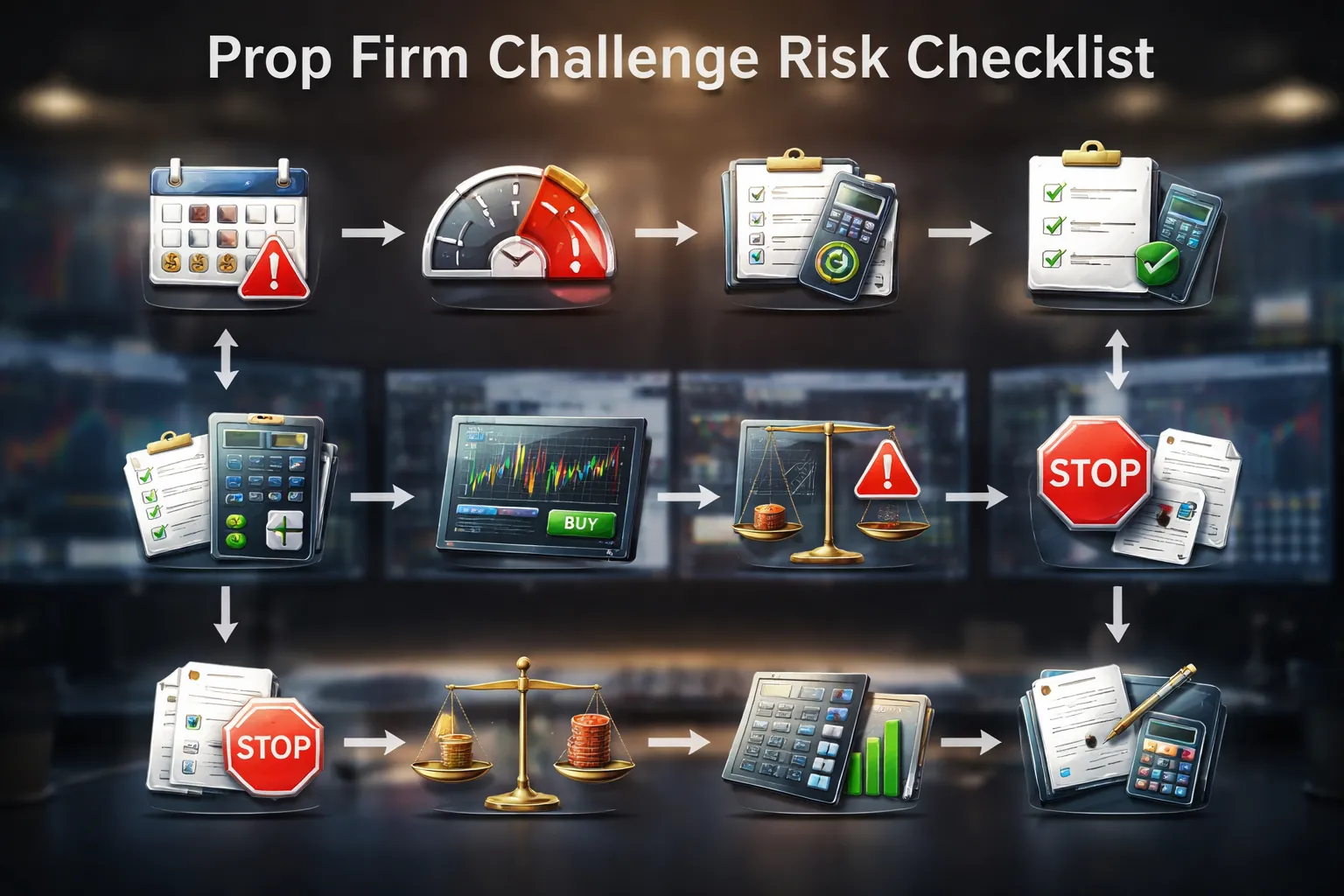
Setting realistic daily risk limits and position sizing
Your challenge rules set the real risk cap, not your confidence.
- Set a daily loss stop that is tighter than the firm limit. If the firm allows 5% daily loss, cap yourself at 1% to 2%. Stop trading when you hit it.
- Risk a fixed amount per trade. Use 0.25% to 0.50% per trade in most evaluations. Drop to 0.10% to 0.25% if the account uses trailing drawdown.
- Limit simultaneous exposure. Keep total open risk under 1% to 2% across all trades. Correlated pairs count as the same bet.
- Size from the stop loss. Calculate lots from your stop distance and account size. Do not change lot size to “make back” a loss.
- Use a max trades per day rule. 1 to 3 clean attempts beats 10 low quality entries.
Trade plan templates aligned to evaluation rules
Build a one page plan that matches the firm’s limits. Follow it trade by trade.
- Account rules snapshot. Daily loss, max loss, trailing or static, news rules, minimum days, max lot limits, weekend holding.
- Risk rules. Risk per trade, max daily loss, max open risk, max trades per day.
- Setup list. Define 1 to 2 setups you will trade. State session, pair list, and entry trigger.
- Exit rules. Fixed stop, partials or no partials, when you move to break even, time stop.
- Target math. Convert the profit target into required net R. Example, a 10% target with 0.5% risk needs +20R net. If your system averages 0.3R per trade, you need about 67 trades. If that pushes you into overtrading, lower risk and accept a longer path, or pick a firm with a lower target.
For a full schedule and execution checklist, use our step-by-step plan to pass a Forex prop firm challenge.
Managing drawdown during open trades (equity vs. balance awareness)
Firms fail traders on equity, not feelings. Track equity in real time.
- Know what triggers the breach. Many firms use equity for daily loss and max loss. Floating losses count.
- Treat open risk as already lost. If you risk 0.5% with a stop, assume that 0.5% is gone when you place the trade. Do not add another trade that pushes you near the limit.
- Trailing drawdown needs extra space. When the drawdown trails equity highs, new peaks raise the floor. Avoid pushing for new highs with oversized lots. Your next pullback can breach.
- Avoid stop widening. Wider stops increase real risk and often increase time in drawdown. If the stop is wrong, exit. Re-enter only on a fresh setup.
- Reduce risk after a drawdown. After a 2R downswing, cut risk per trade by 25% to 50% until you recover.
Avoiding overtrading and revenge trading during challenges
Challenges punish volume without edge. You need restraint and a process.
- Trade only your sessions. Pick one window. Ignore the rest. Less screen time cuts impulsive entries.
- Use a hard daily stop. Stop after 2 losing trades, or after you hit your daily loss cap, whichever comes first.
- Ban “recovery” trades. After a loss, require a full reset before the next entry. Step away for 15 minutes. Review the setup checklist again.
- Keep a quality filter. If the setup does not meet all conditions, you skip. No exceptions.
- Focus on survival first. Passing often comes from avoiding rule breaches, not from big days.
Journaling metrics that prop firms effectively reward (R-multiple, win rate, expectancy)
Prop firms say they care about discipline and consistency. Your journal should prove it.
| Metric | What to track | Why it matters in evaluations |
|---|---|---|
| R-multiple | Profit or loss divided by initial risk per trade | Shows you control risk and avoid outsized losses |
| Win rate | Wins divided by total trades | Helps you forecast drawdowns and avoid panic sizing |
| Expectancy | (Win rate × avg win in R) minus (loss rate × avg loss in R) | One number that tells you if your method has an edge |
| Max adverse excursion | Worst floating loss during the trade, in R | Helps you avoid equity drawdown breaches and tighten entries |
| Rule buffer | Distance to daily and max loss limits before each entry | Keeps you from placing trades that can fail the account on normal noise |
- Log each trade in 60 seconds. Setup name, entry reason, stop distance, planned R, result in R, screenshot.
- Review weekly. Cut the bottom setup. Keep the top setup. Reduce trades, not standards.
Due Diligence Checklist Before You Buy a Challenge
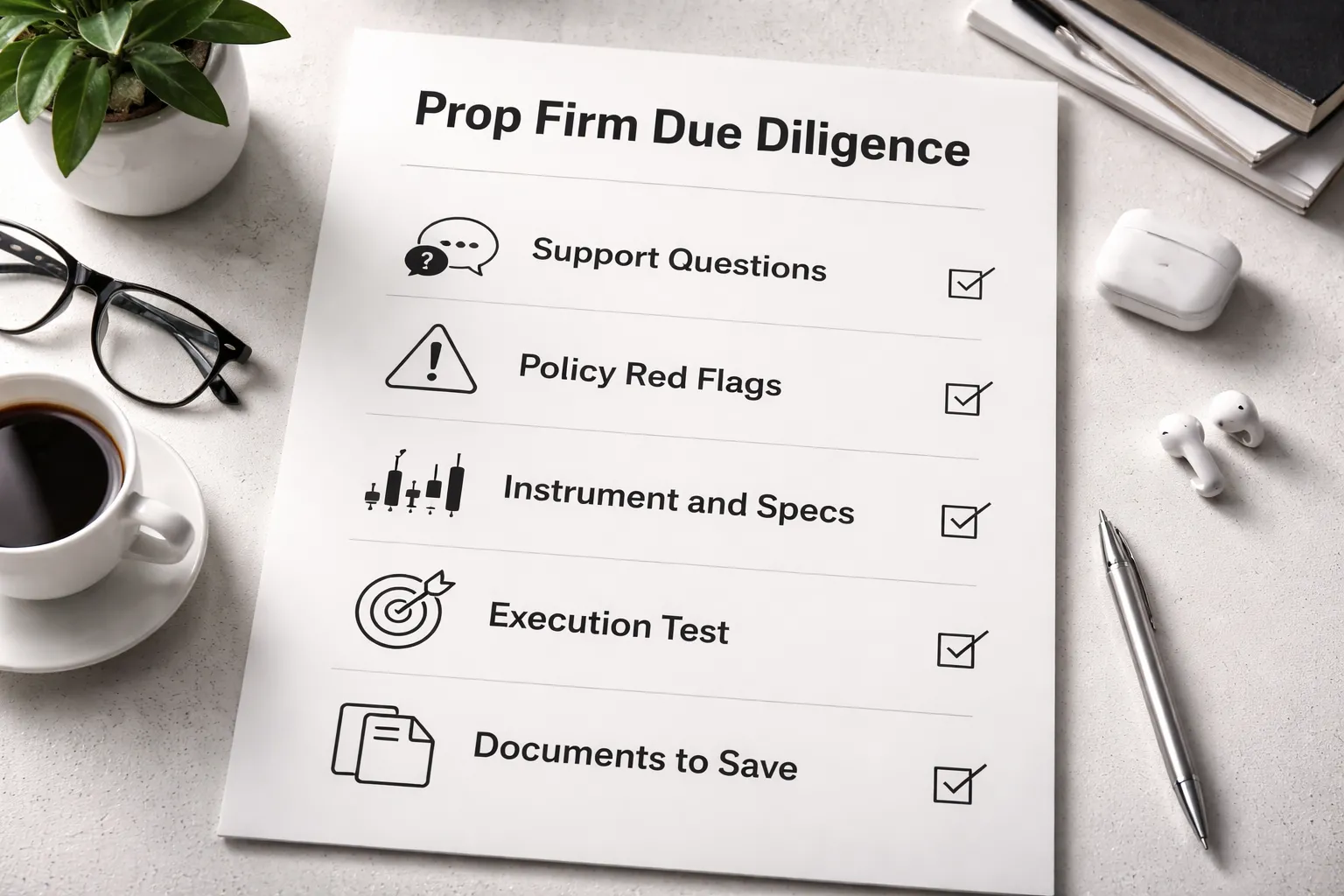
Questions to ask support before purchasing
- Daily loss reset time: Server time, your local time, or fixed UTC. Ask what happens during DST shifts.
- Floating loss rules: Does unrealized PnL count toward daily and max loss. Ask for a numeric example.
- Trade close rules: Do they force-close positions at end of day, end of week, or news events.
- Weekend holding: Can you hold over Friday close. Any crypto indices rules if offered.
- News trading: Is it allowed. If restricted, define the window in minutes before and after. Ask if limit orders count.
- EA and copy trading: Are EAs allowed. Are trade copiers allowed between your own accounts. Any “third-party signals” ban.
- HFT and scalping definitions: Minimum hold time. Max orders per minute. Any ban on “tick scalping.”
- Martingale and grid rules: Do they ban averaging down, hedged grids, or “recovery” sizing. Ask for their exact definition.
- Hedging: Can you hedge within the same account. Can you hedge across accounts. Ask how they treat correlated hedges.
- Account merging: Can you merge funded accounts. What happens to payout schedule and loss limits after merge.
- Inactivity: Any minimum trading days. Any inactivity fees. Any time limit on the challenge.
- Consistency rules: Any cap like “max day profit %.” Any limit on single trade contribution to target or payout.
- Soft breaches: If you hit the limit intraday then recover, does it still fail. Ask how they measure breaches, tick-by-tick or candle close.
- Platform and feed: MT4, MT5, cTrader, TradingView. Ask if they use a specific broker or internal feed.
- Payout requirements: Minimum days, profit split, first payout timing, payout methods, and fees. Ask if KYC must be completed before trading or only before payout.
- Disputes: How you appeal a breach. What evidence they accept. Expected response time.
Policy red flags to avoid
- Vague wording: “Toxic flow,” “suspicious activity,” “gaming,” “unfair advantage,” with no measurable thresholds.
- Unilateral rule changes: Terms that let them change rules mid-challenge or mid-funded period without notice.
- Undefined execution clauses: Broad statements that they can void trades due to “price discrepancies” without an audit process.
- Unclear payout terms: No written payout timeline, no profit split in writing, or “payout at our discretion.”
- Hidden caps: Profit caps, lot size caps, or payout caps that only appear in FAQ comments or Discord posts.
- One-way liability: You accept all execution risk, but they accept none, even for platform outages.
- Conflicting documents: Website rules, PDF rules, and dashboard rules do not match.
- Hard KYC surprises: Rules that allow denial for “inability to verify” without listing accepted documents or countries.
- No audit trail: They refuse to provide server time, symbol specs, or detailed logs when a breach happens.
Verify instruments, trading hours, and symbol specs
You need the exact contract specs. Small differences can flip your risk math.
- Instrument list: Confirm which FX pairs, metals, indices, oil, and crypto they allow. Get the list in writing.
- Symbol names: Note suffixes like EURUSD.a or XAUUSDm. Your EA and position sizing must match.
- Lot and contract size: Standard lot units, tick size, tick value, and pip value per symbol.
- Leverage: Per asset class, not just the headline number.
- Margin rules: Hedged margin, weekend margin increases, and high-impact news margin changes.
- Trading hours: Daily open and close, maintenance windows, and early Friday close rules.
- Swap policy: Swap-free availability, qualification rules, and whether they still apply admin fees.
- Commissions: Per lot per side, and whether they differ by symbol.
- Stops and limits: Minimum stop distance, freeze level, and max pending orders.
- Price source: Ask which broker or liquidity source they mirror. Also ask how they handle off-market spikes.
Test execution on a trial or demo
- Spreads: Log spreads during your trading hours. Check rollover and news windows.
- Slippage: Measure requested vs filled price on market orders. Do this on calm sessions and on fast moves.
- Latency: Track order round-trip time in platform logs. Slow fills change your stop distance needs.
- Stops and take profits: Verify they trigger cleanly. Watch for gaps and “stop hunts” caused by wide spreads.
- Partial fills and re-quotes: Note how often they occur and on which symbols.
- Swaps: Hold a small position past rollover and record the swap charged or credited.
- Execution during maintenance: Check what happens to open trades during platform restarts or symbol freezes.
Keep your test simple. Trade small. Collect data. If the feed behaves differently than your normal broker, adjust your strategy or skip the firm.
Documentation to keep
- Rule PDFs: Download and save the full rule page and any PDFs on the day you buy. Save the URL and date.
- Dashboard screenshots: Take screenshots of drawdown limits, targets, payout rules, and account status.
- Symbol specs: Save contract specs and trading hours pages for each symbol you trade.
- Support emails and chat logs: Export tickets. Screenshot live chat. Keep responses that confirm edge cases.
- Platform evidence: Save MT4 or MT5 logs, journal tabs, and trade history exports.
- Order-level proof: Screenshot entries, stops, and fills, especially around a breach or a denied payout.
- Payout terms: Save payout schedule, profit split, fees, and KYC requirements in writing.
If you need a fast rule refresher before buying, read our guide to how forex prop firms work and compare it to the firm’s written terms.
Legal, Tax, and Safety Considerations (E-E-A-T)
Prop firm regulation vs. broker regulation, what it means for you
Most forex prop firms are not regulated like retail brokers. You usually trade on a demo account that mirrors a live feed. The firm pays you based on its rules, not under broker client money rules.
A regulated broker must follow standards on client funds, disclosures, and conduct. A prop firm can change terms faster and can refuse payouts if you breach rules. Treat the prop firm contract as the product.
Before you pay a fee, confirm these basics in writing.
- Legal entity: Company name, registration number, and jurisdiction.
- Dispute process: How you appeal a breach or payout denial, and where disputes get handled.
- Trading environment: Demo vs live, and which broker liquidity feed the platform uses.
- Rule enforcement: How the firm measures drawdown, daily loss, and news restrictions.
KYC, AML, and payout verification
Expect KYC before your first payout. Some firms also recheck you after large payouts or pattern changes. Build time for verification into your cash flow plan.
- Identity: Government ID, selfie, and sometimes a liveness check.
- Address: Utility bill or bank statement, usually within 60 to 90 days.
- Payment method match: Card or wallet name must match your KYC name.
- Source of funds: Sometimes requested for compliance or payment processor rules.
- Trade review: The firm may review execution around spikes, gaps, and copy trading flags.
Reduce payout friction. Use one identity, one payment method, and one device profile. Keep your invoices, receipts, and payout emails. Save your platform logs and trade exports.
Taxes, payout treatment, and recordkeeping
Prop firm payouts can count as income in many countries. The label varies. Some firms treat you as an independent contractor. Some pay as “profit share” or “performance fee.” Your tax result depends on your local rules.
Keep clean records from day one.
- Payout statements: Amount, date, currency, and method.
- Fees: Challenge fees, resets, platform fees, and add-ons.
- FX conversion: Exchange rate used and conversion fees.
- Agreements: Terms at purchase date, plus any later amendments.
- Proof of work: Trade history exports tied to each payout period.
Do not guess. If you scale payouts, talk to a qualified tax professional in your country.
Data security and account safety best practices
Prop firm accounts attract scammers. You also share sensitive documents during KYC. Lock down your access.
- Use unique passwords: Long, random, and stored in a password manager.
- Enable 2FA: Use an authenticator app when available, avoid SMS when possible.
- Separate email: Use a dedicated email for prop firms, with its own 2FA.
- Verify domains: Bookmark the real login and dashboard URLs, avoid ad links.
- Limit sharing: Do not share investor passwords or broker credentials in chat groups.
- Check withdrawals: Confirm payout destination addresses before you submit.
- Watch permissions: Review any “trade copier” or EA that requests account access.
If you buy signals or copy trades, run extra checks on access and custody risk. Read our guide on how to choose a copy trading provider.
Responsible trading and leveraged FX risk
Leverage magnifies errors. Prop rules add another layer of risk because drawdown limits can force a failure even if your strategy has edge.
- Size for the rules: Set position size so normal variance does not hit daily loss limits.
- Respect slippage: News, gaps, and low liquidity can break tight stops.
- Plan for correlation: Multiple pairs can move as one and breach your limit fast.
- Avoid revenge trading: One bad day can end the account, stop when your plan says stop.
- Assume payouts can pause: Payment processor holds and compliance checks happen.
You control your risk. The firm controls the rulebook. Trade like both can change your outcome.
FAQ
What is a forex prop firm?
A forex prop firm gives you access to a funded account if you follow its rules. You usually start with an evaluation. You pay a fee. If you pass and stay within drawdown limits, you can earn a profit split. Learn more in this guide.
How do evaluations work?
You trade a demo or simulated account with targets and risk limits. Common limits include daily drawdown, max drawdown, and minimum trading days. Some firms use one phase. Others use two. You fail if you breach limits, even if you stay profitable overall.
What rules matter most for avoiding a fail?
Watch max daily loss and max overall drawdown. Track trailing drawdown rules if used. Know if the firm counts floating loss. Check news, weekend, and lot size limits. Confirm if you must close trades before the end of day or week.
Are funded accounts real money?
Many funded accounts are simulated. Your payouts come from the firm based on your results and rule compliance. Some firms route trades to live liquidity after you prove consistency. Do not assume live execution. Ask how fills, slippage, and pricing get handled.
How do payouts work?
You request a payout after you meet the firm’s profit and eligibility rules. Firms set payout frequency, minimum amounts, and split rates. Compliance checks can delay payments. Your payout can drop to zero if you break rules before the payout date.
What is a profit split?
A profit split is the percent you keep from profits. Common splits range from 70 to 90 percent. Some firms increase the split after consistent payouts. Read the fine print for caps, scaling rules, and whether the split applies before or after fees.
What fees should you expect?
You usually pay an evaluation fee. Some firms charge platform, data, or withdrawal fees. Some refund the evaluation fee after your first payout. Compare total cost per funded dollar, not the headline account size. Confirm if resets cost extra.
What is drawdown and why does it matter?
Drawdown is your allowed loss before the account fails. Daily drawdown limits your worst day. Max drawdown limits your worst peak to trough. Trailing drawdown moves up as your equity rises, which can tighten risk after you profit.
Can you trade news and hold over weekends?
It depends on the firm. Many restrict trading during high impact news windows. Some ban weekend holds. Violations often cause an instant fail. If your strategy uses volatility spikes or swing holds, only pick firms that allow your holding period.
Which platforms do prop firms support?
Most support MT4, MT5, cTrader, or a web platform. Platform choice affects spreads, commissions, and order types. Check if you can use EAs, custom indicators, and trade copiers. Confirm whether the firm limits latency arbitrage or scalping.
Do prop firms allow EAs and algorithmic trading?
Some allow EAs, some ban them, and many restrict certain behaviors. Common bans include latency arbitrage, grid martingale, and trade copying across many accounts. If you automate, get written confirmation of what you can run and how they detect violations.
How do you compare firms fast?
- Rules: daily loss, max loss, trailing logic, news rules.
- Costs: fees, resets, commissions, spreads.
- Payouts: split, schedule, minimums, payment methods.
- Execution: slippage, symbols, hours, leverage.
- Support: response time, dispute process.
Are “free funded” offers legit?
Some are marketing promos with strict limits and low payout potential. Many require you to buy add ons, meet high activity thresholds, or accept reduced profit splits. Read the full terms. If the firm will not show the rulebook and payout policy, skip it.
What is the safest way to size risk on a funded account?
Risk small per trade so one loss streak cannot hit daily loss. Keep extra buffer for slippage and gaps. Reduce size near payout dates. If the firm uses trailing drawdown, treat your high water mark as fragile and avoid sharp equity swings.
Conclusion
Conclusion
Prop firms sell leverage, rules, and a payout path. You need to buy the right rule set, not the marketing.
Start with the non-negotiables. Clear rulebook, clear payout policy, clear drawdown math. If any of those stay vague, move on.
Then match the firm to your execution. If you scalp, avoid firms that punish short holds. If you swing, avoid tight daily loss limits and weekend restrictions. If the firm uses trailing drawdown, treat your peak equity as a hard ceiling and keep variance low.
Final tip. Risk to the rule, not to your confidence. Set a fixed per-trade risk that keeps you far from daily loss, even with slippage. Reduce size after a good run so you do not tighten the trailing stop on yourself.
-
Best Forex Copy Trading Platforms (Features, Fees & Safety Compared)
7 months ago -
Forex Prop Firm Challenge Rules Explained (Drawdown, Targets, Payouts)
7 months ago -
What Is a Forex Prop Firm? How Prop Trading Works for Forex
7 months ago -
Copy Trading Forex Explained: How It Works, Pros, Cons & Risks
7 months ago -
Forex Signals: Are They Worth It? (What to Know Before You Buy)
7 months ago
-
-
- Profit split, payout frequency, and withdrawals
- Drawdown rules that decide if you survive
- Trading objectives and challenge design
- Trading conditions that change your real expectancy
- Platform and tooling
- Risk controls and restrictions
- Account sizes, scaling plans, and capital progression
- Trust signals that reduce counterparty risk
-
- Minimum trading days and the consistency trap
- Max daily loss vs. max overall loss, real-world examples
- Equity-based vs. balance-based calculations during floating drawdown
- News trading and high-impact event restrictions
- Weekend holding, swap exposure, and gap risk policies
- Martingale, grid, DCA, and high-frequency constraints
- Hedging across accounts, copy trading, and trade mirroring rules
-
- Best for beginners learning risk management
- Best for scalpers and day traders (tight costs and fast execution)
- Best for swing traders (time flexibility and weekend holding)
- Best for news traders (rule clarity and event permissions)
- Best for algorithmic/EA traders (VPS, stability, and automation policies)
- Best for conservative traders (lower targets, safer drawdowns)
-
- Setting realistic daily risk limits and position sizing
- Trade plan templates aligned to evaluation rules
- Managing drawdown during open trades (equity vs. balance awareness)
- Avoiding overtrading and revenge trading during challenges
- Journaling metrics that prop firms effectively reward (R-multiple, win rate, expectancy)
-
- What is a forex prop firm?
- How do evaluations work?
- What rules matter most for avoiding a fail?
- Are funded accounts real money?
- How do payouts work?
- What is a profit split?
- What fees should you expect?
- What is drawdown and why does it matter?
- Can you trade news and hold over weekends?
- Which platforms do prop firms support?
- Do prop firms allow EAs and algorithmic trading?
- How do you compare firms fast?
- Are “free funded” offers legit?
- What is the safest way to size risk on a funded account?
-
-
- Profit split, payout frequency, and withdrawals
- Drawdown rules that decide if you survive
- Trading objectives and challenge design
- Trading conditions that change your real expectancy
- Platform and tooling
- Risk controls and restrictions
- Account sizes, scaling plans, and capital progression
- Trust signals that reduce counterparty risk
-
- Minimum trading days and the consistency trap
- Max daily loss vs. max overall loss, real-world examples
- Equity-based vs. balance-based calculations during floating drawdown
- News trading and high-impact event restrictions
- Weekend holding, swap exposure, and gap risk policies
- Martingale, grid, DCA, and high-frequency constraints
- Hedging across accounts, copy trading, and trade mirroring rules
-
- Best for beginners learning risk management
- Best for scalpers and day traders (tight costs and fast execution)
- Best for swing traders (time flexibility and weekend holding)
- Best for news traders (rule clarity and event permissions)
- Best for algorithmic/EA traders (VPS, stability, and automation policies)
- Best for conservative traders (lower targets, safer drawdowns)
-
- Setting realistic daily risk limits and position sizing
- Trade plan templates aligned to evaluation rules
- Managing drawdown during open trades (equity vs. balance awareness)
- Avoiding overtrading and revenge trading during challenges
- Journaling metrics that prop firms effectively reward (R-multiple, win rate, expectancy)
-
- What is a forex prop firm?
- How do evaluations work?
- What rules matter most for avoiding a fail?
- Are funded accounts real money?
- How do payouts work?
- What is a profit split?
- What fees should you expect?
- What is drawdown and why does it matter?
- Can you trade news and hold over weekends?
- Which platforms do prop firms support?
- Do prop firms allow EAs and algorithmic trading?
- How do you compare firms fast?
- Are “free funded” offers legit?
- What is the safest way to size risk on a funded account?
-
How to Place a Forex Trade Step by Step (Your First Trade Explained)
5 months ago -
Forex Trading vs Crypto Trading: Which Market Is Better for Beginners?
5 months ago -
Forex Lot Size Calculator: How to Use It to Size Trades Correctly
7 months ago -
How to Calculate Position Size in Forex (Position Sizing Formula + Examples)
7 months ago -
Forex Leverage Explained: How It Works, Pros, Cons & Examples
7 months ago
-
Forex Trading Platforms Comparison: MetaTrader vs cTrader vs TradingView
7 months ago -
Stop Loss vs Take Profit: Differences, Examples & Best Practices
7 months ago -
Is Forex Trading Legal in the United States? Rules, Regulators & What to Know
7 months ago -
Forex Leverage Explained: How It Works, Pros, Cons & Examples
7 months ago -
Forex Market Hours & Trading Sessions Explained (Best Times to Trade)
7 months ago