Common Forex Trading Mistakes Beginners Make (And How to Avoid Them)

Most beginner Forex losses come from repeatable mistakes. Bad risk control. Too much leverage. No plan. Emotional decisions after a win or loss.
This guide lists the most common errors new traders make. You will learn how to spot them in your own trading, what damage they cause, and the exact rules that prevent them. We cover mindset traps, planning and strategy gaps, and risk management failures. You will also get simple habits you can apply today, like position sizing checks and trade reviews.
If you want one tool that speeds up your improvement, start with a trading journal. It shows you which mistakes cost you money, and how often you repeat them.
Key Takeaways
Key Takeaways
- In het kort: Trade with a written plan, or do not trade.
- In het kort: Risk a fixed small percent per trade, keep it consistent.
- In het kort: Use low leverage, do not use margin as a target.
- In het kort: Set your stop loss before entry, do not move it wider.
- In het kort: Avoid revenge trading and overtrading, cap your daily trades and daily loss.
- In het kort: Do not add to losers, add only to winners based on your plan.
- In het kort: Backtest and demo test changes, do not improvise live.
- In het kort: Journal every trade, review weekly, fix one repeat mistake at a time. Start with a trading journal template.
Minimum rules to follow: Define your setup, entry trigger, stop placement, take profit method, and risk per trade. If one piece is missing, skip the trade.
Risk rule that prevents most blowups: Keep risk per trade small and fixed, and stop trading for the day after a set loss limit. This blocks tilt, overleverage, and martingale behavior.
Process that drives improvement: Track execution errors, not just P and L. Your journal should show which mistakes repeat, how often, and what they cost.
What counts as a Forex trading mistake (and why beginners repeat them)
What counts as a Forex trading mistake
A trading mistake is a rule break. It is an execution error you can control.
A losing trade is not automatically a mistake. Losses happen even with good decisions.
Separate results from process. Judge the trade by what you did, not by what happened after.
- Good trade, losing outcome: You followed your entry rules. You sized risk correctly. You placed the stop and target where your plan said. Price still hit the stop.
- Bad trade, winning outcome: You entered late, moved the stop, oversized the position, or took a setup you did not define. Price bailed you out.
Track mistakes as categories. Keep them specific so you can fix them.
- Entry errors, chasing, early entries, late entries.
- Risk errors, lot size too large, stop too tight, stop moved wider.
- Exit errors, cutting winners early, letting losers run, taking profit with no rule.
- Discipline errors, trading outside your sessions, trading after daily loss limit, revenge trading.
Why beginners repeat mistakes
You overestimate control. You see patterns fast. You assume skill explains short-term results.
Forex outcomes contain randomness. Your edge shows up over a sample, not over a few trades.
Three forces keep mistakes repeating.
- Small sample bias: A few wins make you think your method is proven. You increase size too early.
- Outcome bias: You label a trade “good” because it won. You keep the same bad behavior.
- Recency and tilt: A loss feels urgent. You try to win it back. You break your risk rules.
Fix this with measurement. Your journal should tag rule breaks and count them. Use that data to set one correction goal at a time. If you need a structure, use a Forex trading journal template that forces you to log setup, risk, and rule compliance.
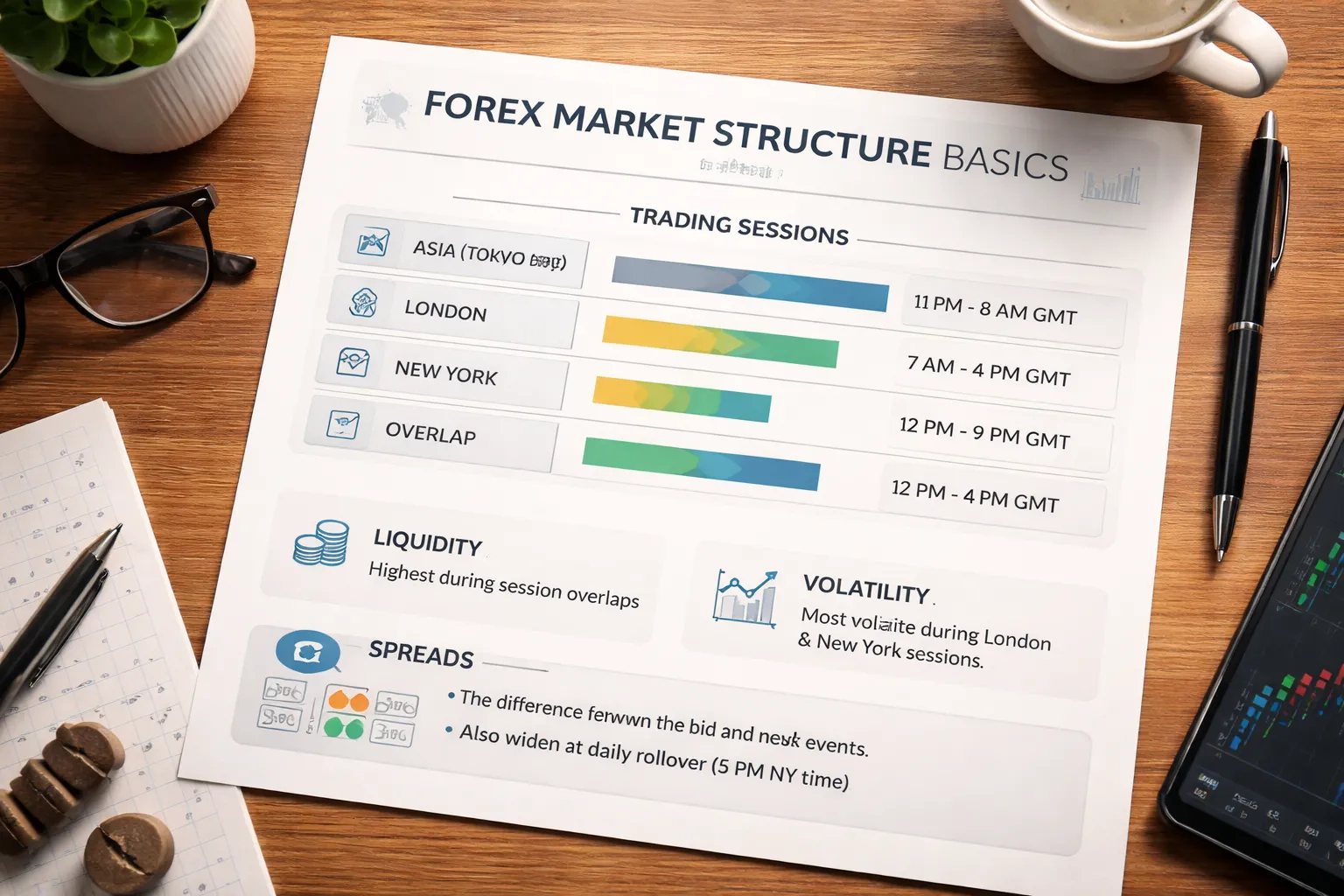
Market structure basics that reduce confusion
Many “mistakes” come from not knowing what changes during the day. Start with structure. It reduces surprise.
- Pairs: Each pair moves differently. EUR/USD often trades with tighter spreads than exotic pairs. GBP pairs often swing more. JPY pairs can move fast around rate news.
- Sessions: Liquidity shifts by time of day. London and New York overlap often brings the most volume. Asia can move slower in many majors, with exceptions like JPY pairs.
- Volatility: Volatility expands and contracts. Your stop and position size must adapt. A stop that works in a quiet market can fail in a fast market.
- Spreads and costs: Spread is part of your loss at entry. Wider spreads raise your break-even point. Spreads often widen around rollovers, session transitions, and major news.
Basic checks prevent common errors. Know your active session. Know typical spread for your pair at that time. Know today’s event risk. Then size the trade to match the current volatility and your fixed risk rule.
Mistakes in expectations and goals
Chasing quick profits and unrealistic monthly return targets
Many beginners set a fixed monthly return goal. They force trades to hit it. That leads to overtrading, higher leverage, and poor entries.
Forex returns do not arrive in a straight line. Your month can end negative even if your process works. Judge performance by execution and risk, not by a calendar target.
- Set process goals. Example, follow your plan on every trade, risk the same fixed percent, and stop after your daily loss limit.
- Track drawdown, not just profit. If your max drawdown doubles, your risk is too high for your edge.
- Use expectancy, not hope. Expectancy = (win rate x average win) minus (loss rate x average loss). If it is negative, no return target matters.
| Goal type | Bad target | Better target |
|---|---|---|
| Return | Make 10% this month | Focus on consistency, let returns follow |
| Risk | Increase lot size to catch up | Risk a fixed percent per trade, keep max daily loss |
| Execution | Trade every day | Trade only when your setup appears |
Treating Forex like a lottery instead of a probability business
Lottery thinking shows up as big position sizes, random entries, and holding losses because you want a miracle reversal. You stop trading your edge. You start betting.
Professional trading looks boring. You take small losses often. You press only when your setup meets your rules. You accept that any single trade can lose.
- Define your edge in one sentence. Example, trade trend continuation after a pullback to a key level, with a volatility based stop.
- Predefine loss. Place a stop where your setup fails, not where you feel pain.
- Run samples. Evaluate your results after at least 50 to 100 trades, not after a week.
- Journal outcomes. Log setup, entry, stop, target, and rule breaks. Use a trading journal template to stay consistent.
Switching strategies too soon (strategy-hopping) before gathering enough data
Strategy-hopping happens when you quit after a normal losing streak. You never reach the sample size needed to know if the method works. You keep paying spreads and mistakes while learning nothing.
Every strategy has variance. Even a strong edge can lose several trades in a row. If you change systems during drawdown, you lock in losses and restart the learning curve.
- Write hard rules. Entry trigger, stop method, target method, and when you skip a trade.
- Commit to a test window. Trade it for a fixed sample size, not a fixed number of days.
- Change one variable at a time. If you change session, pair, timeframe, and stop style at once, you cannot find the cause.
- Separate method from execution. If most losses come from rule breaks, the strategy is not the first problem.
| What you change | What happens | Fix |
|---|---|---|
| Strategy every week | No usable data, constant reset | One strategy, one market, one timeframe for a full sample |
| Multiple tweaks at once | No clear feedback loop | Test one change, track results |
Ignoring time horizon fit (scalping vs day trading vs swing trading)
Your time horizon must match your schedule, focus, and risk tolerance. If you scalp without speed and discipline, spreads and slippage can erase your edge. If you swing trade but check charts every five minutes, you will interfere with good trades.
- Scalping. Many trades, short holds, tight stops. You need fast execution, low spreads, and strict limits on mistakes.
- Day trading. Fewer trades, intraday holds. You need a clear session plan and rules for news and cutoffs.
- Swing trading. Few trades, multi-day holds. You need wider stops, lower leverage, and comfort with overnight risk and swaps.
| Style | Typical issue for beginners | Practical fix |
|---|---|---|
| Scalping | Costs dominate small targets | Trade only the tightest spread sessions, demand clean fills |
| Day trading | Overtrading during slow hours | Trade set windows, stop when no setup appears |
| Swing trading | Position too large for stop size | Reduce size, accept wider stops, plan around event risk |
Pick one time horizon. Build rules around it. Then measure results from that lane only.
Planning and strategy mistakes
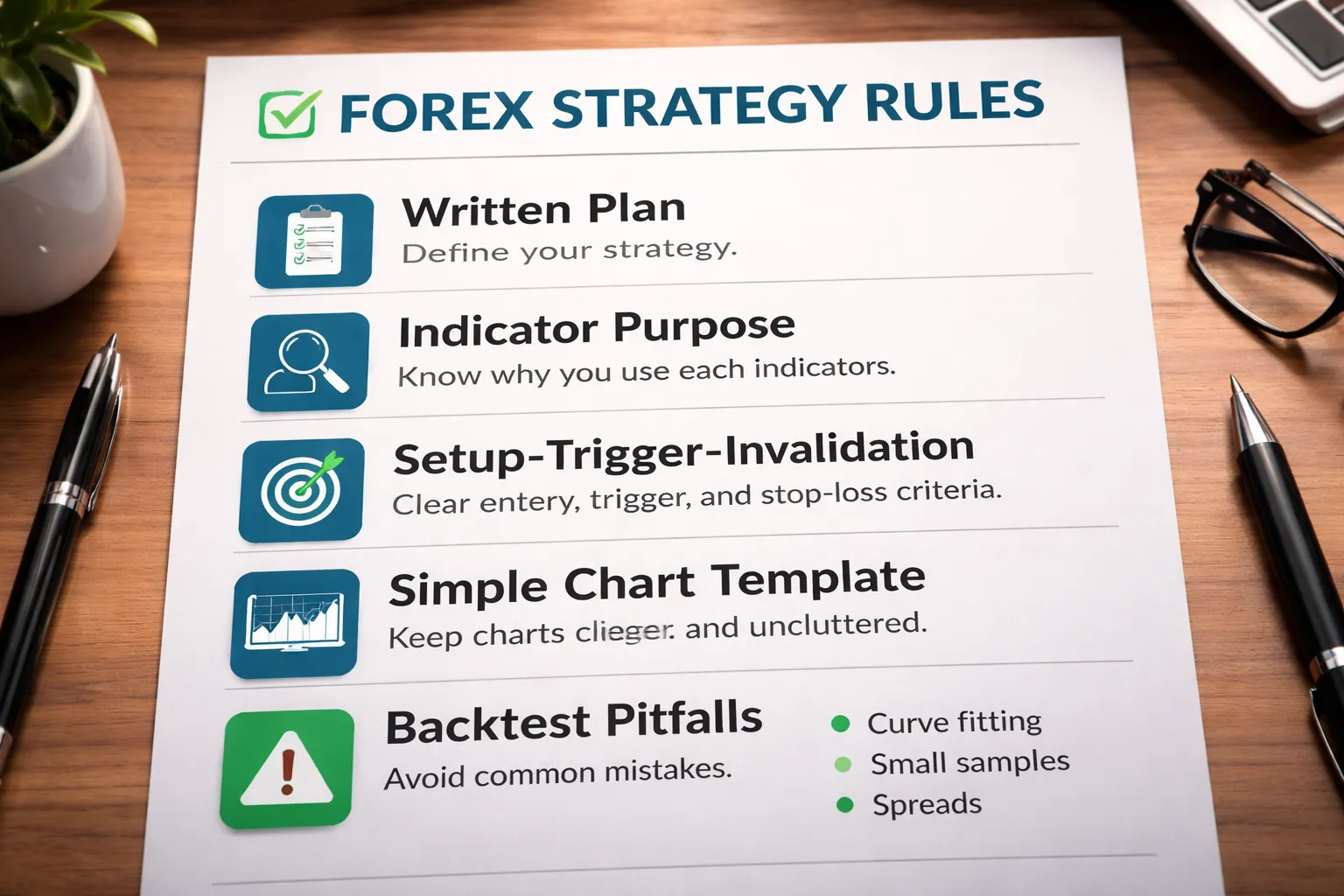
Trading without a written plan
If you cannot write your rules, you do not have rules. You have impulses. Your plan must remove decisions during the trade.
- Markets: List the exact pairs you trade. Avoid adding pairs midweek.
- Sessions and times: Define your trading window in platform time. Example, London open to first 2 hours of New York. Do not trade outside it.
- Entry conditions: Write what must be true before you place an order. Include trend context, level type, and volatility filter.
- Trigger: Define the one event that executes the trade. Example, candle close beyond a level, then pullback retest.
- Stop loss: Place it where your idea is invalid. Do not move it wider after entry.
- Take profit and management: Define targets, partials, and exit rules. Keep it mechanical.
- Risk per trade: Set a fixed percent or fixed currency risk. Keep it constant until you have a large sample.
- Daily limits: Max trades per day, max loss per day, and a hard stop time.
Keep the plan on one page. If you need exceptions, your plan is not a plan.
Using indicators without understanding what they measure
Most indicators compress price into a smoother line. That creates lag. Lag costs you during fast moves and regime changes.
- Know the input: Many indicators use close price only. Your signal ignores intrabar range.
- Know the math: Moving averages and MACD are trend filters, not timing tools. RSI is a momentum oscillator, not a buy low sell high button.
- Respect regime shifts: A setting that works in a clean trend fails in chop. Forex alternates between expansion and contraction.
- Define the job: Use one indicator per job. Trend filter, momentum check, volatility filter. Stop stacking duplicates.
Write what each tool measures and what it does not. If you cannot explain it in one sentence, remove it.
No defined edge: missing setup, trigger, and invalidation
An edge is a repeatable pattern with a reason. You must specify three parts. Setup, trigger, invalidation.
- Setup: The context that creates opportunity. Example, price breaks a range and returns to the broken boundary.
- Trigger: The exact entry event. Example, rejection candle close plus a higher low on the retest.
- Invalidation: The point that proves your idea wrong. Example, a close back inside the range.
If you cannot mark these on a chart after the fact, you cannot trade them live with discipline.
Overcomplicating charts with conflicting signals
More signals create more vetoes. You hesitate. You chase. You change rules midtrade.
- Limit your inputs: One market structure view, one trend filter, one volatility filter.
- Remove contradictions: If one tool says trend and another says mean reversion, you will cherry pick.
- Standardize your layout: Same templates, same timeframes, same markings. Variation hides mistakes.
Complexity feels like control. It usually produces noise.
Backtesting errors beginners make
Backtesting should answer one question. Does your rule set produce a stable result over many trades after costs.
- Curve fitting: You tweak settings until the past looks perfect. Then the live market changes and the edge disappears.
- Small samples: Ten to thirty trades prove nothing. Aim for at least 100 trades per setup before you trust the numbers.
- Ignoring spreads and slippage: Your best backtest is worthless if it assumes perfect fills. Forex costs hit hardest on tight targets and high frequency entries.
- Testing the wrong hours: Results differ by session. Tag trades by time window or your averages lie.
- Not separating regimes: Trend weeks and range weeks produce different outcomes. Track both.
Log every trade with setup tag, session, stop size, and result. Use a simple trading journal template so you can measure your edge without guesswork.
Risk management and leverage mistakes
Risking too much per trade and blowing up from normal drawdowns
Most beginners fail from position size, not entries.
If you risk 5% per trade, a normal losing streak hurts. Ten losses in a row takes you down about 40%. At 10% risk, ten losses cuts you to about 35% of your starting equity. You then need a large gain just to get back to breakeven.
Keep risk small and fixed. Use a percent rule you can repeat.
- Set a max risk per trade. Many new traders stay at 0.25% to 1% until they prove consistency.
- Set a max daily and weekly loss. Example, stop for the day at 2R, stop for the week at 5R.
- Size from the stop. You pick the stop first, then calculate lots. Use a forex lot size calculator so your risk stays constant across pairs.
Misusing leverage and margin (how margin calls happen in practice)
Leverage speeds up both profit and ruin. Margin is the part that forces the exit.
Here is what happens in practice.
- You open a large position.
- Price moves against you.
- Your unrealized loss reduces equity.
- Your used margin stays high because the position stays open.
- Your margin level drops. Your broker blocks new trades first, then liquidates positions at a set threshold.
Margin calls do not require a huge market move. They require a huge position.
- Cap your leverage. Decide a hard max, for example 2:1 to 5:1 effective leverage, and enforce it.
- Keep free margin high. Do not run near the broker’s stop-out level.
- Account for spread and swaps. They reduce equity and can push you into a margin event during flat periods.
Skipping stop-losses or moving them farther away to avoid being stopped out
No stop means your risk is unknown.
Moving the stop after entry usually turns a planned loss into an account level problem. It also breaks your stats. Your journal can no longer tell you if the setup works.
- Place the stop when you place the trade. No exceptions.
- Only move stops by rule. Examples, to break even after +1R, or to trail behind a structure point you defined before entry.
- If your stops get hit often, fix the setup. Do not “solve” it by widening the stop without reducing size.
Poor reward-to-risk planning and inconsistent exits
Risk control fails when exits change trade to trade.
If you take 0.5R wins and 1R losses, you need a high win rate to survive. If you aim for 2R but take profits early out of fear, you will not reach the math your backtest assumed.
- Define your exit before entry. Target, stop, and management rules.
- Track R multiples. Measure every result in R so performance stays comparable across different stop sizes.
- Keep one main exit model. Example, fixed 1.5R target, or partial at 1R then trail, but keep it consistent for a sample size.
Averaging down and adding to losing positions without a rule-based plan
Averaging down increases exposure while your trade thesis loses.
Without strict rules, it becomes a leverage trap. Your average price improves, but your margin and downside grow.
- Do not add to a loser by default. Treat it as a separate strategy that needs testing.
- If you use adds, predefine them. Entry levels, max number of adds, total max risk, and the exact invalidation level.
- Keep total risk capped. If you add size, you must reduce risk elsewhere, or your risk per idea explodes.
Ignoring correlation and concentration risk across pairs (USD exposure stacking)
Many pairs move together. Your account can hold one trade idea in five wrappers.
Example. Long EURUSD, long GBPUSD, short USDJPY, long AUDUSD. You stacked short USD risk across four positions. A single USD rally can hit all stops in the same hour.
- Measure exposure by currency, not by pair count. Track how much USD, EUR, JPY you effectively hold.
- Set a max risk per theme. Example, 2R total across all USD trades combined.
- Avoid duplicate trades. If two pairs give the same signal and share the same driver, take the best one and skip the rest.
- Review correlation during the week. Correlations shift around major events and risk-on, risk-off moves.
Execution mistakes that quietly drain accounts
Overtrading, taking marginal setups outside your edge
Overtrading usually looks harmless. One extra trade. Then another. Your win rate drops because you take weaker versions of your setup.
- Define a daily and weekly trade cap. Example, max 3 trades per day, max 10 per week.
- Use an A, B, C grade checklist. You trade only A setups. You log B and C setups without taking them.
- Track “edge compliance,” not P and L. Percentage of trades that met every rule. Aim for 90%+.
- Stop after hitting your loss limit. Example, stop trading for the day at -2R.
Revenge trading after a loss and doubling risk to get it back
Revenge trading is a risk error first. A strategy error second. You raise size after a loss to recover faster, then you hit a larger drawdown.
- Lock your risk per trade. Use a fixed R, not a feeling.
- Add a cooldown rule. After any -1R loss, wait 30 to 60 minutes or skip the next signal.
- Ban immediate re-entry. No new trade in the same pair within X candles unless your rules require it.
- Pre-plan your response. If you feel the urge to “make it back,” you stop for the day.
- Journal the trigger. One line, what happened, what you felt, what you did. Use a simple trading journal template so you do it every time.
FOMO entries and late chasing after the move already happened
Late entries wreck your trade location. You buy after expansion, then your stop must go wider or your stop sits in noise. Either way, your R-multiple drops.
- Set an entry deadline. Example, if price moves more than 0.5 ATR from your planned entry, you cancel the trade.
- Use limit orders for planned levels. If you miss it, you miss it.
- Require a pullback structure. No pullback, no trade.
- Measure “slippage from plan.” Planned entry vs actual entry in pips. If the gap grows, your process slips.
Letting spreads, slippage, and liquidity conditions ruin entries and exits
Many beginners “backtest” mid prices, then trade real spreads. Costs compound. Slippage spikes around news, session opens, and thin liquidity. Your stop gets hit earlier, your take profit fills worse, and your expectancy drops.
- Set a max spread rule. Example, do not enter if spread is above your 20-day median plus a buffer.
- Avoid market orders in thin conditions. Use limit orders, or reduce size.
- Widen stops only if your system requires it. Do not widen stops to “fit” a bad fill.
- Track effective cost per trade. Spread plus slippage in pips, convert to R. If trading costs exceed 0.1R often, you have a structural problem.
- Watch the calendar for liquidity traps. Major data releases, rollover, holidays, and end of month flows.
| Execution issue | What you see | Rule to prevent it |
|---|---|---|
| Wide spread | Entry starts negative and stays negative longer | Max spread filter before entry |
| Slippage | Fill far from your price, stops hit faster | No market orders near high-impact news |
| Thin liquidity | Erratic spikes, poor fills, gaps | Trade only your active session window |
Trading during the wrong session for your strategy
Session choice changes volatility, spread, and follow-through. If your setup needs movement and you trade dead hours, you get chop. If your setup needs stable conditions and you trade the most volatile window, you get stop-outs.
- Match strategy type to session. Breakouts often work best during London and New York overlap. Mean reversion often needs stable ranges and tighter spreads.
- Define your trading hours. Example, only 2 to 3 hours per day, same window.
- Measure average range by hour. Use ADR or ATR-by-hour. Trade only when range supports your target.
- Stop trading during low-volume transitions. Late New York, pre-Asia, holidays, and post-news drift.
Not accounting for swap and rollover costs on multi-day positions
Swap seems small until you hold positions for weeks or you trade high-rate differentials. It can flip a marginal strategy negative. It can also force you out early if you hold through triple-swap days.
- Check the swap before you enter. Know if you pay or receive on long and short.
- Plan for holding cost in your expectancy. Add projected swap to your trade plan and R-multiple.
- Watch triple-swap timing. Many brokers charge triple swap midweek. Confirm the day and time on your platform.
- Avoid carrying positions with negative swap without an edge buffer. If your expected edge is small, swap can erase it.
Psychology and mindset mistakes
Turning trading into entertainment
Entertainment trading looks like action without a plan. It feels good in the moment and ruins your numbers over time.
Gambling mindset signals to watch for
- You trade when you feel bored, stressed, or restless.
- You increase size after a win to press the feeling.
- You take setups outside your plan because they look “clean.”
- You open extra trades to get back to breakeven faster.
- You check P and L more than your entry criteria and risk.
- You hold losers because closing feels like losing.
How to avoid it
- Write a hard entry checklist. If one item fails, you do not trade.
- Set a daily max loss and a max number of trades. Stop when you hit either.
- Use limit orders and alerts. Reduce impulse clicks.
- Size every trade from a fixed risk rule, then calculate it before entry with a forex lot size calculator.
Fear of taking valid trades after losses
Losses can train you to avoid the next signal. You start waiting for “extra confirmation.” You miss the entry, chase late, or skip the trade and watch it run.
What it looks like
- You hesitate after your trigger prints.
- You move your entry farther away to feel safer.
- You reduce size randomly, then increase it on the next trade.
- You stop trading right before the best sessions for your system.
How to avoid it
- Predefine your next trade. Same setup, same risk, same execution steps.
- Use an “if then” rule. If the checklist passes, then you place the order within a set time window.
- Track execution quality, not P and L, for the next 20 trades. Grade only process.
- Cut your trading frequency for a week, not your standards. One clean trade beats five hesitant ones.
Ego trading, needing to be right
Ego turns trading into a debate. You defend an idea instead of managing a position. That leads to late exits, no exits, and oversizing.
Common behaviors
- You add to losers to “prove” your read.
- You move the stop because the market “should not” go there.
- You take profit early to lock a win and avoid being wrong later.
- You argue with your plan after entry.
How to avoid it
- Define invalidation before entry. Your stop marks the point where your idea failed.
- Use fixed risk per trade. Your identity does not set your position size.
- Measure performance in R multiples and drawdown, not win rate.
- Review trades like a checklist audit. Remove “I felt” from your notes.
Confirmation bias
Confirmation bias makes you collect supporting evidence and ignore conflict. You keep looking until you find something that justifies the trade.
Where it shows up
- You switch timeframes until one agrees with your view.
- You follow only analysts who share your bias on a pair.
- You ignore key levels because they do not fit your thesis.
- You treat news as validation, not risk.
How to avoid it
- Add a forced disproof step. List two reasons not to take the trade.
- Define one primary timeframe and one confirmation timeframe. No more.
- Use a standard pre trade template that includes “what would prove me wrong.”
- Track outcomes by setup and market regime. Let stats, not opinions, decide.
Decision fatigue and burnout from constant screen time
Staring at charts drains your focus. Your standards slip. You take weaker setups. You miss strong ones. You start reacting.
Signs you are fatigued
- You break rules late in the session.
- You feel urgency to trade when price moves fast.
- You keep adjusting orders without new information.
- You trade more but your average R falls.
How to avoid it
- Trade set sessions only. Use a start time and a hard stop time.
- Limit chart checks to scheduled scans, for example every 15 or 30 minutes.
- Automate what you can, alerts for levels, preset order tickets, saved templates.
- Set a rule for stopping after consecutive losses, or after a max time on screen.
- Keep a short post session review. Then step away. Recovery is part of edge.
News and macro mistakes beginners make
Trading major news releases without a plan
Beginners treat NFP, CPI, and rate decisions like easy money. They click fast and hope the spike picks a direction. This fails because spreads widen, liquidity thins, and price jumps past your levels. Slippage turns a small risk into a large loss.
Set rules before the release. Write them down.
- Choose a mode. Trade it, or stand down. Do not decide in the last minute.
- Know your broker conditions. Expect wider spreads and worse fills. Assume stops can slip.
- Reduce size. Cut risk per trade for news. A normal stop may not behave like a normal stop.
- Use time filters. Avoid entries in the final 1 to 5 minutes before the number. Avoid chasing the first spike.
- Plan your invalidation. Define the price level that proves you wrong, not a random pip count.
- Use bracket orders only if tested. If you place buy stop and sell stop orders, accept you can get slipped into the worse side, or filled then reversed.
- Limit attempts. One trade idea per release. No rapid re-entries.
Confusing economic calendars: impact levels, timing, and revisions
Calendars look simple. They hide details that matter. Beginners miss time zones, mix up “tentative” times, and ignore revisions. They also treat “high impact” as a trade signal. It is not.
- Lock the time zone. Set your calendar to your local time and confirm it weekly. Watch DST shifts.
- Read the event line fully. Some releases have multiple parts, like CPI headline vs core, and MoM vs YoY.
- Track prior, forecast, and actual. Price reacts to the gap between actual and expectations, not the number alone.
- Respect revisions. GDP, employment, and inflation series can revise. A revision can move price like a fresh miss.
- Know the lag. Some data matters because it shifts rate expectations, not because it describes last month.
| Calendar item | Common beginner mistake | Fix |
|---|---|---|
| Impact label | Assume “high impact” means “trade it” | Use it as a risk flag, adjust size or stand down |
| Release time | Miss DST or use the wrong time zone | Set one time zone and verify on Sunday |
| Forecast vs actual | Trade the number, ignore expectations | Compare actual to forecast and prior, then act |
| Revisions | Ignore revised prior prints | Check revision fields and headlines |
Overreacting to headlines vs understanding expectations and surprises
Headlines move fast. Beginners read one line, hit buy or sell, and get trapped on the retrace. You need context. Markets price expectations first. They move on surprises.
- Know the consensus. Check the forecast range, not just the single forecast number.
- Focus on surprise size. A small beat can fade. A large beat can trend.
- Watch the second wave. The first spike often reflects liquidity gaps. The follow-through shows real positioning.
- Separate data from interpretation. CPI can beat and still drop a currency if the market expected more, or if core cools.
- Do not trade headlines you cannot verify. One false alert can wreck your day.
If you cannot size risk cleanly in a fast market, you should not trade it. Use a lot size tool and lock your risk before you enter. See our lot size calculator.
Ignoring central bank regime shifts and risk-on, risk-off environments
Beginners trade the same setup in every macro regime. They ignore that central banks change the rules. When inflation dominates, rates drive FX. When growth fear dominates, safety flows drive FX. Your old playbook stops working.
- Define the regime. Ask what the market trades most, inflation, growth, or financial stress.
- Track the rate path. Follow expected cuts and hikes, not just the latest decision.
- Respect guidance. A hold with hawkish guidance can move more than a small hike.
- Map risk-on and risk-off. In risk-off, JPY and CHF often strengthen, high beta currencies often weaken. Correlations tighten.
- Avoid fighting the bank. Do not fade a fresh hiking cycle trend until you see clear evidence of a turn.
- Reduce exposure across correlated pairs. Five USD trades can act like one large USD bet.
Keep one macro page in your plan. Current central bank bias. Next key data. Current risk tone. Update it weekly. Trade less when the regime shifts. Protect your capital while you learn the new rules.
Broker, platform, and account setup pitfalls (often overlooked)
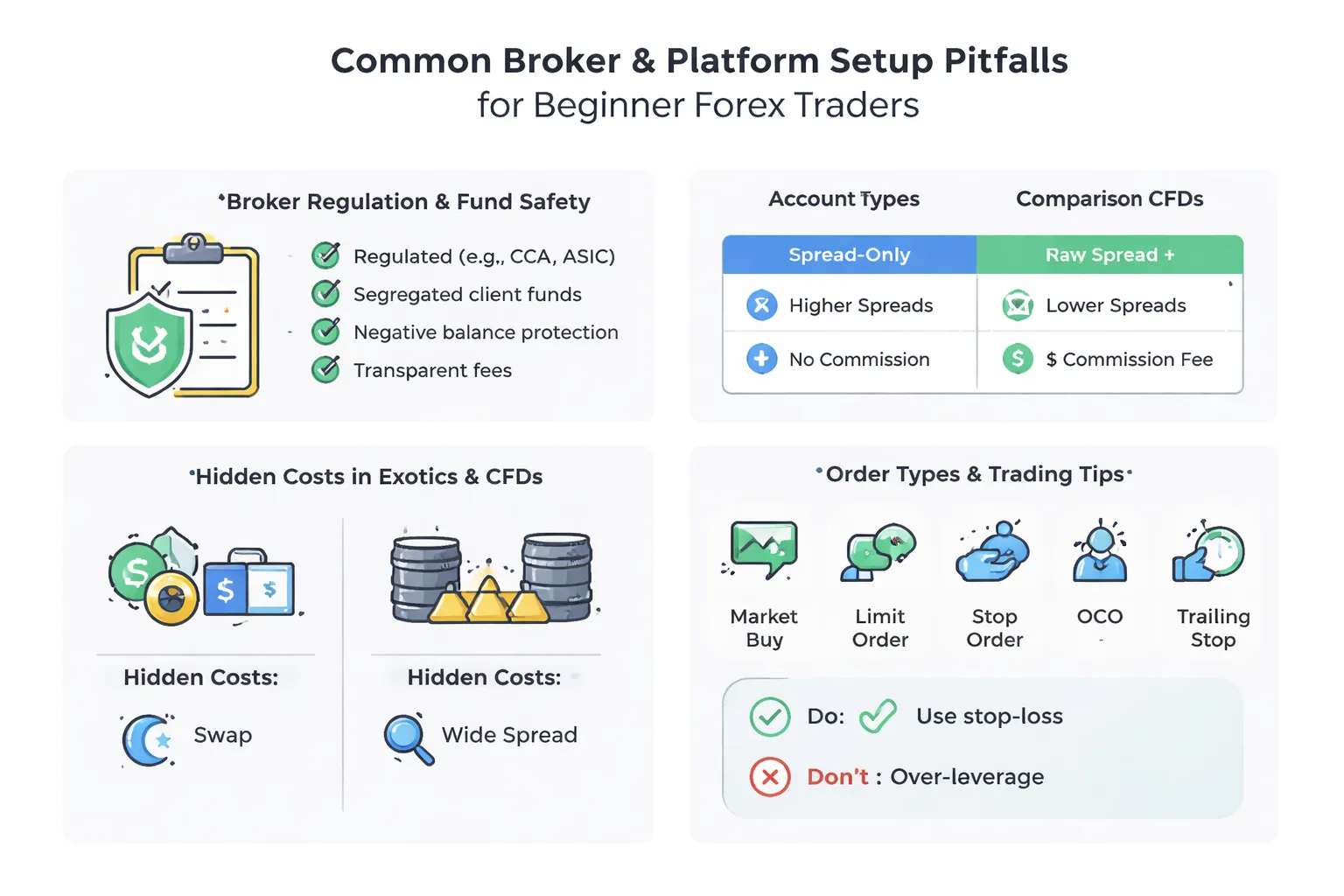
Choosing an unregulated broker or ignoring fund safety protections
Many beginners pick a broker for bonuses, high leverage, or a slick app. You should start with regulation and fund safety.
- Check regulation first. Use the regulator register, not the broker website. Confirm the legal entity name matches your account paperwork.
- Know where your money sits. Look for segregated client funds. Avoid brokers that pool client money with operating cash.
- Understand your protection level. Some regions offer compensation schemes, others do not. Do not assume you will get reimbursed after a broker failure.
- Read the deposit and withdrawal rules. Check fees, processing times, and limits. Test a small withdrawal early.
- Watch the “dealing desk” fine print. A broker can act as your counterparty under market maker models. That can be fine, but you must understand the incentives.
Minimum due diligence: verify regulation, confirm segregated funds, test support response, then deposit small.
Picking the wrong account type (spread vs commission, execution model basics)
Your costs come from spreads, commissions, and swaps. The account type decides how you pay.
| Account choice | What you pay | Common beginner mistake | Fix |
|---|---|---|---|
| Spread-only | Wider spread, no separate commission | Trading small targets where spread eats the edge | Use higher timeframes or larger targets, compare average spreads during your trading hours |
| Raw spread + commission | Tighter spread, commission per lot | Ignoring commission in backtests and journaling | Add commission to every trade result, compare all-in cost in pips |
| Market maker | Spread can be stable, broker may internalize flow | Assuming “no slippage” means best execution | Track fill quality, requotes, and rejected orders around news |
| STP/ECN style | Variable spread, slippage possible, often commission | Placing market orders in thin liquidity and blaming the platform | Use limit entries when you need price control, avoid illiquid hours |
Compare accounts using all-in cost. Convert commission into pips and add average spread. Then check swap rates if you hold overnight.
Trading instruments you don’t understand (exotics, CFDs) and hidden costs
Beginners blow up faster when they leave major pairs and simple spot FX.
- Exotic pairs. They often carry wide spreads and sharp gaps. A “small” position can behave like a leveraged bet because the spread is large relative to your stop.
- CFDs. Index, metal, and crypto CFDs can move differently than FX. They also carry their own contract specs, margin rules, and trading hours.
- Swap and rollover. Overnight financing can dominate your P and L on long holds. Triple-swap days can surprise you.
- Contract specs. Lot size, pip value, minimum stop distance, and tick size change by instrument. If you guess, you mis-size risk.
Before you trade any new symbol, read the contract spec page. Write down spread range, typical volatility, swap rate, and market hours. If you cannot explain your cost per trade in pips and dollars, skip it.
Platform order types beginners misuse (market, limit, stop, OCO, trailing stops)
Order type errors create bad fills and random risk.
- Market orders. You accept the next available price. Use them when execution matters more than price. Avoid them in fast markets and around major data.
- Limit orders. You set price. You may miss the trade. Use limits when you need price control and can accept no fill.
- Stop orders. They trigger a market order once price hits your level. Expect slippage in spikes. Do not place stops at obvious levels without a buffer.
- Stop-loss vs take-profit confusion. Many beginners flip them on buy and sell tickets. Double check the exact price level and direction before you send.
- OCO orders. One-cancels-the-other reduces mistakes on breakouts and bracket setups. Use OCO to avoid being filled both ways.
- Trailing stops. They follow price by a set distance. They can cut you out in normal noise. Use trailing stops only after price clears a level that changes the trade.
Build a pre-trade checklist inside your workflow: order type, entry, stop, target, position size, and time-in-force. Log slippage and rejected orders in your journal. Use a simple journaling template so you spot platform and execution issues early.
Not using a demo or micro account correctly (how to simulate realistic conditions)
Demo can help, but only if you treat it like real trading. Most beginners do not.
- Use realistic balance and leverage. Match your planned deposit. Keep leverage at the broker setting you will use live.
- Trade one strategy only. Do not hop systems each day. Run a minimum sample size, then review.
- Include real costs. Track spread, commission, and swap. Demo fills can look cleaner than live. Assume some slippage on stops.
- Simulate your schedule. Trade the same sessions you will trade live. Do not cherry-pick perfect hours after the fact.
- Graduate to micro. After consistency on demo, trade micro lots with real money. Focus on process, not profit.
Goal for demo and micro: prove you can follow rules for 20 to 50 trades. If you cannot execute your plan when stakes are low, you will not execute it when stakes rise.
A practical routine to avoid common Forex trading mistakes
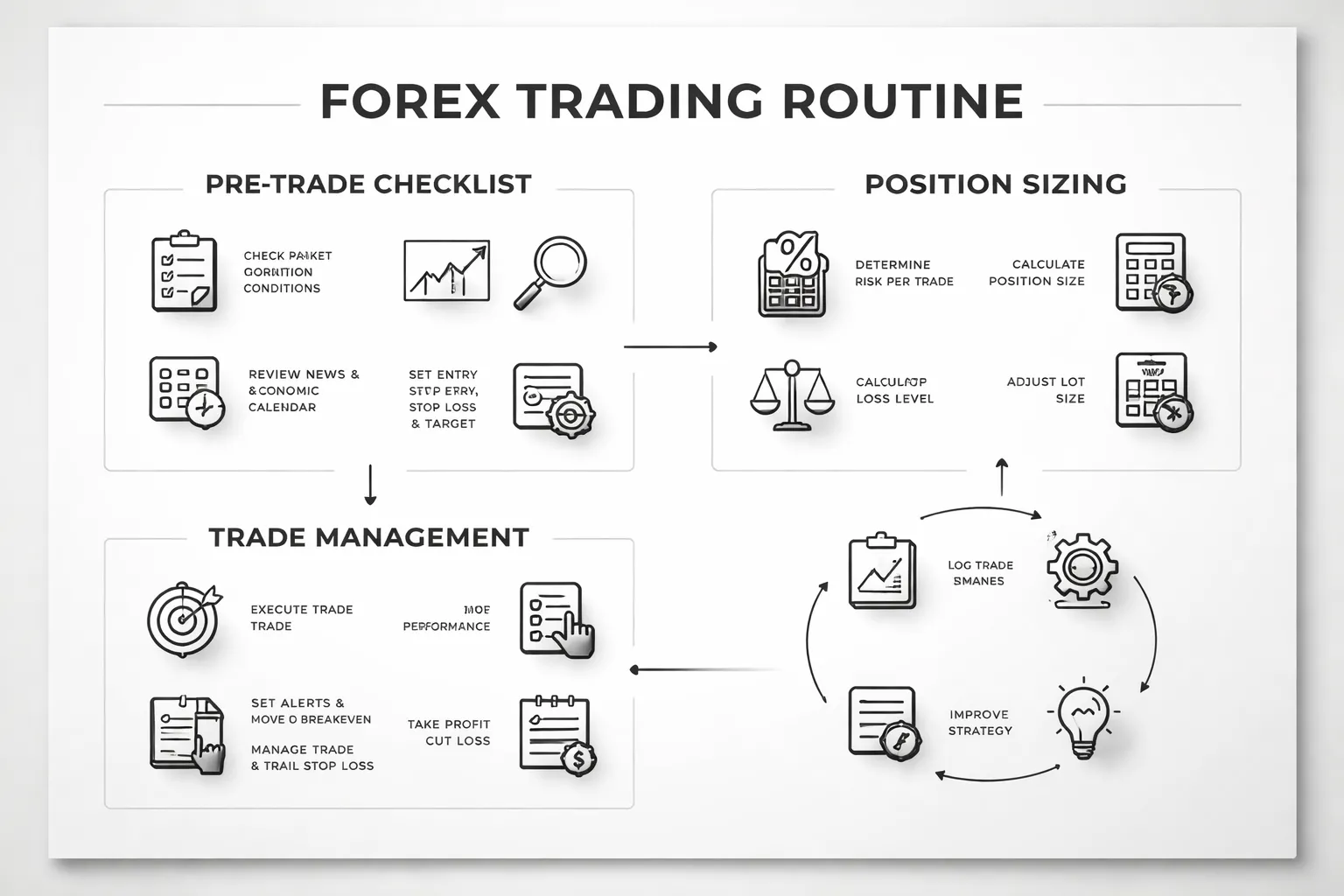
Pre-trade checklist
Run the same checklist before every trade. If one item fails, you do not trade.
- Market condition: Trending or ranging. Do not trade a trend setup in a range. Do not trade a range setup in a trend. Mark key support and resistance. Note the session and liquidity.
- Setup quality: Your exact pattern. No near-misses. You need a clear trigger, clear invalidation, and space to target. If you cannot point to the rule on your plan, it is not a setup.
- Risk check: Define stop first. Confirm your risk per trade and maximum daily loss. Skip the trade if the stop must be too wide for your rules.
- Timing filters: Trade only your planned sessions. Avoid entries right before high-impact news if your plan does not include it. Avoid low-volume hours where spreads widen and fills worsen.
Position sizing framework
Use fixed fractional risk. Pair it with volatility-based stops so your risk stays stable across pairs and conditions.
- Fixed fractional risk: Risk a fixed percent of your account per trade. Most beginners should stay near 0.25 to 1.0 percent. Pick one number and keep it for 20 to 50 trades.
- Volatility-based stop: Place your stop where the trade idea breaks, then sanity-check it against current volatility. If normal price movement will hit your stop, the stop is too tight. If the stop is so wide that your position size becomes tiny or your target becomes unrealistic, skip the trade.
- Hard limits: Set a max leverage cap and a max open risk cap. Example, never risk more than 1R total across all open trades if you tend to stack correlated pairs.
Keep sizing mechanical. Use a forex lot size calculator so you stop guessing.
Trade management rules
Manage the trade with rules. Do not improvise because the P and L moves.
- Before entry: Write down entry, stop, target, and what would make you exit early. If you cannot write it in one line, you do not understand the trade.
- When to leave it alone: If price behaves as expected and no rule triggers, do nothing. Most damage comes from moving stops to avoid a loss or taking profit early out of fear.
- When to trail: Trail only after price confirms the move. Use one trailing method, not three. Example methods, behind the last swing, behind a moving average you already use, or by a fixed multiple of recent volatility. Pick one and apply it the same way each trade.
- When to scale out: Scale out only if your plan includes it. Use fixed levels. Example, take partial at 1R, move stop to breakeven only after a structure break. Do not scale out because you feel nervous.
- What you never do: Add to a losing position. Widen the stop to avoid taking the loss. Re-enter without a new valid setup.
Post-trade review process
Review every trade the same day. Keep it short. Focus on errors you can fix.
- Log the facts: Pair, session, direction, entry, stop size in pips, position size, planned R, realized R, screenshots at entry and exit.
- Tag mistakes: Use a small set of tags so you can count them. Examples, early entry, late entry, moved stop, no setup, news trade, over-risk, revenge trade, ignored session rule.
- Track metrics that matter: Rule-follow rate, average R, win rate, average win in R, average loss in R, max drawdown in R, and expectancy in R. Track per setup type, not just overall.
- Improvement loop: Each week, pick one mistake tag to reduce. Write one rule change or one checklist addition. Test it for the next 20 trades. Do not change five things at once.
One-page trading plan template
Keep your plan to one page. If you need more space, you have too many rules.
| Markets | Pairs you trade. Pairs you avoid. Correlation rule. |
| Sessions | Exact trading windows. No-trade hours. |
| Setup | Entry trigger. Required confluence. What invalidates the idea. |
| Risk | Risk per trade percent. Max daily loss in R. Max weekly loss in R. Max open risk. |
| Stop and target | Stop placement rule. Minimum target rule in R. Conditions to skip due to stop size. |
| Management | When you trail. How you trail. If you scale out, where and how much. |
| Execution | Order type. Spread and slippage limits. News filter rule. |
| Review | Journal fields. Mistake tags. Weekly metric review and one change to test. |
Your goal stays simple. Follow this routine for 20 to 50 trades on demo or micro. If your rule-follow rate is low, you do not need a new strategy. You need fewer decisions.
Common “fixes” that backfire (and what to do instead)
Adding more indicators instead of improving decision rules
More indicators feel like more certainty. They usually add more conflicts.
You get late entries, missed trades, and constant setting changes. Your results stay random because your decisions stay random.
Do this instead.
- Pick one trigger and one filter. Example, a breakout trigger, trend filter from a higher timeframe.
- Write the rule in yes or no form. “If X, then enter. If not, no trade.”
- Define the invalidation point first. Your stop goes where your idea is wrong, not where it feels safer.
- Limit your chart to what you execute. Price, key levels, one indicator max.
- Track rule-follow rate. If you break rules, remove steps. Do not add tools.
Widening stop-losses to avoid losses rather than improving entries
A wider stop reduces the chance you get stopped out. It also increases the size of each loss.
If you keep position size the same, your risk per trade jumps. If you keep risk per trade the same, your position size shrinks and your edge must work harder.
Do this instead.
- Set the stop based on structure. Beyond the swing, beyond the level, beyond the invalidation.
- Enter closer to invalidation. Use a limit entry at a level, or wait for a pullback, or require a clear trigger candle near the level.
- Keep risk fixed. Risk a set percent or dollar amount, then calculate size from stop distance.
- Measure stop quality. Tag stop-outs as “good stop” or “bad entry.” Fix bad entries, not good stops.
- Use a position size tool. A forex lot size calculator keeps risk stable when your stop changes.
| Action | What happens | Better move |
|---|---|---|
| Widen stop, same lot size | Higher risk per trade, deeper drawdowns | Keep risk fixed, recalc position size |
| Widen stop, same risk | Smaller size, weaker payoff when right | Improve entry location and selectivity |
Martingale and recovery systems that amplify risk
Recovery systems promise fast comebacks. They work until they fail. Then they fail big.
Doubling down turns a normal losing streak into a margin event. Forex produces streaks. Your system must survive them.
Do this instead.
- Use a max loss limit. Daily stop, weekly stop, and a max drawdown stop where you pause and review.
- Keep risk per trade flat. Same risk on trade one and trade ten.
- Lower risk after poor execution. If you broke rules, cut risk or stop trading. Do not increase it.
- Plan for streaks. Assume you can take 6 to 10 losses in a row and still trade normally.
- Scale up only after rule compliance. Increase size after you hit a rule-follow target over a fixed sample.
Copy trading without understanding risk controls and drawdown behavior
Copy trading hides the decision process. You inherit someone else’s risk.
Many providers run high leverage, average down, or hold deep drawdowns. Your account can blow up even if the history looks smooth.
Do this instead.
- Check max drawdown and time to recover. You need both. A 30 percent drawdown that takes months to recover can break your plan.
- Match risk to your account, not theirs. Use a hard cap on risk per trade and a max open exposure limit.
- Audit leverage and position concentration. One pair, one direction, multiple entries can create hidden leverage.
- Require a stop-loss policy. No clear stop rules, no copy.
- Start with small allocation. Treat it like a test. Review weekly and stop if rules change.
- Learn the playbook. If you cannot explain entry, exit, and risk limits, you cannot control the outcome.
FAQ
What are the most common forex trading mistakes beginners make?
Overleveraging, no stop-loss, and no written plan. You also chase moves, move stops, and add to losers. You trade too many pairs and ignore correlation. You risk too much per trade and size positions by feeling, not math.
Why is a stop-loss policy non-negotiable?
A stop-loss caps damage when you are wrong. It keeps one trade from breaking your account. Set the stop before entry, then size the trade to that stop. Do not widen the stop. Exit when price hits it.
How much should you risk per trade as a beginner?
Keep it small. Many beginners use 0.25 to 1.0 percent of account equity per trade. Your goal is survival and clean execution. If you cannot take 20 losses in a row and keep trading, you risk too much.
How do you stop overtrading and revenge trading?
Set hard limits. Max trades per day, max losses per day, and max open exposure. After you hit a limit, you stop. Use a cooldown rule. Wait a fixed time, then review your plan before the next trade.
Is high leverage always a mistake?
High leverage becomes a mistake when you use it. Brokers may offer 30:1 or 500:1, but your position size sets your real leverage. Track total exposure across pairs. Reduce size when pairs move together.
Should you start with a live account right away?
Start with a demo to learn order types and execution. Then go live with a small allocation. Treat it like a test. Trade one setup, one risk rule, and one journal process. Scale only after consistent rule following.
How do you size trades correctly?
Size from risk, not from lot preference. Pick a stop distance in pips, set a fixed percent risk, then calculate lot size. Use a forex lot size calculator to avoid math errors.
What should you track in a trading journal?
Entry, exit, stop, target, position size, and result in R. Log the setup name, time, pair, and market condition. Record rule breaks. Review weekly. Cut any setup that loses money or triggers repeated mistakes.
Conclusion
Most beginner losses come from process mistakes, not bad luck. You fix them with rules you can follow under stress.
- Trade a written plan. Define your setup, entry trigger, stop placement, and exit rules. Skip trades that do not match.
- Control risk first. Risk a fixed percent per trade. Place the stop before you enter. Size the position to the stop, not your hope.
- Use leverage as a tool. Keep exposure small enough that a normal losing streak does not force you to change your behavior.
- Cut decision volume. Limit pairs, sessions, and trades per day. Reduce signals, reduce mistakes.
- Track outcomes in R. Review weekly. Remove any setup that loses over a sample. Fix any rule break that repeats.
Final tip. Build one repeatable routine and run it for 20 trading days before you change anything. Use a trading journal template, score each trade as followed rules or broke rules, then adjust the rules, not your discipline.
-
- Risking too much per trade and blowing up from normal drawdowns
- Misusing leverage and margin (how margin calls happen in practice)
- Skipping stop-losses or moving them farther away to avoid being stopped out
- Poor reward-to-risk planning and inconsistent exits
- Averaging down and adding to losing positions without a rule-based plan
- Ignoring correlation and concentration risk across pairs (USD exposure stacking)
-
- Overtrading, taking marginal setups outside your edge
- Revenge trading after a loss and doubling risk to get it back
- FOMO entries and late chasing after the move already happened
- Letting spreads, slippage, and liquidity conditions ruin entries and exits
- Trading during the wrong session for your strategy
- Not accounting for swap and rollover costs on multi-day positions
-
- Choosing an unregulated broker or ignoring fund safety protections
- Picking the wrong account type (spread vs commission, execution model basics)
- Trading instruments you don’t understand (exotics, CFDs) and hidden costs
- Platform order types beginners misuse (market, limit, stop, OCO, trailing stops)
- Not using a demo or micro account correctly (how to simulate realistic conditions)
-
- What are the most common forex trading mistakes beginners make?
- Why is a stop-loss policy non-negotiable?
- How much should you risk per trade as a beginner?
- How do you stop overtrading and revenge trading?
- Is high leverage always a mistake?
- Should you start with a live account right away?
- How do you size trades correctly?
- What should you track in a trading journal?
-
-
- Risking too much per trade and blowing up from normal drawdowns
- Misusing leverage and margin (how margin calls happen in practice)
- Skipping stop-losses or moving them farther away to avoid being stopped out
- Poor reward-to-risk planning and inconsistent exits
- Averaging down and adding to losing positions without a rule-based plan
- Ignoring correlation and concentration risk across pairs (USD exposure stacking)
-
- Overtrading, taking marginal setups outside your edge
- Revenge trading after a loss and doubling risk to get it back
- FOMO entries and late chasing after the move already happened
- Letting spreads, slippage, and liquidity conditions ruin entries and exits
- Trading during the wrong session for your strategy
- Not accounting for swap and rollover costs on multi-day positions
-
- Choosing an unregulated broker or ignoring fund safety protections
- Picking the wrong account type (spread vs commission, execution model basics)
- Trading instruments you don’t understand (exotics, CFDs) and hidden costs
- Platform order types beginners misuse (market, limit, stop, OCO, trailing stops)
- Not using a demo or micro account correctly (how to simulate realistic conditions)
-
- What are the most common forex trading mistakes beginners make?
- Why is a stop-loss policy non-negotiable?
- How much should you risk per trade as a beginner?
- How do you stop overtrading and revenge trading?
- Is high leverage always a mistake?
- Should you start with a live account right away?
- How do you size trades correctly?
- What should you track in a trading journal?
-
-
How to Place a Forex Trade Step by Step (Your First Trade Explained)
3 months ago -
Forex Trading vs Crypto Trading: Which Market Is Better for Beginners?
3 months ago -
Forex Lot Size Calculator: How to Use It to Size Trades Correctly
5 months ago -
How to Calculate Position Size in Forex (Position Sizing Formula + Examples)
5 months ago -
Forex Leverage Explained: How It Works, Pros, Cons & Examples
5 months ago
-
Forex Trading Platforms Comparison: MetaTrader vs cTrader vs TradingView
5 months ago -
Is Forex Trading Legal in the United States? Rules, Regulators & What to Know
5 months ago -
Stop Loss vs Take Profit: Differences, Examples & Best Practices
5 months ago -
Forex Market Hours & Trading Sessions Explained (Best Times to Trade)
5 months ago -
Forex Leverage Explained: How It Works, Pros, Cons & Examples
5 months ago