How to Trade Forex News (NFP, CPI, FOMC) Without Getting Wrecked

News trading can wipe out your account in minutes. Spreads jump. Slippage hits. Liquidity vanishes. Your stop fills late. Your risk doubles.
This guide shows you how to trade the three FX market movers, NFP, CPI, and FOMC, without gambling. You will learn what each event moves, when the real move starts, and why the first spike often traps traders. You will learn a simple pre-event checklist, specific risk rules for spreads and slippage, and clean execution options for both breakout and post-release pullback setups. You will also learn when to skip the trade and protect your equity.
If you need the bigger framework behind why prices react, start with fundamental analysis in forex.
Key Takeaways
Key Takeaways
- In het kort: Treat NFP, CPI, and FOMC as spread and slippage events first, and chart events second.
- In het kort: The first spike often runs stops, then reverses; you need rules for the first minutes, not opinions.
- In het kort: If you cannot define your maximum loss before the release, you skip the trade.
- In het kort: Pick one execution plan, breakout or post-release pullback, and follow it.
- In het kort: Your edge comes from preparation, clean sizing, and avoiding bad conditions, not from predicting the number.
- Check the calendar. Confirm the exact release time, forecast, and prior print.
- Mark your levels before the event. Use obvious highs, lows, and liquidity pools.
- Expect wider spreads. Assume worse fills than normal. Size down.
- Use hard risk limits. One trade, one idea, one max loss. No averaging.
- Avoid market orders into the first seconds. You pay the worst spread and the worst slippage.
- If you trade breakouts, require structure. A clear break and hold beats a one-candle spike.
- If you trade pullbacks, wait for the real move. Let price retrace into a level, then trade with the trend.
- Skip the trade when spreads stay inflated, price chops, or you do not get a clean retest.
- Track results by event type. NFP whipsaws more, CPI trends more, FOMC changes tone and rates. Treat them differently.
- Link the move to rate expectations. Use this framework to stay focused on what matters, interest rates and currency pricing.
What “Forex News Trading” Really Means (and Why Traders Get Wrecked)
What “Forex News Trading” Really Means
Forex news trading means you trade the repricing of interest rate expectations.
The release is the trigger. The real driver is the path of policy rates and yields.
If you do not link the move to rates, you trade noise.
Some events create clean drift. Some create two-way chaos. Your job is to match tactics to the event.
The Hidden Enemy, Spread Widening, Slippage, and Partial Fills
Your biggest cost on news is execution, not your entry model.
- Spread widening turns a normal 0.8 pip spread into 3 to 10 pips on majors, and more on crosses. Your stop gets closer in real terms.
- Slippage hits market orders and stops. You plan 10 pips of risk, you can take 18.
- Partial fills happen when liquidity thins. You get a worse average price, or you get filled on size that ruins your R multiple.
News candles look tradable on a chart. Your fill often does not match the chart.
If your broker widens spreads and rejects limits during releases, you trade a different market than you backtested.
Why the First Move Is Often a Trap (Stop Runs and Liquidity Vacuum)
The first spike often reflects order flow stress, not information.
- Liquidity pulls before the print. Fewer quotes sit in the book.
- Stops cluster above and below obvious levels. The spike sweeps them.
- Algorithms hit both sides to find liquidity. You see a fast up move, then a fast down move.
This is why chasing the first candle wrecks accounts.
You pay the widest spread, you eat slippage, you enter at the worst point.
Wait for the second phase, the retrace into a level, then confirmation that price can hold and continue.
Volatility vs. Direction, Separating Noise From Information
Volatility is how far price moves. Direction is where it settles.
News can produce high volatility with no direction. That is a bad environment for breakout chasing.
You need a filter that tells you when the market learned something new.
- Does the move align with a change in rate pricing, not just the headline number.
- Does price hold beyond the initial range after the first retrace.
- Do correlated markets confirm, like USD pairs moving together, and rate-sensitive pairs reacting more.
If you want the why behind CPI reactions, read inflation and exchange rates explained.
Common Retail Mistakes, Oversized Leverage, Revenge Trades, and No Scenario Plan
- Oversized leverage. You size for normal spreads and normal slippage. News makes both worse. Your real risk doubles.
- Revenge trades. You take a loss on the spike, then you hit the next candle to get it back. You stack losses inside the highest spread window.
- No scenario plan. You trade the number, not the outcome. You need at least three cases, hot, cold, in-line, and the likely rate reaction for each.
News does not require prediction. It requires rules for execution, sizing, and when to stand down.
Know the Calendar and the Market Context Before Any Release
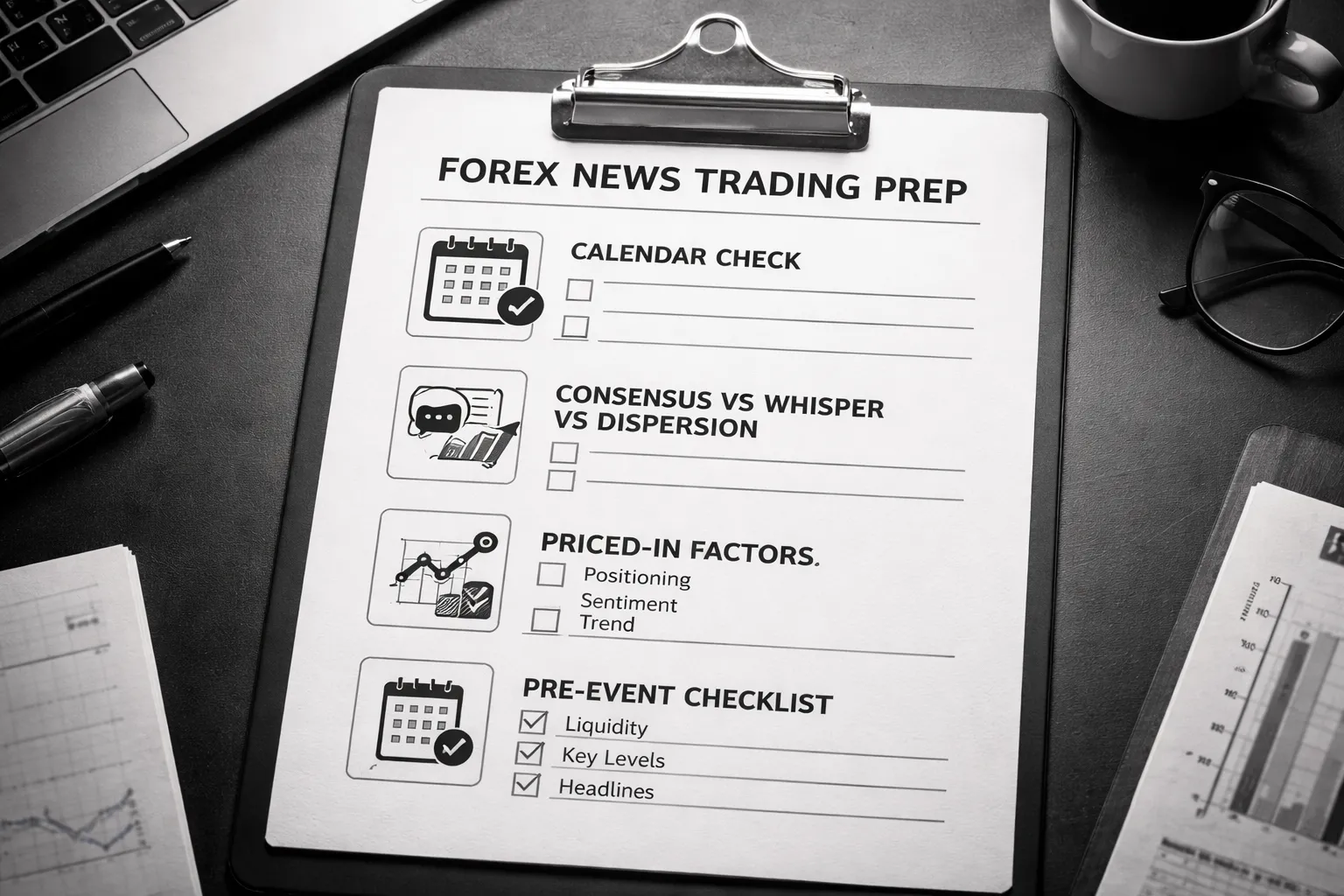
Which events matter most for each pair
Stop treating every release like it moves every pair the same. Map the event to the dominant rate driver of the instrument you trade.
| Instrument | Highest impact releases | What usually drives the first move | What often drives the second move |
|---|---|---|---|
| EURUSD | US CPI, US NFP, FOMC. Then ECB rate decision, Eurozone CPI. | US rate path repricing, USD leg dominates. | Risk tone and relative central bank gap, Fed minus ECB. |
| GBPUSD | US CPI, US NFP, FOMC. Then UK CPI, BoE decision, UK wages. | US front end yields and USD momentum. | UK inflation and wage impulse, BoE pricing, risk swings. |
| USDJPY | US CPI, FOMC, US NFP. Then BoJ decision, Japan CPI, MoF comments. | US yields, especially the 2Y and real yields. | Risk moves and policy headlines, BOJ and intervention risk. |
| XAUUSD | US CPI, FOMC, US NFP. Also US PCE and major risk shocks. | Real yield impulse and USD knee jerk. | Risk sentiment and follow-through in rates markets. |
If you do not track the rate leg for your pair, you trade blind. Learn the core drivers first, then tie the news to those drivers. Use fundamental analysis in forex as your base model.
Reading expectations, consensus, whisper numbers, forecast dispersion
The market trades the gap versus expectations, not the headline. You need three numbers before you size up.
- Consensus. The published median forecast. This is the baseline move trigger.
- Whisper. The number traders lean toward right before the release. It can sit above or below consensus after leaks, components, or recent prints.
- Forecast dispersion. The spread between high and low estimates. Wide dispersion signals low conviction. It often increases whipsaw risk.
Use dispersion to set your aggression. Tight dispersion can create cleaner directional follow-through if the print surprises. Wide dispersion can turn a surprise into chop because nobody had a shared base case.
For CPI, know the focus variable. Sometimes the market prices core CPI more than headline. Sometimes it keys on supercore, services ex shelter, or month over month. For NFP, the market can ignore payrolls if wages or unemployment rate breaks the narrative. For FOMC, the press conference and dots can reverse the first move.
Understanding priced in, positioning, sentiment, trend regime
Priced in means the market already moved to reflect a likely outcome. Then a matching print can still cause a move, but it often fades.
- Positioning. If traders already piled into USD longs, a strong USD print can trigger buy the rumor, sell the fact. An in-line number can dump positions.
- Sentiment. If risk is on, bad data can get ignored. If risk is off, the same data can accelerate the move. Your pair inherits this bias.
- Trend regime. In a strong trend, news often acts as a continuation trigger. In a range, news often spikes both sides, then returns to the mean.
Do not guess positioning from price alone. Use simple checks. Look at the last 1 to 3 sessions into the event. Track whether the pair already ran toward the expected direction. Mark if the move came on thin liquidity or strong volume hours. A thin pre-move breaks easier.
Pre-event checklist, liquidity, key levels, conflicting headlines
Build a checklist you run the same way every time. This stops impulse trades.
- Time and session. Know the exact release time and your broker server time. Know if London or New York is open. Liquidity changes the spike.
- Liquidity conditions. Avoid trading inside holiday sessions, end of quarter fixes, and the first minutes after market open. Spreads widen, fills degrade.
- Key levels. Mark the prior day high and low, Asia range, London high and low, weekly open, and the nearest obvious swing. News moves often anchor to these levels.
- Volatility baseline. Check the average 5 minute and 15 minute candle size from the last week at the same hour. If today already matched an average event move, risk rises.
- Conflicting headlines. Scan for central bank speakers, surprise geopolitical risk, and major earnings or equity gaps. If another driver can override the release, stand down.
- Your scenarios. Hot, cold, in-line. For each, write the expected rate reaction and the likely first instrument to move, yields, DXY, S and P futures.
- Your no-trade rules. Maximum spread, maximum slippage, maximum candle size. If any trip, you skip.
When your calendar plan and your context disagree, you reduce size or do nothing. No trade is a position.
The Three Major Events: NFP vs. CPI vs. FOMC (Different Rules for Each)
NFP: Whipsaw Risk and Two-Sided Liquidity Hunts
NFP is the fastest way to get chopped. The first move often fails. The second move often runs stops.
You see two-sided liquidity hunts because the report is a bundle. Jobs, unemployment, and wages can point different directions. Algos hit both sides while humans interpret.
- Common pattern: spike, snapback, then a real move after 2 to 10 minutes.
- Common trap: you trade the headline payrolls and ignore wages or unemployment.
- Best fit trades: post-spike fade only with clear level and tight invalidation, or delayed breakout after the range forms.
NFP is also revision-heavy. A big miss can get offset by prior-month revisions. Treat revisions as part of the print.
CPI: Sustained Repricing and Trend Continuation Setups
CPI moves rates expectations. Rates expectations move FX. CPI tends to reprice the curve and then trend.
- Common pattern: first impulse, small pullback, continuation for 15 to 90 minutes.
- Common trap: you trade headline CPI while core and services say the opposite.
- Best fit trades: continuation after the first pullback, or break and hold of a key level once spreads normalize.
CPI often produces cleaner direction than NFP because it hits the inflation mandate directly. When the surprise is large, the move can last into the US close.
FOMC: Decision vs. Statement vs. Press Conference Sequencing
FOMC is not one event. It is a sequence. You trade the sequence, not the first headline.
- Step 1, rate decision: usually known. The surprise comes from guidance.
- Step 2, statement: the first real repricing. Words about inflation, labor, and “progress” matter.
- Step 3, dots and SEP: the market maps the path. This can flip the first move.
- Step 4, press conference Q&A: tone can confirm or reverse. Volatility often rises again.
FOMC days produce multiple tradable swings. They also produce the most fake-outs if you treat the first 30 seconds as the final answer.
What Usually Moves First: Yields, DXY, and Index Futures
On US macro news, rates lead. FX follows. Risk reacts too.
| Event | Typical first tell | Next | Often last |
|---|---|---|---|
| NFP | Front-end yields jump | DXY spikes | S&P futures pick direction after whipsaw |
| CPI | 2Y yield reprices hard | DXY trends | S&P follows the rates impulse |
| FOMC | 2Y and Fed funds pricing | DXY reacts to guidance | S&P swings with risk tone in Q&A |
If yields and DXY disagree, you lower size or you wait. Your cleanest trades happen when yields, DXY, and your pair align. If you need a refresher on the chain, read how interest rates affect currency pairs.
Secondary Drivers That Change the Reaction
- NFP: unemployment rate and average hourly earnings can override payrolls. A hot payroll with rising unemployment can fade fast. A soft payroll with hot wages can still lift yields and the dollar.
- CPI: core CPI matters more than headline for policy. Watch core services and shelter proxies. A soft headline with firm core can still push yields up.
- FOMC: dots and SEP can overwhelm the decision. Then the Q&A tone sets the close. If the chair leans hawkish on inflation risk, the dollar can bid even with an unchanged decision.
You need different rules for each event. NFP punishes speed and certainty. CPI rewards structure and continuation. FOMC rewards patience and sequencing.
Preparation Framework: Build a Scenario Map (Before the Number Hits)
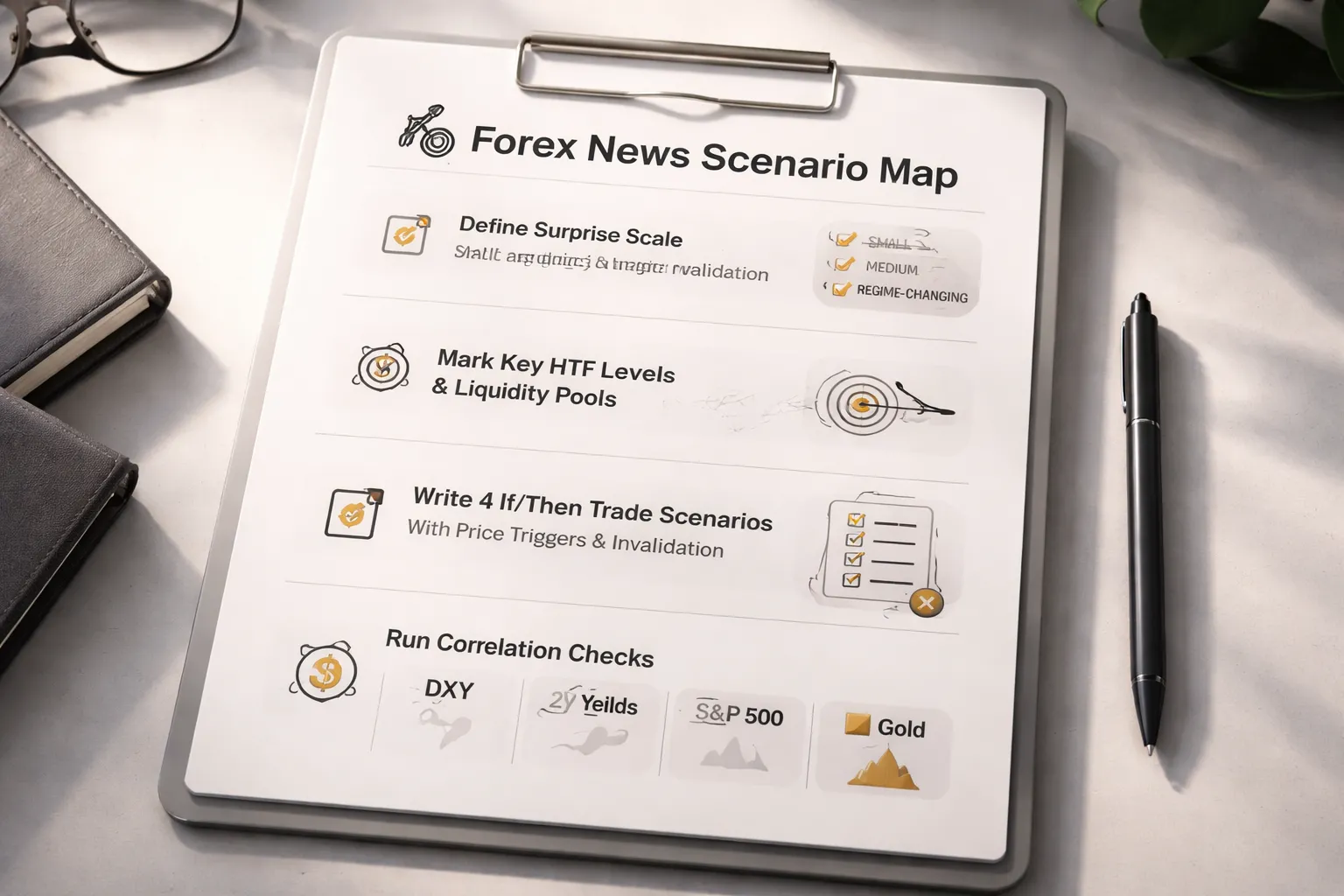
Define Your “Surprise” Scale Before You Look at the Chart
You trade the gap between consensus and the print. You do not trade the print alone.
Set a simple surprise scale. Use the same scale every time so your reactions stay consistent.
- Small surprise: inside the recent miss range. Expect mean reversion, whipsaw, and fades back to the pre-release zone.
- Medium surprise: outside the usual miss range, but not a narrative break. Expect a directional move that still respects major levels.
- Regime-changing surprise: forces a repricing of the next 1 to 3 Fed meetings. Expect trend day conditions, level breaks, and shallow pullbacks.
Match the scale to the event.
- NFP: treat small and medium surprises as noise until price proves direction. Reserve size for confirmation.
- CPI: medium surprises can trend. Regime-changing surprises can run for hours with limited retrace.
- FOMC: the “surprise” often lives in dots, SEP, and press conference tone, not the rate decision. Build scenarios for each step.
Build 3 to 4 If/Then Scenarios With Triggers and Invalidation
Write your plan in if/then form. Add a price trigger. Add one invalidation level. Keep it binary.
- Scenario 1, USD risk-on break: If DXY breaks and holds above the pre-release range high on a 1 to 5 minute close, then you look for a pullback to that breakout level. Invalidate the trade on a close back inside the range.
- Scenario 2, USD spike and fade: If the first impulse spikes into a known liquidity pool, then stalls and closes back below the spike base, then you take the fade toward the mid of the pre-release range. Invalidate on a new high that holds.
- Scenario 3, continuation trend day: If price breaks the day’s high or low and does not return to the pre-release midpoint within 15 to 30 minutes, then you treat it as continuation. Enter on the first clean pullback. Invalidate on a break of the pullback low or high, not on noise.
- Scenario 4, FOMC sequence flip: If the decision reaction fades after dots or the chair, then you trade the second move, not the first. Trigger on a break of the post-dots or post-Q&A swing point. Invalidate on a reclaim of the pre-flip level.
Set your “no trade” rule in advance. If the first minute prints both sides of the pre-release range, you stand down until structure returns.
Key Technicals That Matter on News Days
You do not need ten indicators. You need levels that large flows respect.
- HTF levels: prior day high and low, weekly open, weekly high and low, and the last major swing high and low on the 4H or daily chart.
- Liquidity pools: equal highs and lows, obvious stop clusters above round numbers, and prior session extremes. Mark them. Expect the first impulse to sweep them.
- Session highs and lows: Asia high and low, London high and low, and the pre-release range high and low from the last 60 to 120 minutes.
- Midpoints: the pre-release midpoint and the prior day midpoint. These act as “acceptance” lines. Holds suggest trend. Reclaims suggest chop.
Use one rule for validation. A level matters only if price closes beyond it and holds it on the retest.
Correlation Checks for Confirmation
You want alignment across the drivers. If they disagree, you reduce size or skip.
- DXY: use it as direction filter for USD pairs. If EURUSD sells but DXY fails to break up, you treat it as suspect.
- Yields: watch the front end first for Fed pricing. Rising 2-year yields support USD strength. Falling 2-year yields support USD weakness. Learn the chain reaction in how interest rates move currency pairs.
- S&P risk tone: risk-on can mute USD upside versus high beta FX, risk-off can amplify it. Use it to choose pairs, not to argue with the tape.
- Gold: it often reflects real yield and USD pressure. If USD rips and gold holds firm, the move may lack follow-through.
Lock these checks before the release. You want a fast go or no-go, not a debate while spreads widen.
Execution Tactics: Safer Ways to Trade the Release Without Gambling
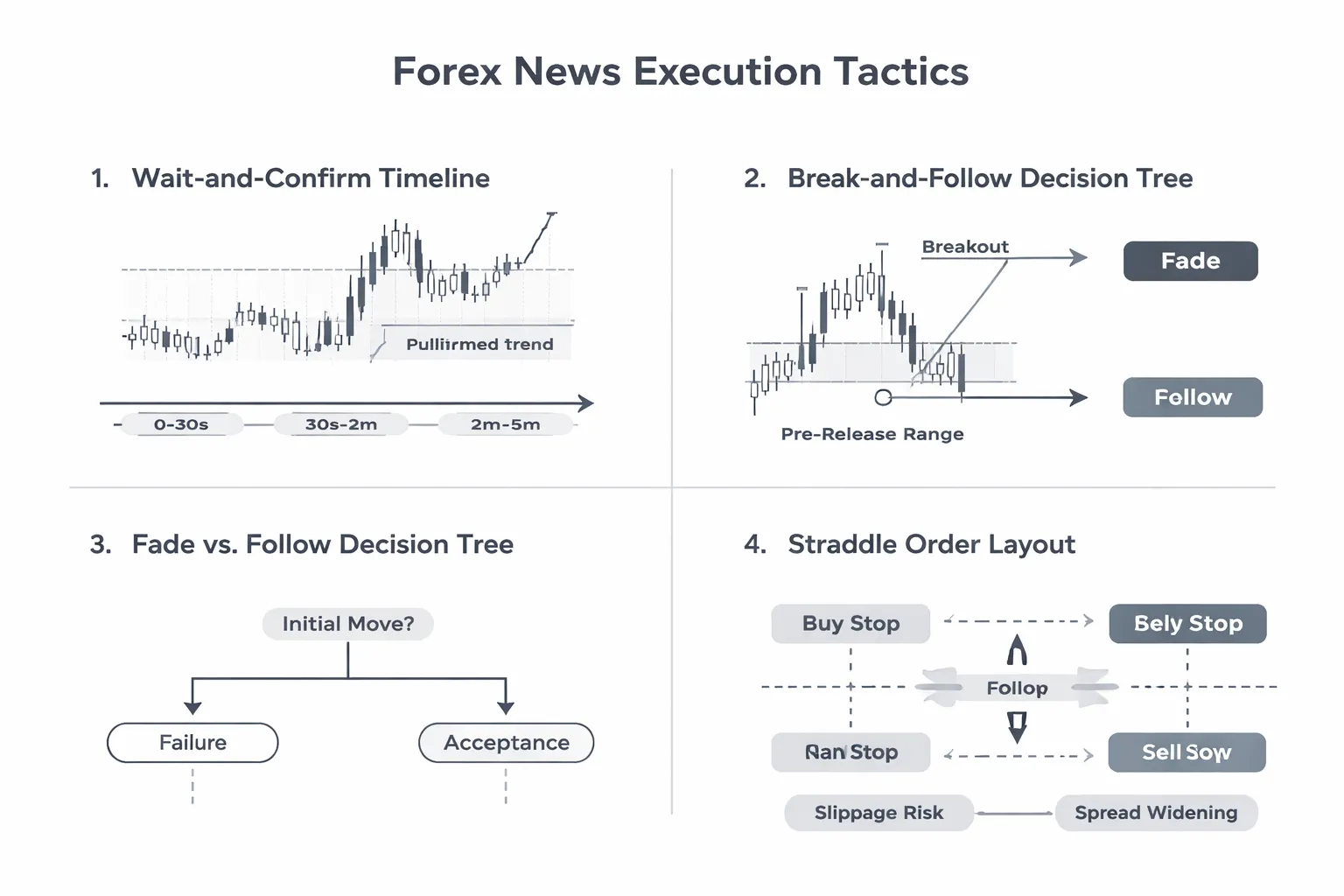
The wait-and-confirm entry
You do not need the first spike. You need the second move.
Use fixed timing windows. Watch spreads, prints, and candle closes on your execution timeframe.
- 0 to 30 seconds. Do not enter. Spreads widen. Quotes gap. Your stop can fill late. Your limit can miss.
- 30 seconds to 2 minutes. Look for direction plus control. You want a clean break that holds, not a full reversal. You want candles that close near their extremes, not long wicks both ways.
- 2 to 5 minutes. Trade only if structure forms. You want a clear high and low after the spike, then a break from that mini range. This filters the first whipsaw.
Confirmation checklist. Keep it short.
- Spread returns near normal for that session.
- Price holds above or below the pre-release level you marked.
- One side stops getting fully retraced within the next 1 to 3 candles.
- You can place a stop beyond a recent swing, with size that fits your risk.
Break-and-retest method
This method reduces false-break risk. It forces price to prove the level.
- Mark the nearest pre-release range. Use the last 15 to 60 minutes. Draw the high, the low, and the midpoint.
- Wait for a break and a close outside the range. Ignore the wick. Trade the close.
- Wait for the retest of the broken level. You want a hold, not an instant snapback.
- Enter on the rejection. Keep the stop on the other side of the level, beyond the retest swing.
- Take partial at 1R if volatility stays high. Move the rest to reduce downside if spreads jump again.
Retest quality rules.
- If price re-enters the old range and closes inside, skip it.
- If the retest runs 50 to 80 percent of the spike and still cannot reclaim the level, the break has better odds.
- If liquidity looks thin and candles print with large gaps, wait longer. Your level means less when execution breaks.
Fade vs. follow
Most traders lose by fading the first move. Some traders lose by chasing it. Pick one play based on conditions.
Follow momentum when:
- The surprise is clear and large relative to expectations.
- The first pullback holds above or below the pre-release range.
- USD and rates agree, and the pair reacts in the same direction.
- Price starts to trend with higher highs and higher lows, or lower lows and lower highs, after minute 2.
Fade mean reversion when:
- The spike breaks a level then fails fast, and closes back inside the pre-release range.
- Wicks dominate bodies for several candles, and both sides get taken.
- The move runs far with no pause, then prints a sharp rejection at a higher timeframe level.
- USD and rates disagree, or the first move conflicts with the rates impulse.
Fade rules. Keep them strict.
- Fade only after failure, not on the first touch.
- Use the spike high or low as the invalidation point.
- Target the range midpoint first. Take the rest only if price accepts back inside the range.
Straddle orders explained
A straddle places a buy stop above price and a sell stop below price before the release. You try to catch whichever side breaks first.
Pros:
- You have a plan before spreads widen.
- You avoid decision-making during the first seconds.
- You can capture a clean breakout on rare smooth releases.
Cons:
- Slippage can turn a small planned loss into a large one.
- Both orders can trigger in a whipsaw, then both stops can hit.
- Stops can fill worse than expected, and limits can miss.
- Your broker can widen spreads enough to trigger one side early.
Brokers can make straddles unreliable for simple reasons. They stream wider quotes, add execution delay, reject prices, or fill at the next available level during gaps. You cannot control that during NFP, CPI, or FOMC.
If you still use a straddle, reduce size and increase distance. Place orders beyond the pre-release range plus a buffer that matches typical event noise for that pair. Cancel the opposite order as soon as one side fills. Use a hard max loss for the event. If you cannot cap it, do not straddle.
For release times and forecast numbers, keep your schedule tight with your forex economic calendar.
Order Types, Platform Settings, and Broker Reality (Avoid the Spread Trap)
Market vs. limit vs. stop, choose the least-bad option per setup
News trading fails at execution. Your order type decides how much you pay for speed.
- Market order. You get filled fast. You accept spread expansion and slippage. Use it only when you trade after the first impulse, when spreads normalize and price action stabilizes.
- Limit order. You control the worst price. You may not get filled. Use it for pullbacks after the release, not for the first print. If you chase, you miss. That is a feature.
- Stop order. You trigger on momentum. You risk getting filled at a bad price if the book gaps. Use it only if you place it far enough from the pre-release range, with a buffer, and with a defined max loss.
For most traders, the highest survival setup is simple. Wait 30 to 120 seconds. Let spreads and execution recover. Trade the second move with limits or small markets.
Slippage controls, deviation settings, limit-on-stop, execution modes
Your platform has settings that decide whether you get slipped, rejected, or protected. Set them before the event.
- Max deviation, max slippage. Tight values reduce bad fills. They increase rejects. For post-release entries, keep it tight. For breakout entries, a tight cap often turns into missed fills and partial fills.
- Stop with limit, limit-on-stop. This converts your stop trigger into a limit order. It prevents extreme slippage. It can leave you unfilled during gaps. Use it when you can accept missing the trade. Do not use it if your plan needs guaranteed entry.
- Execution mode. Prefer market execution with transparent fills over instant execution with requotes. If your platform shows requotes in normal conditions, it will get worse on news.
- Reduce platform friction. Pre-load your trade ticket. Save presets for size, stop, and take profit. Disable popups and confirmations that slow clicks.
Plan for failure states. If your stop converts to a limit and does not fill, you still need a hard exit rule. If you cannot enforce it, you should not trade the release.
How to detect unhealthy conditions, abnormal spreads, requotes, latency
You need simple filters that tell you to stand down.
- Abnormal spread. Track the normal spread for the pair during your session. If it expands to 3x to 5x your baseline, your edge is gone. Do not enter. If you are in, reduce risk or exit.
- Quote freezing. If ticks stop, your platform is blind. Your stop may still execute at the broker, but you cannot manage the trade. Stand down.
- Requotes and rejects. Requotes mean the broker will not fill at the shown price. Repeated rejects mean your slippage cap is too tight or liquidity is thin. Either way, you cannot execute the plan.
- Latency spikes. Watch order round-trip time. If clicks take seconds to confirm, you trade stale prices. Move to post-event only, or skip.
| Red flag | What it usually means | Action |
|---|---|---|
| Spread jumps and stays wide | Liquidity pulled, wider dealing costs | Wait, or stop trading the event |
| Frequent requotes | Instant execution, broker control | Do not trade the first move |
| Orders fill far from price | Gap, thin book, or weak execution | Use smaller size, wider stops, or switch to limit-based entries |
| Platform freezes | Feed or terminal overload | Flatten if possible, skip the next releases |
Broker checklist, regulation, execution model, news restrictions, minimum stop distances
Your broker decides your real costs on CPI, NFP, and FOMC. Check these items before you trade news.
- Regulation. Use a regulated entity you can verify. Confirm the legal entity name matches your account.
- Execution model. Prefer brokers that disclose STP or ECN routing and publish execution quality stats. If your fills get worse only on news, assume you face internalization or aggressive risk controls.
- News restrictions. Read the trading conditions. Look for clauses on order cancellation, slippage, execution at next available price, and trade review. Avoid brokers that reserve the right to void trades for “off-market pricing” during news.
- Minimum stop distance and freeze levels. Some brokers enforce a minimum distance for stops and pending orders near price. On news, your planned buffer may violate these rules and your order will fail.
- Guaranteed stops. Rare in spot FX. If offered, read the premium and limits. Treat it as insurance, not a free feature.
- Data and platform stability. Test the broker on smaller releases first. Record spreads and fill quality. Keep notes per pair and event type.
If you base trades on rate expectations, align your event plan with your macro framework. Use one clean reference like how interest rates affect currency pairs, then build execution rules that keep losses capped when spreads blow out.
Risk Management for High-Volatility Windows
Position sizing by volatility
News risk comes from range expansion and spread expansion. Size for both. Use a volatility unit, then apply an event-day multiplier.
ATR-based sizing
- Pick one ATR. Use ATR(14) on the timeframe you execute on, or ATR(14) on H1 if you scalp.
- Set your stop distance as a multiple of ATR, or as a structure level with a minimum ATR buffer.
- Calculate position size from dollars at risk, not from a fixed lot size.
Formula
- Risk per trade = Account equity x risk %.
- Stop in pips = planned stop distance.
- Position size (lots) = Risk per trade / (Stop in pips x pip value per lot).
Event-day multipliers
- Cut size into the release window. Start with 0.25x to 0.50x your normal size for CPI, NFP, and FOMC.
- Increase only after you log at least 20 events for your pair, broker, and execution method.
- If spreads double versus normal, cut size again or stand down.
Setting realistic stops during news
Stops that work on quiet days fail on release minutes. You need room for the first impulse and the first pullback. You still need a hard cap.
Structure-based stops
- Place the stop beyond a clean level. Use the prior swing high or low, or the session high or low.
- Add a buffer. Use 0.25 to 0.50 ATR so a single spike does not tap you out.
- Do not anchor to round numbers. Liquidity hunts cluster there.
Volatility-based stops
- Set a stop as a multiple of ATR when structure sits too close. Common ranges are 1.0 to 2.0 ATR depending on your timeframe.
- Pair the stop with smaller size. A wider stop with the same lot size is hidden leverage.
- Avoid tight trailing stops in the first minutes. They convert normal noise into a loss.
Rule for choosing
- If structure sits outside 1.5 ATR, use structure.
- If structure sits inside 1.5 ATR, use an ATR stop or skip the trade.
Time stops and no-trade zones around the release
You need a time plan because price discovery happens in bursts. Your edge usually sits after the first burst, not inside it.
- No-trade zone: Do not open new positions 2 to 5 minutes before the release.
- First-minute ban: Skip the first 30 to 90 seconds after the number. Spreads and slippage peak here.
- Re-entry window: Trade only after spreads normalize and the first impulse prints a clear high and low.
- Time stop: If price does not move in your favor within 5 to 15 minutes, exit. Dead trades in news environments turn into fast losses.
- Calendar discipline: Mark releases and blackout windows in your economic calendar. Treat them as hard constraints.
Circuit breaker rules
Your plan needs automatic off-switches. You will not think clearly after slippage, a spike, or a fast loss.
- Daily max loss: Stop trading for the day at 1R to 3R, or 1% to 2% of equity. Pick one number and keep it fixed.
- Max slippage tolerance: Define a maximum acceptable slippage per order. If fills exceed it, stop trading that event.
- Spread filter: Do not trade if the spread exceeds a set ceiling, such as 2x to 3x your normal spread for that pair.
- Two-strike rule: After two execution problems, such as rejected orders, abnormal spreads, platform lag, or surprise widening, pause until the next session.
- Revenge-trade ban: After any circuit breaker triggers, you cannot re-enter for at least 30 minutes. You trade only your next planned setup.
| Control | Default setting | Action |
|---|---|---|
| Event size multiplier | 0.25x to 0.50x normal | Reduce lots before release window |
| Spread ceiling | 2x to 3x normal | No new trades until spreads normalize |
| Max slippage | Pre-defined in pips | Stop trading the event if exceeded |
| Daily max loss | 1R to 3R, or 1% to 2% | Shut down for the day |
| Time stop | 5 to 15 minutes | Exit if trade does not work fast |
Event-Specific Playbooks You Can Reuse
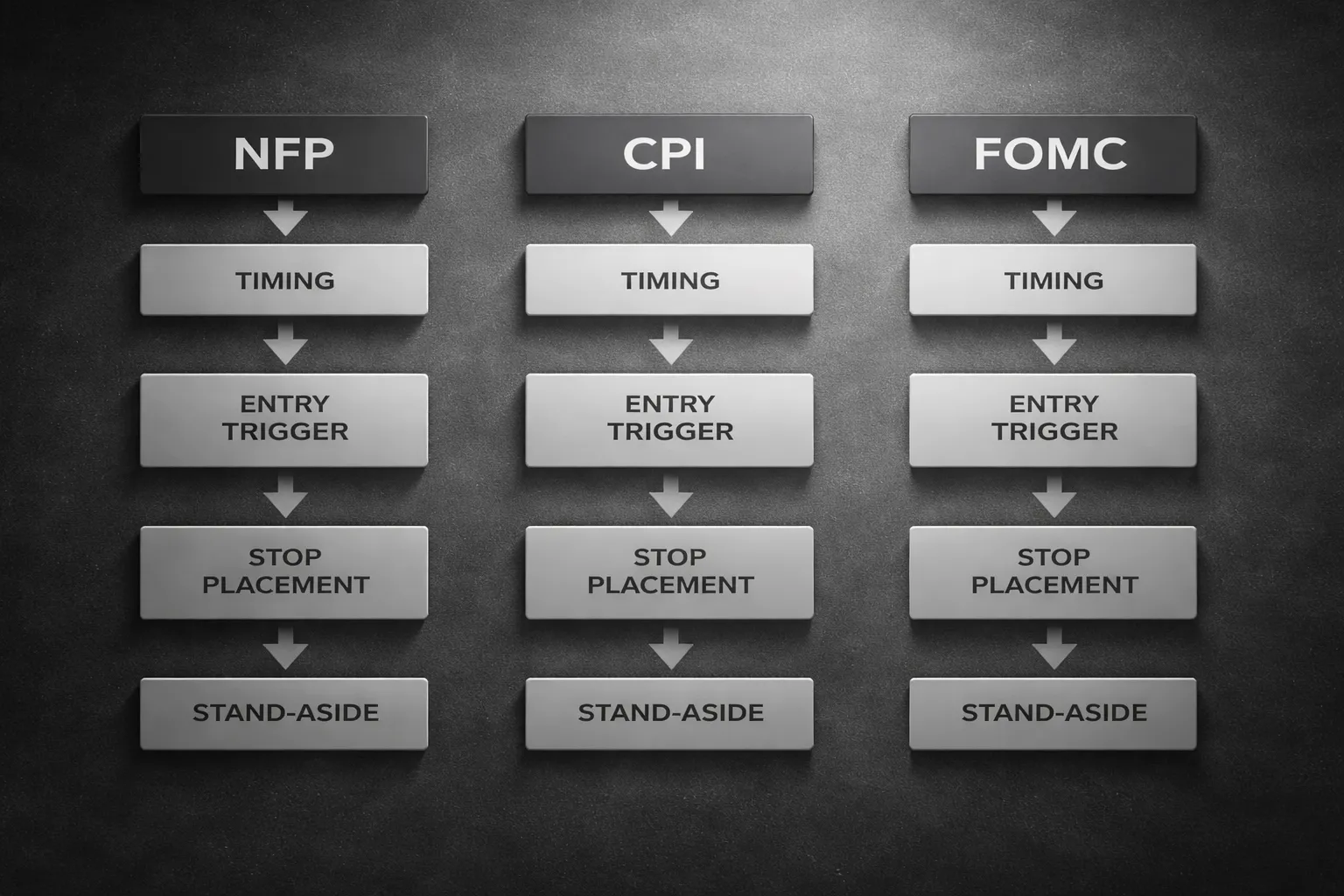
NFP Playbook
Goal: avoid the first whipsaw and trade the cleaner move.
- First spike filter: no orders in the first 30 to 90 seconds. Let spreads and liquidity normalize. Only consider a trade after the 1-minute candle closes.
- Second-move entry: mark the pre-release range on the 5-minute chart. After the first spike, wait for price to revisit the breakout level. Enter only if price rejects that level and pushes back in the breakout direction. Place the stop beyond the spike extreme, not inside the chop.
- Whipsaw protection: trade one direction only. If the first spike breaks up then dumps below the pre-release low, stand down. If you take a trade and it does not move within 5 to 15 minutes, exit on your time stop. Do not re-enter more than once.
CPI Playbook
Goal: catch continuation when inflation reprices rate expectations.
- Breakout continuation: use the 15-minute pre-release range. If the first 5-minute close holds outside the range and spreads stay under your ceiling, enter in the breakout direction. Reduce size, then add only after price makes a new high or low and holds it for one more 5-minute close.
- Pullback entry: skip the first push. Wait for a pullback to the breakout level or the 50% retrace of the impulse leg. Enter on rejection, keep the stop beyond the pullback low or high. If the pullback breaks the pre-release range, cancel the setup.
- Session trend management: treat CPI as a session driver. Manage in segments. Take partials at 1R, trail the rest behind 5-minute structure. Stop trading the move when price goes flat for 20 to 30 minutes or when a full reversal breaks the last swing.
Inflation surprises matter because they shift rate paths. Review the core logic in inflation and exchange rates if your bias keeps flipping mid-event.
FOMC Playbook
Goal: separate the decision spike from the presser trend.
- Decision-phase caution: avoid entries from 2 minutes before to 2 minutes after the statement and rate decision. Spreads widen and fills degrade. If you trade it, trade smaller and use hard limits on slippage.
- Presser-phase opportunities: look for the second phase once the press conference starts and the market selects a direction. Use the decision high and low as anchors. Trade the break and retest of those levels on a 5-minute close basis. Keep your time stop tight, FOMC trends either go or fail fast.
- Headline risk control: expect sharp reversals on single lines. Limit to one open position. No scaling in during live headlines. If slippage exceeds your max once, stop trading the event. If price snaps back through both decision extremes, stand aside for the day.
When to Stand Aside
- Holidays: skip major releases when the US or the paired country runs a market holiday. Liquidity thins, spreads jump, and moves fail more.
- Thin liquidity: stand down if spreads hit your ceiling pre-release or if your broker shows repeated price gaps. If you cannot get stable quotes, you cannot manage risk.
- Conflicting macro signals: avoid the trade when the release sends mixed messages, for example strong headline but weak core, strong jobs but weak wages. Price often whipsaws as desks reprice different parts of the curve. Wait for the second phase, or skip it.
Post-News Trading: The Safer Edge Most Traders Ignore
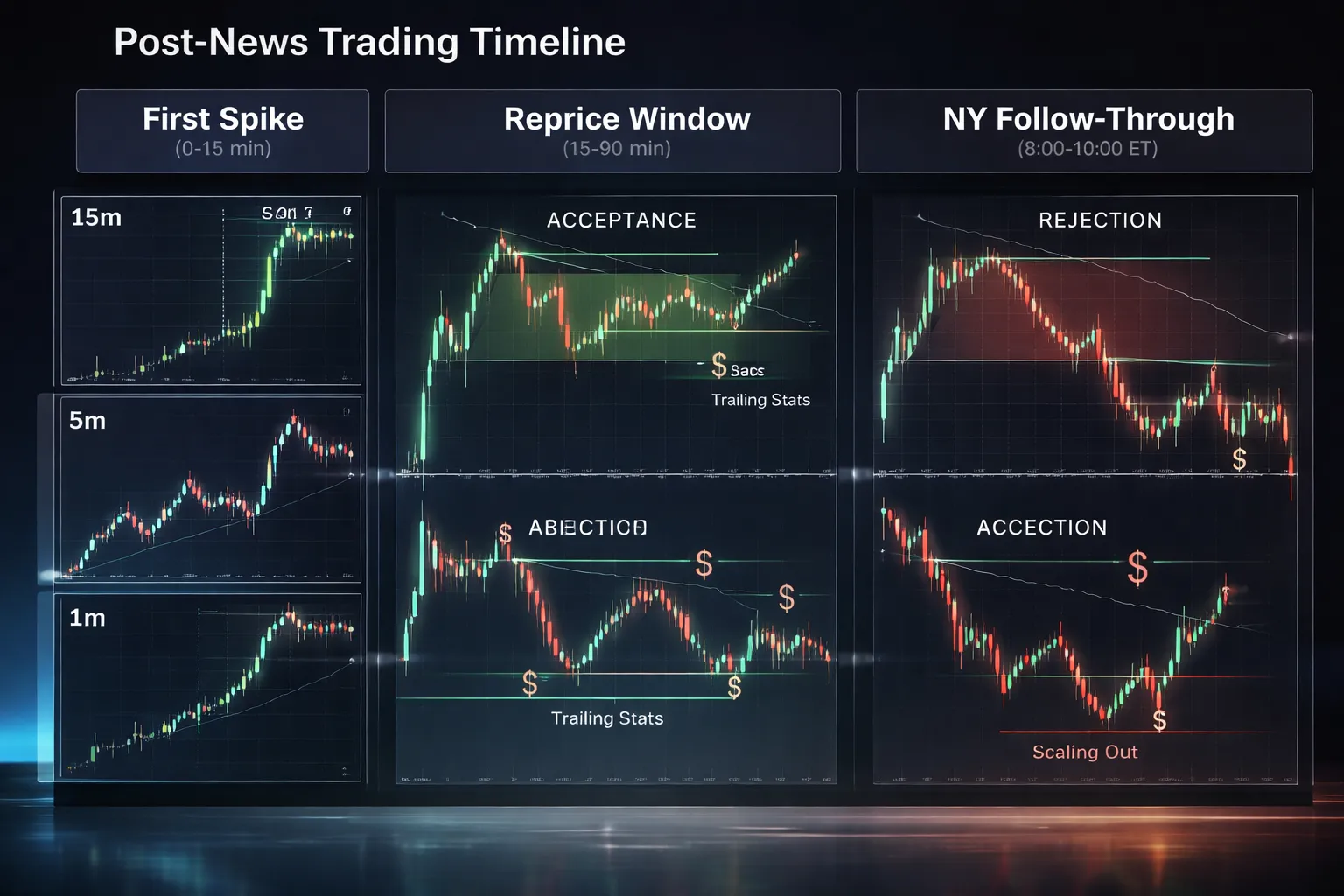
The 15 to 90 minute reprice window, spot acceptance vs. rejection
The first spike is order flow and hedging. The next 15 to 90 minutes is repricing. This is where the cleaner edge sits.
Focus on one level. Use the pre-release range high and low, plus the first 5 minute impulse high and low.
- Acceptance, price breaks a key level, holds above or below it, and builds a base. You see smaller pullbacks, tighter wicks, and closes that stay on the breakout side.
- Rejection, price breaks a level, fails to hold it, then snaps back through. You see long wicks, fast retraces, and closes back inside the prior range.
Simple filter, wait for two consecutive 5 minute closes on the same side of the level. If price cannot do that, you do not have control.
When spreads stay wide or quotes gap during this window, do nothing. You cannot size risk. You cannot exit cleanly.
NY session continuation vs. reversal, read follow-through
London often sets the first direction. New York decides if it sticks.
Use the NY open as a checkpoint. Track what price does from 8:00 to 10:00 ET.
- Continuation setup, NY holds the post-news direction and defends the reprice level. Pullbacks stay shallow and bid or offer returns fast. Price makes a higher high after a bullish reprice, or a lower low after a bearish reprice.
- Reversal setup, NY fades the move and pushes price back through the reprice level. The first pullback fails, then the market breaks the post-news base. You often see a full retrace into the pre-release range.
Do not trade “because it moved.” Trade because the market proves direction with follow-through.
If you trade NFP often, keep your rules aligned with your NFP trading guide so you do not change your process when volatility spikes.
Use multi-timeframe structure to target logical exits
Post-news trades win or lose at obvious structure. Mark it before you enter.
- 15 minute chart, set the bias and the key swing level from the reprice window.
- 5 minute chart, time the entry after acceptance, or after a clean retest of the level.
- 1 minute chart, avoid using it for direction. Use it to reduce slippage on entries and exits.
Pick exits that other traders will respect.
- Prior day high or low.
- Asia range high or low.
- London high or low.
- Round numbers when they align with one of the above.
Avoid “open air” targets. If you cannot point to a real level, you will hold too long and give it back.
Scale out and trail, protect gains in fast markets
News moves can trend, then reverse in minutes. You need a plan that locks profit without choking the trade.
- Scale out, take partial profit at the first logical level. This reduces pressure and cuts the chance you turn a winner into a loss.
- Move to reduce risk, after price accepts beyond the level and prints a new swing in your favor, tighten the stop to a structure point, not to breakeven “because you feel like it.”
- Trail with structure, trail behind the last 5 minute swing high or low, or behind the 15 minute pullback low in a trend. If the swing breaks, the move is likely done.
- Use time stops, if price stalls for 20 to 30 minutes after your entry and cannot extend, exit. Post-news markets either go or they chop.
Keep position size smaller than your normal day trades. Slippage is part of the cost. Your edge comes from waiting for confirmation, not from forcing the first move.
Backtesting and Journaling News Trades (So You Improve Instead of Repeat Pain)
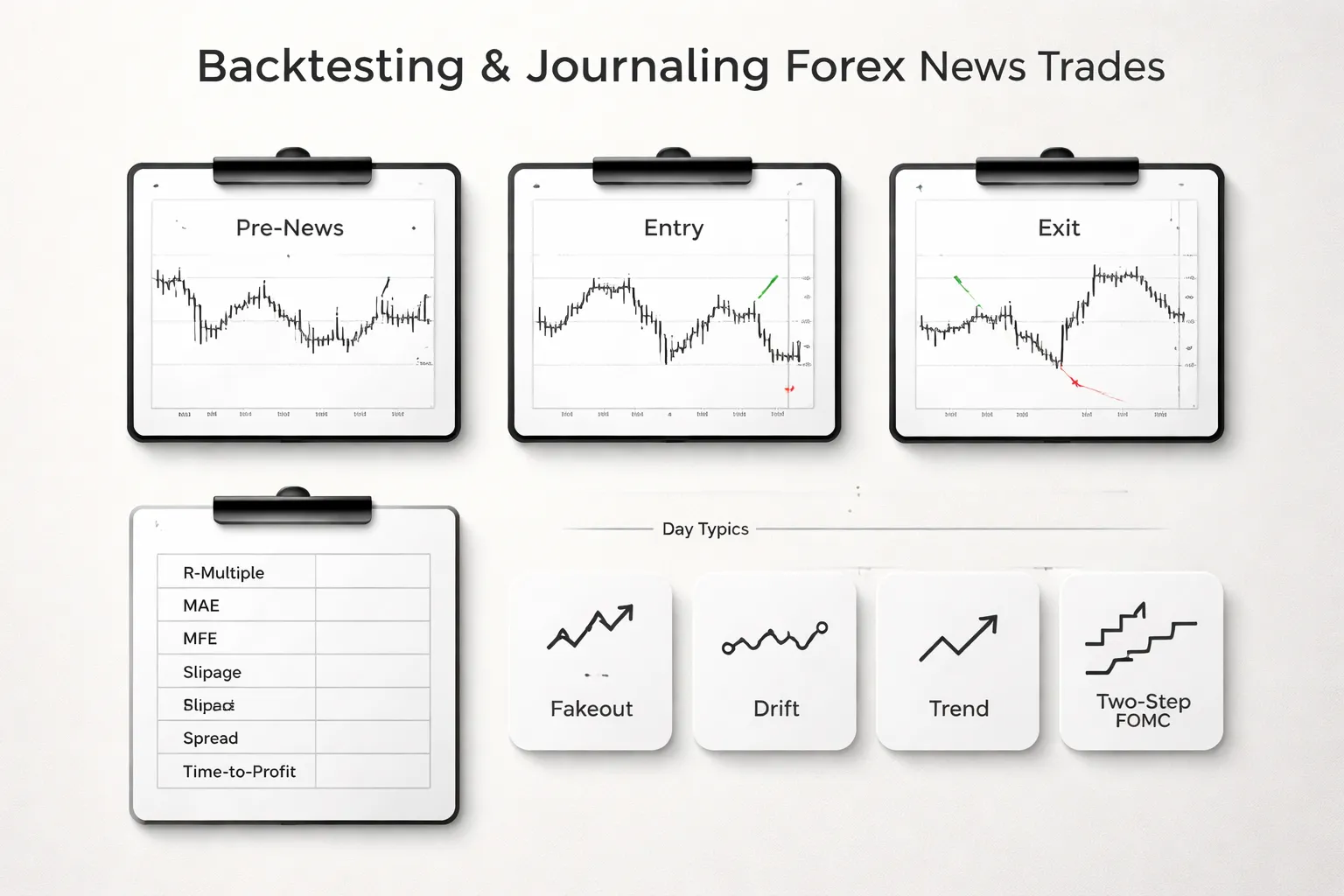
How to Collect Data, Screenshots, Spreads, Slippage, and Execution Notes
You cannot improve what you do not record. News trading punishes vague notes. You need proof.
- Screenshot 1, pre-release: 5 minutes before. Mark your levels, bias, and the exact time.
- Screenshot 2, entry: show the candle that triggered you. Include your order ticket if possible.
- Screenshot 3, exit: show where you got out and why.
- Spread log: write the spread at 1 minute pre-news, at the spike, at your entry, and at your exit.
- Slippage log: record intended entry price, fill price, and the difference in pips. Do the same for exits.
- Execution notes: market or limit, time-in-force, partial fill, rejected order, platform freeze, missed click, or widened stops.
- Context notes: event type, actual vs forecast, and which leg moved first, USD or the other currency.
Keep it in one place. A spreadsheet plus a folder of screenshots works. Name files with date, pair, event, session.
Metrics That Matter, MAE and MFE, Fill Quality, R-Multiples, and Time-to-Profit
News trades fail in predictable ways. Track the numbers that show if your plan works, or if you just got lucky.
- R-multiple: profit or loss divided by your initial risk. Track average R, median R, and worst 10 percent days.
- MAE: maximum adverse excursion, in pips and in R. This tells you if your stop placement fits news volatility.
- MFE: maximum favorable excursion, in pips and in R. This tells you if you exit too fast.
- Fill quality: slippage in pips, plus slippage as a percent of your stop size. A 2 pip slip on a 10 pip stop matters.
- Time-to-profit: time from entry to first +0.5R, +1R, and to peak MFE. News moves that work tend to work fast.
- Time-in-trade: minutes held. Compare winners vs losers. Your time stop should match your data.
| Field | What you record | Why it matters |
|---|---|---|
| Event | NFP, CPI, FOMC, date, session | Separates clean trend events from whipsaw events |
| Pair | EUR/USD, GBP/USD, USD/JPY, etc. | Each pair has different spike and spread behavior |
| Entry trigger | Break, retest, pullback, range break | Shows which confirmation rules hold up |
| Risk | Stop in pips, $ risk, planned R | Lets you compare trades across different volatility |
| MAE, MFE | Pips and R | Improves stops, targets, and time stops |
| Execution | Spread, slippage, partial fills | Shows if your broker and order type fit news |
Build a Personal Event Playbook by Pair and Session
Your playbook is your rules, backed by your numbers. Build it from your own samples, not someone else’s highlights.
- Split by event: NFP, CPI, FOMC. Keep separate stats for each.
- Split by pair: do not mix EUR/USD with GBP/JPY. Their behavior differs.
- Split by session: London, New York, and overlap. Liquidity changes the follow-through.
- Define one setup at a time: example, 1 minute spike, 5 minute close confirmation, 15 minute pullback entry. Track only that for a month.
- Set minimum sample size: aim for 20 to 30 trades per setup before you trust the stats.
- Write hard rules from data: typical stop size, typical time stop, typical slippage, and when you skip the trade.
Keep a notes column for rate context. Many big news days are rate-expectation days. Link your trade outcomes to the rate theme so you stop guessing. Use this guide on how interest rates affect currency pairs as a reference when you tag the backdrop.
Common Patterns to Tag, Fakeouts, Drift Days, and Trend Days
Tag the day type. Your plan should change based on the type. Your journal should force you to classify it.
- Fakeout: first spike breaks a key level, then reverses and closes back inside the pre-news range. Notes to record, wick size, close location, and how long it took to fail.
- Drift day: no clean impulse after the release. Price grinds in one direction with small candles and frequent pullbacks. Notes to record, spread behavior and whether time-to-profit stayed slow.
- Trend day: one direction dominates after the first 5 to 15 minutes. Pullbacks hold. Breakouts retest and continue. Notes to record, best entry window and average MFE before the first deep pullback.
- Two-step FOMC: first move, reversal, then the real move. Notes to record, which step produced your best R and how long the flip took.
- Liquidity trap: wide spread, thin book, fast stop runs on both sides. Notes to record, your slippage as percent of stop and whether limit entries improved fills.
After every event, write one sentence. What you did right. What you did wrong. What you will change next time. Keep it specific and measurable.
Pros, Cons, and Who Should (and Shouldn’t) Trade Forex News
Advantages
- Opportunity density. You get multiple tradable moves in minutes, not days. One event can trigger a breakout, a pullback, and a continuation.
- Clean catalysts. You know the timestamp and the driver. You can plan levels, risk, and order type before the spike.
- Strong range expansion. NFP, CPI, and FOMC can expand the hourly range fast. That can improve R if you keep stops defined and size small.
Disadvantages
- Execution uncertainty. Spreads widen. Quotes gap. Stops slip. Your fill quality can decide the trade more than your analysis.
- Emotional intensity. Price moves fast and reverses hard. You will feel urgency. Urgency leads to chasing, doubling risk, and breaking rules.
- Tail risk. One bad print can gap through your stop. One surprise headline can flip the market twice. If you trade too big, one event can erase a month.
Trader fit checklist
- Experience level. You should already execute your normal strategy cleanly. If you still move stops, add to losers, or revenge trade, skip news.
- Platform quality. You need stable execution, fast order routing, and reliable stop handling. Test during active sessions. Record spread at release and your average slippage.
- Rule discipline. You need hard limits you will not break, max loss per event, max attempts, and a time stop for standing down after a loss.
| Trade news if | Do not trade news if |
|---|---|
| You can keep risk fixed even when price spikes. | You increase size after a miss or a loss. |
| You accept missed moves and wait for your trigger. | You chase candles and enter late. |
| You track fills, spread, and slippage like performance stats. | You do not review trades or you ignore execution data. |
| You can stop after 1 to 2 attempts and walk away. | You take repeated entries in the same chop. |
Alternatives to direct news trading
- Trade the trend after. Let the first spike set the range. Wait for spread to normalize. Then trade a pullback or a break and retest with defined risk. This reduces slippage and lowers decision speed.
- Reduce exposure. If you hold positions into CPI, NFP, or FOMC, cut size, tighten your plan, and set a max loss that assumes slippage. If you cannot define worst case, flatten.
- Use the calendar as a filter. Avoid new entries right before red folder releases, or switch to higher timeframes. Use the economic calendar to plan no-trade windows.
FAQ
Should you trade NFP, CPI, and FOMC live?
Only if you have a tested plan, fast execution, and strict risk limits. If you cannot handle 5 to 30 pips of slippage and instant spread blowouts, do not trade the release. Trade the post-release structure instead.
What is the safest way to trade forex news?
Wait 5 to 15 minutes after the release. Let spreads normalize. Then trade a simple breakout or pullback around key levels on a higher timeframe. You trade fewer moves, but you cut slippage and reduce random whipsaws.
How much can spreads widen during major releases?
It depends on the pair and broker. On majors, spreads can jump from under 1 pip to 5 to 20 pips. On crosses, it can be worse. Plan your stops and max loss for the wide spread, not the normal spread.
Why do you get stopped out even when price goes your way?
Spread widening can hit your stop without real downside movement. Slippage can also fill your stop below your level. Avoid tight stops on release. If you trade, size down and use a stop that assumes spread expansion.
Do stop losses protect you on news?
They limit risk, but they do not guarantee your exit price. In fast markets, you can get slipped. Treat your stop as a trigger, not a fixed price. Use a hard max loss per event, and cut size to fit it.
Are pending orders better than market orders for news?
Pending orders can reduce decision time, but they can fill at bad prices. Stops can trigger on a spread spike. Limits can miss fills. If you use them, place them farther from price, reduce size, and accept missed trades.
Which is more dangerous, NFP, CPI, or FOMC?
NFP often whipsaws first and trends later. CPI can set direction fast and then trend. FOMC can move in stages, statement, presser, and repricing. Treat all three as high risk. Your broker conditions matter more than the label.
How long should your no-trade window be?
Common rules are 10 to 30 minutes before, and 5 to 30 minutes after. Use longer windows if you trade lower timeframes. If spreads stay wide, extend the window. Use an economic calendar to plan the blackout.
What position size should you use for news trades?
Cut size hard. Many traders use 25 to 50 percent of normal risk, or skip the release. Base sizing on worst-case slippage plus a wider stop. If that math forces a tiny position, do not trade the event.
Can you hedge a news event?
Most retail hedges fail because both legs suffer spread widening and slippage. Correlation can also break on releases. If you hedge, define the exact exit rules for both legs and cap total loss. Do not improvise mid-spike.
What data matters most in CPI and NFP?
Markets usually trade the surprise versus forecast and the details. For CPI, core and services matter. For NFP, earnings and unemployment rate can override the headline. Connect the data to rate expectations, not the headline number alone.
Why does price reverse after the first spike?
Liquidity is thin at the release. Dealers widen spreads. Fast traders hit stops. Then larger players reprice after reading the details. If you chase the first candle, you often buy the top. Wait for structure and a second move.
Where can you learn how inflation impacts currencies?
Use this guide on inflation and exchange rates to link CPI surprises to yield spreads, rate expectations, and currency direction. It helps you filter noise and focus on what drives follow-through.
Conclusion
Conclusion
News does not give you an edge. Your process does.
Trade the release like a drill. Plan the scenario, set the risk, then wait for price to confirm direction after the first spike.
- Before the release: Know the consensus, the prior print, and the key subcomponents. Mark levels. Decide your max loss in dollars.
- At the release: Do not hit market on the first candle. Spreads widen and slippage spikes.
- After the release: Wait for a second move. Trade only if price breaks structure and holds.
- Risk control: Use smaller size than normal. Use hard stops. Stop trading after one clean loss.
- Review: Log the surprise size, first move, second move, and follow-through. Track which events your setup handles.
Your final tip. If you cannot define your risk and your entry trigger in one sentence, skip the trade.
For the macro filter, learn what matters in fundamental analysis in forex, then use it to trade fewer events with more clarity.
-
How Interest Rates Affect Currency Pairs (With Real Examples)
7 months ago -
Fundamental Analysis in Forex Explained (What Actually Moves Prices)
7 months ago -
What Moves EUR/USD? The Biggest Drivers You Should Watch
7 months ago -
Inflation and Exchange Rates Explained (Why Currencies Rise or Fall)
7 months ago -
Economic Calendar for Forex: How to Use It (Step-by-Step)
7 months ago
-
- What “Forex News Trading” Really Means
- The Hidden Enemy, Spread Widening, Slippage, and Partial Fills
- Why the First Move Is Often a Trap (Stop Runs and Liquidity Vacuum)
- Volatility vs. Direction, Separating Noise From Information
- Common Retail Mistakes, Oversized Leverage, Revenge Trades, and No Scenario Plan
-
- Should you trade NFP, CPI, and FOMC live?
- What is the safest way to trade forex news?
- How much can spreads widen during major releases?
- Why do you get stopped out even when price goes your way?
- Do stop losses protect you on news?
- Are pending orders better than market orders for news?
- Which is more dangerous, NFP, CPI, or FOMC?
- How long should your no-trade window be?
- What position size should you use for news trades?
- Can you hedge a news event?
- What data matters most in CPI and NFP?
- Why does price reverse after the first spike?
- Where can you learn how inflation impacts currencies?
-
- What “Forex News Trading” Really Means
- The Hidden Enemy, Spread Widening, Slippage, and Partial Fills
- Why the First Move Is Often a Trap (Stop Runs and Liquidity Vacuum)
- Volatility vs. Direction, Separating Noise From Information
- Common Retail Mistakes, Oversized Leverage, Revenge Trades, and No Scenario Plan
-
- Should you trade NFP, CPI, and FOMC live?
- What is the safest way to trade forex news?
- How much can spreads widen during major releases?
- Why do you get stopped out even when price goes your way?
- Do stop losses protect you on news?
- Are pending orders better than market orders for news?
- Which is more dangerous, NFP, CPI, or FOMC?
- How long should your no-trade window be?
- What position size should you use for news trades?
- Can you hedge a news event?
- What data matters most in CPI and NFP?
- Why does price reverse after the first spike?
- Where can you learn how inflation impacts currencies?
-
How to Place a Forex Trade Step by Step (Your First Trade Explained)
5 months ago -
Forex Trading vs Crypto Trading: Which Market Is Better for Beginners?
5 months ago -
Forex Lot Size Calculator: How to Use It to Size Trades Correctly
7 months ago -
How to Calculate Position Size in Forex (Position Sizing Formula + Examples)
7 months ago -
Forex Leverage Explained: How It Works, Pros, Cons & Examples
7 months ago
-
Forex Trading Platforms Comparison: MetaTrader vs cTrader vs TradingView
7 months ago -
Stop Loss vs Take Profit: Differences, Examples & Best Practices
7 months ago -
Is Forex Trading Legal in the United States? Rules, Regulators & What to Know
7 months ago -
Forex Leverage Explained: How It Works, Pros, Cons & Examples
7 months ago -
Forex Market Hours & Trading Sessions Explained (Best Times to Trade)
7 months ago