Forex Prop Firm Challenge Rules Explained (Drawdown, Targets, Payouts)

Prop firm challenges look simple. The rules make or break your account.
This guide explains the core challenge rules you must follow, and how firms calculate them. You will learn how maximum drawdown works, how daily loss limits trigger, and what counts as a violation. You will also learn how profit targets get measured, what minimum trading days mean in practice, and which trading restrictions often catch traders off guard. Last, you will see how payouts work, including profit splits, withdrawal schedules, and common conditions before your first payout.
If you need a quick breakdown of how firms structure funding and accounts, read what a forex prop firm is.
Key Takeaways
Key Takeaways
- In het kort: Treat drawdown rules as your real leverage limit, not your broker margin.
- In het kort: Know which drawdown model you face, static, trailing, or equity based. Each changes how you size positions.
- In het kort: Daily loss caps fail traders faster than max drawdown. Plan your worst day before you place your first trade.
- In het kort: Profit targets get measured on closed PnL. Open profit usually does not count. Hit the number, then protect it.
- In het kort: Minimum trading days force activity. You can pass the target and still fail if you do not meet the day count.
- In het kort: Most failures come from rule breaks, news trading windows, holding over weekends, lot size limits, and restricted instruments.
- In het kort: Payouts depend on profit split and schedule. Many firms add conditions like consistency rules, minimum profit, or no breaches since last reset.
- In het kort: Pick one simple plan and execute it under the rules. If you want a process, use this step-by-step plan to pass a forex prop firm challenge.
Forex prop firm challenges: what they are and how they work
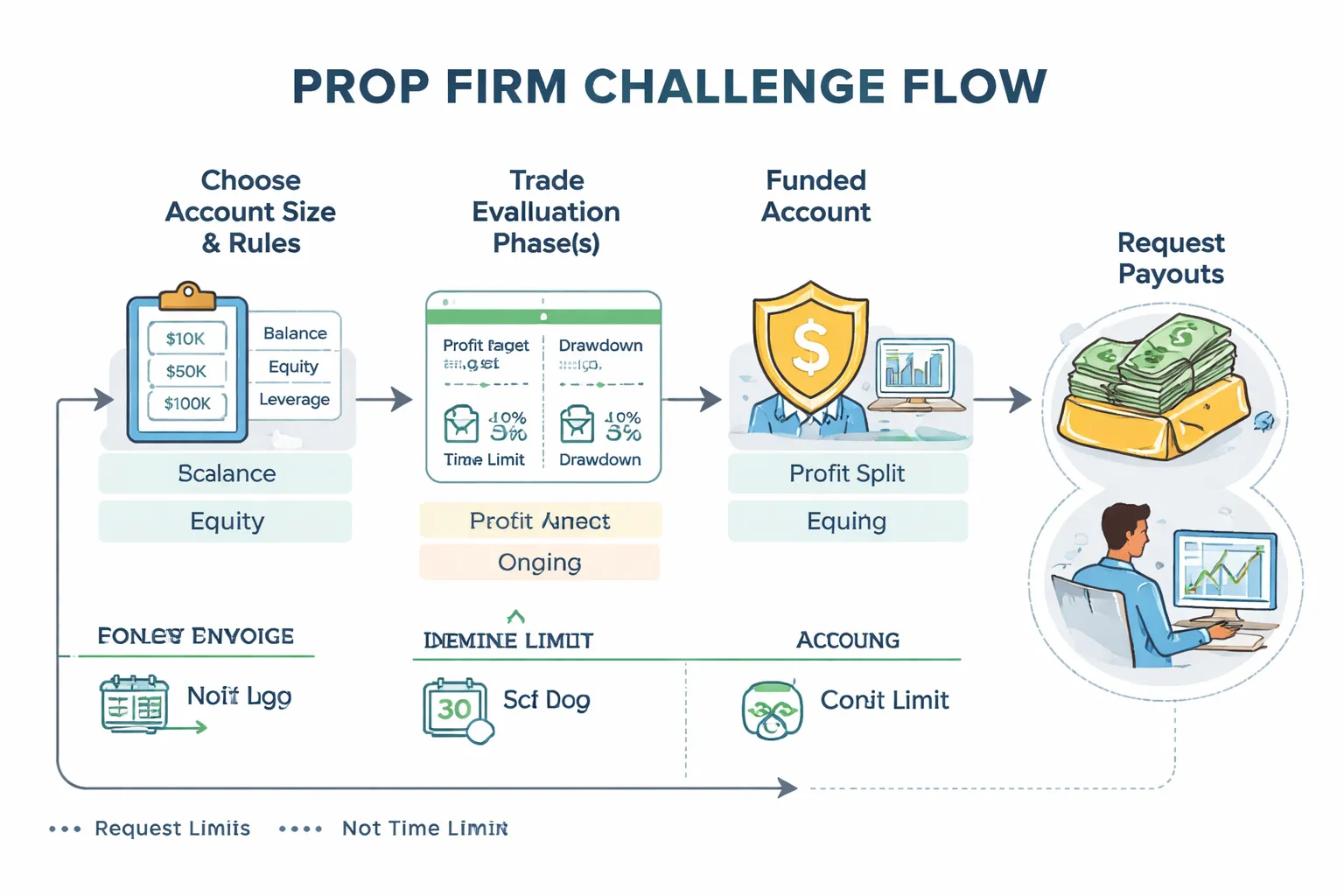
Forex prop firm challenges, what they are
A forex prop firm challenge is a paid evaluation. You trade on a demo account under strict rules. If you hit the profit target without breaking risk limits, the firm offers you a funded account, sometimes also called a live account or funded simulation.
You do not invest your own trading capital in the challenge. You pay a fee for the evaluation and the chance to earn payouts later under a profit split.
Why prop firms use challenges
- Screen risk. The firm wants proof you can limit losses. Drawdown rules force you to keep your account alive.
- Check consistency. Many traders can spike one good day. Firms prefer repeatable results across days and weeks.
- Test discipline. Rules around news, lot size, trading hours, and minimum days show if you can follow a process.
- Protect the firm’s book. Passing traders get larger allocations. The challenge filters out high variance trading.
How a challenge works, step by step
- You choose an account size and a rule set, for example $10k, $50k, or $200k.
- You trade until you either hit the profit target or breach a rule.
- If you pass, you sign a funded agreement and get access to a funded account.
- You keep trading under ongoing rules. You request withdrawals based on the payout schedule.
Common challenge formats
- One-step. One profit target. One set of drawdown rules. Often higher target or tighter limits to compensate.
- Two-step. Phase 1 has a higher profit target. Phase 2 has a lower target and similar or tighter risk rules. This is the most common model.
- Three-step. Smaller targets per phase. More checkpoints. More time spent proving consistency.
- Evaluation-to-funded. You pass the evaluation, then you start on a smaller funded account and scale up after hitting milestones.
| Format | What you must prove | What usually changes by phase |
|---|---|---|
| One-step | Fast profitability plus risk control | No second chance, one target |
| Two-step | Profitability, then repeatability | Lower target in phase 2 |
| Three-step | Lower variance over more time | More phases, smaller targets |
| Evaluation-to-funded | Clean performance, then growth | Scaling rules after funding |
Key terms you will see in the rules
- Balance. Closed profit and loss. It changes only when you close trades.
- Equity. Balance plus open profit and loss. Many drawdown rules trigger from equity.
- Leverage. Your position size power, for example 1:30 or 1:100. Higher leverage increases drawdown risk.
- Profit target. The required gain to pass a phase, often a percentage of starting balance.
- Profit split. Your payout share, for example 80/20 or 90/10. Terms can change after scaling.
- Scaling. A plan that increases your funded account size after you hit profit milestones and follow rules.
- Consistency rule. A limit on how much of your total profit can come from one day or one trade, or a requirement for steady daily performance.
Typical timeline rules
Firms use one of two time models. Each model changes how you should trade.
- Time limit. You get a fixed window, often 30 to 60 days per phase. This pushes you to take enough valid setups to reach the target, but it also tempts overtrading.
- No time limit. You can take as long as needed. This reduces pressure, but you still must follow minimum trading days, inactivity rules, and drawdown limits.
If you want to compare rule sets side by side, use our list of best forex prop firms and check targets, drawdown type, and payout terms before you buy.
Profit targets explained (phases, calculations, and realistic expectations)
How profit targets are calculated
Most prop firms set the profit target as a percent of your starting balance. They usually measure it on end-of-day equity, but they only credit closed profit.
- Starting balance based target: Target = starting balance x target percent. A 10,000 account with an 8% target needs 800 profit.
- Equity vs balance: Equity includes open profit and loss. Balance only includes closed trades. Many dashboards show equity progress during the day, but you still need the trades closed to lock the target.
- Scaling effect: The target does not drop after a losing streak. It stays tied to the original starting balance for that phase.
Phase by phase target examples (8% and 5% models)
The common model uses two evaluation phases. Phase 1 has the higher target. Phase 2 has the lower target.
| Model | Phase 1 target | Phase 2 target | 10,000 example |
|---|---|---|---|
| Standard | 8% | 5% | Phase 1: 800, Phase 2: 500 |
| Aggressive | 10% | 5% | Phase 1: 1,000, Phase 2: 500 |
| Lower target | 6% | 4% | Phase 1: 600, Phase 2: 400 |
| One phase | 10% | N/A | 1,000 once |
Some firms reset the account between phases. Others keep the same account and just switch the target. Read the wording. If they reset, your Phase 2 target still ties to the new phase starting balance, not your original deposit size.
What counts toward the target
Your target progress usually comes from net closed profit. That means after trading costs.
- Closed trades count: Realized profit and loss from executed orders.
- Commissions and spreads count against you: You must earn enough to cover costs and still hit the percent target.
- Swaps usually count: Positive swap can help. Negative swap can drag results, especially if you hold trades overnight.
- Bonuses excluded: If a firm offers discounts, credits, or promotional bonuses, they usually do not count toward the target.
- Refunds are separate: Fee refunds and first payout terms do not change the target math.
Realistic expectations for hitting the target
An 8% Phase 1 target demands either high trade frequency, larger risk per trade, or a strong edge. You control this with your risk plan.
- If you risk 0.5% per trade: You need about 16R of profit to hit 8%. With a 1R average win, that can take many trades.
- If you risk 1% per trade: You need about 8R of profit to hit 8%. That cuts trade count, but it increases drawdown pressure.
- If you trade for small R: Targets take longer. Costs matter more. Your hit rate must stay high.
Set expectations around R, not pips. Your job is to stack clean trades while staying far from the loss limits.
Hidden gotchas that fail traders
- Target hit intraday, fail by close: Your equity can touch the target on an open trade, then drop before you close it. Close the position if you need the pass locked.
- Target met, then drawdown breach the same day: You can reach the target, then give back profit and break daily loss or trailing drawdown rules. Stop trading after you lock the pass.
- Spread spikes at rollover: A brief spread expansion can hit a stop and drop you under limits. Avoid thin liquidity windows if your account sits near a rule threshold.
- Costs make you miss by a small amount: You might show gross profit above the target, but net profit falls short after commissions and swap.
If you want a deeper breakdown of rule interactions, read our forex prop firm challenge explained guide and match the target rules to the drawdown model.
Drawdown rules explained (max loss, daily loss, and trailing drawdown)
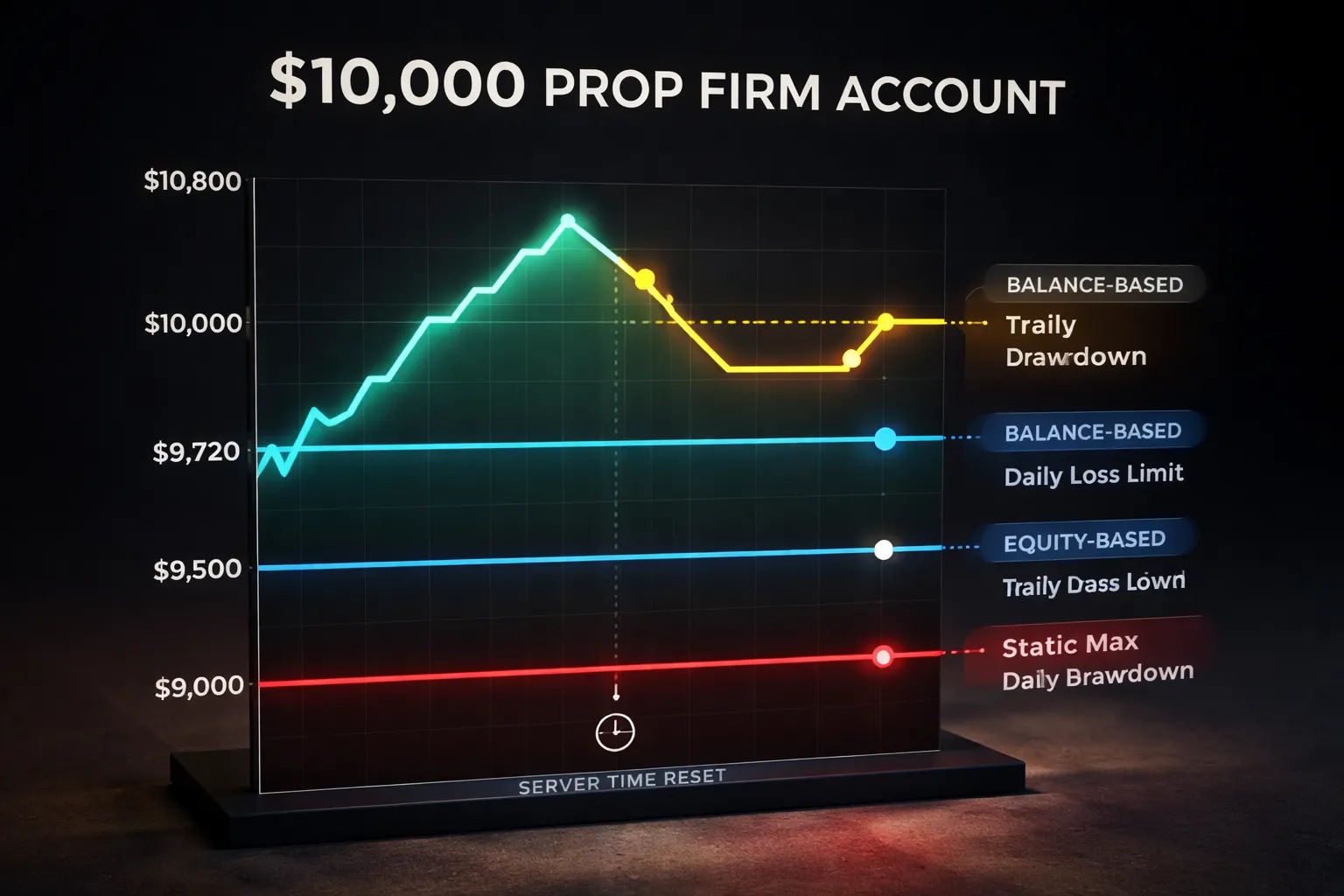
Maximum drawdown vs daily drawdown
Prop firms cap losses in two ways. A max drawdown limit for the whole account, and a daily loss limit for a single trading day.
- Maximum drawdown sets your hard floor. If your equity or balance hits it, you fail.
- Daily drawdown sets your daily floor. You can be profitable overall and still fail from one bad day.
Firms define these limits as a fixed dollar amount, a percent of starting balance, or a percent of a moving reference like high water mark. Always check which.
Static drawdown vs trailing drawdown
Static drawdown stays in one place. Trailing drawdown moves up as your account reaches new highs.
- Static max drawdown usually anchors to starting balance. Example, 10% max loss on $10,000 means your floor stays at $9,000.
- Trailing max drawdown usually anchors to peak equity or peak balance. If you grow the account, the floor rises. If you give back profits, you can hit the floor fast.
Trailing models punish large pullbacks after a good run. You need smoother equity. You also need smaller position size after you make new highs, because the floor sits closer under current price action.
Balance-based vs equity-based limits
Some firms measure drawdown on balance. Others measure on equity. Equity includes floating P and L, balance does not.
- Balance-based gives you more room during open drawdown. The breach happens when you close the loss and the balance drops below the limit.
- Equity-based is stricter. A temporary spike against your open trades can fail you even if you planned to hold.
Equity-based rules make spread, slippage, and news spikes matter more. If you trade around high impact releases, your stop can survive but your equity can still breach from a widened spread.
Reset times and server time
Daily loss rules reset at a defined time, based on the firm’s server clock. This trips traders who assume their local midnight controls the reset.
- Reset time often aligns with the broker server day, such as 00:00 platform time. Some firms use a fixed time like 17:00 New York close.
- Floating daily loss can measure from the day’s starting equity. If you start the day down from overnight swaps or an open position, you begin closer to the limit.
- Weekend gaps can create an instant equity hit at open. If the firm counts equity in real time, you can breach before you place a trade.
Before you trade, write down the reset time in your local time zone. Treat the first minutes after reset like a new risk budget.
Practical drawdown math examples (a $10,000 account)
Use these examples to map rules to your sizing. Assume a $10,000 challenge with 10% max drawdown and 5% daily loss, and a breach triggers the moment equity touches the limit.
| Rule type | Definition | Fail level | What can trigger it |
|---|---|---|---|
| Static max drawdown | 10% of starting balance | $9,000 equity | Any open or closed loss that drops equity to $9,000 |
| Daily loss | 5% of start of day equity | $9,500 equity for that day | Intraday drawdown, including floating loss if equity-based |
| Trailing max drawdown | 10% below peak equity | Moves with peak | Giving back profits after hitting a new peak |
Static example: You start at $10,000. Your max floor is $9,000. If you take a floating loss of $1,020 and equity prints $8,980, you fail, even if it later rebounds.
Daily example: You start the day at $10,000. Your daily floor is $9,500. You can still be above $9,000 overall, but if equity touches $9,500 during the day, you fail that day.
Trailing example: You grow to $10,800 peak equity. With a 10% trailing rule, your new floor becomes $9,720. You now have $1,080 of room from peak, but only $1,080, even though you are up on the account. A pullback of $1,100 from peak fails you.
Common failure patterns
- Overtrading after wins. You feel ahead of schedule, you increase size, you hit the daily cap in one reversal.
- Averaging down. You add to a loser, your average price improves, but your equity drawdown expands and trips an equity-based limit.
- Revenge trading. You try to recover a loss fast, you take lower quality setups, your execution worsens, you compound slippage and spread costs.
If you want to compare how top firms apply trailing and equity rules in practice, use our best forex prop firms comparison and filter by drawdown model.
Minimum trading days, activity rules, and consistency requirements
Minimum trading days rule
Many challenges require a minimum number of trading days before you can pass or request a payout. Firms use this rule to reduce one day luck and force basic risk control.
Most firms count a trading day when you open and close at least one trade, or when you place a trade that creates a real position at any point during that day. Some firms only count a day if you generate a minimum amount of volume, or if the trade stays open for a minimum time.
- Typical range: 3 to 10 trading days in the evaluation stage. Some programs also require 2 to 5 days on funded accounts before your first payout.
- Server time matters: A “day” usually follows the broker server clock, not your local time. A trade opened near rollover can count toward a different day than you expect.
- Partial days still count: If the firm counts “any executed trade,” one small position can tick the box. Do not use this as a loophole if the firm also enforces consistency rules.
- Weekend gap does not help: Non trading days do not reduce the requirement. You still need X separate trading days.
Plan your evaluation pace around the minimum day rule. If you hit the profit target early, many firms still make you wait until you meet the day count before you can complete the phase.
Inactivity clauses
Most firms also enforce inactivity limits. If you do not place a trade for a set number of calendar days, the firm can pause, reset, or close your account.
- Common trigger: 7 to 30 days with no executed trades.
- Common outcomes: warning email, forced breach, account closure, or a paid extension option.
- What “activity” means: Pending orders that never fill often do not count. Logins also do not count. Execution usually matters.
If you trade a higher timeframe and you can go weeks without a setup, pick a program with a looser inactivity window. If you want a broader rule breakdown, see our best forex prop firms comparison and check inactivity and time limits side by side.
Consistency requirements
Some firms add consistency rules to stop you from passing on one oversized day. These rules vary, so you must read the exact formula.
- Max daily profit percentage: Your best day cannot exceed a fixed share of your total profit, often 30% to 60%. If you make too much in one day, you need more profitable days to dilute that share.
- Profit distribution caps: Similar idea, but measured across weeks or across the full phase. The firm looks for smoother equity growth.
- Max daily loss or negative day limits: Some programs cap the number of losing days, or apply a stricter daily loss threshold once you are near the target.
Trade sizing causes most consistency violations. If you double risk to finish fast, you usually create a single “spike day,” then you fail the distribution rule even if you stay inside drawdown.
Lot size limits and exposure caps
Firms limit exposure to control risk concentration. These limits sit on top of drawdown rules.
- Max lots per account or per symbol: A hard ceiling on total volume. This can block scaling even when your stop loss stays small.
- Max open risk: A cap on total risk across all open trades, sometimes measured in account percent, sometimes in margin used.
- Correlation limits: Some firms restrict holding multiple highly correlated positions at the same time, like EURUSD and GBPUSD in the same direction. They treat it as one bigger bet.
- News and session exposure: Even if news trading is allowed, exposure caps can still reduce what you can hold through high impact events.
Track exposure by theme, not by ticket count. Two pairs can move like one position. If your rules cap total risk, treat correlated trades as shared risk and size them down as a group.
Trading restrictions that can disqualify you (the fine print)
Trading restrictions that can disqualify you (the fine print)
Most challenge failures come from small rule breaks, not bad trades. Read the prohibited behavior list line by line. Assume the firm audits your logs, IP history, and trade timestamps.
News trading rules
Many firms allow news trading in general, but restrict it around specific releases. They enforce this with a time window and by symbol.
- Before and after window: Common restrictions block opening, closing, or modifying orders from 1 to 5 minutes before, and 1 to 5 minutes after a high impact event. Some firms use longer windows, such as 10 to 15 minutes.
- What counts as a violation: New market orders, pending order placement, pending order triggering, SL or TP edits, partial closes, and lot increases during the restricted window.
- Restricted instruments: Usually the currency in the headline. NFP often means USD pairs. CPI affects the local currency. Central bank decisions usually restrict all related FX pairs and sometimes indices and gold.
- Exception cases: Some firms allow you to hold positions opened earlier, but still ban modifications. Others ban holding exposure through the event. Some allow closing only, but not opening.
- Slippage and spreads: A fill during the window can trigger an audit even if you clicked earlier. If the firm uses server time, your local time does not matter.
Practical rule. If a release can move your pair 30 to 100 pips in seconds, flatten or reduce exposure early. Do not rely on stop orders to solve it, many firms treat triggered pending orders as news trading.
Weekend and overnight holding policies
Firms limit holding because gaps can bypass your stop. They also track swap exposure because it can distort results.
- Weekend holds: Many firms ban holding past market close on Friday. They force you to close before a cutoff time. Some allow holds on swing accounts only.
- Overnight holds: Some intraday programs require flat at end of session. Others allow overnight holds but restrict size or total margin used.
- Gaps and stop execution: A weekend gap can breach max loss even if you set a stop. The firm still counts the loss and can fail the account.
- Swap and triple swap: Holding through rollover adds swap costs or credits. Firms may flag strategies that target positive swap carry with oversized positions.
- Permitted instruments: Some firms allow holds on major FX but restrict indices, oil, or crypto due to wider weekend gap risk and spread spikes.
Martingale, grid, latency arbitrage, and HFT bans
Firms ban tactics that exploit execution or rely on uncontrolled risk escalation.
- Martingale: Increasing lot size after losses to recover quickly. Many firms treat any loss driven lot ramp as martingale, even if you call it scaling.
- Grid trading: Placing multiple orders at fixed intervals to average into drawdown. Firms often ban grids without a hard stop per basket, or grids that create large open exposure.
- Latency arbitrage: Hitting stale quotes, off market prices, or delayed feeds. This includes trading during price freezes and exploiting bridge delays.
- HFT style scalping: Very high order count, ultra short holds, and burst trading around micro moves. Many firms define this by average holding time, number of trades per day, and orders per minute.
- Quote stuffing behavior: Rapid order placement and cancellation, or frequent modifications designed to probe execution.
If your edge depends on speed, tick level behavior, or dozens of orders per minute, expect rejection. Firms want discretionary or normal algorithmic flow, not execution gaming.
Expert Advisors, automation, and API trading
Automation can be allowed, but the firm will still restrict how it behaves.
- What is usually allowed: Standard MT4 or MT5 EAs, trade managers, alerts, partial close logic, and risk based sizing.
- What is often restricted: EAs that scalp in milliseconds, place large batches of orders, use tick scalping, use arbitrage between brokers, or depend on trade copying farms.
- API trading rules: Some firms allow FIX or platform APIs, but ban high message rates, repeated cancels, or actions that overload the server.
- Stability requirements: Crashes and reconnect loops can trigger duplicate orders. The firm still counts the trades, and can flag abnormal activity.
Keep your automation simple. Cap max orders per symbol, cap total open lots, and enforce a hard stop on every trade and on the whole account.
Copy trading, trade mirroring, and account sharing
This is where many traders get disqualified. Firms treat identity and control as compliance issues, not trading style issues.
- Copy trading restrictions: Some firms ban copying from any external source. Some allow copying between your own accounts only. Some allow it if you register the master account.
- Trade mirroring flags: Identical entries, identical lot sizes, and identical timing across many accounts can trigger an audit. Firms can void payouts if they see coordinated behavior.
- Account sharing: Two people logging into one account often breaks terms. It can also break KYC rules if the trader and the verified person differ.
- IP and device checks: Firms log IP addresses, device fingerprints, VPS usage, and location changes. Frequent jumps can trigger a review, even if you travel.
- KYC implications: If your challenge name, payment method, or identity docs do not match, the firm can deny funding or payouts.
If you use copying tools, keep it within the firm policy and keep ownership clear. Review the basics in Forex copy trading explained before you link any accounts.
Trade execution constraints
Firms set limits to reduce platform load and reduce abuse. You must trade inside those limits.
- Max orders and positions: Many firms cap open trades per account and pending orders. Grid systems often break this limit.
- Minimum SL distance: Some brokers enforce a minimum stop level in points. Some prop firms add their own minimum to block ultra tight scalps.
- Scalping limitations: Some firms ban holding times below a threshold, or ban strategies that depend on spread capture. Others allow scalping but monitor trade frequency and execution style.
- One sided exposure caps: The firm can limit total lots on one symbol or one direction. This ties back to correlation and theme exposure.
- Trade modifications: Rapid SL and TP edits can look like automation abuse. Some firms set limits on modification frequency.
Before you start the challenge, write down these numbers. Max positions. Max pending orders. Minimum stop distance. Any time based holding rule. Then build your risk plan around them.
Allowed instruments, leverage, and costs (spreads, commissions, swaps)
Allowed instruments
Most prop firms give you a CFD list. You trade what they offer, on their server, with their symbol specs.
- FX pairs: Majors and minors almost always. Exotics depend on the broker feed. Exotics can have wide spreads and low max leverage.
- Indices: Common ones include US30, NAS100, SPX, DAX, FTSE. They often come with higher margin and bigger tick values.
- Metals: XAUUSD and XAGUSD are standard. Gold can move like an index on news, size your risk the same way.
- Energies: USOIL, UKOIL, NATGAS. These can gap and spike around inventory and OPEC headlines.
- Crypto: BTCUSD and ETHUSD show up on many accounts, but firms may block crypto on weekends or lower leverage hard.
Typical limits live inside the contract spec and the rulebook. Watch for max lots per symbol, max total exposure, and any ban on specific symbols during news.
Leverage by asset class
Leverage usually drops as volatility and gap risk rises. FX tends to get the highest leverage because it trades deep liquidity most of the day.
- FX: Often 1:50 to 1:200 on challenges, sometimes higher. This supports tight stops and multi-pair baskets.
- Indices: Often 1:10 to 1:50. Index CFDs can jump at the open and around data releases.
- Metals: Often 1:10 to 1:100. Gold margin can change fast during volatility.
- Energies: Often 1:10 to 1:50. Oil and gas can spike and gap.
- Crypto: Often 1:2 to 1:10. Weekend moves and thin liquidity drive the cap.
Lower leverage forces smaller position size. That can make your profit target harder if your strategy needs scale. Plan your lot size around margin, not just stop distance.
Costs that decide whether you pass
Many traders fail a challenge on costs, not on direction. Costs hit every entry, every exit, and every stop-out.
- Spreads: Wider spreads raise your break-even. They hurt most on scalps and tight-stop systems. They often widen at rollover, at session change, and during news.
- Commissions: Some accounts run raw spreads plus a per-lot commission. That cost is fixed. It punishes high turnover.
- Slippage: Market orders and stop orders can fill worse than your price. Slippage grows on news, on illiquid symbols, and on fast moves.
Do a quick break-even check before you trade the evaluation. Add spread plus average slippage plus round-turn commission. If that number is bigger than your average take-profit, you will grind your account down.
| Cost | Where it hits you | What to do |
|---|---|---|
| Spread | Entry and exit price | Trade liquid sessions, avoid rollovers, use limit orders when your model allows it |
| Commission | Every round turn | Reduce churn, raise average R per trade, avoid micro-scalping |
| Slippage | Stops and market entries | Give stops room, reduce size on news, avoid thin symbols |
Swaps and rollover rules
Swaps matter in evaluations because you hold positions while the clock runs. A good trade can turn into a slow leak if the swap is heavy.
- Positive carry is not guaranteed: Brokers adjust swap rates. The same pair can pay one week and charge the next.
- Triple swap days: Many CFD feeds apply a 3x swap once per week to cover the weekend. If you hold through it, you feel it.
- Long holds: Swing and position styles can hit hidden drawdown from swaps alone. That can push you into daily loss or max drawdown without a price move.
- Carry trades: Some firms restrict them by blocking certain symbols or changing swap terms. Read the fine print.
Before you commit to multi-day holds, check the swap for your direction on your platform. Then include it in your risk plan as a real cost. If you rely on signals or trade ideas from others, vet the provider first, especially if their model holds through rollover, using the same checks you would use when reviewing forex signals.
Risk management rules and position sizing to stay compliant
Choosing a fixed risk-per-trade model
Prop rules punish oversized trades. Pick a fixed risk model and keep it stable across sessions.
Base your risk on the rule that matters most. Daily drawdown rules require smaller risk than max drawdown rules.
- Balance-based drawdown: You can size off balance, but you still need to respect daily loss. Use 0.5% to 1% risk per trade if your daily loss cap gives you room.
- Equity-based drawdown: Your limit moves with open profit and loss. Risk smaller. Use 0.25% to 0.5% risk per trade.
- Trailing drawdown (often on equity or high-water mark): Open profit can reduce your buffer if price pulls back. Risk smallest. Use 0.25% risk per trade, sometimes less during high volatility.
Set a hard maximum risk that includes spread and expected slippage. If news spikes slippage on your pair, cut risk or skip the trade.
| Drawdown style | Typical challenge risk-per-trade range | Reason |
|---|---|---|
| Balance-based max drawdown | 0.5% to 1% | Buffer stays stable, daily cap still controls speed of losses |
| Equity-based max drawdown | 0.25% to 0.5% | Open loss counts, limit tightens when equity dips |
| Trailing drawdown | 0.1% to 0.25% | Pullbacks after floating profit can breach the trail |
Daily loss cap protection tactics
The daily loss cap fails accounts. You need rules that stop you before the platform stops you.
- Use hard stops on every trade. No exceptions. A manual exit fails under fast moves and slippage.
- Set a daily stop-trading limit. Stop for the day at 50% to 70% of the firm’s daily loss cap. Leave room for spread, swaps, and execution noise.
- Limit number of attempts. Cap yourself at 2 to 4 losing trades per day. After that, you stop.
- Add an equity alarm. Use platform alerts at your daily stop level and at your max drawdown warning level. Treat the first alert as a shutdown trigger.
- Reduce risk after a loss streak. Cut risk per trade by half after 2 consecutive losses. Reset only after a green day.
If you use a trade copier, your copier can keep firing orders while you hesitate. Learn the risks in copy trading forex before you connect a funded or challenge account.
Correlation and portfolio risk
Multiple pairs can behave like one position. Your platform shows separate trades, the market shows one bet.
- Group pairs by driver. USD pairs often move together. JPY crosses often move together in risk-off moves. Gold and AUD can sync during risk sentiment.
- Count correlated trades as one. If EURUSD and GBPUSD share direction and timing, treat them as one position for risk.
- Cap total portfolio risk. Keep combined open risk at 1% to 2% for most challenges. For trailing drawdown, keep it closer to 0.5% to 1%.
- Avoid stacking into the same theme. Long EURUSD, long GBPUSD, short USDJPY, long XAUUSD often equals one large short USD trade.
When correlation rises, reduce size. Correlation tends to spike around major data releases and risk events.
Stop-loss placement and invalidation points
Your stop must match your trade idea. Place it at the point where the setup is wrong, then size the position to keep risk fixed.
- Pick the invalidation level first. Structure break, range low, swing high, or a volatility boundary.
- Then calculate lot size. Use your fixed risk-per-trade amount divided by stop distance in pips, adjusted for pip value.
- Do not force a tight stop to increase lot size. Tight stops raise stop-out rate and push you into revenge trading.
- Do not widen stops to avoid being wrong. Wider stops increase loss size and can breach daily limits fast.
Keep technical stops and monetary limits separate. The market decides where the stop goes. You decide how many lots you can afford.
Scaling in/out without violating risk limits
Scaling can help execution, but it can also sneak you past your risk cap.
- Scaling in: Treat the final planned position as one trade. If you plan three entries, each entry must keep total worst-case loss at or below your risk limit.
- Pyramiding: Add only after price moves in your favor and you can move the stop to reduce initial risk. If the added leg increases worst-case loss, you sized it wrong.
- Partial closes: Lock risk down first. If you take partial profit, consider moving stop to a level that makes the remaining position low-risk or risk-free.
- Break-even moves: Use them with structure, not emotion. Moving to break-even too early can create many small losses and missed runners.
- One-direction exposure limit: If you already hold exposure to one driver, do not add another leg unless the total portfolio risk stays under your cap.
Write your scaling plan before entry. If you decide mid-trade, you will usually increase risk at the wrong time.
Payout rules explained (profit split, payout schedule, and withdrawal constraints)
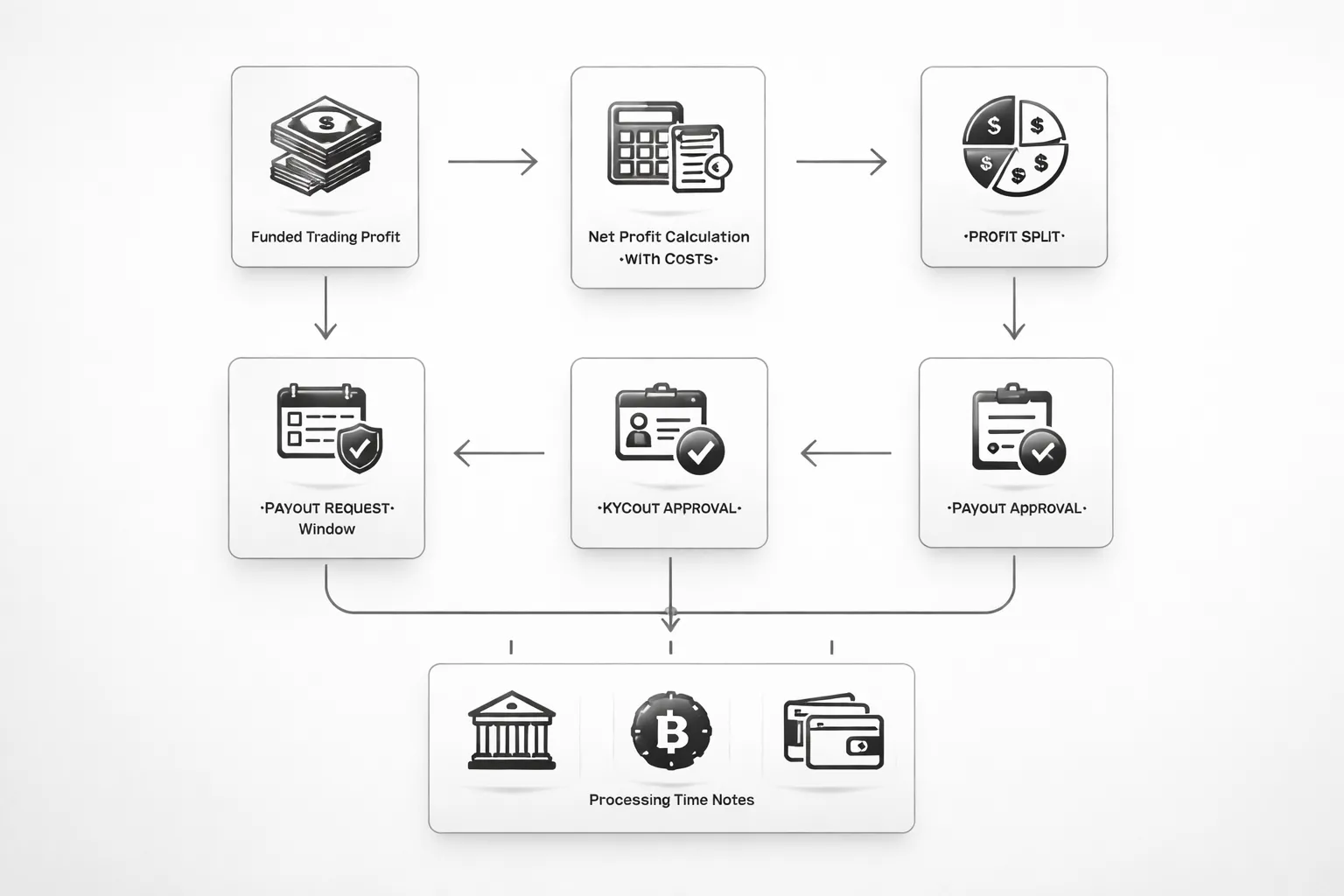
How profit splits work
Most firms pay a fixed split on profits you generate on a funded account. Common splits are 80/20, 85/15, and 90/10. The first number is your share.
Read the definition of net profit. Firms usually calculate it after trading costs. That means swaps, commissions, and spreads already sit inside your PnL. Some firms also deduct platform or data fees before they calculate the split.
- Example: You make $1,200 gross. You pay $80 commissions and $20 swaps. Net profit is $1,100. On an 80/20 split, your payout is $880.
- If the firm uses high-water mark accounting, you only withdraw profits above your last payout baseline.
- If you get a scaling split, the split improves after consistent payouts. Do not assume it applies on day one.
First payout timing and payout cycles
Payout rules usually start after you pass the challenge and trade the funded account for a set number of days.
- Bi-weekly: You request payouts every 14 days. Faster cashflow, more frequent reviews.
- Monthly: You request once per month. Fewer requests, slower access to profits.
- On-demand: You request anytime after a minimum holding period, often with extra conditions.
Check the first payout delay. Many firms require 14 to 30 days after first funded trade. Plan your risk around that window. If you spike risk to reach a payout date, you usually violate consistency checks.
Minimum payout thresholds and fee deductions
Firms often set a minimum withdrawal amount. If you stay below it, you either wait or forfeit the request.
- Common minimums: $50, $100, $200, or a % of account size.
- Some firms also require a minimum number of trading days in the payout cycle.
Know what gets deducted.
- Trading costs: Commissions and swaps reduce net profit.
- Platform fees: Some firms charge monthly for MT4, MT5, or cTrader access.
- Payment fees: Wire and some e-wallets charge incoming or conversion fees.
- Challenge fee refunds: Some firms refund the evaluation fee only after your first payout, and only if you meet their exact conditions.
Profit caps and consistency checks on funded accounts
Some firms limit how you earn, not just how much you earn.
- Profit cap: A hard limit on profit per day, per week, or per cycle. If you hit it, you stop trading or you risk a breach.
- Consistency rule: A limit on how much of your total profit can come from one day or one trade, such as 30% to 60% of the cycle profit.
- Lot size and risk limits: Caps on max lots, max risk per trade, or max exposure during news.
Trade with a payout plan. Aim for repeatable days, not one oversized day. If you rely on one large winner, you can pass targets but fail withdrawal review.
Payment methods and processing steps
Most payout delays come from verification, not trading.
- KYC: You submit ID, proof of address, and sometimes a selfie check.
- Proof of payment method: Some firms require the payout method to match the name on your ID.
- Invoices: Some firms ask for an invoice or contractor form before they release funds.
- Processing time: Many firms quote 1 to 5 business days. Bank wires can take longer.
Common payout rails include bank transfer, crypto, and e-wallets. Each has different fees and settlement times. Track your payout history and keep screenshots of requests and confirmations.
| Rule item | What to verify | What you do |
|---|---|---|
| Profit split | Split %, net profit definition | Estimate payout using net, not gross |
| Payout timing | First payout delay, cycle length | Set risk to survive the waiting period |
| Minimum withdrawal | Minimum amount, minimum days | Batch payouts, do not force trades |
| Deductions | Platform, payment fees, refund terms | Model true net and cash received |
| Consistency checks | Single-day or single-trade profit limits | Avoid one-trade reliance |
| Verification | KYC, invoices, name matching | Complete checks before your first request |
After you pass: funded account rules, scaling plans, and rule changes to watch
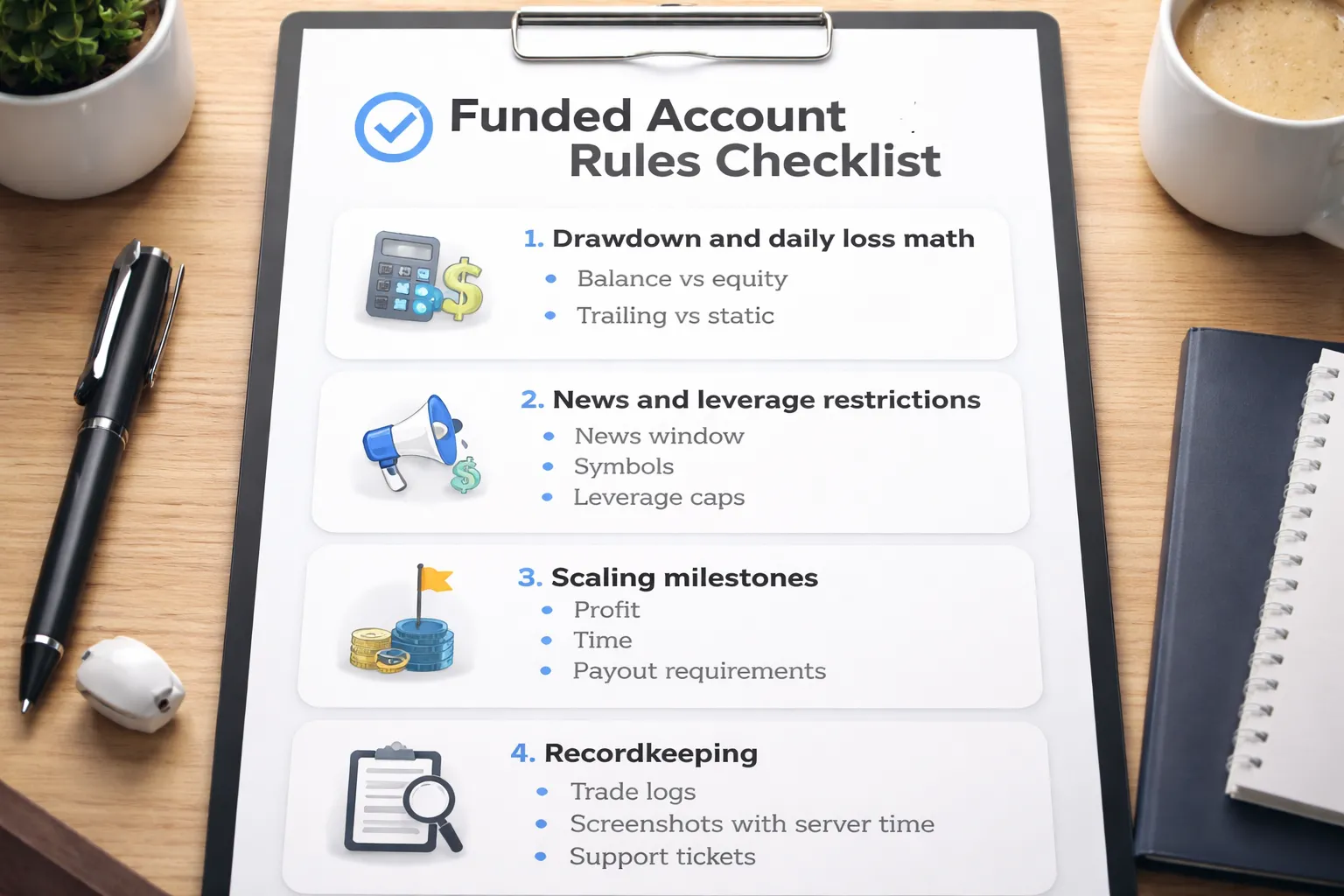
After you pass: funded account rules can differ from the evaluation
Do not assume the funded stage matches the challenge. Many firms tighten rules after you get funded.
- Drawdown type can change. A challenge may use static drawdown, then the funded account uses trailing drawdown. Trailing drawdown can move up with equity and reduce room for recovery after a peak.
- Daily loss math can change. Some firms calculate daily loss from start-of-day balance, others from start-of-day equity. Equity-based limits punish open floating loss.
- News rules can tighten. Common changes include wider restricted windows, banned holding through red-folder events, or forced flat rules on specific symbols.
- Leverage can drop. It is common to see lower leverage on funded accounts, and lower leverage again during major news or on indices, metals, and crypto.
- Allowed strategies can narrow. Some firms block certain EAs, latency arbitrage, tick scalping, or copying between accounts after funding.
- Trade management limits can appear. Watch for max lots, max orders, max daily trades, or limits on simultaneous positions.
- Execution and pricing rules can matter more. Some firms enforce “no off-market fills” language and can void trades they label as bad ticks or platform errors.
Scaling plans explained: what triggers more capital
Scaling sounds simple. It usually comes with conditions that delay upgrades.
- Milestone-based scaling. You reach a profit amount or percentage, then the firm increases your account size. Some use net profit, others use closed profit only.
- Time-based scaling. You must trade a minimum number of days, or complete a fixed period, before the firm reviews you for scaling.
- Payout-gated scaling. Some firms scale only after one or more payouts. Others require you to withdraw a minimum amount to qualify.
- Risk-based scaling. Many firms require no rule breaches, no violations, and clean risk metrics. Consistency rules can block scaling even if you hit the profit level.
- Reset after losses. Some programs reset the scaling clock if you draw down past a threshold, even if you later recover.
| Scaling trigger | What to check | What can block it |
|---|---|---|
| Profit milestone | Net vs. gross, closed vs. floating, measured from which starting balance | Consistency rules, high single-day profit, “one big trade” flags |
| Time requirement | Minimum days, minimum weeks, required activity per period | Inactivity, too few trading days, calendar resets |
| Payout requirement | Number of payouts, minimum withdrawal, payout schedule | Missing KYC, account name mismatch, payout batch windows |
| Risk metrics | Max loss, average risk, lot caps, drawdown profile | Equity swings, over-leverage, hedging or martingale language |
Track your scaling path before you trade the funded account. If your plan relies on scaling, do not trade blind.
Rule updates: what changes, what “grandfathered” means, and what to document
Firms update terms. They can change the funded rules faster than you can adapt.
- Grandfathering. Some firms keep your account under the rules you started with. Others move all traders to the new rules on a set date.
- Hidden changes. Firms may update FAQ pages, dashboard text, or Discord announcements without changing the contract title or version you remember.
- High-impact updates to watch. Trailing drawdown added, reduced leverage, tighter news restrictions, new consistency limits, new prohibited strategies, new payout caps, or profit split changes.
- What to save. Screenshot the rules page, your dashboard rules, and the full terms PDF. Save timestamps. Keep the URL. Store a local copy.
- What to compare. Check definitions. “Balance” vs. “equity” wording changes outcomes. “Server time” vs. “your local time” changes news windows.
If you need a shortlist of reputable options with clearer rule history, use this comparison of best forex prop firms.
Recordkeeping for disputes: build a paper trail before you need it
When a payout gets flagged, your records become your leverage. Keep them simple and complete.
- Trade logs. Export your full account history, not only the last payout period. Save CSV and HTML if possible.
- Per-trade evidence. Screenshot entry, stop loss, take profit, and modifications. Include ticket number, symbol, and lot size.
- Server time. Record the broker server time for each trade. News rules often depend on server time, not your local time.
- Charts and spreads. Capture the chart with time visible, plus spread at entry and exit if your platform shows it.
- Platform logs. Save journal logs and connection logs during any execution issue, disconnection, or “off quotes” event.
- Support tickets. Use the firm’s official support channel. Keep ticket IDs, email threads, and chat transcripts. Ask for written confirmation when rules affect your case.
- Daily snapshots. Screenshot your dashboard daily balance, equity, and drawdown metrics. This helps when the dashboard numbers change later.
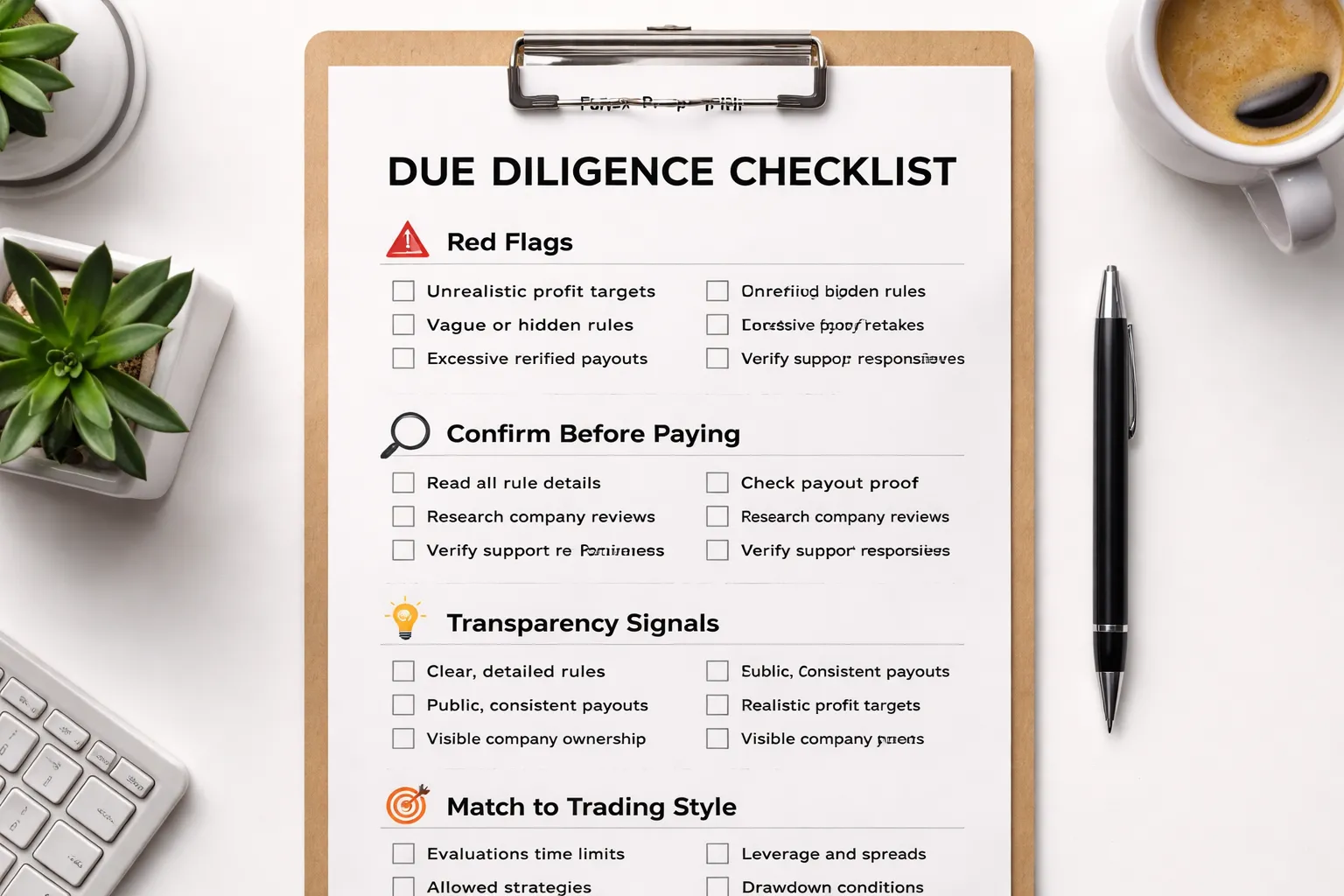
How to evaluate a prop firm’s rule set (a due diligence checklist)
Red flags in challenge terms
- Vague banned strategies. Terms like “toxic flow,” “gaming,” “latency arbitrage,” “unfair advantage,” or “platform abuse” with no definition, no examples, and no measurable triggers.
- Undefined drawdown math. They do not state if drawdown uses balance or equity, if it is static or trailing, when it updates, and what price source they use for equity during spikes.
- Discretionary denials. Any clause that lets them void trades, reset accounts, or deny payouts “at our sole discretion,” without a clear appeal process and timelines.
- One sided execution language. They reserve the right to reprice fills or cancel trades for “off quotes” while holding you to losses.
- Rule conflicts. A news rule that conflicts with a minimum trading day rule, or a max lot rule that makes the profit target unrealistic.
- Hidden limits. Lot caps, position limits, symbol bans, time of day limits, or max orders per day that only appear in FAQs or Discord posts.
- Moving goalposts. They can change rules mid challenge and apply changes retroactively.
What to confirm before paying
- Broker and liquidity model. Ask if trades route to a real broker, a B book simulator, or an internal matching engine. Get the answer in writing.
- Platform details. Confirm MT4, MT5, cTrader, or web platform. Confirm server time, chart feed, and whether EAs, scripts, and trade copiers are allowed.
- Execution and slippage policy. Confirm if they allow positive slippage, how they handle gaps, and whether stops trigger on bid, ask, or last price.
- Spread and commission schedule. Ask for typical spreads by session, commission per lot, and swap policy. Verify if they use “raw plus commission” or “all in spread.”
- Trading hours and symbol list. Confirm if indices, metals, crypto, and exotics qualify. Confirm weekend rules and daily maintenance windows.
- News rules. Get exact times, affected symbols, and what counts as “trading news.” Confirm if holding positions through news is allowed.
- Scaling and payout rules. Confirm split, payout frequency, minimum payout amount, payout fee, and KYC timeline. Confirm if a payout resets drawdown or keeps it trailing.
Transparency signals to look for
- Public rulebook. A single, versioned rule page with dates and change logs. No scattered rules across popups and support chats.
- Worked examples. They show drawdown calculations with numbers. They show trailing drawdown behavior after profits and after withdrawals.
- Fast, specific support. You ask one question about drawdown math and they answer with definitions, timing, and examples. You get the answer in writing.
- Payout proof you can verify. Consistent, time stamped payout confirmations, and clear payout terms that match the proof. Avoid firms that rely on screenshots with no context.
- Consistent platform data. Dashboard metrics match platform equity and history. They explain discrepancies and provide audit logs.
Match rules to your trading style
| Trading style | Rules that must fit | What breaks your edge |
|---|---|---|
| Scalper | Low spreads, clear slippage rules, no minimum hold time, no anti scalping clause, stable execution during London and New York opens. | “Toxic flow” bans, minimum seconds in trade, trade frequency limits, wide spreads at rollover, asymmetric slippage. |
| Swing trader | No time limit or a long time limit, weekend holding allowed, reasonable swaps, drawdown based on end of day balance if possible, clear gap policy. | Short evaluation windows, strict daily loss caps, high swaps, equity based trailing drawdown that tightens after floating profit. |
| News trader | Explicit news trading permission, defined blackout window, clear fill policy for fast markets, rules for pending orders and stops. | Wide “news trading prohibited” language, retroactive trade cancellations, limits on pending orders, execution clauses that void volatility fills. |
Use this checklist before you buy, and before you change your plan. If you want a rules first workflow for the full challenge process, use this step-by-step plan to pass a prop firm challenge.
Practical examples: rule walkthroughs with common account sizes
Example A: $10,000 account with 10% max drawdown and 5% daily loss cap
Assume a $10,000 challenge account with these rules.
- Max drawdown: 10% of starting balance.
- Daily loss cap: 5% per day.
- Drawdown basis: balance, equity, or the higher of the two, it matters.
Translate the limits into dollars.
- Max drawdown: $10,000 x 10% = $1,000. You fail at $9,000 if the firm uses balance-only. You can fail earlier if it uses equity.
- Daily loss cap: $10,000 x 5% = $500 per day. You fail the moment you hit the limit if the firm uses equity and includes open loss.
Walkthrough with a common day.
- You start the day at $10,000.
- You open a trade and it goes to -$520 floating loss. If the daily loss uses equity, you fail before you can recover.
- You close the trade at -$480, then take another trade and it floats -$40. If the firm counts closed plus open, you hit -$520 for the day and you fail.
Risk sizing implication.
- If your average stop is 25 pips and you trade 1 lot on EURUSD, your risk is about $250. Two full losses can push you near the daily cap.
- If you keep risk at 0.5% per trade, you risk $50. It takes 10 straight losses to hit -$500, which gives you room for spread and slippage.
Example B: trailing drawdown account and how the threshold moves after wins
Assume a $50,000 account with a 10% trailing drawdown.
- Trailing drawdown distance: $50,000 x 10% = $5,000.
- Fail level: a moving floor set at peak equity minus $5,000.
Walkthrough.
- You start at $50,000. Peak equity is $50,000. Fail level is $45,000.
- You gain $2,000. Equity hits $52,000. Peak equity becomes $52,000. Fail level moves up to $47,000.
- You then lose $4,500. Equity drops to $47,500. You survive because you stayed above $47,000.
- You gain again and hit $53,500. Peak equity becomes $53,500. Fail level moves up to $48,500.
- You take a hit and drop to $48,400. You fail, even though you are still above your starting balance.
What this means for your trade plan.
- After a good run, your account becomes easier to fail. Your drawdown floor rises with your peak.
- Large lot size increases after a win streak can break the account fast.
- If the firm calculates trailing drawdown on equity, intraday spikes against your position can fail you even if the trade later recovers.
Example C: news window restriction and how it affects entries and stops
Assume the firm bans trading 5 minutes before and 5 minutes after high-impact news for the traded currency.
- No new trades: you cannot open a position inside the window.
- No modifications: some firms also block changing stops, limits, and partial closes inside the window.
- Pending orders: some firms treat a pending order fill during the window as a violation.
Walkthrough with a scheduled event.
- 12:30:00 is the release time. The restricted window is 12:25:00 to 12:35:00.
- You place a buy stop at 12:20:00. Price spikes and triggers it at 12:29:30. Many firms count this as a news trade and can void it.
- You hold a trade from earlier. At 12:27:00 you tighten the stop. If modifications are banned, you can violate the rule even though you did not open a new trade.
- You set a stop and take profit at entry. Some firms allow this because it is not a modification later.
Execution risk you must plan for.
- Spreads widen. A stop can fill worse than your level.
- Daily loss can trigger from slippage alone if the firm counts equity.
- If the firm uses retroactive cancellations, you can lose valid profits from volatility fills.
Example D: meeting profit target while respecting minimum trading days
Assume a $100,000 challenge with an 8% profit target and a 5 minimum trading days rule.
- Profit target: $100,000 x 8% = $8,000.
- Minimum trading days: 5 separate days with at least one executed trade per day, based on the firm definition.
Walkthrough with a fast start.
- Day 1: you make $5,000. You are close to target but you still have 4 trading days to complete.
- Day 2: you make $3,200. You hit $8,200 total profit and meet the target, but you still need 3 more trading days.
- Days 3 to 5: you must trade without giving back too much profit and without breaking daily loss or drawdown rules.
How traders fail here.
- They oversize on the extra days and give back profits into trailing or daily loss limits.
- They open micro trades that still trigger slippage and spreads, then a small loss clips the daily cap because the account is already near a moving threshold.
- They assume a “trading day” means any activity. Some firms require a closed trade, others count an open trade, others require a minimum lot size.
Simple operating rule.
- Once you are near target, reduce risk and trade only if the setup is clean.
- Keep extra days focused on rule compliance, not profit.
- Use a written checklist, or follow a rules-first workflow like this step-by-step plan to pass a prop firm challenge.
FAQ
Error: Invalid type for 'messages[1].content': expected one of a string or array of objects, but got a boolean instead.Conclusion
Conclusion
Prop firm challenges reward rule control, not big trades.
Your three numbers decide everything, max drawdown, daily loss cap, and profit target. Build your plan around the tightest limit. Track equity and balance the way your firm calculates breaches.
Keep risk small and repeatable. Use a fixed percentage per trade. Cut size after a losing streak. Stop trading for the day when you get close to the daily cap.
Payout rules matter as much as passing. Check the first payout timing, profit split, minimum payout amount, and any consistency requirement. Plan your withdrawals so you do not force trades to hit a date.
- Before you start: write your max daily loss number on your chart and in your journal.
- During the challenge: risk the same amount on every setup, no exceptions.
- After a red day: reduce size or pause, do not try to earn it back.
If you still have not chosen a firm, compare rules side by side before you pay. Use this list of best forex prop firms to check drawdown method, targets, and payout terms in one place.
-
Best Forex Copy Trading Platforms (Features, Fees & Safety Compared)
7 months ago -
Best Forex Prop Firms (Top Firms Compared)
7 months ago -
What Is a Forex Prop Firm? How Prop Trading Works for Forex
7 months ago -
Copy Trading Forex Explained: How It Works, Pros, Cons & Risks
7 months ago -
Forex Signals: Are They Worth It? (What to Know Before You Buy)
7 months ago
-
How to Place a Forex Trade Step by Step (Your First Trade Explained)
5 months ago -
Forex Trading vs Crypto Trading: Which Market Is Better for Beginners?
5 months ago -
Forex Lot Size Calculator: How to Use It to Size Trades Correctly
7 months ago -
How to Calculate Position Size in Forex (Position Sizing Formula + Examples)
7 months ago -
Forex Leverage Explained: How It Works, Pros, Cons & Examples
7 months ago
-
Forex Trading Platforms Comparison: MetaTrader vs cTrader vs TradingView
7 months ago -
Stop Loss vs Take Profit: Differences, Examples & Best Practices
7 months ago -
Is Forex Trading Legal in the United States? Rules, Regulators & What to Know
7 months ago -
Forex Leverage Explained: How It Works, Pros, Cons & Examples
7 months ago -
Forex Market Hours & Trading Sessions Explained (Best Times to Trade)
7 months ago