Best Forex Pairs to Trade for Beginners (Low Spread, High Liquidity Picks)

Pair selection decides your trading costs and how clean your charts look. Beginners do best with low spreads and deep liquidity. These pairs fill fast, slip less, and move on clear news.
This guide lists the best forex pairs for beginners, based on typical spread levels, average daily volume, and market hours. You will learn which majors tend to trade tight, which pairs can stay liquid outside London and New York, and which pairs to avoid when spreads widen. You will also get a simple checklist to match pairs to your schedule and risk.
If you need a quick refresher on costs, read our guide to what a spread is in forex.
Key Takeaways
Key Takeaways
- In het kort: Start with major pairs. They usually give you the lowest spreads and the most consistent liquidity.
- In het kort: EUR/USD often has the tightest spreads. It is the standard beginner pair for cost control.
- In het kort: USD/JPY and GBP/USD usually stay liquid and tradable, but GBP/USD can swing more, size down.
- In het kort: Trade when your pair is active. London and New York hours tend to deliver the best pricing.
- In het kort: Avoid thin hours. Spreads widen around rollover and during quiet sessions, your costs rise fast.
- In het kort: Skip most exotics as a beginner. They often have wider spreads, lower liquidity, and sharper moves.
- In het kort: Check average spread, average daily volume, and session overlap before you choose a pair.
- In het kort: Keep leverage low until you can manage drawdowns, read margin vs leverage.
What forex pairs are (and what “best for beginners” really means)
What a forex pair is
A forex pair quotes one currency against another.
The first currency is the base. The second is the quote.
The price tells you how much quote currency you pay for 1 unit of the base.
Example: If EUR/USD trades at 1.0850, you pay 1.0850 USD for 1 EUR. If it moves to 1.0900, EUR got stronger versus USD.
Majors, minors, and exotics, and why cost changes
- Majors pair the USD with a top currency, like EUR/USD, GBP/USD, USD/JPY, USD/CHF, AUD/USD, NZD/USD, USD/CAD. They usually have the highest liquidity and the most stable spreads.
- Minors are crosses without USD, like EUR/GBP, EUR/JPY, GBP/JPY, AUD/JPY. Liquidity can still be strong, but spreads often run wider than majors and can jump faster when one side goes quiet.
- Exotics combine a major currency with an emerging market currency, like USD/TRY or EUR/ZAR. Liquidity is lower, spreads are wider, and price can gap on news or thin order books.
Higher liquidity usually means tighter spreads and better fills. Lower liquidity usually means higher costs and more slippage during fast moves. If you do not understand slippage yet, read how slippage works.
What “best for beginners” really means
“Best” does not mean the pair that moves the most. It means the pair that keeps your costs and execution problems small while you learn.
- Spread stability. You want a pair where spreads stay tight during active hours and do not spike often.
- Execution quality. You want deep liquidity, so market orders fill close to your price and stops behave more predictably.
- More predictable behavior. You want pairs that react in a consistent way to major data and central bank news, with fewer random jumps from thin liquidity.
Common misconceptions that cost beginners money
- “This pair is cheap”. Price level does not matter. USD/JPY at 150 is not more expensive than EUR/USD at 1.08. Your cost comes from spread, commission, swap, and slippage.
- Tight spreads at quiet hours. Brokers can show tight quotes when the market is thin, then widen spreads fast when orders hit. Your real cost shows up in fills and stop execution, not the quote you see.
- Overtrading correlated pairs. EUR/USD and GBP/USD often move in the same direction. EUR/JPY and GBP/JPY often share JPY risk. If you take multiple trades that all depend on USD or JPY, you increase exposure without noticing.
The 6 metrics beginners should use to pick a currency pair
1) Spreads, typical vs minimum
Ignore the best case spread you see in ads. Track the typical spread during the hours you trade.
- Minimum spread is the tightest quote that may show for seconds in perfect conditions.
- Typical spread is what you pay most of the time. Many brokers publish it. You should still verify it on your platform.
- Widening around news hits majors and crosses. Quotes can jump from 0.8 pips to 3 to 10 pips during CPI, NFP, or rate decisions. Your stop can fill worse than planned.
- Widening at rollover often shows near 5pm New York. Liquidity drops, spreads expand, and stops can trigger from spread alone.
For beginners, pick pairs that keep a tight typical spread in your session. If you see frequent spread spikes, move on.
2) Liquidity and slippage
Liquidity decides how close your fill is to your price. It matters most on stop-loss orders.
- High liquidity usually means smaller gaps between bid and ask, and less slippage on market orders and stops.
- Low liquidity means more slippage. A small account feels it faster because each pip is a larger share of your risk.
- Liquidity protects you when price moves fast. It does not eliminate slippage, it reduces it.
If your strategy uses tight stops, liquidity is not optional. Read this guide to understand the mechanics: why liquidity matters.
3) Volatility, ATR and average daily range
Volatility sets your stop size and position size. If volatility does not match your risk plan, you will cut winners early or take oversized losses.
- Average Daily Range tells you how far the pair tends to move in a day. Use it to avoid pairs that regularly outmove your stop.
- ATR tells you recent average movement over your chosen period. Many traders use ATR(14) on the timeframe they trade.
- If ATR is high, you need wider stops or smaller size. If ATR is low, you may face more chop and false breaks.
Pick pairs where your normal stop size fits inside typical movement without constant stop-outs.
4) Session alignment
Trade a pair when its home markets are active. You want consistent volume, not dead hours.
- EUR pairs often move best during London and the London to New York overlap.
- USD pairs often move most during New York and the overlap.
- JPY pairs often pick up during Tokyo, then again when London opens.
- AUD and NZD pairs often move most during Sydney and Tokyo hours.
If you trade outside active hours, you can see thin liquidity, jumpy spreads, and more stop noise.
5) News sensitivity
Some pairs react harder to specific data. You should know what can move your pair before you place a trade.
- CPI often hits USD pairs hard, and can reprice markets fast if inflation surprises.
- NFP can move USD pairs in seconds. Spreads widen and slippage rises.
- Rate decisions and press conferences can drive the largest one day moves. Expect fast repricing and sudden reversals.
- Risk sentiment often shows up in JPY crosses and sometimes CHF. In risk-off moves, JPY strength can hit multiple JPY pairs at once.
If you do not trade news, avoid holding positions through top tier releases for the base currencies in your pair.
6) Overnight costs, swaps and rollover
Your broker charges or pays a swap when you hold past rollover. This can change results, especially on longer holds.
- Swap depends on the pair, your direction, and your broker. It can be a cost or a credit.
- Triple swap often applies once per week to account for weekends. Many traders see it midweek, but timing depends on the broker.
- When it matters is simple. If you hold for days or weeks, swap can rival your target profit or deepen drawdowns.
- Widening at rollover adds a second cost. Your spread can expand, and stops near price can trigger.
Before you commit to a pair, check the swap rates in your platform and test your plan with a realistic holding period.
| Metric | What you check | Beginner rule |
|---|---|---|
| Spread | Typical spread in your trading hours, spread spikes near news and rollover | Prefer pairs with stable typical spreads |
| Liquidity | Slippage on stops, depth during active sessions | Prefer high liquidity if you use tight stops |
| Volatility | ATR and average daily range | Match stop size to normal movement |
| Session alignment | When volume is highest for the currencies in the pair | Trade during active sessions and overlaps |
| News sensitivity | CPI, NFP, rate decisions, risk sentiment moves | Avoid holding through major releases if you cannot manage spikes |
| Overnight costs | Swap rates, triple swap day, rollover spread widening | Do not ignore swap on multi-day holds |
Best forex pairs to trade for beginners (low spread, high liquidity picks)
EUR/USD, the benchmark major
EUR/USD is the cleanest starting point for most beginners. It trades with deep liquidity and tight spreads at most brokers. That usually means lower trading friction and fewer random spikes.
- Why it fits beginners: tight spreads, high liquidity, stable price behavior during normal sessions.
- When it moves most: London session, New York session, and the London to New York overlap.
- What to watch: ECB and Fed rate decisions, CPI, NFP. Spreads can widen around releases.
- How to trade it: keep it simple, focus on one setup, avoid overtrading during low volume hours.
USD/JPY, liquid with clear session rhythms
USD/JPY is a top liquidity pair with strong session patterns. It often responds to rate expectations, bond yields, and risk sentiment. Moves can accelerate when Japan and US markets overlap in news flow.
- Why it fits beginners: tight spreads, steady liquidity, clear reactions to rate and yield shifts.
- When it moves most: Tokyo session for baseline flow, New York session for bigger rate driven moves.
- What to watch: US Treasury yields, Fed guidance, BOJ policy signals, intervention headlines.
- Beginner risk control: use hard stops, reduce size during BOJ events, avoid holding through surprise intervention risk.
GBP/USD, liquid but faster
GBP/USD stays liquid, but it moves faster than EUR/USD. It can overshoot levels and reverse quickly. You can trade it as a beginner, but you must lower position size and widen your tolerance for noise.
- Why it can work: high liquidity, strong participation during London and the overlap.
- Main downside: larger average swings, sharper stop runs, more whipsaw around UK data.
- What to watch: UK CPI, wage data, GDP, Bank of England decisions, US data in the overlap.
- How to manage volatility: trade fewer positions, use smaller size, set stops based on structure, not on a fixed pip number.
USD/CHF, defensive behavior in risk-off
USD/CHF often acts defensive when markets turn cautious. CHF demand can rise during risk-off periods, which can shift trends fast. Liquidity stays solid, but you should respect sudden sentiment flips.
- Why it fits beginners: major pair liquidity, often cleaner swings during clear risk regimes.
- When it matters most: global risk events, equity sell-offs, geopolitical headlines.
- What to watch: broad USD moves, risk sentiment, Swiss National Bank communication.
- Execution note: during shock headlines, fills can degrade, review what slippage is in forex and plan for it.
USD/CAD, oil-linked tendencies
USD/CAD often reacts to energy moves because oil exports matter to Canada. You will see stronger directional days when crude trends and when Canada data surprises. Spreads stay competitive, but volatility can rise on energy headlines.
- Why it fits beginners: major pair liquidity, clear drivers on oil and North American data.
- When it moves most: New York session, especially during US and Canada data releases.
- What to watch: crude oil direction, BoC decisions, US data, Canada employment and CPI.
- Energy-driven day rule: if oil spikes, expect wider intraday ranges, reduce size or wait for price to stabilize.
AUD/USD, risk-on proxy with Asia-Pacific catalysts
AUD/USD often tracks risk appetite and China-related headlines. It also follows commodity demand expectations. The pair has clear session structure, with active moves during Asia and follow-through when London opens.
- Why it fits beginners: liquid major, often trades cleanly around session opens, tight spreads in active hours.
- When it moves most: Sydney and Tokyo sessions, then renewed activity around London open.
- What to watch: RBA decisions, Australia jobs and CPI, China PMI, broad risk sentiment.
- Practical tip: avoid trading it in the quiet gap between New York close and Asia open, spreads can widen and signals degrade.
| Pair | Why beginners use it | Primary drivers | Best active windows |
|---|---|---|---|
| EUR/USD | Very tight spreads, deep liquidity | ECB, Fed, US and EU inflation and jobs data | London, New York, overlap |
| USD/JPY | High liquidity, rate-sensitive moves | US yields, BOJ signals, risk sentiment | Tokyo, New York |
| GBP/USD | Liquid with strong trends, higher speed | BoE, UK data, US data in overlap | London, overlap |
| USD/CHF | Defensive behavior in risk-off | Risk sentiment, USD moves, SNB | London, New York during news |
| USD/CAD | Clear macro links, stable liquidity | Oil, BoC, US and Canada data | New York |
| AUD/USD | Clear session patterns, risk-on proxy | RBA, China data, global risk tone | Asia session, London open |
Beginner-friendly alternatives (once you understand majors)
Beginner-friendly alternatives (once you understand majors)
After you can read price action on majors, add one or two alternatives. Keep your focus on liquidity, spread behavior, and clean drivers. These pairs can teach you range trading, cross-pair behavior, and risk sentiment without jumping into illiquid markets.
EUR/GBP
EUR/GBP often trades steadier than GBP/USD. It can spend more time in ranges, especially outside major UK and Eurozone data releases. That makes it useful for learning range structure, support and resistance, and mean reversion.
- Why it helps beginners: Often less headline-driven than GBP/USD, fewer sharp spikes on broad USD moves.
- Main drivers: BoE vs ECB rate expectations, UK and Eurozone inflation and jobs data, risk sentiment during Europe hours.
- Best time to trade: London session. Liquidity usually stays solid through the London to New York overlap.
- Practical tip: Mark the last 5 to 10 London sessions’ range highs and lows. Many clean setups form when price revisits those levels before major data.
AUD/JPY
AUD/JPY is a risk-sentiment cross. It can trend fast when markets shift between risk-on and risk-off. It can also spike without warning when Japan or Australia headlines hit, or when global risk tone flips.
- Why it helps beginners: It teaches you how crosses move without the USD acting as a middle driver.
- Main drivers: Global equities tone, commodity sentiment, China-related news, RBA signals, BoJ policy and intervention risk.
- Where volatility spikes: Asia open, Tokyo news, Sydney data, and during sudden risk events.
- Practical tip: Use smaller size than you use on majors. Place stops with room for fast swings, or skip the trade when spreads jump around session changes.
NZD/USD
NZD/USD can work as a simpler add-on after AUD/USD. It often has lower liquidity than AUD/USD, so the spread can widen more during quiet hours and around New Zealand data.
- Liquidity vs AUD/USD: Usually thinner. You will see more spread expansion outside active sessions.
- When spreads widen: Late New York, pre-Asia, rollover, and during New Zealand CPI, jobs, and RBNZ decisions.
- Best time to trade: Asia session when New Zealand and Australia markets are active, then again during London if risk tone is strong.
- Practical tip: Set a max-spread rule in your platform. If spreads exceed your limit, do not trade.
Pairs beginners should usually avoid early
Early on, avoid pairs that punish small mistakes with wide spreads, poor fills, and sudden gaps. Learn clean execution first. Then expand.
- Exotics: Often high spreads, thin liquidity, and sharp moves on local news. Slippage can erase your edge.
- Thin minors: Some minors look liquid but trade unevenly outside their home session. Spreads can change fast.
- High-spread crosses: Crosses with two less-liquid legs can cost more to trade, especially around rollovers and news.
If you want a clear breakdown of pair categories before you branch out, read major vs minor vs exotic currency pairs.
| Pair | Why it is beginner-friendly | Common spread risk | Best session focus |
|---|---|---|---|
| EUR/GBP | Often range-friendly, cleaner European drivers | Widens around UK and Eurozone data | London, London to New York overlap |
| AUD/JPY | Teaches risk sentiment and cross behavior | Can spike on headlines, spreads can jump at session changes | Asia open, Tokyo hours |
| NZD/USD | Simple structure, similar feel to AUD/USD | More spread expansion in quiet hours, sharp widening on NZ events | Asia session, selective London setups |
When to trade these pairs: best sessions and overlaps
Asian session: where AUD and NZD lead
Asia runs on AUD, NZD, and JPY flow. Liquidity is lower than London and New York, so spreads can widen on some pairs.
- Pairs that tend to move: AUD/USD, NZD/USD, AUD/JPY. You often see clean pushes around the Tokyo open and again into key AU and NZ data.
- Pairs that tend to stall: EUR/USD and GBP/USD. They can drift in tight ranges until Europe steps in.
- Best use for beginners: Range trades and level to level moves. Keep position size modest because spreads can jump at session changes.
- Watchouts: NZ data can widen NZD/USD fast. Risk headlines can hit AUD/JPY without warning.
London session: liquidity surge, breakouts, and traps
London brings the biggest daily liquidity jump for EUR and GBP pairs. Spreads often tighten, then price starts to travel.
- Best pairs: EUR/USD and GBP/USD. You get more consistent fills and faster follow through.
- Common breakout window: The first 60 to 120 minutes of London. Price often breaks the Asia range.
- False-break risk: Early London can run stops above and below the Asia range, then snap back. You avoid many traps by waiting for a close beyond the range, then a retest.
- News catalyst: UK and Eurozone data can move GBP/USD and EUR/USD fast. Your spread and slippage risk rises near releases.
New York session: US data impact, then a fade
New York can extend London trends, or flip them on US data. Liquidity stays strong early, then drops later.
- Best pairs: EUR/USD and GBP/USD. USD flow dominates, so these pairs react cleanly to US numbers.
- Highest-impact window: The first half of New York, especially around major US releases. Expect fast moves and wider spreads around the exact release minute.
- Afternoon liquidity fade: Later New York often turns choppy. Spreads can widen and breakouts fail more often.
London to New York overlap: best blend of spread and movement
The overlap gives you peak participation from Europe and the US at the same time. You usually get the tightest spreads and the best follow through.
- Top picks: EUR/USD and GBP/USD. You get strong liquidity and cleaner execution.
- What works well: Continuation trades and breakouts with volume behind them. Trends often either extend or fully reverse here.
- Why beginners like it: You get movement without needing to chase thin liquidity. You can place tighter stops without spread pressure, if your setup supports it.
Timing pitfalls: rollover hour, holidays, end of week
- Rollover (swap) hour: Spreads can widen hard and fills get worse. You avoid opening new trades during this window, and you tighten risk if you hold positions through it.
- Holidays: A holiday in the US, UK, or Eurozone can drain liquidity. You often see random spikes, worse spreads, and weaker follow through.
- End of week: Late Friday can turn thin and jumpy. Many traders close risk, so price can whip on small orders. You avoid forcing trades into the close.
If you want a deeper breakdown by local time and session map, read forex market hours and trading sessions.
Simple strategies that fit beginner pairs (and why they work)
Support, resistance, and market structure on liquid majors
Start with liquid majors like EUR/USD, GBP/USD, and USD/JPY. You get tighter spreads and cleaner fills. That matters when your edge is small.
Mark structure before you look for entries. Use the higher timeframe to avoid noise.
- Timeframes: 4H for structure, 15M to execute.
- Trend structure: higher highs and higher lows for uptrend, lower highs and lower lows for downtrend.
- Key zones: prior day high and low, Asian range high and low, last swing high and low.
- Entry idea: wait for price to touch a zone, then show rejection and a clear break of a minor swing on 15M.
- Stop: beyond the swing that defines the zone, not a random pip count.
Why it works. Liquidity clusters around obvious highs and lows. Majors often respect these levels because many orders sit there. You avoid thin markets where levels break from one large order.
Trend continuation using moving averages and higher timeframe bias
Beginners do better with continuation than reversal. Continuation needs less precision. It also aligns you with flows that already show direction.
- Timeframes: 1H bias, 5M or 15M entry.
- Tools: 20 EMA and 50 EMA.
- Bias rule: only buy when price sits above both EMAs on 1H and the 20 EMA stays above the 50 EMA. Only sell when the opposite holds.
- Entry rule: wait for a pullback into the 20 to 50 EMA area on 5M or 15M, then enter after a strong close back in the trend direction.
- Filter: skip trades if the EMAs are flat and tangled. That signals chop.
- Stop: beyond the pullback swing low for longs, beyond the pullback swing high for shorts.
Why it works. Liquid pairs trend during active sessions. The EMA stack gives you a simple way to stay with that direction and avoid most range traps.
Range trading on calmer pairs, plus clear invalidation rules
Some sessions produce ranges, especially outside the main overlaps. Range trades fit pairs that often mean-revert when liquidity stays steady.
- Timeframes: 1H to define the box, 15M to trade it.
- Range definition: at least two clean touches at the top and bottom, with clear rejections.
- Entry: fade the edges only after rejection on 15M. Do not enter mid-range.
- Target: opposite side of the range, or the midpoint if volatility drops.
- Range invalidation: a 15M close outside the range, plus a retest that holds outside. Stop trading the range after that.
- Hard stop: a few pips beyond the range edge and beyond the rejection swing.
Why it works. In ranges, price often returns to fair value because neither side controls the move. Your invalidation rules keep you from fading a real breakout.
Breakout plan for session opens, with filters that cut whipsaws
Most fake breakouts happen when liquidity is thin or when price breaks a level with no follow through. Use simple filters that force you to trade only the better breaks.
- Pairs: focus on majors during the London open and the London to New York overlap.
- Level: use the Asian session high and low, plus prior day high and low.
- Filter 1: trade only in the direction of the 1H bias.
- Filter 2: require a 15M close beyond the level. No entries on the first spike.
- Filter 3: wait for a retest of the broken level, then enter on continuation.
- Stop: beyond the retest swing and back inside the old range.
- Exit rule: take partials at the next obvious liquidity level, then trail behind 15M swings.
Why it works. Session opens bring volume. A close plus retest forces the market to prove direction. It also reduces slippage and random stop outs.
Risk framework that keeps you consistent
Keep your system small. More setups and more timeframes create conflicting signals. That leads to overtrading.
- Use 1 to 2 setups: pick trend continuation and one other, either range or breakout.
- Use 1 to 2 timeframes: one for bias, one for entry. Example, 1H and 15M.
- One stop method: swing-based stops only. Place your stop beyond the swing that invalidates the setup.
- One risk unit: risk a fixed percent per trade. Keep it stable across pairs and sessions.
- One position sizing rule: calculate lot size from your stop distance, not from gut feel. Use a simple position size formula. Link your sizing to your stop and risk cap with position sizing.
This framework fits beginner pairs because it avoids low liquidity noise, limits decision points, and makes your results easier to measure and improve.
Risk management essentials tailored to forex pairs
Position sizing that stays constant across pairs
Your risk comes from your stop distance and pip value. Keep your dollar risk fixed, then adjust lot size.
Basic rule: size from the stop, not from your confidence level.
- Step 1: Set your risk per trade in account currency, for example $50.
- Step 2: Define your stop in pips, for example 25 pips.
- Step 3: Get pip value per 1 standard lot for that pair, in your account currency.
- Step 4: Calculate lot size.
Lot size formula: Lot size = Risk per trade / (Stop pips × Pip value per 1 lot).
This prevents a “small” stop on EUR/USD from risking less than a “wide” stop on GBP/USD. You keep risk equal. Use a pip value calculator if you do not want to convert quote currencies by hand.
Stop-loss placement, technical vs volatility-based
Pick one stop method per setup. Do not mix rules mid trade.
- Technical stops: Place the stop beyond a structure level that invalidates your idea. Examples include above the last swing high for shorts, below the last swing low for longs, or beyond a broken range.
- Volatility stops: Place the stop far enough away to survive normal movement. Use ATR or a fixed multiple of recent average range. Then reduce lot size to keep the same dollar risk.
Common stop mistakes on beginner pairs:
- Setting stops at obvious round numbers where many orders cluster.
- Using a tight stop on a volatile pair like GBP/JPY, then blaming “spread” for the loss.
- Moving the stop wider after entry to avoid a loss. This breaks your risk cap.
- Using the same pip stop on every pair. Different pairs have different daily ranges.
Manage correlation so you do not double your exposure
Many major pairs move together because they share the same base or quote currency.
Practical rule: treat strongly correlated trades as one idea.
- EUR/USD long plus GBP/USD long often stacks USD short exposure. A single USD move can hit both.
- EUR/USD short plus USD/CHF long often express a similar USD long view.
- AUD/USD and NZD/USD often react to the same risk sentiment moves.
Simple controls:
- Limit one open position per currency, or cap total risk across correlated pairs, for example 1R total across the cluster.
- If you take two similar trades, cut size on each so combined risk stays inside your normal limit.
Leverage guidelines and how margin calls happen
Leverage does not change spread or probability. It changes how fast losses threaten your account.
Beginner guideline: use low effective leverage. Keep wide safety room for drawdowns and news spikes. If you cannot survive a normal losing streak, your leverage is too high.
How margin calls happen in practice:
- You open a position that uses a large share of your free margin.
- Price moves against you. Your unrealized loss reduces equity.
- Your margin level drops because equity falls while used margin stays similar.
- Your broker starts closing positions when you hit their stop-out level.
Keep free margin high. Avoid holding multiple large trades in the same currency direction. If you want details and examples, use this guide on forex leverage.
High-impact news, plan your response before the release
Spreads can widen. Liquidity can thin. Slippage can jump. This matters even on major pairs.
Pick one of these plans and write it into your rules:
- Avoid: do not open new trades in a set window, for example 15 to 60 minutes before and after Tier 1 events. Close or reduce exposure if your setup depends on tight execution.
- Reduce size: keep the trade, but cut risk, for example from 1R to 0.25R. Expect worse fills and wider spreads.
- Predefined breakout rules: trade the post release structure only. Wait for the first impulse, then a pullback, then enter with a clear invalidation level. Use a stop that accounts for higher volatility, then size down to keep dollar risk fixed.
Do not widen stops during the spike to “give it room” unless your plan says so and your size already reflects the wider stop.
Pair-selection checklist (a repeatable process for beginners)
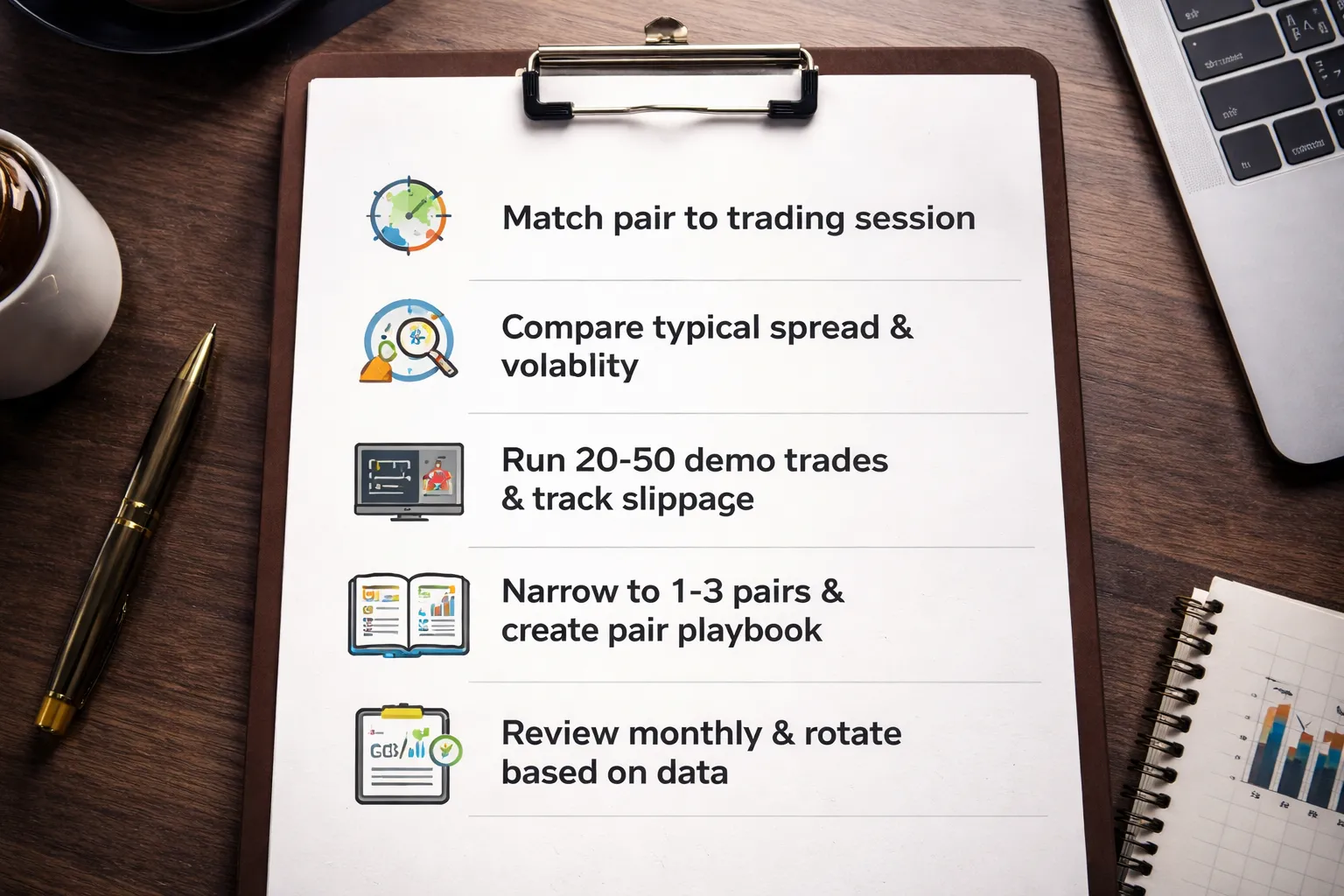
Pair-selection checklist (a repeatable process for beginners)
Use this checklist to pick pairs based on how they actually trade on your broker, during your hours.
Step 1: Pick your trading window, match pairs to that session
- Write your trading hours. Use your local time. Be specific.
- Trade pairs that overlap your session. Liquidity rises when the pair’s home markets are open.
- Start with majors tied to your session. They usually give tighter spreads and cleaner fills than minors and exotics.
- Default mapping:
- Asia hours: USDJPY, AUDUSD, NZDUSD.
- London hours: EURUSD, GBPUSD, USDCHF.
- New York hours: EURUSD, GBPUSD, USDCAD.
- London to New York overlap: EURUSD, GBPUSD, USDJPY.
- Avoid forcing it. If you trade Asia hours, do not default to GBP crosses. Spreads and moves often look worse.
Step 2: Compare average spread and typical volatility, skip marketing minimums
- Pull real spread stats from your platform. Use your broker’s typical spread, or record live spreads at your trade times.
- Use an average, not the minimum. Minimum spreads show the best case. You trade the rest of the day.
- Check spread behavior around your entries. Note what spread does during session opens and scheduled news.
- Measure typical volatility. Use your platform’s ATR(14) on your main timeframe, or a simple high to low range for the last 20 sessions.
- Score each pair with the same inputs. Spread in pips, average range in pips, and your expected stop size in pips.
| What to record | How to record it | What you want |
|---|---|---|
| Typical spread | Sample 30 to 60 observations during your trading window | Low and stable |
| Spread at session open | Record 15 minutes before and after open | No blowouts |
| Spread during news | Record on major calendar events you trade | Predictable widening, or you avoid trading it |
| Typical range | ATR(14) or last 20 day average range | Enough movement to cover spread plus your target |
If you do not understand why your fills differ from your click price, read this guide on slippage in forex.
Step 3: Run a 20 to 50 trade demo sample, track spread and slippage
- Demo the exact pairs you shortlisted. Use the same trade window, same setup, same order type.
- Take 20 to 50 trades per pair. Less data lies to you.
- Log every fill. Entry time, order type, intended price, filled price, spread at entry, spread at exit.
- Separate normal trades from news trades. Do not mix them in one average.
- Compute three numbers:
- Average spread cost per trade in pips.
- Average slippage in pips, plus worst 1 to 3 fills.
- Stop hit rate by noise where price tags your stop then returns.
- Drop pairs with ugly tails. One or two extreme spread spikes can erase many small wins.
Step 4: Narrow to 1 to 3 pairs, build a pair playbook
- Pick the top 1 to 3 pairs by data. You want consistency, not variety.
- Create a one page playbook per pair. Keep it simple and repeatable.
- Include these fields:
- Best trading window: your hours that show the cleanest moves.
- Key levels: prior day high and low, weekly high and low, session open range.
- Catalysts: the few news events that regularly move the pair.
- Rhythm: average spread, typical pullback depth, common fakeout zones.
- Execution rules: order type, max spread you accept, when you skip trades.
- Risk template: typical stop size range in pips, and your fixed dollar risk.
- Trade your playbook only. If the pair does not match your conditions, you stand down.
Step 5: Review monthly, rotate only when the data justifies it
- Review once per month. Do not change pairs after a bad week.
- Track the same metrics every month: average spread, worst spread, average slippage, win rate, average R, and expectancy.
- Rotate only with a clear trigger. Examples include a sustained spread increase during your window, repeated slippage spikes, or a drop in clean setups.
- Keep one backup pair. Use it only if your main pair fails the trigger rules.
Common beginner mistakes when choosing forex pairs (and fixes)
Chasing the most volatile pair after seeing big candles
Big candles attract beginners. They also hide higher spread, higher slippage, and faster reversals.
Fix it with rules you can measure.
- Filter by transaction cost first. Track average spread and worst spread during your trading window. Do not pick a pair because it moved 120 pips.
- Define a volatility band. Use a simple 20 day ATR check. Avoid pairs where current ATR sits far above its 6 month median. You want stable conditions while you learn.
- Backtest your setup on the pair. Record win rate, average R, and expectancy. If the edge does not show, the candle size does not matter.
Trading illiquid hours and mistaking spread widening for “bad broker fills”
Spread widens when liquidity drops. Your broker did not need to cheat for your fill to get worse.
Fix it by matching pairs to active sessions.
- Trade majors during their main overlap. EURUSD and GBPUSD usually behave best during London and London to New York overlap.
- Log spread and slippage by hour. Build a simple table. Your goal is to find the hours with the lowest worst spread and lowest slippage spikes.
- Avoid rollover if you cannot manage it. Spreads often jump around daily rollover. Swaps also apply when you hold past rollover. Learn the cost model in forex swap fees (rollover).
| What you see | Common wrong conclusion | Better explanation | Fix |
|---|---|---|---|
| Stops hit by 1 to 3 pips, then price moves your way | “Hunting” | Spread widened, your stop sat inside the wider spread | Place stops beyond normal worst spread, trade liquid hours |
| Entry fill worse than clicked price | “Bad fills” | Slippage during thin liquidity or fast move | Use limit orders, avoid news minutes, log slippage by hour |
Ignoring economic calendars and entering right before major releases
News can flip structure in seconds. Spreads can expand. Slippage can jump. Your plan can break even if your analysis was fine.
Fix it with a calendar routine.
- Mark high impact releases for your pair. For USD pairs, watch CPI, NFP, FOMC, and unemployment claims. For EUR, watch ECB and CPI. For GBP, watch BoE and CPI.
- Set a hard no trade window. Example, no new trades 15 minutes before to 15 minutes after major releases. Extend the window for rate decisions.
- Track post news metrics. Record worst spread and slippage during the event window. If it repeatedly breaks your limits, treat it as a trigger to stand down.
Over-diversifying: why too many pairs slows learning and increases errors
More pairs means more charts, more setups, more context switches. Your execution drops. Your journal gets noisy. You learn slower.
Fix it with a narrow universe.
- Start with 1 main pair. Add a second only after you log at least 50 to 100 trades with stable process metrics.
- Standardize one playbook. Same entry rules, same stop logic, same risk model, same session. Change one variable at a time.
- Use your backup pair only by trigger. Switch only when your tracked metrics show sustained spread increase, repeated slippage spikes, or fewer clean setups.
Misreading pip sizes and pip value across JPY vs non-JPY pairs
JPY pairs quote with two decimal pips. Most other pairs quote with four. This changes your pip count and your position size math.
Fix it with a simple checklist.
- Know the pip format. Non JPY pairs, 1 pip is 0.0001. JPY pairs, 1 pip is 0.01.
- Size trades by money risk, not pip count. If you risk $50, calculate lot size from stop distance and pip value. Do not copy a 20 pip stop from EURUSD to USDJPY without recalculating.
- Use the same risk per trade across pairs. Keep your R consistent. Let pip counts vary.
| Pair type | Typical quote | 1 pip | Common beginner error |
|---|---|---|---|
| Non JPY, example EURUSD | 1.0850 | 0.0001 | Confusing points with pips on 5 digit quotes |
| JPY, example USDJPY | 150.25 | 0.01 | Using the same lot size as EURUSD for the same pip stop |
FAQ
What are the best forex pairs for beginners?
Start with major pairs. They have high liquidity and tight spreads. Good picks include EURUSD, USDJPY, GBPUSD, and USDCHF. Keep your watchlist small. Learn one or two pairs before adding more.
Which forex pairs have the lowest spreads?
EURUSD usually has the lowest typical spread. USDJPY and USDCHF often follow. Your broker and session matter. Spreads widen during news, rollovers, and low liquidity hours.
What is the most liquid forex pair?
EURUSD leads on daily volume and order flow. It usually gives the cleanest fills and the smallest average spread. Liquidity still drops after the New York close and around major holidays.
Should you trade exotic pairs as a beginner?
No. Exotics often have wider spreads, larger gaps, and more slippage. They can move fast on thin liquidity. Stick to majors until you can manage costs and volatility with consistency.
What is a “good” spread for a beginner pair?
On a liquid major, aim for consistently tight spreads during your trading hours. As a rough guide, EURUSD near 0.0 to 1.2 pips on a low cost account, USDJPY near 0.5 to 1.5. Check your broker’s typical spread, not minimum.
When are spreads lowest?
During peak overlap. London plus New York typically gives the best liquidity and tighter spreads on majors. Spreads often widen around daily rollover, major news releases, and during the Asia session for some pairs.
How many pairs should you trade as a beginner?
One to three pairs. Fewer pairs means fewer variables. You learn each pair’s average range, reaction to news, and best session. You also reduce impulsive switching.
Do tighter spreads always mean better trading?
No. Spread is one cost. You still need stable execution, low slippage, and enough volatility to reach targets. Track total cost per trade, spread plus slippage plus commissions if you pay them. Read more about slippage in forex.
How do you compare pairs fairly?
Use the same risk in dollars, then size the position per pair. Do not compare raw pip stops across pairs. A 30 pip stop on EURUSD is not the same dollar risk as 30 pips on USDJPY at the same lot size.
Is EURUSD better than GBPUSD for beginners?
Often, yes. EURUSD usually has tighter spreads and steadier moves. GBPUSD can swing harder and spike on UK data. If you want smoother conditions and lower costs, start with EURUSD.
Conclusion
Conclusion
Start with pairs that trade cheap and clean. That means low spreads, deep liquidity, and stable order flow. For most beginners, EURUSD sits at the top. USDJPY and GBPUSD can work, but they demand tighter discipline on news and volatility.
- Pick 1 to 2 pairs. Learn their daily range, peak sessions, and news sensitivity.
- Track your all-in cost. Spread plus any commission, measured in pips and dollars.
- Size every trade from risk, not from lot size. Use your stop distance and pip value per pair.
- Trade the liquid hours. London and London to New York overlap usually give better fills.
- Avoid exotic pairs. Wide spreads and thin liquidity punish small mistakes.
Your best next step is simple. Set a fixed risk per trade, then calculate position size per pair before you enter. Use this position sizing guide, then stick to one pair until your results stay stable.
-
Forex Leverage Explained: How It Works, Pros, Cons & Examples
7 months ago -
Forex Market Hours & Trading Sessions Explained (Best Times to Trade)
7 months ago -
How to Calculate Position Size in Forex (Position Sizing Formula + Examples)
7 months ago -
What Is a Lot Size in Forex? Lot Types + Quick Examples
7 months ago -
What Are Pips in Forex? Definition, Examples & Why They Matter
7 months ago
-
- Pair-selection checklist (a repeatable process for beginners)
- Step 1: Pick your trading window, match pairs to that session
- Step 2: Compare average spread and typical volatility, skip marketing minimums
- Step 3: Run a 20 to 50 trade demo sample, track spread and slippage
- Step 4: Narrow to 1 to 3 pairs, build a pair playbook
- Step 5: Review monthly, rotate only when the data justifies it
-
- Chasing the most volatile pair after seeing big candles
- Trading illiquid hours and mistaking spread widening for “bad broker fills”
- Ignoring economic calendars and entering right before major releases
- Over-diversifying: why too many pairs slows learning and increases errors
- Misreading pip sizes and pip value across JPY vs non-JPY pairs
-
- What are the best forex pairs for beginners?
- Which forex pairs have the lowest spreads?
- What is the most liquid forex pair?
- Should you trade exotic pairs as a beginner?
- What is a “good” spread for a beginner pair?
- When are spreads lowest?
- How many pairs should you trade as a beginner?
- Do tighter spreads always mean better trading?
- How do you compare pairs fairly?
- Is EURUSD better than GBPUSD for beginners?
-
- Pair-selection checklist (a repeatable process for beginners)
- Step 1: Pick your trading window, match pairs to that session
- Step 2: Compare average spread and typical volatility, skip marketing minimums
- Step 3: Run a 20 to 50 trade demo sample, track spread and slippage
- Step 4: Narrow to 1 to 3 pairs, build a pair playbook
- Step 5: Review monthly, rotate only when the data justifies it
-
- Chasing the most volatile pair after seeing big candles
- Trading illiquid hours and mistaking spread widening for “bad broker fills”
- Ignoring economic calendars and entering right before major releases
- Over-diversifying: why too many pairs slows learning and increases errors
- Misreading pip sizes and pip value across JPY vs non-JPY pairs
-
- What are the best forex pairs for beginners?
- Which forex pairs have the lowest spreads?
- What is the most liquid forex pair?
- Should you trade exotic pairs as a beginner?
- What is a “good” spread for a beginner pair?
- When are spreads lowest?
- How many pairs should you trade as a beginner?
- Do tighter spreads always mean better trading?
- How do you compare pairs fairly?
- Is EURUSD better than GBPUSD for beginners?
-
How to Place a Forex Trade Step by Step (Your First Trade Explained)
5 months ago -
Forex Trading vs Crypto Trading: Which Market Is Better for Beginners?
5 months ago -
Forex Lot Size Calculator: How to Use It to Size Trades Correctly
7 months ago -
How to Calculate Position Size in Forex (Position Sizing Formula + Examples)
7 months ago -
Forex Leverage Explained: How It Works, Pros, Cons & Examples
7 months ago
-
Forex Trading Platforms Comparison: MetaTrader vs cTrader vs TradingView
7 months ago -
Stop Loss vs Take Profit: Differences, Examples & Best Practices
7 months ago -
Is Forex Trading Legal in the United States? Rules, Regulators & What to Know
7 months ago -
Forex Leverage Explained: How It Works, Pros, Cons & Examples
7 months ago -
Forex Market Hours & Trading Sessions Explained (Best Times to Trade)
7 months ago