Margin Call vs Stop Out: What They Mean and How to Avoid Them

A margin call and a stop out are account-protection triggers. They hit when your equity falls and your margin level drops. A margin call warns you to add funds, cut risk, or reduce positions. A stop out forces closures to stop your balance from going negative.
These events usually come from high leverage, oversized positions, and fast price moves. Brokers set the exact thresholds, often as margin level percentages. Once you hit them, you lose control of timing and exits.
You will learn the difference between margin call and stop out, how brokers calculate margin level, what actions trigger each event, and the steps you can take to avoid forced liquidations. You will also see how forex leverage changes your margin requirements and risk.
Key Takeaways
In het kort:
- A margin call is a warning, your margin level hit your broker’s margin call threshold.
- A stop out is forced liquidation, your margin level hit the stop out threshold.
- Brokers base both on margin level, usually equity divided by used margin, shown as a percentage.
- Losses lower equity. Higher leverage raises position size and speeds up margin level drops.
- Once you reach stop out, you lose control of exits. The broker closes positions to restore margin.
- Prevent both by using smaller positions, tighter risk limits, and more free margin.
- Track margin level, equity, used margin, and free margin on your platform. Do not trade blind.
- Keep a cash buffer. Do not run near your broker’s call and stop out levels.
- Cut losers early. Reduce exposure before your margin level hits the warning zone.
- Avoid stacking correlated trades. Correlation can turn “diversified” positions into one big bet.
- Size positions from risk, not from available leverage. Review lot size basics if you need a reset.
- Know your broker’s exact rules. Thresholds and closeout mechanics vary by broker and account type.
What is margin call and stop out (clear definitions for traders and investors)
Margin call meaning in plain English
A margin call is a warning that your account equity has dropped too close to your used margin. You no longer have enough buffer to support your open positions.
In broker terms, it triggers when your margin level falls below a set threshold. Many brokers define margin level like this.
| Metric | Plain meaning |
| Balance | Your closed P&L cash, excluding open trades. |
| Equity | Balance plus open P&L. |
| Used margin | Margin locked to keep your current positions open. |
| Free margin | Equity minus used margin. Your remaining buffer. |
| Margin level | (Equity / Used margin) x 100. |
A margin call does not always mean forced liquidation. It means you must act fast. Reduce risk, add funds, or both. If you do nothing and losses continue, you reach stop out.
Stop out meaning in plain English
A stop out is forced liquidation. Your broker closes positions because your equity can no longer support your used margin.
It triggers at a lower margin level than the margin call. Once you hit the stop-out level, the broker starts closing trades. Most brokers close losing positions first, but the exact order depends on the broker.
- Margin call: warning zone, you still control the exits.
- Stop out: closeout zone, the broker takes control.
Why brokers use margin requirements
Margin protects the broker from credit risk. You can lose more than your deposit during fast moves or gaps. This risk rises when you trade high leverage or volatile markets.
- Credit risk: your losses can exceed your remaining equity before you can exit.
- Gap risk: price can jump past stops and fills, especially around news, weekends, and illiquid hours.
- Liquidity risk: the broker may not get fills at expected prices during spikes.
Margin call and stop out are enforcement tools. They aim to reduce the chance your account goes negative and the broker eats the loss.
Where you’ll encounter them
- FX and CFDs: common. You will see margin level, margin call level, and stop-out level in the platform. Leverage makes the buffer thin.
- Stocks on margin: your broker enforces initial margin and maintenance margin. A margin call usually means you must deposit cash or sell positions to restore the required equity.
- Futures: you post initial margin and must maintain maintenance margin. If your account drops below maintenance, you must top up to initial. Futures can move fast, and margin deficits can grow in seconds.
- Crypto margin: liquidation engines close positions when collateral falls below maintenance. Fees, funding rates, and slippage can accelerate liquidation.
Each market uses different terms, but the mechanics match. Your equity falls, your margin buffer shrinks, and the platform forces risk reduction when you cross set thresholds.
How margin is calculated: the numbers that trigger a margin call
Key terms you must track
Balance is your account cash after closed trades. It does not change with open trade profit or loss.
Unrealized P&L is the profit or loss on open trades. It changes tick by tick.
Equity is your real-time account value. Equity equals balance plus unrealized P&L, minus any open costs your broker applies.
Used margin is the margin your broker locks to hold open positions. It depends on position size, price, and required margin rate.
Free margin is what you have left to absorb losses or open new trades. Free margin equals equity minus used margin.
Margin level formula and the trigger number
Most platforms base warnings and forced actions on margin level.
Margin level (%) = (Equity ÷ Used margin) × 100.
- When equity drops, margin level drops.
- When used margin rises, margin level drops.
- Your broker sets a margin call level, often 100% or higher.
- Your broker sets a stop out level, often 50% or lower.
Margin call means you are close to forced reduction. Stop out means the platform starts closing positions.
Initial margin vs maintenance margin
Initial margin is what you need to open a position. It equals notional value times the initial margin rate.
Maintenance margin is what you must keep to hold the position. It is lower than initial in many markets, but rules vary.
- Forex and CFDs often use one main margin rate per instrument, plus margin call and stop out levels.
- Futures split rules into initial and maintenance margin. If equity falls below maintenance, you face a margin call.
- Crypto perpetuals use initial and maintenance margin, then liquidate when collateral falls below maintenance after fees and funding.
Check your broker specs per instrument. Leverage and margin rates change the trigger points fast. See how forex leverage works if you want the math behind margin requirements.
Worked example, from healthy margin to margin call
Assume your broker triggers a margin call at 100%.
| Item | Value |
|---|---|
| Balance | $1,000 |
| Unrealized P&L | $0 |
| Equity | $1,000 |
| Used margin | $500 |
| Free margin | $500 |
| Margin level | (1,000 ÷ 500) × 100 = 200% |
You have room. Then price moves against you.
| Scenario | Unrealized P&L | Equity | Free margin | Margin level |
|---|---|---|---|---|
| Small loss | -$200 | $800 | $300 | (800 ÷ 500) × 100 = 160% |
| Near call | -$450 | $550 | $50 | (550 ÷ 500) × 100 = 110% |
| Margin call level | -$500 | $500 | $0 | (500 ÷ 500) × 100 = 100% |
At 100%, you have no buffer. Any further loss, or any increase in used margin, can push you into stop out territory.
Costs that push you into a margin call
- Floating losses cut equity in real time. Your margin level can drop in seconds during fast moves.
- Spread and commission hit you at entry. Your position often starts with an unrealized loss. That loss reduces equity right away.
- Swaps and financing reduce equity over time. Overnight holding costs can turn a stable account into a margin call, even if price goes sideways.
- Funding rates on perpetual futures can drain collateral during long holds.
- Slippage increases the loss when stops fill worse than expected. That can drop equity below the threshold faster than your plan assumed.
Track equity and margin level, not balance. Balance looks fine until you hit the trigger.
Margin call vs stop out: the practical differences that affect your trades
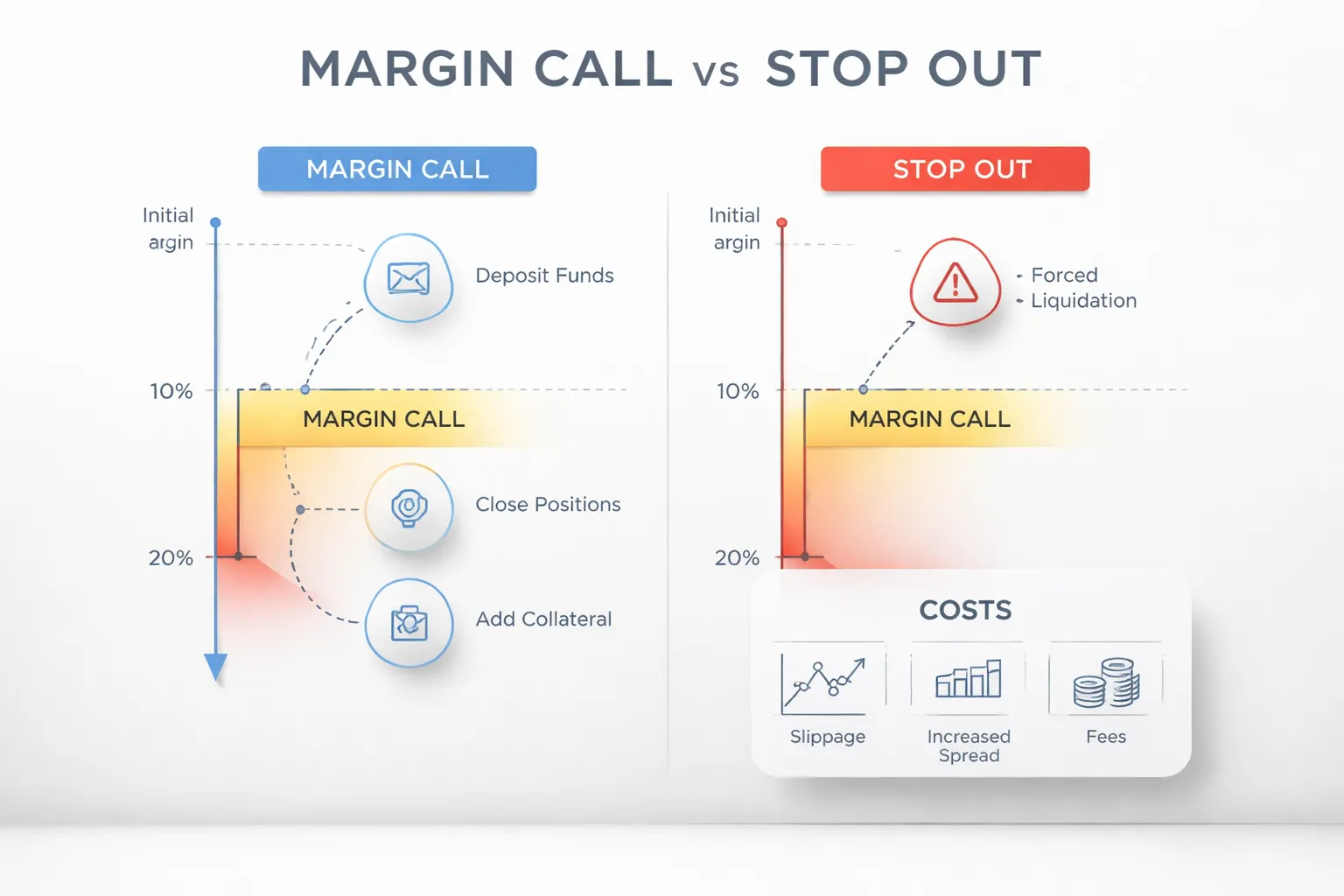
Timing difference, margin call is the warning phase, stop out is the liquidation phase
A margin call triggers when your margin level drops to the broker’s margin call level. You still have open positions. You still have time to act.
A stop out triggers at a lower margin level. The broker starts closing positions to reduce used margin and protect the loaned funds. At that point, you lose control over the exit sequence.
Control difference, what you can do during the warning window
During a margin call, you can still choose the least damaging fix. The goal is simple, raise margin level fast.
- Cut risk first. Close the biggest loser or the most margin-heavy position.
- Reduce position size. Partial close lowers used margin and slows equity decline.
- Cancel pending orders. Remove orders that could open new exposure and increase used margin.
- Add funds. It boosts equity, but it does not fix bad sizing or correlated exposure.
- Hedge only if you understand the margin impact. Some brokers net exposure, others margin both legs.
At stop out, your actions shrink to almost nothing. You can try to deposit, but execution speed and broker rules decide if it helps in time.
Outcome difference, partial close vs full close-out depends on broker rules
Margin call does not mean forced liquidation. It means you breached a threshold and you must reduce risk or increase equity.
Stop out means forced liquidation starts. Some brokers close positions one by one until margin level recovers. Others close everything at once. Some start with the largest loser, others with the largest margin user.
You can end with a smaller drawdown if the broker uses partial close logic. You can also end with a full wipe of all positions if the broker uses full close-out, or if volatility jumps and equity falls faster than positions can be closed.
Cost difference, slippage, widened spreads, and liquidation execution risk
Most of the damage comes from execution conditions, not the label.
- Slippage. Forced exits often hit thin liquidity. Your fill can land worse than your stop level.
- Widened spreads. During news or off-hours, spreads can expand. That reduces equity instantly because floating P&L worsens.
- Execution priority. Liquidation orders can execute as market orders. You get whatever the book offers.
- Gap risk. If price gaps, there may be no tradable prices near your intended exit. Equity can fall through the stop out level before any fill occurs.
These risks increase when you trade less liquid instruments and sessions. Liquidity conditions change by pair and time of day. See forex liquidity explained if you need a practical framework.
Broker policy variations, alerts, grace periods, and liquidation order
Do not assume your broker handles margin events the same way as another broker. Read the margin policy and test it on a small account.
- Alerts. Some brokers send email or app alerts. Some only show a platform notification. Some do nothing.
- Grace periods. Many brokers give no grace period. A margin call level is not a promise of time.
- Liquidation method. Position-by-position, partial close, or full close-out.
- Liquidation order. Largest loss first, largest margin first, oldest first, or broker-defined.
- Margin on hedges. Netting vs gross margin can change your stop out risk.
Build your plan around your broker’s exact triggers. Track equity and margin level in real time. Treat alerts as optional, not guaranteed.
What triggers margin calls and stop outs in real markets
Over-leveraging and oversized positions relative to account equity
Margin calls and stop outs start with position size. Your required margin rises with bigger lots and higher leverage. Your free margin shrinks fast when price moves against you.
- High margin usage at entry. If most of your equity becomes used margin, a small move can push your margin level below your broker’s trigger.
- Wide stops with large size. You risk more money per pip than your account can absorb, so equity drops faster than you expect.
- Multiple positions opened at once. You stack margin requirements and amplify drawdown.
Volatility spikes and news events
Fast markets cut through equity and can break your exits. Margin calls often hit during short, violent moves.
- Scheduled releases. CPI, jobs data, rate decisions, press conferences, and earnings can expand spreads and move price in seconds.
- Unscheduled shocks. Geopolitical headlines, emergency central bank action, and sudden risk-off flows can gap price.
- Execution impact. Stops can slip, limit orders may not fill, and spreads can spike. Your equity falls faster than your risk plan assumed.
Correlation and concentration risk
Several trades can behave like one big bet. Your platform shows separate positions, but the market treats them as one exposure.
- Same base theme. Long EURUSD, long GBPUSD, and short USDJPY can all become one large USD short.
- Risk-on baskets. Multiple long positions in high beta pairs can drop together when sentiment flips.
- Hedge illusions. “Hedged” positions can still consume margin if your broker uses gross margin, and they can still lose if correlation breaks.
Weekend gaps and low-liquidity sessions
Gaps and thin markets can jump over your stop. That turns a planned loss into a margin event.
- Weekend reopen. News hits when markets close, price reopens at a new level, and your stop fills at the first available price.
- Rollover and session transitions. Liquidity drops, spreads widen, and small moves can trigger margin thresholds.
- Holidays. Fewer participants can mean sharper spikes and worse fills.
Hidden margin drains: currency conversion, commissions, financing, options assignment
Your equity can fall without price moving much. These costs hit your balance, then your equity, then your margin level.
- Currency conversion. P&L and fees convert into your account currency. Exchange rate shifts can change your equity and margin requirement.
- Commissions and platform fees. Frequent trading compounds costs and reduces free margin.
- Financing and interest. Overnight funding can bleed equity, especially on leveraged holds. Learn the mechanics in our forex swap fees guide.
- Options assignment and futures settlement. Assignment can create unexpected stock or futures exposure, which brings new margin rules and larger requirements.
Margin requirement changes by broker or exchange
Your broker can raise margin during turbulence. That can trigger a margin call even if price stays near your entry.
- Event-driven hikes. Brokers often increase margin before elections, major data, or central bank meetings.
- Instrument-specific changes. Exotic FX pairs, small-cap stocks, and crypto often carry higher or variable margin.
- Portfolio impact. Higher margin requirements increase used margin, which lowers your margin level and can force liquidation.
| Trigger | What changes first | Why it leads to a call or stop out |
|---|---|---|
| Oversized position | Used margin rises | Small adverse move drops margin level below the broker threshold |
| News volatility | Equity drops fast, spreads widen | Losses plus execution costs compress free margin in seconds |
| Correlation concentration | Equity swings amplify | Several positions lose together, drawdown accelerates |
| Weekend gap, thin liquidity | Fill price worsens | Stops slip or gap, realized loss exceeds plan, margin level breaks |
| Fees and financing | Balance and equity erode | Costs reduce free margin without a visible price trigger |
| Raised margin requirements | Used margin jumps | Margin level falls even with flat P&L, liquidation can start |
What to do if you get a margin call (step-by-step response plan)
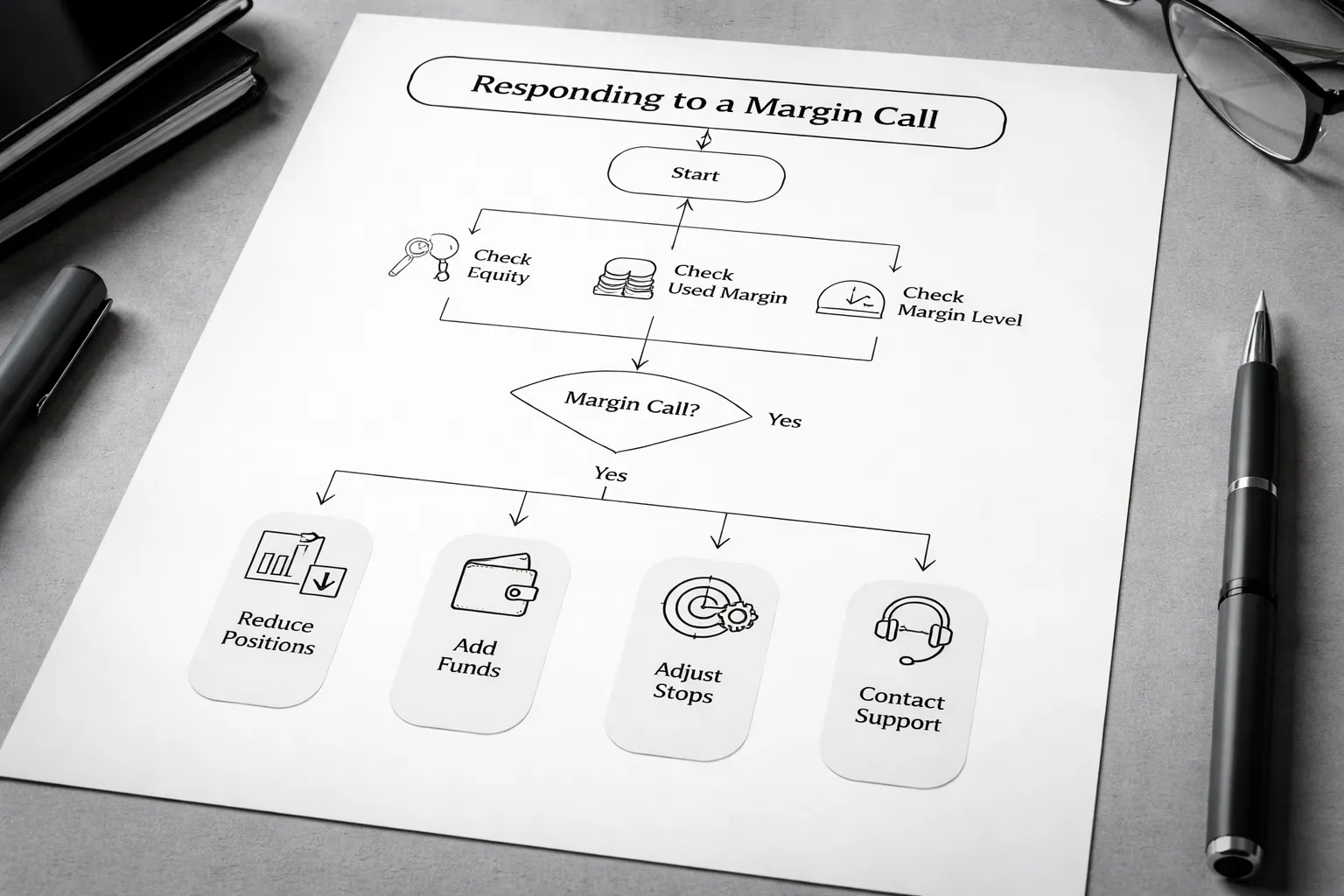
Confirm the trigger in your platform
Act fast. Start with the numbers that decide liquidation.
- Equity: your balance plus floating P&L. This is what margin rules use.
- Used margin: margin locked to keep current positions open.
- Free margin: equity minus used margin. This is your buffer.
- Margin level: equity divided by used margin, shown as a percent in most platforms.
Check the broker’s margin call level and stop out level for your account and each instrument. Some brokers apply different levels by symbol, leverage tier, or volatility.
Reduce exposure fast, close the highest-risk positions first
Your goal is simple. Raise margin level now.
- Sort positions by margin used. Large notional and high leverage positions usually consume the most.
- Sort positions by unrealized loss. Big losers cut equity and can trigger the next liquidation step.
- Close or trim positions with wide spreads or thin liquidity. They can slip more during fast markets.
- Reduce correlated exposure. Two trades in the same direction on related pairs behave like one oversized trade.
Close first. Optimize later. Hesitation costs equity and increases the chance of forced closeout at a bad fill.
Add funds vs reduce positions, decide under time pressure
Adding funds can work, but it can also delay a loss. Use a rule.
- Add funds if you can do it immediately and you still want the trade based on your plan.
- Reduce positions if funding will take time, you face a news event, or margin level sits near stop out.
- Reduce positions if the move already broke your invalidation level. Do not use margin as a substitute for a stop.
| Situation | Best move |
| Margin level is near stop out, price is moving fast | Close or trim now |
| Deposit will clear in hours or days | Close or trim now |
| Deposit clears in minutes, trade thesis still valid | Add funds, then reduce if needed |
| You cannot explain the risk in one sentence | Close or cut size |
After you stabilize margin, rebuild using a fixed sizing method. Use this guide on how to calculate position size to keep your next drawdown from becoming a margin event.
Adjust protective orders, when tightening stops helps vs hurts
Stops can protect you, or they can speed up the margin call.
- Tighten stops when you can place them beyond spread noise and outside obvious liquidity pools.
- Do not tighten stops in a spread spike. You can get stopped by pricing, not by the move.
- Do not move stops closer just to avoid liquidation. That often converts a temporary drawdown into a realized loss.
- If margin is critical, prioritize reducing size over micro-adjusting stops.
If you must change orders, do it after you cut exposure. Size fixes margin. Stops manage the trade.
Document and review, identify the decision that caused the drawdown
Write it down while the details are fresh.
- Record equity, used margin, margin level, and open positions at the time of the alert.
- Note what changed first. Price move, spread widening, swap, or margin requirement increase.
- List the single decision that created fragility. Too much leverage, too many correlated positions, no hard stop, holding through news, or holding into a weekend.
- Set one hard rule for next time. Example, cap total used margin, cap correlated exposure, or require a stop on every position.
When to contact support, clarify liquidation rules and execution
Contact support when you need a rule clarified, not to negotiate an outcome.
- Ask for your exact margin call level and stop out level, and whether they vary by instrument.
- Confirm the closeout method. Some brokers close the biggest loser first, others close the biggest margin user, others close in FIFO order.
- Confirm how they calculate margin during raised requirements, and whether pending orders reserve margin.
- Ask what happens during gaps and negative balance scenarios, and what protections apply to your account type.
Use the answers to update your risk limits and your trade selection. The rules decide how fast a drawdown becomes a forced exit.
How to avoid margin calls and stop outs (risk controls that actually work)

Set a personal soft margin limit
Your broker’s margin call and stop out levels are hard limits. Set your own limit above them. Treat it as a trigger to cut risk before the platform does.
- Pick a margin level buffer: If your broker calls at 100% and stops out at 50%, set a soft limit like 200% to 300%.
- Act fast when you hit it: Close weakest positions first. Reduce the biggest margin user. Cancel pending orders that reserve margin.
- Track it daily: Margin spikes during volatile sessions, weekends, and requirement changes.
Position sizing rules that prevent forced exits
Margin problems start with oversized positions. Fix sizing, and margin calls become rare.
- Risk per trade cap: Risk a fixed percent of equity per trade. Many retail traders use 0.25% to 1%.
- Leverage cap: Set a hard maximum leverage for your account, even if the broker offers more.
- Notional exposure limit: Cap total open notional. Limit exposure per instrument and across the book. This stops hidden leverage from multiple positions.
- Add-on rule: Do not add to losers if it pushes margin near your soft limit.
Use stop-loss orders correctly
A stop loss must match volatility and market structure. A random fixed pip stop fails in fast markets.
- Place stops where the trade idea breaks: Use structure, not pain tolerance.
- Size the position from the stop distance: Wider stop, smaller size. Tighter stop, larger size only if the level makes sense.
- Use volatility-based stops: Use ATR or recent range to avoid stops that sit inside normal noise.
- Avoid obvious levels: Round numbers and prior equal highs and lows attract liquidity runs. Give the stop room or choose a different setup.
- Plan for gaps: Stops can fill worse than your price. Leave margin for slippage.
Diversify and de-correlate exposure
Many portfolios look diversified but move like one trade. Correlation turns small risk into one big bet.
- Check pair and sector clustering: EURUSD, GBPUSD, and AUDUSD can all be the same USD trade.
- Limit one theme: Cap total risk on one driver like USD strength, oil, rates, or tech beta.
- Watch cross-margin effects: Two hedged trades can still consume margin and still lose together during spikes.
Keep a cash buffer
Do not run your account near maximum usable margin. You need room for spread widening, swaps, and slippage.
- Use less than your available margin: Keep free margin high enough to survive a normal adverse move plus a volatility spike.
- Account for costs: Swaps and commissions reduce equity, which reduces margin level.
- Respect weekend risk: Gaps can jump over stops. Reduce risk before illiquid periods.
Plan for volatility
Volatility changes your real leverage. Your sizing must change with it.
- ATR-based sizing: If ATR doubles, cut size. Keep your dollar risk stable.
- Event calendar rule: Reduce exposure before scheduled catalysts. NFP, CPI, central bank decisions, earnings, and crypto unlocks move fast.
- Pre-news de-risking: Trim or close trades that rely on tight stops. Spreads widen and fills worsen in the seconds around releases.
- Trade when liquidity helps you: Session choice affects spreads and slippage. Use the market hours guide to avoid thin windows.
Hedging basics, and how it can fail
Hedges can slow drawdowns, but they can also trap margin and increase costs.
- Pro: A hedge can reduce net directional exposure and smooth equity swings.
- Con: Many brokers charge margin on both legs. Your margin level can drop even if price risk feels lower.
- Con: Two spreads, two swaps, and more slippage. Costs rise fast.
- When hedges backfire: Correlations break, one leg gaps, or you freeze and do not unwind. You end up holding two losing positions.
- Rule: Hedge only with a clear exit plan. Define when you remove the hedge and when you cut the original trade.
Avoid common platform mistakes
Many stop outs come from simple execution errors.
- Wrong lot size: Double-check units, lots, and contract size. A single extra zero can wipe your margin.
- Wrong account currency: P and L and margin can look smaller or larger than expected. Know your base currency conversions.
- Overtrading: More trades increase total notional and correlation. Cap the number of open positions.
- Ignoring pending orders: Some platforms reserve margin for stops, limits, and OCO orders. Cancel what you do not need.
- Forgetting raised requirements: Brokers can raise margin during events. If you run tight, that change can trigger a forced close.
| Control | Rule you set | What it prevents |
|---|---|---|
| Soft margin limit | Act at 200% to 300% margin level | Getting trapped near broker stop out |
| Risk per trade | 0.25% to 1% of equity | Oversized losses that crush margin |
| Leverage cap | Hard max leverage for the account | Hidden exposure from small moves |
| Volatility sizing | Size from ATR and stop distance | Stops inside normal noise |
| Correlation limits | Cap risk per theme and currency | Multiple positions acting like one |
| Cash buffer | Keep high free margin at all times | Spread widening, slippage, swaps |
Understanding broker policies before you trade on margin (the fine print)
Where to find margin call level and stop out level in your broker’s terms
Find the exact trigger numbers before you place your first trade.
- Client agreement or margin trading addendum. Look for “margin call level,” “stop out level,” “closeout,” and “forced liquidation.”
- Product schedule. Many brokers set different margin rates by instrument, index, or equity CFD.
- Platform specs. Some platforms show “margin closeout” in the account window. Do not treat this as the legal source if it conflicts with the agreement.
Write down the thresholds as percentages of margin level, and the formula your broker uses. Many brokers define margin level as equity divided by used margin, multiplied by 100.
| Item | What to record | Why it matters |
| Margin call level | Exact % and what happens at that level | Some brokers only warn, others block new trades |
| Stop out level | Exact % and whether it is fixed or variable | It defines when forced closes start |
| Margin formula | Equity, used margin, and how open P&L counts | Small definition changes shift your real buffer |
Negative balance protection, what it covers and what it doesn’t
Negative balance protection usually means your account balance cannot go below zero. It does not mean you cannot get stopped out. It does not mean fills will be clean during gaps.
- Often covered. Extreme moves that push equity below zero, broker resets balance to zero after liquidation.
- Often not covered. Professional accounts, certain jurisdictions, or specific products.
- Check the carve-outs. “Abuse,” “manifest error,” and “exceptional market conditions” clauses can give the broker discretion.
If you run tight margin, negative balance protection can limit debt. It will not protect your strategy from liquidation at the stop out level.
Closeout mechanics, which positions get closed first and why it matters
Brokers use different liquidation rules. The rule changes your outcome when your account hits stop out.
- Largest loss first. Common in CFD and FX. It reduces equity drag fast, but it can lock in the worst fills.
- Largest margin first. Closes the position consuming the most margin to lift margin level quickly.
- FIFO. Some venues enforce first in, first out, especially where hedging is restricted.
- Broker discretion. The terms may say they can close any position at any time once you breach a threshold.
This matters when you hold multiple trades with different spreads, liquidity, and gap risk. Your “safest” trade might survive while your hedge gets closed, or the broker may close the trade you planned to keep.
Margin on hedged positions and netting vs hedging account modes
Your margin can jump based on account mode and broker rules.
- Netting mode. Opposite positions merge into one net exposure. This can reduce used margin, but it can also remove a planned hedge.
- Hedging mode. Long and short can sit side by side. Some brokers charge full margin on both legs. Others give reduced margin on the hedged portion.
- “Locked” trades still cost. Even if P&L looks stable, you can pay swaps on both sides and face spread costs on exit.
Verify the broker’s hedged margin rate per instrument. Do not assume a hedge halves your risk or your margin use.
Product-specific rules, CFDs and FX vs stocks margin accounts vs futures exchanges
Margin rules change by product. You must read the right document for what you trade.
- FX and CFDs. Broker sets margin rates and can change them fast, especially around news and weekends. Stop out logic sits inside the broker’s risk system.
- Stocks on margin. Rules often split into initial margin and maintenance margin. Concentration and low priced stocks can carry higher house margin than the baseline rule.
- Futures. The exchange sets base margin, and your broker can add a house buffer. Margin can change intraday. Losses settle quickly, and liquidation can happen fast when variation margin hits.
If you trade FX, you still need to understand execution and liquidity. Market structure drives spreads and fills, and it shows up as margin stress when price jumps. See how the forex market works.
Stress scenarios to test, gap moves, spread widening, and margin hikes
Test your plan against the events that break margin.
- Gap moves. Model a gap beyond your stop. Use a larger jump for weekends and high impact events. Assume your stop fills at the first available price, not your stop price.
- Spread widening. Add a spread shock to your exit and to your floating P&L. Wider spreads reduce equity and can trigger stop out earlier than your chart suggests.
- Margin hikes. Simulate a margin rate increase. Your used margin rises, your margin level drops, and liquidation can start without any price move.
Run the numbers with your real contract size and pip value, not a rough estimate. Then size so your margin level stays well above both thresholds under these shocks.
Pros, cons, and who should (and shouldn’t) use margin
Potential benefits, capital efficiency and tactical flexibility
- More exposure with less cash tied up. Margin lets you control a larger position while posting a smaller deposit. You keep more free equity available for drawdowns and routine costs like spread and swaps.
- Faster deployment. You can scale into a trade without waiting to transfer funds. That matters when you trade short-term setups with tight invalidation levels.
- Hedging and position management. Margin can support temporary hedges, staggered entries, and partial exits. It can also help you run multiple small, uncorrelated positions instead of one oversized bet.
- Access to markets that price in leverage. Spot FX accounts often assume margin use. If you want a lower-leverage structure, compare products like spot, futures, and options in spot forex vs futures vs options.
Key downsides, amplified losses, liquidation risk, and behavioral traps
- Losses scale with position size. Leverage does not change pip movement. It changes how much each pip costs you. A small move against you can wipe weeks of gains if you oversize.
- Margin call and stop out can force bad exits. The broker closes positions when your margin level hits the stop-out threshold. You lose control of timing. You can lock in the worst price in a fast market.
- Spread and slippage hit harder. Wider spreads lower equity instantly. Slippage can push equity below the stop-out line even if your stop-loss sits “above” it on your chart.
- Correlation makes risk look smaller than it is. Several trades in the same direction can behave like one large trade. Your used margin rises. Your equity swings as one.
- Behavioral traps. High available leverage tempts you to ignore sizing rules, widen stops, and hold losers. You start managing emotion instead of risk.
Who should use margin
- Experienced traders with a tested plan. You already know your win rate, average loss, and worst historical drawdown from real or properly simulated data.
- Traders who size from risk, not from available leverage. You pick a fixed account risk per trade. You cap total portfolio risk across open positions.
- Traders who monitor margin level as a risk metric. You set a personal buffer well above broker thresholds and keep it there under stress tests.
- Traders with strict exit rules. You place stops where the trade idea breaks, not where your margin “needs” them to be.
Who shouldn’t use margin, red flags
- You use margin to “save” losing trades. Adding size to recover faster raises used margin and cuts margin level. You move closer to forced liquidation.
- You average down without a predefined rule. If you add because price moved against you, you increase exposure as your account weakens.
- You run near the threshold. If normal spread widening, a weekend gap, or a margin hike can trigger stop out, your sizing is already too large.
- You cannot explain your worst-case day. If you do not know your maximum loss under a gap, slippage, and correlation, you are trading blind.
- You chase high leverage because it is available. Availability is not capacity. Your equity is capacity.
Quick checklist and templates (practical tools you can copy)
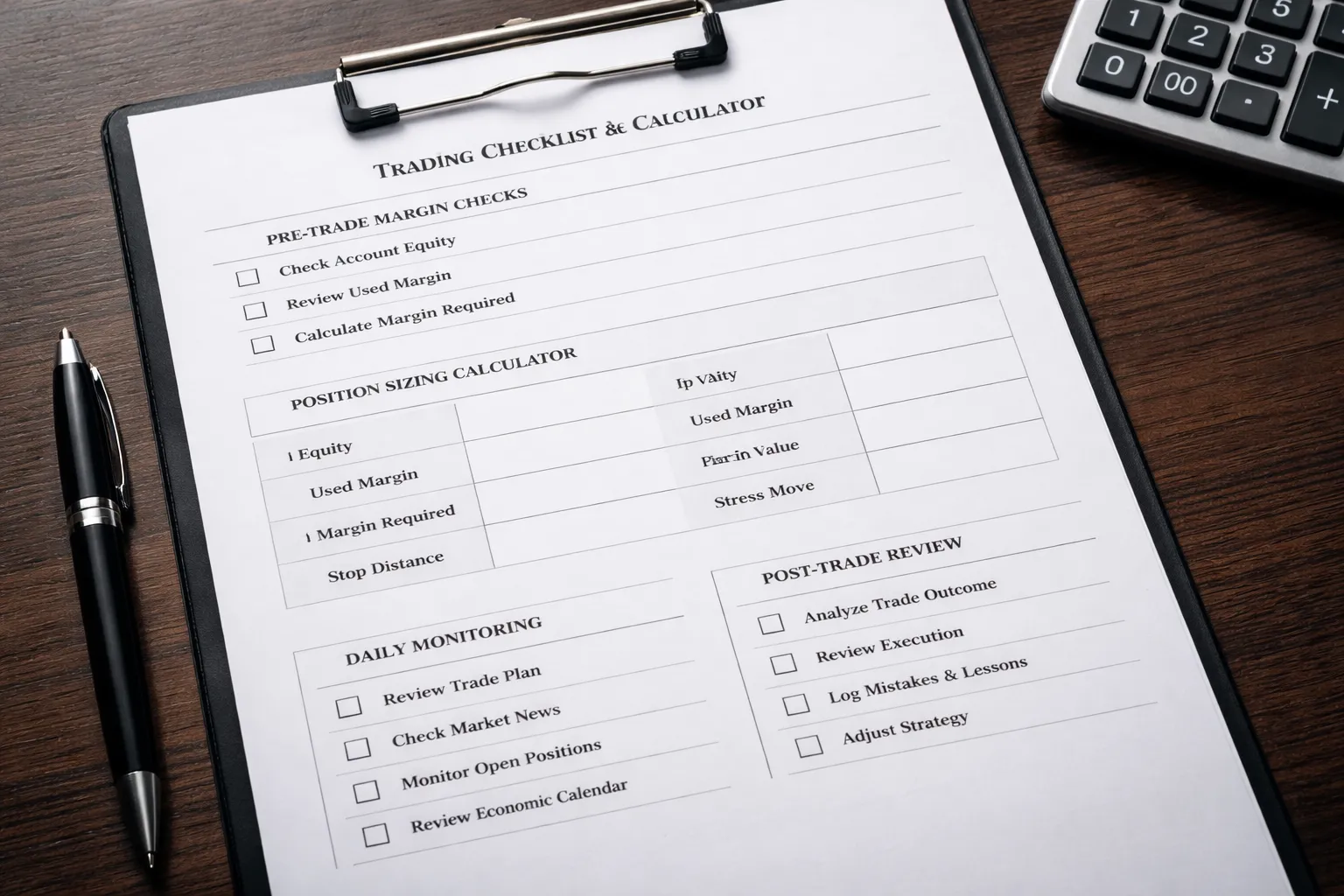
Pre-trade checklist, leverage, margin buffer, event risk
- Know your broker levels. Record margin call level and stop out level as margin level percent. Keep them visible.
- Set a hard buffer. Plan to keep your margin level above a minimum you choose. Many traders use 300 to 500 percent as an operating floor. Use a higher floor if you hold through news or weekends.
- Cap account leverage. Define max effective leverage for your account. Effective leverage equals total notional exposure divided by equity. Keep it low enough that a normal swing does not push margin level near your broker trigger. If you are unsure, start at 2x to 5x and adjust only after data.
- Estimate worst-case move. Use a stress move in percent or pips based on recent volatility, plus extra for gaps. Use a larger stress for crypto, indices, and thin sessions.
- Account for spread and slippage. Add a fixed cost buffer for spread widening. Add slippage for stop execution. If your strategy needs tight stops, you need a larger buffer.
- Check correlation. If positions move together, treat them as one larger position. Do not count them as diversification.
- Check margin changes. Some brokers raise margin before weekends or events. If your plan breaks under a margin hike, reduce size or close.
- Confirm trade invalidation point. Your stop must sit at the price where your idea fails, not where your margin level feels safe.
- Quick refresher. If you mix up margin, leverage, and margin level, review margin vs leverage before you size.
Simple position sizing template (copy and fill)
Goal: size the trade so a stress move does not trigger margin call or stop out, and the loss stays inside your risk limit.
| Input | Example |
| Equity (E) | $10,000 |
| Free margin (FM) | $7,500 |
| Current used margin (UM) | $2,500 |
| Broker stop out level (SOL) | 50% |
| Your operating margin level floor (MLF) | 300% |
| Max loss you accept on this trade (R) | $100 |
| Stop distance (SD) in pips or points | 25 pips |
| Value per pip per 1 lot or 1 contract (PV) | $10 per pip |
| Stress move (SM) in pips or points | 80 pips |
| Extra execution cost buffer (EC) | $20 |
| Margin required per 1 lot or 1 contract (MR) | $400 |
- Risk-based size. Max size by stop equals R divided by (SD times PV). If you trade lots, size_lots_risk = R / (SD * PV).
- Stress-loss size. Max size by stress equals (R_stress) divided by (SM times PV). Set R_stress lower than a margin event can tolerate. Many traders use 1 to 2R. Use size_lots_stress = (R_stress - EC) / (SM * PV).
- Margin-floor size. Keep margin level above your floor after entry. Margin level equals equity divided by used margin times 100. After entry, used margin becomes UM + (size * MR). Enforce E / (UM + size * MR) * 100 is greater than or equal to MLF.
- Stop-out safety check. Under stress, equity drops by (SM * PV * size) plus EC. Used margin stays near UM + (size * MR). Enforce (E - SM * PV * size - EC) / (UM + size * MR) * 100 stays above SOL.
- Final size. Use the smallest size from the checks above. If the size is too small to matter, skip the trade.
Ongoing monitoring routine (daily and weekly margin health)
- Daily, before trading. Record equity, used margin, free margin, and margin level. If margin level sits near your floor, do not add exposure.
- Daily, after major moves. Recalculate effective leverage and your stop-out safety check using your current open risk and a stress move.
- Daily, check concentrated exposure. Group positions by the same base or quote currency, same index sector, or same theme. If one move can hit all positions, cut size.
- Weekly, review volatility. Update your stress move inputs from recent ranges. Increase stress assumptions in high volatility regimes.
- Weekly, review broker notices. Look for margin hikes, symbol changes, and trading hours changes. Adjust before the change, not after.
- Weekly, set a reduction rule. If margin level falls below your floor, reduce positions until it returns above the floor. Do not deposit to avoid fixing sizing errors.
Post-trade review prompts (prevent repeat margin issues)
- Margin proximity. Lowest margin level reached during the trade. Compare it to your floor and your broker triggers.
- Cause of pressure. Price move, spread widening, slippage, correlation, or margin hike. Pick one primary cause.
- Sizing error. Which check failed, risk-based, stress-based, margin-floor, or stop-out safety.
- Execution gap. Planned stop distance versus filled distance. Record the difference in pips and dollars.
- Decision quality. Did you add to losers, remove stops, or hold through known event risk.
- Rule update. One change for next time. Examples, raise margin floor, reduce leverage cap, increase stress move, limit correlated positions.
- Template log line. Instrument, direction, size, entry, stop, take profit, max adverse excursion, max favorable excursion, lowest margin level, outcome, lesson.
Frequently Asked Questions
What is a margin call?
A margin call is a warning that your margin level hit your broker’s threshold. Your free margin is too low for your open risk. You must reduce exposure, add funds, or accept forced position reductions if losses continue.
What is a stop out?
A stop out is forced liquidation. Your broker closes positions when your margin level hits the stop out level. It starts with the largest losing trades or highest margin users, based on broker rules. You lose control of exits.
What is the difference between margin call level and stop out level?
Margin call level triggers an alert or trading restriction. Stop out level triggers automatic closes. Both use margin level percent, equity divided by used margin, times 100. Margin call comes first, stop out comes after if equity keeps falling.
What is margin level percent, and why does it matter?
Margin level percent equals equity divided by used margin, times 100. It is your safety gauge. Higher is safer. It drops when losses cut equity or when you open more positions that raise used margin.
Do stop losses prevent a margin call or stop out?
They help, but they do not guarantee safety. Stops can slip in fast markets. Gaps can skip your price. A stop that is too wide still allows large drawdowns. Use position sizing so a stop hit keeps margin level above your floor.
Can you get a margin call even if your trade is “hedged”?
Yes. Many brokers still charge margin on both legs, or apply higher margin during volatility. Equity can still fall from spreads, swaps, and slippage. A hedge can reduce directional risk, but it can still consume margin.
What are the most common triggers for margin calls?
- Oversized position relative to account equity.
- High leverage in volatile pairs.
- Correlated positions that move together.
- Holding through major news with tight free margin.
- Adding to losing trades.
What is the fastest way to avoid a stop out when you get a margin call?
Cut exposure first. Close the worst loser or reduce overall size to raise margin level. Cancel new entries. If your plan allows, add funds, but only after you reduce risk. Do not average down to “fix” margin.
Should you add funds to meet a margin call?
Only if your trade thesis stays valid and your risk is defined. Adding funds without reducing size often delays the problem. Treat it as a risk decision, not a rescue. Fix the leverage and sizing issue or it repeats.
How can you set a personal margin floor?
Pick a margin level percent that you will not cross, like 300 percent or 500 percent. When you hit it, you must reduce size. This buffer absorbs spread widening and slippage. Your broker levels are too late to manage calmly.
How do you size trades to reduce margin call risk?
Size from risk per trade and stop distance, then check used margin and worst case drawdown. Keep enough free margin for volatility spikes. Use a sizing method with hard numbers. See position sizing.
Do brokers all use the same margin call and stop out rules?
No. Thresholds, alerts, and closeout order vary. Some stop you from opening new trades at margin call. Others close positions one by one at stop out. Check your broker’s product schedule, margin policy, and volatility add ons.
Can spreads and swaps cause a stop out?
Yes. Spread widening increases floating loss and reduces equity. Overnight swaps can also reduce equity each day. Around news and rollover, margin level can drop fast even if price barely moves. Leave extra buffer during these periods.
Conclusion
Conclusion
Margin call is your warning. Stop out is forced liquidation. Both happen when equity falls and margin level breaks your broker’s thresholds.
You avoid them the same way. Control leverage. Limit position size. Keep free margin high. Cut losses fast. Add funds before margin gets tight, not after.
- Set a hard floor for margin level, for example 200 percent, and reduce exposure if you drop below it.
- Cap risk per trade, for example 0.5 to 1 percent of equity, and size positions from that number.
- Plan for spread and swap. Hold extra buffer around major news, illiquid sessions, and rollover.
- Know your numbers. Track pip value, stop distance, and worst-case loss before you enter. Use a pip value calculator to verify size.
Your best protection is simple. Trade smaller than you think you need. Keep margin as a reserve, not as fuel.
-
Forex Leverage Explained: How It Works, Pros, Cons & Examples
1 month ago -
Forex Market Hours & Trading Sessions Explained (Best Times to Trade)
1 month ago -
What Is a Lot Size in Forex? Lot Types + Quick Examples
1 month ago -
How to Calculate Position Size in Forex (Position Sizing Formula + Examples)
1 month ago -
What Are Pips in Forex? Definition, Examples & Why They Matter
1 month ago
-
-
- Timing difference, margin call is the warning phase, stop out is the liquidation phase
- Control difference, what you can do during the warning window
- Outcome difference, partial close vs full close-out depends on broker rules
- Cost difference, slippage, widened spreads, and liquidation execution risk
- Broker policy variations, alerts, grace periods, and liquidation order
-
- Over-leveraging and oversized positions relative to account equity
- Volatility spikes and news events
- Correlation and concentration risk
- Weekend gaps and low-liquidity sessions
- Hidden margin drains: currency conversion, commissions, financing, options assignment
- Margin requirement changes by broker or exchange
-
- Confirm the trigger in your platform
- Reduce exposure fast, close the highest-risk positions first
- Add funds vs reduce positions, decide under time pressure
- Adjust protective orders, when tightening stops helps vs hurts
- Document and review, identify the decision that caused the drawdown
- When to contact support, clarify liquidation rules and execution
-
- Where to find margin call level and stop out level in your broker’s terms
- Negative balance protection, what it covers and what it doesn’t
- Closeout mechanics, which positions get closed first and why it matters
- Margin on hedged positions and netting vs hedging account modes
- Product-specific rules, CFDs and FX vs stocks margin accounts vs futures exchanges
- Stress scenarios to test, gap moves, spread widening, and margin hikes
-
- What is a margin call?
- What is a stop out?
- What is the difference between margin call level and stop out level?
- What is margin level percent, and why does it matter?
- Do stop losses prevent a margin call or stop out?
- Can you get a margin call even if your trade is “hedged”?
- What are the most common triggers for margin calls?
- What is the fastest way to avoid a stop out when you get a margin call?
- Should you add funds to meet a margin call?
- How can you set a personal margin floor?
- How do you size trades to reduce margin call risk?
- Do brokers all use the same margin call and stop out rules?
- Can spreads and swaps cause a stop out?
-
-
- Timing difference, margin call is the warning phase, stop out is the liquidation phase
- Control difference, what you can do during the warning window
- Outcome difference, partial close vs full close-out depends on broker rules
- Cost difference, slippage, widened spreads, and liquidation execution risk
- Broker policy variations, alerts, grace periods, and liquidation order
-
- Over-leveraging and oversized positions relative to account equity
- Volatility spikes and news events
- Correlation and concentration risk
- Weekend gaps and low-liquidity sessions
- Hidden margin drains: currency conversion, commissions, financing, options assignment
- Margin requirement changes by broker or exchange
-
- Confirm the trigger in your platform
- Reduce exposure fast, close the highest-risk positions first
- Add funds vs reduce positions, decide under time pressure
- Adjust protective orders, when tightening stops helps vs hurts
- Document and review, identify the decision that caused the drawdown
- When to contact support, clarify liquidation rules and execution
-
- Where to find margin call level and stop out level in your broker’s terms
- Negative balance protection, what it covers and what it doesn’t
- Closeout mechanics, which positions get closed first and why it matters
- Margin on hedged positions and netting vs hedging account modes
- Product-specific rules, CFDs and FX vs stocks margin accounts vs futures exchanges
- Stress scenarios to test, gap moves, spread widening, and margin hikes
-
- What is a margin call?
- What is a stop out?
- What is the difference between margin call level and stop out level?
- What is margin level percent, and why does it matter?
- Do stop losses prevent a margin call or stop out?
- Can you get a margin call even if your trade is “hedged”?
- What are the most common triggers for margin calls?
- What is the fastest way to avoid a stop out when you get a margin call?
- Should you add funds to meet a margin call?
- How can you set a personal margin floor?
- How do you size trades to reduce margin call risk?
- Do brokers all use the same margin call and stop out rules?
- Can spreads and swaps cause a stop out?
-
Forex Lot Size Calculator: How to Use It to Size Trades Correctly
1 month ago -
How to Calculate Position Size in Forex (Position Sizing Formula + Examples)
1 month ago -
Forex Leverage Explained: How It Works, Pros, Cons & Examples
1 month ago -
Margin vs Leverage in Forex: What’s the Difference?
1 month ago -
What Is Forex Trading? A Beginner’s Guide to How It Works
1 month ago
-
Forex Leverage Explained: How It Works, Pros, Cons & Examples
1 month ago -
Forex Market Hours & Trading Sessions Explained (Best Times to Trade)
1 month ago -
Is Forex Trading Legal in the United States? Rules, Regulators & What to Know
1 month ago -
What Is a Lot Size in Forex? Lot Types + Quick Examples
1 month ago -
Forex Trading Platforms Comparison: MetaTrader vs cTrader vs TradingView
1 month ago