Is Forex Trading Legal in the US? Rules, Regulators and What Traders Must Know
Forex trading is legal in the US, but only under strict federal rules. You must trade through a regulated broker, follow leverage limits, and accept tight reporting and anti fraud controls. If you miss these details, you risk account freezes, denied withdrawals, or trading with an illegal offshore firm.
This guide explains who regulates US forex, what products you can trade, and which brokers can legally take your order. You will learn the core rules set by the CFTC and NFA, how registration works, what “retail forex” means, and the key limits that affect your risk. You will also learn how to check a broker’s status and avoid common traps. For extra protection, read our safety checklist for unregulated brokers.
- In het kort: Forex trading is legal in the US, but you must trade through a properly registered, regulated firm.
- In het kort: The main regulators are the CFTC and the NFA, they set and enforce the retail forex rulebook.
- In het kort: “Retail forex” has specific protections and limits, your broker must follow them if it takes your order.
- In het kort: US leverage is capped, major pairs typically allow up to 50:1 and non majors up to 20:1.
- In het kort: Your counterparty matters, only certain registered entities can act as your forex dealer.
- In het kort: Registration is not optional, you should confirm your broker and any salesperson in the NFA system before funding.
- In het kort: Most “offshore” offers break US rules, if a firm is not registered it should not solicit you or accept your retail forex trades.
- In het kort: You reduce risk by checking status, reading disclosures, and avoiding bonus driven promotions and unverified track records.
If you need the full rule breakdown and how to verify a broker step by step, use our guide: Is forex trading legal in the United States?
Is Forex Trading Legal in the US? The Short Answer and What It Really Means
Is forex trading legal in the US, the short answer
Yes. Forex trading is legal in the United States. The catch is simple. You must trade through a properly registered US firm, or through a US regulated market product. If a company is not registered to deal retail forex with US clients, it should not take your trade.
Legality does not mean you can trade with any broker, on any terms, from any country. US rules control who can offer forex to you, how they must handle your orders, what they must disclose, and what leverage they can offer.
Legal vs permitted, where most traders get confused
Forex is legal. Many common setups are not permitted for US retail traders.
- Legal: You place retail forex trades with a US registered Retail Foreign Exchange Dealer, or a Futures Commission Merchant that is allowed to offer retail forex.
- Not permitted: An offshore broker solicits you and opens a retail forex account for you without proper US registration.
- Not permitted: A firm offers CFD style forex to US retail clients.
- Risky: You send money to an unregistered entity because it shows high returns, offers bonuses, or claims it can bypass US limits.
Use one rule to protect yourself. If the firm cannot show US registration status for retail forex, you treat it as a no.
Retail vs institutional FX, why the rules differ
US regulators draw a hard line between retail and institutional participants.
- Retail: You trade as an individual. You get stronger protections and tighter restrictions. That includes limits on leverage and strict requirements on how a broker can solicit you and hold your funds.
- Institutional: Banks, large funds, and eligible contract participants can access the interbank market and bespoke agreements. They negotiate terms and take on more counterparty risk.
This is why you see different pricing, leverage, and platform access. It is not a feature gap. It is a regulatory split.
Common lawful ways Americans access FX markets
- Retail spot forex through a registered US broker: You trade major and minor pairs under US retail forex rules and leverage caps.
- Currency futures and options on regulated exchanges: You trade standardized FX contracts with exchange clearing.
- FX exposure through regulated securities products: Some ETFs and funds provide currency exposure without a retail forex account.
If you track performance claims from a broker, signal seller, or account manager, verify the reporting before you fund an account. Use this guide on how to read Myfxbook results to spot hidden risk and misleading returns.
Who Regulates Forex Trading in the United States
CFTC: the federal regulator for retail forex
The Commodity Futures Trading Commission, CFTC, sets the core federal rules for retail forex in the US. If you trade spot forex on margin with a broker, the CFTC framework applies.
The CFTC focuses on market integrity and enforcement. It brings civil actions for fraud, misrepresentation, and illegal off exchange forex. It also writes and enforces rules that shape what you can trade and how a broker must operate, including leverage limits for retail accounts and reporting obligations.
When you vet a broker, look for a firm that registers in the right CFTC category for retail forex. In practice, most US retail forex brokers register as a Retail Foreign Exchange Dealer, RFED, and often as a Futures Commission Merchant, FCM, too.
NFA: membership, audits, and trader protection
The National Futures Association, NFA, runs day to day oversight for many forex firms under CFTC supervision. If a broker offers retail forex legally in the US, you should expect NFA membership and ongoing compliance checks.
- Registration screening. The NFA reviews applications, principals, and disciplinary history before membership.
- Rules and supervision. The NFA sets conduct standards for advertising, disclosures, order handling, and supervision.
- Audits and exams. The NFA performs routine and targeted reviews, including financial and compliance exams.
- Capital and risk monitoring. The NFA tracks financial filings and capital requirements for member firms.
- Enforcement. The NFA can fine, suspend, or bar members and individuals.
- Dispute resolution. The NFA offers arbitration and complaint processes for customers.
Use the NFA BASIC database to confirm registration status and check disciplinary actions. Do this before you fund an account, and again if a firm changes its name or website domain.
SEC, FINRA, and banking regulators: where they touch FX
The SEC and FINRA regulate securities. They intersect with FX when your currency exposure comes through securities products, or when a broker dealer offers currency related products that fall under securities rules.
- SEC. Oversees ETFs, mutual funds, and other securities that hold currency instruments or use FX forwards and swaps inside the fund.
- FINRA. Oversees brokerage firms and registered reps selling those securities products to customers, including marketing and suitability rules where they apply.
- Bank regulators. The Federal Reserve, OCC, and FDIC oversee banks that provide FX services. This matters if you access FX through a bank, a bank affiliate, or an institutional platform tied to a bank.
If a platform pitches itself as a forex broker but routes you into a securities product, confirm which regulator governs your account. Your protections and complaint channels change with the product type.
State level rules: why federal oversight usually controls retail forex
Retail forex regulation sits mainly at the federal level through the CFTC and NFA. States still matter, but they rarely set the primary rules for leveraged spot forex.
- State enforcement. State attorneys general can pursue fraud, deceptive marketing, and unlicensed activity.
- Money transmission laws. Some FX adjacent services can trigger state licensing, especially payments and remittances.
- Local fraud claims. State consumer protection laws can support claims against marketers, educators, and signal sellers operating in the state.
For your broker choice, federal registration and NFA membership should carry the most weight. If a firm cannot prove both, treat it as a high risk counterparty and move on.
Which Forex Brokers Are Legal in the US (and How to Verify Them)
Which registrations a legal US forex broker must have
For retail spot forex in the US, legal brokers sit inside the CFTC and NFA framework. They must register with the CFTC and hold NFA membership. Registration type tells you what the firm can do and what role it plays in your trade.
- RFED (Retail Foreign Exchange Dealer). The firm can act as your counterparty for retail forex. You trade against the dealer. The dealer takes the other side or offsets it.
- FCM (Futures Commission Merchant). The firm can hold customer funds for futures and swaps. Some FCMs also offer retail forex, usually as an RFED or under forex rules that apply to FCMs. If the firm holds your margin, this category matters.
- IB (Introducing Broker). The firm solicits or introduces your account but does not hold your funds. Your account sits at an RFED or FCM. IBs often market platforms, education, or “broker services” while the carrying firm executes and holds the money.
- CTA (Commodity Trading Advisor). The firm or person gives trading advice for compensation. This includes managing your account under power of attorney, or providing signals if they meet the legal definition of advice.
- CPO (Commodity Pool Operator). The firm runs a pooled vehicle that trades futures or forex and takes investor money. If you join a managed pool, you are dealing with a CPO.
Match the registration to the promise. If a firm claims it is your “broker” and takes deposits for retail forex, you should see RFED status, or an FCM authorized for retail forex activity. If you only see IB, your money should sit somewhere else.
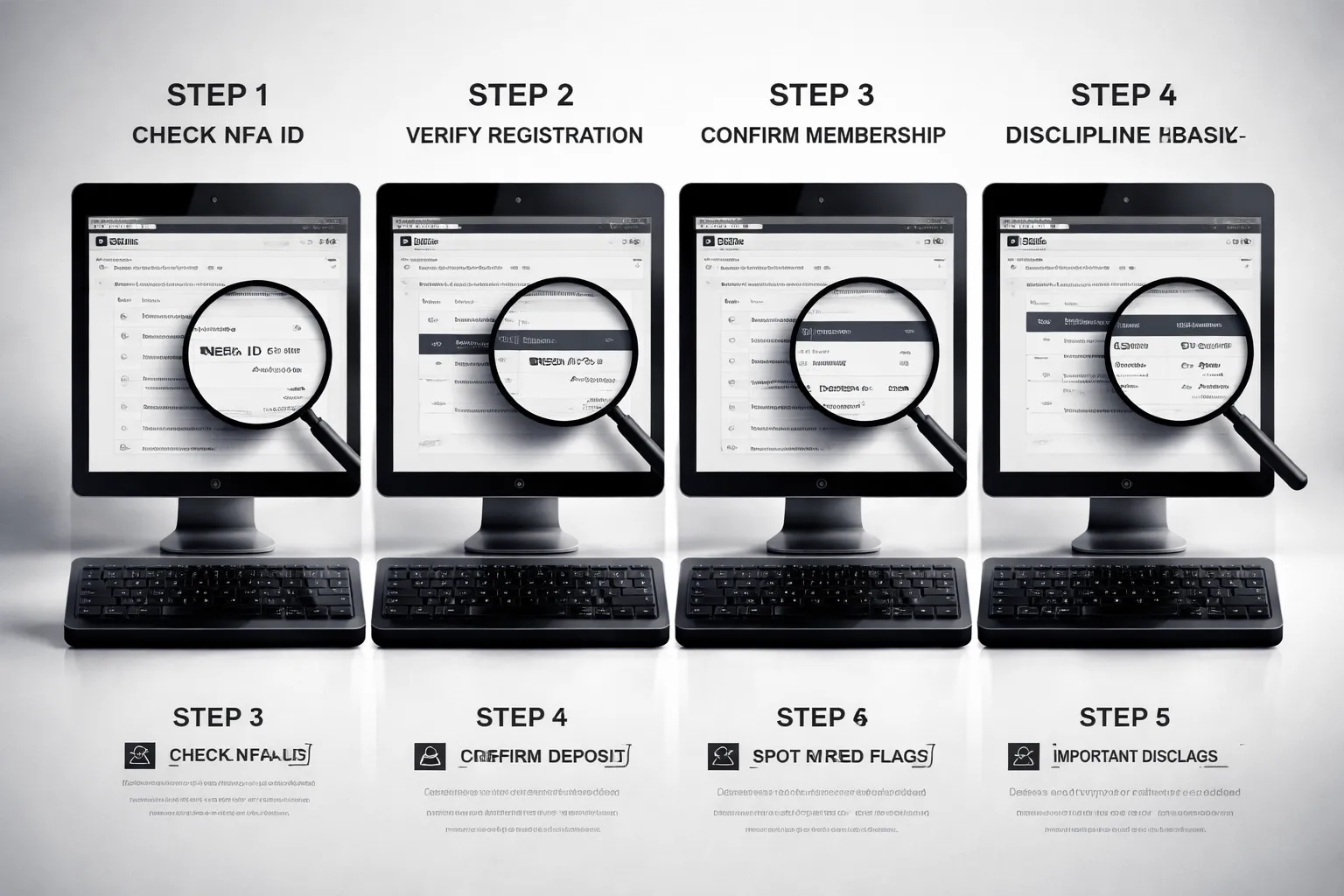
How to verify a broker fast using NFA BASIC
Use NFA BASIC to verify any firm or individual before you open an account or send funds. Do it yourself. Do not rely on screenshots or badges.
- Step 1. Go to NFA BASIC and search the firm name and any brand name shown on the website.
- Step 2. Confirm the NFA ID matches the ID shown on the firm’s website and legal documents.
- Step 3. Check Registration Status. Look for “Active” and the correct category, such as RFED or FCM. If status shows inactive, withdrawn, or barred, walk away.
- Step 4. Check Membership Status. You want current NFA membership. “Not a member” is a stop sign for retail forex dealing.
- Step 5. Open the Details page. Verify the legal name, main office address, and listed principals. Mismatched addresses and shell looking details raise risk.
- Step 6. Review Branches and Associated Persons if you work with a salesperson. Confirm your contact appears in BASIC and shows an active status.
- Step 7. Check Disclosure Documents and any linked filings. Use them to confirm the exact entity that will hold your account.
Key red flags.
- The website name does not appear in BASIC, or appears only as an unregistered “doing business as” with no clear link to an RFED or FCM.
- The firm claims “regulated in the US” but BASIC shows no active registration category.
- You see a registered US entity, but the deposit instructions route you to an offshore company or unrelated payment processor.
- The firm pushes you to open under a foreign affiliate “for better leverage” or “fewer restrictions.” That often means you lose US protections.
If you want a deeper scam screen beyond BASIC, use our safety checklist for spotting forex scams and unregulated brokers.
How to read disciplinary actions and regulatory history
A record in BASIC does not mean “bad.” It tells you what happened and how the firm responded. Focus on patterns and severity.
- Type of action. Complaints differ from formal disciplinary actions. An NFA or CFTC action carries more weight than a customer complaint entry.
- Recent versus old. A single old action with years of clean history matters less than repeated recent issues.
- Core risk areas. Pay close attention to actions involving failure to supervise, misleading promotions, pricing and execution practices, forex disclosure failures, capital problems, or mishandling of customer funds.
- Sanctions. Large fines, restitution orders, or membership bars signal serious misconduct. Restrictions on activities also matter, especially if they limit forex dealing or solicitation.
- Repeat behavior. Multiple actions across related entities or principals signal a culture problem. Check principals and affiliates, not just the brand.
If you use an IB, CTA, or managed account provider, run the same check on the firm and the individual. Many losses start with an unregistered salesperson, not the carrying broker.
Why many global brokers do not accept US clients
Most offshore forex brokers reject US customers because US rules impose high fixed costs and strict limits.
- Registration and oversight. Retail forex dealing requires CFTC registration and NFA membership. Firms must file reports and follow detailed conduct rules.
- Capital requirements. US regulators impose high minimum net capital standards on retail forex dealers. Many firms cannot or will not meet them.
- Leverage limits and product limits. US retail forex leverage caps reduce revenue for brokers built around high leverage offers.
- Marketing restrictions. Performance claims, bonuses, and sales scripts face tighter scrutiny. Many global firms rely on aggressive acquisition tactics that do not survive in the US.
- Enforcement reach. The CFTC and NFA pursue offshore firms that solicit US residents. Some brokers choose to block US traffic to reduce exposure.
This signal cuts both ways. A refusal to take US clients often reflects business reality, not fraud. But if a broker says it accepts US clients without showing active CFTC registration and NFA membership, treat that as a high risk warning.
Core US Forex Trading Rules Retail Traders Must Know
Leverage caps and margin requirements
US retail forex leverage caps come from CFTC rules and NFA enforcement. Your broker must apply them on a per-pair basis.
- Major currency pairs: maximum 50:1 leverage. That equals 2 percent margin.
- Non-major currency pairs: maximum 20:1 leverage. That equals 5 percent margin.
Margin works like a minimum equity requirement. If your account equity drops too far, your broker can liquidate positions to bring the account back into compliance. You control the risk, but the broker controls the cut-off.
FIFO and anti-hedging constraints in many retail forex accounts
Many US retail forex accounts must follow NFA rules designed to standardize position handling.
- FIFO: If you hold multiple positions in the same pair, the first position you opened must close first.
- No offsetting hedges in the same account: You usually cannot hold a long and a short in the same pair at the same time in the same account. Brokers often net the positions instead.
If your strategy relies on trade stacking or internal hedging, test it on the broker platform before funding. These rules can change how stops, partial closes, and trade management behave.
Order execution expectations, slippage, requotes, and price improvement
US brokers must handle orders under rules that focus on fair dealing and supervision, not on guaranteeing a specific fill. You should still know what to expect.
- Slippage: Fast markets can fill you worse or better than your requested price. Both outcomes can happen.
- Requotes: Some dealing desk models may reject your requested price and offer a new one. You should see this clearly on the platform.
- Price improvement: If the market moves in your favor, your broker should not block better fills as a standard practice. Watch your trade history for one-way slippage patterns.
Track your fills. Save timestamps, requested prices, fills, and any rejections. If you see repeated negative slippage with no positive slippage, treat it as a serious execution red flag.
Mandatory risk disclosures and what they must include
US retail forex brokers must give you standardized risk disclosures. You should read them because they set the legal baseline for what the broker says it can do.
- Trading risk: A clear statement that forex trading involves substantial risk of loss and you can lose more than your deposit in some structures.
- Leverage risk: A plain explanation that leverage magnifies gains and losses and can trigger rapid liquidation.
- Counterparty and execution risk: Disclosure that the broker may act as counterparty, may internalize trades, and that execution depends on market conditions.
- Costs: Disclosure of spreads, commissions, rollover or financing charges, and how those charges apply.
- Performance disclaimers: Clear language that past performance does not predict future results, especially around hypothetical or simulated performance.
Keep copies of the disclosures you received on signup. If a dispute happens, the version and date matter.
Recordkeeping, statements, and confirmations you should receive
A regulated US forex firm must give you account records that let you audit what happened.
- Trade confirmations: Details for each trade, including the instrument, size, price, time, and any commissions or fees.
- Account statements: Regular statements showing deposits, withdrawals, realized and unrealized P&L, open positions, margin, and account equity.
- Order and execution records: A history that shows submitted orders, modifications, cancellations, and fills.
- Fee and financing breakdown: Clear line items for spreads, commissions, and rollover or financing charges.
Download statements monthly and store them offline. You will need them for disputes, performance review, and tax reporting. For tax treatment details, see our forex taxes guide.
What Products Are (and Aren’t) Legal for US Traders Under “Forex”
Retail forex, spot FX, and “rolling spot”, what US law actually allows
US traders can trade retail off-exchange forex, but only through regulated counterparties. In practice, that means an NFA member firm, registered with the CFTC, acting as your dealer or counterparty.
Most US “forex” platforms offer rolling spot. You do not settle delivery. You hold a leveraged position that rolls each day. The product can look like spot FX, but regulators treat it as a leveraged retail forex contract.
Labels matter. A broker can call something “spot,” “cash,” or “FX.” Regulators look at the structure. If it is leveraged, margined, and you do not take delivery, it often falls under retail forex rules.
- Legal for US retail traders: Off-exchange retail forex offered by a properly registered US firm, under CFTC and NFA oversight.
- High risk or often blocked: “Spot FX” accounts offered offshore that avoid US registration, especially when they market high leverage and easy onboarding.
- Common red flag: A firm claims “spot is unregulated” and uses that to justify no US licensing.
Exchange-traded currency futures and options
Currency futures and options trade on regulated US exchanges. They clear through a clearinghouse. You do not face a dealer as your counterparty in the same way.
- Where they trade: US exchanges such as CME.
- Who regulates: CFTC. Brokers also fall under NFA rules, and often SEC and FINRA if they offer securities products too.
- Why some traders prefer them: Central clearing, standardized contracts, and consolidated reporting.
Many traders use futures and options when they want USD-based pricing, clear contract specs, and exchange surveillance.
CFDs and CFD-like “forex” structures
US retail traders generally cannot trade CFDs. Many offshore brokers still offer “FX CFDs” or “synthetic spot.” They often bundle FX, indices, commodities, and crypto under one account. The label changes. The structure stays the same.
If the product is a leveraged contract where the provider sets terms and you do not own the underlying, treat it as a CFD-like product. That usually means you will not get US regulatory protections.
- Typical CFD-like terms: “contract for difference,” “perpetual FX,” “synthetic pairs,” “unlimited leverage,” “bonus margin.”
- Practical problem: Disputes, pricing, and liquidation rules depend on the provider, not an exchange rulebook.
- US reality: If a platform offers CFDs to US retail clients, assume you face legal and account access risk.
Forex ETFs and currency mutual funds as alternatives
If you want currency exposure without retail forex, you can use ETFs and mutual funds that hold currency instruments or track currency indexes. You trade them in a brokerage account like stocks.
- What you get: Regulated securities, standard statements, and simpler tax paperwork in many cases.
- What you give up: Direct spot-style leverage and 24-hour dealing.
This route fits long bias, hedging, and allocation, not high-frequency trading.
Copy trading, signal services, and managed accounts, when registration kicks in
Automation and “copy” features can cross a legal line fast. The key issue is control. If someone else places trades for you, or directs trades in a way that acts like management, they may need registration.
- Signals only: Education and alerts can stay unregistered if you make your own decisions and place your own trades.
- Trade execution for you: If a provider can trade your account via login access, API keys, or a platform allocation tool, treat it as account management.
- Pooled funds: If they take money from multiple people and trade as a combined pool, they may trigger pool operator rules.
- Performance fees: Percentage-of-profit fees raise the stakes, and often come with tighter compliance expectations.
Track any third-party strategy like a business relationship. Keep written agreements, full trade logs, and verified performance records. If they show Myfxbook, you still need to know what the numbers mean, use our guide on how to read Myfxbook results.
Quick legality map for “forex” products offered to US retail traders
| Product type | Common label | Typical US status | What to check |
|---|---|---|---|
| Retail off-exchange forex | Forex, rolling spot | Legal through CFTC-registered, NFA-member firms | Firm registration, NFA membership, disclosures, statements |
| Exchange-traded futures | Currency futures | Legal on US exchanges | Exchange listing, clearing, broker membership |
| Exchange-traded options | FX options on futures | Legal on US exchanges | Contract specs, clearing, margin rules |
| CFDs | FX CFD, synthetic spot | Generally not offered legally to US retail | Offshore entity, terms, withdrawal and dispute process |
| Funds and ETFs | Currency ETF, mutual fund | Legal as securities products | Prospectus, fees, holdings, tracking method |
| Copy trading and managed accounts | Copy, PAMM, managed forex | Depends on control and compensation | Who executes trades, licensing, fee model, disclosures |
Offshore Brokers and the Biggest Legal Risks for Americans
Why “offshore” often means unprotected
Many offshore brokers sit outside US jurisdiction. You lose US-level oversight, audits, and enforcement leverage.
- Jurisdiction limits your options. If the broker is based in a small island jurisdiction, your complaint and lawsuit must follow that country’s rules, timelines, and courts.
- Recourse is thin. You may have no effective regulator to escalate to, no arbitration you can access, and no realistic path to recover funds if the broker refuses a withdrawal.
- Insolvency risk is higher. If the broker fails, you usually do not get SIPC-style protections. Some offshore firms advertise “segregated accounts” but you cannot verify how they hold client money or what happens in bankruptcy.
- Terms favor the broker. Offshore client agreements often give the broker wide discretion to cancel trades, widen pricing, reject orders, or delay withdrawals during “reviews.”
How illegal solicitation happens
Most problems start with marketing, not trading. Offshore firms often target Americans while claiming they do not.
- Social media ads. Instagram, YouTube, TikTok, and X promotions push high leverage, bonuses, and “instant funding.”
- Telegram and Discord. Groups offer “signals,” “VIP copy,” or “account management,” then route you to an offshore broker link.
- Affiliates and “introducers.” A middleman gets paid per deposit or per lot traded. That creates pressure to oversell and downplay risks.
- US-facing funnels. US phone numbers, US time zone support, USD-only deposit flows, and US-specific promos show intent, even if the site says “no US clients.”
What happens if you trade with an unregistered broker
You usually will not get arrested for placing a trade. Your biggest risk is practical. You may not be able to get your money back.
- Withdrawals can fail. The broker can stall with extra KYC requests, source-of-funds demands, “tax” invoices, or platform “investigations.”
- Disputes go nowhere. Chargebacks and wire recalls often fail after funds move through payment processors or crypto rails.
- Account terms can erase gains. The broker can claim “abusive trading,” “latency arbitrage,” or “bonus abuse” and void profits under its own rules.
- You can get cut off fast. If a broker decides to block US users, it can close accounts or force liquidation under its terms.
- You may trigger compliance reviews. Banks and payment apps can flag repeated offshore deposits, especially when the counterparty looks like high-risk gambling or unlicensed finance.
If you want a step-by-step screening process, use this safety checklist for spotting unregulated brokers.
How to recognize spoofed regulation claims and fake license numbers
Scam brokers copy real regulator logos and invent “license IDs.” You must verify, not trust screenshots.
- Name mismatch. The regulator register shows a different legal entity name than the broker’s website, or the broker uses a “group” name that does not appear in the register.
- Wrong regulator for the product. The broker cites a securities license that does not cover retail FX or leveraged CFDs.
- Clone firms. The broker uses a real firm’s license number, then changes one letter in the brand name or uses a different domain.
- Fake certificates. PDF “licenses” and framed certificates prove nothing. Only the regulator’s public register matters.
- Maildrop addresses. The listed office is a virtual suite, co-working space, or unrelated building.
- Contact mismatch. The regulator listing shows different phone numbers, emails, or websites than the broker gives you.
| Claim you see | What you should do |
|---|---|
| “Regulated, license #123456” | Find the regulator’s public register and match the legal entity name, website domain, and status. |
| “We do not accept US clients” | Check if the broker still markets to you, offers US onboarding, or routes you through an affiliate or mirror domain. |
| “Client funds are segregated” | Ask where funds are held, in whose name, at which bank, and what happens if the broker becomes insolvent. |
| “Negative balance protection” | Read the contract. Some firms reserve the right to void it during volatility or “exceptional market conditions.” |
Scams, Fraud Patterns, and Enforcement: How to Protect Yourself
Common FX scam models: PAMM fraud, “guaranteed returns,” and withdrawal traps
Most retail FX scams use the same playbook. They promise ease, speed, and certainty. FX does not offer certainty. When a promoter sells certainty, treat it as a threat.
- PAMM and managed account fraud. A “manager” asks you to deposit into their PAMM, MAM, or copy account. They show a perfect track record. They control trading, sometimes deposits, sometimes both. Common signs include no verified brokerage statements, no third-party audit, and pressure to add funds after losses. Many schemes mix real trading with new deposits to pay early withdrawals.
- “Guaranteed returns” and fixed income claims. You hear numbers like 3 percent per day, 10 percent per week, or “risk-free arbitrage.” Real FX returns vary. Losses happen. In the US, anyone soliciting you for pooled FX trading may need CFTC registration, often as a CPO or CTA, and NFA membership. If they avoid registration talk, assume you carry the risk alone.
- Withdrawal traps. You can deposit fast, but you cannot withdraw. The firm invents reasons like “tax clearance,” “liquidity fee,” “blockchain verification,” “margin reset,” or “compliance unlock.” They may demand another payment to release your money. Stop paying. Save every message and screenshot. Move to complaints fast.
If you want a deeper checklist, use this guide to spot forex scams and fake gurus.
Broker manipulation allegations explained: spreads, slippage, and conflicts of interest
Bad fills can come from market structure or from a broker’s dealing practices. You need to know the difference. You also need proof.
- Spreads. Spreads widen during news, low liquidity, and volatility. That can happen at any broker. Compare quoted spreads across multiple sources at the same time. Track the timestamps and the instrument.
- Slippage. Slippage means your fill differs from your requested price. It can be negative or positive. If you only see negative slippage, document it. Pull order logs and execution reports. Look for a pattern around stop orders and news events.
- Requotes and execution delays. Requotes can happen on dealing desk models. Delays can come from your connection, platform issues, or broker handling. Record platform logs, ping, and order timestamps. Keep screenshots with time and price.
- Conflicts of interest. Some brokers act as your counterparty. They can profit when you lose. That structure does not prove manipulation, but it raises the need for strong supervision, clear disclosures, and consistent execution quality. Read the customer agreement and execution policy. Save a copy.
Focus on evidence. Save statements, trade confirmations, chat logs, emails, and deposit and withdrawal records. You will need them for any claim.
How to check the CFTC RED List and NFA investor alerts
Do these checks before you fund an account. Repeat them if the broker changes domains, payment methods, or account terms.
- Check the CFTC RED List. Search the CFTC RED List for the brand name, website, and any “group” company name. Also search the payment recipient name you see on wires or card charges. A match is a stop sign. Do not deposit.
- Check NFA BASIC. Use NFA BASIC to verify registration status and to view disciplinary history. Confirm the exact legal name, NFA ID, and approved business address. Scammers copy real firm names and use lookalike domains.
- Read NFA investor alerts and CFTC enforcement releases. Search both sites for the brand, principals, and affiliate marketers. If you see repeat warnings about withdrawals, fake platforms, or unregistered solicitation, walk away.
Do not trust a badge on a website. Trust the regulator database entry and the legal entity match.
Where and how to file complaints (NFA arbitration, CFTC tips, state AG)
Act fast. Your leverage drops when money leaves the US banking system or when crypto transfers settle.
- NFA arbitration or mediation. If your dispute involves an NFA member, you may qualify for NFA arbitration or mediation. Gather your account documents, statements, trade logs, and all communications. Write a timeline with dates, amounts, and names.
- CFTC tips and complaints. Submit a tip or complaint to the CFTC with the broker name, domain, payment rails used, wallet addresses if any, and the full paper trail. Include screenshots of marketing claims like “guaranteed profit” and any refusal to process withdrawals.
- State Attorney General and state regulators. File with your state AG consumer protection office. Also file with your state securities regulator if the pitch looked like an investment program, pooled product, or managed account offer.
- Your bank or card issuer. Ask for a chargeback or dispute if you used a card. For wires, request a recall immediately. For ACH, ask about return options. Time matters.
When you file, stick to facts. Attach documents. List exact URLs, Telegram handles, email addresses, and payment recipients. Give investigators something they can act on.
Taxes and Reporting Basics for US Forex Traders
Taxes and Reporting Basics for US Forex Traders
Forex profits can be taxable even if you never withdraw funds. Your broker may not issue a 1099 for spot FX. You still must report your results.
How FX trading may be taxed, ordinary income vs capital gains
US tax rules split many trading profits into two buckets, ordinary income and capital gains. Ordinary income often faces higher rates. Capital gains rates depend on holding period. Many spot forex trades do not fit the usual stock and ETF capital gains pattern. That is why your tax result can differ from what you expect.
Section 988 vs Section 1256, what typically applies and why it matters
Most retail spot forex trading falls under Section 988 by default. That usually means ordinary income treatment for gains and losses.
Section 1256 treatment often applies to certain regulated futures and options contracts, and some currency contracts that meet specific rules. When it applies, it uses a blended rate concept, 60 percent treated as long term, 40 percent as short term, marked to market at year end. This can change your effective tax rate and how losses work.
The practical point is simple. Your product type and how your broker structures the instrument can drive the tax category. Spot FX commonly points to 988. Exchange traded currency futures commonly point to 1256.
| Topic | Section 988 (common for spot FX) | Section 1256 (common for regulated futures) |
|---|---|---|
| Typical tax character | Ordinary income or loss | Mixed 60 40 long term short term |
| Year end handling | Based on realized results, plus specific rules | Marked to market at year end |
| Why it matters | Rate impact, loss treatment, reporting approach | Rate impact, mark to market, loss treatment |
What records to keep
- Broker statements, monthly and annual, including deposits, withdrawals, and fees.
- Trade history export with ticket ID, time, pair, size, entry, exit, and commissions.
- Realized P&L report for the tax year, and an open positions report for year end.
- Exchange rate conversions used to translate non USD activity into USD, with the source and timestamp you used.
- Interest and financing details, including swaps, rollover, and any cash balance interest.
- Platform logs if you run automated strategies, plus VPS invoices and data feed costs if you plan to deduct expenses.
- Form and account documents, W-9 on file, account agreements, and any corrected statements.
Save PDFs and raw CSV exports. Keep a clean folder by year. If you ever need to defend a number, you want to reproduce it from source files.
When to talk to a tax professional
- You trade both spot FX and currency futures or options, and you need to split 988 and 1256 reporting.
- You traded on multiple venues, including offshore accounts, or you moved money across borders.
- You have large losses, and you want to confirm how they apply against other income.
- You run an LLC, S corp, or you want to explore trader tax status, elections, or mark to market rules.
- You received a notice from the IRS, or your broker statements do not match your own records.
- You got hit by fraud or an account takeover, and you need to document transfers and potential deductions. Use your incident file from your forex scam safety checklist.
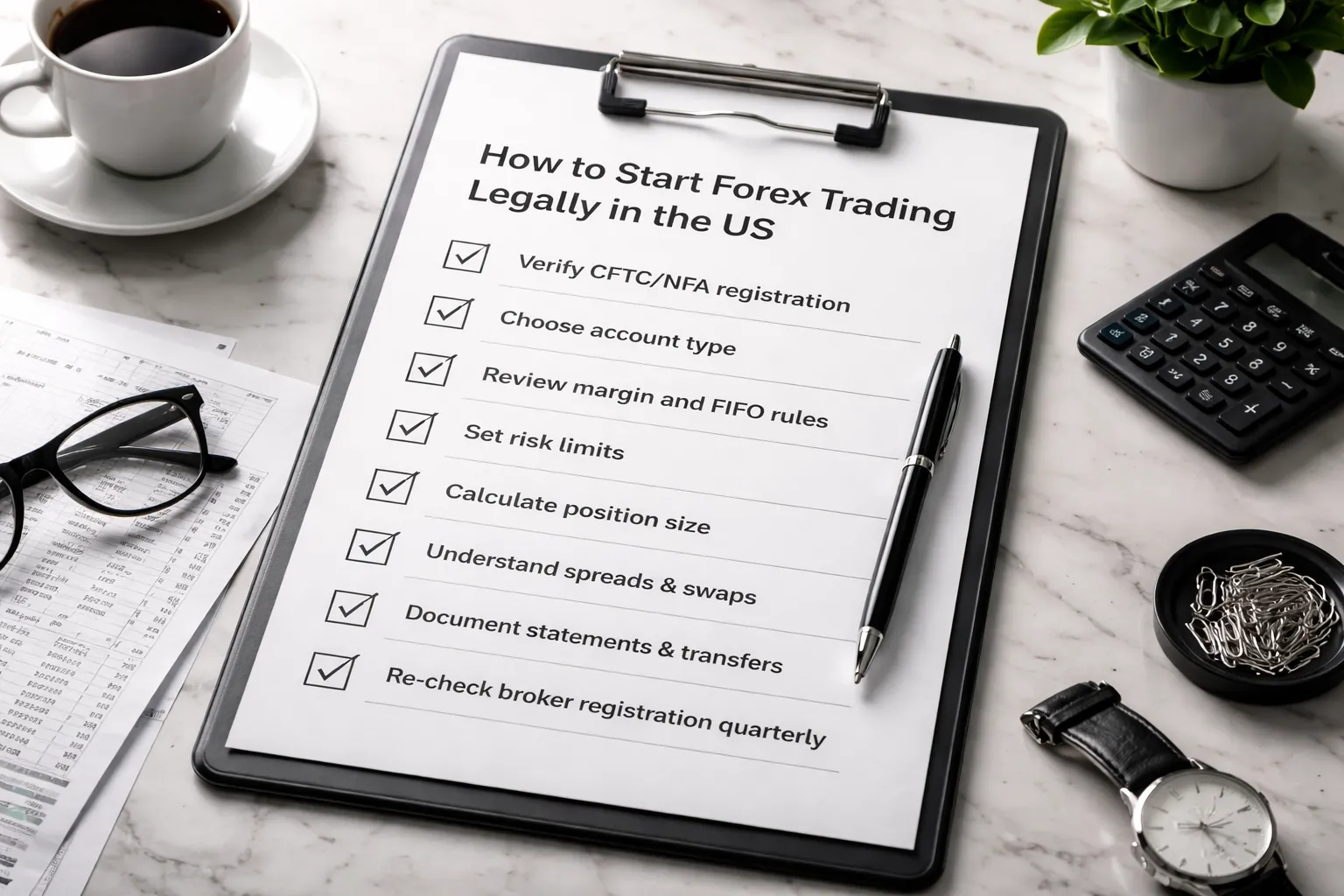
How to Start Forex Trading Legally in the US (Practical Checklist)
Choose a regulated provider and confirm registration before funding
- Use a US regulated broker. For retail forex, look for registration with the CFTC and NFA membership.
- Verify, then verify again. Check the firm name and any “doing business as” names. Match the website domain, support email, and legal entity to the registration record.
- Confirm the sales contact. If a person solicits your account, confirm they are properly registered or affiliated. Do not rely on screenshots or forwarded links.
- Do not fund first. Treat urgency, “limited slots,” and bonus offers as a stop sign. Keep proof of who asked you to send money, where, and why.
- Know what you are opening. US retail forex typically runs through an RFED or FCM. If you cannot identify which one, pause.
- Use the same caution rules you use for fraud prevention. Keep your process tight. See forex scam safety checklist.
Understand account types, margin disclosures, and platform constraints
- Retail vs professional. Most US traders open a retail forex account. “Pro” labeling does not remove US rules; it often changes pricing and minimums.
- Individual vs joint vs entity. Choose the ownership that matches who funds the account and who reports taxes. Do not mix personal and business transfers.
- Read the risk disclosure. Focus on margin liquidation, negative balance handling, slippage, and order execution rules.
- Know US leverage caps. Common caps are 50:1 on major FX pairs and 20:1 on non majors. Your broker can set lower limits.
- Platform limits matter. Some strategies fail under FIFO rules and no hedging restrictions at many US brokers. Test your workflow before you trade size.
- Corporate actions in FX. Rollover timing, holiday schedules, and symbol conventions differ by broker. Check the contract specs for each pair.
Set risk controls: position sizing, stop-loss discipline, and leverage limits
- Set a hard loss limit per trade. Many retail traders use 0.25 to 1.00 percent of account equity per trade. Pick a number you can follow.
- Size from the stop, not from the feeling. Define stop distance first. Then calculate units so the dollar loss equals your risk limit.
- Use leverage as a cap, not a target. Lower leverage reduces liquidation risk and execution stress during spikes.
- Use stop-loss orders with rules. Place them at entry. Move them only under written conditions. Do not widen stops to avoid a loss.
- Plan for gaps and slippage. News releases and thin liquidity can skip your price. Assume worst case fills when you backtest.
- Set account level circuit breakers. Daily loss limit. Weekly loss limit. Max open risk across all positions.
Know your costs: spreads, commissions, swaps/rollover, and funding fees
- Spread. You pay it every time you enter and exit. Wider spreads hit short-term systems the most.
- Commission. Some accounts charge a separate commission on top of tight spreads. Compare total cost, not marketing labels.
- Swap or rollover. Holding past the broker’s rollover cut-off can create a credit or debit. Triple swap days can apply.
- Financing and borrow costs. Some brokers embed costs in pricing. Read the schedule for each instrument.
- Funding and withdrawal fees. Wires, ACH, cards, and third-party payment rails can add fixed fees, FX conversion fees, and intermediary bank charges.
- Inactivity and data fees. Check the fee table. Small recurring charges add up in low frequency trading.
Build a compliance-minded routine: documentation and periodic broker re-checks
- Keep clean records. Save monthly statements, trade confirms, and year-end summaries. Export your order history from the platform.
- Document all transfers. Keep receipts for deposits, withdrawals, and internal transfers. Match each transfer to a bank statement line.
- Write down your trading method. Rules for entries, exits, risk per trade, and maximum leverage. This protects you when you review performance and when you reconcile disputes.
- Re-check your broker quarterly. Confirm registration status, legal entity name, and customer support channels. Save screenshots or PDFs of the profile page.
- Track performance with audit-friendly logs. Log dates, pair, size, entry, exit, stop, and rationale. Keep a change log for strategy edits.
- Prepare for taxes early. Categorize trades and keep backups. If you want deeper detail on tax treatment and elections, use your tax guide: Section 988 vs 1256 rules.
Pros and Cons of Trading Forex Under US Regulations
Benefits of Trading Forex Under US Rules
- Stronger oversight. You trade through firms that must register and follow strict conduct rules. That reduces counterparty risk versus offshore brokers.
- Segregation and custody controls. Regulated firms face tighter requirements around how they handle customer money and reporting. You get clearer accountability when issues arise.
- Cleaner disclosures. US brokers must publish risk disclosures and follow rules on marketing and performance claims. You see fewer “too good to be true” offers.
- More transparent pricing and execution standards. You can better compare spreads, commissions, and fill quality. Your broker has less room to hide costs inside vague terms.
- Better paper trail for compliance and taxes. Regulated statements, confirmations, and audit trails simplify recordkeeping. Pair this with your own logs and verified performance tracking.
If you want a safety-first checklist before funding any account, use this guide to spotting forex scams and unregulated brokers.
Trade-offs: What You Give Up Under US Regulations
- Fewer broker choices. Many global brands do not accept US residents. You end up comparing a smaller list of regulated firms.
- Lower leverage caps. Retail leverage typically caps at 50:1 on major pairs and 20:1 on minors. This limits position size and can reduce the appeal of small accounts.
- Higher margin discipline. Lower leverage forces you to size trades more conservatively. That helps survival, but it can slow growth for aggressive strategies.
- Strategy limits, especially for hedging. Rules like FIFO and restrictions on holding offsetting positions in the same pair can break some hedge-style systems. You may need to adapt with separate accounts, different pairs, or options and futures where appropriate.
- Promotions and bonuses are rare. You will not see the same deposit bonuses and rebates common offshore. That removes an incentive, but it also removes a common trap.
- Product access can be narrower. Some exotic CFDs and synthetic products offered overseas are not available from US-regulated forex dealers.
Who US-Style Restrictions Help Most, and Who They Frustrate
- Best fit: new traders. Lower leverage and tighter supervision reduce the chance that a single mistake wipes out your account. You also face fewer predatory offers.
- Best fit: risk-managed swing traders. If you trade higher timeframes and use modest position sizing, leverage caps matter less. The regulated environment becomes the main benefit.
- Best fit: traders who value legal recourse. If a dispute happens, you deal with a regulated firm inside US jurisdiction, with clear complaint channels and enforcement.
- Frustrates: high-frequency scalpers. Tight rules do not guarantee tight spreads. Some scalpers need broader broker access, deeper liquidity options, or different market structures.
- Frustrates: hedging and grid system users. FIFO and no-offsetting constraints can force major changes to how you manage exposure and exits.
- Frustrates: small accounts chasing high leverage. If your plan depends on 200:1 or 500:1 leverage, US rules will not support it. That plan also carries a higher blow-up rate.
| US Regulation Feature | What It Means for You | Practical Impact |
|---|---|---|
| Leverage caps | Lower maximum position size per dollar of margin | Smaller returns and smaller losses per trade, more focus on risk control |
| Registration and supervision | Broker must meet ongoing compliance and reporting standards | Lower chance of fly-by-night operations, clearer accountability |
| FIFO and hedging limits | Restrictions on order handling and offsetting positions | Some EAs and hedge systems need redesign or replacement |
| Marketing and disclosure rules | Stricter standards for claims and risk statements | Fewer misleading promos, easier comparison across brokers |
FAQ
Is forex trading legal in the US?
Yes. You can trade spot forex in the US through brokers registered with the CFTC and members of the NFA. Trading through offshore brokers can break US rules and can limit your legal protections if something goes wrong.
Who regulates forex in the US?
The CFTC sets and enforces rules for retail forex. The NFA oversees member compliance, audits, reporting, and customer protections. If your broker is not CFTC registered and NFA compliant, you take higher counterparty and fraud risk.
How do I check if a forex broker is legit in the US?
Check the broker and its principals in the NFA BASIC database. Match the firm name, NFA ID, registration status, and any disciplinary actions. Do not rely on website logos, reviews, or claimed “US clients accepted” statements.
What leverage can US forex traders use?
Retail leverage caps are 50:1 on major currency pairs and 20:1 on non-majors. Your broker must enforce margin rules. Higher leverage offers from “international” accounts usually mean you are outside US protections.
What is the FIFO rule and why does it matter?
FIFO means you must close your oldest position first when you hold multiple positions in the same pair and size. It can break some hedging and scaling strategies. Many traders switch to netting-style execution and adjust order sizing.
Can I hedge in a US forex account?
US retail forex rules generally block true hedging in the same account and pair, meaning long and short positions offset. You can still manage risk with stops, reduced size, correlated pairs, or separate sub-accounts if your broker allows.
Can I use MetaTrader in the US?
Sometimes. Availability depends on the broker, platform licensing, and how the broker offers retail forex. Some US brokers use proprietary platforms instead. Confirm platform support before funding, especially if you rely on EAs or custom indicators.
Do US forex brokers have to segregate client funds?
Retail forex customer money has specific protection rules, but it is not the same as securities account segregation. Ask your broker how it holds retail forex customer funds, where funds sit, and what happens in an insolvency event.
Do I pay taxes on forex trading in the US?
Yes. Tax treatment depends on how you trade and which election applies, often Section 988 or Section 1256. Track your trades, keep statements, and plan before year-end. Use this guide on forex taxes in the US.
Can I trade forex with an offshore broker as a US resident?
US regulators restrict solicitation and onboarding of US retail clients by non-compliant firms. You may face account closures, withdrawal issues, and weak dispute options. If a firm targets US clients without CFTC and NFA status, treat it as a red flag.
What protections do US forex rules give you?
They force higher capital standards, risk disclosures, supervision, and limits on leverage and order handling. You get clearer accountability and more consistent broker reporting. You still carry market risk and broker risk, so use position sizing and withdrawals.
What documents should I review before opening a US forex account?
Read the risk disclosure, customer agreement, margin policy, order execution policy, and fee schedule. Confirm how spreads, commissions, swaps, and slippage work. Save PDFs and screenshots. Written terms matter more than support chat promises.
Conclusion
Forex trading is legal in the US, but only inside a tight rule set. You must use a properly registered broker. You must accept higher margin requirements, strict reporting, and limits on how brokers market and run accounts.
Your edge is compliance and process. Verify the broker in NFA BASIC. Read the account terms. Track your leverage, fees, and withdrawals. Keep records.
- Trade only with a CFTC regulated, NFA member broker. Do not fund offshore entities that solicit US clients.
- Keep leverage low. You control risk with position size, not account promises.
- Assume slippage and spreads will change. Plan for news, low liquidity, and rollover.
- Withdraw profits on a schedule. Reduce broker exposure and test payout speed.
- Document everything. Save disclosures, statements, and support emails.
If you want a final checklist for screening brokers and avoiding traps, read how to spot forex scams and unregulated brokers.
-
Is Forex Trading Legal in the United States? Rules, Regulators & What to Know
7 months ago -
Forex Taxes in the US: Section 988 vs 1256 (Complete Guide)
7 months ago -
Is Forex Trading Halal? Islamic Finance Rules Explained
7 months ago -
How to Spot Forex Scams and Unregulated Brokers (Safety Checklist)
7 months ago -
How to Read Myfxbook Results: Metrics Explained (Drawdown, Gain, Risk & More)
7 months ago
-
- Retail forex, spot FX, and “rolling spot”, what US law actually allows
- Exchange-traded currency futures and options
- CFDs and CFD-like “forex” structures
- Forex ETFs and currency mutual funds as alternatives
- Copy trading, signal services, and managed accounts, when registration kicks in
- Quick legality map for “forex” products offered to US retail traders
-
- Choose a regulated provider and confirm registration before funding
- Understand account types, margin disclosures, and platform constraints
- Set risk controls: position sizing, stop-loss discipline, and leverage limits
- Know your costs: spreads, commissions, swaps/rollover, and funding fees
- Build a compliance-minded routine: documentation and periodic broker re-checks
-
- Is forex trading legal in the US?
- Who regulates forex in the US?
- How do I check if a forex broker is legit in the US?
- What leverage can US forex traders use?
- What is the FIFO rule and why does it matter?
- Can I hedge in a US forex account?
- Can I use MetaTrader in the US?
- Do US forex brokers have to segregate client funds?
- Do I pay taxes on forex trading in the US?
- Can I trade forex with an offshore broker as a US resident?
- What protections do US forex rules give you?
- What documents should I review before opening a US forex account?
-
-
- Retail forex, spot FX, and “rolling spot”, what US law actually allows
- Exchange-traded currency futures and options
- CFDs and CFD-like “forex” structures
- Forex ETFs and currency mutual funds as alternatives
- Copy trading, signal services, and managed accounts, when registration kicks in
- Quick legality map for “forex” products offered to US retail traders
-
- Choose a regulated provider and confirm registration before funding
- Understand account types, margin disclosures, and platform constraints
- Set risk controls: position sizing, stop-loss discipline, and leverage limits
- Know your costs: spreads, commissions, swaps/rollover, and funding fees
- Build a compliance-minded routine: documentation and periodic broker re-checks
-
- Is forex trading legal in the US?
- Who regulates forex in the US?
- How do I check if a forex broker is legit in the US?
- What leverage can US forex traders use?
- What is the FIFO rule and why does it matter?
- Can I hedge in a US forex account?
- Can I use MetaTrader in the US?
- Do US forex brokers have to segregate client funds?
- Do I pay taxes on forex trading in the US?
- Can I trade forex with an offshore broker as a US resident?
- What protections do US forex rules give you?
- What documents should I review before opening a US forex account?
-
-
How to Place a Forex Trade Step by Step (Your First Trade Explained)
5 months ago -
Forex Trading vs Crypto Trading: Which Market Is Better for Beginners?
5 months ago -
Forex Lot Size Calculator: How to Use It to Size Trades Correctly
7 months ago -
How to Calculate Position Size in Forex (Position Sizing Formula + Examples)
7 months ago -
Forex Leverage Explained: How It Works, Pros, Cons & Examples
7 months ago
-
Forex Trading Platforms Comparison: MetaTrader vs cTrader vs TradingView
7 months ago -
Stop Loss vs Take Profit: Differences, Examples & Best Practices
7 months ago -
Is Forex Trading Legal in the United States? Rules, Regulators & What to Know
7 months ago -
Forex Leverage Explained: How It Works, Pros, Cons & Examples
7 months ago -
Forex Market Hours & Trading Sessions Explained (Best Times to Trade)
7 months ago