Best Forex Copy Trading Platforms (Features, Fees & Safety Compared)

Forex copy trading lets you mirror another trader’s orders in your own account. Your results depend on the platform’s costs, controls, and safeguards. Pick wrong and you pay high spreads, hidden performance fees, or take risks you did not plan for.
This guide compares the best forex copy trading platforms side by side. You will see the key features that matter, trade and non trade fees to check, minimum deposit and sizing tools, and which safety signals to demand. We also cover broker oversight, account segregation, execution model, and what to verify before you connect your funds. If you need the basics first, read copy trading forex explained.
Key Takeaways
In het kort:
- Pick platforms that show full, audited stats. You need long track records, max drawdown, win rate, average R multiple, and open trade exposure.
- Know what you pay. Check spread or commission, plus copy fees like performance fees, subscription fees, and follower profit splits.
- Control position sizing. Use fixed lot, equity percent, multiplier scaling, and per trade caps. Avoid any setup that copies 1:1 without limits.
- Demand risk controls. Use max drawdown stop, equity stop, per day loss limits, and a kill switch to disconnect fast.
- Verify safety signals. Prioritize regulated brokers, segregated client funds, and clear complaint channels.
- Check execution quality. Review slippage, latency, requotes, and whether the broker runs B-book or STP or ECN.
- Do not trust marketing. Trust verifiable reporting, fee tables, and platform logs.
- Run a small test first. Start with the minimum deposit, then scale only after you confirm fills, fees, and drawdowns match the stats.
- Use a checklist before you follow anyone. Read how to choose a copy trading provider.
What forex copy trading is (and how platforms differ)
What forex copy trading is
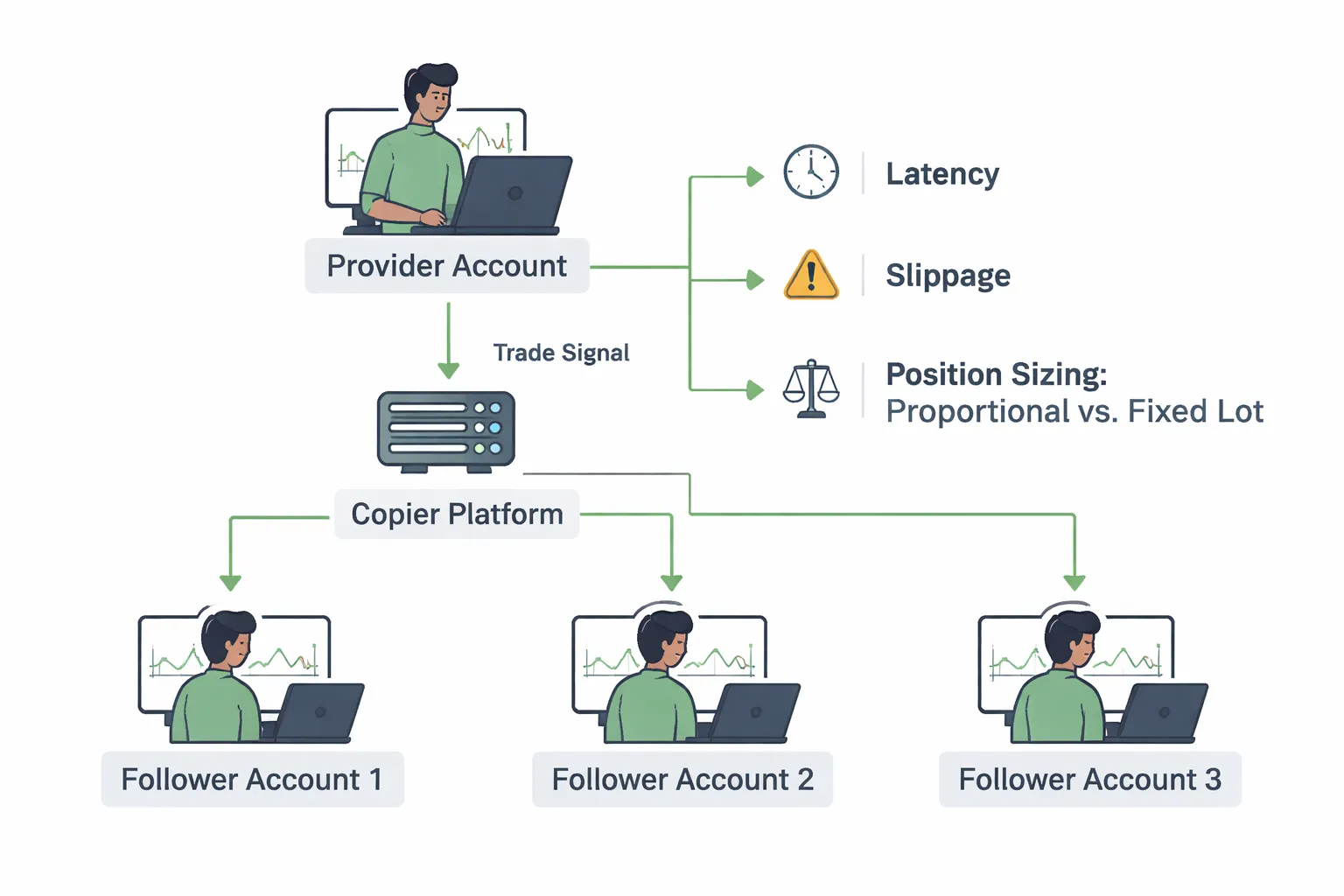
Forex copy trading links your account to another trader or strategy. When they open, close, or change a trade, your account attempts to do the same based on rules you set.
You do not buy a “fund.” You follow a live trading feed. Your results can still differ from the provider’s results due to execution, pricing, and position sizing.
Copy trading vs social trading vs signal services
- Copy trading: Trades replicate automatically in your account. You set allocation, risk limits, and sometimes max lot size and max drawdown cutoffs.
- Social trading: A broader product. It can include copy trading, leaderboards, comments, and portfolios. The social layer does not improve fills or reduce risk.
- Signal services: You receive alerts with entries and exits. You place trades manually or via an external tool. Execution depends on you, your timing, and your broker.
For due diligence on who you follow, use a checklist. See how to choose a copy trading provider.
Broker-integrated platforms vs third-party trade copiers
- Broker-integrated copy trading: The broker hosts the copying inside its app or client portal. Setup stays simple. Reporting can be cleaner because the broker controls pricing, order routing, and account logs.
- Trade-offs: You stay locked to that broker. Provider selection can be limited. Porting your follows to a new broker often means starting over.
- Third-party copiers: A separate service connects a provider account to follower accounts, sometimes across brokers and platforms. You get more choice and more routing options.
- Trade-offs: You add another layer that can fail. You rely on API bridges, plugins, or account permissions. Support becomes split between broker and copier.
Execution models you will see
- Mirroring: Your account copies the same instrument and direction. Lot sizing follows a defined rule. Timing tries to match the provider’s entries and exits.
- Proportional allocation: The platform scales positions by equity, balance, or a set allocation amount. Example: you allocate 20% of your equity to one provider, and the copier sizes trades inside that budget.
- Fixed-lot copying: Every copied trade uses a fixed lot size you set. This can break risk alignment fast when the provider changes leverage, trades different pairs, or increases frequency.
Common limitations that change your results
- Slippage: Your fill price differs from the provider’s. It increases on market orders, news spikes, and low-liquidity sessions. It also grows when many followers pile into the same trade.
- Latency: Time delay between the provider trade and your copy. Even small delays can matter for scalping and tight stop strategies.
- Requotes and execution rules: Some brokers reject or reprice orders. Others fill at the next available price. Your outcomes depend on the broker’s execution policy and platform bridge.
- Symbol and contract differences: Your broker may use different symbol names, different point values, different minimum lots, different stop level rules, or different swap rates. A copier can map symbols, but it cannot force identical trading conditions.
Our methodology: how we evaluated the best forex copy trading platforms
Scoring framework: safety, fees, features, marketplace quality, usability
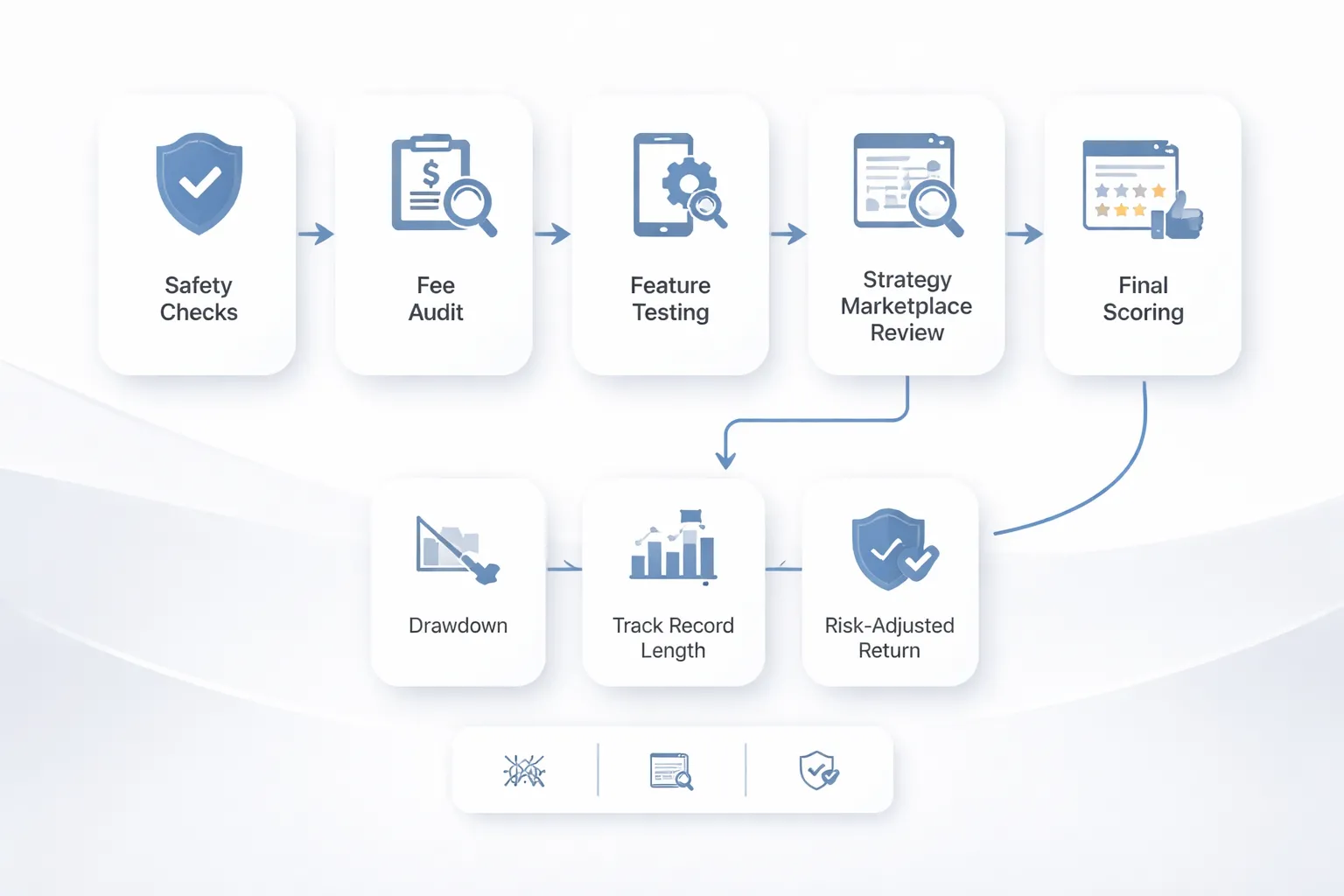
We scored each platform on five buckets. We used the same checklist for all reviews.
- Safety. Regulation where it matters, client money protections, clear risk tools, and clean marketing. We also checked withdrawal terms and account control. You should keep your own account credentials and you should control lot sizing, max open trades, and max drawdown stops.
- Fees. Spread and commission impact, platform subscription fees, signal fees, performance fees, and any bridge or VPS costs. We priced typical setups for small and mid-size accounts. We marked platforms down when pricing stayed vague.
- Features. Trade copying rules, risk scaling, symbol mapping, partial close support, SL and TP sync, and handling of failed fills. We also checked if you can pause copying, close all copied trades, and cap exposure per strategy.
- Strategy marketplace quality. Filtering, transparency, and whether the platform makes it hard for bad systems to look good. We prefer marketplaces that show drawdowns, trade history, and live account proof, with easy to read stats.
- Usability. Setup time, mobile experience, clarity of settings, and support. Copy trading fails most often at setup, lot sizing, and risk caps. We favored platforms that reduce these mistakes.
Data points that matter: drawdowns, track record length, risk-adjusted metrics
We focused on numbers that predict survivability. Return alone tells you little.
- Max drawdown and equity curve shape. We looked for deep dips, long recoveries, and sudden cliff drops. We treated equity drawdown as more important than balance drawdown.
- Track record length. We favored longer live histories. Short histories can hide blowups. We also checked how the strategy behaved across different market regimes.
- Risk-adjusted performance. We compared returns to drawdown and volatility. We also checked consistency by month, not just the total return.
- Trade behavior. Average holding time, win rate versus payoff ratio, and exposure concentration. High win rates with rare large losses often signal hidden tail risk.
- Replication risk. We noted whether results depended on perfect fills, tight spreads, or specific symbols. Your broker conditions can change outcomes through slippage and execution rules.
Red flags we downgrade: martingale, grids, short histories, hidden costs
Some patterns look good until they fail. We downgraded platforms and strategies that make these patterns easy to sell and hard to detect.
- Martingale and grid averaging. We flagged aggressive position increases, recovery trades, and widening exposure in drawdowns. These systems can show smooth growth, then crash fast.
- Short or reset track records. We reduced scores for strategies with limited history, frequent account changes, or missing trading periods.
- Hidden costs. We marked down unclear performance fees, wide markups, extra bridge charges, VPS requirements, and payout rules that change based on volume.
- Low transparency. We penalized platforms that hide trade history, hide open positions, or show only curated metrics.
- Overstated safety claims. We reduced scores when marketing promised “risk free” copying or implied guaranteed returns. If you want a baseline on what to verify before paying for signals, read our forex signals guide.
Who each platform is best for: beginners, active traders, hands-off investors
| Trader type | What you should prioritize | What we looked for |
|---|---|---|
| Beginners | Simple setup and hard risk limits | Clear lot scaling, max drawdown stop, easy pause button, strong reporting, and strict provider vetting |
| Active traders | Control and execution tools | Fast syncing, partial close support, symbol mapping, copier rules per symbol, and detailed logs for mismatched fills |
| Hands-off investors | Transparency and low maintenance | Long live track records, clean fee disclosure, auto risk caps, and a marketplace that makes bad risk obvious |
Best forex copy trading platforms (features, fees & safety compared)
Platform comparison table: regulation, minimum deposit, pricing model, and key tools
Copy trading lives on two layers. The broker. And the copy network or software. Regulation sits with the broker. The copy tool adds execution and risk controls. You need both to be solid.
| Platform | How it works | Regulation (where it sits) | Typical minimum deposit | Pricing model | Key tools to check |
|---|---|---|---|---|---|
| eToro | Built-in social copy inside one broker | Broker regulated (varies by region) | Often $50 to $200 depending on country and payment method | Spread plus overnight fees, some withdrawal and conversion fees. No separate copier subscription | Copy allocation per trader, pause or stop copy, proportional sizing, performance and risk stats |
| ZuluTrade | Copy network connected to partner brokers | Regulation at your chosen broker. ZuluTrade runs the network layer | Depends on broker. Commonly $100 to $500 | Broker spreads plus possible signal or markup fees. Some accounts use profit share | Strategy rankings, risk scoring, trade-by-trade history, copy controls, follower slippage reporting varies by broker |
| Myfxbook AutoTrade | Copy via connected brokers, built on Myfxbook verified track records | Regulation at your chosen broker. Myfxbook provides verification and copying | Depends on broker. Often $100+ | Strategy fees vary, plus normal broker trading costs | Verified performance, open trades visibility, drawdown stats, system filters, follower results depend on execution |
| Duplikium | Trade copier infrastructure that links accounts across brokers and platforms | Regulation at your broker. Duplikium is a copier service, not a broker | Depends on broker. Copier itself has no deposit requirement | Monthly subscription tiers, plus your broker trading costs | Low latency routing, symbol mapping, multi-account copying, scaling rules, logs and error reporting, cross-platform support |
| Broker native copy apps | Copy feature inside one broker app | Broker regulated | Depends on broker. Often $50+ | Usually spreads and swaps. Some add performance or management fees | Fast setup, simple allocation, basic risk caps. Often fewer transparency tools |
Use this table to narrow options. Then vet the broker license, account type, and trade execution rules. Copy results can collapse if your broker widens spreads, rejects orders, or delays fills.
Best for beginners: simple discovery, onboarding, and copy controls
- Pick a broker-first platform when you want fewer moving parts. You open one account, fund it, then copy inside the same app.
- Look for clear copy controls. Set a fixed allocation per strategy. Use pause and stop. Keep manual close available.
- Prefer clean stats. You want max drawdown, average trade length, win rate, and worst month. Avoid leaderboards that push short track records.
- Start with small allocation. Your first goal is to confirm that fills, slippage, and position sizing match what you expect.
Best for advanced risk controls: equity stops, max drawdown limits, and allocation rules
- Use hard account level stops when possible. Equity stop or balance stop should cut all copying if losses hit your limit.
- Cap drawdown per strategy. A platform should let you stop copying one provider when their drawdown breaches your threshold.
- Control exposure. Set max open trades, max lots, max leverage, and symbol-level limits if available.
- Use allocation rules. Fixed lot, proportional by equity, or multiplier. Avoid martingale style sizing unless you can cap it.
- Demand logs. You need a clear record for every copied order, including rejected orders, partial fills, and price differences.
Best for MetaTrader users: MT4/MT5 compatibility and EA/copy integrations
- Decide if you want broker marketplace copy or external copier. MetaTrader Signals runs inside MT4 and MT5. External copiers can link MT accounts across brokers.
- Check symbol mapping. Many brokers use different suffixes. If mapping fails, copying breaks or opens the wrong instrument.
- Confirm partial close support. Some copiers mishandle partial closes and leave your follower account mis-sized.
- Watch hedging and netting modes. MT4 hedges by default. MT5 can run netting. Your copier must match account mode or handle conversions.
- Plan for EA conflicts. If you run EAs, you need magic number filtering or trade comment filtering to avoid interference.
Best for low latency copying: infrastructure, server locations, and execution transparency
- Prefer copier services with regional servers. Shorter distance to your broker trade server reduces delay.
- Check how orders route. API based routing and broker side integrations usually beat screen scraping or local terminal bridging.
- Measure, do not guess. Look for timestamps for provider fill vs follower fill, plus average slippage stats.
- Confirm failover behavior. If the copier disconnects, it should resync positions fast and show mismatches.
- Avoid hidden latency costs. Cloud copiers remove the need for your own VPS, but you still need stable broker execution.
Best for strategy variety: number of providers, filters, and instrument coverage
- Go where filtering is strict. You need filters for track record length, max drawdown, leverage, average trade duration, and instrument list.
- Demand full history access. You should see open trades, closed trades, and risk spikes. If a platform hides details, skip it.
- Check instrument coverage. Some networks focus on forex only. Others include indices, commodities, crypto, or CFDs depending on broker offering.
- Watch survivorship bias. Big marketplaces remove blown accounts from rankings. You need long histories and worst period visibility.
- Separate copying from signals. If you want manual entries, use a vetted alerts provider instead of auto copy. See our guide to best forex signal providers.
Safety comes from structure. Use a regulated broker. Use a copier with strong controls and logs. Keep your risk caps tight until the real fills match the advertised track record.
Deep-dive: must-have features to compare before choosing a platform
Strategy discovery tools, filters, rankings, and statistical transparency
You need tools that help you find repeatable behavior, not one lucky run.
- Filters that match your risk limits. Filter by max drawdown, average trade length, leverage used, and instruments traded. Avoid platforms that only let you sort by returns.
- Rankings that you can audit. Look for clear ranking rules, time windows, and whether results include open trades. Avoid “top traders” lists that hide the formula.
- Long history and worst-period visibility. You want multi-year results, plus a view of the worst month, worst quarter, and worst rolling drawdown. One drawdown chart is not enough.
- Trade-level transparency. You should see entry time, exit time, position size, and instrument for every trade. You also need whether results come from real money accounts, not demos.
- Return quality stats. Check profit factor, win rate, average win vs average loss, and trade frequency. High win rate with rare large losses often breaks fast in live copying.
- Survivorship and reset controls. Platforms should show closed strategies and blown accounts, not only current winners. They should also flag strategy resets, account changes, or broker switches.
Risk management controls, lot scaling, exposure caps, and stop-copy rules
Your risk controls matter more than the trader’s marketing.
- Lot scaling options. You need fixed lots, balance-based scaling, and equity-based scaling. Equity-based scaling handles floating PnL better during drawdowns.
- Per-trade and per-strategy caps. Set max lots, max positions, and max risk per symbol. If you cannot cap EURUSD exposure, you cannot control blowups.
- Account-level guardrails. Set daily loss limits, max drawdown stop, and max margin usage. These rules should trigger a hard stop on new copies.
- Stop-copy rules that actually execute. You need auto-unfollow on breach, plus the choice to close all copied positions or keep managing them manually.
- Slippage and price deviation limits. Define max entry deviation. If the platform cannot block bad fills, your live results will drift from the track record.
- Pause and resume controls. Pause new entries while keeping exits and SL or TP updates. Full pause should block everything.
Portfolio tools, copying multiple traders, rebalancing, and correlation awareness
Single-strategy copying concentrates risk. Portfolios spread it, if the platform gives you control.
- Multi-trader allocations. Allocate by percent, fixed risk, or fixed margin budget. Avoid “equal weight” only setups.
- Rebalancing rules. You need rebalance on schedule, on equity drift, or on drawdown events. Without this, winners grow into oversized risk.
- Correlation awareness. The platform should flag shared symbols, shared direction, and high overlap in positions. Three traders can still be one EURUSD bet.
- Duplicate trade handling. You need rules for when two traders open similar trades. Options should include netting, ignore duplicates, or cap combined exposure.
- Strategy diversification visibility. Show exposure by currency, session, and holding time bucket. This helps you avoid stacking the same style.
Execution and order handling, partial fills, FIFO and hedging, and copier mapping
Copy trading fails in the gaps between the master account and your account.
- Order mapping. You need clear mapping between the trader’s ticket and your ticket. Logs should show every routed action, modification, rejection, and retry.
- Partial fills and requotes. The copier must handle partial fills, broker rejections, and re-quotes without doubling positions. Look for retry rules and max retry limits.
- Netting vs hedging support. MT5 netting behaves differently from MT4 hedging. The platform should support your account mode and explain how it translates trades.
- FIFO compliance where required. If your broker enforces FIFO, the copier must manage close order sequencing. If it cannot, your exits will fail.
- Latency and execution stats. You want measured delay between master and follower, plus average slippage. “Low latency” claims without data do not help you.
- Symbol and contract mapping. Brokers use different suffixes and contract specs. The copier should map symbols and adjust for lot minimums, step sizes, and leverage differences.
Mobile and desktop experience, monitoring, alerts, and one-tap risk actions
If you cannot act fast, you cannot control risk during news, gaps, or platform errors.
- Real-time monitoring. You need live equity, open positions, margin, and per-strategy exposure. Data should refresh fast and match your broker.
- Alerts that matter. Set alerts for drawdown thresholds, margin level, missed copies, rejected orders, and large position changes by the trader.
- One-tap safety actions. Pause copying, stop new entries, close all copied positions, and reduce risk multiplier. These actions should work on mobile.
- Clear incident visibility. The app should show execution errors and the exact reason. “Failed” with no code wastes time.
- Secure access. Use 2FA, device management, and login history. Your copier controls your account, treat access as high risk.
Reporting, performance attribution, fees breakdown, and tax-friendly statements
Good reporting lets you verify results and spot when copying drifts.
- Performance attribution. Break results by trader, symbol, and time period. You need realized vs unrealized PnL, and the impact of slippage and spread.
- Fee transparency. Itemize platform fees, profit share, subscription costs, and broker costs such as spreads and commissions. Show the net return after all fees.
- Copy quality reporting. Track missed trades, delayed entries, partial fills, and average price deviation versus the master. This is where most “same strategy” claims fail.
- Downloadable statements. Export CSV and PDF with trade-level detail. You should not need screenshots to reconcile performance.
- Tax-friendly outputs. Provide realized PnL summaries, open position lists, and monthly statements. If you use many small trades, clean exports save hours.
- Audit trail. Keep logs of risk setting changes, follow and unfollow events, and copier configuration edits. If results change, you need a record of what you changed.
If you need a primer on the mechanics and risks behind these features, read our copy trading forex explained guide.
Fees explained: what copy trading really costs in forex
Fees explained: what copy trading really costs in forex
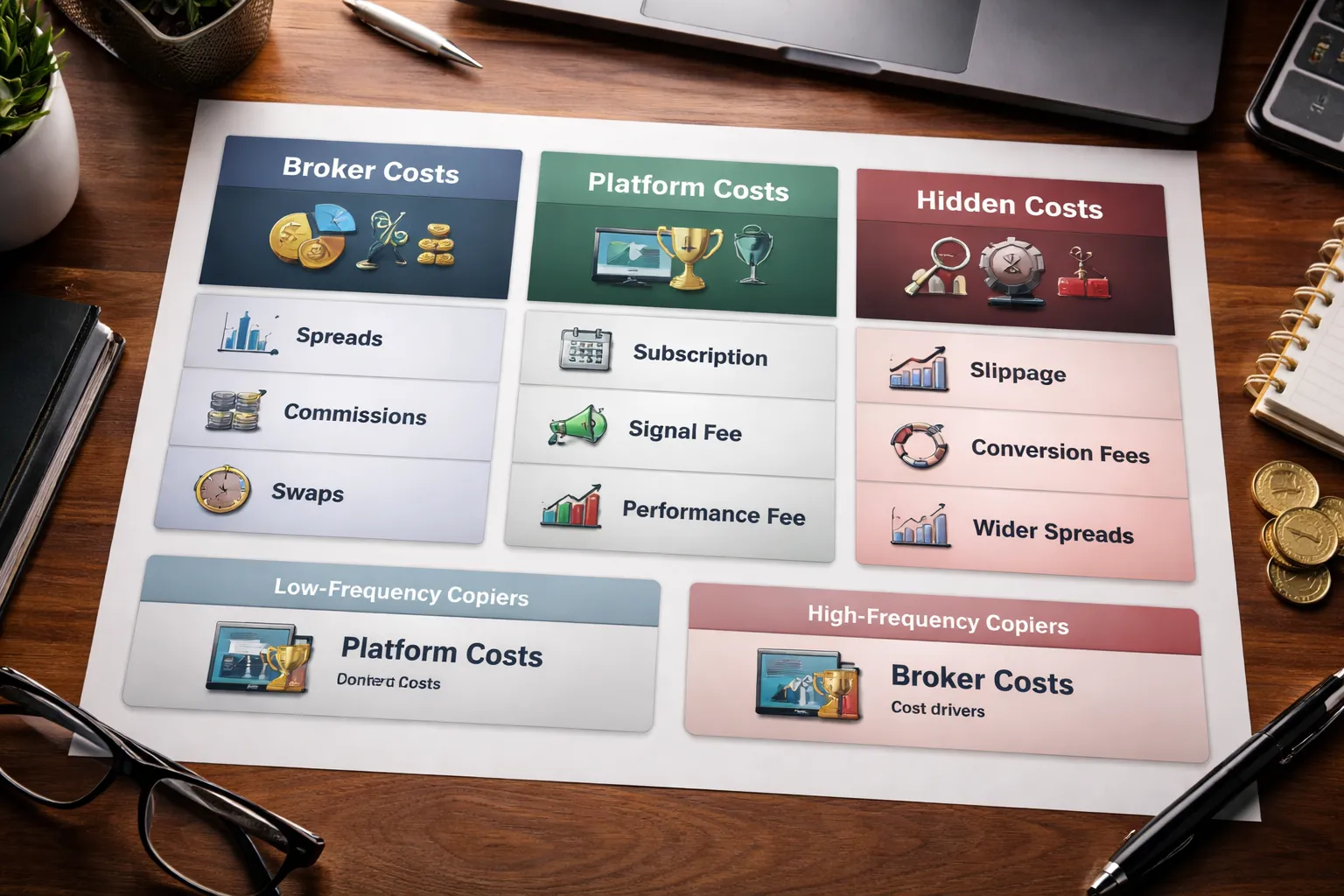
Copy trading fees come from two places. Your broker charges to execute trades. Your copy platform charges to access strategies or to pay the provider. You also pay indirect costs that do not show up as a line item.
Broker costs: spreads, commissions, swaps, and overnight financing
- Spread. You pay the difference between bid and ask on every entry and exit. Spreads widen during news, rollovers, and low-liquidity hours. Wider spreads hit fast strategies the hardest.
- Commission. Many raw or ECN accounts charge a fixed amount per lot, per side. Round-turn commission doubles the one-way rate.
- Swaps and overnight financing. You pay or receive a daily carry when you hold positions past the broker cutoff. Some symbols also use financing based on notional value. Copying swing traders can turn swaps into a major cost line.
- Execution add-ons. Some brokers charge for guaranteed stops, advanced data, or premium account tiers. These do not always sit inside the spread.
Platform costs: subscriptions, signal fees, and performance fees
- Monthly subscription. You pay a flat fee to follow a strategy or to use the copier tool. This fee stays the same even if you trade less.
- Signal fee per provider. You pay per strategy you follow. Following three providers can triple the platform bill.
- Performance fee. You share profits with the provider. Common models use a percentage of profits, sometimes with a high-water mark. You still pay broker spreads and commissions on top.
- Volume-based fees. Some services price by lots copied or by number of accounts connected. High-frequency copying increases this cost even if your net PnL stays flat.
Hidden and indirect costs: slippage, wider spreads on certain accounts, and conversion fees
- Slippage. You rarely get the provider's exact fill. Delay, volatility, and partial fills can move your entry and exit. Slippage scales with trade frequency and during news.
- Wider spreads on the wrong account type. Some brokers bundle costs into larger spreads on standard accounts. A copier that trades often usually performs better on raw spread plus commission pricing, if execution quality stays strong.
- Currency conversion fees. If your account currency differs from the quote currency, your broker converts PnL, swap, and commissions. Some brokers add a markup. Conversions also apply to deposits and withdrawals.
- Provider trade size mismatch. If you copy with a smaller balance, rounding can change position sizing. You can end up with more trades at minimum lot sizes, or skipped trades. That changes your cost per unit of risk.
Cost scenarios: low-frequency copier vs high-frequency copier
- Low-frequency copier. You place fewer trades and hold longer. You pay fewer spreads and commissions. You pay more swap exposure. Fixed platform subscriptions weigh more because you spread them across fewer trades.
- High-frequency copier. You place many trades and hold shorter. You pay spreads and commissions over and over. Slippage becomes a core cost driver. Swap matters less. Volume-based platform pricing can rise fast.
| Cost driver | Low-frequency copying | High-frequency copying |
|---|---|---|
| Spreads | Lower impact | Higher impact |
| Commissions | Lower impact | Higher impact |
| Swaps | Higher impact | Lower impact |
| Slippage | Moderate impact | High impact |
| Fixed subscription fees | Higher impact per trade | Lower impact per trade |
| Performance fees | Depends on profitability | Depends on profitability |
How to compare all-in costs: a checklist for estimating monthly and annual expenses
- Step 1. List your broker pricing. Record average spread on your copied symbols, commission per lot round-turn, and swap rates for long and short.
- Step 2. Estimate monthly volume. Use the provider's history to estimate lots per month and average holding time. Adjust for your scaling and risk cap.
- Step 3. Price execution costs. Multiply expected lots by commission. Add spread cost using your broker's average spread during the provider's trading hours.
- Step 4. Add financing. Estimate swap by average lots held overnight times expected nights held. Use the symbol-specific swap rate, not a generic average.
- Step 5. Add platform fees. Include subscription, per-strategy charges, and any lot-based pricing.
- Step 6. Add performance fees correctly. Apply the fee to net profits after trading costs, if that is how the platform calculates it. Confirm the high-water mark rules.
- Step 7. Add conversion and funding costs. Include deposit, withdrawal, and currency conversion markups. Do not ignore base-currency mismatches.
- Step 8. Stress-test slippage. Apply a conservative slippage assumption per trade, then recalc. High-frequency strategies can flip from profitable to flat with small slippage.
- Step 9. Compare providers by net after all fees. A strategy that looks best before costs can rank lower after spreads, swaps, and platform charges.
- Step 10. Document the fee schedule. Save screenshots or PDFs of broker and platform pricing. Fees change.
If you pay for external trade ideas, use the same checklist for any signal service; see our guide on forex signals and whether they are worth it.
Safety and regulation: how to assess platform trustworthiness (E-E-A-T)

Regulation basics: what to look for in brokers and what regulation does (and doesn’t) cover
Start with the broker, not the signal app. Your broker holds your money. The platform usually routes trades and shows stats.
- Verify the broker license on the regulator website. Match the legal entity name, license number, and domain. Do not rely on a badge in the footer.
- Check where your account is opened. Big brands run multiple entities. Protection depends on the specific entity on your account agreement.
- Know what regulation covers. It can enforce conduct rules, capital requirements, reporting, complaint handling, and marketing limits.
- Know what regulation does not cover. It does not prevent losses, stop slippage, guarantee fills, or ensure a strategy is honest.
- Confirm who acts as counterparty. Some brokers run a dealing desk. Others pass orders through. This affects conflicts and execution quality.
Fund safety: segregated accounts, investor compensation schemes, and withdrawal reliability
- Segregated client funds. Look for clear wording in the legal docs. Segregation reduces misuse risk. It does not remove broker default risk.
- Investor compensation scheme. Check eligibility, limits, and conditions for your entity and country. Many users assume coverage that does not apply.
- Negative balance protection. If you trade leveraged FX, this matters. Confirm it in the client agreement, not in marketing copy.
- Withdrawal track record. Test a small withdrawal early. Track time to process, fees, and any extra verification steps.
- Payment rails. Bank transfer and major card rails usually give better dispute options than irreversible crypto deposits.
Provider due diligence: identity verification, audited stats, and history length
Copy trading adds a second trust layer. You trust the person or model placing trades. Treat provider selection like hiring.
- Identity verification. Prefer platforms that verify provider identity and show it. Anonymous providers increase fraud risk.
- Broker-linked performance. Prefer stats pulled from a live trading account via broker connection. Avoid screenshots and self-reported results.
- Auditability. Look for third-party verified history and clear methodology for returns, drawdown, and fees.
- History length. Favor multi-year, continuous track records. Avoid strategies that appear recently with perfect curves.
- Risk metrics. Check max drawdown, average leverage, holding time, and concentration by pair. Returns alone do not describe risk.
Operational security: 2FA, encryption, permissions, and API/token safety
- Two-factor authentication. Use app-based 2FA. Avoid SMS if you can. Enforce it on both the platform and the broker portal.
- Encryption. Look for HTTPS everywhere and clear disclosure of how credentials and tokens get stored.
- Permission controls. You should control max lot size, max open trades, max daily loss, and allowed symbols.
- API or token scope. Use read-only access where possible. If trade access is required, avoid tokens that allow withdrawals.
- Session and device controls. Prefer platforms that show active sessions and let you revoke access fast.
Fraud and manipulation risks: signal spoofing, survivorship bias, and cherry-picked performance
- Signal spoofing. Some providers show one track record but route followers to a different account, worse pricing, or different risk. Confirm your copied trades match the provider history and timing.
- Survivorship bias. Platforms often promote winners and hide dead strategies. Ask for delisted provider stats or full marketplace history if available.
- Cherry-picked performance. Watch for short sample windows, resets after blowups, and multiple accounts where only the best gets marketed.
- Martingale and grid masking. Smooth equity curves can hide tail risk. Check for increasing position size into losses and long underwater periods.
- Conflict incentives. Some providers earn more when you trade more. Prefer fee models that align with your net returns, not your volume.
If you copy trades from a prop trader, check how their rules shape risk and behavior. Many strategies look stable until a drawdown limit forces a stop. See our guide to how forex prop firms work.
How to choose the right strategy provider (beyond top returns)
Metrics that matter
Start with risk. Returns come second.
- Max drawdown (MDD). Use peak to trough equity drawdown, not balance drawdown. Compare MDD to your pain limit. If you cannot hold through it, do not copy it.
- Recovery factor. Net profit divided by max drawdown. Higher means the strategy earns more per unit of pain. Treat low recovery as a sign of fragile edge.
- Profit factor. Gross profit divided by gross loss. Aim for a profit factor that stays stable across months, not one big spike from a single run.
- Consistency. Check monthly hit rate and monthly return dispersion. Prefer smooth, repeatable months over a few extreme months that drive the whole curve.
Behavioral patterns to avoid
- Martingale sizing. Position size rises after losses. You will see fast recoveries and rare, deep blowups. Avoid.
- Averaging down. The strategy adds to a losing trade to improve the average entry. This creates long underwater periods and outsized tail risk.
- Over-leveraging. Watch margin use and trade size relative to equity. If a normal losing streak can trigger a margin call, the provider runs too hot.
Track record quality
- Live beats demo. Demo fills and spreads can flatter results. Prefer audited or broker verified live history.
- Time in market. Look for a track record that covers different regimes, trend, range, high and low volatility. A few weeks tells you almost nothing.
- Sample size. More trades gives you a tighter read on edge. Be cautious with low trade counts, even if the equity curve looks clean.
Risk alignment
- Leverage. Match provider risk to your account and broker limits. A strategy built for high leverage can break when you scale it down, or when spreads widen.
- Holding time. Scalpers need tight spreads and low latency. Swing strategies need swap tolerance and room for drawdowns. Copy what fits your setup.
- News and event exposure. Check if the provider trades through CPI, NFP, rate decisions, and opens. If they hold during spikes, assume slippage and gap risk will hit your results.
Diversification approach
Do not allocate 100 percent to one provider or one style.
- Mix styles. Combine trend, mean reversion, and scalping only if their drawdowns do not peak at the same time.
- Stagger risk budgets. Cap each provider at a fixed share of your equity, then rebalance monthly. Do not chase the current top performer.
- Watch correlation. Two providers can look different but trade the same pairs, sessions, and triggers. If they lose together, you did not diversify.
For a deeper risk checklist, see our copy trading forex explained guide.
Step-by-step: how to start forex copy trading safely
Account setup, choose a regulated broker and the right account type
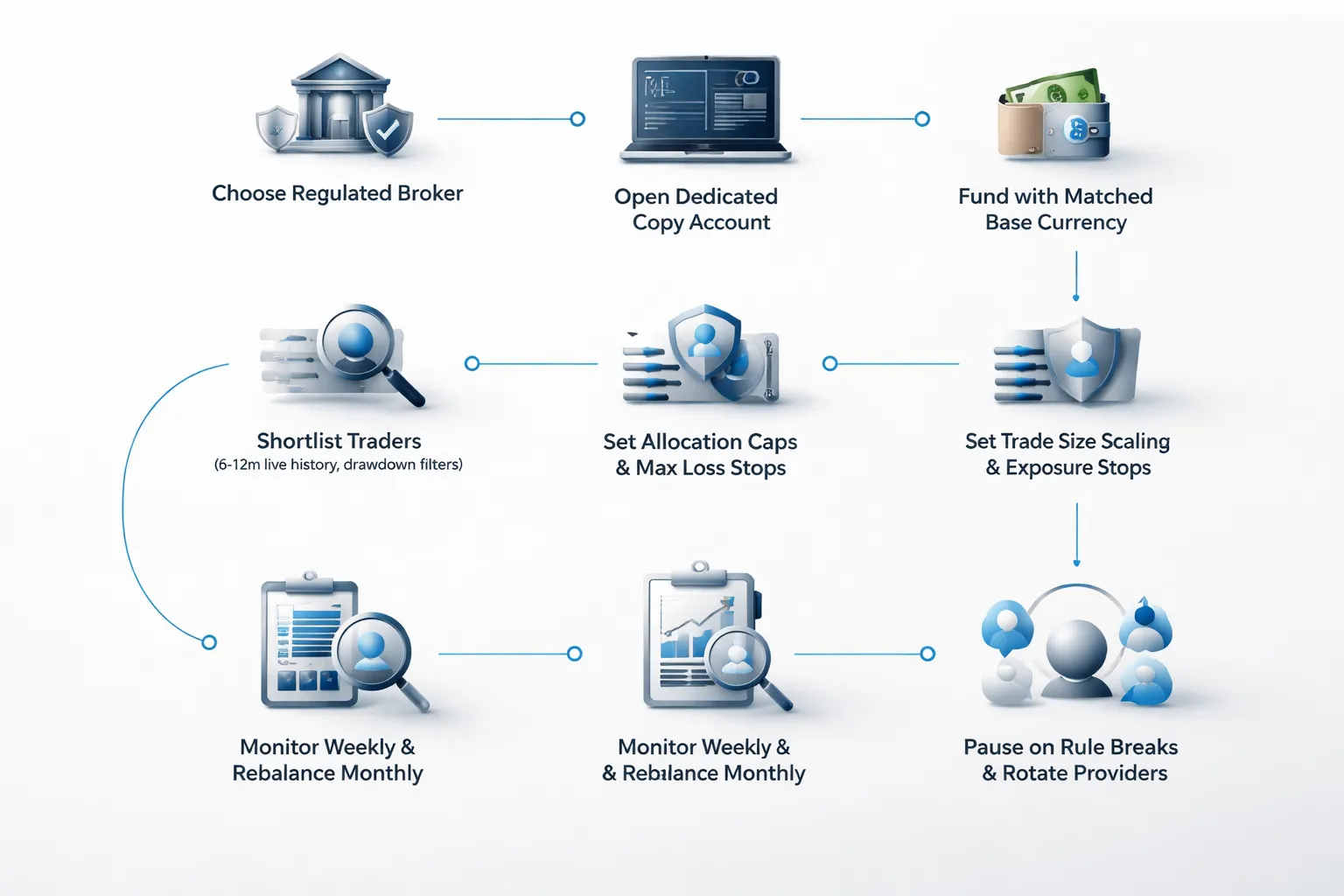
- Start with regulation. Use a broker regulated in your country or a top tier jurisdiction. Check the broker’s license number on the regulator site, not in an ad.
- Pick the copy method. Choose broker native copy trading if you want fewer moving parts. Choose a third party copier only if you need cross broker or cross platform copying.
- Use a separate account. Open a dedicated copy trading account. Keep manual trades in another account so you can measure results and control risk.
- Choose execution that matches the providers. If most providers scalp, you need tight spreads and fast fills. If most swing trade, prioritize swap rates and stable pricing.
- Use the simplest account type you can. Standard or raw spread accounts work. Avoid exotic leverage tiers and bonus accounts with withdrawal rules.
Funding and currency conversions, cut friction and hidden costs
- Match your account currency to your funding currency. If you deposit in USD, use a USD base account. This reduces conversion spreads.
- Plan the full cash cycle. Check deposit fees, withdrawal fees, and minimum withdrawal amounts. Some brokers charge more on small withdrawals.
- Use low fee rails. Card and bank wires can add costs and delays. Local transfer options often clear faster and cost less.
- Keep a cash buffer. Leave unallocated equity for margin spikes and drawdowns. Do not allocate 100% of your balance to copying.
Selecting traders, build a shortlist with objective filters
- Set hard minimum history. Filter for at least 6 to 12 months of live results. Demo track records can mislead.
- Reject extreme leverage. Watch average position size, margin use, and worst historical drawdown. Avoid strategies that rely on high leverage to look good.
- Check trade style consistency. Look for stable holding times and stable risk per trade. Big swings often signal rule changes.
- Scan for blow up patterns. Red flags include long losing streak recovery with one huge win, frequent averaging down, and large position adds during drawdown.
- Prefer transparent stats. You want open trade visibility, instrument list, and risk metrics. If you cannot see what they trade, skip.
- Keep the shortlist small. Start with 2 to 4 providers. Add only after you learn how each behaves in losses.
Setting copy parameters, allocation, max loss limits, and scaling
- Use fixed allocation per provider. Set each provider to a capped share of equity. Example, 20% to 35% each, not 70% to the current leader.
- Define a provider stop. Set a max loss level where you pause copying that provider. Use an equity based rule, not hope. Example, pause at 8% to 12% drawdown on that allocation.
- Scale trade size by equity, not by emotion. Use proportional scaling or fixed lots that match your risk plan. Avoid multiplier settings above 1.0 until you have months of data.
- Cap open risk. Limit max open positions and max exposure per pair. This prevents one provider from stacking trades into a single event risk.
- Control slippage. If the platform allows it, set max slippage and avoid copying news spikes. Slippage can turn a backtest edge into a real loss.
- Decide how to handle existing trades. Choose whether you copy open trades or only new ones. Copying open trades can lock you into a late entry at a worse price.
Monitoring and maintenance, when to pause, cut size, or rotate
- Review weekly, rebalance monthly. Weekly checks catch drift. Monthly rebalancing keeps allocations aligned with your caps.
- Pause on rule breaks. Pause if you see sudden leverage increases, new pairs, new holding times, or bigger position adds in drawdown.
- Cut size after a drawdown step. Reduce allocation after predefined drawdown levels. Example, cut by 50% after the first stop threshold, then pause at the second.
- Rotate on stagnation plus risk. Replace a provider if they underperform for a full cycle and take more risk to recover. Do not rotate based on one bad week.
- Log everything. Track provider, allocation, max drawdown, fees, and net return. You need net results after spreads, swaps, and copying fees.
- Know your account rules if you trade a funded account. Copying can breach daily or max drawdown limits faster than manual trading. Read your limits before you connect, especially if you run a prop evaluation. See prop firm challenge drawdown rules.
Pros and cons of forex copy trading (realistic expectations)
Benefits (speed to market, learning by observation, diversification)
- Speed to market. You can follow a live strategy in minutes. You avoid months of trial trades just to get basic execution and position sizing routines in place.
- Learning by observation. You see real entries, exits, and risk changes in real time. You can review the provider’s trade history and compare it to your copied fills to understand what works and what breaks.
- Diversification. You can split capital across multiple providers, styles, and pairs. This can smooth returns if one strategy hits a bad period, but only if you control overlap and total risk.
Downsides (execution differences, dependency risk, psychological pitfalls)
- Execution differences. Your results will differ from the provider’s results. Spreads, swaps, commissions, latency, and liquidity can change entries and exits. Slippage hurts most on news, scalping, and tight-stop systems.
- Dependency risk. You outsource decisions. If the provider changes strategy, increases leverage, or starts revenge trading, your account follows. If the platform disconnects or the provider pauses trading, you lose continuity.
- Psychological pitfalls. Copy trading still triggers panic. You may stop copying after a drawdown, then rejoin after a hot streak. You may over-allocate because the recent curve looks smooth. This buy-high, sell-low cycle destroys good systems.
Who should avoid it
- Undercapitalized accounts. If your account cannot handle normal drawdowns, you will fail. Small balances plus high leverage plus copying fees lead to fast blowups. You need room for variance, not just margin to open trades.
- Anyone seeking guaranteed income. Copy trading does not provide stable monthly cash flow. Providers hit losing streaks. Markets change. If you need predictable withdrawals, you will likely force bad decisions.
Common myths that cause losses
- Myth: set-and-forget. You must monitor risk, connection status, and sizing drift. You must check net performance after spreads, swaps, and copying fees. You must cut allocation when drawdown breaks your plan. For a full breakdown of mechanics and costs, see forex copy trading explained.
- Myth: top-ranked equals safest. Rankings often reward short-term returns. A provider can reach the top with high leverage and low sample size. Safety comes from long track record, controlled drawdowns, consistent position sizing, and transparency on fees and trade logic.
Realistic expectations (what “good” looks like)
| Area | Realistic expectation | What to do |
|---|---|---|
| Returns | Uneven. Profits cluster, losses cluster. Flat months happen. | Judge over a long sample. Track net return after all costs. |
| Drawdowns | Normal and unavoidable. Even strong systems dip. | Set a max drawdown rule per provider and for your total account. |
| Tracking error | Your results will lag the provider, sometimes by a lot. | Avoid strategies that depend on perfect fills. Prefer longer holds and wider stops. |
| Time required | Lower than manual trading, not zero. | Review weekly. Rebalance allocation. Audit slippage and fees. |
| Risk control | You control outcomes more than the provider does. | Use equity stop, sizing limits, and provider caps. |
Common mistakes to avoid when using copy trading platforms
Over-allocating to a single provider or strategy style
Do not put most of your capital behind one trader, one bot, or one style. One regime change can hit everything at once.
- Cap any single provider at 10 to 25 percent of your copy allocation.
- Spread risk across uncorrelated styles, trend, mean reversion, intraday, swing.
- Set a hard portfolio equity stop. Use it even if the provider looks “due” for a rebound.
Ignoring drawdown history and focusing on recent performance
Recent returns sell. Drawdowns decide if you can stay in the strategy.
- Check max drawdown, average drawdown length, and time to recover.
- Do not trust short track records. Prefer at least 12 to 24 months of live results.
- Look for smooth equity with controlled risk. Avoid equity curves driven by a few lucky weeks.
- Confirm the provider trades in the same account type you use, same symbols, same leverage rules.
Using excessive leverage or copying fixed lots without scaling
Most blowups come from sizing, not entries. Fixed lots can silently over-lever your account when your balance differs from the provider.
- Use proportional sizing by equity or balance, not fixed lots.
- Set a max lot cap per trade and a max total exposure cap per symbol.
- Reduce size if the provider uses martingale, grid, or adds to losers.
- Match leverage assumptions. A strategy built on 1:500 can fail at 1:30.
Not accounting for news volatility, spreads, and swap costs
Your results include execution. Copy trading adds delays. News spikes widen spreads and increase slippage. Overnight holds add swap.
- Avoid copying strategies that trade during major releases unless they prove stable through them.
- Track average spread and slippage on your broker, not the provider’s.
- Check swap sensitivity. High-frequency holds overnight can bleed from negative swaps.
- Prefer limit risk methods, wider stops, longer holds, and lower trade frequency.
Changing providers too frequently (performance chasing) vs rule-based rotation
Switching after a drawdown locks in losses and buys the top. You need rules, not reactions.
- Set review dates, weekly or monthly. Do not change providers mid-week due to noise.
- Use objective drop rules, for example, stop copying after a defined drawdown or rule break.
- Use objective add rules, for example, increase allocation only after stable risk metrics over multiple months.
- Keep a short list and rotate only when your criteria change, not when rankings change.
If you want to copy “signals” outside broker platforms, apply the same filters and risk caps. Use your own sizing rules and stops, not the seller’s. See our guide on forex signals before you pay for any signal stream.
Frequently Asked Questions
Is forex copy trading legal?
Yes in most jurisdictions, but rules depend on your country and broker. Check if the provider markets “managed accounts” or “investment advice.” Use regulated brokers when possible. Avoid platforms that cannot name their regulator or legal entity.
Is copy trading profitable?
It can be, but most copied strategies fail after costs and drawdowns. Focus on risk first. Review multi month performance, max drawdown, and trade frequency. Treat short track records and sharp equity curves as higher risk.
How much money do you need to start?
Start with the broker minimum, then size for risk. Many strategies need more to handle lot sizing and drawdown. Aim to keep per provider risk small. If a 20 percent drawdown would break your account, your sizing is too large.
What fees will you pay?
Expect spreads and swaps, plus platform fees. Some providers charge performance fees, subscriptions, or volume based fees. Slippage can act like a hidden cost. Compare net returns after all charges, not headline percentages.
How do you judge a provider fast?
Check verified history, live account status, and duration. Look at max drawdown, average holding time, leverage use, and loss streaks. Avoid martingale, grid, and “no stop loss” systems. Require stable results across different market regimes.
What risk controls should you set?
Use an allocation cap per provider. Set a max daily and max total drawdown cut. Limit leverage. Use equity stop rules if available. Reduce size after a drawdown and scale up only after recovery with consistent risk metrics.
Can you copy trade on MT4 and MT5?
Yes. Many brokers offer built in copying or connect to third party services. Confirm if copying runs server side or needs your terminal or VPS online. Server side copying usually reduces missed trades during outages.
What causes copy trade differences versus the master account?
Latency, broker pricing, spreads, and execution rules. Smaller accounts also face lot size limits. Different symbol names and contract sizes can break copying. News spikes increase slippage. Always compare results in pips and net return after costs.
Are copy trading platforms safe?
Safer platforms use regulated brokers, segregated funds, and read only connections. Avoid giving anyone withdrawal access. Prefer API or investor password access over shared login. If a platform cannot explain custody and permissions, skip it.
Can you use copy trading with a prop firm account?
Sometimes, but many firms ban trade copiers or require specific tools. Rule breaches can void payouts. Confirm copier rules, news trading limits, and max lot sizing before you connect. See our guide on what a forex prop firm is.
Should you use a demo first?
Yes. Run a demo for at least a few weeks to test execution, symbol mapping, and risk settings. Then start small on live and compare fill quality. Do not treat demo results as proof of profitability.
Conclusion
Pick a platform that matches your setup. Start with your broker, then confirm platform support, copier compatibility, and account type limits.
- Features: Use risk controls you will actually use, equity stop, max open trades, per-trade cap, and symbol mapping.
- Fees: Add every layer, spread, commission, copier subscription, performance fee, and any markup.
- Safety: Check regulation, segregation of client funds, 2FA, and clear strategy stats. Avoid unverified track records.
- Execution: Test slippage, latency, and partial fills. Compare demo vs live fills before you scale.
Final step. Run one strategy on a small live account, set hard loss limits, then review results after 20 to 50 trades. If costs or slippage break the edge, switch copier, switch broker, or stop.
Use this checklist before you connect in how to choose a copy trading provider.
-
Forex Prop Firm Challenge Rules Explained (Drawdown, Targets, Payouts)
7 months ago -
Best Forex Prop Firms (Top Firms Compared)
7 months ago -
What Is a Forex Prop Firm? How Prop Trading Works for Forex
7 months ago -
Copy Trading Forex Explained: How It Works, Pros, Cons & Risks
7 months ago -
Forex Signals: Are They Worth It? (What to Know Before You Buy)
7 months ago
-
-
- Scoring framework: safety, fees, features, marketplace quality, usability
- Data points that matter: drawdowns, track record length, risk-adjusted metrics
- Red flags we downgrade: martingale, grids, short histories, hidden costs
- Who each platform is best for: beginners, active traders, hands-off investors
-
- Platform comparison table: regulation, minimum deposit, pricing model, and key tools
- Best for beginners: simple discovery, onboarding, and copy controls
- Best for advanced risk controls: equity stops, max drawdown limits, and allocation rules
- Best for MetaTrader users: MT4/MT5 compatibility and EA/copy integrations
- Best for low latency copying: infrastructure, server locations, and execution transparency
- Best for strategy variety: number of providers, filters, and instrument coverage
-
- Strategy discovery tools, filters, rankings, and statistical transparency
- Risk management controls, lot scaling, exposure caps, and stop-copy rules
- Portfolio tools, copying multiple traders, rebalancing, and correlation awareness
- Execution and order handling, partial fills, FIFO and hedging, and copier mapping
- Mobile and desktop experience, monitoring, alerts, and one-tap risk actions
- Reporting, performance attribution, fees breakdown, and tax-friendly statements
-
- Fees explained: what copy trading really costs in forex
- Broker costs: spreads, commissions, swaps, and overnight financing
- Platform costs: subscriptions, signal fees, and performance fees
- Hidden and indirect costs: slippage, wider spreads on certain accounts, and conversion fees
- Cost scenarios: low-frequency copier vs high-frequency copier
- How to compare all-in costs: a checklist for estimating monthly and annual expenses
-
- Regulation basics: what to look for in brokers and what regulation does (and doesn’t) cover
- Fund safety: segregated accounts, investor compensation schemes, and withdrawal reliability
- Provider due diligence: identity verification, audited stats, and history length
- Operational security: 2FA, encryption, permissions, and API/token safety
- Fraud and manipulation risks: signal spoofing, survivorship bias, and cherry-picked performance
-
- Account setup, choose a regulated broker and the right account type
- Funding and currency conversions, cut friction and hidden costs
- Selecting traders, build a shortlist with objective filters
- Setting copy parameters, allocation, max loss limits, and scaling
- Monitoring and maintenance, when to pause, cut size, or rotate
-
- Over-allocating to a single provider or strategy style
- Ignoring drawdown history and focusing on recent performance
- Using excessive leverage or copying fixed lots without scaling
- Not accounting for news volatility, spreads, and swap costs
- Changing providers too frequently (performance chasing) vs rule-based rotation
-
- Is forex copy trading legal?
- Is copy trading profitable?
- How much money do you need to start?
- What fees will you pay?
- How do you judge a provider fast?
- What risk controls should you set?
- Can you copy trade on MT4 and MT5?
- What causes copy trade differences versus the master account?
- Are copy trading platforms safe?
- Can you use copy trading with a prop firm account?
- Should you use a demo first?
-
-
-
- Scoring framework: safety, fees, features, marketplace quality, usability
- Data points that matter: drawdowns, track record length, risk-adjusted metrics
- Red flags we downgrade: martingale, grids, short histories, hidden costs
- Who each platform is best for: beginners, active traders, hands-off investors
-
- Platform comparison table: regulation, minimum deposit, pricing model, and key tools
- Best for beginners: simple discovery, onboarding, and copy controls
- Best for advanced risk controls: equity stops, max drawdown limits, and allocation rules
- Best for MetaTrader users: MT4/MT5 compatibility and EA/copy integrations
- Best for low latency copying: infrastructure, server locations, and execution transparency
- Best for strategy variety: number of providers, filters, and instrument coverage
-
- Strategy discovery tools, filters, rankings, and statistical transparency
- Risk management controls, lot scaling, exposure caps, and stop-copy rules
- Portfolio tools, copying multiple traders, rebalancing, and correlation awareness
- Execution and order handling, partial fills, FIFO and hedging, and copier mapping
- Mobile and desktop experience, monitoring, alerts, and one-tap risk actions
- Reporting, performance attribution, fees breakdown, and tax-friendly statements
-
- Fees explained: what copy trading really costs in forex
- Broker costs: spreads, commissions, swaps, and overnight financing
- Platform costs: subscriptions, signal fees, and performance fees
- Hidden and indirect costs: slippage, wider spreads on certain accounts, and conversion fees
- Cost scenarios: low-frequency copier vs high-frequency copier
- How to compare all-in costs: a checklist for estimating monthly and annual expenses
-
- Regulation basics: what to look for in brokers and what regulation does (and doesn’t) cover
- Fund safety: segregated accounts, investor compensation schemes, and withdrawal reliability
- Provider due diligence: identity verification, audited stats, and history length
- Operational security: 2FA, encryption, permissions, and API/token safety
- Fraud and manipulation risks: signal spoofing, survivorship bias, and cherry-picked performance
-
- Account setup, choose a regulated broker and the right account type
- Funding and currency conversions, cut friction and hidden costs
- Selecting traders, build a shortlist with objective filters
- Setting copy parameters, allocation, max loss limits, and scaling
- Monitoring and maintenance, when to pause, cut size, or rotate
-
- Over-allocating to a single provider or strategy style
- Ignoring drawdown history and focusing on recent performance
- Using excessive leverage or copying fixed lots without scaling
- Not accounting for news volatility, spreads, and swap costs
- Changing providers too frequently (performance chasing) vs rule-based rotation
-
- Is forex copy trading legal?
- Is copy trading profitable?
- How much money do you need to start?
- What fees will you pay?
- How do you judge a provider fast?
- What risk controls should you set?
- Can you copy trade on MT4 and MT5?
- What causes copy trade differences versus the master account?
- Are copy trading platforms safe?
- Can you use copy trading with a prop firm account?
- Should you use a demo first?
-
-
How to Place a Forex Trade Step by Step (Your First Trade Explained)
5 months ago -
Forex Trading vs Crypto Trading: Which Market Is Better for Beginners?
5 months ago -
Forex Lot Size Calculator: How to Use It to Size Trades Correctly
7 months ago -
How to Calculate Position Size in Forex (Position Sizing Formula + Examples)
7 months ago -
Forex Leverage Explained: How It Works, Pros, Cons & Examples
7 months ago
-
Forex Trading Platforms Comparison: MetaTrader vs cTrader vs TradingView
7 months ago -
Stop Loss vs Take Profit: Differences, Examples & Best Practices
7 months ago -
Is Forex Trading Legal in the United States? Rules, Regulators & What to Know
7 months ago -
Forex Leverage Explained: How It Works, Pros, Cons & Examples
7 months ago -
Forex Market Hours & Trading Sessions Explained (Best Times to Trade)
7 months ago