Copy Trading Forex Explained: How It Works, Pros, Cons & Risks

Copy trading in forex lets you link your account to another trader and mirror their trades in real time. You choose who to follow, how much to allocate, and when to stop. The platform handles the trade execution.
This guide explains how forex copy trading works, step by step. You will learn the main models platforms use, including fixed lot, proportional, and equity-based copying. You will see the real costs, spreads, commissions, performance fees, and slippage. You will also learn the core risks, leverage, drawdowns, strategy changes, and provider failure.
Copy trading can speed up your learning curve. It can also magnify losses. Use it as a tool, not a shortcut. If you want a simpler alternative, read our forex signals guide.
Key Takeaways
- In het kort: Copy trading links your account to a provider and mirrors their trades, based on a fixed lot size, proportional sizing, or equity-based sizing.
- In het kort: Your results will differ from the provider because of spreads, commissions, performance fees, swap rates, and slippage.
- In het kort: Leverage cuts both ways. Small market moves can create large gains or large losses.
- In het kort: Drawdowns matter more than win rate. A strategy can look “profitable” and still blow up your account.
- In het kort: Providers can change risk, stop trading, or fail. You carry the full account risk either way.
- In het kort: Use hard rules. Cap allocation, set a max drawdown stop, and review performance after costs.
- In het kort: Treat copy trading as a tool to learn process and risk control, not as a hands-off income plan.
- In het kort: If you want more structure and rules, compare options like forex prop firms.
Copy Trading Forex Explained: Definition, Terminology, and What It Is (and Isn’t)
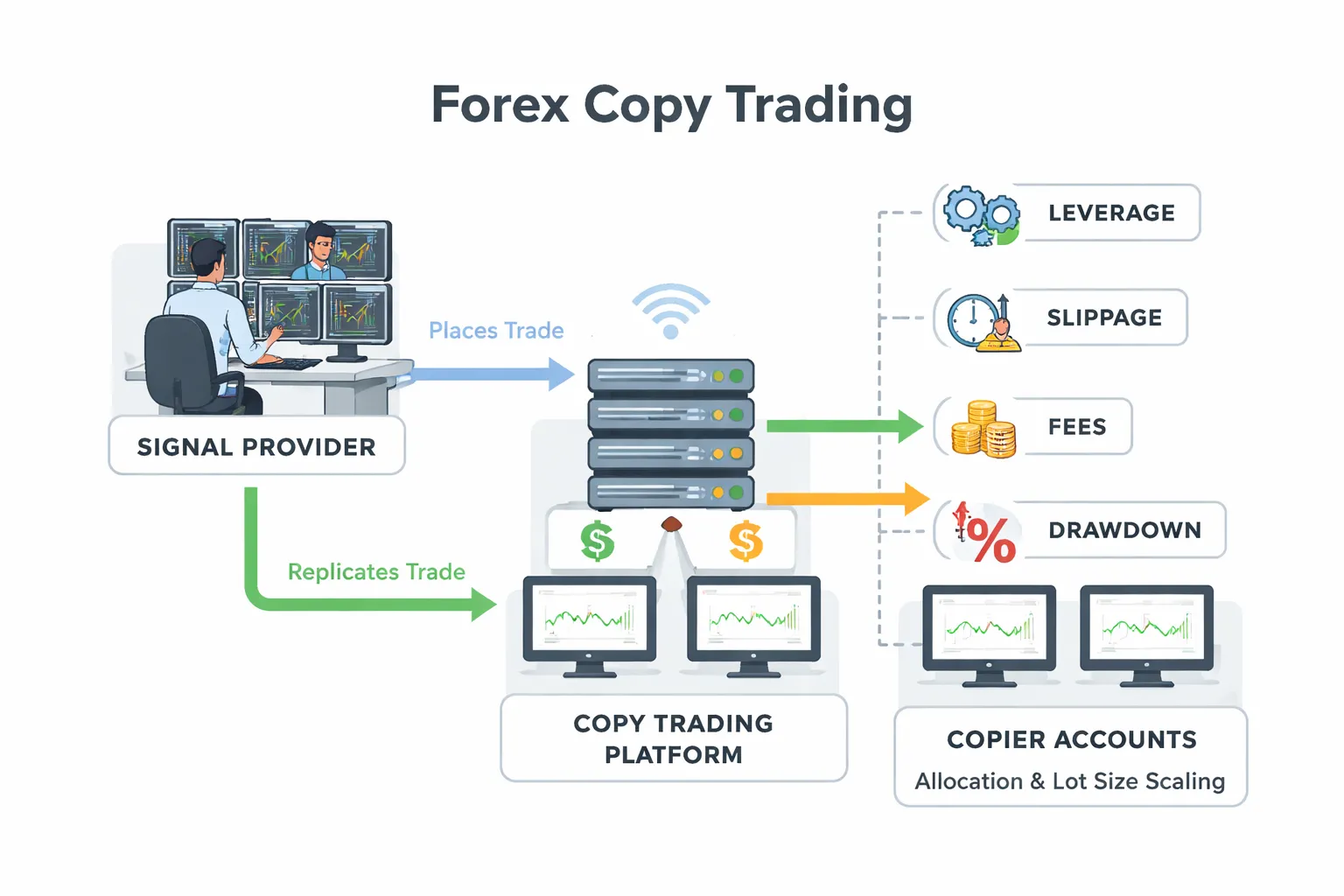
Plain-English definition of forex copy trading
Forex copy trading lets you link your trading account to another trader’s account, then automatically copy their forex trades in your account.
You choose who to copy and how much of your account to allocate. The platform mirrors entries, exits, and position changes based on your settings and account limits.
Copy trading is execution automation. It is not a strategy by itself. Your results will differ from the provider’s results because of fees, spreads, slippage, different leverage, and different account size.
Key terms you must understand
- Signal provider (master), the trader you copy. They place trades. Their track record may reflect one account, not yours.
- Copier (follower), you. You take the full profit and loss on your account.
- Allocation, the amount of your equity you assign to copy. Some platforms use a fixed amount. Others use a percentage. Treat it as your maximum capital at risk for that provider, not a promise of loss limits.
- Lot size, trade size in forex. Standard is 1.00 lot. Many brokers support mini and micro lots. Lot size controls how much each pip move changes your P and L.
- Leverage, borrowed exposure provided by the broker. Higher leverage lets small moves create big gains and big losses. It can also trigger margin calls faster.
- Drawdown, the peak-to-trough decline in equity or balance. Platforms may show max drawdown, current drawdown, or average drawdown. These are different numbers. Know which one you are reading.
- Equity curve, a line chart of account equity over time. Focus on the shape, long flat periods, sharp drops, and recovery time, not just the final return.
What copy trading is and isn’t
- It is, an automated way to follow another trader’s execution.
- It is, a way to test risk controls, position sizing, and your own tolerance for drawdowns.
- It isn’t, a guaranteed income stream.
- It isn’t, a substitute for understanding leverage, margin, and stop losses.
- It isn’t, hands-off. You still need rules for allocation, max loss, and when to stop copying.
Copy trading vs social trading vs manual signals vs PAMM/MAM
| Method | How trades happen | Who executes | Where the risk sits |
|---|---|---|---|
| Copy trading | Automatic mirroring of trades to your account | Platform executes based on provider actions and your settings | You carry all P and L, plus execution differences and platform fees |
| Social trading | Community feed, ideas, leaderboards, sometimes copying | Either you manually trade or you enable copying if offered | You carry all account risk; social proof can push bad decisions |
| Signal services (manual) | Provider sends trade ideas, you place the trade | You execute every order | You control timing and sizing; you also carry full responsibility for mistakes and delays |
| PAMM/MAM | Manager trades one master account; allocations apply across investors | Manager executes, broker allocates results to sub-accounts | You still carry investment risk; you have less control over trade-level decisions |
If you want to compare platform mechanics, fees, and safety features, use this guide on forex copy trading platforms.
Myths to avoid
- Myth: Set-and-forget. Providers change behavior. Market regimes change. Your broker conditions change. You need a schedule to review drawdown, leverage use, and open risk.
- Myth: Guaranteed profits. No platform can remove market risk. Leverage can turn a normal losing streak into a large drawdown.
- Myth: Top-ranked means safest. Rankings often reward short-term return. High returns can come from high leverage, martingale-style sizing, or long periods of hidden risk. Look at max drawdown, time to recover, and consistency after fees.
How Copy Trading in Forex Works Step by Step
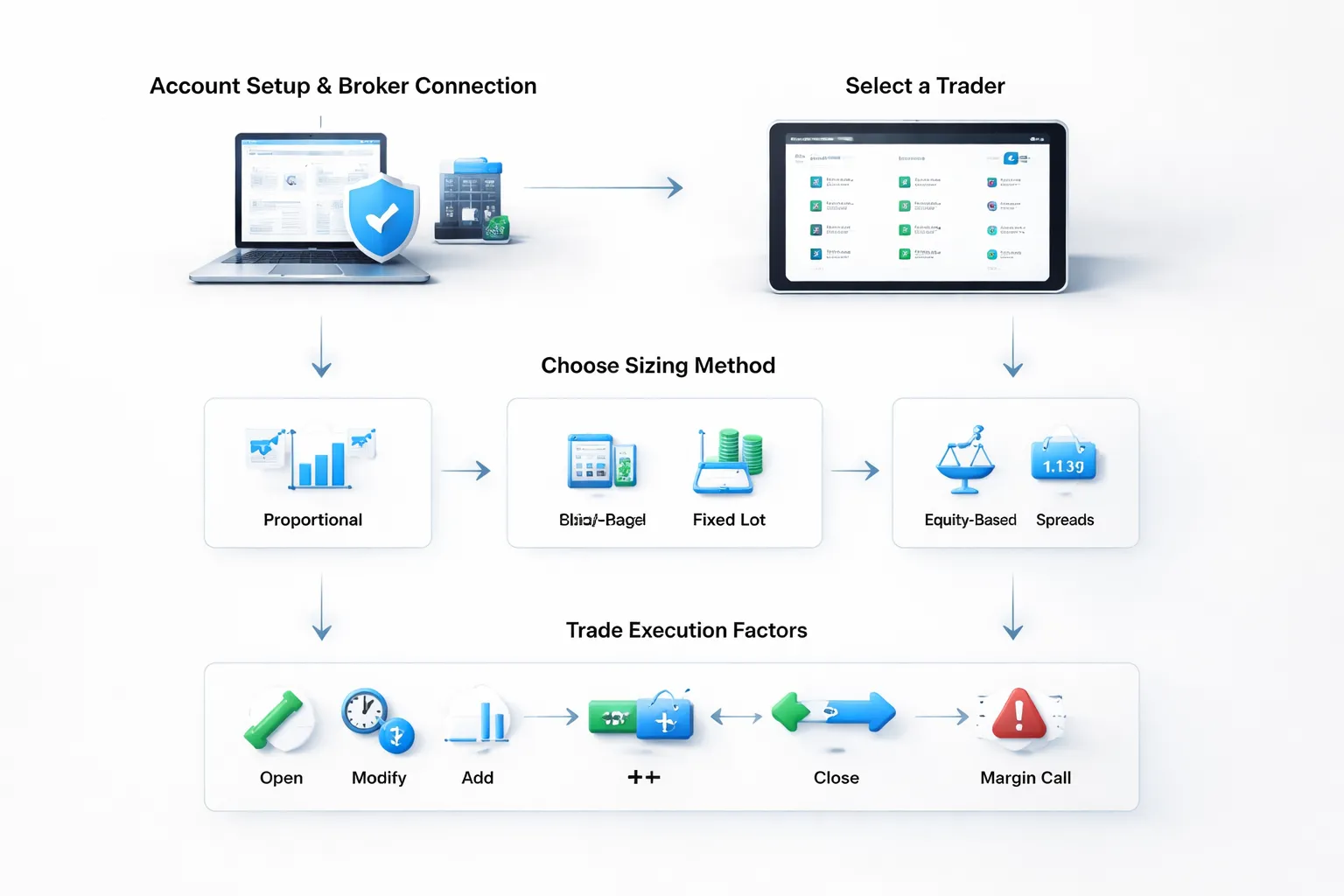
Account setup, broker integration, platform connection, and permissions
- Step 1. Open accounts. You need a trading account at a broker and a copy trading account on the platform, sometimes they are the same login.
- Step 2. Verify identity. Most regulated brokers require KYC before you can deposit or trade.
- Step 3. Connect the broker. Platforms connect by API, a partner integration, or by linking a trading terminal. Some support MetaTrader, others run on their own web platform.
- Step 4. Set permissions. You grant trade access so the platform can open, modify, and close positions in your account. Use trade only access when possible. Avoid giving withdrawal rights.
- Step 5. Fund the account. Your deposit, leverage setting, and account currency affect position sizes and drawdown.
Trader selection flow, browsing, filtering, and due diligence checkpoints
- Step 1. Browse strategies. You see a list of traders with returns, drawdown, trade count, and fees.
- Step 2. Filter hard. Start with max drawdown, months of track record, and number of trades. Then check average holding time and typical leverage.
- Step 3. Verify the record source. Prefer verified broker statements or platform-verified trading history. Treat screenshots as marketing.
- Step 4. Check risk behavior. Look for loss clustering, deep equity dips, and long recovery periods. Watch for martingale-like position sizing and oversized exposure during drawdowns.
- Step 5. Understand the fee stack. You can pay spread, commission, platform fee, and performance fee. High turnover strategies suffer most from costs.
- Step 6. Set your guardrails. Use a per-strategy allocation, max drawdown stop, and max open positions if the platform offers them.
Trade mirroring mechanics, proportional sizing, fixed lot, and equity-based scaling
- Proportional by balance. The platform scales your trade size by the ratio of your balance to the trader’s balance. If the trader uses 1.00 lot on a 10,000 account and you allocate 2,000, you copy at about 0.20 lots, before broker minimums and rounding.
- Equity-based scaling. Size changes with floating profit and loss. This can cut size during drawdowns and increase size during winning streaks. It can also amplify risk if equity jumps due to leverage.
- Fixed lot copying. You copy every trade at a set lot size, like 0.01 or 0.10. This ignores the trader’s account size. It can blow up small accounts if you set it too high.
- Allocation caps. Some platforms size trades to keep margin use under a target, others do not. Your leverage and margin rules still control what fills.
Execution realities, latency, slippage, spreads, and partial fills
- Latency. The trader’s order hits the market first. Your order follows. Fast markets turn milliseconds into worse prices.
- Slippage. You can get filled above or below the intended price. Slippage increases during news, low liquidity hours, and for volatile pairs.
- Spread differences. Your broker’s spread may be wider than the trader’s. The same entry can start deeper in loss on your account.
- Partial fills and rejections. Some brokers fill in pieces or reject orders when margin is tight. Your copy can diverge from the trader’s position size.
- Different symbols and contract specs. A trader may use a symbol format or contract size your broker handles differently. The platform may map it, or it may fail.
Lifecycle of a copied trade, open, modify, add-to-position, close, and risk events
- Open. The trader opens a position. The platform calculates your size using the method you chose, checks margin, then sends your order.
- Modify. If the trader moves a stop loss or take profit, the platform updates your order. Some brokers restrict stop distances, so your update may fail or adjust.
- Add-to-position. If the trader scales in, your account receives additional orders. This can raise margin use fast, especially with high leverage.
- Partial close. If the trader takes profit on part of the position, you should see a proportional reduction. Rounding and minimum lot rules can cause mismatch.
- Close. When the trader exits, the platform closes your position. Price gaps can create a different result on your account.
- Risk events. Margin calls, stop-outs, and platform disconnects can break synchronization. Your account can close trades earlier than the trader or fail to open them at all.
For deeper evaluation checkpoints, position sizing rules, and common fee traps, read our forex copy trading explained guide.
Types of Copy Trading Models and Allocation Methods
1:1 copying, percentage-of-equity, and fixed trade size
Copy platforms use three core sizing models. Each one changes your leverage, drawdown, and odds of a margin call.
- 1:1 copying (same lot size as the trader). You match the trader’s trade size. This ignores account size. If the trader runs a larger account than you, you take more risk per trade. If the trader runs a smaller account, you under-risk and your results lag.
- Percentage-of-equity (proportional copying). The platform scales positions to your balance or equity. If you allocate 20% of a $5,000 account, you copy with $1,000. This keeps risk closer to the trader’s intent, but your results still diverge due to spreads, swaps, slippage, and execution speed.
- Fixed trade size. You set a fixed lot or fixed cash risk per trade. This gives you control. It also breaks the relationship to the trader’s sizing logic. If the trader scales up during strong periods and down during weak periods, you will not follow that behavior.
Risk multipliers and copy ratios, what they change in real outcomes
Most platforms add a multiplier or ratio on top of the base model. It directly changes your exposure per trade.
- Multiplier above 1.0 increases leverage. Your equity curve gets steeper. Your drawdowns get deeper. Your margin use rises fast during trade clusters.
- Multiplier below 1.0 reduces leverage. You cut drawdowns and margin pressure. You also reduce the chance your results match the trader’s published track record.
- Copy ratio can distort stop distance risk. If the trader risks 1% with a 50 pip stop, your platform may scale lots but not perfectly match effective risk if it rounds lot sizes or enforces min lot steps.
- Outcome drift compounds. Small differences in fill price and size rounding add up over many trades. The trader’s max drawdown number can understate what you experience.
Portfolio copying, splitting funds across multiple traders or strategies
Portfolio copying spreads risk. It can also stack correlated risk if you pick similar traders.
- Allocation methods. You can split by fixed percentages, by risk score, or by your own caps. A common structure is 50% to a low frequency swing trader, 30% to a medium frequency day trader, 20% to a higher risk scalper.
- Correlation matters more than count. Five traders who all buy EURUSD during risk-on periods behave like one bigger position. You still take concentrated drawdowns.
- Shared margin is the hidden constraint. If two traders open trades at the same time, your account pools the margin. Even if each trader looks safe alone, the combined exposure can trigger a margin call.
- Rebalancing changes risk. If you rebalance weekly, you may sell winners and add to losers. If you never rebalance, a single trader can grow to dominate your account.
Auto-copy with constraints, max open trades, max lot, and exposure caps
Constraints protect you from trade bursts, martingale sizing, and runaway correlation. They also create desync.
- Max open trades. You cap the number of simultaneous positions. This reduces margin spikes. It can also block later trades that the trader uses to hedge or recover.
- Max lot size. You stop the worst sizing jumps. This matters when a trader increases lot size after losses. The downside is partial copying, you might take a smaller position but still hold the same stop distance, which changes your effective risk plan.
- Exposure caps by symbol or currency. You limit total EUR, USD, JPY exposure across all trades. This helps when multiple traders load the same theme. It can also cause you to miss offsetting trades that would have reduced net exposure.
- Equity stop and max drawdown stop. You auto-disable copying if your equity falls to a set level. This can prevent account ruin. It can also lock in losses if the trader’s strategy has deep but short drawdowns.
When each model tends to work best, and when it fails
- 1:1 copying works best when you and the trader run similar account sizes, leverage, and instruments, and the trader uses stable lot sizing. It fails when your account is smaller, the trader pyramids, or the trader trades during news with high slippage.
- Percentage-of-equity works best when you want risk to scale with your account and you plan to copy long term. It fails when the platform uses equity that includes floating PnL, which can increase size during winning streaks and cut size after losses in a way you did not intend.
- Fixed trade size works best when you need strict control and you only want the trader’s entries and exits. It fails when the trader’s edge depends on dynamic sizing, scaling in, or reducing size during volatility spikes.
- Portfolio copying works best when you manage correlation, cap exposure, and monitor combined margin use. It fails when you chase top performers with similar styles, or when you let one trader grow to an oversized share.
- Auto-copy with constraints works best when you treat it as risk insurance and accept tracking error. It fails when your caps block key hedges or recovery legs, leaving you with a worse path than the trader.
If you want tight control over allocation, caps, and fee handling, compare the tools on the best forex copy trading platforms list.
Pros of Copy Trading Forex
Faster market participation without building a strategy from scratch
Copy trading lets you deploy a complete execution process on day one. You pick a trader, set your allocation, and the platform mirrors trades.
- Less setup time. You skip years of strategy design, backtesting, and forward testing.
- Clear operational rules. You inherit position sizing logic, entry triggers, and exit handling, even if you do not understand every detail.
- Faster feedback loop. You see results from real fills, spreads, swaps, and slippage, not from an idealized spreadsheet.
Learning-by-observing in real time
Copy trading gives you a live trade journal. You watch entries, exits, and risk decisions as they happen.
- Entry and exit timing. You see how the trader places stops, takes partial profits, and reacts to volatility.
- Position management. You learn how scaling, hedging, and trade duration affect drawdown and recovery speed.
- Risk behavior. You can spot habits like moving stops, adding to losers, or cutting winners early, then decide if you want exposure to that behavior.
Potential diversification across trading styles
You can split capital across multiple traders with different approaches. This can smooth equity swings if the styles fail at different times.
- Trend. Often performs better in directional markets, can suffer in range-bound conditions.
- Mean reversion. Often performs better in ranges, can get hit during breakouts and strong trends.
- News. Targets short windows around events, faces higher slippage and spread widening risk.
- Carry. Seeks swap yield, depends on rate differentials and can face sharp reversals.
Diversification works best when traders use different pairs, timeframes, and risk profiles. If they all trade the same instruments with similar leverage, you just duplicate the same risk.
Process automation benefits
Automation enforces execution. It reduces your urge to override a plan mid-trade.
- Consistency. You copy the same signals the trader takes, without skipping trades after a loss.
- Lower decision fatigue. You do not need to watch charts all day to act on a setup.
- Cleaner performance review. Your results tie back to allocation, fees, and execution quality, not to random manual changes.
Automation still needs rules. Use per-trader limits, max open risk, and a stop-copy threshold. If you want firm-style loss limits, borrow ideas from prop firm challenge rules and apply them to your copy account.
Accessibility with smaller capital
Many platforms let you start small, depending on broker rules, minimum trade size, and the trader’s typical position sizing.
- Lower starting threshold. You can test a trader with a smaller allocation instead of funding a full-sized discretionary account.
- Scaling control. You can increase allocation only after the trader proves performance under live conditions.
- Granular exposure. You can run several small allocations rather than one large bet on a single approach.
Cons and Risks of Copy Trading Forex (What Can Go Wrong)
Performance Risk: Strategy Decay, Regime Changes, Overfitting
Past returns do not transfer cleanly to new market conditions. Many providers build a track record in one volatility regime, one rate cycle, or one liquidity environment. When that regime changes, the edge can vanish fast.
- Strategy decay. Crowding, broker changes, and shifting spreads can erode a once-profitable setup.
- Regime shifts. Trend systems can fail in choppy markets. Mean reversion can fail in strong trends. News-driven spikes can break both.
- Overfitting. Some strategies look strong because they fit past data too well. Live trading exposes the weakness.
You see this in equity curves that look smooth for months, then suffer one steep drawdown. Copy trading makes the drop instant on your account.
Leverage and Margin Risk: Amplified Losses, Stop-Outs, Negative Balance
Forex copy trading often runs on leveraged products. Leverage magnifies small mistakes into large losses.
- Stop-outs. If margin usage spikes during a drawdown, your broker can close positions at the worst time.
- Gap risk. Stops can fail during news or illiquid periods. The fill can land far beyond the stop price.
- Negative balance scenarios. In extreme gaps, losses can exceed cash if your broker does not enforce negative balance protection.
Providers sometimes trade with high leverage to boost short-term rankings. You inherit that risk even if your personal plan would never use it.
Execution Risk: Slippage, Widened Spreads, Provider vs Copier Prices
Your fill will not match the provider’s fill. Small differences compound over many trades.
- Slippage. Fast markets can move between signal and execution. You enter worse and exit worse.
- Spread widening. Around news and rollover, spreads can expand. That raises costs and triggers stops earlier.
- Price feed differences. Providers and copiers may use different brokers, symbols, or contract specs. The same trade can behave differently.
- Latency and partial fills. Delays can turn a profitable scalp into a loss. Size constraints can create uneven execution.
This risk hits hardest on short-term systems. A strategy that targets a few pips per trade can flip negative after real-world costs.
Concentration Risk: Single-Trader Dependency, Correlated Strategies
Copy trading makes it easy to bet your account on one person. That creates single point of failure.
- Provider risk. The trader can change style, reduce attention, or stop trading without warning.
- Hidden correlation. Copying three traders can still mean one trade idea. Many strategies cluster around the same pairs and the same risk-on, risk-off flows.
- Event clustering. Correlated systems can draw down together during central bank events and risk shocks.
Diversification only works if strategies differ in time frame, instruments, and logic. Rankings do not show that. For more risk controls and setup checks, see forex copy trading best practices.
Behavioral Risk: Chasing Rankings, Panic-Stopping, Revenge Copying
Your biggest risk can be your own reaction to the equity curve.
- Chasing rankings. You enter after a hot streak. Mean reversion hits and you eat the drawdown.
- Panic-stopping. You stop copying mid-drawdown, then miss the recovery. You lock in losses.
- Revenge copying. After losses, you jump to a higher risk trader to “make it back.” That often compounds the damage.
Copy trading shortens the feedback loop. You can change providers in one click, which makes impulsive decisions easier.
Fraud and Manipulation Risk: Track Record Gaming, Martingale Masking, Influencer Marketing
Some track records exist to attract copiers, not to manage risk.
- Track record gaming. Traders can reset accounts, hide blown accounts, or show only the best period. You see survival, not the full sample.
- Martingale masking. A trader can average down and avoid closing losers for weeks. The curve looks stable until one move wipes out months of gains.
- Signal stuffing. High trade counts and short holding times can inflate activity and rankings while hiding poor expectancy after costs.
- Influencer marketing. Promotions can push high-risk providers. Popularity can replace due diligence.
Use hard filters. Look for maximum drawdown, leverage used, average loss size versus average win, and how the trader behaves during high-impact news. If the curve looks too smooth, treat it as a risk signal, not a selling point.
Costs, Fees, and the Real Impact on Returns
Common fee structures you will pay
- Performance fee. A percentage of profits, often 10% to 30%. Some platforms use a high-water mark. Some do not. If they do not, you can pay fees again after a drawdown and recovery.
- Subscription fee. A flat monthly charge to follow the provider. You pay it whether you win or lose.
- Spread markups. The platform or broker widens the spread on copied trades. You may never see this as a line item. You feel it in worse entries and exits.
- Commissions. Cost per lot. Some accounts charge commission plus spread. Others bundle it into the spread. Your real cost is the all-in round turn.
Hidden frictions that cut returns
- Slippage. Your fill price differs from the provider’s. It gets worse in fast markets, during news, and when the provider scales in or out. Small slippage repeated often becomes a large drag.
- Swap and rollover. Overnight financing can turn a “small hold” into a steady leak. It hits carry trades and hedged grids. It also hits traders who hold losers for days.
- Funding and withdrawal fees. Card deposits, e-wallet fees, and withdrawal charges reduce your net return. Some platforms also add inactivity fees.
- Currency conversion. If your account currency differs from the quote currency, you pay conversion on deposits, withdrawals, and sometimes on P&L settlement.
- Execution limits. Copy caps, minimum lot sizes, and partial fills can change trade sizing. That changes risk. It also changes expectancy.
How fees and slippage change your expectancy
Copy trading looks clean on a chart because the provider shows gross performance. You earn net performance.
Costs hit hardest when the provider targets small wins. If the average win is 6 pips and your all-in cost is 2.5 pips, you give up 42% of the average win before slippage. Add 0.5 to 1.5 pips of slippage in active sessions, and the edge can disappear.
High trade frequency amplifies this. A strategy that takes 400 trades per month can lose a lot to 0.5 pips of average extra cost. On EURUSD, 0.5 pips equals about $5 per standard lot. At 400 round turns, that is $2,000 per lot traded in a month. Most retail copy accounts cannot absorb that.
Performance fees add another layer. If you pay 20% of profits, your upside shrinks while your downside stays the same. If the provider takes high risk and swings between big up months and deep drawdowns, you can pay fees during the good months and still end the year flat or down.
Simple net return example
| Item | Example | Impact on you |
|---|---|---|
| Provider gross return | +20% in a quarter | Starting point, not what you bank |
| Performance fee | 20% of profits | -4.0% if calculated on the full +20% |
| Subscription | $30 per month | About -0.9% on a $10,000 account over a quarter |
| Extra spread and commission | +$3 per round turn per mini-lot equivalent | Depends on trade count, hits high frequency most |
| Slippage | 0.8 pips average | Can remove most of a small-take-profit edge |
| Swap and conversion | Variable | Often hidden, steady drag on holds |
That +20% can turn into +10% or less. In some strategies it turns negative. You need a wide margin of edge to survive real-world costs.
Fee comparison checklist for providers and platforms
- Ask for the all-in trading cost per pair, spread plus commission, at your account type.
- Confirm whether the platform adds a spread markup on copied trades.
- Read the performance fee rules, high-water mark, fee crystallization schedule, and whether fees apply to open equity.
- Check the provider’s average trade duration and average win size. Avoid tight-target systems unless you have proof of low slippage.
- Look for trade frequency. More trades means costs matter more.
- Review swap sensitivity. If the provider holds overnight, estimate swap on your broker, not theirs.
- Check copy settings, scaling method, max slippage control, and whether the platform supports partial fills and re-quotes.
- List deposit, withdrawal, inactivity, and conversion fees. Include them in your expected annual drag.
- Compare your broker execution versus the provider’s broker. Different liquidity and spreads can change results.
- Run a net expectancy test. Subtract your estimated round-turn cost and average slippage from the provider’s average win and average loss.
If you want a simpler path to assess trading costs and payout rules, compare this with how forex prop firms work, many publish clearer fee schedules and execution conditions than copy marketplaces.
How to Choose a Forex Trader to Copy (Due Diligence Framework)
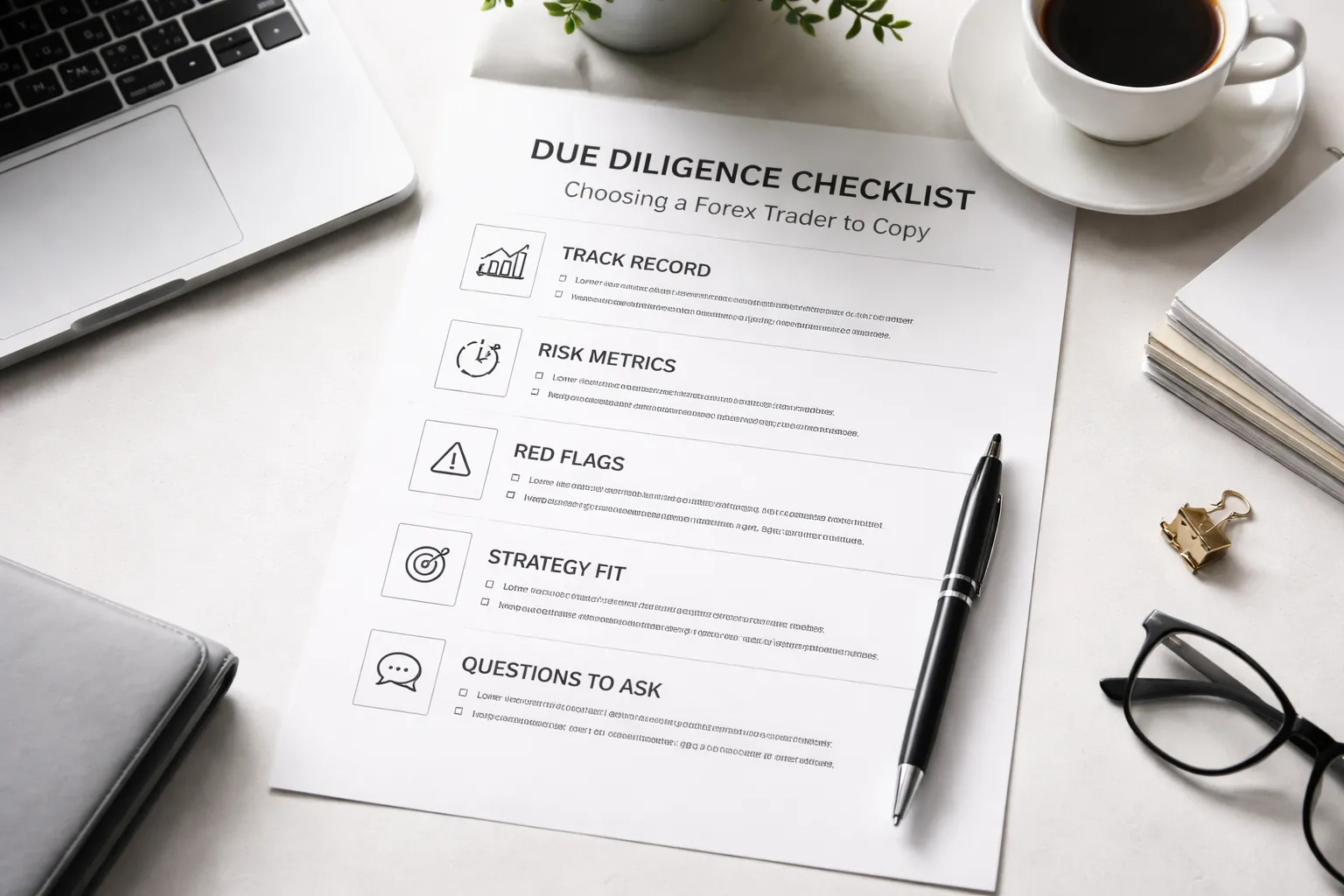
Track record quality
- Length: Prefer a long, continuous record. Treat anything under 6 to 12 months as weak. More market regimes gives you better signal.
- Consistency: Look for steady equity growth and controlled dips. One or two huge months often means high leverage or a lucky streak.
- Live vs demo: Only trust results from a live account. Ask for verified, third party reporting, plus broker name and account type.
- Replicability: The provider’s broker, symbol, and execution model must match yours as closely as possible. Copy performance breaks fast when spreads and swaps differ.
- Trade log access: You need entries, exits, position size, stops, and timestamps. If you only see a chart, you cannot audit behavior.
Risk metrics that matter
- Max drawdown: Use peak to trough percent, not currency amount. Compare it to average monthly return. If drawdown is close to the size of returns, you have thin edge.
- Volatility of returns: Check month to month variance. Smooth returns with high win rate can hide rare, large losses.
- Exposure: Track average leverage, max leverage, and percent of equity at risk per trade. Also check total open risk when multiple trades stack.
- Concentration: Watch pair concentration and USD exposure. Many “diversified” traders still load the same risk across correlated pairs.
- Win and loss distribution: Look for a few very large losses, and many small wins. That profile often signals averaging down.
Red flags you can spot fast
- Martingale behavior: Position size increases after losses. You will see lot size step up as price moves against the position.
- Grid without stops: Multiple entries every X pips, no clear invalidation, no hard stop loss. This can look stable until a trend runs.
- Oversized positions: Large lot sizes relative to equity, even if the win rate looks high. One gap or spike can wipe the account.
- Sudden leverage spikes: Leverage jumps after a drawdown, or near month end. This often means the trader tries to “get back to high water mark.”
- Holding losers, cutting winners: Short average winning duration, long average losing duration. This pattern erodes expectancy.
- Hidden risk via correlation: Many simultaneous trades that all depend on one theme, like USD strength. It is one bet split into parts.
Strategy fit
- Time horizon: Align the strategy with your patience and margin. Scalping needs tight spreads and fast execution. Swing trading needs enough free margin to sit through noise.
- Average holding time: Match it to your broker conditions. Short holds suffer from spread and slippage. Long holds suffer from swaps and weekend gaps.
- Preferred market sessions: Check when trades open and close. Asia session behavior differs from London and New York. Your spread and liquidity change by session.
- News exposure: Review if the trader holds through major releases. If you cannot handle event risk, avoid traders who trade CPI, NFP, and rate decisions without protection.
- Instrument focus: Some traders rely on one pair. That can work, but you must accept long flat periods and regime risk.
Questions to ask before copying
- What is your risk per trade? Ask for a percent of equity and a max position size rule.
- What is your hard stop policy? Ask if every trade has a stop loss, and when they widen or remove it.
- What is your max drawdown limit? Ask what triggers a stop in trading or a reduction in size.
- What makes you change the strategy? Ask for specific triggers, like volatility shifts, spread changes, or performance thresholds.
- How do you handle losing streaks? Ask if they reduce size, pause, or keep pressing.
- What market conditions break your approach? You need to know the failure mode, not the success story.
- What broker conditions do you require? Ask for max spread, execution type, and whether they need low swaps or raw spreads.
- Can you share a full trade history export? You want raw data so you can test costs, slippage, and risk.
If you also need a checklist for the platform itself, use this guide on how to choose a copy trading provider before you follow anyone.
Risk Management for Copy Trading (Controls You Should Set First)
Capital allocation rules
Start with money you can isolate. Do not fund copy trading with rent, bills, or emergency cash.
Set your copy size from your account, not from the trader's account. Platforms use a multiplier, a fixed lot, or a percent allocation. Pick one method and keep it consistent.
- Percent allocation: Allocate a fixed percent of your equity to each trader. Keep it low at first. Example, 10% to 25% per trader until you have enough data.
- Multiplier: Set your multiplier so your typical trade risk stays small. Your goal is stable exposure, not matching their lot size.
- Fixed lot: Use only if you understand contract size, margin, and how the trader scales in and out.
Match your risk to their risk. If the trader runs high leverage, lower your allocation or multiplier. If the trader holds for weeks, check swap costs and margin use.
Hard limits
Hard limits stop the damage when the strategy breaks. Set them before you copy the first trade.
- Max drawdown stop: Stop copying a trader if your peak to trough equity drop hits your limit. Many retail accounts fail because they never cut off a drawdown. A common retail guardrail is 10% to 20% per trader.
- Equity stop: Set an account level equity floor that closes positions and disables copying. This protects you from a single correlated event.
- Maximum daily loss: Cap daily loss to prevent revenge trading by the signal and to limit news shock days. Use an account level stop and a per trader stop if the platform allows it.
Do not set stops so tight that normal variance triggers them every week. Do not set them so wide that you accept a blowup.
Exposure controls
Most copy trading losses come from hidden concentration. Control exposure directly.
- Currency pair caps: Set a max total exposure per pair. If three traders all buy EURUSD, your portfolio becomes one trade.
- Leverage ceilings: Cap total margin use. Leave free margin for spread widening, swaps, and floating drawdown. Avoid running near margin call during high impact news.
- Correlation management: Treat highly related pairs as the same risk. EURUSD, GBPUSD, and XAUUSD can move together in risk on, risk off swings. JPY crosses can cluster. Limit combined exposure across correlated instruments.
If your platform shows net exposure, use it. If it does not, track it in a spreadsheet from open positions.
Diversification rules
Diversification works only if the traders behave differently in stress.
- Number of traders: Use enough traders to reduce single trader failure, but not so many that you lose control. Many accounts do better with 2 to 5 well tracked traders than 20 random follows.
- Style mix: Combine uncorrelated approaches. Example, one intraday trend trader, one mean reversion trader with tight risk, one longer term swing trader with low leverage.
- Rebalancing cadence: Set a schedule. Monthly works for many followers. Rebalance allocation based on drawdown, consistency, and whether the strategy still matches its stated rules.
Do not add a new trader after a big winning streak. Wait for a full cycle that includes a drawdown and recovery.
Monitoring routine
You do not need to watch every tick. You do need a fixed review routine.
- Weekly checks: Current drawdown versus your limit, margin use, open trade count, average holding time, and any jump in lot size. Check net exposure by pair and by direction.
- Monthly checks: Slippage versus expected, spread and swap impact, profit factor trend, and whether results come from a few outlier trades. Compare the trader's current behavior to their prior history.
- Pause copying when: The trader changes risk style, doubles average position size, starts holding losers longer, uses martingale or grid behavior, or breaches your daily loss or drawdown rules.
If you need platform tools that support these controls, use this breakdown of best Forex copy trading platforms and filter by risk limits, allocation options, and reporting exports.
Regulation, Safety, and Platform Due Diligence
How regulation differs by country, and what it covers
Copy trading rules depend on where you live, where the broker operates, and where the platform operates. You can see one set of protections in one country and almost none in another.
Regulation usually covers the broker first. It often includes capital requirements, client money handling rules, complaints processes, and conduct rules for marketing and disclosures. Some regulators also restrict leverage and require negative balance protection for retail clients.
Regulation often does not cover the performance of signal providers. It does not guarantee profits. It does not stop slippage, gaps, or execution delays. It may not cover the copy platform at all if the platform only “provides technology” and does not hold client funds.
- Check the legal entity. A brand can list multiple entities. Protections apply only to the entity that holds your account.
- Check your client classification. Retail protections can drop if you opt up to professional.
- Check product scope. A license can cover spot FX, CFDs, or both. Your risk and protections can differ.
Broker vs platform responsibilities: custody, execution, and disputes
Separate the broker from the copy platform. Your broker holds your money and executes trades. The platform routes signals and sets copying logic.
- Custody. If the broker holds your funds, your safety depends on the broker’s client money rules, segregation practices, and insolvency treatment.
- Execution. Your fills depend on the broker’s pricing, spreads, commissions, latency, and order handling. The platform cannot fix poor execution.
- Disputes. Trade disputes usually go to the broker first because the broker owns execution records. Platform disputes usually cover copying errors, outages, and data display issues.
Ask the platform to state, in writing, who is responsible when a copied trade misfires due to a bridge failure, partial fill, or symbol mismatch. If they refuse, treat it as a risk cost.
Data integrity: verified statements, audited performance, and transparency
Most copy trading fraud starts with performance data. You need data you can verify, not screenshots.
- Prefer broker verified history. Look for trading records tied to a real account statement with deposits, withdrawals, and open trades shown.
- Demand full track record context. Include max drawdown, time in market, leverage used, average position size, and worst single day.
- Watch for survivorship bias. Leaderboards often highlight accounts that survived. They hide accounts that blew up or stopped reporting.
- Check for strategy resets. A provider can abandon a losing account and relaunch a new one. You need continuity across accounts, or you price in the risk.
If a provider markets returns without publishing drawdowns and loss streaks, treat the track record as incomplete. Use a platform that supports exportable reporting and clear risk stats, see best Forex copy trading platforms.
Security basics: account protections, API permissions, and withdrawal safeguards
Copy trading connects systems. That expands your attack surface. Lock down access and limit permissions.
- Use broker side controls. Enable two factor authentication, use a unique password, and set login alerts if available.
- Limit API rights. If you use an API key, use trade only permissions when possible. Avoid keys that allow withdrawals.
- Control whitelists. Use IP whitelisting and device approvals if your broker supports them.
- Protect withdrawals. Use withdrawal address whitelists, cooling off periods, and manual approval steps where available.
- Segregate accounts. Keep copy trading in a dedicated account. Do not mix it with long term holdings or payroll cash.
Also test failure behavior. Pause the copier during major news and during platform maintenance windows. Know what happens if the platform disconnects. Some systems keep positions open with no further management.
Compliance checks: disclosures, marketing claims, and suitability
Platforms and brokers must show risk disclosures. Many also run suitability or appropriateness checks for leveraged products. You should treat these as a baseline, not as protection.
- Risk disclosures. Read the exact disclosure for copy trading. It should state how slippage, gaps, and latency can change results.
- Marketing claims. Avoid providers that promise fixed returns, “low risk” income, or guaranteed drawdown limits. Those claims often breach rules and signal poor governance.
- Fee clarity. Confirm all costs, spreads, commissions, performance fees, platform fees, and any markups on signals.
- Suitability checks. Do not bypass questionnaires. If you lie to gain access, you remove your own guardrails and can lose complaint rights.
When you finish due diligence, document what you checked, the links you relied on, and the dates. If performance or terms change later, you will spot it faster and you can act faster.
Practical Example: What Copy Trading Forex Looks Like in Numbers
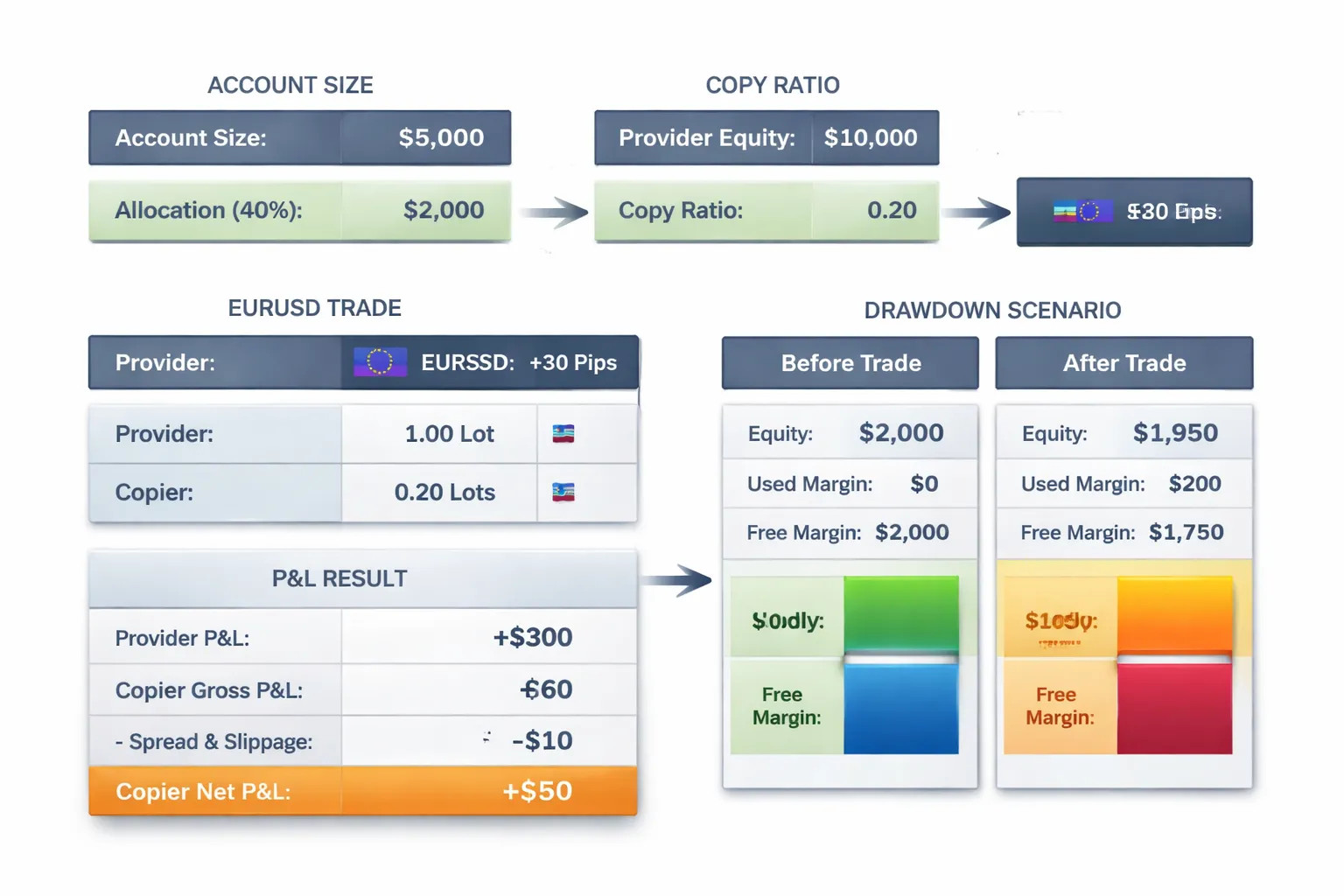
Scenario setup, account size, allocation, copy ratio
You have a $5,000 trading account. You allocate 40% to copy trading. Your copy allocation is $2,000.
The provider trades a $10,000 account. The platform uses proportional sizing based on allocated equity.
Your copy ratio equals $2,000 divided by $10,000. Your ratio is 0.20. You copy 20% of the provider’s position size.
| Input | Provider | You (copier) |
|---|---|---|
| Account equity used for sizing | $10,000 | $2,000 |
| Copy ratio | 1.00 | 0.20 |
Trade example, pips, position size, P&L
The provider buys EURUSD. The provider opens 1.00 lot. EURUSD moves +30 pips. Assume 1 pip on 1.00 lot equals $10.
Provider gross P&L equals 30 pips times $10 per pip. Provider gross P&L equals $300.
Your copied size equals 1.00 lot times 0.20. Your size equals 0.20 lots. On 0.20 lots, 1 pip equals $2.
Your gross P&L equals 30 pips times $2 per pip. Your gross P&L equals $60.
| Item | Provider | You (copier) |
|---|---|---|
| EURUSD position size | 1.00 lot | 0.20 lots |
| Pip value | $10 per pip | $2 per pip |
| Move | +30 pips | +30 pips (signal intent) |
| Gross P&L | +$300 | +$60 |
How spread and slippage change your result
You rarely match the provider’s entry and exit. Two common reasons are spread and slippage.
- Spread hits you at entry and exit. Wider spread increases your trading cost.
- Slippage shifts your fill price. Fast markets and thin liquidity increase slippage risk.
Assume your total extra cost versus the provider equals 1.2 pips on the round trip. On 0.20 lots, 1 pip equals $2. Your extra cost equals 1.2 times $2. Your extra cost equals $2.40.
Your net P&L becomes $60 minus $2.40. Your net P&L becomes $57.60.
Now assume the market move is small, only +5 pips. Your gross P&L would be 5 times $2, which is $10. Subtract the same $2.40 extra cost. Your net drops to $7.60. Costs matter more on short targets and high frequency signals.
| Move on EURUSD | Your gross P&L (0.20 lots) | Extra cost vs provider | Your net P&L |
|---|---|---|---|
| +30 pips | +$60.00 | -$2.40 | +$57.60 |
| +5 pips | +$10.00 | -$2.40 | +$7.60 |
Example drawdown event, margin impact, why stop rules matter
Leverage magnifies drawdowns. Copy trading can keep adding risk if the provider scales in or holds losers.
Assume your broker requires 3.33% margin on EURUSD, about 30:1 leverage. A 0.20 lot EURUSD position has a notional value near $20,000. Your required margin is about $666.
Your copy allocation is $2,000. After margin, your free margin is about $1,334.
Now price moves against the trade by 120 pips before the provider exits. On 0.20 lots, your loss equals 120 times $2. Your floating loss equals $240.
Your equity becomes $2,000 minus $240, which is $1,760. Your used margin stays near $666. Your free margin drops to about $1,094.
If the provider adds a second 0.20 lot entry, your used margin doubles to about $1,332. Your free margin drops to about $428. A further 100 pip adverse move across the combined 0.40 lots loses about $400. Your equity drops to about $1,360. Your free margin drops close to zero. Your broker can force close positions if margin falls below its threshold.
| Stage | Position size | Equity | Used margin (approx.) | Free margin (approx.) |
|---|---|---|---|---|
| After first entry | 0.20 lots | $2,000 | $666 | $1,334 |
| After 120 pip drawdown | 0.20 lots | $1,760 | $666 | $1,094 |
| After adding a second entry | 0.40 lots | $1,760 | $1,332 | $428 |
Set copier-side stop rules. Use a max open loss, a max daily loss, and an equity stop. If you rely only on the provider’s exits, you can hit a margin stop before the provider changes course.
If you want a clear reference point for loss limits used in funded trading, read our guide to drawdown rules and payout conditions.
Who Copy Trading Is Best For (and Who Should Avoid It)
Good Fit Profiles
- Beginners with risk discipline. You can follow a proven process while you learn execution basics. You still need to set your own risk limits, position sizing, and stop rules. If you can stick to a max loss and avoid revenge trading, copy trading can reduce early mistakes.
- Busy traders. You can stay exposed without watching charts all day. This works best when you check performance on a schedule, review open risk, and pause copying after rule breaks.
- Diversification seekers. You can split risk across more than one approach. Use small allocations per provider and cap total correlation. If two providers trade the same pairs the same way, you do not diversify.
Poor Fit Profiles
- Low risk tolerance. Copy trading still includes drawdowns. Many forex strategies run with leverage and can swing fast. If you cannot handle multi week equity dips without changing settings mid trade, avoid it.
- Short term cash needs. You can face negative months, platform outages, and slippage. Do not copy trade with rent money, debt payments, or emergency funds.
- Overconfidence in automation. Copying is not “set and forget.” Providers change behavior. Market regimes shift. Your broker conditions can differ from the provider’s. If you will not monitor risk and stop copying when rules break, you will take avoidable losses.
Goal Alignment: Income Expectations vs Realistic Trade-Offs
Copy trading fits best when your goal is steady process, not fast income. Higher returns usually mean higher leverage, deeper drawdowns, or both. Many platforms and brokers warn that most retail CFD accounts lose money, often around 70 percent to 80 percent. Treat that as a base rate.
- If you want smooth equity. Expect lower returns and fewer trades. Favor providers with lower leverage, smaller drawdowns, and clear risk caps.
- If you want high returns. Expect sharp drawdowns and the risk of a large loss streak. Use smaller allocation, tighter copier side stops, and accept that you may need to stop copying after a breach.
- If you want “monthly income.” Plan for withdrawals only after your account builds a buffer. Do not set fixed monthly targets. The market does not pay on schedule.
When Demo or Paper Copy Trading Makes More Sense First
- You have no live trading experience. Use a demo to learn how lot sizing, leverage, swaps, and margin work in your broker account.
- You do not know your drawdown limit. Paper trade until you see how you react to a 5 percent, 10 percent, and 20 percent drawdown. Then set hard stops before you go live.
- You are testing a provider. Run a demo for long enough to catch different conditions, not just a hot streak. Track max drawdown, average trade length, win rate, and exposure per pair. Then compare to your risk rules before funding.
- You plan to copy inside strict rules. If you want to pass a prop style evaluation, practice on demo with the same daily loss and max drawdown limits you will face. Use this prop firm challenge step-by-step plan as your rule framework.
How to Start Copy Trading Forex Responsibly (Beginner Checklist)
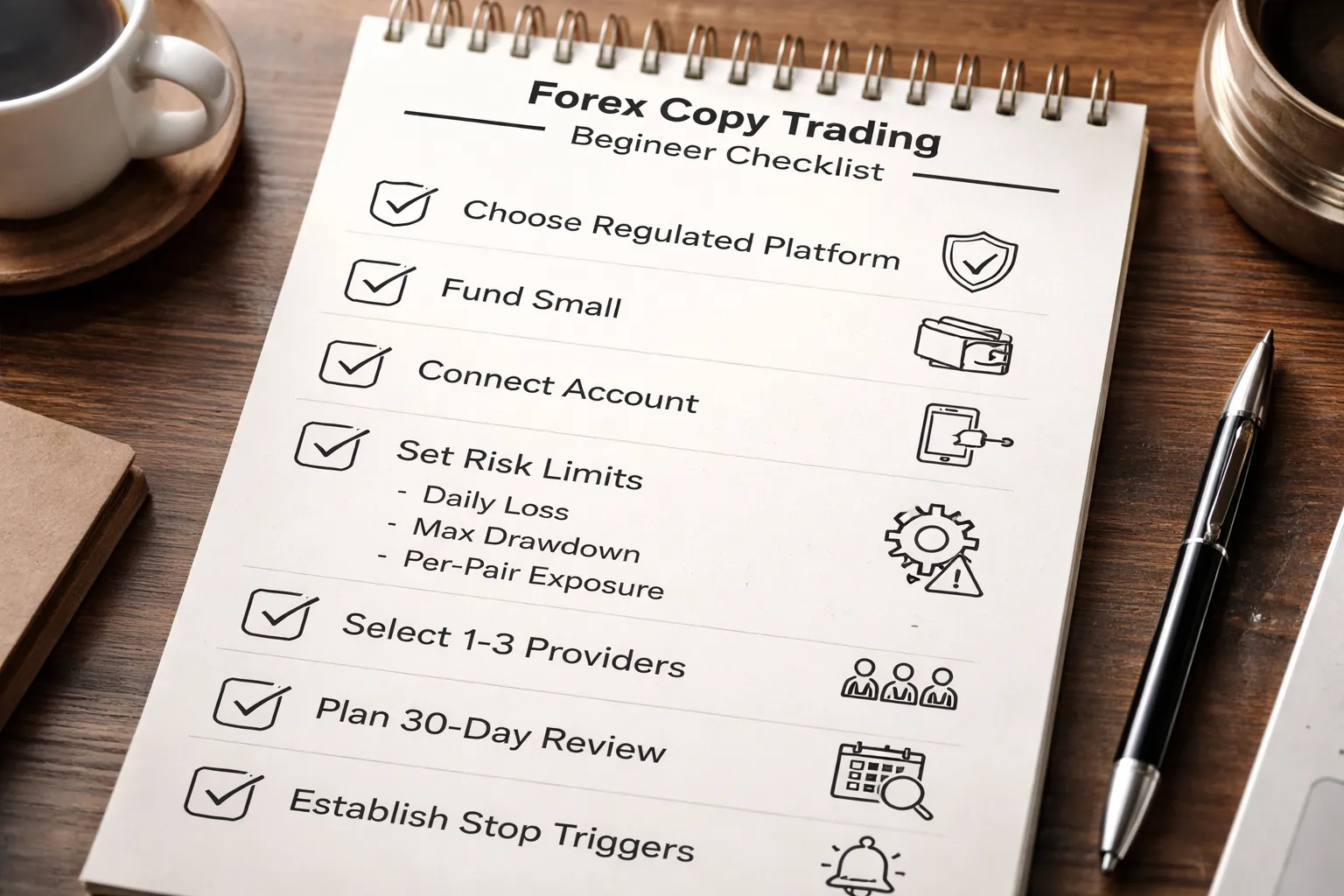
Step-by-step, set up copy trading the safe way
- Pick a regulated broker or copy platform. Confirm regulation in your country. Check segregation of client funds, negative balance protection, and clear fee terms. Avoid unlicensed offshore entities.
- Check the copy mechanism. Look for fixed lot, proportional by equity, and risk multiplier controls. You need per-provider limits and an emergency stop.
- Open an account and lock down security. Use 2FA. Set withdrawal protection if available.
- Fund small first. Use an amount you can lose without changing your life. Do not start with leverage you do not understand.
- Connect your account to copy. Link MT4, MT5, or the platform account. Verify trade permissions and that you can pause or close copied trades manually.
- Shortlist providers using hard filters. Track record length, max drawdown, average trade length, leverage used, and exposure per pair. Reject providers who hide open trades or refuse to disclose key stats.
- Set risk controls before you click copy. Set max daily loss, max total drawdown, max open positions, and max exposure per pair. Set a max position size cap.
- Start on demo or small live. Run the same rules you will use on a larger account. If you care about prop rules, align limits with the style used by best forex prop firms.
Minimum viable setup (keep it simple)
- Start small. Use the minimum deposit that still lets your sizing rules work. Avoid oversizing due to broker minimum lot constraints.
- Define your limits in numbers. Set max daily loss, max weekly loss, and max account drawdown. Write them down. Do not change them mid-week.
- Copy 1 to 3 complementary providers. Mix by style, not by hype. Example mix, one short-term intraday, one swing, one trend. Avoid three traders who all trade the same pair the same way.
- Cap correlation risk. Set a per-pair exposure limit across all providers. EURUSD and GBPUSD often move together, treat them as related risk.
- Use conservative copy sizing. Start with a low risk multiplier. Scale only after you see stable behavior across different market conditions.
First 30 days plan (evaluate, journal, adjust)
You need a review schedule. You need rules for what you change and when.
| Timeline | What you do | What you measure | Decision rule |
|---|---|---|---|
| Day 1 to 3 | Run with tight caps. Confirm execution, slippage, and lot sizing. | Average slippage, spread impact, copied lot accuracy, missed trades. | If lots do not match or slippage spikes, stop and fix settings. |
| Week 1 | Journal every copied trade at a summary level. | Max drawdown to date, number of trades, average holding time, pair exposure. | If exposure breaches your rules, reduce multiplier or disable the provider. |
| Week 2 | Compare results to provider stats. | Your return vs provider return, drawdown gap, win rate gap. | If your drawdown is much worse, execution or sizing is off, scale down. |
| Week 3 | Stress test risk limits. | Worst day loss, worst week loss, largest open floating loss. | If you hit limits, pause copying for 48 hours and review. |
| Week 4 | Grade each provider and rebalance. | Max drawdown, profit factor, average R per trade, time in drawdown. | Keep only providers who stay inside your risk plan. |
- Journal fields that matter. Provider, pair, direction, entry time, exit time, lot size, stop loss distance, slippage, max adverse excursion, reason for trade if shown, your rule compliance.
- Adjust only on schedule. Change sizing once per week. Add or remove providers only after a weekly review, unless a stop trigger hits.
- Do not chase performance. Do not add a provider after a big winning week. Wait for enough trades and at least one rough patch.
When to stop copying (clear triggers)
- You hit your hard risk limits. Daily loss limit breached. Account drawdown limit breached. Stop copying first, then review.
- The provider changes behavior. Bigger position sizes, higher leverage, shorter holding time, more pairs, or holding losers longer than before.
- Drawdown breaks the profile. Current drawdown exceeds the provider’s historical max drawdown by a meaningful margin.
- Execution stops matching. Your fills consistently worsen. You see frequent missed trades, re-quotes, or large slippage.
- Transparency drops. Hidden open trades, delayed reporting, removed history, or unclear strategy changes.
- Risk controls fail. Platform does not respect your max lot cap, stop-out rules, or per-provider limits.
- You break your own process. You keep overriding stops, adding funds to avoid limits, or increasing multiplier to recover losses. Stop and reset on demo.
FAQ
Is copy trading legal in forex?
It depends on your country, broker, and platform. Some jurisdictions treat providers as asset managers or signal services. Check if the broker is licensed, if the platform can market to your region, and if providers disclose performance and risk.
Do you need a lot of money to start?
No, but you need enough to handle lot sizing and drawdowns. Many brokers let you start with $50 to $500. Small balances force high leverage or tiny trade sizes, which can distort results and trigger stop-outs faster.
Can you lose more than you deposit?
Yes, if your account can go negative or you trade products with margin and gaps. Some brokers offer negative balance protection, some do not. Read the account terms. Use lower leverage and hard risk limits per provider.
What is the typical cost of copy trading?
Costs include spreads, commissions, swaps, and platform fees. Some providers charge performance fees or subscriptions. You also pay hidden costs from slippage and worse fills. Compare net results after all fees, not headline returns.
How do you pick a provider without getting fooled?
Start with a long track record on the same account. Check max drawdown, average leverage, and trade frequency. Avoid martingale, grid, and no-stop systems. Verify that history is complete. Cross-check with independent tracking when possible.
How much should you allocate to one provider?
Cap exposure per provider. Many traders use 10% to 30% per strategy, then diversify. Your cap should reflect the provider’s worst historical drawdown plus a buffer. If you cannot survive that drawdown, cut the allocation.
What risk settings matter most?
Use an equity stop, max daily loss, max open lots, and a copy multiplier. Set a max slippage limit if available. Block copying during high-impact news if the strategy cannot handle gaps. Never remove stops to “help” the system.
Why do copied results differ from the provider?
Your broker, leverage, and execution differ. Slippage, re-quotes, spread spikes, and latency change entries and exits. Different account currencies and contract sizes also matter. Small accounts suffer more from minimum lot rounding and margin limits.
Is copy trading better than forex signals?
Copy trading automates execution. Signals require you to place trades yourself. Automation reduces delays, but you still face execution risk and provider risk. If you want more control, read this guide on forex signals.
Can you pause or stop copying without closing trades?
Most platforms let you stop copying new trades while keeping existing positions. Some close all positions when you disconnect. Confirm the setting before you start. Plan your exit rules, including how you will unwind positions during volatility.
Should you use demo first?
Yes. Run the same broker, leverage, and risk settings you plan to use live. Track slippage, drawdowns, and how the system behaves during news. If you keep overriding rules on demo, you will do it live. Fix the process first.
Conclusion
Copy trading can save time. It does not remove risk. You still face leverage, spread costs, slippage, and strategy failure. A good past curve does not protect your account.
Use copy trading like a risk-managed system. Set a hard max loss. Limit leverage. Cap allocation per trader. Diversify only if strategies differ. Watch correlation during news. Audit results net of fees, spreads, and swaps.
- Control size: risk a small, fixed percent per trade or per day. Avoid martingale and grid sizing.
- Control exposure: cap open positions, cap total lots, and limit single-pair concentration.
- Control damage: use an equity stop, and set clear rules for when you pause, reduce, or stop copying.
Your final step is simple. Run a demo with your exact broker settings. Then go live with the smallest size your broker allows. Increase only after you hit your drawdown limits and execution checks for several weeks. Use a checklist when you choose a provider.
-
Best Forex Copy Trading Platforms (Features, Fees & Safety Compared)
7 months ago -
Forex Prop Firm Challenge Rules Explained (Drawdown, Targets, Payouts)
7 months ago -
Best Forex Prop Firms (Top Firms Compared)
7 months ago -
What Is a Forex Prop Firm? How Prop Trading Works for Forex
7 months ago -
Forex Signals: Are They Worth It? (What to Know Before You Buy)
7 months ago
-
-
- Account setup, broker integration, platform connection, and permissions
- Trader selection flow, browsing, filtering, and due diligence checkpoints
- Trade mirroring mechanics, proportional sizing, fixed lot, and equity-based scaling
- Execution realities, latency, slippage, spreads, and partial fills
- Lifecycle of a copied trade, open, modify, add-to-position, close, and risk events
-
- 1:1 copying, percentage-of-equity, and fixed trade size
- Risk multipliers and copy ratios, what they change in real outcomes
- Portfolio copying, splitting funds across multiple traders or strategies
- Auto-copy with constraints, max open trades, max lot, and exposure caps
- When each model tends to work best, and when it fails
-
- Performance Risk: Strategy Decay, Regime Changes, Overfitting
- Leverage and Margin Risk: Amplified Losses, Stop-Outs, Negative Balance
- Execution Risk: Slippage, Widened Spreads, Provider vs Copier Prices
- Concentration Risk: Single-Trader Dependency, Correlated Strategies
- Behavioral Risk: Chasing Rankings, Panic-Stopping, Revenge Copying
- Fraud and Manipulation Risk: Track Record Gaming, Martingale Masking, Influencer Marketing
-
- How regulation differs by country, and what it covers
- Broker vs platform responsibilities: custody, execution, and disputes
- Data integrity: verified statements, audited performance, and transparency
- Security basics: account protections, API permissions, and withdrawal safeguards
- Compliance checks: disclosures, marketing claims, and suitability
-
- Is copy trading legal in forex?
- Do you need a lot of money to start?
- Can you lose more than you deposit?
- What is the typical cost of copy trading?
- How do you pick a provider without getting fooled?
- How much should you allocate to one provider?
- What risk settings matter most?
- Why do copied results differ from the provider?
- Is copy trading better than forex signals?
- Can you pause or stop copying without closing trades?
- Should you use demo first?
-
-
-
- Account setup, broker integration, platform connection, and permissions
- Trader selection flow, browsing, filtering, and due diligence checkpoints
- Trade mirroring mechanics, proportional sizing, fixed lot, and equity-based scaling
- Execution realities, latency, slippage, spreads, and partial fills
- Lifecycle of a copied trade, open, modify, add-to-position, close, and risk events
-
- 1:1 copying, percentage-of-equity, and fixed trade size
- Risk multipliers and copy ratios, what they change in real outcomes
- Portfolio copying, splitting funds across multiple traders or strategies
- Auto-copy with constraints, max open trades, max lot, and exposure caps
- When each model tends to work best, and when it fails
-
- Performance Risk: Strategy Decay, Regime Changes, Overfitting
- Leverage and Margin Risk: Amplified Losses, Stop-Outs, Negative Balance
- Execution Risk: Slippage, Widened Spreads, Provider vs Copier Prices
- Concentration Risk: Single-Trader Dependency, Correlated Strategies
- Behavioral Risk: Chasing Rankings, Panic-Stopping, Revenge Copying
- Fraud and Manipulation Risk: Track Record Gaming, Martingale Masking, Influencer Marketing
-
- How regulation differs by country, and what it covers
- Broker vs platform responsibilities: custody, execution, and disputes
- Data integrity: verified statements, audited performance, and transparency
- Security basics: account protections, API permissions, and withdrawal safeguards
- Compliance checks: disclosures, marketing claims, and suitability
-
- Is copy trading legal in forex?
- Do you need a lot of money to start?
- Can you lose more than you deposit?
- What is the typical cost of copy trading?
- How do you pick a provider without getting fooled?
- How much should you allocate to one provider?
- What risk settings matter most?
- Why do copied results differ from the provider?
- Is copy trading better than forex signals?
- Can you pause or stop copying without closing trades?
- Should you use demo first?
-
-
How to Place a Forex Trade Step by Step (Your First Trade Explained)
5 months ago -
Forex Trading vs Crypto Trading: Which Market Is Better for Beginners?
5 months ago -
Forex Lot Size Calculator: How to Use It to Size Trades Correctly
7 months ago -
How to Calculate Position Size in Forex (Position Sizing Formula + Examples)
7 months ago -
Forex Leverage Explained: How It Works, Pros, Cons & Examples
7 months ago
-
Forex Trading Platforms Comparison: MetaTrader vs cTrader vs TradingView
7 months ago -
Stop Loss vs Take Profit: Differences, Examples & Best Practices
7 months ago -
Is Forex Trading Legal in the United States? Rules, Regulators & What to Know
7 months ago -
Forex Leverage Explained: How It Works, Pros, Cons & Examples
7 months ago -
Forex Market Hours & Trading Sessions Explained (Best Times to Trade)
7 months ago