ECN vs STP vs Market Maker Brokers: Differences, Pros/Cons and How to Choose

Your broker’s execution model changes your costs, fills, and risk.
Forex brokers usually fall into three groups, ECN, STP, or Market Maker. Each routes your order in a different way. Each charges you in a different way, via spread, commission, or both. Each creates a different mix of slippage, requotes, and price transparency.
This guide breaks down how ECN, STP, and Market Maker brokers work. You will learn the real differences in order routing, liquidity access, spread behavior, commissions, and conflict of interest. You will also get clear pros and cons for each model and a simple checklist to match a broker type to your trading style and account size. For a full broker selection framework, see our practical checklist for choosing a forex broker.
- In het kort: ECN matches your order in a network. You usually pay a tight spread plus a fixed commission.
- In het kort: STP routes your order to one or more liquidity providers. Costs often sit in the spread, sometimes with a markup.
- In het kort: A Market Maker fills your trade internally. You usually get a wider, all-in spread and simple pricing.
- In het kort: The biggest difference is how your order gets filled. Routing drives spreads, slippage, and transparency.
- In het kort: Conflicts of interest differ. Market Makers can take the other side. ECN and STP reduce, but do not remove, broker incentives.
- In het kort: Cost comparison is about total cost per trade. Spread plus commission plus typical slippage, not spread alone.
- In het kort: Match the model to your style. Frequent traders tend to benefit from tighter raw pricing. Casual traders often value simple, stable all-in costs.
What to remember
- ECN: Best when you care about raw spreads and transparent pricing. Watch commissions, minimum deposits, and spread widening in news.
- STP: A middle ground. Execution quality depends on the broker’s liquidity pool and markup policy. Check typical spreads, not minimums.
- Market Maker: Simple pricing and often lower entry requirements. Check execution rules, requotes, and how the broker handles fast markets.
- All models: Regulation, client fund safety, and execution stats matter more than the label on the website.
Quick checklist to choose
- If you scalp or trade high volume, prioritize low all-in cost and consistent fills, often ECN or strong STP.
- If you trade small size or infrequently, prioritize simple fees and platform stability, often Market Maker or STP.
- If you trade around news, expect spread spikes and slippage on any model, then choose the broker with clear execution policies.
- Before funding, validate pricing and execution on a demo account.
ECN vs STP vs Market Maker Brokers Explained: What These Execution Models Really Mean
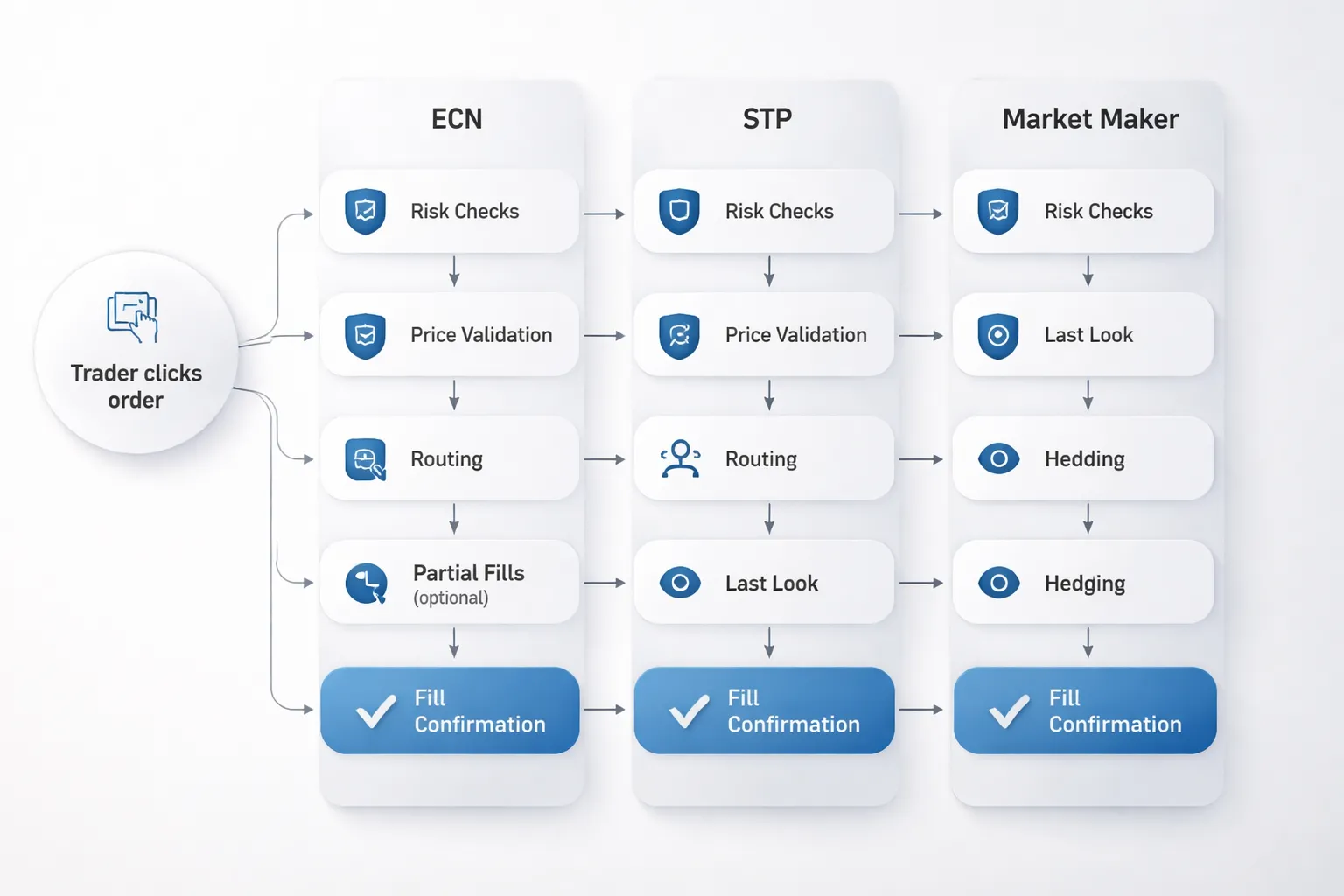
Why broker execution model affects your bottom line
Your broker decides where your order goes. That choice changes your all-in cost and fill quality.
- All-in cost equals spread plus commission plus slippage. The execution model shifts each part.
- Fill quality means how often you get the price you clicked, how fast you get filled, and how often you get partial fills.
- Requotes and rejects happen when the broker cannot or will not fill at your requested price. This risk varies by model and policy.
- Conflicts of interest depend on whether your broker profits from your losses on some trades, or earns mainly from fees and markup.
ECN, STP, and Market Maker are not “good” or “bad.” They are routing and risk models. You must match them to how you trade.
Key terminology glossary
- Liquidity provider (LP). A bank, prime broker, non-bank market maker, or another venue that streams quotes and takes the other side of trades.
- Dealing desk. A broker function that can internalize orders, set its own quotes, and manage risk by hedging or holding exposure.
- A-book. The broker routes your trade to external liquidity. The broker earns from spread markup, commission, or both.
- B-book. The broker keeps your trade internal. The broker manages exposure and may profit when you lose on that position, after hedging and costs.
- Aggregation. Combining quotes from multiple LPs into one best bid and ask, often with depth across price levels.
- Last look. A short window where the LP can accept or reject a trade after you click, based on price movement or risk checks. This can increase rejects or slippage during fast markets.
How pricing is formed, quotes, spreads, and depth
All models start with quotes. What changes is who creates the quote you see and how much depth sits behind it.
- ECN pricing. You see prices built from an order book or aggregated liquidity. Spreads can be tight, but you usually pay a separate commission. Depth matters. If you trade size, your fill can split across levels.
- STP pricing. The broker streams aggregated quotes from one or more LPs, then routes orders through. Spreads often include a markup, sometimes plus commission. Depth is real, but you usually do not see full book detail.
- Market Maker pricing. The broker makes the quote. It can still hedge externally, but your first fill comes from the broker’s internal price. Spreads can be fixed or variable. Depth is internal and can be limited during volatility.
Spreads do not tell the full story. A tight spread with frequent negative slippage can cost more than a wider spread with stable fills. Track your effective spread after fills.
If you want a full breakdown of cost components, see forex broker fees explained.
Order lifecycle overview from click to fill
This is the practical flow. It differs by model, but the checkpoints stay the same.
| Step | What happens | Where ECN, STP, and Market Maker differ |
|---|---|---|
| 1. You click Buy or Sell | Your platform sends order details, symbol, size, type, limits, stops. | Speed depends on server location, bridge, and risk checks. Model alone does not guarantee low latency. |
| 2. Broker risk checks | Margin, max size, exposure limits, compliance filters. | Market Makers often add extra checks during news. ECN and STP still run checks, but routing stays external. |
| 3. Pricing validation | Broker verifies the price is still available. | ECN and STP can face LP rejects from last look. Market Makers can requote or widen internally based on policy. |
| 4. Routing decision | The broker chooses where to execute. | ECN routes into the venue or book. STP routes to one LP or an aggregator. Market Maker fills internally, then may hedge. |
| 5. Execution and fill | You receive a fill price, maybe multiple partial fills. | ECN fills can split across levels. STP fills depend on LP depth and last look. Market Maker fills depend on internal liquidity and rules. |
| 6. Post-trade handling | Confirmation, reporting, and broker hedging if needed. | Market Makers may hedge net exposure later. STP and ECN usually complete externally at execution time. |
When you compare brokers, focus on measurable outcomes. Average spread at your trading hours, average slippage on market orders, reject rate, and fill speed under load.
ECN Brokers: How They Work in Practice
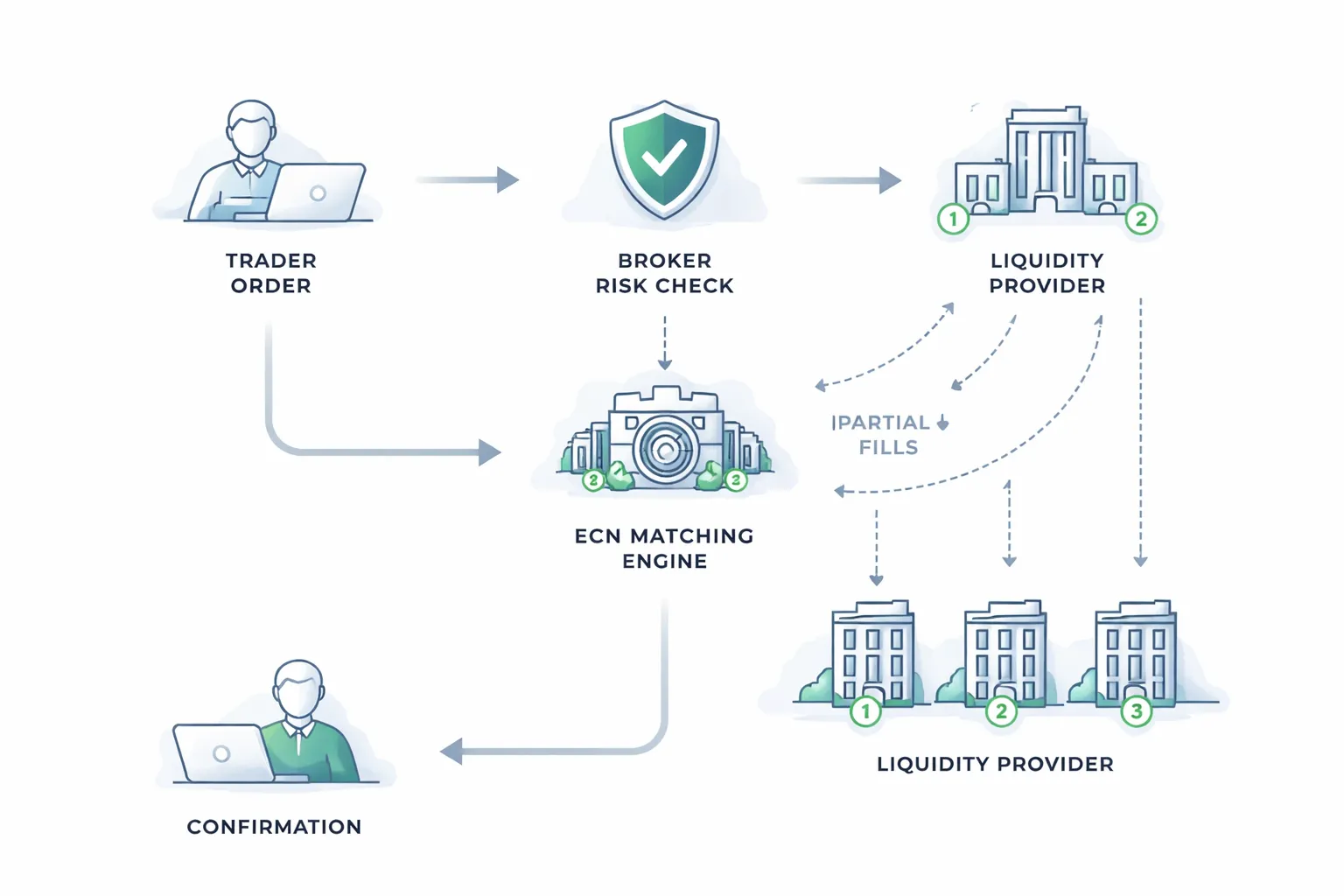
Direct market access and matching engine basics
With an ECN broker, your order routes into an electronic network of liquidity providers. Banks, prime brokers, non-bank market makers, and other participants quote prices. The ECN matches buyers and sellers.
You usually see this flow.
- You place a market or limit order.
- The broker sends it to the ECN, not to an internal dealing desk.
- The matching engine fills you against the best available quotes.
- If your size exceeds top-of-book liquidity, you can get multiple fills at different prices.
In practice, the broker still controls routing, risk checks, and which venues and liquidity providers you can reach. That choice affects your spreads, slippage, and reject rate.
Commission-based pricing vs spread markups
Most ECN accounts price the trade as raw spread plus commission. You pay a fixed cost per lot, per side, or per million traded. The spread can go very low when liquidity is strong, and it can widen fast when liquidity thins.
Some brokers market “ECN” but still add a spread markup and charge commission. Treat that as a cost model, not a label. You need to measure your all-in cost.
- All-in cost equals average spread at your trading hours plus round-turn commission.
- Compare cost by instrument. EURUSD can look great while indices or exotics stay expensive.
Depth of market (DOM) and what you can realistically see
ECN platforms often show Level II or DOM. It lists available liquidity at different prices. This helps you estimate how your order size may impact execution.
DOM has limits.
- You only see the liquidity available on that broker’s connected venues.
- Liquidity can cancel or move before your order hits the book.
- Some “depth” displays aggregate and filter quotes, you do not get a full interbank view.
Use DOM for sizing and timing, not as a promise of fills.
Typical execution characteristics
ECN execution behaves like a live order book. Expect variability.
- Partial fills happen when top liquidity cannot cover your full size at one price.
- Variable spreads tighten in liquid sessions and widen around news, rollovers, and thin hours.
- Slippage can be positive or negative. Market orders can fill worse than you expect when price moves during routing.
- Fewer requotes than dealing desk models, but you can still see rejects from risk checks, price validity rules, or insufficient margin.
Track these metrics per symbol and per session. Log average slippage on market orders, fill speed, and the percentage of trades with multiple fills.
Who ECN is best for
- Scalpers who need tight spreads and fast fills, and who can tolerate variable pricing.
- High-frequency and algorithmic traders who measure execution quality and optimize order types.
- Active day traders who trade liquid pairs and want transparent, commission-based pricing.
If you trade small size, infrequent trades, or mostly during illiquid hours, an ECN label alone will not improve results. Your all-in cost and slippage matter more. Use a practical broker evaluation checklist to compare accounts side by side: how to choose a forex broker.
Common misconceptions
- “ECN means zero conflict.” Your broker can still profit from commissions, markups, and routing choices. Focus on execution stats.
- “ECN means fixed tight spreads.” Spreads float. They can widen sharply in volatile minutes.
- “DOM shows the whole market.” You see a slice, not the full FX market.
- “Any broker that says ECN is true ECN.” Some brokers use the term for marketing. Confirm raw spreads, published commissions, liquidity sources, and whether trades route externally at execution time.
STP Brokers: Straight-Through Processing Without the Hype
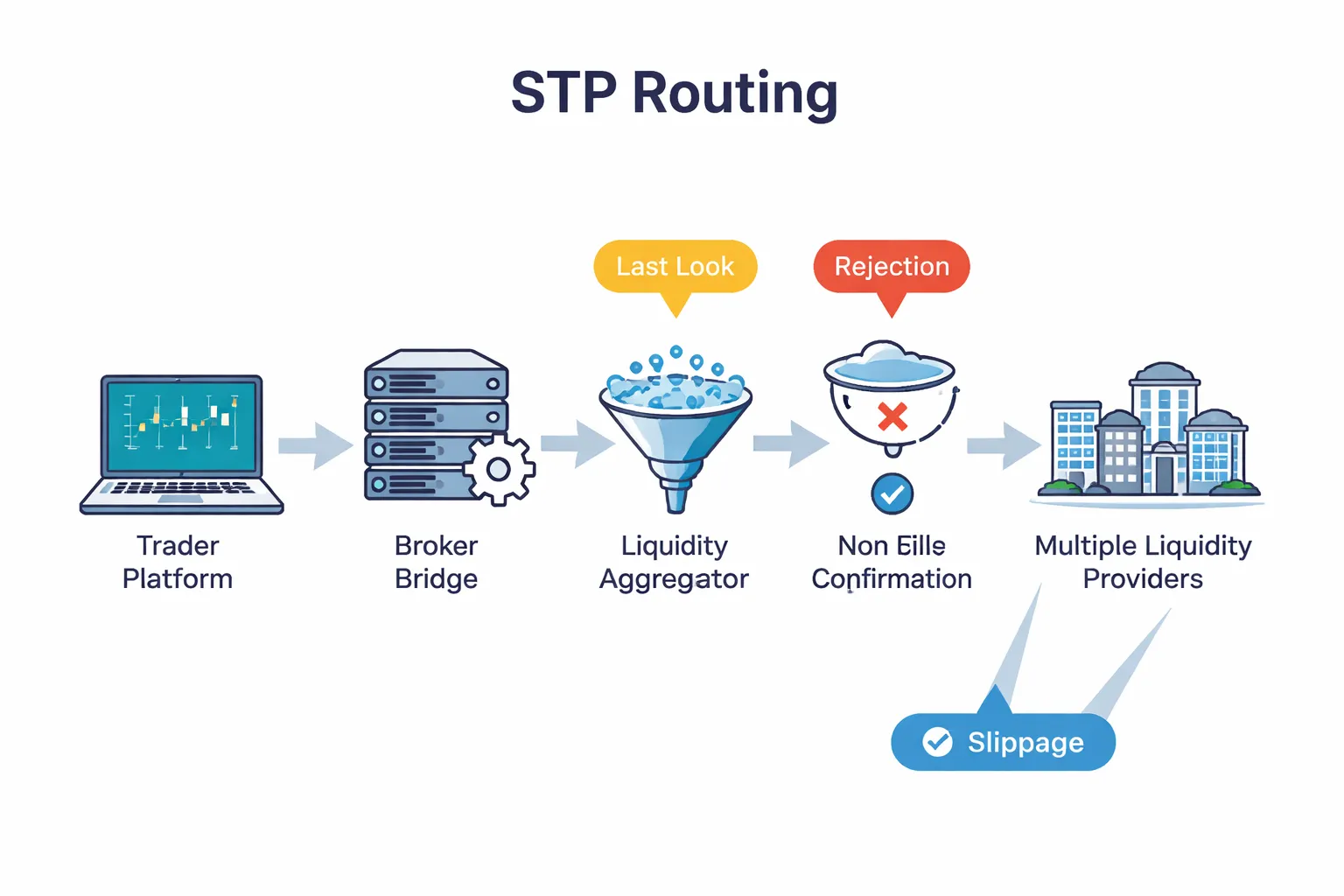
Routing flow to liquidity providers and prime-of-prime relationships
An STP broker routes your order out to external liquidity. In practice, that usually means a prime-of-prime, not a top-tier bank prime broker.
The common chain looks like this. You send an order. The broker sends it to its bridge. The bridge routes to a liquidity aggregator. The aggregator streams quotes from liquidity providers. The best available price becomes your fill, based on the broker’s rules.
Prime-of-prime matters because it sets your real access. It affects the number of liquidity sources, available size at top of book, and how often quotes get pulled in fast markets.
Liquidity aggregation and why it changes spreads and fill quality
STP pricing comes from an aggregated feed. More sources can tighten the displayed spread. It can also increase quote updates and the chance of re-pricing during volatility.
Your results depend on three variables. Feed quality, execution rules, and how the broker handles stale quotes. A broker can show tight spreads and still deliver weak fills if it rejects often or throttles orders.
- Better aggregation can improve average spreads and reduce single-provider outages.
- Shallow top-of-book increases slippage on larger tickets and during news.
- Fast quote changes can raise rejection rates if the broker uses strict price tolerance.
Pricing models: markup-only, commission-only, and mixed accounts
STP does not tell you how you pay. You pay through spread markup, commission, or both.
- Markup-only. The broker adds a markup to the raw spread. You see one all-in spread. Simple, but you cannot separate broker cost from market spread.
- Commission-only. You see near-raw spreads and pay a separate commission. Cleaner for comparing execution and measuring true spread behavior.
- Mixed. A smaller markup plus commission. Common on “pro” accounts that still monetize spread.
If you compare accounts, compare all-in cost in pips at your typical trade size and session. Use your platform’s history, not the broker’s minimum-spread banner. For a deeper breakdown, see forex broker fees.
Execution controls: last look, rejection rules, and order throttling
Most retail STP setups include execution controls. They protect the broker and its liquidity relationships. They can hurt your fills.
- Last look. A liquidity provider can accept or reject after seeing the order. You can see more negative slippage and fewer positive improvements.
- Rejection rules. The broker can reject if price moved beyond tolerance, if liquidity vanished, or if the quote aged out. Some platforms re-quote. Others reject with “off quotes” or “price changed.”
- Order throttling. The broker can cap requests per second, limit order modifications, or slow execution for certain clients, symbols, or sessions.
You cannot fix these with settings. You can only detect them. Track rejection rate, average slippage, and the mix of positive versus negative slippage across a large sample.
Who STP suits best
STP suits most retail traders who want external routing without ECN-level complexity. It fits swing trading, day trading, and systems that trade a few to a few dozen times per day.
It can work for moderate-frequency traders if the broker keeps rejection rates low and does not throttle. It often fails for latency-sensitive scalping, news spikes, and strategies that rely on frequent order modifications.
How to spot “STP in name only”
Some brokers label accounts STP while running a dealing desk or using heavy execution filters. Focus on behavior and disclosures.
- No clear cost breakdown. They advertise “from 0.0” but hide commission, markup policy, or typical spread data.
- Vague liquidity language. They name no liquidity sources, give no execution policy details, and avoid explaining last look and reject conditions.
- High reject or re-quote frequency. You see frequent “off quotes,” “price changed,” or rejected stop entries during normal liquidity.
- One-way slippage. You get negative slippage often, but almost never get price improvement.
- Restrictions that target profitable flow. They block scalping, cap order frequency, or widen spreads sharply on specific symbols while claiming “market spreads.”
- Execution stats look curated. They publish only best-case speed or “up to” figures, not median, percentiles, or rejected-order share.
Ask for the execution policy in writing. Verify whether the broker can internalize flow, apply last look, or reject beyond a stated tolerance.
Market Maker Brokers: Internal Execution and Dealing Desk Mechanics
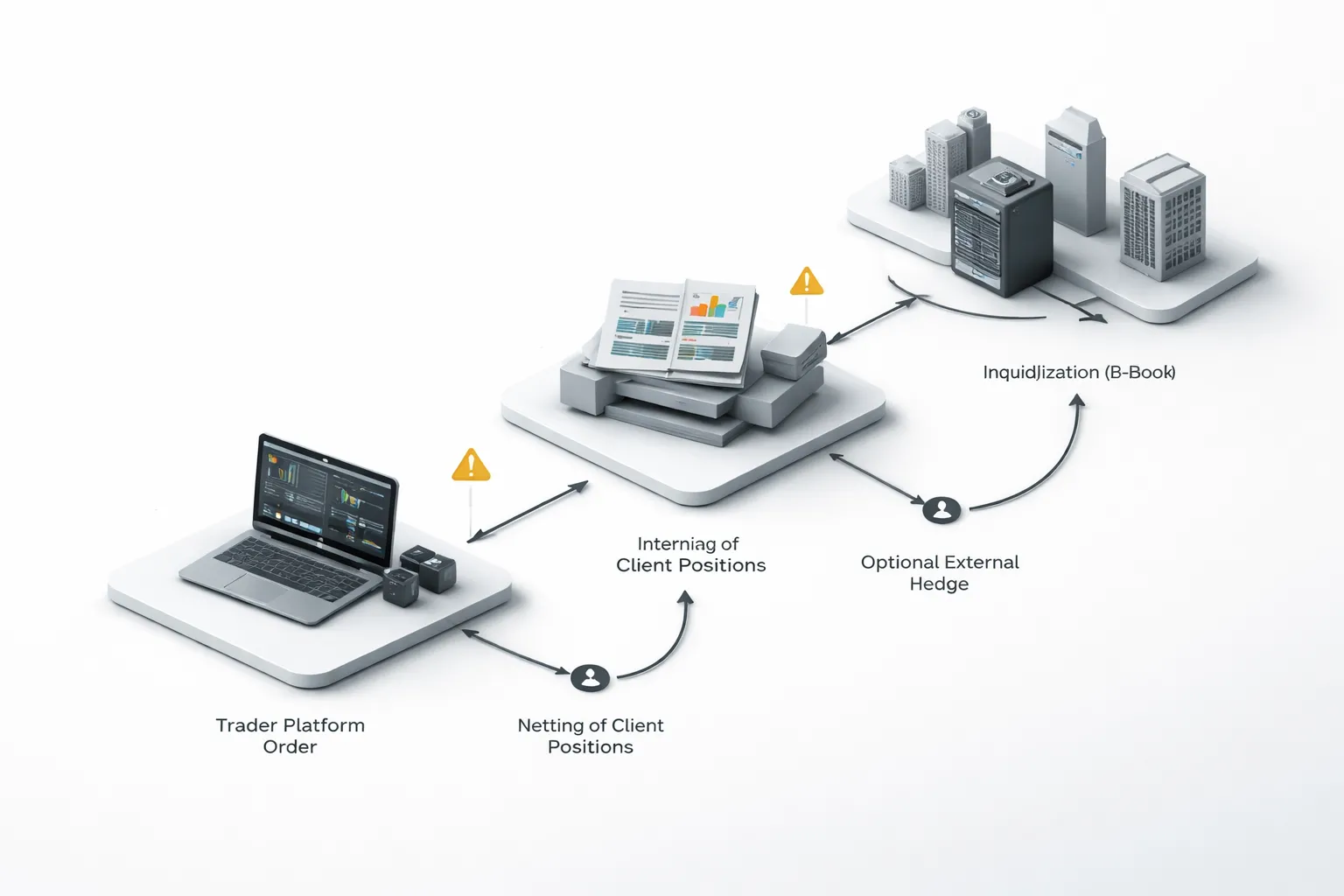
How internalization works (B-book), and why brokers do it
A Market Maker can fill your order inside its own system. It does not route every trade to an external liquidity provider. This is internalization. Many traders call it B-book.
On a B-book, your buy becomes the broker’s sell, and your sell becomes the broker’s buy. The broker carries your risk internally. It earns from the spread, and it can also profit if client flow loses net.
Brokers do this for control and cost. They avoid external hedging fees on small tickets. They keep execution consistent when external liquidity thins. They also manage toxic flow, like latency arbitrage and news spikes, by adjusting how they quote and fill.
Quote setting, fixed spreads, and synthetic liquidity
A Market Maker sets its own bid and ask. It can base them on an interbank feed, but it does not have to mirror it tick for tick. Your platform shows the broker’s quote, not a centralized market.
Fixed spreads come from this setup. The broker can hold a stable spread in normal conditions because it controls the quote and absorbs short-term volatility. That stability has a trade-off. During fast markets, the broker can widen the quote, delay the fill, or reject orders to protect itself.
Liquidity on a Market Maker often looks deep because the broker can always quote size. That depth can be synthetic. It exists because the broker takes the other side, not because external counterparties stand ready at that price.
Requotes, execution delays, and plugin risks, what’s legitimate vs abusive
Market Maker execution often uses instant execution or dealer intervention rules. That is where requotes and delays show up. Some of this can be legitimate. Some of it signals abuse.
- Legitimate behavior: rejecting fills when price moves beyond a stated tolerance, applying slippage rules consistently both ways, widening spreads during known liquidity gaps, limiting orders during outages.
- High-risk behavior: asymmetric slippage where you get worse fills but rarely better fills, frequent requotes only when you trade fast, delayed execution that appears only on winning trades, stop hunts around obvious levels that do not match broader pricing.
Some dealing desks use execution plugins. These tools can manage risk. They can also manipulate outcomes by adding delays, filtering fills, or changing slippage distribution for certain clients or strategies. You cannot see the plugin. You can detect patterns in your own trade log.
Track timestamps, requested price, fill price, and rejection codes. Compare results across sessions and symbols. Look for one-way slippage and strategy-based degradation.
Risk management on the broker side (hedging, netting, exposure limits)
Market Makers run a book. They net client positions against each other. If many clients buy EUR/USD and many sell, the broker can keep the net near zero without hedging.
When the book leans, the broker can hedge externally. It can hedge the net exposure, not every ticket. It can also set exposure limits by symbol, client segment, or time window.
- Netting: offsets client positions to reduce market risk.
- Selective hedging: hedges only when net exposure exceeds a threshold.
- Limits: caps leverage, order size, scalping frequency, or max open risk per account.
This is why your fills can change when you trade size, trade news, or trade a thin symbol. Your order impacts the broker’s inventory risk.
Who Market Makers can be good for
A Market Maker can work well when you value simplicity over microstructure.
- Beginners: simple pricing, fewer moving parts, often small minimum deposits. See best forex brokers for beginners.
- Small accounts: stable spreads on majors, low commissions, micro-lot support.
- Less time-sensitive trading: swing trades and position trades where 0.2 to 1.0 pip execution noise matters less than swaps and total spread.
You still need to price the full cost. Spread, swaps, and execution quality decide your outcome more than the label. Use your own data from a demo and a small live test.
Red flags that signal unfair dealing practices
- One-way slippage: you get negative slippage often, positive slippage rarely.
- Requotes clustered on winners: fills degrade when your strategy performs.
- Unexplained delays: execution time spikes only at specific times or symbols.
- Stops and limits trigger off-market: your stop hits when other feeds do not print that price.
- Rule changes after you trade: new scalping limits, max orders, or min hold time added without clear notice.
- Opaque execution policy: no written slippage, reject, and last-look rules, or vague “market conditions” language with no thresholds.
- Withdrawal friction after profits: extra reviews, sudden KYC requests, or delayed payouts tied to account performance.
Ask for written dealing desk rules. Demand clear definitions for requotes, maximum slippage, and rejection conditions. If the broker will not put it in writing, you should treat the execution as discretionary.
Side-by-Side Comparison: Costs, Speed, Slippage, and Transparency
Quick Table: What You Usually Get
| Factor | ECN | STP | Market Maker |
|---|---|---|---|
| Pricing | Raw spread plus commission | Marked-up spread, sometimes commission | Fixed or variable spread, usually no commission |
| Execution path | Matches in a pool, multiple LP quotes | Routes to one or more LPs via broker | Internalizes, broker sets price and fills |
| Speed and fills | Fast, strong fill probability, can partial fill | Fast, depends on routing and LP quality | Fast in calm markets, discretionary controls possible |
| Slippage | Two-sided, positive and negative | Usually negative bias if routing is one-sided | Often asymmetric, positive slip may not pass through |
| Large orders | Best at sweeping depth across levels | Good if it uses multiple LPs, weaker if single LP | Depends on internal risk limits, may reprice or reject |
| Stops and limits | Market reality, gaps can slip both ways | Similar to ECN, quality varies by LP | Most rule-dependent, watch for stop hunting claims and rules |
| Transparency | Highest, often shows commission, timestamps, sometimes LP tags | Medium, some reporting, less detail on LP and routing | Lowest, execution rules matter more than marketing |
Spreads vs Commissions: Compare Total Cost With Numbers
Judge cost in all-in pips. Spread plus commission converted to pips. Use your typical trade size.
Example, EURUSD, 1 standard lot (100,000)
- ECN: 0.2 pip raw spread plus $7 round turn commission. $7 is about 0.7 pip on EURUSD. Total about 0.9 pip.
- STP: 1.0 pip spread, no commission. Total about 1.0 pip.
- Market Maker: 1.5 pip spread, no commission. Total about 1.5 pips.
This is why you must compare the full ticket cost, not the headline spread. If you want a deeper breakdown, read spread vs commission account costs.
Also price the hidden costs. Swaps, inactivity fees, and withdrawal fees can erase a tight spread.
Execution Speed and Fill Probability in Normal Conditions
Speed matters less than fill quality. You want consistent fills with few rejects.
- ECN: You often get low latency and high fill probability because orders match against available quotes. You may see partial fills on big orders. That is normal.
- STP: Speed depends on routing. Multi-LP routing tends to fill better than single-LP routing. Look for execution statistics, reject rate, and average execution time.
- Market Maker: You can get fast fills in calm markets. You also face broker-side controls. Requotes and rejections usually come from internal rules, not from LP depth.
Ask for hard metrics. Average execution time, fill ratio, reject ratio, and requote rate. If the broker will not share them, assume you will learn the truth with live slippage.
Slippage: Positive vs Negative and What Each Model Tends to Do
Slippage should go both ways. If you only see negative slippage, execution does not treat you fairly.
- ECN: Slippage tends to be two-sided. You can get price improvement when liquidity appears at a better level. You can also get worse fills when the book moves.
- STP: Often similar to ECN, but many setups show a negative bias. The broker can route in a way that keeps improvements, or it can use last-look LPs that reject favorable fills.
- Market Maker: Slippage often becomes asymmetric. The broker can fill you at the quoted price when it helps its book, then slip you when the market moves against it. This depends on dealing desk rules.
Track your own data. Compare requested price vs filled price by time of day and around news. Save exports.
Liquidity Depth and Impact on Large Orders
Large orders test the model. Depth decides how much your order moves through price levels.
- ECN: Best chance of real depth. Your order can sweep multiple levels and fill across them. Your average price can still be worse if the book is thin.
- STP: Depth varies. Multi-LP aggregation helps. Single-LP routing can choke on size and cause rejects or bigger slippage.
- Market Maker: Depth is internal. The broker may cap size per ticket, widen spreads, or delay fills when you trade bigger. You often learn the limit only after you hit it.
If you trade size, ask for maximum ticket size, partial fill policy, and how they handle fills during thin liquidity sessions.
Stop-Loss and Take-Profit Execution Reliability
Stops become market orders when triggered. Limits fill only at your price or better. Each model handles this differently in practice.
- ECN: Stops can slip during fast moves and gaps. Limits can miss if price touches and liquidity disappears. You usually get a clean audit trail.
- STP: Similar mechanics, but your outcome depends on the LP and any last-look behavior. Ask if they use last look and what the reject rules are.
- Market Maker: Reliability depends on internal execution rules. Some brokers run tight rules and behave well. Others widen spreads at trigger points or apply rejection logic during spikes.
Judge with testing. Place small stop orders at different times, then compare trigger price, fill price, and spread at trigger.
Transparency Signals: Trade Receipts, LP Info, and Disclosures
Transparency reduces guesswork. You want proof, not claims.
- Best signals: post-trade reports with timestamps in milliseconds, order IDs, execution venue or liquidity source tags, and clear commission line items.
- ECN: More likely to provide detailed trade receipts. Some show depth-of-market and partial fill details.
- STP: Often provides basic receipts. LP identity usually stays hidden. You can still demand routing and last-look disclosures.
- Market Maker: Usually provides the least detail. Your main protection is written dealing desk rules, a clean complaints history, and tight definitions for requotes and slippage.
Read the execution policy. Look for exact thresholds, not vague language. If the broker will not define the rules, you should treat execution as discretionary.
Conflict of Interest: What It Is, When It Matters, and How to Reduce It
Where conflicts arise across A-book, B-book, and hybrid routing
A conflict of interest exists when your broker can make more money when you trade in a way that hurts your results. It can show up in pricing, execution, or routing.
- A-book (agency routing to liquidity providers). The broker earns from spread markups, commissions, and volume rebates. The conflict sits in routing choices. The broker can send orders to the venue that pays them more, not the venue that fills you better.
- B-book (internalization, market making). The broker takes the other side of your trade. Your loss becomes their gain, before hedging costs. The conflict sits in execution discretion, like last-look, slippage handling, and requote rules.
- Hybrid (A/B mix by client, symbol, or risk). The broker decides when to internalize and when to hedge. The conflict sits in the switching rules. If the broker can move you to B-book after you become profitable, you face a different fill environment.
Why “conflict” does not automatically mean “scam”
Every execution model creates incentives. That alone does not mean fraud.
- Market makers can offer stable quotes and small trade sizes because they warehouse risk and net flow.
- STP and ECN setups can still create conflicts through markups, routing rebates, and selective liquidity.
- The real issue is control. If your broker can change fills without clear, testable rules, the incentive can turn into harm.
Focus on measurable behavior. Fill quality, slippage symmetry, requote frequency, and uptime tell you more than labels.
How reputable brokers mitigate conflicts
- Best execution policy with numbers. Clear rules for slippage handling, requotes, partial fills, and order priority. Named venues or liquidity categories. Disclosures for last-look and any price improvement logic.
- Independent oversight. Strong regulators, audits, and enforceable complaints processes reduce discretionary dealing. Use a broker with a real license and clear rules, see regulated broker safety and red flags.
- Segregation of client money. Client funds sit in segregated accounts. This does not fix execution, but it limits misuse of deposits and supports orderly withdrawals.
- Trade reporting and post-trade transparency. Order timestamps, execution venue tags, and fill breakdowns let you audit outcomes. Some brokers also publish execution statistics, like slippage distribution and fill ratios.
- Risk controls that reduce dealer discretion. Hard limits on manual intervention, automated hedging rules, and consistent execution across account sizes.
Practical trader safeguards
- Use limit orders when price matters. You control the worst acceptable price. You may miss the fill, but you cap adverse execution.
- Set slippage tolerance if your platform supports it. Define maximum deviation for market orders, especially around news.
- Avoid thin markets. Spreads widen and fills worsen at session roll, holidays, and low-liquidity hours. Trading then increases slippage and stop runs across all models.
- Manage news risk with structure, not hope. Reduce size, widen stops, or stay flat during high-impact releases if you cannot accept gaps and fast repricing.
- Track your own execution stats. Log requested price, filled price, time, and spread. Compare slippage on buys versus sells. One-sided slippage over a large sample signals a problem.
- Test withdrawals and support early. A clean execution policy means little if funding and dispute handling fail in practice.
Regulation and Compliance: How Oversight Shapes Execution Quality
Regulation and Compliance: How Oversight Shapes Execution Quality
Execution model matters. Regulation matters more when things go wrong. Strong oversight forces clearer pricing rules, cleaner disclosures, and faster dispute paths. Weak oversight leaves you with marketing claims and little recourse.
Which rules affect execution
- Best execution policies. Regulated brokers must define how they route orders, when they internalize, and how they handle fast markets. You should find this in an execution policy or terms.
- Order handling and slippage disclosures. Look for clear statements on positive slippage, negative slippage, re-quotes, last look, and partial fills. If the broker mentions only “fast execution” and avoids mechanics, treat it as a risk.
- Spread and commission disclosures. Regulators often require “all-in” cost disclosures or typical spread ranges. You need this to compare ECN, STP, and market maker pricing on equal terms.
- Conflict of interest statements. Market makers should disclose when they act as principal. STP and ECN setups should disclose liquidity providers, markups, and when routing can change.
- Complaints process and escalation. Strong regimes require a documented complaint path, timelines, and access to an external ombudsman or arbitration. This matters when you dispute slippage, price spikes, or order rejects.
- Trade reporting and records. Some regulators enforce recordkeeping and audit trails. That increases your chance of getting a real answer when you ask for execution evidence.
Licensing tiers and what they imply
Not all licenses give the same protection. You should treat a “regulated” badge as a starting point, not a decision.
| Tier | Typical signals | What it can mean for you |
|---|---|---|
| Top-tier | Strict audits, capital rules, conduct rules, clear complaint escalation | Better disclosures, stronger enforcement, more leverage limits, more restrictions on bonuses and marketing |
| Mid-tier | Basic licensing and reporting, mixed enforcement | Some protections exist, but you must read execution terms closely and test funding and withdrawals early |
| Offshore or lightly regulated | High leverage offers, weak disclosure, limited dispute support | More execution and withdrawal risk, fewer tools if you face price manipulation or rejected complaints |
Execution quality often tracks enforcement. Top-tier oversight does not guarantee perfect fills, but it raises the cost of bad behavior for the broker.
Negative balance protection, margin closeout, and leverage limits
- Negative balance protection (NBP). NBP limits your loss to your deposit in extreme moves. Without it, a gap can put you in debt. This matters most with high leverage, weekend gaps, and news spikes.
- Margin closeout rules. Many regulators set a forced liquidation level. This reduces the chance that your account goes deeply negative during fast moves. It also changes how your stops behave in stress because the broker may close positions earlier.
- Leverage limits. Limits reduce blowups and reduce the broker’s exposure to client defaults. That often reduces aggressive execution practices that appear when the broker tries to manage risk in-house.
Segregated funds, custodians, and broker insolvency
- Segregated client funds. Segregation keeps your deposit separate from the broker’s operating cash. It does not remove all risk, but it can improve recovery if the broker fails.
- Custodian and banking partners. Strong brokers name where they hold client money and under what rules. If the broker hides this, assume weaker controls.
- Insolvency outcomes. In a failure, your recovery depends on segregation, local insolvency law, and any investor compensation scheme. Your execution model will not help you if you cannot withdraw.
- Bonus and credit offers. Some jurisdictions restrict bonuses because they can lock funds and complicate withdrawals. Treat heavy bonus marketing as a funding risk signal.
How to verify authorization and disciplinary history
- Match the legal entity. Check the broker’s legal name and registration number in the regulator register. Do not rely on the brand name.
- Verify the website domain. Confirm the regulator listing shows the same domain you use for login and funding. Clone sites exist.
- Check permissions. Make sure the entity can deal as principal or agent, hold client money, and offer derivatives in your country.
- Search enforcement actions. Look for fines, license restrictions, past bans, and complaint outcomes. Patterns matter more than one event.
- Review client money statements. Look for clear language on segregation, banks used, and reconciliation frequency.
- Save evidence. Download the execution policy, order handling terms, and fee schedule. If a dispute happens, you need the version you accepted.
- Start small. Fund a small amount, place live trades, then test a withdrawal before you scale. Use the same process you would follow when you open a forex trading account.
Hybrid Brokers and Modern Brokerage Infrastructure
Why many brokers combine models
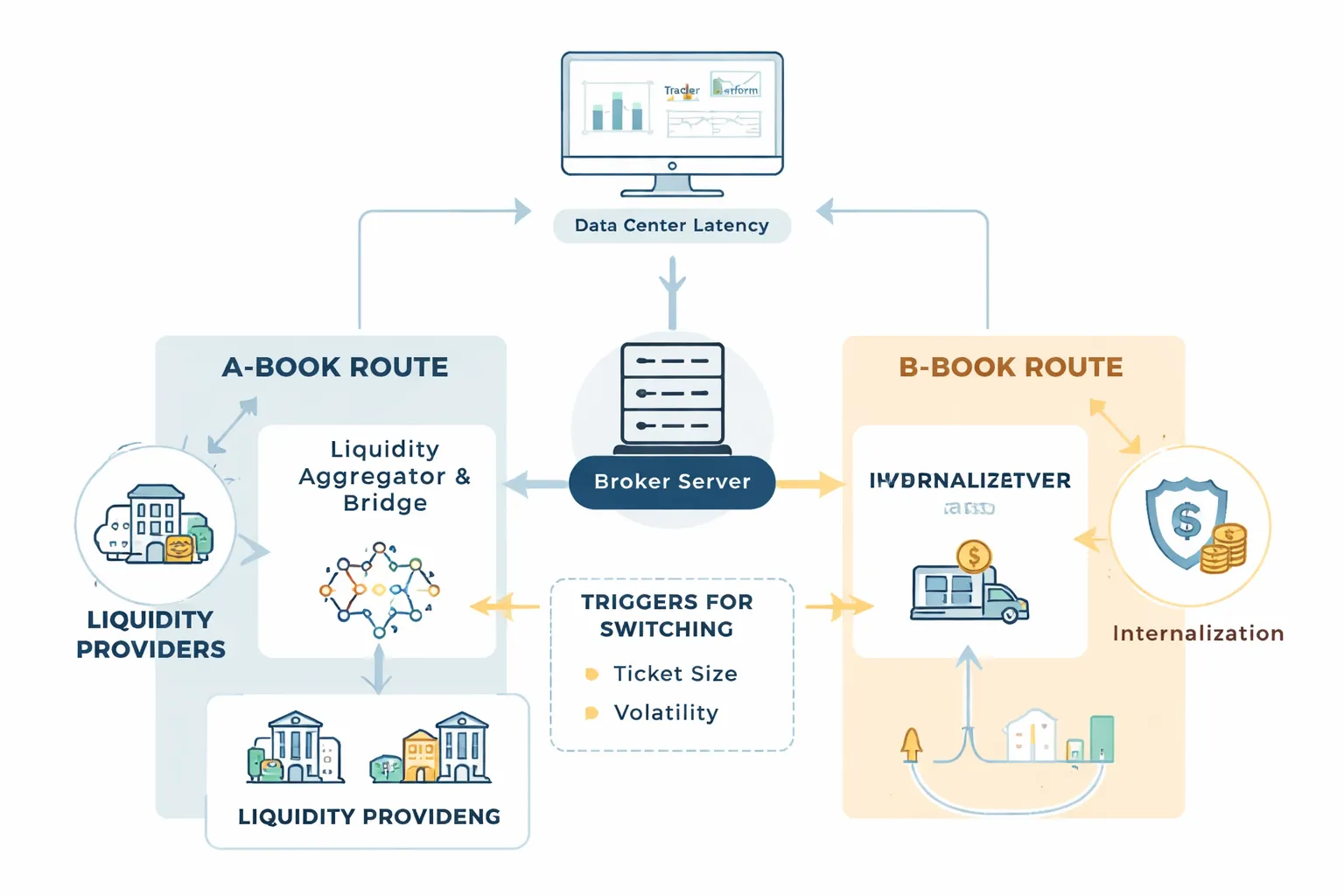
Most brokers run hybrid execution. They mix STP, ECN-style routing, and internalization. They do it to manage risk, control costs, and keep fills stable when markets move.
- Client profile. New, small, or low-frequency accounts often get more internalization. High-volume or “toxic flow” accounts often get more external routing.
- Market conditions. During news, rollovers, or thin liquidity, brokers change routing to reduce rejects and manage exposure.
- Instrument differences. One broker can STP majors, internalize exotics, and route indices or metals to different venues.
- Cost control. External venues charge spread, commission, and sometimes last-look risk. Internal fills reduce those costs.
Order routing logic (A/B switching) and what triggers it
Hybrid brokers use an A/B book. A book routes your trade to liquidity providers. B book internalizes your trade. Routing can happen per account, per symbol, or per ticket.
- Trade size. Large tickets often go A book to reduce broker exposure. Small tickets often stay internal.
- Holding time. Very short holding times and high cancel rates can push routing to A book or trigger wider pricing.
- Profitability and flow metrics. Brokers score flow using win rate, slippage sensitivity, and timing around news.
- Volatility and spread. When spreads widen or liquidity thins, routing can shift to the venue with fewer rejects.
- Correlation and net exposure. If many clients stack the same direction, the broker may offload to reduce net risk.
What you should check in the execution policy.
- Whether the broker uses last look, price filtering, or maximum deviation rules.
- How it handles partial fills, requotes, and rejects.
- Whether it can change routing without notice.
Bridge technology, liquidity aggregators, and data centers
Your platform does not connect to liquidity by default. A broker uses a bridge to route orders, stream quotes, and manage risk. The quality of this stack changes your fills.
- Bridge. Connects MT4 or MT5 to the broker’s pricing engine and liquidity. A weak bridge adds delays, rejects, and mismatched fills.
- Liquidity aggregator. Combines quotes from multiple providers and builds the best bid and ask. It can also split your order across venues.
- Risk engine. Applies markups, limits, and exposure rules. It can throttle fills during fast markets.
- Data center location. Server distance adds latency. Latency increases slippage risk during fast moves. It matters most for scalping and news trading.
| Infrastructure choice | What it changes for you |
|---|---|
| More liquidity providers in the aggregator | Tighter spreads more often, better depth on larger tickets |
| Smart order routing and order splitting | Fewer rejects, more consistent fills during volatility |
| Co-located servers near liquidity venues | Lower round-trip time, lower slippage on fast entries and exits |
| Weak bridge or overloaded servers | Freezes, off-quotes, delayed fills, worse execution on spikes |
Platform choice can change execution outcomes
Execution depends on the platform and how the broker integrates it. Two brokers can both claim STP and still deliver different results.
- MT4. Older architecture. Many brokers run it through bridges. It can show more “off quotes” under load. It often uses simplified order handling.
- MT5. Better multi-asset design and faster infrastructure options. Brokers can run more advanced routing and reporting, if they configure it well.
- cTrader. Built with ECN-style workflows. Often offers clearer depth of market and order types, but outcomes still depend on the broker’s liquidity and settings.
- Proprietary platforms. Can be fast and tightly integrated, but you depend on the broker for transparency, logs, and tools.
What to test on your live account.
- Slippage on market orders during calm periods and during scheduled news.
- Fill speed and reject rate at your normal trade size.
- Stop-loss behavior during spikes. Watch for gaps and stop fills far from your price.
- Consistency across sessions. London open and New York open often look different.
If you need a step-by-step evaluation process, use this practical checklist for choosing a forex broker.
How Volatility and News Events Stress-Test Each Model
What happens during spread widening and liquidity gaps
Volatility changes the market microstructure. Quotes thin out. Top-of-book liquidity disappears. Your broker model determines how that stress shows up in your fills.
- ECN: Spreads widen fast because you see the real order book. Depth can vanish at key levels. Slippage increases on market orders and stops. Partial fills can happen if your size is larger than available liquidity.
- STP: Spreads widen based on what the broker can source from its liquidity providers. If routing fails or quotes go stale, you can see more rejects, more re-quotes on instant execution accounts, or larger slippage on market execution.
- Market maker: The broker can hold spreads steadier, then widen them sharply when risk spikes. You may see fewer partial fills, but you can see more execution controls like maximum deviation rules, order limits, or trade halts on specific pairs.
| Stress event | ECN | STP | Market maker |
|---|---|---|---|
| Spread widening | Immediate, transparent, often extreme on minors | Depends on LP quotes and routing quality | Can look stable, then reprice fast |
| Liquidity gap | Gaps appear in book, stops jump levels | Gaps depend on LP feed, fills can degrade | Broker may internalize, then widen or restrict |
| Large size order | More slippage and partial fills | More slippage, fewer partial fills than ECN in some setups | Fill likely, but price quality can worsen |
Stop hunting vs liquidity gaps: separating myth from mechanics
Most “stop hunts” in fast markets look like mechanics, not a plan to target your account.
- Liquidity gaps: Price jumps because no one quotes in between. Your stop triggers, but the next available price sits far away. You get a worse fill even if your broker acts clean.
- Spread spikes: Bid drops and ask jumps. Your stop on the bid side triggers sooner. This can happen without any real traded price at your stop level.
- Internal pricing risk: With a market maker, the broker controls its quote stream. If it widens spreads more than the external market, your stops trigger earlier. That is not proof of “hunting”, it is still a cost and a risk you must measure.
Your job stays the same across models. Track the tick data around your stop. Compare the broker’s spread to a second feed during the same minute. If the broker runs wider and longer, treat that as a pricing quality problem.
Trading around major releases (NFP, CPI): model-specific risks
News releases compress time. You compete with algorithms and risk controls. Execution quality matters more than advertised spreads.
- ECN risks: Spreads can explode, depth evaporates, and market orders slip. Limit orders can protect price, but they may not fill. Stops can fill far away if the book gaps.
- STP risks: LPs can throttle quotes, reject trades, or widen aggressively. Your broker may switch to last-look behavior at the LP level. You feel it as rejects, delays, and negative slippage.
- Market maker risks: The broker can change dealing rules during news. It can expand spreads, enforce minimum distances for stops and limits, cap lot sizes, or disable trading on specific symbols. You may get fewer rejects, but you can pay with worse pricing and stricter constraints.
Do not evaluate a model based on one trade. Log 20 to 50 events. Record spread at entry, slippage in pips, fill time, and reject rate. Tie the results to your trade size and pairs.
Costs also shift during news. A tight spread account with commission can become expensive when spreads widen, and a fixed spread can break into “variable” behavior via execution rules. Use this guide to understand how broker costs add up in practice: forex broker fees.
Risk controls for traders: position sizing, guaranteed stops (if available), and order types
- Cut size before news: Reduce lots until a worst-case slip still fits your daily loss limit. Use your broker’s worst observed news slippage, not your average.
- Avoid market orders in spikes: Use limit orders when you must control entry price. Accept missed trades as a cost of discipline.
- Use stop-limit with care: It prevents extreme fills, but it can leave you unfilled in a fast move. That can create larger losses if you hold risk without an exit.
- Place stops where liquidity exists: Tight stops near obvious levels fail more during spread spikes. Give room based on recent spread and ATR, then cut size to keep risk fixed.
- Know your broker’s protections: Confirm negative balance protection, margin closeout level, and stop execution method. Test on a small live account, not a demo.
- Use guaranteed stops if your broker offers them: You pay a premium, but you cap gap risk. Read the rules, some brokers restrict guaranteed stops during major releases or on certain instruments.
Match your tools to your model. ECN rewards precise order types and smaller clips. STP demands you track routing quality and rejects. Market maker trading requires you understand house rules and how they change during stress.
How to Choose the Right Broker Model for Your Trading Style
Decision Matrix by Strategy
| Trading style | Best fit | Why it fits | Watch-outs |
|---|---|---|---|
| Scalping | ECN, sometimes STP | Raw spreads, fast matching, transparent fills. | Commission can dominate at small size. Slippage rises during news. Some brokers restrict scalping on market maker terms. |
| Day trading | STP or ECN | Balance of cost and execution. Routing can be fine if liquidity is consistent. | STP quality varies by LP set. Check rejects and re-quotes policy. Avoid wide spread steps at session opens. |
| Swing trading | STP or Market maker | Spread matters less than stability. Fixed or smoother spreads can help planning. | Market maker rules can change during stress. Read margin, stop, and execution clauses. |
| Position trading | Any model, prioritize costs outside the spread | Swaps, financing, and margin terms drive P and L more than entry spread. | Wide rollover charges can erase edge. Check negative balance protection and corporate actions handling. |
| Copy trading | Market maker or STP | Simpler pricing and lot sizing. Fewer commission surprises for followers. | Follower slippage can differ from provider. Check execution sync, max deviation, and partial fills. |
| Automated trading | ECN for latency sensitive systems, STP for mid frequency | ECN rewards precise limit logic. STP can work if routing stays consistent. | Check VPS distance, stop levels, order throttling, and minimum time between orders. Ask about trade size limits per ticket. |
Instrument Considerations
- FX majors, ECN often wins on all-in cost if you trade size and frequency. Compare raw spread plus commission to a typical STP or market maker spread.
- FX exotics, prioritize liquidity and execution rules over headline spreads. STP and ECN can show sharp spread spikes. Market makers can look smoother but may widen fast during events.
- Indices, many brokers internalize or use synthetic pricing. Focus on average spread at your trading hours, slippage on stop orders, and how they handle out-of-hours gaps.
- Commodities, check contract specs and roll schedule. Spread alone does not tell the cost. Look at financing, overnight swap, and how they price around inventory and settlement times.
- Crypto CFDs, spreads and slippage can jump on weekends and during exchange outages. You need clear rules on trading halts, price source, and margin changes.
Account Size and Cost Sensitivity
- Micro-lots and small accounts, commissions can hurt. A slightly wider spread account can be cheaper if your ticket size stays small and your trade count stays low.
- Medium accounts, compare your expected monthly volume to the broker’s commission ladder. Some ECN accounts drop commission after you hit volume tiers.
- Minimum deposits, ECN accounts often set higher minimums or require specific platforms. Do not pick a model you cannot fund and manage through drawdowns.
- Hidden costs, measure swaps, inactivity fees, withdrawal fees, and conversion fees. These can outweigh spread differences for low frequency traders.
When to Prioritize Raw Spreads vs Stability and Simplicity
- Prioritize raw spreads when you scalp, trade high frequency, or you target small take profits. Your edge depends on a tight spread and predictable commission.
- Prioritize stability when you hold through sessions, trade news risk, or run wider stops. You need consistent margin rules, fewer execution surprises, and clean risk controls.
- Prioritize simplicity when you copy trade, trade part time, or you execute infrequently. A clear spread and simple fee schedule beats chasing the lowest quoted spread.
Checklist, Questions to Ask Before You Fund
- Execution, do you run a dealing desk, STP routing, or ECN matching. Do you ever internalize flow.
- Pricing, what is your typical spread at my trading hours, not the minimum. What is the commission per side and per lot.
- Slippage, do you pass positive slippage to clients. Do you allow partial fills. Do you reject orders, and when.
- Stops and limits, what is the minimum stop distance. Do you change stop levels during volatility. Do you restrict guaranteed stops, if offered.
- Liquidity and routing, who are your liquidity providers, and how many. Do you aggregate quotes. Do you have last look conditions.
- Trade rules, do you allow scalping, hedging, and EAs. Do you enforce minimum hold times or maximum orders per minute.
- Costs beyond spread, what are swaps by instrument. How do you calculate triple swap days. What are deposit, withdrawal, and conversion fees.
- Risk controls, do you offer negative balance protection. What are your margin call and stop-out levels, and can they change by instrument.
- Platform and data, do you provide tick data quality, server location, and execution reports. Can you export fill logs for analysis.
- Safety, what license do you operate under. Where is your entity based. How do you hold client funds and handle complaints.
- Proof, can I test these conditions on a demo that matches live settings. Use a demo account and log spreads, slippage, and rejects across normal and high volatility sessions.
Due Diligence Checklist: Proving Execution Quality Before You Commit
How to test with a demo vs a small live account
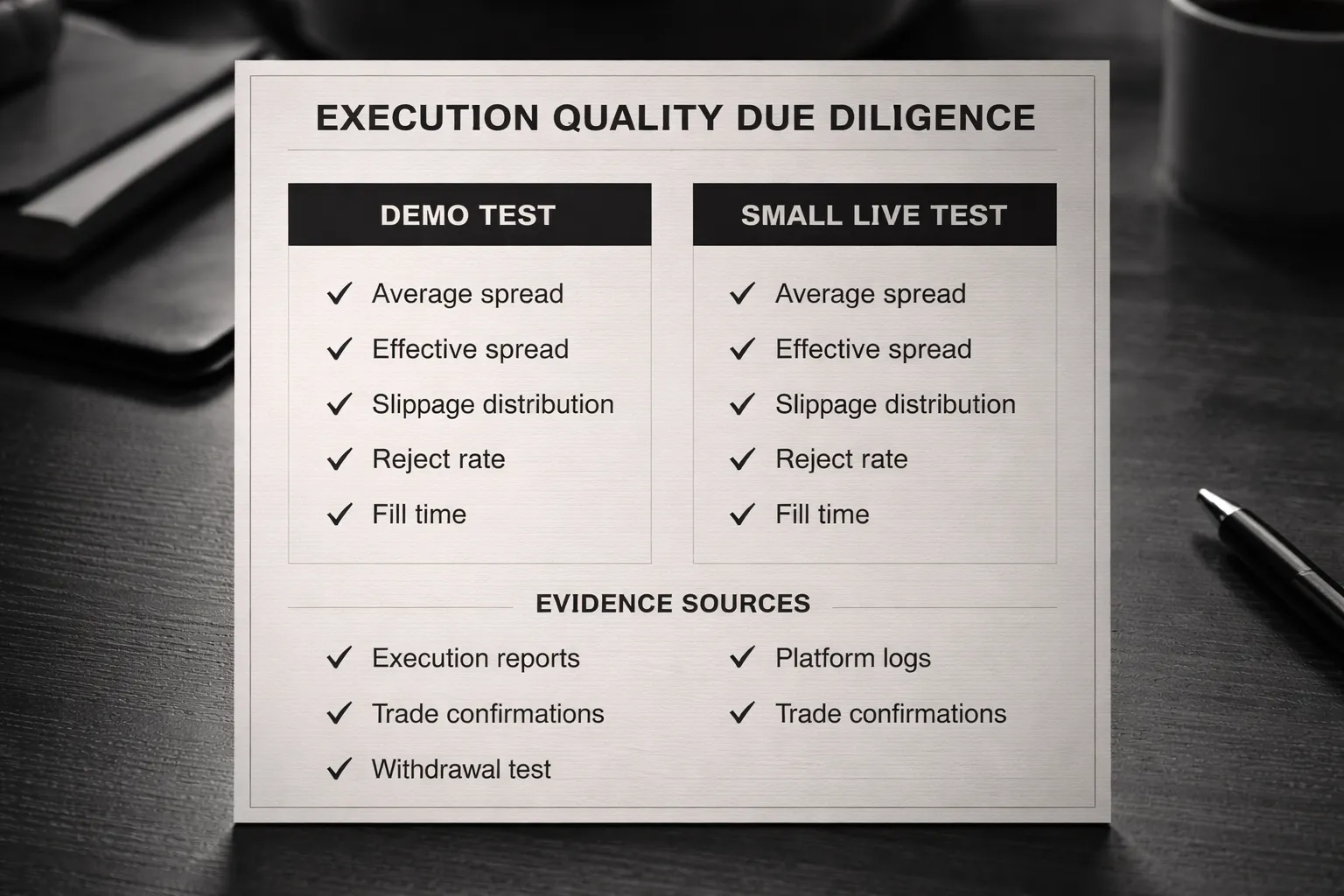
Start with a demo to map behavior. Then confirm with a small live account.
- Use a demo to check platform stability, quote frequency, typical spreads, and order types. Run tests during quiet hours and during major news.
- Do not trust a demo for real slippage, rejects, partial fills, and dealer intervention. Many demos use ideal routing or different liquidity.
- Move to a small live account to measure real execution. Trade the same pairs, same session times, same order sizes. Keep risk fixed and low.
- Test two order styles on live. Market orders for fill quality. Limit orders for queue behavior and fill probability.
- Test stress cases on live. High impact news, market open, and rollover. These periods expose weak routing and thin liquidity.
Metrics to track and how to calculate them
- Average spread. Log bid and ask at the moment you click, then compute ask minus bid. Track by pair and session.
- Effective spread. Use your actual fill price, not the quote. For a buy, effective spread equals 2 times (fill price minus mid price at order time). For a sell, use 2 times (mid price at order time minus fill price).
- Slippage distribution. Slippage equals fill price minus requested price, signed by direction. Break it into buckets, for example 0 to 0.1 pip, 0.1 to 0.5, 0.5 to 1, more than 1. Track positive and negative separately.
- Reject rate. Rejected orders divided by total orders. Log error codes. Separate “off quotes” from “invalid price” and “no liquidity.”
- Fill time. Time from order send to confirmation. Track median and worst 1 percent. Spikes matter more than averages.
- Partial fill rate. Partial fills divided by total fills. Common on true ECN style flows and thin books. A high rate can raise costs if you chase fills.
- All in cost. Spread plus commission, plus swaps if you hold. Keep the fee model clear. Use this guide on forex broker fees if you need a checklist for every cost line.
Where to find evidence you can verify
- Execution reports. Ask for a monthly execution quality report. Look for fill ratios, slippage stats, and routing notes. If they refuse, treat that as a signal.
- Regulator filings and license checks. Verify the entity name, license number, and address on the regulator site. Match it to the account opening documents.
- Audit statements and client money rules. Look for audited financials, segregation language, and complaint handling steps.
- Third party reviews and forums. Use them for patterns, not single stories. Filter for posts with screenshots, logs, and ticket numbers.
- Status pages and incident history. Check uptime history, maintenance windows, and past outage notes.
Operational checks that affect real trading
- Withdrawal speed. Test one small withdrawal early. Time it from request to funds received. Document every step.
- Support responsiveness. Open two tickets. One on execution, one on fees. Measure time to first reply and quality of the answer.
- Fee transparency. Confirm spreads, commissions, swaps, inactivity, deposit and withdrawal fees, and currency conversion fees. Save the page versions you relied on.
- Account terms. Check margin call and stop out levels, negative balance protection, and any order handling clauses.
Platform logs and trade confirmations: what to screenshot and export
Collect evidence before you scale size. Keep it organized by date and session.
- Screenshot the order ticket before you send. Pair, size, order type, and any protection orders.
- Screenshot the quote at click time. Bid, ask, and time to the second. Include the chart and the price ladder if your platform shows it.
- Export trade history. Include open time, close time, requested price, fill price, commission, swap, and any rejection messages.
- Export platform logs. Pull the journal, terminal logs, and any connection logs. These help prove freezes, disconnects, and requote events.
- Save trade confirmations. Keep broker statements and confirmation emails. Match them to your platform exports.
- Record server info. Capture server name, data center location if shown, and ping or latency stats during your tests.
| Item | What you collect | Why it matters |
|---|---|---|
| Quotes at order time | Bid, ask, timestamp screenshot | Lets you compute spread and compare to fill |
| Fill details | Fill price, time, partial fill flags | Shows slippage, speed, and liquidity behavior |
| Order errors | Reject messages, codes, log lines | Separates platform issues from broker handling |
| Costs | Commission, swap, statement export | Confirms all in trading cost |
| Operations | Withdrawal receipt, ticket transcripts | Tests reliability outside the platform |
FAQ
What is the main difference between ECN, STP, and Market Maker?
ECN matches your order in a central network and can show market depth. STP routes your order to one or more liquidity providers. A Market Maker fills you internally using its own prices, then hedges or keeps the risk.
Do Market Makers trade against you?
They can take the other side of your trade inside their book. That creates a conflict risk. A regulated broker can still run fair execution, but you must check slippage, re-quotes, and payout behavior on withdrawals and profits.
Which model has the lowest trading costs?
It depends on your trade size and frequency. ECN often has raw spreads plus commission. STP often uses markups. Market Makers often bundle costs into wider spreads. Compare all-in cost using your average lot size.
Which model is best for scalping and high-frequency trading?
ECN and strong STP setups usually fit better because they can handle fast fills and partial fills. Some Market Makers restrict scalping or widen spreads around news. You must read the terms and test live execution.
Do ECN brokers guarantee no slippage?
No. ECN exposes you to real liquidity. You can get positive or negative slippage. Slippage rises during news, low-liquidity hours, and volatile moves. Judge quality by fill speed, reject rates, and average slippage.
Can an STP broker still be a Market Maker?
Yes. Many brokers run hybrid execution. They can route some flow to liquidity providers and internalize other flow. Ask for their execution policy. Then verify using trade logs, fill timestamps, and reject messages.
What is market depth, and who offers it?
Market depth shows available liquidity at different price levels. True ECN setups may offer Level II depth. Many STP and Market Maker platforms show only top-of-book pricing. Do not assume depth is real without matched fills.
How can you tell if execution is fair?
Track your fills. Export statements and compare requested price vs fill price, time to fill, partial fills, and rejects. Check if slippage skews negative. Save platform logs. Test deposits and withdrawals outside trading hours.
Are fixed spreads safer than variable spreads?
No. Fixed spreads can hide risk through re-quotes, execution delays, or trade restrictions. Variable spreads move with liquidity. Focus on all-in cost, fill quality, and broker rules during volatility, not the spread label.
Does regulation matter more than the execution model?
Yes. Regulation sets rules for client money, disclosures, and complaint paths. A good model with weak oversight still fails. Start with licensing and safety checks, then compare execution and costs. See regulated forex brokers.
What should you choose if you are a beginner?
Pick the broker that gives stable execution, clear costs, and strong support. Model matters less than reliability. Avoid complex commission math if it confuses you. Use a demo to learn, then validate with small live trades.
Conclusion
ECN, STP, and Market Maker models change how your orders route and how you pay. They do not replace broker safety checks. Start with regulation, segregation of funds, and a clean track record. Then compare real trading costs and execution quality on the pairs you trade.
- Pick ECN if you want maximum price transparency, you trade size, and you can handle commission-based pricing.
- Pick STP if you want simple access to external liquidity with pricing that often mixes spreads and markups.
- Pick a Market Maker if you want stable quoted spreads, small minimums, and strong platform support, then watch for requotes, widened spreads, and trading restrictions.
Final tip. Verify costs with your own data. Run the same strategy on a demo and a small live account. Log average spread, commission, slippage, and fills at your trading hours. Keep the broker that gives the lowest all-in cost and the most consistent execution. Use this practical broker checklist to confirm the basics before you scale up.
-
Regulated Forex Brokers Explained: Licenses, Safety & Red Flags
7 months ago -
Forex Demo Account Guide: What It Is, How It Works & How to Use It
7 months ago -
Forex Broker Fees Explained: Spreads, Commissions, Swaps & More
7 months ago -
Spread vs Commission: Which Forex Account Type Is Cheaper?
7 months ago -
How to Open a Forex Trading Account (Step-by-Step for Beginners)
7 months ago
-
- Routing flow to liquidity providers and prime-of-prime relationships
- Liquidity aggregation and why it changes spreads and fill quality
- Pricing models: markup-only, commission-only, and mixed accounts
- Execution controls: last look, rejection rules, and order throttling
- Who STP suits best
- How to spot “STP in name only”
-
- How internalization works (B-book), and why brokers do it
- Quote setting, fixed spreads, and synthetic liquidity
- Requotes, execution delays, and plugin risks, what’s legitimate vs abusive
- Risk management on the broker side (hedging, netting, exposure limits)
- Who Market Makers can be good for
- Red flags that signal unfair dealing practices
-
- Quick Table: What You Usually Get
- Spreads vs Commissions: Compare Total Cost With Numbers
- Execution Speed and Fill Probability in Normal Conditions
- Slippage: Positive vs Negative and What Each Model Tends to Do
- Liquidity Depth and Impact on Large Orders
- Stop-Loss and Take-Profit Execution Reliability
- Transparency Signals: Trade Receipts, LP Info, and Disclosures
-
- What is the main difference between ECN, STP, and Market Maker?
- Do Market Makers trade against you?
- Which model has the lowest trading costs?
- Which model is best for scalping and high-frequency trading?
- Do ECN brokers guarantee no slippage?
- Can an STP broker still be a Market Maker?
- What is market depth, and who offers it?
- How can you tell if execution is fair?
- Are fixed spreads safer than variable spreads?
- Does regulation matter more than the execution model?
- What should you choose if you are a beginner?
-
-
- Routing flow to liquidity providers and prime-of-prime relationships
- Liquidity aggregation and why it changes spreads and fill quality
- Pricing models: markup-only, commission-only, and mixed accounts
- Execution controls: last look, rejection rules, and order throttling
- Who STP suits best
- How to spot “STP in name only”
-
- How internalization works (B-book), and why brokers do it
- Quote setting, fixed spreads, and synthetic liquidity
- Requotes, execution delays, and plugin risks, what’s legitimate vs abusive
- Risk management on the broker side (hedging, netting, exposure limits)
- Who Market Makers can be good for
- Red flags that signal unfair dealing practices
-
- Quick Table: What You Usually Get
- Spreads vs Commissions: Compare Total Cost With Numbers
- Execution Speed and Fill Probability in Normal Conditions
- Slippage: Positive vs Negative and What Each Model Tends to Do
- Liquidity Depth and Impact on Large Orders
- Stop-Loss and Take-Profit Execution Reliability
- Transparency Signals: Trade Receipts, LP Info, and Disclosures
-
- What is the main difference between ECN, STP, and Market Maker?
- Do Market Makers trade against you?
- Which model has the lowest trading costs?
- Which model is best for scalping and high-frequency trading?
- Do ECN brokers guarantee no slippage?
- Can an STP broker still be a Market Maker?
- What is market depth, and who offers it?
- How can you tell if execution is fair?
- Are fixed spreads safer than variable spreads?
- Does regulation matter more than the execution model?
- What should you choose if you are a beginner?
-
-
How to Place a Forex Trade Step by Step (Your First Trade Explained)
5 months ago -
Forex Trading vs Crypto Trading: Which Market Is Better for Beginners?
5 months ago -
Forex Lot Size Calculator: How to Use It to Size Trades Correctly
7 months ago -
How to Calculate Position Size in Forex (Position Sizing Formula + Examples)
7 months ago -
Forex Leverage Explained: How It Works, Pros, Cons & Examples
7 months ago
-
Forex Trading Platforms Comparison: MetaTrader vs cTrader vs TradingView
7 months ago -
Stop Loss vs Take Profit: Differences, Examples & Best Practices
7 months ago -
Is Forex Trading Legal in the United States? Rules, Regulators & What to Know
7 months ago -
Forex Market Hours & Trading Sessions Explained (Best Times to Trade)
7 months ago -
Forex Leverage Explained: How It Works, Pros, Cons & Examples
7 months ago