Forex Broker Fees Explained: Spreads, Commissions, Swaps & More

Forex broker fees decide whether your edge survives. You pay them on every trade, and sometimes when you do not trade.
This guide breaks down the main costs you will face, how brokers quote them, and how to compare them using numbers you can check. You will learn how spreads work in pips and dollars per lot, when commissions replace tight spreads, and how swaps can turn a profitable position into a slow loss if you hold overnight. You will also learn the common non-trading fees that hit your account balance, including deposit and withdrawal charges, inactivity fees, and currency conversion markups.
If you want to compare account types side by side, start with our spread vs commission breakdown.
Key Takeaways
Key Takeaways
- In het kort: You pay to trade through spreads, commissions, and swaps, plus extra non-trading fees that can drain your balance.
- Spread is a built-in cost. You pay it every time you open a trade. Wider spreads raise your break-even point.
- Commission is a separate line item. It often comes with tighter spreads. You must add both to get your true per-trade cost.
- Swap is an overnight cost or credit. It applies when you hold past the broker’s daily rollover. It can erase gains on long holds.
- Watch non-trading fees. Deposit and withdrawal charges, inactivity fees, and currency conversion markups can hit even if you trade well.
- Compare costs in pips and money. Convert all fees into a per-lot cost on the pairs you trade most. Check typical spreads, not best-case minimums.
- Match fees to your style. High-frequency trading needs low all-in transaction costs. Swing and position trading needs competitive swaps and low non-trading fees.
- Use a side-by-side account comparison. Start with our spread vs commission breakdown.
What “Forex Broker Fees” Really Means (and why it matters)
Trading fees vs. non-trading fees, a practical framework
“Forex broker fees” means every cost that reduces your net profit. Some costs hit per trade. Others hit your account balance.
- Trading fees, you pay when you open or close a position. These drive your all-in transaction cost.
- Non-trading fees, you pay to fund, withdraw, or keep the account open. These can erase gains during low activity.
Use this simple checklist.
- First, total your per-trade costs on your main pairs, in pips and in money per lot.
- Second, list your account costs, deposit fees, withdrawal fees, conversion fees, inactivity fees, and platform or data fees.
- Third, match the fee profile to your trade frequency and holding time.
The difference between explicit fees and implicit costs
Some fees show up as a line item. Others hide inside the price you get.
- Explicit fees, commission per lot, swap shown as a daily charge or credit, fixed account fees, withdrawal fees.
- Implicit costs, spread, slippage, and poor execution during fast markets.
Spreads and commissions often trade off. A “zero spread” account can still cost more if the commission is high.
Convert everything into one number, your all-in cost per round trip.
- Start with typical spread, not minimum.
- Add round-trip commission, open plus close.
- Add average slippage if your strategy uses market orders or trades news.
If you need a clean way to compare, use our spread vs commission breakdown.
How fees compound over time for different trading styles
Fees scale with trade count and holding time. Your style decides which fees matter most.
- Scalping and high-frequency trading, transaction costs dominate. A small difference in all-in cost per trade compounds fast across many trades.
- Day trading, spreads and commissions still matter most, but slippage and execution quality can become a major cost during volatility.
- Swing trading, swaps matter. You can run a “cheap” entry cost and still lose to negative carry across multi-day holds.
- Position trading, swaps and currency conversion fees matter most. Funding and withdrawal fees also matter because you move larger sums less often.
Build your cost estimate around your real behavior.
- Trades per month.
- Average position size in lots.
- Average holding time in days.
- Pairs you trade most.
Then stress test it. Use wider spreads than the broker’s best-case numbers. Add a slippage buffer if you trade during releases. This keeps your expected returns honest.
Spreads Explained (the most common cost)
Bid-ask spread basics and how brokers earn from it
The spread is the gap between the bid and the ask price.
You buy at the ask. You sell at the bid. That gap is your immediate cost.
In pip terms, your spread cost is:
- Spread cost (in pips) = quoted spread
- Spread cost (in money) = spread (pips) × pip value × lots
For most USD-quoted pairs, 1 standard lot equals about $10 per pip.
Example. EUR/USD spread is 1.2 pips. You trade 1 lot. Your entry cost is about $12.
Brokers earn from the spread in two main ways.
- Mark-up model: they show you a wider spread than the raw market spread.
- Market maker model: they quote both sides and can internalize flow, the spread becomes a direct revenue source.
Fixed vs. variable spreads and when each is favorable
Fixed spreads stay the same most of the time. Brokers can restrict them during stress. They can widen them around news or switch you to “close only.” Check the fine print.
Fixed spreads suit you if you:
- Trade small size and want predictable costs.
- Trade off-peak hours and hate spread spikes.
- Run simple strategies where consistency matters more than tight pricing.
Variable spreads move with the market. They tighten in liquid hours and widen in thin or volatile conditions.
Variable spreads suit you if you:
- Trade majors during London and New York overlap.
- Need the tightest typical pricing, even if it spikes sometimes.
- Can avoid trading during releases and rollover.
Average spread vs. minimum spread, what to compare
Brokers advertise minimum spreads. You rarely trade the minimum.
Compare average spreads for your exact instruments and account type. Use a full month, not a single session snapshot.
When you compare brokers, collect:
- Average spread on your top pairs.
- Typical spread during your trading hours, not “all day.”
- Spread during news and at rollover if you trade those times.
If the broker offers raw spreads plus commission, convert everything into an all-in cost per lot so you compare like with like. The pricing model often depends on whether the broker routes orders or sets quotes, see our guide on ECN vs STP vs market maker brokers.
How volatility, liquidity, and session timing widen spreads
Spreads widen when liquidity drops or risk jumps.
- High volatility: prices move fast, providers protect themselves by quoting wider.
- Low liquidity: fewer orders sit near the best price, the gap increases.
- Session timing: spreads tend to tighten in London and New York, and widen in late New York and early Asia.
- Rollover: around the daily reset, many brokers widen spreads even on majors.
- News releases: spreads can jump and fills can slip, your real cost becomes spread plus slippage.
If you scalp or use tight stops, spread spikes can break your math. Build your estimate on stressed spreads, not ideal spreads.
Spread behavior on majors vs. minors vs. exotics
Pair choice drives spread cost more than most traders expect.
- Majors like EUR/USD, USD/JPY, GBP/USD. Deep liquidity. Tightest typical spreads. Best fit for frequent trading.
- Minors like EUR/GBP, AUD/JPY, NZD/JPY. Less liquidity. Wider spreads, bigger jumps in off-hours.
- Exotics like USD/TRY, USD/ZAR, USD/MXN. Wide spreads, sharp widening during stress, higher gap risk. Costs can dwarf your edge.
If you trade minors or exotics, treat spread as a core filter, not a detail. Track the average spread during your hours, then multiply it by your monthly volume to see the real drag on performance.
Commissions Explained (common on ECN/RAW accounts)
Commissions Explained (common on ECN/RAW accounts)
On ECN or RAW accounts, the broker often shows tight spreads and charges a separate commission. This can make pricing clearer. It also makes it easier to misread your real cost if you do not convert commission into pips.
Per-side vs. round-turn pricing
Brokers quote commission one of two ways.
- Per-side: charged when you open and when you close. Example, $3.50 per side per lot.
- Round-turn: charged for the full open plus close. Example, $7.00 round-turn per lot.
How to read it fast.
- If the broker says $X per side, double it to compare accounts.
- If the broker says $X round-turn, you already have the full trade cost.
- Confirm the unit. Many brokers mean per standard lot (100,000). Some use per million.
Commission in money vs. converting to an all-in spread
You pay spread in pips. You pay commission in money. You need one number for comparison. Use an all-in spread.
Formula for major pairs where 1 pip on a standard lot is about $10.
- Commission in pips (round-turn) = round-turn commission in USD per lot / 10
- All-in spread (pips) = average raw spread (pips) + commission in pips
| Example (1 standard lot) | Value |
|---|---|
| Average raw spread | 0.2 pips |
| Commission | $3.50 per side |
| Round-turn commission | $7.00 |
| Commission in pips | 0.7 pips |
| All-in spread | 0.9 pips |
For pairs where pip value differs, calculate pip value for your lot size and quote currency, then divide commission by that pip value. If your account is not in USD, convert commission into your account currency first.
When commission accounts are cheaper than spread-only accounts
Commission pricing usually wins when you trade size, trade often, or trade during liquid hours.
- You scalp or day trade majors in London and New York sessions.
- You trade higher volume per month and the raw spread stays close to zero most of the time.
- You use limit orders. You care about tight spreads around your entries and exits.
Spread-only accounts often win when you trade small size, trade rarely, or hold positions for longer and do not want fixed fees on each ticket.
If you want a full breakdown by account type, use this guide on spread vs commission pricing.
Commission tiers, rebates, and active trader programs
Many brokers discount commission when your monthly volume rises. The schedule varies, but the logic stays the same.
- Tiered commission: you hit a volume threshold, your per-lot commission drops.
- Rebates: you pay full commission, then receive a cashback rebate based on lots traded.
- Active trader programs: may bundle lower commission with other benefits, but sometimes add conditions like minimum monthly volume.
Track your last 30 days of lots traded. Price your next month using the tier you will actually reach, not the headline best tier.
Commission edge cases: minimum ticket fees and micro-lot trading
Commission accounts can punish small tickets.
- Minimum commission per trade: some brokers charge a floor fee, even if you trade 0.01 lots. That turns micro-lot trading into an expensive all-in spread.
- Commission rounding: the broker may round commission up to the nearest cent or enforce minimum increments. Small trades feel the impact most.
- Per-million pricing: if the broker quotes $X per million, confirm how it scales down for 0.10 lots and 0.01 lots.
Before you commit, run this check with your real trade size. Convert the commission into pips on a 0.01 and 0.10 lot ticket. If the all-in spread jumps, the account does not fit your sizing.
Swaps & Overnight Financing (the cost of holding positions)
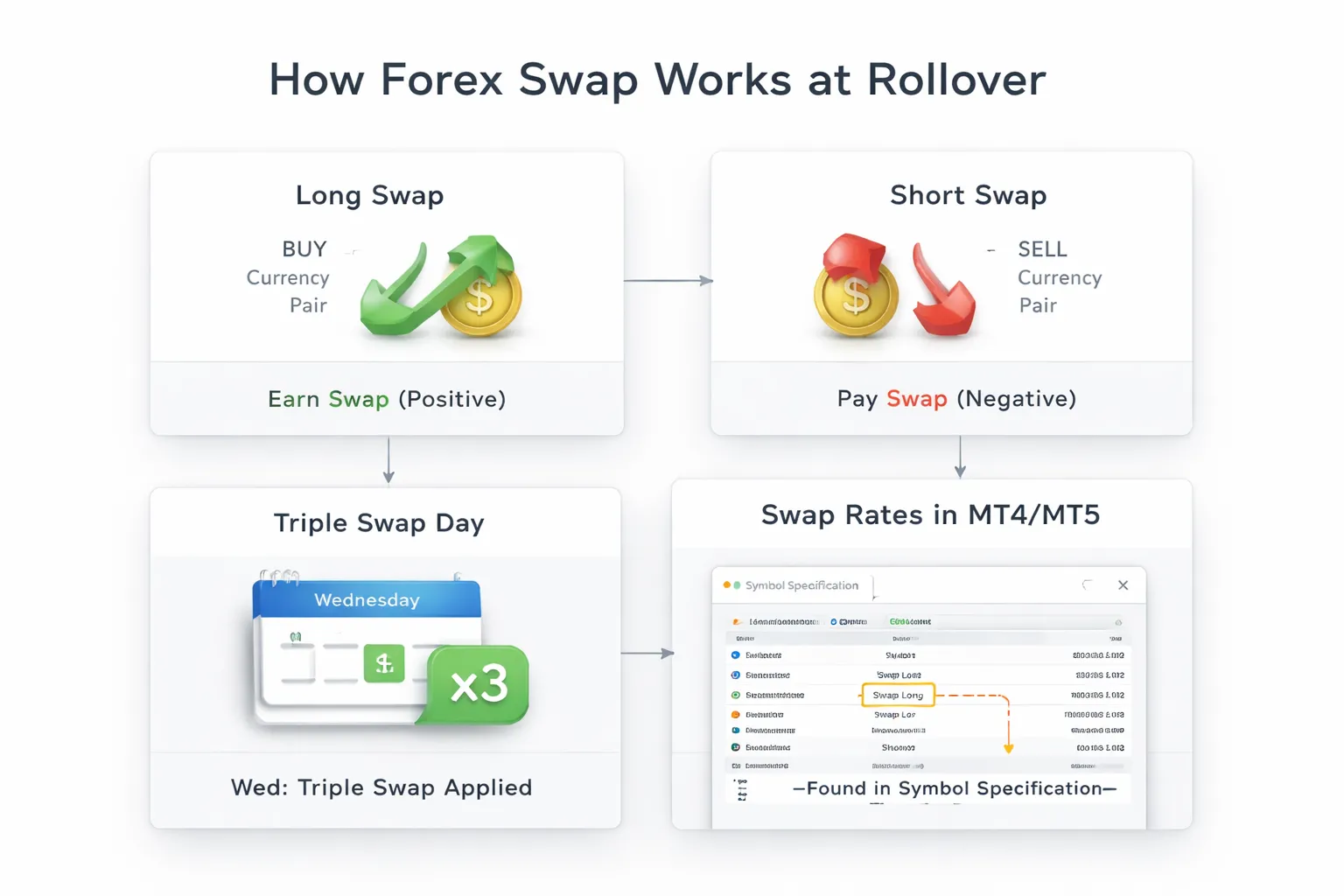
Swaps and Overnight Financing, the cost of holding positions
Swap is the daily financing adjustment on an open position held past the broker’s rollover time. Brokers also call it overnight fee or rollover. You pay it or you receive it. It hits your account as a cash amount in your deposit currency.
Your swap depends on the instrument, your direction (long or short), your position size, and the broker’s markup. Many brokers add their own spread on top of the raw funding rate. That markup can turn a small credit into a charge.
What swap rates are and how they are calculated
Swap comes from the interest rate differential between the two currencies in a pair, plus broker costs. In practice you do not calculate it from central bank rates and expect a match. Brokers price swaps from their liquidity providers, then apply adjustments.
- Quoted as points or cash: Some platforms show swap as points per lot, others as cash per lot.
- Scales with size: Double the lot size, roughly double the swap.
- Applies per night held: Close before rollover, no swap. Hold after rollover, swap posts.
Use the broker’s displayed long swap and short swap as the source of truth. Treat any external “rate” as a rough guide only.
Long vs. short swaps and interest rate differentials
Long and short swaps can differ by a lot. You can pay on both sides. That happens when broker costs exceed the rate differential, or when market funding gets tight.
- Long swap: You hold the base currency and fund the quote currency. The swap reflects that financing.
- Short swap: You do the opposite. The swap can flip sign.
- Carry trades: You target a positive swap, but the broker’s markup and price moves can erase it.
Check both directions before you build a swing plan. A pair that looks like a carry on paper can be negative after broker pricing.
Triple swap days and rollover schedules
Brokers apply a multi-day swap on one day of the week to account for weekend settlement. Most forex pairs use a triple swap midweek, often Wednesday. Some CFDs use different schedules.
- Why it happens: Spot FX uses a standard settlement convention. The rollover reflects days of financing.
- What you feel: A larger than normal debit or credit posts once per week.
- What to do: Know the broker’s rollover time and triple swap day for your symbol.
If you hold positions through the triple swap, your financing risk jumps for that day. Plan margin and stop placement with that in mind.
Swap-free Islamic accounts, how costs may be applied instead
Swap-free does not mean cost-free. Many brokers replace swap with a fixed nightly fee, a wider spread, a higher commission, or a time limit after which charges start.
- Fixed administration fee: Charged per lot per night, often varies by symbol.
- Time limits: Broker may allow swap-free for a set number of days only.
- Excluded instruments: Some pairs and CFDs do not qualify.
Ask for the exact schedule in writing. Compare the effective nightly cost to the standard swap on your usual symbols.
How to find and verify swaps inside your trading platform
Verify swaps in the platform before you trade. Do not rely on a marketing page.
- MT4 or MT5: Right-click the symbol in Market Watch, open Specification, find Swap long and Swap short, confirm the swap type and rollover time.
- cTrader: Open the symbol details, check overnight financing for long and short.
- History check: Hold a small position past rollover, then confirm the posted swap line item in account history.
Also confirm the unit. “Points” can mean different pip conventions across symbols. Convert the posted cash charge into pips for your lot size so you can compare pairs cleanly.
Risk controls for swap exposure in swing and carry strategies
Swaps compound. A small nightly fee becomes a large drag on a long hold. Control it like any other cost.
- Model your holding cost: Multiply the per-night swap by your planned holding days and lot size. Include triple swap.
- Set a max swap budget: Define a dollar cap per trade. Reduce size if the swap breaks the budget.
- Avoid rollover if needed: If your edge is short-term, close before rollover and re-enter after, if spreads and execution support it.
- Watch margin: Large negative swaps reduce equity and can trigger margin pressure during drawdowns.
- Recheck weekly: Swap rates change. A positive carry can turn negative without warning.
Use swaps as a filter when you choose a broker account. Add it to your due diligence alongside spreads and commissions, using a practical broker checklist.
Non-Trading Fees: Deposits, Withdrawals, and Account Charges
Deposit fees and payment provider costs
Most brokers advertise “free deposits.” Your bank or wallet can still charge you.
- Bank wire deposits. Brokers may charge 0 to $30. Your bank can add a wire fee. Intermediary banks can take $10 to $40 from the transfer.
- Card deposits. Brokers often charge 0%. Card issuers can treat the deposit as a cash advance. That can add a fee and immediate interest.
- E-wallet deposits. Brokers often charge 0%. Wallet providers can charge a top-up fee, a transfer fee, or both.
- Local payments. Brokers often subsidize local rails. Providers can still add a small fixed fee.
Check the deposit page for both sides of the cost. Broker fee plus provider fee. Confirm if the broker refunds bank charges or supports “SHA” and “OUR” wire options.
Withdrawal fees, minimums, and processing times
Withdrawals create the biggest surprise costs. Read the broker’s withdrawal policy line by line.
- Withdrawal fee. Common setups include free withdrawals up to a limit, then a fixed charge per payout, or a fixed fee for bank wires.
- Minimum withdrawal. Many brokers set a floor, often $10 to $100. If your balance sits below the minimum, you stay stuck.
- Processing time. Brokers often process within 1 to 3 business days. Banks and card networks add their own time. International wires can take 2 to 7 business days.
- Method rules. Many brokers must send funds back to the original funding method first. That can force slow, expensive routes.
- Extra checks. Compliance reviews can delay payouts. Keep your KYC documents current to avoid resets.
Currency conversion fees on non-base currency funding
If you deposit or withdraw in a currency that does not match your account base currency, you pay a conversion spread.
- At the broker. The broker converts at its rate. Some add a markup. This can cost more than you expect on frequent deposits.
- At your bank or card issuer. The bank converts before the funds reach the broker. You pay the bank’s FX rate plus any foreign transaction fee.
- Double conversion risk. You deposit in currency A to an account in currency B, then withdraw to a bank in currency A. You pay twice.
Ask for the exact conversion markup in percent or pips. If the broker will not state it, assume it is not tight.
Inactivity, maintenance, and dormancy fees
Non-trading charges often hit when you stop trading.
- Inactivity fee. Starts after a set period with no trading activity, often 30 to 180 days. Charged monthly until you trade again or your balance reaches zero.
- Maintenance fee. Some brokers charge a monthly account fee on specific account types, often if you stay below a balance threshold.
- Dormancy fee. Some brokers label long-term inactivity as dormancy and apply a different schedule.
- Data and platform access fees. Some brokers stop waiving platform or data fees when you go inactive.
Track three numbers. The inactivity clock, the monthly fee amount, and what resets the clock. A login often does not count. A trade usually does.
Account base currency as a cost-control lever
Your base currency choice decides how often you pay conversion fees.
- Match your funding currency. If you earn and bank in USD, a USD base account cuts conversion on deposits and withdrawals.
- Match your withdrawal path. If you plan to withdraw to a EUR bank account, use EUR as base where possible.
- Reduce double conversions. Keep one currency from deposit to withdrawal when you can.
- Do not optimize for trading pairs. Base currency does not change the spread on EURUSD. It changes how often you convert cash.
| Fee type | What to record | Where it hits you |
|---|---|---|
| Deposit fee | Broker fee, provider fee, cash advance rule | Each funding event |
| Withdrawal fee | Fee per method, free limits, minimum withdrawal | Each payout |
| Processing time | Broker processing window, bank settlement time | Cash access delay |
| Currency conversion | Markup percent, who converts, double conversion risk | Any non-base currency cash movement |
| Inactivity and dormancy | Days to trigger, monthly charge, reset action | When you stop trading |
How to Calculate Your True “All-In” Trading Cost (with examples)
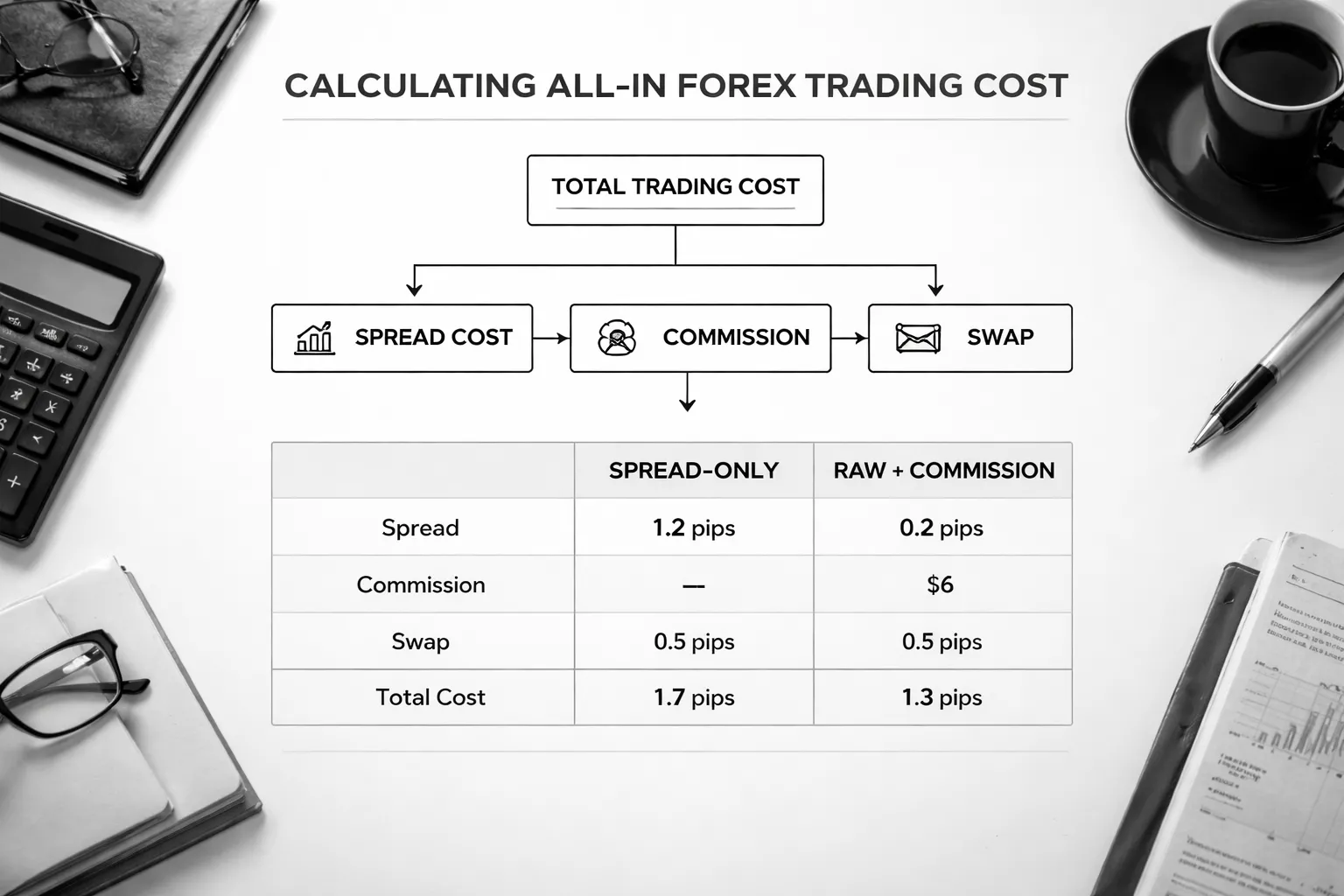
Step-by-step method to estimate round-trip cost per trade
Your true cost is the total you pay to open and close a trade. Use a simple per-trade checklist.
- Spread cost: spread in pips multiplied by your pip value.
- Commission: open commission plus close commission.
- Swap: overnight financing, multiplied by the number of nights held.
- Other trade-linked charges: guaranteed stop fees, exchange fees on CFDs, or platform fees if your broker applies them to orders.
All-in cost (money) per round trip: (spread pips multiplied by pip value) plus (commission in money) plus (swap in money).
Convert spread and commission into pips for easy comparison
Pips let you compare account types fast, even if one uses spread-only and the other uses raw spread plus commission.
Commission in pips (round trip): total commission divided by pip value.
All-in cost in pips (round trip): spread in pips plus commission in pips, then add swap in pips if you hold overnight.
For most USD-quoted major pairs, a common rule is that 1 standard lot has a pip value near $10 per pip. Your platform shows the exact pip value for your position size.
Worked example: EUR/USD on spread-only vs. RAW plus commission
Assumptions. 1 standard lot EUR/USD. Pip value is $10 per pip. No swap because you close the same day.
- Spread cost: 1.2 pips multiplied by $10 = $12.
- Commission: $0.
- All-in round-trip cost: $12.
- All-in in pips: $12 divided by $10 = 1.2 pips.
- Spread cost: 0.2 pips multiplied by $10 = $2.
- Commission: ($3.50 open + $3.50 close) = $7.
- All-in round-trip cost: $2 + $7 = $9.
- Commission in pips: $7 divided by $10 = 0.7 pips.
- All-in in pips: 0.2 + 0.7 = 0.9 pips.
In this example, RAW plus commission is cheaper by $3 per standard lot round trip. Check your own spread averages and your exact commission tier. A tight “from 0.0” spread means little if it rarely prints in your trading hours. If you want a deeper comparison, read spread vs commission.
Worked example: swap impact on a multi-day GBP/JPY position
Swap can turn a “cheap” entry into an expensive hold. Use your broker’s swap rate for your direction. Brokers quote it as money per lot per night, or as points.
Assumptions. You trade 1 standard lot GBP/JPY. Your broker charges a 1.5 pip spread. You hold for 5 nights. Pip value on JPY pairs varies with price, assume $9 per pip for this example. Swap is -$6 per night for this direction.
- Spread cost: 1.5 pips multiplied by $9 = $13.50.
- Commission: $0 in this example.
- Swap: 5 nights multiplied by $6 = $30.
- All-in round-trip cost: $13.50 + $30 = $43.50.
- All-in in pips: $43.50 divided by $9 = 4.83 pips.
If your broker applies triple swap on a specific weekday, your 5-night cost can jump. Confirm the broker’s rollover schedule and your trade direction before you hold.
Build a simple fee tracker using platform reports or spreadsheets
You do not need complex tools. You need consistent inputs per trade.
- Export your history: use your platform account statement, deal history, or fills report. Export to CSV if possible.
- Track these columns: symbol, size, open time, close time, spread paid or entry and exit price, commission, swap, and net P&L.
- Add calculated fields: spread cost in money, commission total, swap total, all-in cost, and all-in cost in pips.
- Group by pair and session: see where spreads widen and where swaps hurt most.
- Compare accounts: log the same fields for each account type, then compare average all-in pips per pair.
A basic tracker shows you what marketing pages do not. Your real all-in cost, for your size, in your trading hours.
What Drives Forex Fees Across Brokers
Account type differences: Standard vs RAW/ECN vs professional
Your account type sets your fee mix. Standard accounts bundle cost into the spread. RAW or ECN-style accounts cut the spread and add a per-lot commission. Professional tiers may cut fees again, but raise entry requirements.
- Standard: wider spreads, usually zero commission. Simple to read, harder to benchmark against low-spread accounts.
- RAW/ECN: tighter spreads, fixed commission per lot per side or round turn. Best for cost tracking because the two fee parts stay separate.
- Professional or VIP: lower commissions or rebates after volume thresholds. Some brokers also reduce financing add-ons for larger clients.
Do not compare spreads alone. Compare all-in cost for your pair, your lot size, and your session. Use the same trade size across accounts when you test.
spread vs commission account cost comparison
Instrument choice: FX pairs vs gold, indices, crypto CFDs
The instrument drives your base cost and your financing cost. Major FX pairs tend to price tighter. Exotic pairs, metals, indices, and crypto CFDs often carry wider spreads and higher overnight costs.
- Majors: high liquidity, low typical spreads, swaps vary by rate differentials.
- Minors and exotics: thinner liquidity, larger spread markups, larger slippage risk, swaps can be steep.
- Gold and other metals: spreads widen fast around volatility, swaps often higher than majors.
- Index CFDs: spreads can look small in points but cost more in money due to contract size. Financing often dominates for multi-day holds.
- Crypto CFDs: wide spreads, high financing, and weekend pricing effects. Some brokers add extra markups outside core hours.
Log costs by symbol, not by asset class. Brokers price each contract differently, even when they use similar labels.
Market hours and news events: expected fee spikes
Fees move with liquidity. Spreads widen when liquidity drops. You pay more during thin sessions, at rollovers, and around high-impact news.
- Session changes: spreads often widen at the New York close and during the first minutes of the Asia open.
- Rollover window: spreads can widen and swaps post. Your stop and limit fills can degrade if you trade through it.
- Major releases: spreads widen and execution worsens. Even a low advertised spread means little if you get slipped.
- Holidays: fewer market makers quote tight prices. Expect wider spreads for longer.
Track time of day with your spread and fill data. If your strategy trades during known spike windows, assume higher average all-in cost.
Leverage, margin requirements, and financing implications
Leverage does not change the spread or commission. It changes how much exposure you can hold. That changes how much financing you pay and how often you face margin stress.
- Higher leverage: makes it easier to hold larger positions. That can amplify swap costs and amplify losses from spread widening.
- Lower margin requirement: reduces idle capital, but increases the chance of forced reduction during volatility.
- Longer holding time: shifts cost from spread to swaps. A trade held for days can pay more in financing than in entry cost.
Match leverage to holding period. For intraday trading, spreads and commissions dominate. For swing and carry trades, swaps dominate.
Regulation, client money rules, and how they influence pricing
Regulation shapes broker costs and risk limits. That flows into pricing.
- Leverage caps: tighter caps can reduce broker risk. They can also push some brokers to compete more on spreads and commissions instead of high leverage marketing.
- Client money segregation: stronger custody rules raise operational costs. Some brokers offset this with slightly higher markups.
- Negative balance protection: adds risk controls and hedging costs. Pricing can reflect that, especially on volatile CFDs.
- Best execution and reporting duties: can limit aggressive dealing practices. You may see more transparent commissions, or less stable spreads during stress because the broker passes through liquidity conditions.
Do not assume regulated means cheaper. Use regulation as a safety filter, then compare pricing with your tracker data.
How to Choose a Broker Based on Fees (without falling for marketing)
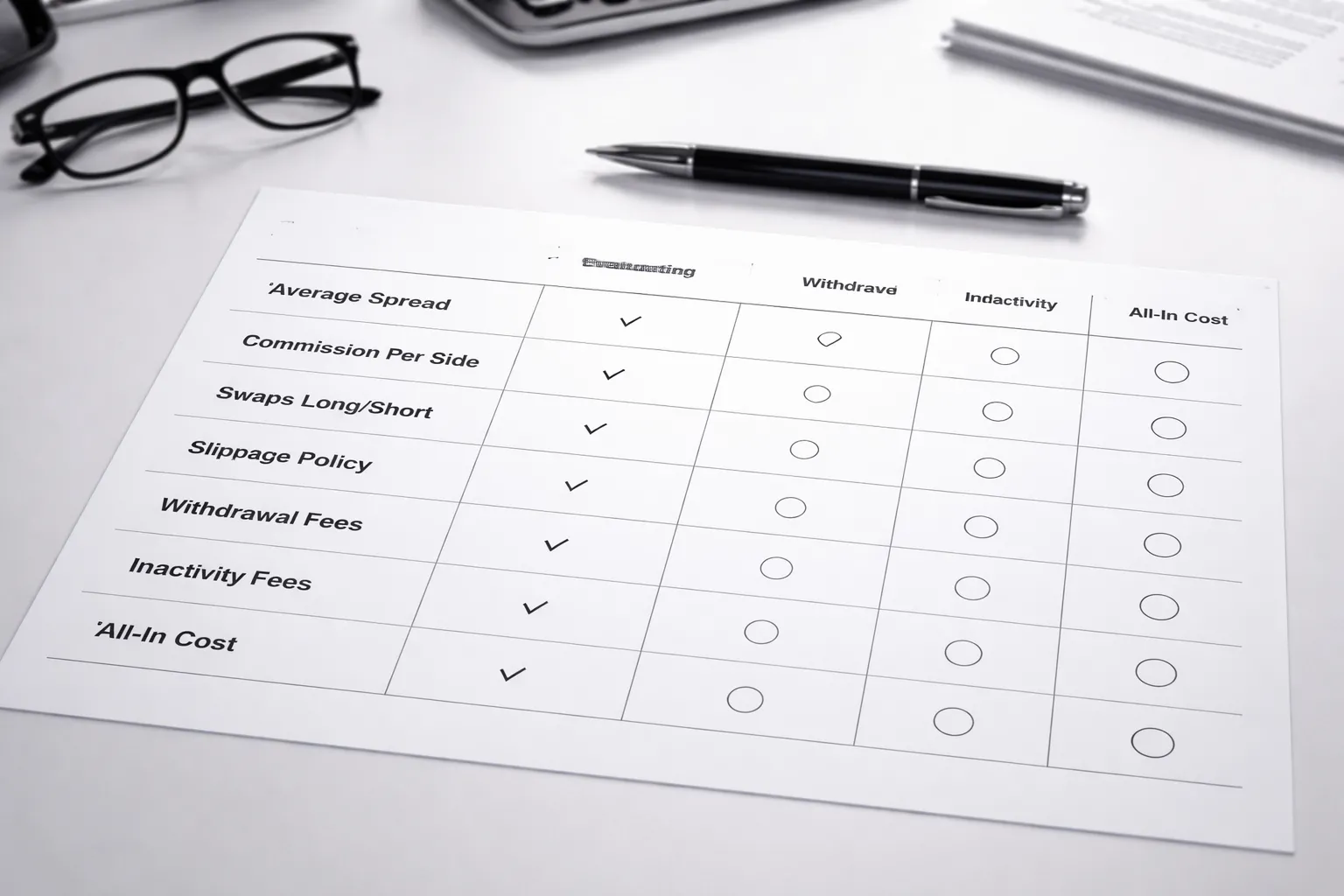
Fee checklist, what to confirm before opening an account
- Account type pricing: spread-only or spread plus commission. Confirm the exact plan name.
- Typical spreads, not minimum: get the broker’s average spread for your main pairs, during your trading hours.
- Commission details: amount per lot, per side or round turn, and the base currency used for billing.
- Swap rates: long and short swaps per symbol. Confirm triple swap day and how they calculate it.
- Execution costs: stop loss handling, slippage policy, partial fills, and any order type restrictions.
- Minimum trade size and step: 0.01 lots vs 0.1 lots changes your effective commission impact.
- Non trading fees: deposit fee, withdrawal fee, currency conversion fee, inactivity fee, and account maintenance fees.
- Data and platform fees: platform subscription, advanced data packages, and VPS costs if you need them.
- Margin terms: leverage per symbol, margin on hedged positions, and how margin changes during news or weekends.
- Realistic funding and payout path: the cheapest trading account means little if withdrawals cost more.
How to compare brokers using average spreads and fee tables
Ignore headline spreads. Build your own fee table. Use your symbols, your size, your time window.
- Pick 3 to 6 instruments you trade most. Example, EURUSD, GBPUSD, USDJPY, XAUUSD, US30.
- Collect average spread during the sessions you trade. Use at least two weeks. One month is better.
- Convert commission into pips for each instrument, then add it to the average spread.
- Add swap cost for your average holding time. Use both long and short. Your bias matters.
- Add non trading fees you will actually pay. Example, one withdrawal per month.
- Rank brokers by all in cost per trade and per month, not by one line item.
| Cost item | What to record | How you use it |
|---|---|---|
| Average spread | Avg pips by symbol and session | Base trading cost |
| Commission | $ per lot, per side or round turn | Convert to pips, add to spread |
| Swap | Long and short swap per day | Multiply by holding days |
| Slippage | Avg negative and positive slippage | Add expected loss to all in cost |
| Withdrawals | Fee per method plus FX conversion | Monthly cash out cost |
| Inactivity | When it starts, monthly charge | Penalty risk if you pause trading |
If you need a broader broker selection checklist beyond fees, use this practical checklist.
Red flags in fee disclosures and “too good to be true” claims
- “From 0.0 pips” with no average spread data: you cannot budget costs from marketing floors.
- Commission shown without “per side” clarity: this doubles your expected cost.
- Swap rates hidden behind login: you need to see long and short swaps before funding.
- Wide spread on majors during normal hours: you will feel it on every entry and exit.
- Frequent “price updates” disclaimers: they can change fee pages without notice.
- Bonus or rebate language tied to volume: it can push you into overtrading for small savings.
- Withdrawal friction: limited methods, long processing times, or extra “verification” steps after profits.
- Fee terms scattered across documents: real pricing should sit in one clear schedule.
Matching fee structure to strategy (scalping, day trading, swing, carry)
- Scalping: you need tight effective spreads and stable execution. Focus on average spread plus commission, and slippage. Avoid brokers that restrict scalping or widen spreads at the times you trade.
- Day trading: you still pay spread and commission often. You also need predictable costs during the session you trade. Track spreads around major data releases if you trade news.
- Swing trading: swaps start to matter. A broker with slightly higher spread can still win if swaps are lower or more favorable on your pairs.
- Carry trading: swaps become the core fee line. Verify both sides, long and short. Check how often the broker changes swap rates and whether they apply extra markups.
Match the pricing model to your trade frequency and holding time. Do not pick a scalping fee structure for a carry strategy, or the reverse.
Questions to ask support to validate real trading conditions
- What are the average spreads for my top symbols over the last 30 days, during London and New York sessions?
- Is the commission per side or round turn, and is it charged in USD or account currency?
- Do you apply any spread markup on top of raw spreads on this account type?
- Where can I see live swap rates for each symbol, and what is the triple swap day?
- How do you handle slippage on stop orders and limit orders, and do you pass on positive slippage?
- Do you have minimum distance rules for stops and limits, or restrictions on scalping and EAs?
- What are the withdrawal fees by method, and do you charge currency conversion fees?
- Under what conditions do you change leverage or margin, and where is that published?
Fee-Reduction Strategies You Can Apply Immediately
Trade timing tactics to reduce spread impact
Spreads widen when liquidity drops and risk spikes. Trade when depth is highest.
- Prioritize liquid sessions. For major pairs, spreads often tighten during London and the London New York overlap.
- Avoid the daily rollover window. Many brokers widen spreads around server midnight when swaps post and liquidity thins.
- Stand aside around red flag news. Spreads and slippage jump around CPI, NFP, rate decisions, and surprise headlines.
- Watch the open. The first minutes of the week open and session opens can show wider spreads and gaps.
- Measure your broker. Log the live spread on your main pairs at fixed times for 10 trading days. Use the median, not the best tick.
Position sizing and order types to manage slippage
Slippage hits harder when you trade bigger than the available liquidity at your price. Control size and execution.
- Size to the pair. Reduce lot size on thin pairs and during volatile periods.
- Split entries. Break one large market order into smaller orders to reduce price impact.
- Use limit orders for entry when you can. Limits control your entry price, but you may miss the trade.
- Use stop orders for confirmation, but plan for slippage. Stops turn into market orders once triggered. Add slippage tolerance in your risk model.
- Place stops at logical levels, not tight to the market. Tight stops trigger more often, then you pay spread plus slippage more frequently.
- Check execution rules. Confirm whether your broker passes on positive slippage and whether it uses requotes or a maximum deviation setting.
Avoiding unnecessary swaps, rollover planning and product selection
Swaps can turn a good trade into a slow bleed. Control holding time and choose the right instrument.
- Know the triple swap day. Many brokers apply triple swap midweek to account for weekend settlement. Avoid holding positions through that rollover if swap is negative for you.
- Close or reduce before rollover. If your edge does not require overnight exposure, flatten or cut risk before swaps post.
- Trade pairs with lower negative carry. Swap depends on rate differentials and broker markup. Compare swaps across your short list of brokers.
- Consider alternative products. In some cases, FX futures or certain CFDs can price financing differently. Compare total cost, not the label.
- Use swap free accounts carefully. Some brokers replace swaps with admin fees or time limits. Read the schedule line by line.
Minimizing funding costs with smarter deposit and withdraw methods
Most avoidable fees show up when you move money. Choose the cheapest rail and keep currency conversion under control.
- Match your account currency to your funding currency. This reduces conversion spreads and bank FX fees.
- Use low fee methods. Cards and some e wallets can cost more than local bank transfer. Check both broker fees and provider fees.
- Withdraw in fewer, larger batches. Fixed withdrawal fees punish small, frequent withdrawals.
- Avoid unnecessary intermediary banks. International wires can trigger correspondent bank fees. Ask your broker for expected routing and fee responsibility.
- Track processing times. Slow withdrawals can force extra deposits and extra fees. Treat speed as a cost factor.
Auditing your monthly statement to catch avoidable charges
You cut fees faster when you track them like performance. Audit every month.
- Export your statement. Pull spreads, commissions, swaps, and non trading fees into one sheet.
- Calculate your all in cost per trade. Add spread cost, commission, and average slippage. Compare by pair and by session.
- Rank your biggest fee drivers. Most traders find one of these at the top, swaps, trading during wide spread hours, or frequent small withdrawals.
- Check for policy triggered fees. Look for inactivity charges, platform fees, data fees, or conversion charges that appear after specific account behavior.
- Verify swap postings. Confirm the triple day and the rate applied match the broker schedule for each symbol.
- Reprice your account type. If your volume is high, a commission account may cost less than a wider spread account. Use a simple comparison and then review spread vs commission based on your trade size and frequency.
Trust, Transparency, and E-E-A-T: How to Verify Fee Claims
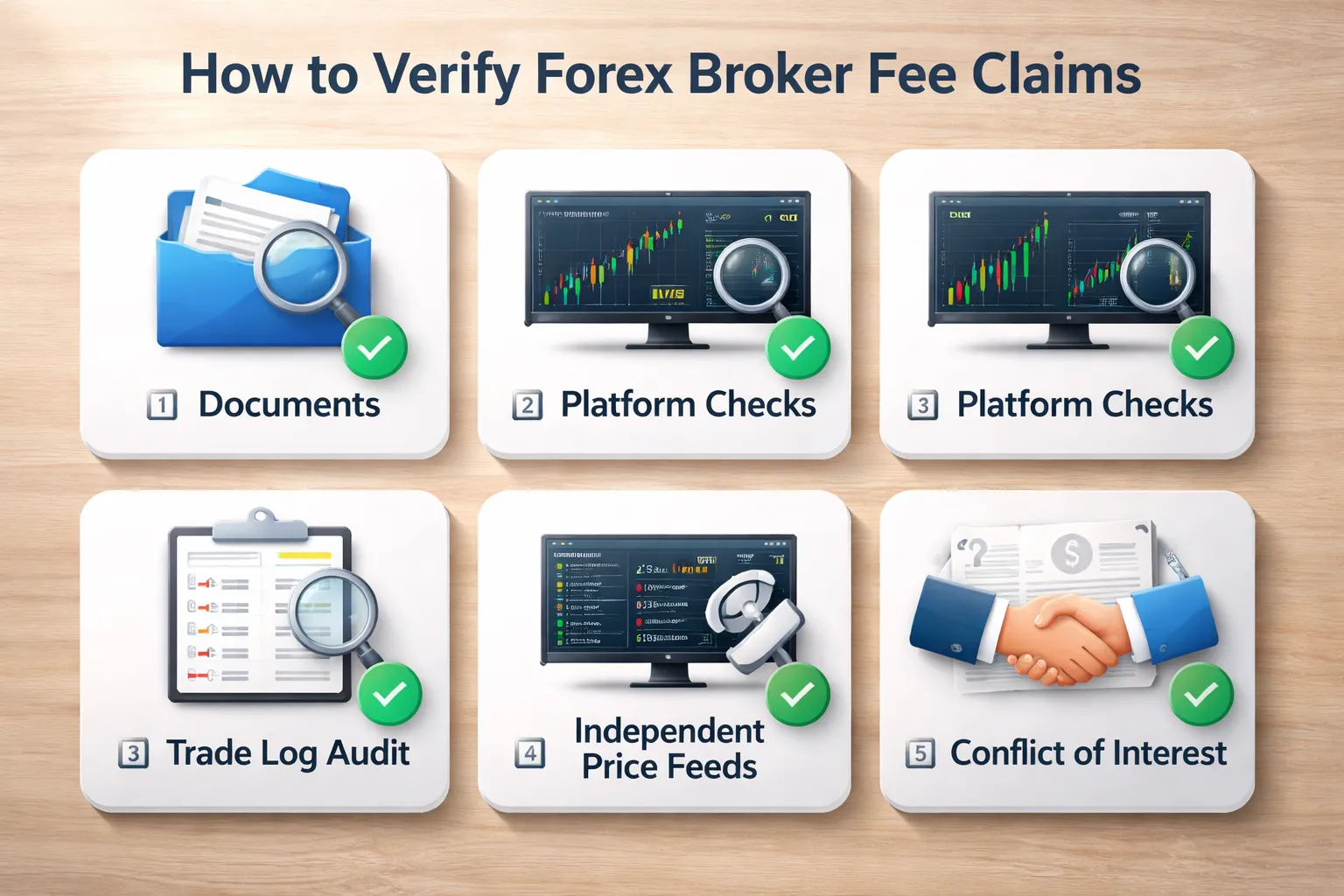
Where Reputable Brokers Disclose Fees
Start with primary sources. Ignore marketing pages until you verify the numbers.
- Client agreement and terms. Look for execution, charges, and negative balance sections.
- Product disclosure or fee schedule. This is where brokers list commissions, swaps, and non trading fees.
- Instrument specifications. Check contract size, tick value, margin, trading hours, and swap method.
- Account type pages. Confirm spread type, commission per lot, minimum deposit, and volume tiers.
- Funding and withdrawal pages. Watch for method fees, processing fees, and currency conversion rules.
Save PDFs and screenshots. Date them. Brokers update schedules. Your proof needs a timestamp.
How to Cross Check Real Spreads and Swaps in Demo vs Live
Demo pricing can differ from live pricing. You need both.
- Test the same symbols. Use the same account type, platform, and server.
- Record spread at set times. Log London open, New York open, and rollover.
- Compare typical vs minimum. Brokers advertise minimum spreads. Your cost comes from average spreads.
- Verify commission math. Open 1.00 lot. Confirm the commission charged matches the posted rate per side.
- Validate swaps. Hold a position through rollover. Check the posted swap points or cash charge. Confirm the triple day and the symbol specific rate.
Use live data for final decisions. Treat demo results as a rough filter.
Use Independent Data and Your Own Trade Logs
Your account history is the best audit trail.
- Export statements. Pull MT4 or MT5 reports, or your cTrader history, plus the broker portal ledger.
- Track effective spread. For each trade, compute entry price vs mid price at entry time if your platform shows bid and ask. If not, record bid, ask, and timestamp manually.
- Separate costs. Tag spread cost, commission, swap, and any platform or admin fees.
- Cross check with third party quotes. Compare your spreads to independent price feeds during the same minutes. Focus on liquid hours.
- Watch for pattern changes. A spread that widens on every entry, or swaps that diverge from the posted table, signals a problem.
| Claim | What you verify | Where you verify it |
|---|---|---|
| 0.0 pip spreads | Average spread during liquid hours | Live platform quotes, spread log |
| $X per lot commission | Commission per side and round turn | Trade history, contract specs, fee schedule |
| Swap free option | Any replacement fees or time limits | Terms, account conditions, ledger entries |
| No withdrawal fees | Broker fee vs payment provider fee vs conversion fee | Funding page, withdrawal receipt, bank or wallet statement |
Conflicts of Interest and How Brokers Get Paid
Fee claims tie directly to the broker business model. Know what incentives you create.
- Spread and commission pay the broker per trade. Higher turnover means higher broker revenue.
- Market makers can earn from the spread and client losses. This can increase conflict. It can also reduce commissions. You still need clean execution rules.
- STP and ECN setups still add markups. A broker can widen raw spreads, add commissions, or route flow to venues that benefit them.
- Swap and financing can be a profit center. Brokers can apply a markup to the underlying funding rate. You see it as a larger overnight charge.
- Non trading fees monetize inactivity. Inactivity fees, platform fees, and withdrawal charges target accounts that trade less.
Use your logs, plus the broker legal documents, to confirm what you pay in real terms. For a broader due diligence process, use this practical broker checklist.
FAQ: Forex broker fees explained
What forex broker fees should you expect?
You pay trading fees and non trading fees. Trading fees include spread, commission, and swap. Non trading fees include deposit, withdrawal, currency conversion, platform, and inactivity fees. Your real cost depends on your trade size, holding time, and account base currency.
What is the spread, in plain terms?
The spread is the gap between bid and ask. You pay it when you enter a trade, and again when you exit. Tight spreads cut costs. Spreads widen in low liquidity, news spikes, and outside peak market hours.
How do commissions work on forex accounts?
Commission is a fixed fee per lot, per side, or round turn. It sits on top of the raw spread. Some accounts show near zero spreads and charge commission. Standard accounts often bundle the cost into a wider spread.
How do you compare spread-only vs commission accounts?
Convert both to an all-in cost. Use your typical lot size. Add commission to the spread cost in dollars. Compare it across the pairs you trade most. Check average spreads, not minimum spreads.
What are swaps or overnight fees?
Swap is the overnight funding charge or credit when you hold past the broker cutoff time. It depends on the currency pair rates and the broker markup. You see it as a daily debit or credit on your account.
When can swap costs spike?
On rollover day, often midweek, brokers charge multiple days at once to cover weekend settlement. Swap can also jump when rate differentials change. Read the instrument specs, then verify with your platform swap values.
Do forex brokers charge deposit or withdrawal fees?
Many brokers price payments through their providers. You may pay broker fees, banking fees, card fees, or crypto network fees. Some brokers offer free withdrawals with limits. Always check fees by method, currency, and region.
What is a currency conversion fee?
You pay conversion when you fund, withdraw, or trade products that settle in another currency. The broker applies a conversion rate that can include a markup. This cost hides inside the exchange rate, not as a separate line item.
What is an inactivity fee?
An inactivity fee is a charge after you stop trading for a set period. Brokers deduct it monthly or quarterly until you trade again or your balance hits zero. Check the exact time threshold and the fee cap in the terms.
Are there platform or data fees in forex?
Some brokers charge for premium platforms, add-ons, VPS hosting, or market data. MetaTrader access usually costs nothing, but extras may not. Check the fee schedule and the client agreement, not the marketing page.
How do you confirm what you pay in real terms?
Track costs in your account history. Export trade logs. Measure average spread at entry, total commission, and swap per night. Compare to the broker legal documents. Use a practical broker checklist before you fund.
Conclusion
Conclusion
Broker fees decide your breakeven. You pay them on every entry, every exit, and often every night you hold.
Keep your focus on the numbers you can measure. Your real cost per trade equals spread + commissions + swaps, plus any non trading fees that hit your account balance.
- Record the average spread on your pairs at your trading hours, not at quiet market times.
- Add commissions in money terms per lot, then convert to pips so you can compare brokers.
- Audit swaps on held positions, and check triple swap days.
- Log non trading fees like withdrawals, conversions, inactivity, and platform extras.
- Verify every fee in the fee schedule and client agreement, not promo pages.
Final tip. Build a one page cost sheet for each broker and update it monthly from your account history. If you cannot confirm pricing from broker documents and your own logs, do not deposit. If you want help choosing the cheaper pricing model, read spread vs commission account types.
-
Regulated Forex Brokers Explained: Licenses, Safety & Red Flags
3 months ago -
Spread vs Commission: Which Forex Account Type Is Cheaper?
3 months ago -
Best Forex Brokers for Beginners (Top Picks + What to Look For)
3 months ago -
Forex Demo Account Guide: What It Is, How It Works & How to Use It
3 months ago -
How to Open a Forex Trading Account (Step-by-Step for Beginners)
3 months ago
-
- Commissions Explained (common on ECN/RAW accounts)
- Per-side vs. round-turn pricing
- Commission in money vs. converting to an all-in spread
- When commission accounts are cheaper than spread-only accounts
- Commission tiers, rebates, and active trader programs
- Commission edge cases: minimum ticket fees and micro-lot trading
-
- Swaps and Overnight Financing, the cost of holding positions
- What swap rates are and how they are calculated
- Long vs. short swaps and interest rate differentials
- Triple swap days and rollover schedules
- Swap-free Islamic accounts, how costs may be applied instead
- How to find and verify swaps inside your trading platform
- Risk controls for swap exposure in swing and carry strategies
-
- Step-by-step method to estimate round-trip cost per trade
- Convert spread and commission into pips for easy comparison
- Worked example: EUR/USD on spread-only vs. RAW plus commission
- Worked example: swap impact on a multi-day GBP/JPY position
- Build a simple fee tracker using platform reports or spreadsheets
-
- Fee checklist, what to confirm before opening an account
- How to compare brokers using average spreads and fee tables
- Red flags in fee disclosures and “too good to be true” claims
- Matching fee structure to strategy (scalping, day trading, swing, carry)
- Questions to ask support to validate real trading conditions
-
- What forex broker fees should you expect?
- What is the spread, in plain terms?
- How do commissions work on forex accounts?
- How do you compare spread-only vs commission accounts?
- What are swaps or overnight fees?
- When can swap costs spike?
- Do forex brokers charge deposit or withdrawal fees?
- What is a currency conversion fee?
- What is an inactivity fee?
- Are there platform or data fees in forex?
- How do you confirm what you pay in real terms?
-
- Commissions Explained (common on ECN/RAW accounts)
- Per-side vs. round-turn pricing
- Commission in money vs. converting to an all-in spread
- When commission accounts are cheaper than spread-only accounts
- Commission tiers, rebates, and active trader programs
- Commission edge cases: minimum ticket fees and micro-lot trading
-
- Swaps and Overnight Financing, the cost of holding positions
- What swap rates are and how they are calculated
- Long vs. short swaps and interest rate differentials
- Triple swap days and rollover schedules
- Swap-free Islamic accounts, how costs may be applied instead
- How to find and verify swaps inside your trading platform
- Risk controls for swap exposure in swing and carry strategies
-
- Step-by-step method to estimate round-trip cost per trade
- Convert spread and commission into pips for easy comparison
- Worked example: EUR/USD on spread-only vs. RAW plus commission
- Worked example: swap impact on a multi-day GBP/JPY position
- Build a simple fee tracker using platform reports or spreadsheets
-
- Fee checklist, what to confirm before opening an account
- How to compare brokers using average spreads and fee tables
- Red flags in fee disclosures and “too good to be true” claims
- Matching fee structure to strategy (scalping, day trading, swing, carry)
- Questions to ask support to validate real trading conditions
-
- What forex broker fees should you expect?
- What is the spread, in plain terms?
- How do commissions work on forex accounts?
- How do you compare spread-only vs commission accounts?
- What are swaps or overnight fees?
- When can swap costs spike?
- Do forex brokers charge deposit or withdrawal fees?
- What is a currency conversion fee?
- What is an inactivity fee?
- Are there platform or data fees in forex?
- How do you confirm what you pay in real terms?
-
How to Place a Forex Trade Step by Step (Your First Trade Explained)
1 month ago -
Forex Trading vs Crypto Trading: Which Market Is Better for Beginners?
1 month ago -
Forex Lot Size Calculator: How to Use It to Size Trades Correctly
3 months ago -
How to Calculate Position Size in Forex (Position Sizing Formula + Examples)
3 months ago -
Forex Leverage Explained: How It Works, Pros, Cons & Examples
3 months ago
-
Is Forex Trading Legal in the United States? Rules, Regulators & What to Know
3 months ago -
Forex Market Hours & Trading Sessions Explained (Best Times to Trade)
3 months ago -
Forex Trading Platforms Comparison: MetaTrader vs cTrader vs TradingView
3 months ago -
Forex Leverage Explained: How It Works, Pros, Cons & Examples
3 months ago -
What Is a Lot Size in Forex? Lot Types + Quick Examples
3 months ago