Is Forex Trading Halal? Islamic Accounts, Riba, Swap-Free Trading Explained

Forex trading can conflict with Islamic finance rules. The main risks are riba from overnight swaps, gharar from unclear terms, and maysir when you trade like a bet.
This guide breaks the issue into parts you can check. You will learn how spot FX works, where leverage and margin fit, and why many brokers charge or pay swaps after rollover. You will see what “Islamic” or “swap-free” accounts change, and what they do not change, including fees that may still act like interest. You will also get a checklist to review broker contracts, execution, and holding periods so you can align your trading with your standards.
- In het kort: Your main Shariah checks in retail FX are riba, gharar, and maysir.
- Spot FX settles T plus 2 at the interbank level, retail platforms simulate this with rolling positions.
- Most brokers apply a daily rollover swap when you hold past the cut-off time, this can act like interest.
- An Islamic or swap-free account removes the posted swap, it does not automatically make all trading halal.
- Some swap-free models replace swaps with admin fees, markups, or time-based charges, you must test if they mirror interest.
- Leverage and margin raise risk fast, they can push trades toward speculation if you trade like a bet.
- Execution terms matter, you need clear pricing, clear fees, and clear settlement rules to reduce gharar.
- Holding period matters, the longer you hold, the more rollover rules and hidden costs affect compliance.
- Use a broker checklist, read the contract, and verify regulator status to avoid fraud and fee traps, see how to spot forex scams and unregulated brokers.
What Forex Trading Is (and What You’re Actually Trading)
How Currency Exchange Works in Practice
Forex is the market for exchanging one currency for another.
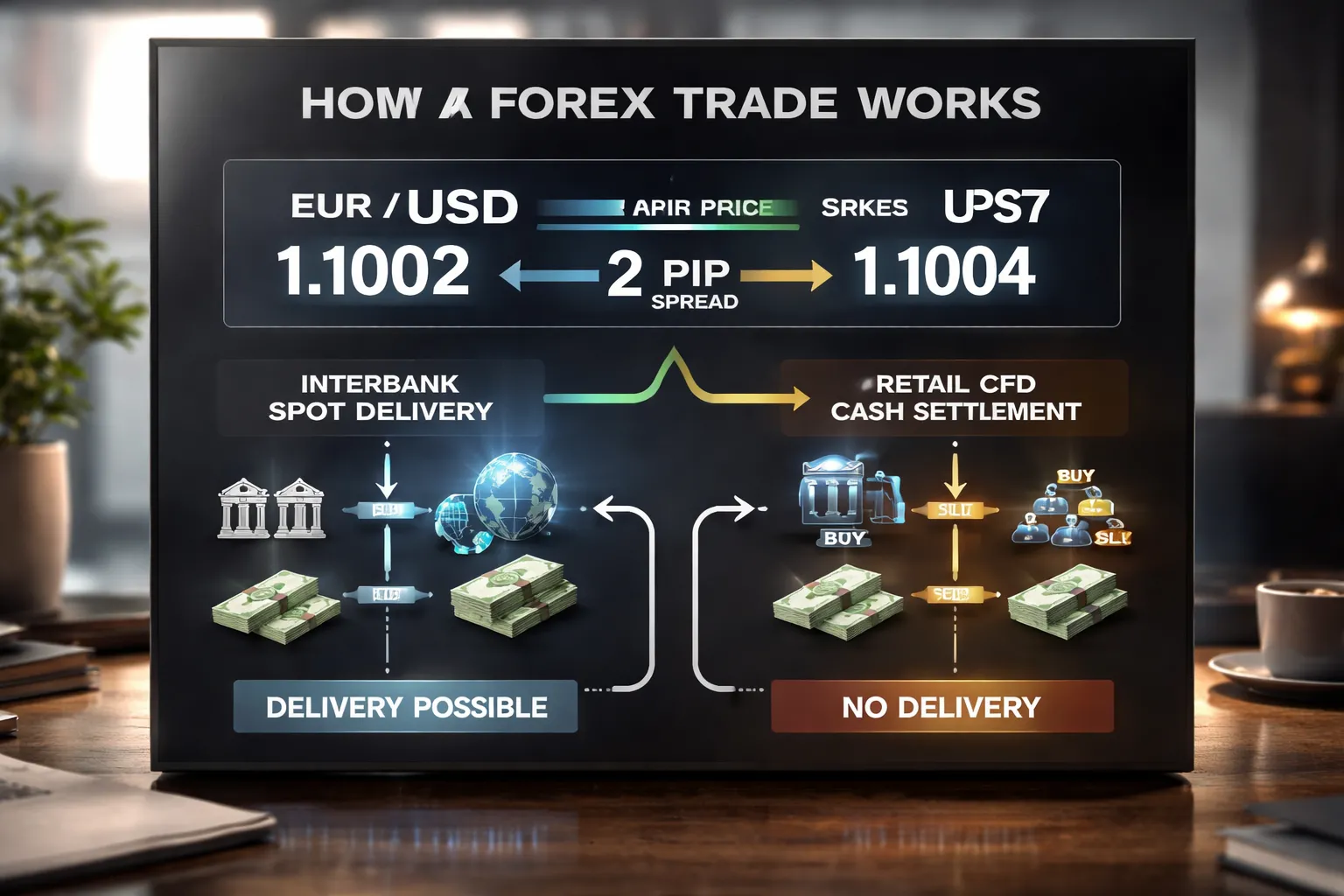
You trade currency in pairs. One currency is the base. The other is the quote. If EUR/USD is 1.1000, one euro equals 1.10 US dollars.
Your broker shows two prices.
- Bid. The price you can sell at.
- Ask. The price you can buy at.
The difference is the spread. It is a core trading cost.
Example.
- EUR/USD bid 1.0999
- EUR/USD ask 1.1001
- Spread 0.0002, or 2 pips
If you buy, you start at the ask. If you sell, you start at the bid. Price must move enough to cover the spread before you profit.
Retail FX vs Interbank FX, Why the Structure Matters
Most individuals do not trade in the interbank market. You trade through a broker.
Interbank FX is the wholesale market between banks and large institutions. Trades use large sizes, credit lines, and standardized settlement rules.
Retail FX usually uses margin and leverage. You post a small deposit. You control a larger position. This structure changes what you actually hold.
For halal rulings, structure matters because it affects:
- Counterparty. You often face the broker, not a bank market.
- Execution. Some brokers act as dealer. Some route orders to liquidity providers.
- Fees. You pay spread, commission, and often overnight financing.
- Settlement. Many retail products do not deliver currency to you.
If your trade never results in ownership or deliverable claim to currency, scholars often treat it differently than a real exchange contract.
Spot, Forward, Futures, Options, and CFDs
These are different instruments. They do not carry the same fiqh issues.
- Spot FX. A currency exchange for near term settlement. In global FX, spot typically settles on T+2 business days. Some pairs settle faster.
- Forward. A private contract to exchange currencies on a future date at a set rate. It commonly embeds a rate differential.
- Futures. A standardized exchange traded contract on a currency. It uses daily mark-to-market and margin rules set by the exchange.
- Options. A contract that gives a right, not an obligation, to buy or sell at a set rate before a date. You pay a premium.
- CFDs. A contract for difference. You do not buy or sell the currency. You settle profit or loss in cash with the broker.
Many “forex trading” accounts actually trade CFDs on FX, not spot delivery. This distinction drives many halal versus haram outcomes.
Ownership and Delivery, What Counts as Qabd Today
In classical fiqh, sarf requires exchange with possession, qabd, and rules against deferred exchange between money types.
Modern markets use electronic settlement. You rarely touch cash. Qabd often becomes constructive possession, qabd hukmi, if you gain control and the right to withdraw or transfer.
Practical signs your trade looks closer to qabd:
- Your account shows an actual currency balance after the trade, not just P and L.
- You can withdraw the bought currency.
- You can transfer it out to a bank or wallet in that currency.
- Settlement terms stay clear and fixed. No hidden rollover fees.
Practical signs you did not take possession:
- The product is labeled CFD, rolling spot, or perpetual spot.
- You cannot withdraw the base currency you “bought”.
- Your position exists only as an open contract with your broker.
- You pay or receive overnight financing tied to holding the position.
Before you decide on halal compliance, identify which product you trade and whether you can take delivery or only cash settle.
Use a safety checklist to screen forex brokers before you fund an account.
Islamic Finance Principles Used to Judge Forex (Shariah Framework)
Riba, where interest shows up in FX accounts
Riba means a guaranteed increase tied to time, not trade. In retail forex, it usually appears as financing.
- Overnight swap or rollover. Your broker debits or credits you when you hold a leveraged position past a cutoff time. Many brokers calculate it from interbank rates plus a markup.
- Embedded interest in CFDs. Even if you never see the word “swap,” the broker can price the cost into spreads, commissions, or a “holding fee.”
- Margin lending logic. With leverage, you effectively rent buying power. If the cost tracks time held, you must treat it as an interest-like charge unless the structure avoids riba under a recognized Shariah opinion.
- Cash balances. Some brokers pay or charge interest on idle cash, negative balance financing, or “credit” features. Turn these off when possible.
Swap-free accounts reduce one common riba channel, but you still need to check the full fee schedule and the contract terms.
Gharar, ambiguity in price, execution, and terms
Gharar means material uncertainty that changes the deal after you commit. In forex, the main risk sits in broker mechanics.
- Unclear execution. Requotes, last-look behavior, or “market execution” with wide discretion can make your fill price unpredictable.
- Confusing product definition. Many retail accounts trade a CFD or rolling spot contract, not a true currency exchange. If you cannot identify what you own, you cannot judge compliance.
- Hidden costs. Variable spreads, markups, and non-transparent “admin fees” can turn into unknown consideration.
- Unilateral contract changes. Terms that let the broker change margin rules, close trades, or adjust pricing with broad discretion increase gharar.
Reduce gharar by using brokers with clear product disclosure, published fee tables, and consistent execution policies. Use a safety checklist before you fund an account.
Maysir, when trading becomes gambling
Maysir links profit to chance-like behavior, with no productive aim and no disciplined risk control. Forex can drift into maysir when you trade for thrills, not for a defined economic purpose.
- Over-leverage. High leverage makes outcomes hinge on small ticks, not analysis or value.
- Random entries. Signals with no tested edge, revenge trading, and constant switching mimic games of chance.
- All-or-nothing risk. No stop-loss, oversized positions, and averaging down without a plan push you into lottery behavior.
- Bonus chasing. Promotions that require high turnover can encourage compulsive trading.
If your method cannot define risk per trade, maximum drawdown, and exit rules, you should treat it as high maysir risk.
Bay’ al-sarf rules for currency exchange
Bay’ al-sarf governs currency for currency exchange. Retail forex often breaks these rules because it is not structured as a real exchange with possession.
- Immediate exchange. Currency exchange must happen on the spot, without deferred delivery of one side. In practice, scholars discuss “constructive possession” and standard settlement, but a rolling contract that never settles creates problems.
- Same currency, equal amounts. If you exchange USD for USD later with an increase, that becomes riba. This matters in disguised structures that act like lending.
- Possession matters. Many brokers do not give you the base currency you “buy.” You hold a contract, not money you can withdraw and use. That weakens the case for bay’ al-sarf compliance.
| Rule area | What to verify in your account |
|---|---|
| What you trade | Spot exchange, deliverable account, CFD, rolling spot, or futures. Read the product disclosure. |
| Settlement and possession | Can you take delivery, withdraw the currency, or use it as real balance, or do you only cash settle P and L. |
| Time-based charges | Swap, rollover, holding fee, or any daily charge tied to keeping positions open. |
Ethics and intent, niyyah and economic purpose
Shariah screening does not stop at fees. You also weigh intent and harm.
- Purpose. Hedging a real currency need looks different from pure short-term speculation.
- Harm reduction. You must avoid excessive risk that can lead to debt, family harm, or deception.
- Counterparty conduct. If your broker profits from client losses through dealing-desk practices, you face ethical concerns beyond swaps.
- Transparency. You should understand the contract, costs, and execution before you trade. If you cannot explain it, you should not trade it.
So, Is Forex Trading Halal? A Practical Ruling Matrix (By Scenario)
When currency exchange is generally considered permissible
Most scholars treat currency exchange as permissible when you follow the rules of sarf, the Islamic contract for exchanging money.
- Everyday exchange, you convert money for travel, bills, imports, or savings. You pay a clear rate. You receive the currency immediately or within the standard spot settlement window used by the market.
- Clear spot FX, you buy and sell currencies at a known price, with no interest, no hidden fees, and no delayed delivery you cannot control.
- Same session exchange, you do not lock in a price now and postpone delivery later as a separate bargain. You exchange as one deal.
Cases that often become impermissible
Most “haram” issues in retail forex come from how the broker structures the account, not from the idea of exchanging currencies.
- Riba, you pay or receive overnight swap, rollover interest, or any interest-linked charge tied to time held.
- Fake swap-free pricing, the broker removes swaps but adds a time-based “administration fee” that tracks days held. Many scholars treat this as riba by another name.
- Unclear settlement, you cannot explain what you own, when settlement occurs, and what happens on rollover. If you do not understand delivery and closing mechanics, you risk gharar.
- Unfair contract terms, the broker can widen spreads at will, re-quote selectively, or void profits under vague clauses. This turns the contract into a dispute machine.
- Dealing desk conflict, the broker profits mainly when you lose, and it controls execution. This adds ethical risk beyond the swap question.
High-frequency scalping vs longer-term positions
Time horizon does not change the core rules, but it changes what you trigger in practice.
- Intraday trades, you often avoid swaps by closing before rollover. That removes the most common riba channel. You still must avoid deception, excessive leverage, and unclear execution.
- Multi-day trades, you face rollover rules, swap-free policies, and “fee instead of swap” structures. This is where many accounts fail Sharia screening.
- Very high frequency, you increase slippage, spread costs, and execution games. If your edge depends on broker latency or exploiting pricing errors, you move closer to unfairness and dispute.
Hedging for business needs vs pure speculation
Scholars often weigh intent and harm. Risk management for a real exposure usually gets more tolerance than seeking profit from price swings.
- Business hedging, you hedge a known future payment or receivable in a foreign currency. You aim to reduce risk, not create it. You still must avoid interest-based products and unclear contracts.
- Personal conversion planning, you stage conversions for tuition, rent, or travel, with clear pricing and settlement. This stays close to normal exchange.
- Pure speculation, you trade mainly for short-term gain, with high leverage and no underlying need. Scholars may classify this closer to maysir if your process looks like betting, or if risk control fails.
A practical ruling matrix (by scenario)
| Scenario | Typical ruling direction | Why | What to fix |
|---|---|---|---|
| Cash exchange at a bank or money changer | Likely halal | Clear price. Immediate exchange. | Confirm no interest, no deceptive fees. |
| Spot FX trade with transparent settlement, no swaps, no time-based fees | Often halal | Matches sarf conditions in practice. | Keep leverage controlled. Use clear execution. |
| Standard retail account with overnight swaps | Likely haram | Direct riba on holding time. | Do not use it. |
| “Swap-free” account that charges a fee per day held | Doubtful to likely haram | Time-linked charge can function like interest. | Ask for the fee basis. Avoid if it scales with days. |
| Swap-free account with a fixed, disclosed commission that does not depend on holding days | Often halal | Cost looks like a service fee, not riba. | Get the fee schedule in writing. Check enforcement. |
| Trading CFDs where you never own the currency, plus swaps or financing charges | Often doubtful to haram | Structure adds financing, synthetic exposure, and contract ambiguity. | Prefer spot-style structures. Avoid financing charges. |
| Highly leveraged day trading with tight stops and defined risk | Doubtful | May avoid riba, but can still resemble maysir if risk control fails. | Lower leverage. Use strict risk limits. |
| Hedging a real business exposure with Sharia-compliant execution | Often halal | Risk reduction for a real need. | Use clear contracts. Avoid interest-based hedges. |
| Broker with vague “we can cancel profits” clauses, poor regulation, or execution manipulation | Likely haram | Unfair contract terms and harm risk. | Use a safer broker, see this safety checklist for brokers. |
Simple checklist to classify your setup
- Likely halal if you have no swaps, no time-based fees, clear pricing, clear settlement, and you cap leverage and loss.
- Doubtful if costs change with time held, the contract language feels vague, you cannot explain execution, or your strategy depends on extreme leverage.
- Likely haram if you pay or receive any interest, you use products built on financing charges, or your broker uses unfair terms and conflict-driven execution.
- List every cost on your trade, spread, commission, swap, and “admin” charges.
- Check if any cost increases with time. Treat that as a red flag.
- Confirm when rollover occurs and what happens if you hold past it.
- Limit leverage. Set a maximum loss per day and per week.
- Read the broker’s legal terms on price adjustments, order execution, and profit cancellation.
- Document your intent, hedging or speculation, and your risk rules.
Islamic Accounts Explained (Swap-Free Forex) and How They Work
What “swap” and “rollover” mean, and why they link to riba
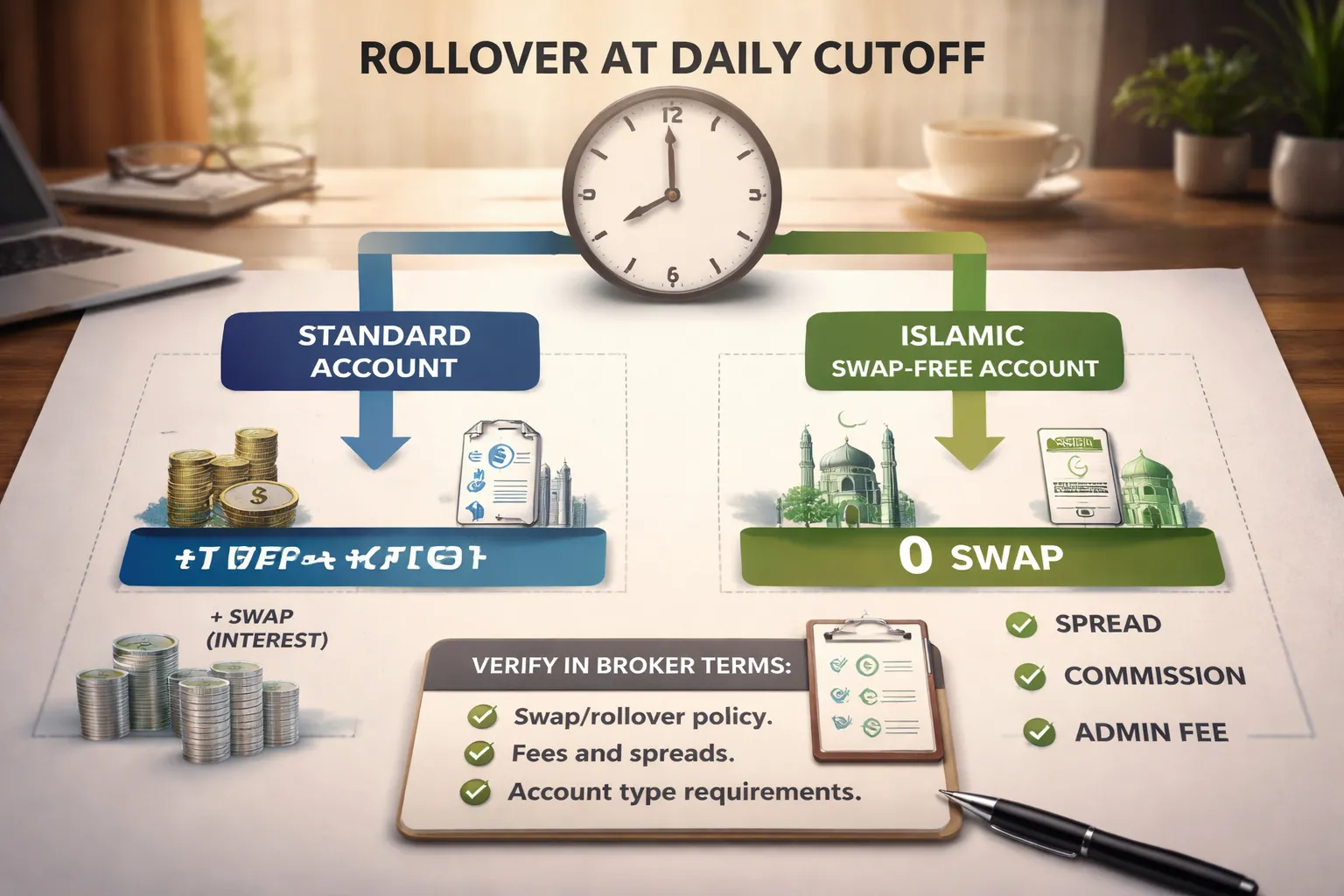
Rollover is the broker process that extends your open spot FX position past the daily cutoff. Many brokers run it around 5:00 pm New York time, but the exact time varies by server and symbol.
Swap is the overnight financing amount the broker adds or subtracts after rollover. It comes from the interest rate difference between the two currencies in your pair, plus the broker’s own markup.
In practice, swap works like interest on an open position held overnight. If you receive it or pay it, you touch riba in a form most scholars flag. That is why Muslim traders focus on removing swap from retail FX.
How swap-free accounts remove overnight interest, and what changes operationally
An Islamic or swap-free account sets the swap rate to zero. The broker does not credit or debit overnight interest when rollover happens.
Your trading workflow changes in a few ways.
- Account flag: The broker marks your account as swap-free. The setting may apply to all symbols or only to selected FX pairs.
- Rollover still occurs: Positions still roll to the next value date. You just do not see a swap line item posted.
- Costs move elsewhere: The broker still needs revenue and risk coverage. You often pay through spreads, commissions, markups, or fees that can mimic swap.
- Instrument limits: Many brokers exclude exotics, metals, indices, crypto, or certain CFDs from swap-free treatment.
Common Islamic account pricing models
Brokers use a few standard models. The label “swap-free” does not tell you which one you get.
| Model | How you pay | What to check |
|---|---|---|
| Fixed markup | A fixed fee per lot, per night, or per trade, described as an administration charge. | Does the fee rise with holding time. Does it apply only after rollover. If yes, it can function like interest. |
| Widened spread | A higher bid-ask spread on the swap-free account versus the standard account. | Compare average spreads on the same pair, same session, same account type. Check slippage and execution quality. |
| Commission-based | A clear per-side commission, with swaps set to zero. | Confirm commissions stay the same regardless of how long you hold. Watch for extra “handling” fees after a set number of days. |
Time limits and eligibility rules, and why brokers restrict access
Many brokers restrict swap-free access because it creates operational and risk problems for them.
- Arbitrage risk: Traders can target positive carry pairs and try to capture financing advantages without paying swap. Brokers block this with symbol restrictions, fee schedules, or time limits.
- Liquidity and hedge costs: Brokers and liquidity providers still face funding costs. They pass costs back to you through other charges.
- Eligibility checks: Some brokers require proof of religion or residency in Muslim-majority countries. Others approve any client but monitor behavior and can revoke swap-free status.
- Holding-period rules: A broker may allow swap-free for a limited number of days, then apply a fee. Read the exact day count, the fee basis, and which instruments it covers.
Why “swap-free” does not automatically mean Shariah-compliant
Swap-free only addresses one issue, overnight interest. Shariah compliance depends on the full structure of your trading and the broker’s terms.
- Disguised interest: A “daily admin fee” that increases with time and applies after rollover can replicate riba in another name.
- Contract mechanics: Many retail FX products are CFDs with no real delivery. Some scholars reject this regardless of swap.
- Excessive gharar: High leverage, weak execution terms, or the broker’s right to cancel profits can add unacceptable uncertainty.
- Shariah oversight: Some brokers cite a Shariah board or certificate. Do not treat marketing as proof. Verify the fee schedule and the legal terms line by line.
Use your own checklist and treat unclear fees as a warning sign. If the broker refuses to show exact swap-free pricing and eligibility rules in writing, walk away. For broker due diligence, use this safety checklist for spotting unregulated forex brokers.
Leverage, Margin, and CFDs: The Biggest Pain Points for Halal Forex
How margin trading works, and why it can look like borrowing with benefit
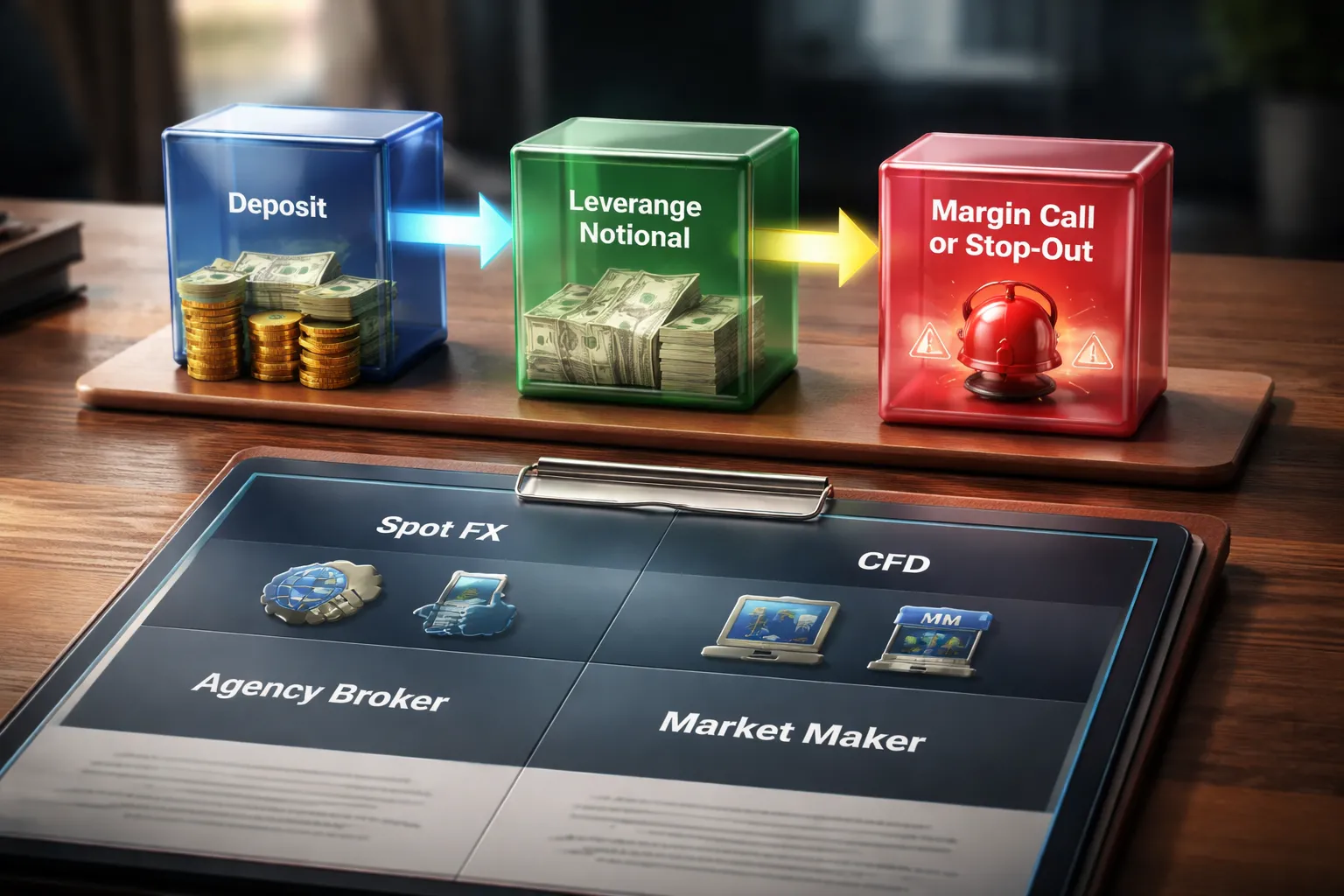
Retail forex usually runs on margin. You deposit a small amount. The broker lets you control a larger position using leverage.
Example. You deposit $1,000. You trade $100,000 notional with 1:100 leverage. Your $1,000 acts as collateral. Your broker finances the rest inside its system.
Shariah pain point. Margin can resemble a loan tied to a benefit for the lender. The benefit can show up as spreads, commissions, markups, or forced product choices. Even if the broker says “no interest,” you still need to test whether the structure functions like borrowing that generates a return for the broker.
- Check if the account agreement calls margin a “loan,” “credit,” or “financing.”
- Check if higher leverage requires higher fees, wider spreads, or a specific account type.
- Check if losses can create a debt balance, and how the broker enforces repayment.
CFDs vs spot FX, what you own, and why scholars disagree
Most retail forex is a CFD or CFD-like contract. You do not own currency. You hold a derivative claim against the broker based on price movement.
Spot FX in fiqh discussions often centers on sarf rules. Exchange must happen hand to hand, with immediate settlement, and without deferment. Retail platforms blur this because you rarely take delivery, and settlement is internal.
CFDs add more issues. The contract usually settles in cash differences. That shifts the trade away from currency exchange and toward a wager-like payoff structure, depending on how it is implemented.
- Spot-like model: you exchange currencies, and the broker acts as agent, with clear settlement mechanics.
- CFD model: you trade a price quote, you settle P and L in base currency, with no delivery.
- Why disagreement happens: some focus on intent and netting mechanics, others focus on legal form, delivery, and whether the trade becomes maysir or excessive gharar.
Broker as counterparty vs agency model, conflict-of-interest checks
Your broker may act as your counterparty. That is a market maker model. Your loss can become the broker’s gain. This creates a direct conflict.
Your broker may also route orders to external liquidity. That is closer to an agency model. The broker earns from commission or markup, not from your trading losses.
For halal risk, you want clear execution and fewer incentives to engineer slippage, re-quotes, or stop hunting.
- Ask who is the counterparty to your trade. If it is the broker, treat it as higher risk.
- Ask how they manage “A-book” vs “B-book” flow. Many brokers internalize losing traders.
- Ask for an execution policy. Look for terms on slippage, rejections, and price improvement.
- Prefer brokers with strong regulation. It does not make a product halal, but it reduces abuse risk. Use this safety checklist for spotting unregulated forex brokers.
Margin calls, stop-outs, and forced liquidation, gharar and fairness issues
Leverage makes small moves matter. If price moves against you, your equity falls. When equity hits a threshold, the broker issues a margin call or triggers a stop-out. The platform closes positions automatically.
The Shariah concern here is gharar and fairness. You can lose control of exit price. Closure can happen in fast markets, during spreads spikes, or on thin liquidity. Your loss can exceed what you expected, especially if negative balance protection fails.
| Mechanic | What happens | Halal risk angle |
|---|---|---|
| Margin call | You must add funds or reduce exposure | Pressure trading, forced behavior under stress |
| Stop-out | Broker closes trades to protect its collateral | Uncontrolled liquidation price, dispute risk |
| Spread widening | Costs jump during news or low liquidity | Hidden cost, sudden stop-outs |
| Negative balance | Loss exceeds deposit | Debt risk, possible interest language if overdue |
- Use lower leverage. It reduces forced liquidation risk.
- Trade smaller position sizes. Keep free margin high.
- Avoid holding through major news. Spreads and gaps cause unfair fills.
- Require written negative balance protection. Do not rely on marketing pages.
Practical alternatives with less Shariah risk
If you want FX exposure but you want to reduce Shariah conflicts, adjust the product and the time horizon.
- Use a Shariah-screened fund or portfolio that has FX as a risk component, not as leveraged speculation. You outsource execution to a structure designed for compliance.
- Use real currency exchange for travel or business needs. This aligns more cleanly with sarf, with actual delivery.
- Limit yourself to fully-funded trades. Avoid margin and high leverage. You reduce the “loan plus benefit” concern.
- Avoid CFDs when possible. If the only access is via CFDs, treat it as a higher-risk area and seek qualified Shariah advice tied to the exact contract.
- Focus on risk-managed, audited performance records. If you trade, track drawdown and exposure, and avoid strategies that depend on extreme leverage.
Spot FX Settlement, Qabd (Possession), and the ‘Immediate Exchange’ Requirement
What “hand-to-hand” means in digital finance, constructive possession explained
Classical fiqh requires taqabud, an immediate exchange in currency trades. You pay, you receive, in the same sitting. This blocks riba and settlement disputes.
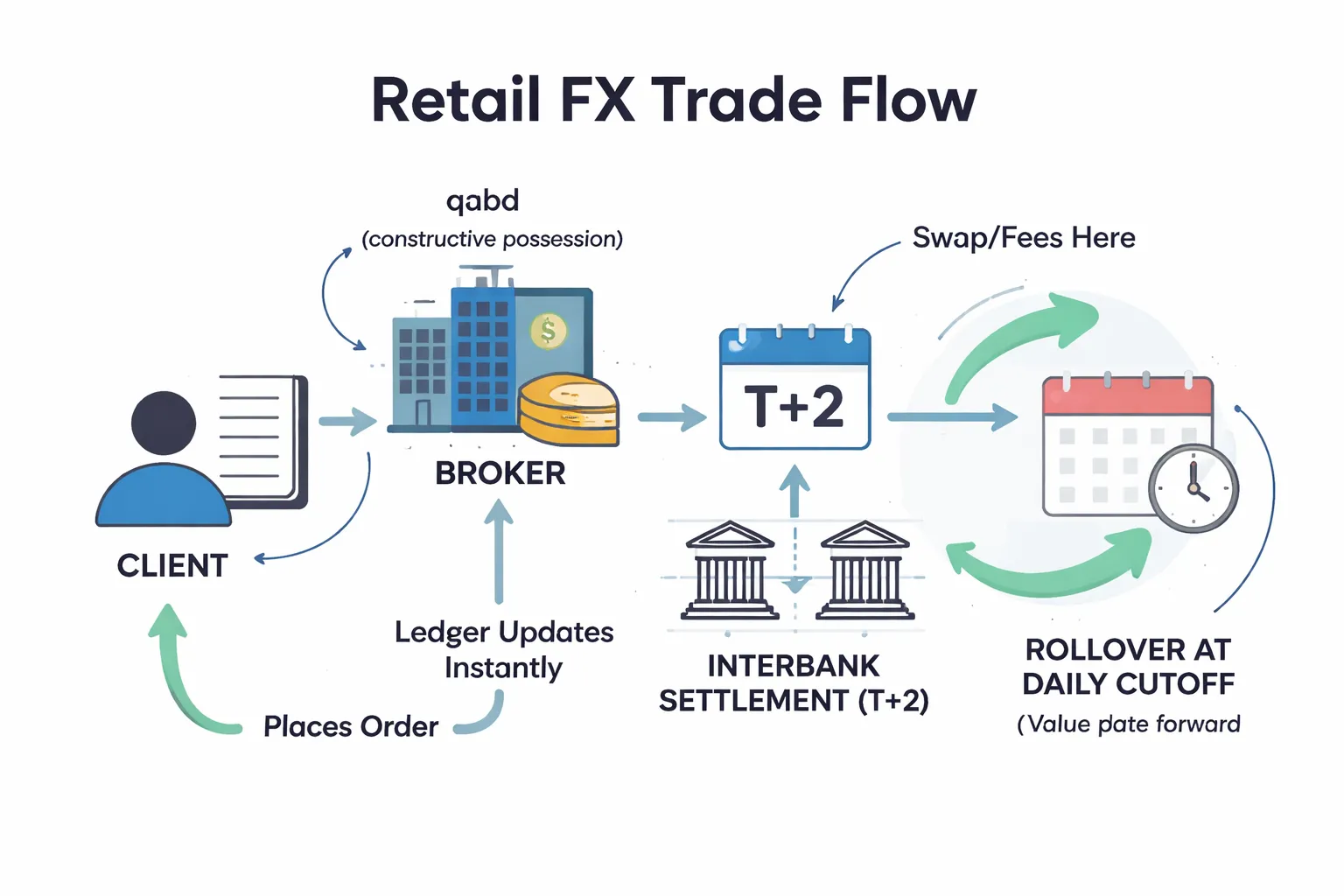
Modern trading does not pass paper cash across a table. It uses constructive possession, called qabd hukmi. You do not hold banknotes, but you control the asset and can dispose of it.
- You have constructive possession when your account balance updates, you can close the position, and you can withdraw or transfer funds under normal conditions.
- You do not have possession when the broker only gives you a price exposure, blocks delivery by design, or makes your “ownership” depend on a loan contract.
- Key point for Shariah review is control, not physical handling.
Why T+2 settlement historically mattered, and how modern systems handle it
In institutional FX, spot often settles on T+2. This came from banking rails, time zones, and payment system cutoffs. The trade confirms now, the cash movement happens later.
Retail platforms usually show instant execution. That screen update is not the same as interbank settlement. Most retail brokers internalize flow, net client positions, or hedge later. Your trade can be “effective now” in your ledger while cash settlement occurs later inside the broker’s plumbing.
Shariah relevance sits in this gap. Some scholars accept constructive possession if the transaction is binding and your ownership and disposal rights start immediately. Others argue currency exchange needs real-time settlement, not delayed netting.
Same-day vs next-day rollover mechanics, and Shariah implications
Spot FX uses a rolling settlement convention. If you keep a position past the daily cutoff, the broker “rolls” the value date forward. This creates the overnight financing element that causes most Shariah problems.
- Close before rollover, you avoid the rollover process. You still face the question of spot settlement and possession, but you reduce interest-linked mechanics.
- Hold after rollover, the position usually triggers a credit or debit based on interest rate differentials. Many brokers label this swap.
- Swap-free accounts remove the posted swap. Some brokers replace it with admin fees, markups, or time-based charges. You must verify the fee logic and whether it tracks interest rates.
Practical check. Review your trade history and confirm what happens at the cutoff time. Look for any recurring debit pattern tied to nights held, even if the broker calls it a “service fee.”
Evidence-based view, how contemporary scholars interpret settlement on retail platforms
Modern fatwas split because retail FX structures split. Scholars who allow it usually rely on constructive possession and the argument that binding account credit counts as qabd. Scholars who prohibit it usually point to one or more of these:
- No true delivery, the platform gives a contract for differences, not currency exchange.
- Margin lending, you trade with borrowed money, then any benefit to the lender becomes a riba risk.
- Interest mechanics, rollover and swap embed rate differentials, even if hidden.
- Settlement uncertainty, the broker can delay, cancel, or reprice fills, which weakens the “immediate exchange” claim.
You can make this more concrete. Ask for the broker’s product disclosure and execution policy. Confirm whether you trade spot deliverable FX or a derivative. Confirm whether you can take delivery, even if you never plan to. If you need a clean way to audit your trading records and exposure, use this guide to reading Myfxbook metrics.
How to Trade Forex the Halal Way (Step-by-Step Process)
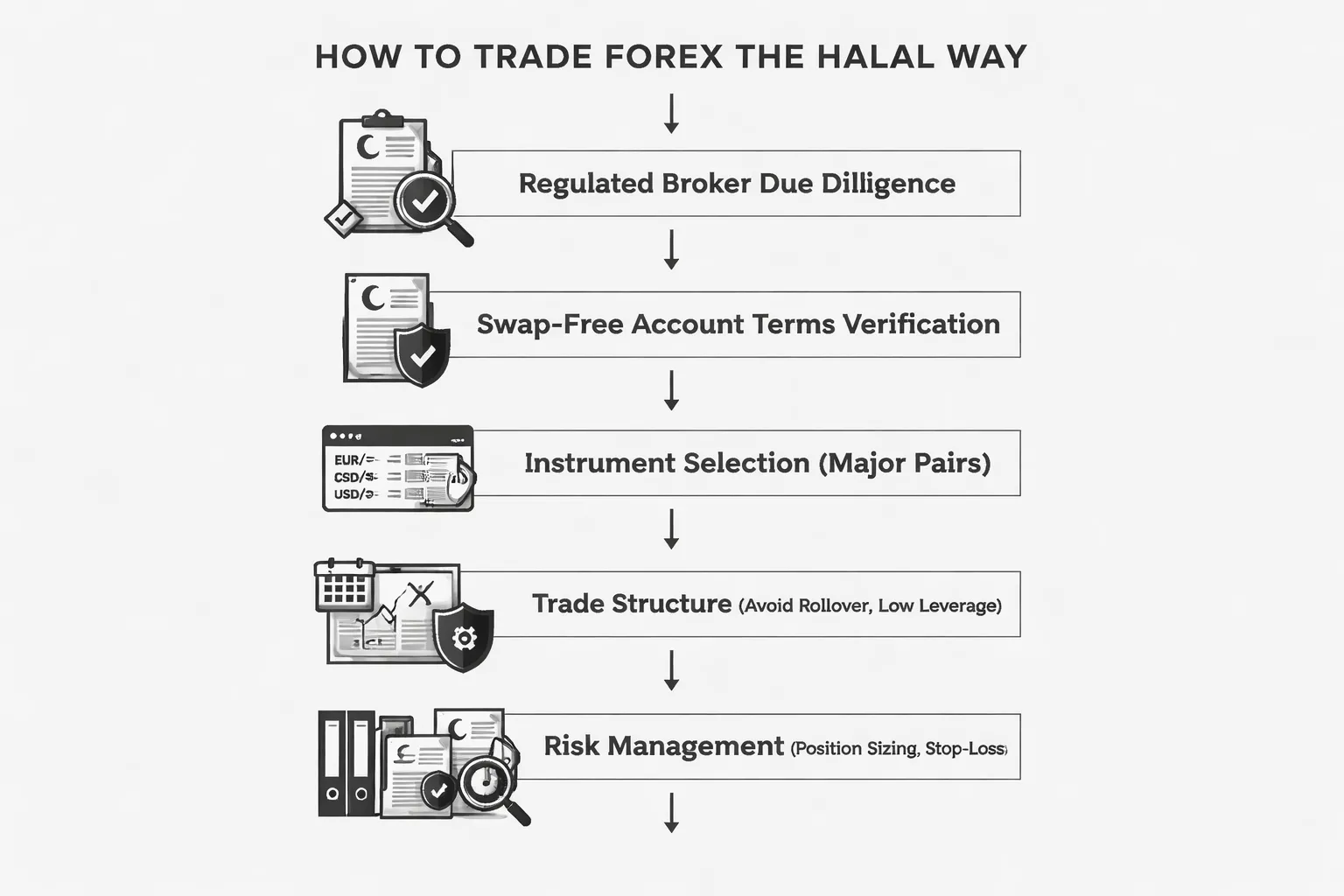
Selecting a broker, due diligence checklist for Islamic accounts
- Verify regulation. Check the broker’s license, regulator, and legal entity name. Match it to the website footer and client agreement. Use this unregulated broker safety checklist if anything looks off.
- Request the right documents. Get the Product Disclosure Statement, Terms of Business, execution policy, and full fee schedule. Save PDFs.
- Confirm what you trade. Ask if you trade spot deliverable FX or CFDs. Ask if delivery is possible in principle, even if you never plan to take delivery.
- Get the Islamic account terms in writing. Confirm swap-free status, the exact swap policy, and any replacement fees. Many brokers replace swaps with admin fees.
- Check for hidden interest by another name. Look for “overnight financing,” “rollover fee,” “storage,” “carry adjustment,” “swap compensation,” or tiered fees by holding days.
- Check time limits. Some brokers allow swap-free only for a set number of days, then charge financing. Confirm limits per symbol.
- Check spreads and commissions on Islamic accounts. Compare to standard accounts on the same symbols. A wider spread can function like a financing substitute.
- Confirm execution and slippage policy. You need clear rules on fills, requotes, partial fills, and order handling. Save the policy and date.
- Ask about negative balance protection and margin closeout. You want predictable risk rules. Unclear liquidation rules increase gharar.
Choosing instruments, which pairs and products raise fewer issues
- Prefer major FX pairs with deep liquidity. EURUSD, USDJPY, GBPUSD, USDCHF, AUDUSD, USDCAD. They usually have tighter spreads and cleaner execution.
- Avoid high-swap pairs and thin crosses. Exotic pairs often come with wider spreads and larger overnight adjustments, even on “swap-free” setups.
- Avoid products that embed financing by design. Many indices, metals, and crypto products trade as CFDs with explicit financing mechanics.
- Avoid options and futures if you cannot justify the structure. They add contract-specific terms and settlement features that can increase gharar for retail traders.
- Trade fewer symbols. You can audit costs and terms faster and spot fee changes sooner.
Structuring trades, avoiding overnight interest and minimizing doubtful elements
- Use a swap-free account. Do not assume it applies to every symbol. Confirm symbol-by-symbol.
- Keep holding periods short when practical. Intraday and short swing trades reduce exposure to rollover rules, admin charges, and policy changes.
- Avoid trading through rollover time. Many brokers apply adjustments at a set server time. Know that time and plan entries and exits around it.
- Use simple order types. Market, limit, and stop orders with clear levels. Avoid complex conditional orders you do not fully understand.
- Reduce leverage. High leverage increases forced liquidation risk and turns small price moves into account-threatening events.
- Do not chase rebates, bonuses, or volume programs. They push overtrading and distort your decision process.
- Refuse any arrangement that guarantees profit. If the broker, signal seller, or account manager promises fixed returns, walk away.
Risk management as a Shariah safeguard, position sizing, stop-loss, and discipline
- Cap risk per trade. Use a fixed fraction of equity, many disciplined traders use 0.25% to 1% per trade. Keep it consistent.
- Place a stop-loss at entry. Decide the invalidation level first, then size the position to match your risk limit.
- Set a daily and weekly loss limit. Stop trading after you hit it. This blocks revenge trading and reduces maysir-like behavior.
- Limit correlation. Do not stack multiple USD trades that behave like one oversized bet. Count correlated positions as one risk.
- Use a maximum leverage rule. Example, keep effective leverage under 3x to 5x. This reduces blow-up risk from normal volatility.
- Trade a written plan. Define setup, entry trigger, stop, target or exit rule, and maximum number of trades per day.
Record-keeping and transparency, documenting fees, terms, and trade rationale
- Save the broker terms. Keep dated copies of the Islamic account policy, fee schedule, and execution policy.
- Export trade history monthly. Download statements showing open, close, commissions, spreads, and any overnight or admin charges.
- Track all non-price charges. Log commissions, conversion fees, inactivity fees, withdrawal fees, and any “adjustments.”
- Write a trade note. Record the setup, reason for entry, risk size, and exit rule. Keep it short and factual.
- Audit for prohibited charges. If you see recurring overnight items or day-based holding fees, escalate to support and request a written explanation.
- Keep a clean paper trail for scholars and for yourself. You need proof of what you traded, what you paid, and what the broker applied.
Scholarly Opinions and Real-World Fatwa Nuance (Why You’ll See Different Answers)
Why Scholars Differ: Market Structure, Possession, and Brokerage Models
You will see different answers because scholars start from different assumptions about how your trade works.
- Market structure. Many retail FX trades never reach the interbank spot market. Your broker may internalize flow, hedge later, or use a synthetic contract. Some scholars treat this as a private derivative, not currency exchange.
- What you actually trade. You might trade spot, a CFD, a forward, or a rolling spot product. Each one changes the riba and bayʿ al-sarf rules.
- Possession (qabd). Classical rules require exchange hand to hand for currencies. Modern systems use book entries. Scholars differ on whether account credit equals constructive possession, and on when it happens.
- Settlement timing. True spot FX settles T+2 for many pairs. Retail platforms show instant execution. Some scholars accept constructive settlement. Others treat delayed settlement as non-compliant unless structured as a permissible agency model.
- Leverage and margin. Some scholars view margin as a loan that brings benefit to the lender, especially when linked to fees, spreads, or forced rollover mechanics.
- Swap-free accounts. Brokers often replace swaps with admin fees, wider spreads, or time-based charges. Scholars differ on when a substitute becomes interest in another name.
- Regulation and documentation. Many rulings depend on the exact contract terms. Two brokers can both label an account “Islamic” and still use different fee logic.
Major Themes in Permissive vs Cautious Views
You will usually find the disagreement around a few repeat issues.
- Permissive lean. Some scholars allow trading when you avoid explicit interest, use a swap-free structure with no time-value charge, and treat platform settlement as valid constructive possession.
- Permissive lean. Some accept that profit from price movement in currencies can be halal if the contract resembles a valid exchange and you avoid excessive uncertainty.
- Cautious lean. Some scholars reject most retail FX because the product is effectively a CFD, not spot sarf, and you do not take real delivery or possession.
- Cautious lean. Many treat any time-based overnight charge, even if renamed, as riba when it tracks holding duration or interest benchmarks.
- Cautious lean. Some see leverage as a loan tied to trading, where the broker benefits through spread, commissions, or forced rollovers.
- Both sides focus on intent and behavior. High leverage, frequent gambling-like bets, and no risk controls push the activity toward maysir, even if the account claims swap-free terms.
If you want a tighter framework for the core fiqh rules that keep showing up in these opinions, read Islamic finance rules for forex trading.
Questions to Ask a Qualified Scholar for a Tailored Answer
Bring facts, not marketing claims. Give your scholar your broker agreement, fee schedule, and a real statement export.
- What is the legal contract? Spot FX, CFD, rolling spot, forward, or something else.
- Do I gain qabd, and when? At execution, at end of day, or never.
- Does the broker lend me funds? If yes, what benefit does the broker receive because of that loan.
- How does the broker earn on my holding time? Ask specifically about overnight fees, admin fees, “storage,” “profit share,” or tiered spread changes after X days.
- Does the swap-free model apply to every symbol I trade? Some brokers exempt majors but charge on exotics, metals, indices, or crypto.
- Can fees exceed the conventional swap? If yes, ask if that changes the ruling.
- Do I face forced rollover exposure? Ask about end-of-day policies, triple-day adjustments, and whether the broker can change conditions.
- Does my trading resemble speculation without purpose? Share your holding time, leverage, risk limits, and whether you treat it as income replacement or entertainment.
Personal Circumstances: Necessity, Hardship, and Ethical Boundaries
Rulings can change based on your situation. Scholars may apply different thresholds when hardship exists.
- Necessity (darura). Darura has limits. It does not turn a prohibited structure into a preferred job. It may affect what you do when you cannot access a halal alternative and your need is real and immediate.
- Hardship (hajah). Some scholars treat strong need as a reason to permit narrower forms with tighter controls, such as lower leverage, shorter holding, and strict avoidance of time-based charges.
- Ethical boundaries you control. You choose leverage, frequency, and risk. Use hard loss limits. Avoid revenge trading. Avoid instruments with unclear fee logic. Stop if you cannot explain every charge on your statement.
- Income dependence. If trading becomes your only income, you face pressure to overtrade and ignore rules. Plan for that risk.
- Transparency. If you cannot audit the fees, you cannot give a clean answer. Lack of clarity itself can push the activity into prohibited uncertainty.
Pros, Cons, and Ethical Considerations for Muslim Traders
Potential benefits when structured correctly
- Liquidity. Major FX pairs trade around the clock. You can enter and exit fast. That helps you control slippage on liquid pairs, but it does not remove risk.
- Hedging. If you earn or spend in multiple currencies, FX can reduce currency risk. You can hedge known exposures like tuition, invoices, or salary conversions. Treat hedges as risk control, not profit engines.
- Skill-based approach. You can build a rules-based method, define risk per trade, and track execution. This pushes trading toward analysis and away from impulsive behavior. You still must avoid riba, hidden swap logic, and products with unclear settlement terms.
Common harms you need to plan for
- Addiction-like behavior. Fast feedback and high leverage can lock you into constant checking and constant trading. Set hard limits on screen time, trades per day, and maximum weekly loss.
- Overtrading. Low spreads and easy execution can make frequent trades feel harmless. Fees compound. Errors compound. Your edge disappears when you force trades.
- Financial stress. Drawdowns create pressure. Pressure leads to rule breaking. If you need trading profits to pay monthly bills, you will likely increase risk at the worst time.
Analysis-driven trading vs gambling-like speculation
- Start with intent. You must be able to explain why you entered, where you exit, and what invalidates the trade. If you cannot state those in one minute, you trade on hope.
- Use defined risk. Set position size from a fixed risk limit. Do not size up after losses. Do not martingale. Do not chase.
- Avoid “lottery” setups. Very high leverage, no stop-loss, and revenge trading turn trading into maysir-like behavior. The structure matters as much as the instrument.
- Control uncertainty. You can reduce gharar by using transparent contracts, clear fee schedules, and known rollover policies. If the broker cannot show a clean breakdown of every charge, walk away.
Zakat and taxation considerations for FX profits
Zakat. Zakat treatment depends on what you hold, how long you hold it, and local scholarly guidance. Many traders treat cash balances and liquid trading equity as zakatable assets when they reach nisab and a hawl passes. Keep clean records of deposits, withdrawals, open equity, and closed profits. Ask a qualified local scholar how to treat margin, open positions, and unsettled P and L in your jurisdiction.
Taxes. Tax rules vary by country and can apply even if you withdraw nothing. Track every trade, fee, and financing line item. Save statements and daily reports. Verify local reporting rules and whether your broker reports to tax authorities. If you trade from the US, follow the correct FX tax treatment and consider reading our Forex taxes in the US guide.
FAQ
Is forex trading halal in Islam?
It depends on how you trade. Many scholars allow spot FX with real delivery, clear pricing, and no interest. Your setup must avoid riba, reduce gharar, and avoid maysir. Get a ruling from a qualified scholar who understands your broker model.
What makes forex trading haram?
Common triggers are interest charges, disguised financing, excessive uncertainty, and gambling-like behavior. Swap fees, margin loan interest, and bonus schemes tied to turnover can fall under riba. High leverage with no plan can resemble maysir. Read your broker’s fee schedule line by line.
What is riba in forex trading?
Riba is interest on money. In retail FX it often shows up as overnight swap, financing, or rollover credits and debits. Some brokers re-label it as “administration” or “carry.” If it varies with interest rate differentials, treat it as riba unless your scholar states otherwise.
What is a swap-free Islamic account?
A swap-free account removes overnight swap. You still pay spreads, commissions, and sometimes a fixed fee. Check how the broker replaces swap revenue. If the “swap-free” model adds time-based fees that mimic interest, the account may still be non-compliant.
Are swap-free accounts always halal?
No. Some brokers charge a daily fee after a holding period, widen spreads, or apply “profit adjustments.” You need to verify the fee logic and the contract terms. Ask for a written schedule that lists every charge by instrument and holding time.
Is leverage halal in forex?
Scholars differ. Leverage can involve an interest-based loan, which creates riba. Some brokers structure margin differently, but you must confirm the legal reality, not the marketing. If leverage increases reckless risk, it can also push you toward maysir.
Is day trading forex halal?
It can be, if trades avoid riba and you follow a disciplined process. Fast trading increases execution risk and can turn into gambling behavior. Use defined risk limits, position sizing, and written rules. Avoid “revenge trading” and random entries.
Is scalping halal?
Scalping is a method, not a ruling. It becomes problematic when it depends on deception, abuse of broker terms, or gambling-like impulses. Confirm your broker allows scalping and your fills reflect real market conditions. Keep records to prove the fee and execution model.
Is trading CFDs halal?
Many scholars view CFDs as non-compliant because you do not take delivery and the contract can resemble wagering on price. CFDs also often include financing charges. If you trade CFDs, ask a qualified scholar and review the exact contract and fee mechanics.
Is trading forex on MetaTrader halal?
The platform does not decide permissibility. Your account type, fees, and execution model do. MT4 and MT5 can show swaps and commissions, but you must still verify the broker’s back-end. Download daily statements and check all financing lines.
How do I check if my broker’s “Islamic account” is real?
Request written terms, a full fee schedule, and sample statements. Look for any time-based holding fee, rollover adjustment, or interest-linked credit. Test with a small account and hold positions overnight. Compare statements to the advertised “swap-free” promise.
What documents should I keep for compliance and taxes?
Save trade confirmations, daily statements, and monthly account reports. Keep records of spreads, commissions, swaps, and any “administration” fees. Store withdrawal and deposit receipts. If you trade from the US, review Forex taxes in the US to log the right numbers.
How do I avoid forex scams that target “halal” traders?
Avoid guaranteed returns, “Sharia-certified” claims with no documentation, and pressure to deposit fast. Verify regulation, ownership, and withdrawal terms. Search for independent complaints and test withdrawals early. Use this checklist on how to spot forex scams before funding.
Conclusion
Forex can fit Islamic rules, but only if you control the details. Your biggest risks are riba through swaps or hidden financing charges, and gharar through unclear terms.
- Start with the structure. Favor spot trading with clear settlement and documented fees.
- Use swap-free accounts with proof. Read the product disclosure. Check if the broker uses admin fees, wider spreads, or time limits that act like interest.
- Cut leverage and hold times. High leverage and long holds increase financing risk, gap risk, and forced liquidations.
- Trade a written plan. Set position size, entry, exit, and max loss before you place the order.
- Verify the broker. Confirm regulation, ownership, and withdrawals. Test a small withdrawal before you scale.
Final tip. Treat “halal” as a checklist, not a label. Save screenshots of the swap-free terms, fee schedule, and statements. You will need them for compliance, and you will need them if a dispute starts. For your tax records, keep clean logs and match them to your filing method in Forex taxes in the US.
-
Is Forex Trading Legal in the United States? Rules, Regulators & What to Know
7 months ago -
Forex Taxes in the US: Section 988 vs 1256 (Complete Guide)
7 months ago -
Is Forex Trading Halal? Islamic Finance Rules Explained
7 months ago -
How to Spot Forex Scams and Unregulated Brokers (Safety Checklist)
7 months ago -
How to Read Myfxbook Results: Metrics Explained (Drawdown, Gain, Risk & More)
7 months ago
-
- What “swap” and “rollover” mean, and why they link to riba
- How swap-free accounts remove overnight interest, and what changes operationally
- Common Islamic account pricing models
- Time limits and eligibility rules, and why brokers restrict access
- Why “swap-free” does not automatically mean Shariah-compliant
-
- Administration Fees vs Disguised Interest, How to Tell the Difference
- Widened Spreads and Commissions, When Pricing Becomes Time-Linked
- “Islamic Account” Marketing Claims vs Verifiable Contract Disclosures
- Negative Balance Protection and Financing Language to Scrutinize in T&Cs
- Shariah Board Certification, What It Proves, What It Doesn’t, and What to Request
-
- How margin trading works, and why it can look like borrowing with benefit
- CFDs vs spot FX, what you own, and why scholars disagree
- Broker as counterparty vs agency model, conflict-of-interest checks
- Margin calls, stop-outs, and forced liquidation, gharar and fairness issues
- Practical alternatives with less Shariah risk
-
- What “hand-to-hand” means in digital finance, constructive possession explained
- Why T+2 settlement historically mattered, and how modern systems handle it
- Same-day vs next-day rollover mechanics, and Shariah implications
- Evidence-based view, how contemporary scholars interpret settlement on retail platforms
-
- Selecting a broker, due diligence checklist for Islamic accounts
- Choosing instruments, which pairs and products raise fewer issues
- Structuring trades, avoiding overnight interest and minimizing doubtful elements
- Risk management as a Shariah safeguard, position sizing, stop-loss, and discipline
- Record-keeping and transparency, documenting fees, terms, and trade rationale
-
- Is forex trading halal in Islam?
- What makes forex trading haram?
- What is riba in forex trading?
- What is a swap-free Islamic account?
- Are swap-free accounts always halal?
- Is leverage halal in forex?
- Is day trading forex halal?
- Is scalping halal?
- Is trading CFDs halal?
- Is trading forex on MetaTrader halal?
- How do I check if my broker’s “Islamic account” is real?
- What documents should I keep for compliance and taxes?
- How do I avoid forex scams that target “halal” traders?
-
-
- What “swap” and “rollover” mean, and why they link to riba
- How swap-free accounts remove overnight interest, and what changes operationally
- Common Islamic account pricing models
- Time limits and eligibility rules, and why brokers restrict access
- Why “swap-free” does not automatically mean Shariah-compliant
-
- Administration Fees vs Disguised Interest, How to Tell the Difference
- Widened Spreads and Commissions, When Pricing Becomes Time-Linked
- “Islamic Account” Marketing Claims vs Verifiable Contract Disclosures
- Negative Balance Protection and Financing Language to Scrutinize in T&Cs
- Shariah Board Certification, What It Proves, What It Doesn’t, and What to Request
-
- How margin trading works, and why it can look like borrowing with benefit
- CFDs vs spot FX, what you own, and why scholars disagree
- Broker as counterparty vs agency model, conflict-of-interest checks
- Margin calls, stop-outs, and forced liquidation, gharar and fairness issues
- Practical alternatives with less Shariah risk
-
- What “hand-to-hand” means in digital finance, constructive possession explained
- Why T+2 settlement historically mattered, and how modern systems handle it
- Same-day vs next-day rollover mechanics, and Shariah implications
- Evidence-based view, how contemporary scholars interpret settlement on retail platforms
-
- Selecting a broker, due diligence checklist for Islamic accounts
- Choosing instruments, which pairs and products raise fewer issues
- Structuring trades, avoiding overnight interest and minimizing doubtful elements
- Risk management as a Shariah safeguard, position sizing, stop-loss, and discipline
- Record-keeping and transparency, documenting fees, terms, and trade rationale
-
- Is forex trading halal in Islam?
- What makes forex trading haram?
- What is riba in forex trading?
- What is a swap-free Islamic account?
- Are swap-free accounts always halal?
- Is leverage halal in forex?
- Is day trading forex halal?
- Is scalping halal?
- Is trading CFDs halal?
- Is trading forex on MetaTrader halal?
- How do I check if my broker’s “Islamic account” is real?
- What documents should I keep for compliance and taxes?
- How do I avoid forex scams that target “halal” traders?
-
-
How to Place a Forex Trade Step by Step (Your First Trade Explained)
5 months ago -
Forex Trading vs Crypto Trading: Which Market Is Better for Beginners?
5 months ago -
Forex Lot Size Calculator: How to Use It to Size Trades Correctly
7 months ago -
How to Calculate Position Size in Forex (Position Sizing Formula + Examples)
7 months ago -
Forex Leverage Explained: How It Works, Pros, Cons & Examples
7 months ago
-
Forex Trading Platforms Comparison: MetaTrader vs cTrader vs TradingView
7 months ago -
Stop Loss vs Take Profit: Differences, Examples & Best Practices
7 months ago -
Is Forex Trading Legal in the United States? Rules, Regulators & What to Know
7 months ago -
Forex Leverage Explained: How It Works, Pros, Cons & Examples
7 months ago -
Forex Market Hours & Trading Sessions Explained (Best Times to Trade)
7 months ago