How to Practice Forex Trading Effectively (Demo, Replays & Routines)
Most forex losses come from poor execution and weak process. You fix both with structured practice. This guide shows you how to practice forex trading with three tools, demo accounts, market replays, and routines.
You will learn how to set up a demo the right way, so your results mean something. You will learn how to use replays to test entries, exits, and trade management on real historical price movement. You will build a weekly routine that tracks every trade, measures performance, and forces you to improve one skill at a time.
You will also learn what to record, what to ignore, and how to use risk-reward ratio to keep your practice aligned with real trading.
Key Takeaways
- In het kort:
- Use demo trading to learn your platform, order types, and risk settings, not to chase profit.
- Keep position size fixed, use the same risk per trade, and treat every demo trade like a live one.
- Use market replays to test one setup on real historical movement and remove guesswork.
- Track every trade, then review weekly to find one problem to fix next week.
- Measure results with risk-reward ratio and a small set of key stats, not feelings.
- Ignore noise, focus on process, and make your practice repeatable.
Key Takeaways
- Demo trading builds execution skill. If you change lot size and rules every trade, you train randomness.
- Replays give you more reps per hour than live markets. You can test entries, exits, and management across many sessions fast.
- Your practice needs constraints. Define your setup, session, risk per trade, and max trades per day.
- Log what matters. Entry reason, stop size, target, R multiple, time, and screenshot. Skip stories and predictions.
- Review on schedule. Mark wins and losses by rule quality, then adjust one variable at a time.
- Keep your scoring in R. It keeps practice aligned with real trading. Use a clear risk-reward ratio rule before you click buy or sell.
What “effective” forex practice actually means (and why most traders plateau)
Outcome vs process, train decision quality, not short-term P&L
Effective practice means your decisions improve in a measurable way. Your P&L can rise for the wrong reasons. A trend day can hide bad entries. A choppy day can punish good ones.
Judge your practice by rule quality and R, not dollars and not win rate. If you followed your entry rules, placed your stop where it belongs, sized risk correctly, and managed the trade per plan, you did the rep.
Track two scores in your journal. Process score and R result.
- Process score: Did you follow your rules, yes or no. If no, mark the exact break.
- R result: What the trade paid relative to risk. This keeps outcomes comparable.
Most traders plateau because they chase outcome. They tighten stops after a loss. They skip valid setups after two losers. They change targets mid-trade. They stop practicing the real skill, consistent decisions.
The three skill pillars to train, execution, strategy, psychology
You need three tracks. If you mix them, you get noise and slow progress.
- Execution: Order placement, stop placement, target placement, position sizing, timing, and error rate. You train speed and accuracy. You remove fat-finger mistakes. You build a checklist you can run under pressure. Use one method for stops and targets, then repeat it. If you need a refresher, follow this guide on setting stop loss and take profit.
- Strategy: Setup definition, filters, entry trigger, invalidation, and exit rules. You test one idea at a time. You collect samples. You stop “feeling” your way through trades.
- Psychology: Rule adherence under stress. Patience in dead hours. Recovery after a loss. Resisting revenge trades. You measure it with your process score, not with mood.
Each session, pick one pillar as the main goal. Keep the other two stable.
Common practice traps, overtrading demos, strategy hopping, ignoring data quality
- Overtrading demos: You take every wiggle because it feels free. You train impulse, not skill. Set a max trades per day and stop when you hit it.
- Strategy hopping: You change rules after a small losing streak. You reset your sample size to zero each time. Lock one setup for a fixed number of trades, then review.
- Ignoring data quality: You journal vague reasons like “looked strong.” You forget screenshots. You skip session tags. You cannot find patterns later because you did not record them.
Clean inputs create useful feedback. Sloppy inputs create stories.
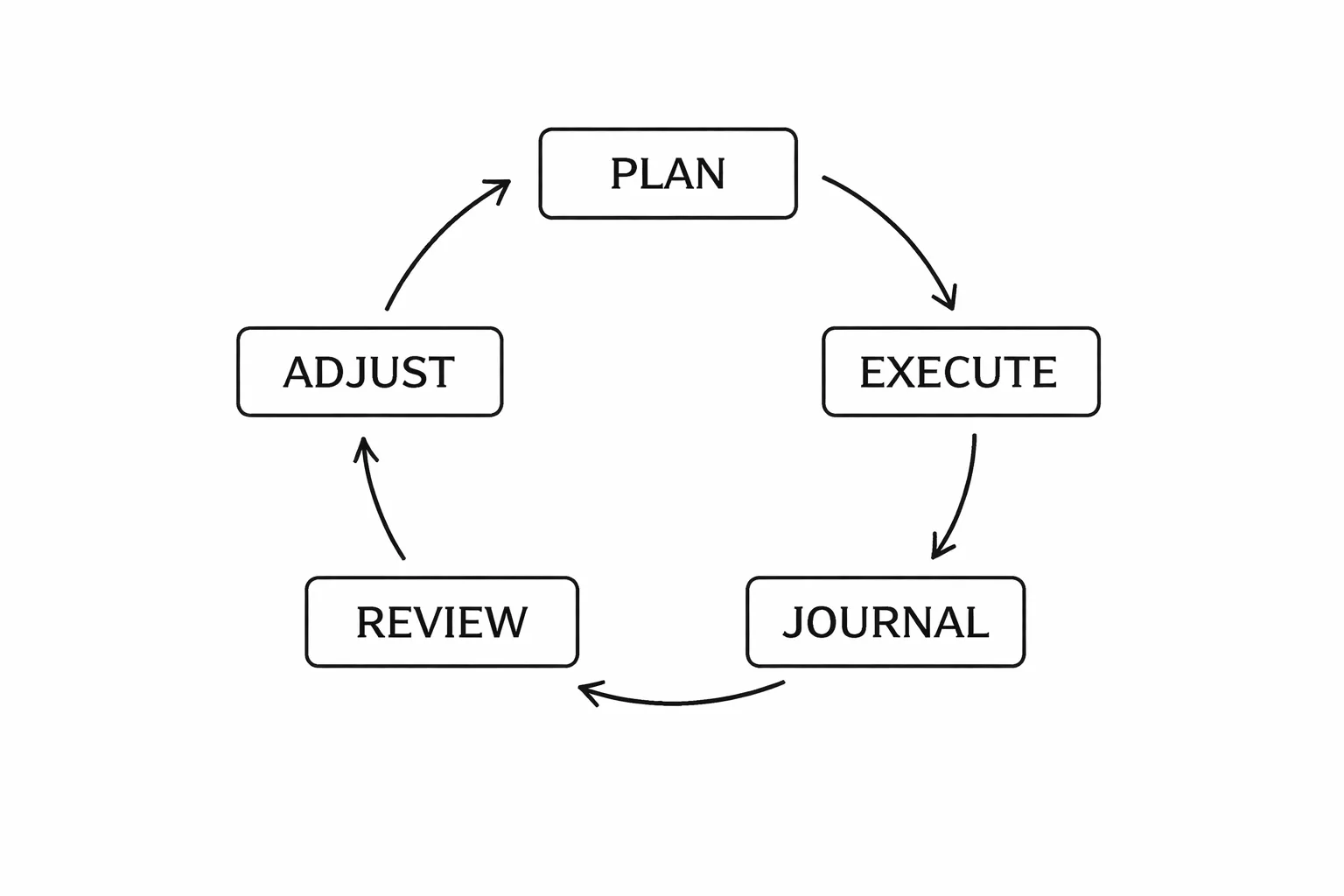
The minimum feedback loop, plan, execute, journal, review, adjust
| Step | What you do | What you record |
|---|---|---|
| Plan | Define session, setup, entry trigger, stop rule, target rule, risk per trade, and max trades. | One-page plan, plus a checklist you can tick fast. |
| Execute | Take only signals that match the plan. Place orders the same way each time. | Any deviations, plus the reason in one sentence. |
| Journal | Log the trade within minutes. Keep it factual. | Setup tag, entry reason, stop size, target, R multiple, time, screenshot. |
| Review | Score rule quality first, then results. Separate A trades from B and C trades. | Process score, R, and the top 1 to 2 recurring errors. |
| Adjust | Change one variable for the next block. Keep everything else fixed. | The exact rule change, plus the date you started it. |
This loop prevents plateau. It forces clarity, repeatability, and controlled change. You stop guessing and start training.
Set up your practice environment like a pro (tools, accounts, and data)
Choosing a demo broker (spreads, execution model, leverage, realistic pricing)
Your demo should behave like your future live account. If it does not, your results will lie.
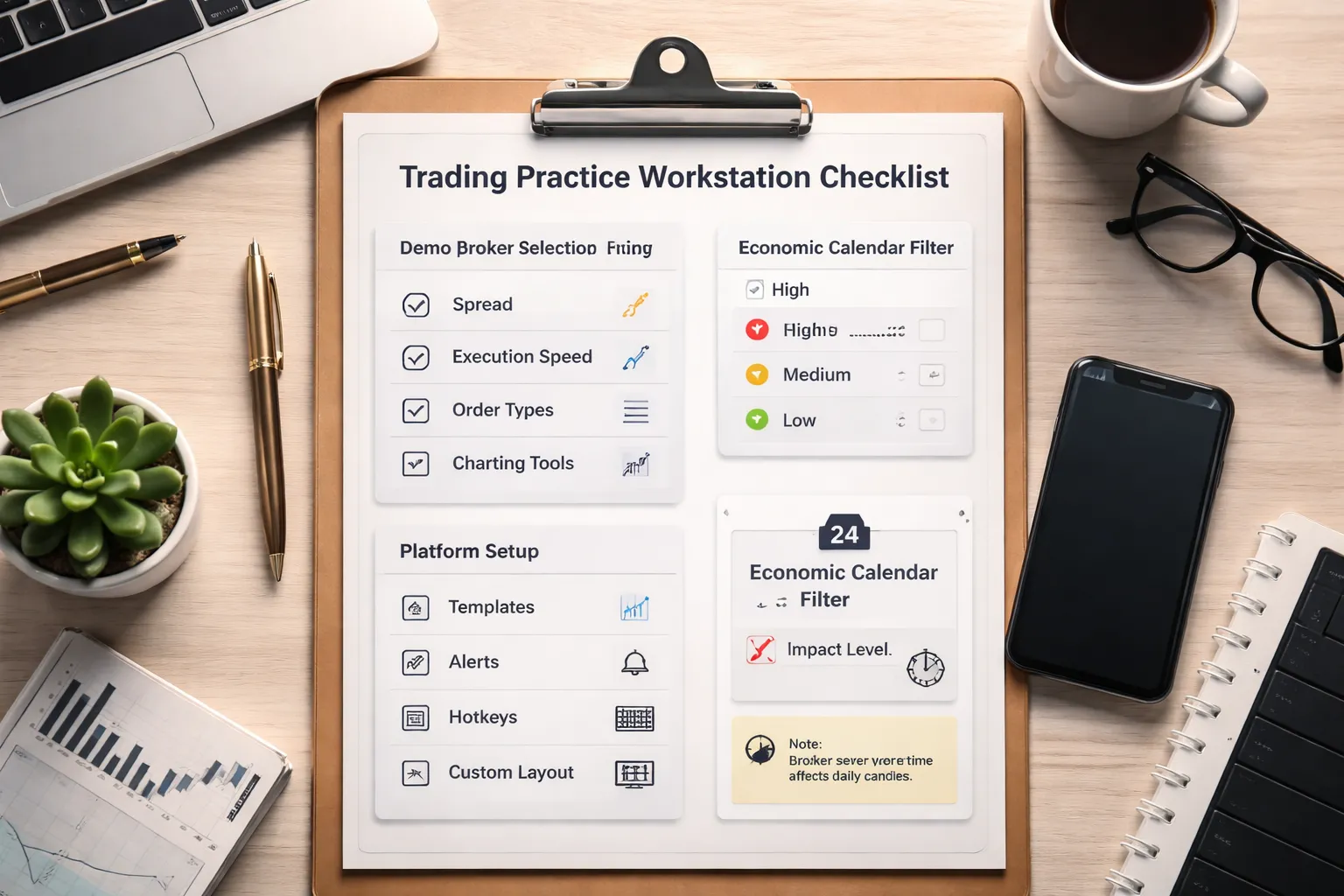
- Match the instrument. Trade the same pairs you plan to trade live. EURUSD on one broker can trade with a different spread profile than another.
- Check typical spreads, not minimum spreads. Record the average spread during your trading session, plus the worst spikes around rollovers and news.
- Know the execution model. Look for clear terms on market execution vs instant execution, and how re-quotes or slippage show up in fills. Your practice needs fills that can slip.
- Use realistic leverage. Set leverage to what you will use live. High demo leverage hides risk mistakes and position sizing errors.
- Confirm pricing inputs. Verify that swaps, commissions, and contract sizes match what you expect. If you ignore costs, you train the wrong expectancy.
- Track spread and slippage in your journal. Add two fields, spread at entry, spread at exit. If you can, log slippage in pips versus your clicked price.
Platform setup checklist (chart templates, session times, alerts, hotkeys)
Reduce decisions. Standardize your screen. Keep your routine fast.
- Time zone. Set platform time zone and stick to it. Log trades in the same time zone.
- Session blocks. Define your trading windows by clock time. Example, London open to mid session, New York open to lunch. Do not float.
- Chart templates. Save one template per strategy. Lock in timeframes, colors, and objects so every chart looks the same.
- Default risk tools. Add a position size calculator or script. Keep a fixed R per trade for each practice block.
- One-click actions. Set hotkeys for buy, sell, close, and partial close if your platform allows it. You want fewer mouse mistakes.
- Alerts. Use price alerts for key levels and session highs and lows. Use time alerts for routine checkpoints. Avoid alerts for every indicator wiggle.
- Clean watchlist. Limit to the pairs you trade. Sort by priority. Remove everything else.
- Execution view. Keep the order ticket visible. Show spread, stop distance, and projected margin before you click.
Using economic calendars and news filters without becoming headline-driven
Use news to manage risk, not to predict direction.
- Pick one calendar. Use the same source every day. Set your time zone correctly.
- Filter by your pairs. Track only events tied to your currencies. Ignore the rest.
- Classify events. Mark high impact, medium impact, low impact. Treat unscheduled headlines as noise unless they move price fast.
- Set hard rules. Example, no new trades 10 minutes before and after high impact events on your pair. Or reduce size and widen stops. Write your rule.
- Separate analysis from execution. Do your bias work before the session. During the session, follow your setup rules and your event filter. Do not scroll headlines.
- Record the effect. Log whether a trade occurred near an event, and whether spread widened or slippage increased. This becomes data for your next practice block.
Data integrity basics (why candles can differ across brokers and how to standardize)
Two charts can show different candles for the same pair. That can break your backtests and replays.
- Server time changes daily candles. A broker that closes the daily candle at a different hour will print different daily and H4 structures.
- Liquidity feeds differ. Brokers pull prices from different sources. Spreads and highs and lows can vary, especially during thin hours.
- Weekend and rollover prints vary. Some feeds show Sunday candles, some do not. Rollover can create spikes on one feed and not another.
- CFD vs spot differences. Many retail platforms use CFDs that track spot closely but still differ in microstructure and costs.
Standardize your practice data so your rules stay stable.
- Pick a reference feed. Choose one broker or one data provider for your practice blocks. Use it for demo, replays, and screenshots.
- Lock the timeframe logic. If your strategy uses daily or H4, confirm your broker uses New York close style candles, or adjust rules to your feed and document it.
- Use the same symbols. EURUSD can be EURUSD, EURUSD., or EURUSDm. Make sure your replay, demo, and journal all point to the same contract specs.
- Keep one chart template per feed. If you must use two brokers, create separate templates and label them. Do not mix screenshots in the same review set.
- Verify with snapshots. Save a screenshot of the same timestamp across feeds once per week. If differences grow, stop and re-baseline.
Build a practice plan: goals, timeline, and rules before you place a trade
Define your trading profile: timeframe, sessions, and instrument universe
You cannot practice well with a moving target. Lock your profile before you place a trade.
- Primary timeframe: Pick one, M15, H1, or H4. Use one higher timeframe for context, one lower timeframe for execution. Example, H1 context, M15 execution.
- Sessions: Choose the hours you will trade. London, New York, or overlap. Set a fixed start and stop time. Do not extend the session after losses.
- Instrument universe: Start with 1 to 3 pairs. Keep the same pairs in demo, replay, and journal. Avoid adding pairs because one looks “clean”.
- News policy: Write your rule. Example, no new entries 10 minutes before red folder news on your pair, resume 10 minutes after.
- Trade frequency cap: Set a maximum trades per session. Example, 3 trades. This forces selectivity.
Translate goals into measurable targets: risk per trade, max daily loss, and rule adherence
Practice goals must show up in your numbers. Track the same metrics every week.
- Risk per trade: Set a fixed percent or fixed cash amount. Example, 0.25% per trade in demo. Keep it constant for a full test block.
- Max daily loss: Set a hard stop. Example, 1% per day. If you hit it, stop trading, journal, and end the session.
- Max consecutive losses: Add a second circuit breaker. Example, stop after 3 losses in a row.
- Rule adherence rate: Score each trade as followed rules, bent rules, broke rules. Your main target in early practice is 90% plus followed rules.
- Execution quality: Track slippage in pips, late entries, and missed exits. These often matter more than the strategy.
| Metric | Default target | How you measure it |
|---|---|---|
| Risk per trade | 0.25% to 0.50% | Account risk based on stop distance and position size |
| Max daily loss | 1.0% | Realized P and L, stops trading when hit |
| Max trades per session | 3 | Count of entries, including re-entries |
| Rule adherence | 90% plus | Checklist score logged per trade |
| Review cadence | Weekly | One batch review with screenshots and notes |
Set a timeline. Use blocks. Example, 4 weeks on one setup, same pairs, same hours. Do not change rules mid-block. If you must change a rule, end the block, document why, then start a new one.
Write a one-page trading plan: entry criteria, invalidation, and management rules
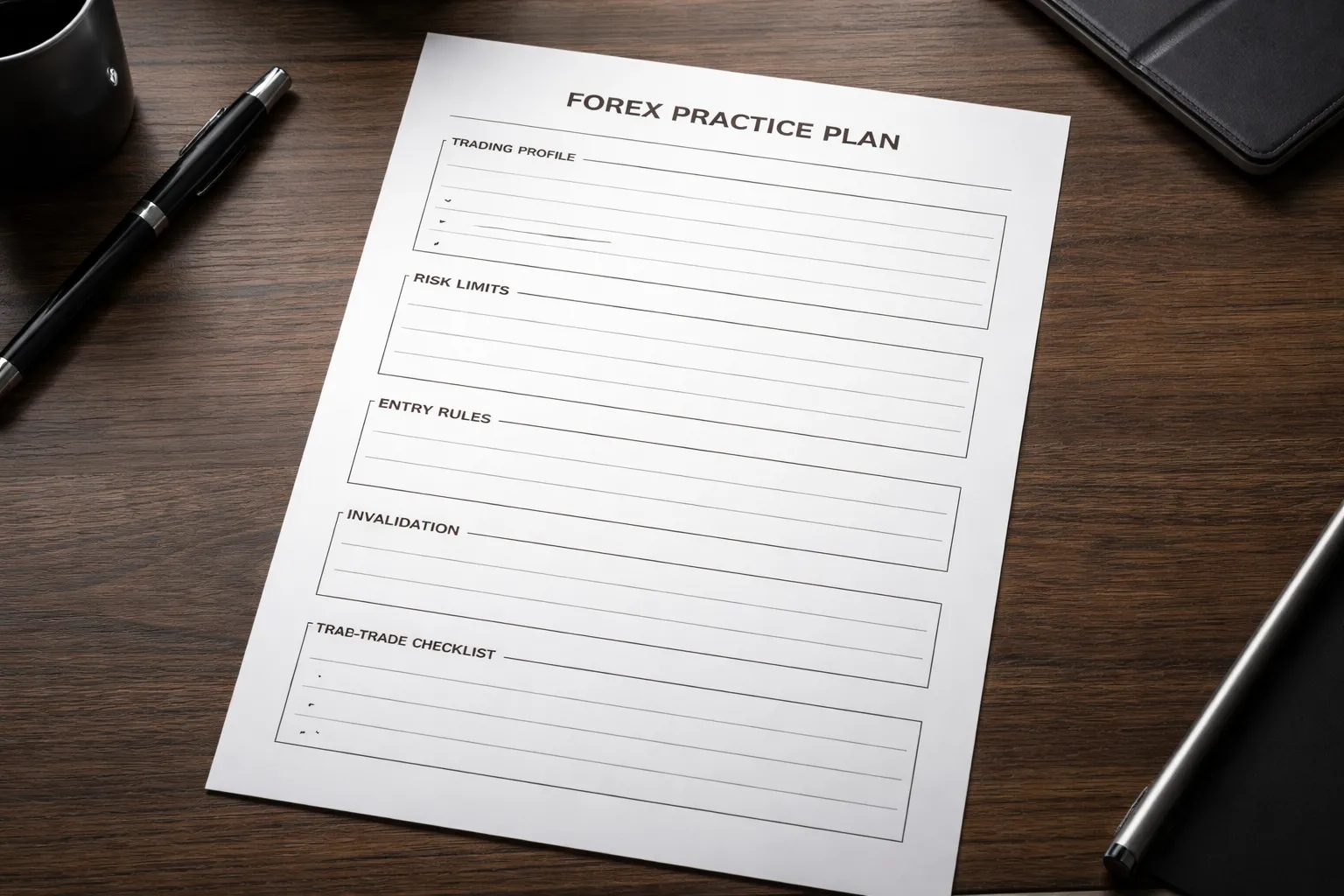
Your plan must fit on one page. If it takes longer to read than to execute, you will not use it.
- Market condition filter: Define when your setup applies. Example, trade breakouts only when the last 20 bars form a tight range and price sits near a clear level.
- Entry criteria: List the required signals in order. Keep it binary. Present or not present. If you trade breaks, define the trigger candle and the acceptable entry window.
- Invalidation: Define where the idea is wrong. Put the stop there. Do not move the stop wider.
- Position size: Size from the stop. Keep risk fixed. Do not size from “confidence”.
- Management rules: Decide before entry. Example, take partial at 1R, move stop to break-even only after X condition, trail by swing points, or use fixed targets. Use one method per test block.
- Exit rules: Define what ends the trade besides stop or target. Example, close if you get an opposite signal on your execution timeframe.
- Allowed discretion: Write what you can change. Example, you can skip trades that trigger into a major news window, you cannot change the stop logic.
If you use fixed targets, standardize how you set them. Keep your method consistent and log it, see how to set take profit in forex.
Create a pre-trade checklist to reduce impulsive decisions
Use a short checklist. Read it out loud. If one item fails, you do not trade.
- Profile match: Pair is in your universe, time is in your session, timeframe is correct.
- Data match: Correct symbol, correct feed template, correct contract specs.
- Setup match: All entry criteria are present. No “close enough”.
- Stop defined: Invalidation level is clear. Stop distance is acceptable for your risk.
- Size defined: Position size matches your fixed risk per trade.
- Target and management set: Target, partials, trail rules, and move-to-break-even rule are set before entry.
- Risk limits OK: You are below max daily loss, below max trades, below max consecutive losses.
- News check: No restricted news window for this pair.
- State check: You are not rushing, angry, or trying to win back losses. If you are, you stop.
- Journal ready: Screenshot before entry, planned entry, stop, target, and reason typed in one sentence.
Print the plan and checklist. Keep them next to your chart. Practice the same way every day. Your edge starts with repeatable behavior.
Demo trading practice: how to simulate real trading conditions (not fantasy results)
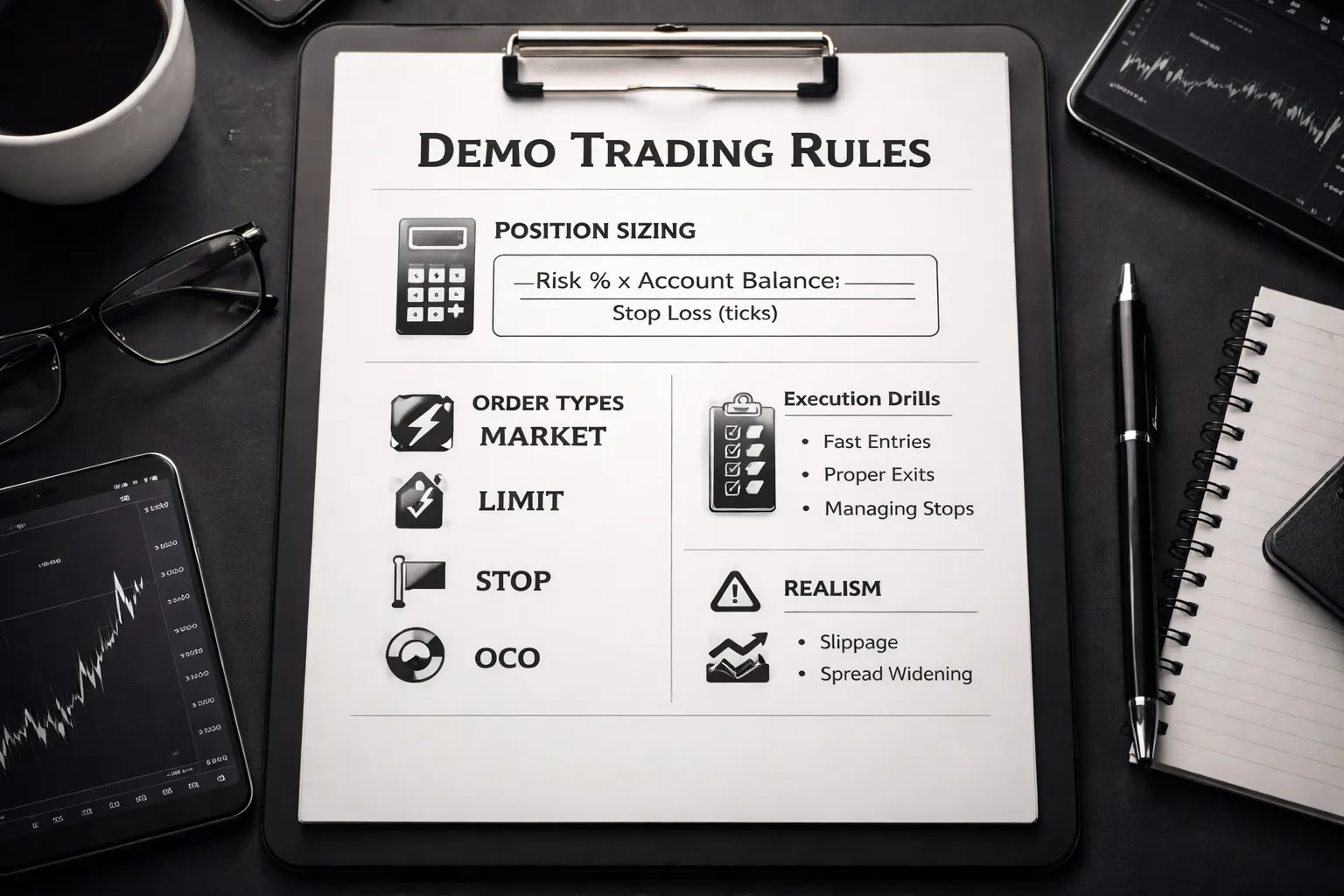
Position sizing on demo, match your intended live account
Demo practice fails when your sizing makes no sense. You need the same account size, leverage, and risk you will use live.
- Set your demo balance to your planned live deposit. If you will start with $2,000, set $2,000. Do not use $100,000.
- Risk a fixed percent per trade, usually 0.25% to 1.00%. Pick one number and keep it constant during practice.
- Calculate position size from your stop loss, not from gut feel.
- Use the same lot units you will trade live, micro, mini, or standard. Do not jump between them.
Your sizing rule should fit in one line.
Position size = (Account balance x Risk %) / Stop distance (pips) / Pip value
If you do not know your stop distance, you are not ready to place the trade. Use ATR to set stops with volatility, see ATR-based stop loss.
Order types practice, market, limit, stop, OCO, partial exits
Most demo traders only click market orders. That hides weak execution. Drill every order type you will use.
- Market orders, practice fast entry during momentum. Record spread and fill price.
- Limit orders, practice pullback entries. Define the level, set the limit, walk away.
- Stop orders, practice breakout entries. Place the stop beyond the level and accept you may not get filled.
- OCO, one cancels the other. Use it to bracket price when you do not want to chase. If your broker platform does not support true OCO, simulate it with alerts and strict cancel rules.
- Partial exits, scale out with a rule. Example, take 50% at 1R, move stop to break even only if your plan says so.
Keep order placement consistent. Same templates, same hotkeys, same fields checked every time.
Execution drills, speed, error control, volatility handling
You need reps that target execution errors. Treat it like a checklist and a timer.
- Timed entry drill, from decision to order placed in 10 to 20 seconds. No rushing. No skipping fields.
- Ticket check drill, confirm symbol, direction, lot size, stop price, target price, and expiration.
- Modify drill, move stop to the correct level without dragging mistakes. Practice reducing size and closing partials.
- Cancel drill, cancel pending orders the moment your setup invalidates. Do not let old orders sit.
- Volatility drill, during fast candles you either place the planned order or you stand down. No mid-candle improvising.
Track errors like data. Wrong symbol, wrong size, missing stop, wrong side, late cancel. One error counts as a failed rep even if the trade wins.
Realism rules, slippage, spread widening, no revenge clicking
You must force demo to feel like live. Add friction on purpose.
- Assume slippage on market and stop orders. Add a small buffer in your journal, then grade your trade using that worse fill. If you trade around news, assume bigger slippage or skip the window.
- Account for spread widening during session opens, low liquidity, and high volatility. Do not place tight stops that only work with perfect spreads.
- Use realistic fills. If price touches your limit by 0.1 pip in a spike, do not auto-credit yourself a perfect fill. Mark it as missed or partial.
- Ban revenge clicking. After a stop out, you take a mandatory pause. Set a timer for 5 to 15 minutes. No new trade until you re-check your state and your setup rules.
- Cap your daily risk. Stop after a set drawdown, example 2R or 3R per day. Demo must teach stopping, not chasing.
Grade your demo trades like live trades. You earn points for process, not P and L.
Replay and simulator practice: compress years of screen time into weeks
Replay vs backtest vs forward test, what each is good for
Replay means you trade historical price as if it is live. You control the speed and pause. You practice execution, decision timing, and rule compliance. Replay does not prove a strategy works in real spreads, slippage, and news conditions unless the simulator models them well.
Backtest means you test rules on past data, either manually or with code. You measure expectancy, drawdowns, and win rate. Backtests do not train your eyes or your discipline. Most backtests also miss spread changes, latency, and stop run behavior unless you model them.
Forward test means you trade in real time on demo or small live size. You validate fills, spreads, and your behavior under uncertainty. Forward tests take time. They also suffer from small sample size if you do not commit to enough trades.
| Method | Best for | Weak for |
|---|---|---|
| Replay | Screen time fast, execution reps, rule adherence | Real fill pressure, true session liquidity, real news surprise |
| Backtest | Edge research, parameter sanity, risk sizing inputs | Discipline training, discretionary context, realistic costs |
| Forward test | Reality check, broker costs, routine building | Speed, fast learning loops |
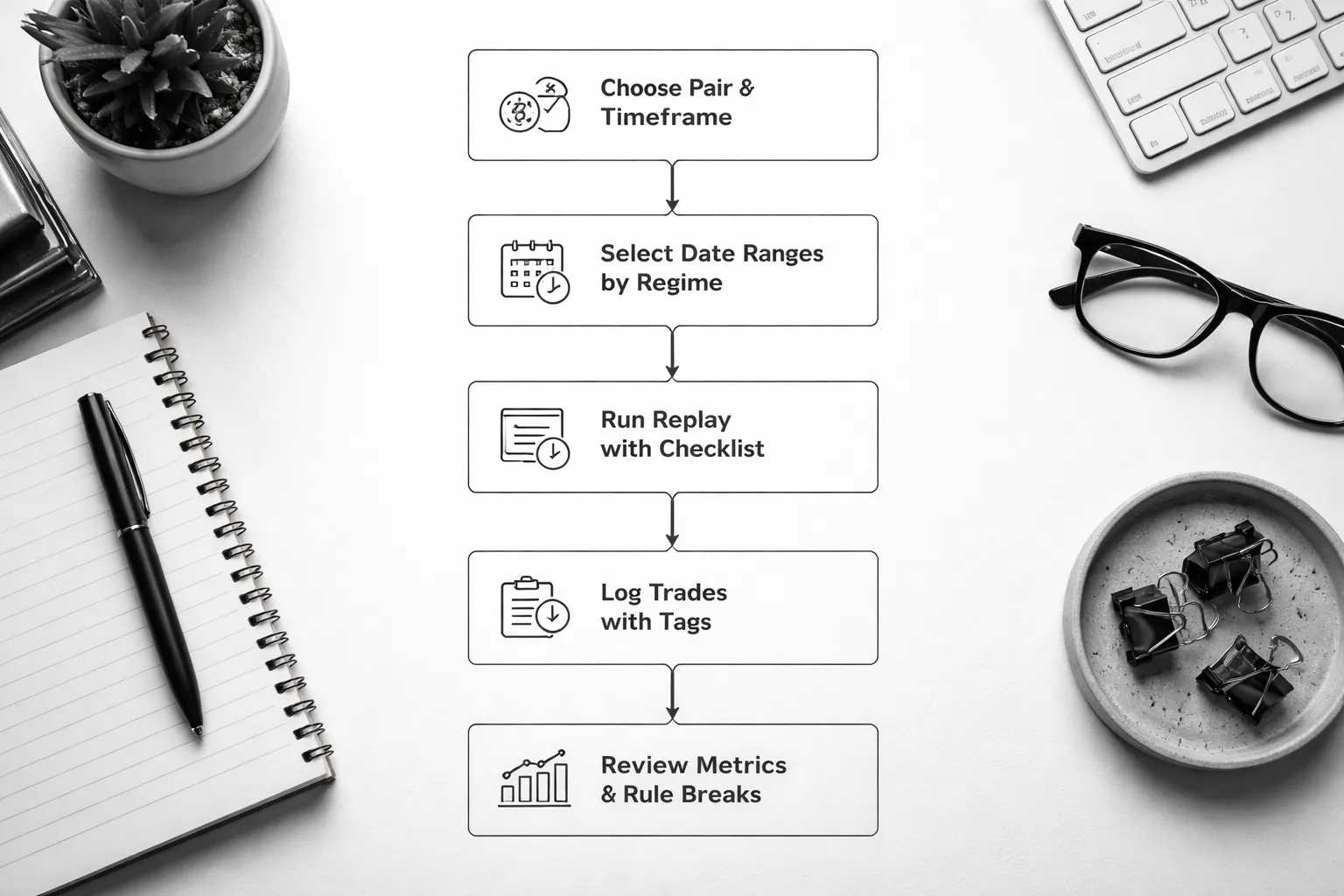
How to run a replay session
- Pick one pair. Stay on one instrument until your stats stabilize. Spreads and behavior change by pair.
- Pick one timeframe set. Example, entries on M5, context on H1. Do not change it mid-study.
- Select dates by regime. Build three buckets, trend, range, high volatility. Pull multiple months from each bucket.
- Include different sessions. London open, London to NY overlap, NY afternoon, Asia. Your setup may only work in one.
- Define your replay speed. Use 1x to place orders and manage. Use 4x to 16x only when nothing happens.
- Use a fixed checklist. Same entry trigger, same stop rule, same risk, same trade management rule.
- Log every trade. Screenshot, reason, rule grade, R result, time of day, regime tag.
- End with a review block. Count rule breaks, measure average R, list the top two error types.
One-variable-at-a-time testing
You improve faster when you isolate one driver. Change one thing. Keep everything else fixed for a full sample.
- Test entries. Keep stop and target fixed. Compare one trigger vs another, example, break and retest vs close beyond level.
- Test stops. Keep entry and target fixed. Compare structure stop vs ATR stop vs fixed pip stop.
- Test filters. Keep entry and stop fixed. Add one filter, example, trade only with H1 trend, or only during London and overlap.
- Test management. Keep entry and stop fixed. Compare full take profit vs partials vs trailing rules.
Track results with the same metrics each time, win rate, average win in R, average loss in R, profit factor, max drawdown in R, and rule break rate.
Avoiding curve-fitting
- Set a minimum sample. Aim for 50 to 100 trades per variant before you judge it. More if the setup is rare.
- Use out-of-sample checks. Build rules on one block of dates. Validate on a different block. Do not touch settings during validation.
- Respect regimes. Report stats by regime bucket. If your edge only appears in one regime, write that into the rules.
- Limit parameter tweaks. If you keep adjusting stops and filters, you fit noise. Cap yourself to a small number of planned variants.
- Include costs. Add spread and slippage assumptions. A strategy that only works with zero costs does not work.
If you use price action rules, keep them objective. Define levels, triggers, and invalidation. Avoid vague labels. If you need a framework, start with price action basics, then convert each idea into a checklist item.
Tool selection criteria
- Historical data quality. Prefer tick data or high quality 1 minute data with accurate session gaps. Bad data creates fake fills.
- Spread modeling. You need variable spreads by session. Fixed spreads inflate results and hide risk.
- Execution realism. Support market and limit orders, stop orders, partial fills if possible, slippage settings, and realistic stop triggering.
- Speed control. Hotkeys, pause, bar-by-bar, and fast forward. You need volume reps without losing precision.
- Multi-timeframe view. You need context charts without changing the tested entry timeframe.
- News markers. At least a way to see high impact event times. Surprise spikes distort replay results.
- Journaling exports. Export trades to CSV. Include time, price, size, direction, stop, take profit, and outcome in R.
- Screenshot support. Fast chart snapshots tied to each trade help review patterns and mistakes.
Practice routines that create consistent performance (daily, weekly, monthly)
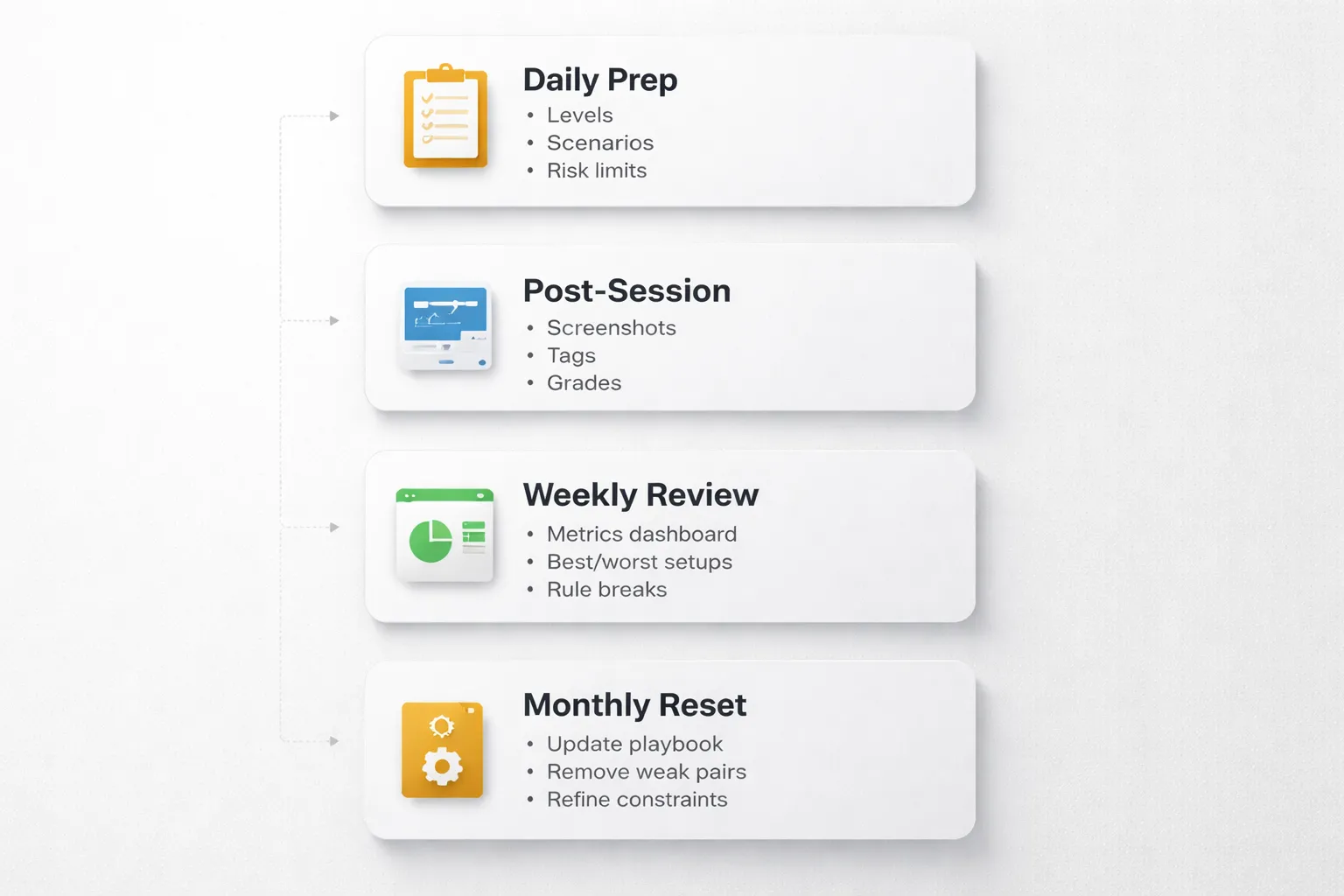
A 30 to 60 minute daily routine (prep, levels, scenarios, risk limits)
Start each practice day the same way. You build consistency by removing decisions that do not matter.
- Set your session window. Pick one market block, London open, NY open, or overlap. Use the same block in demo and replays.
- Check high impact news times. Mark the events on your chart. Define a no-trade buffer, for example 15 minutes before and after.
- Scan higher timeframes for context. Use one or two context charts only, for example H4 and D1. Mark trend, range, and key swing points.
- Mark levels. Add prior day high and low, week high and low, and the nearest clean swing support and resistance. Keep the list short.
- Write 2 to 3 scenarios. One bullish, one bearish, one range. Each scenario needs a trigger and an invalidation level.
- Set your risk limits. Define max risk per trade, max trades per session, and a daily stop. Example: 0.5% per trade, 3 trades max, stop after 1.5% down.
- Define allowed setups. Trade only what is in your playbook. If you practice breakouts, use strict rules like those in your breakout trading strategy plan.
Your goal is simple. You start the session with levels, scenarios, and hard limits already set.
A post-session routine (screenshots, tagging mistakes, grading trades)
End every session with a fast review. You do not improve without clean labels.
- Screenshot every trade. Capture entry, stop, take profit, and the level or trigger you used. Save one chart at entry and one at exit.
- Export trades to CSV. Keep time, pair, direction, entry, stop, take profit, size, result in R, and session tag.
- Tag setup type. Example tags: breakout, pullback, reversal, range fade, news spike. Use one primary tag only.
- Tag mistake codes. Keep a short list. Example: early entry, late entry, stop too tight, stop too wide, moved stop, skipped plan, traded news, revenge trade, overtraded.
- Grade execution. Use A, B, C, F. Base the grade on rule adherence, not outcome.
- Write one line per trade. What was the trigger, did you follow the rules, what will you change next time.
Track two numbers daily. Rule breaks per session, and average execution grade. You want both to improve even if P and L stays flat.
Weekly review (metrics dashboard, best and worst setups, rule-break analysis)
Do a weekly review on the same day. Use a simple dashboard. Use the same metrics every week.
- Sort by setup tag. Find your top 1 to 2 setups by average R and by execution grade.
- List the worst 1 to 2 setups. Check if the issue is strategy or execution. Strategy issues show clean execution with bad results. Execution issues show rule breaks and low grades.
- Audit rule breaks. Count each mistake code. Pick the top one. Write one constraint to stop it next week.
- Refine your constraints. Examples: trade only first touch of a level, no trades after two losses, no trades when spread exceeds X, stop trading after your daily stop.
Finish with one weekly focus. One setup to emphasize, and one mistake to eliminate.
Monthly reset (update playbook, remove weak pairs, refine constraints)
Each month you clean your practice environment. You keep what works. You cut what does not.
- Update your playbook pages. For each approved setup, keep one rule set, one example winner, one example loser, and the common failure mode.
- Remove weak pairs. Drop pairs with low liquidity in your session, inconsistent spreads, or poor results with good execution. Keep a short watchlist.
- Adjust time windows. If your best trades cluster in one hour, narrow your session. If news keeps breaking your results, extend your no-trade buffer.
- Refine risk constraints. Set limits based on your data. If drawdowns spike after trade four, cap trades at three. If your worst losses come from moved stops, ban stop changes.
- Set next month targets. Use process targets only. Example: less than 2 rule breaks per week, 70% A or B grades, 100% screenshots and CSV exports.
Consistency comes from repetition. You use the same routine, the same tags, and the same metrics until the data proves a change.
Journaling and metrics: what to track to improve faster
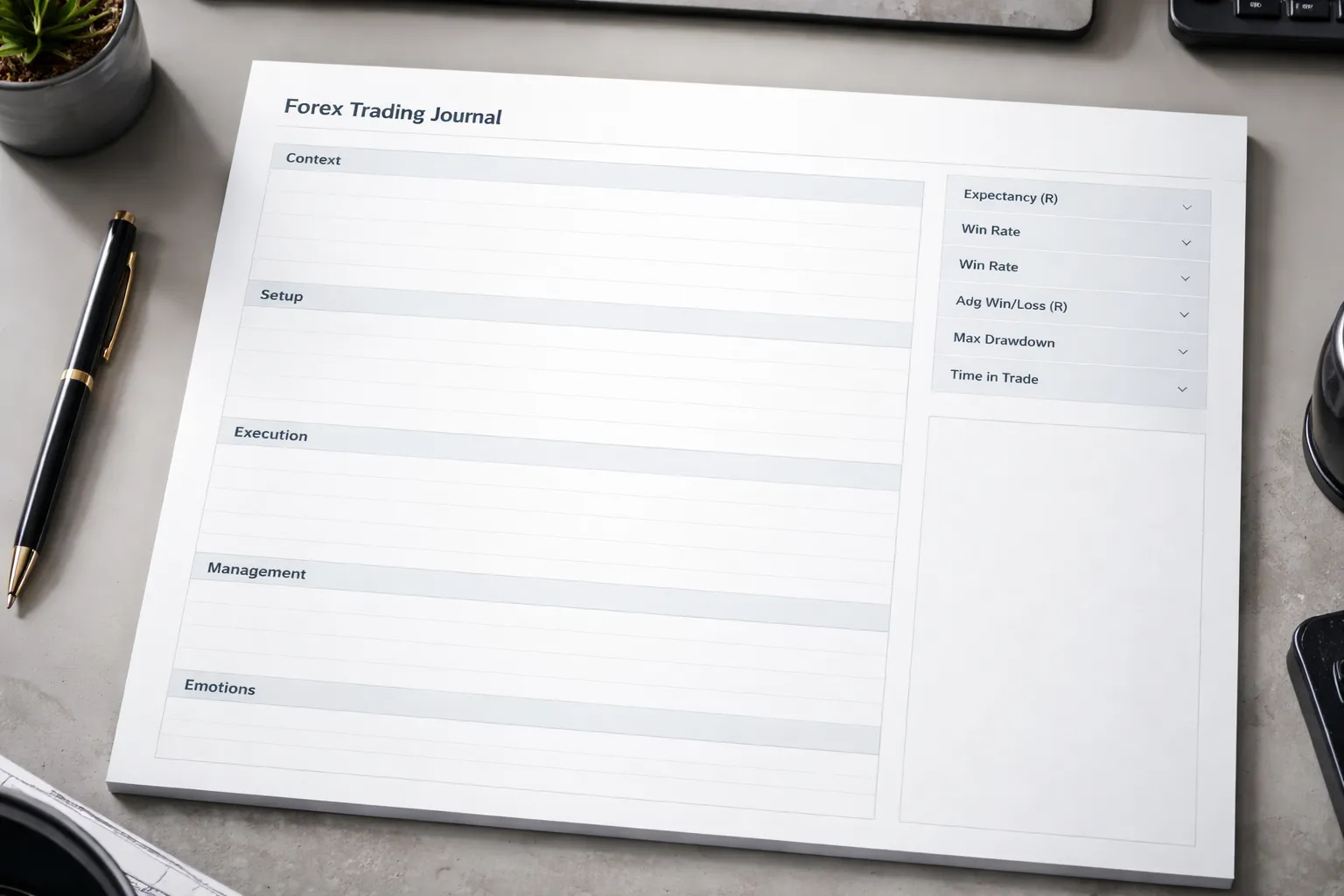
The minimum viable journal: context, setup, execution, management, and emotions
Your journal exists to answer one thing. Why you made or lost money.
Keep it small. Track the same fields every trade.
- Context. Pair, session, date, news filter on or off, market state you defined (trend, range, breakout).
- Setup. Setup name, timeframe, trigger, level type (S/R, trendline, VWAP, etc.), confluence tags, pre-trade grade (A, B, C).
- Execution. Entry type (limit, market, stop), spread at entry, slippage note, stop distance, position size, risk per trade.
- Management. Initial stop location reason, take profit plan, trailing rule, partials rule, any stop changes with timestamps and reasons. Use one standard method for stops and targets so your data stays clean. Link it to your rules from setting stop loss and take profit.
- Emotions. One word before entry and one word after exit (calm, rushed, angry). Add a short trigger note like “late start” or “missed first move”.
Key performance metrics: expectancy, win rate vs R-multiple, drawdown, and time-in-trade
Ignore account currency at first. Track R. R equals profit or loss divided by your initial risk.
- Expectancy (in R). Expectancy = (Win rate x Avg win in R) minus (Loss rate x Avg loss in R). You want this above 0 with a sample size you trust.
- Win rate vs average R. A high win rate can hide small wins and large losses. A low win rate can work if your average win is large. Track both.
- Max drawdown. Track peak-to-trough in R and in percent. Also track average drawdown per week. Your drawdown tells you if risk and sizing match your edge.
- Time-in-trade. Log minutes from entry to exit. Then split results by hold time buckets. Fast exits often signal fear. Long holds with no plan signal hope.
Process metrics that predict success: checklist score, plan compliance, and impulse frequency
Results lag. Process leads. Track what you control.
- Checklist score. Build a 5 to 10 item checklist for your setup. Score each trade 0 or 1 per item. Store the total. Later, compare average R by score band.
- Plan compliance. Mark each trade as compliant or not. Compliant means you followed entry, stop, target, and management rules. No exceptions.
- Impulse frequency. Count impulse trades per week. Define impulse as “entered without checklist complete” or “entered outside session rules” or “changed stop without rule”. Track the reason tag.
Use these metrics to set targets. “Less than 2 impulse trades per week” beats “make 10R”.
Building a “setup library”: screenshots, annotations, and outcome distributions
A setup library turns randomness into patterns you can repeat.
- Screenshot pack. Save three images per trade, pre-entry, entry, exit. Keep the same zoom and timeframe.
- Annotations. Mark entry, stop, target, key level, and invalidation. Add one sentence on why the trade qualified.
- Outcome distribution. Group trades by setup name. Build a simple table: count, win rate, expectancy, average MAE and MFE in R, best and worst 5 trades. This shows what the setup really pays, not what you hope it pays.
- Best-of folder. Save your cleanest A-grade examples. Review before sessions. This reduces improvisation.
Keep the library strict. If a trade does not match the written setup, tag it as “variant” or “impulse”. Do not let it pollute your core stats.
Skills drills: targeted exercises to fix specific weaknesses
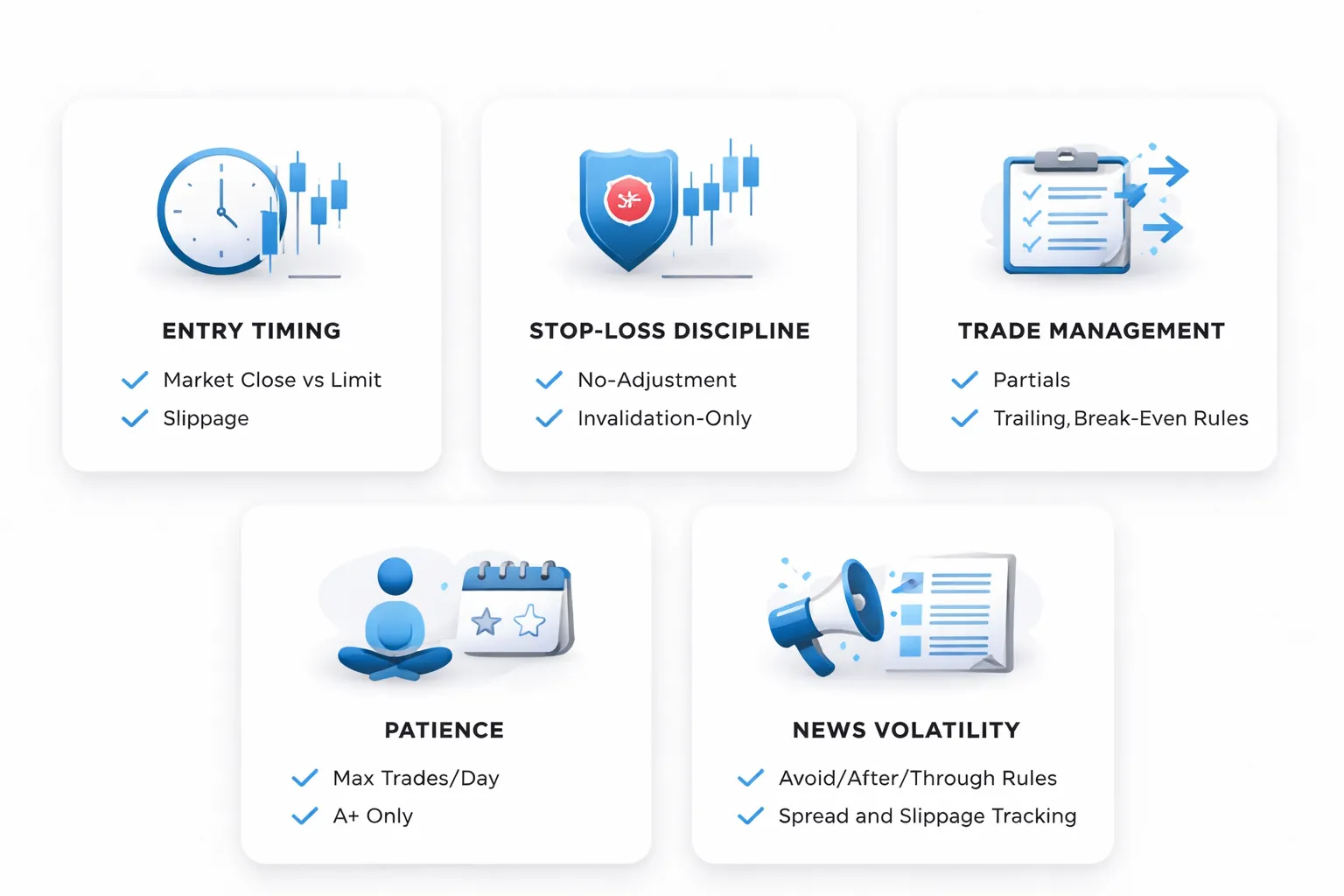
Skills drills: targeted exercises to fix specific weaknesses
Drills work when they target one variable. Keep your setup constant. Change one rule. Track the result in R and in execution stats.
Entry timing drill: candle-close entries vs limit entries and measuring slippage
Run two controlled blocks on the same setup and session. One block uses candle-close market entries. The other uses limit entries at a defined level.
- Block A, candle-close: Enter at the close of your trigger candle. Record the spread and your fill price.
- Block B, limit: Place a limit at your level, for example 50 percent pullback or prior swing. Cancel after X candles or when invalidated.
- Do not mix rules: No chasing. No late clicks. If you miss it, you miss it.
Log these fields for every trade.
- Planned entry price
- Actual fill price
- Slippage in pips and slippage in R
- Time to fill in seconds or candles
- Missed trades count and reason, no fill, canceled, invalidated
Compare blocks on expectancy, win rate, and average slippage. If candle-close improves fill rate but adds negative slippage, decide if the net expectancy still rises.
Stop-loss discipline drill: no-adjustment sessions and invalidation-only moves
Most traders leak R by moving stops. Fix it with strict sessions.
- No-adjustment session: Place the stop. Do not move it. Do not widen it. No break-even. You can only exit at stop or target.
- Invalidation-only session: You may move the stop only when price action creates a new objective invalidation point based on your written setup. Never move it because you feel heat.
- One-click rules: Pre-set stop and take-profit orders before you confirm the entry.
Track how often you wanted to adjust the stop. Log it as an urge, not an action. Then compare your MAE in R, stop-out frequency, and average loss in R across both sessions.
If you still widen stops, reduce size and repeat. Use a fixed risk per trade. For deeper mechanics on stops and targets, use this guide on stop loss vs take profit.
Trade management drill: standardized partials, trailing rules, and break-even logic
Random management hides edge. Standardize it, then test.
- Partial plan: Take 50 percent off at 1R. Move stop to entry only if your rule says so, not by default.
- Trailing plan: Trail behind the last closed swing only after price reaches 2R. Use one swing definition. Do not switch mid-trade.
- Break-even logic: Move to break-even only after a specific event, for example a close beyond structure plus a retest hold. Write the exact condition.
Run three management variants as separate batches. Keep entries and stops identical.
| Variant | Partial | BE rule | Trail rule | What to measure |
|---|---|---|---|---|
| A | None | None | None | Baseline expectancy, MFE, MAE |
| B | 50% at 1R | After 1R close | None | Win rate, average win in R, scratch rate |
| C | 50% at 1R | After rule event | Trail after 2R via swings | Average win, max favorable excursion captured |
Pick the variant with the best expectancy and the lowest execution error rate. Do not pick the one that looks best on one big outlier.
Patience drill: maximum trades per day and only A+ setups
Overtrading kills stats. Your drill must cap decisions.
- Hard cap: Max 1 to 3 trades per day. Stop when you hit the cap, even if the next setup looks good.
- A+ filter: Trade only your best tag. No variants. No impulses.
- Time box: Trade one session window only. Close the platform after the window.
Measure impact with simple counts.
- Trades per day
- Percent A+ trades
- Expectancy per trade and per day
- Largest drawdown streak in trades
If daily expectancy improves but you feel bored, keep the rule. Boredom often signals you stopped forcing trades.
News volatility drill: practicing around scheduled events with predefined rules
News spikes punish weak rules. Train with a calendar and fixed constraints.
- Define event types: Tier 1, CPI, NFP, rate decisions. Tag them in your log.
- Choose one policy per batch: Avoid, trade only after, or trade through with adjusted rules.
- Spread and slip checks: Record spread at entry and worst spread during the first minute after entry.
Use one of these rule sets. Do not improvise.
- Avoid set: No new trades from T-minus 15 to T-plus 15 minutes. Manage existing trades with original stops only.
- After set: No trades until a candle closes after the event. Enter only if your setup triggers and spread is below your threshold.
- Through set: Reduce risk by a fixed percent, widen stops only if your setup invalidation requires it, and set a max slippage allowance. Skip the trade if slippage exceeds it.
Compare news vs non-news trades on slippage in R, stop-out rate, and average MAE. If your edge collapses during news windows, you now have proof. Build the avoid rule into your plan.
Risk management practice: the fastest way to avoid blowing up when you go live
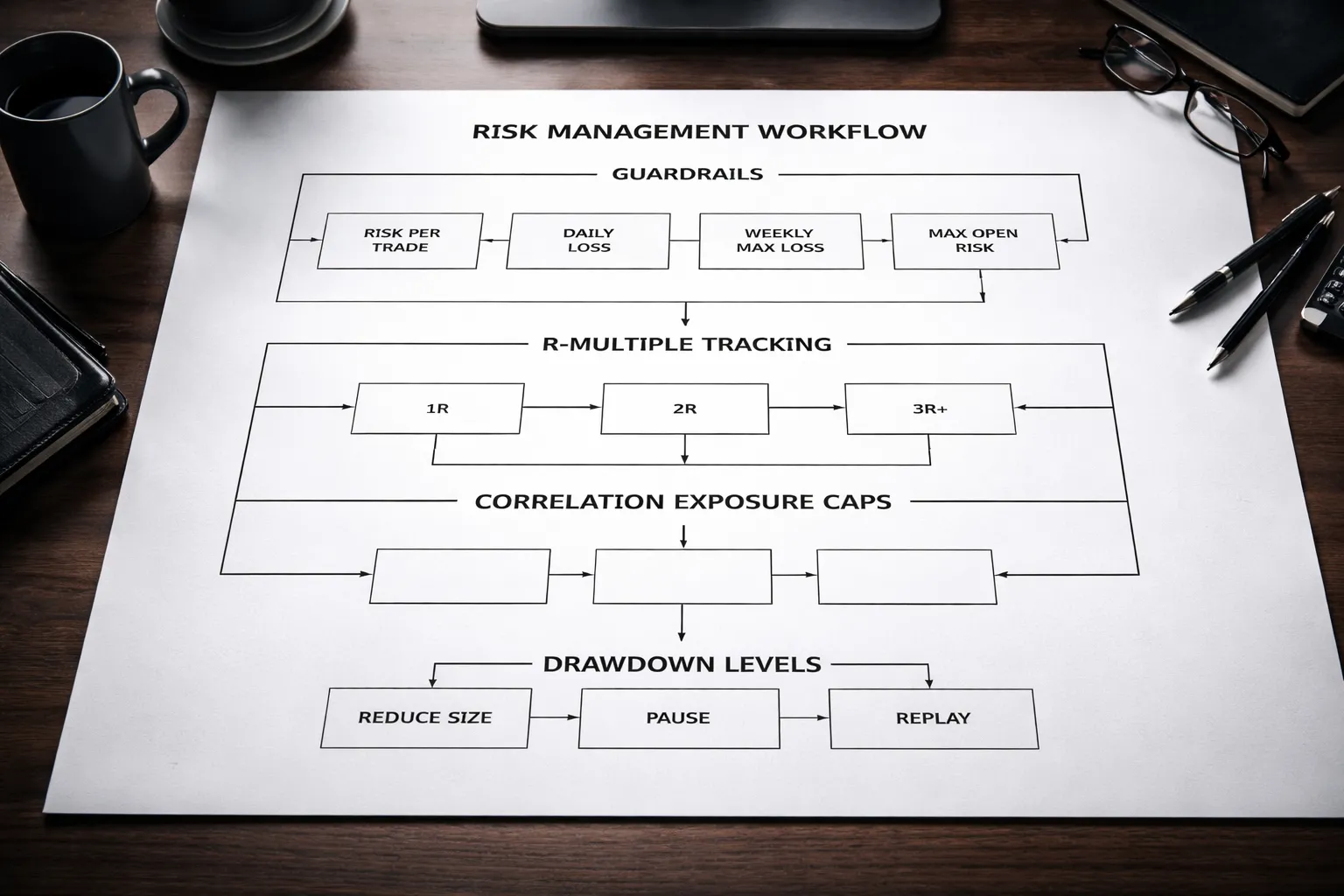
Risk management practice, the fastest way to avoid blowing up when you go live
Most demo accounts fail for one reason. You ignore risk rules because the money is not real. Fix that. Treat risk like the strategy. Train it until it becomes automatic.
Risk per trade and max loss limits, setting guardrails you can follow
Pick numbers you can execute every day. Then hard code them into your practice.
- Risk per trade: 0.25% to 1.0% of equity. Start at 0.5% if you do not know.
- Daily max loss: 2R or 3R. Stop trading when you hit it.
- Weekly max loss: 5R to 8R. Pause new trades when you hit it.
- Max open risk: cap total risk across all open positions at 2R.
- Stop rule: you place the stop first. You do not move it farther.
Log every breach as a failure. No excuses. If you break a rule in demo, you will break it live.
| Guardrail | Default setting | What you do when hit |
|---|---|---|
| Per-trade risk | 0.5% equity (1R) | Size down if stops get wider, keep R constant |
| Daily max loss | 3R | Stop trading for the day, journal only |
| Weekly max loss | 6R | Switch to replay practice until next week |
| Max open risk | 2R | No new trades until risk drops below the cap |
R-multiples and fixed fractional sizing, making results comparable across trades
Track performance in R. R equals the distance from entry to stop. This makes every trade comparable, even when stops differ.
- Set 1R: entry to stop in pips.
- Position size: choose lots so the money risked equals your fixed fraction of equity.
- Record outcomes in R: +1.2R, -1R, +0.4R. Ignore dollars in analysis.
In your journal, add these fields. Risk%, stop size, planned R, realized R, MAE in R, MFE in R, exit reason.
After 50 to 100 trades, compare setups by average R, win rate, and max losing streak. Dollars hide problems. R shows them fast.
Correlation and exposure, avoiding hidden leverage across pairs
You can follow your per-trade risk and still overleverage. It happens when you stack trades that move together.
- Group pairs by shared currency: EURUSD, GBPUSD, AUDUSD often load you into USD risk.
- Set an exposure cap: max 2R total risk per currency, max 2 positions that share the same driver.
- Assume correlation goes to 1 in stress: size like the trades are the same trade.
- Journal exposure: note shared currency, session, and driver for each trade.
If you need a simple rule, treat any two USD pairs in the same direction as one combined position. Split risk across them. For deeper work, read forex correlation explained.
Drawdown protocols, when to reduce size, pause, or return to replay practice
Plan drawdown actions before you trade. Then follow the plan without debate.
- Level 1 drawdown: down 3R from peak. Cut risk per trade by 25% for the next 20 trades.
- Level 2 drawdown: down 6R from peak. Cut risk per trade by 50%. Trade only your top setup.
- Level 3 drawdown: down 10R from peak or 2 weeks below expectancy. Stop live trading. Switch to replay for 20 to 50 trades.
Use a fixed process in the pause. Review your last 20 trades. Tag every loss by cause, setup failure, execution error, rule break, slippage. If execution causes over 30% of losses, drill execution in replay until the error rate drops.
Return to normal size only after you complete the protocol and you show positive expectancy in replay with zero rule breaks.
Mindset and psychology training during practice (so demo habits don’t sabotage you)
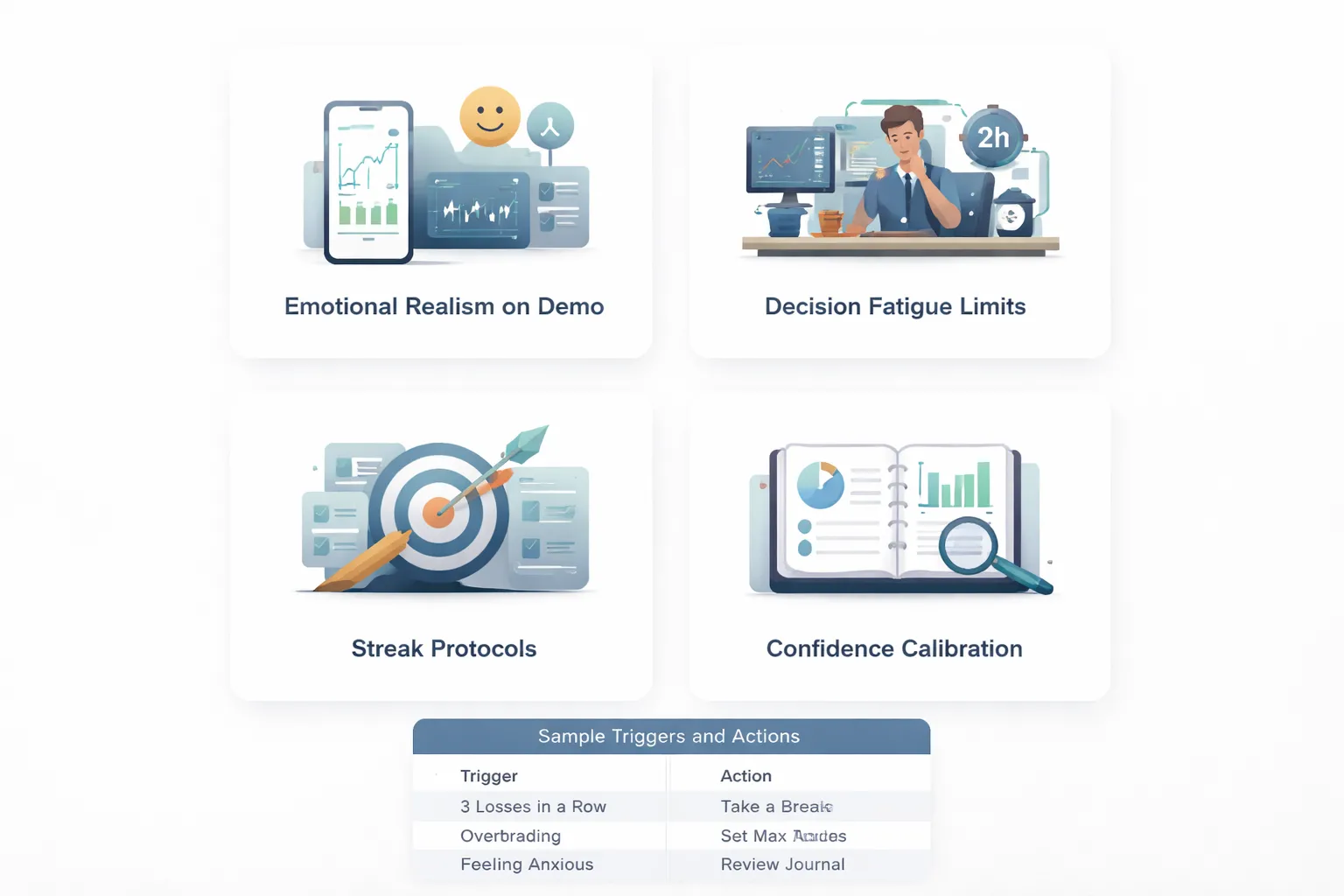
Detaching from money, create emotional realism on demo
Demo fails when you treat it like a game. Fix that with constraints that force respect for risk.
- Use live-like sizing. Set your demo balance to your planned live balance. Risk a fixed percent per trade, usually 0.25% to 1%.
- Hard cap your daily loss. Stop for the day at minus 1R to minus 3R. Log the stop time. No exceptions.
- One setup list. Trade only your approved setups. If you trade support and resistance, define the levels and rules in writing, then follow them.
- Use a real spread and commissions. Match your broker conditions. Many demo feeds look cleaner than live.
- Delay gratification. No instant re-entry after exit. Wait for the next valid trigger. This blocks impulse trading.
- Score process, not P and L. Your main metric is rule compliance percent. Target 95% plus before you increase size.
Decision fatigue management, session limits, breaks, rule simplification
Your brain degrades during long sessions. You start forcing trades. You miss stops. You widen targets. You fix this with limits and fewer decisions.
- Set a trade limit. Max 3 to 5 trades per session. Stop when you hit the number.
- Set a time limit. 60 to 120 minutes. After that, your edge drops.
- Use a break rule. Take 5 to 10 minutes off after any trade, win or loss. Stand up. Leave the screen.
- Simplify the checklist. Keep 5 to 7 items. If you need 15 checks, you will ignore them under stress.
- Pre-plan orders. Decide entry, stop, and target before you click. Do not adjust the plan mid-trade without a rule.
- Use a single risk model. Fixed R, fixed stop method, fixed exit rules. Remove choices.
If you keep pushing past your limits, you will overtrade. Use the same fixes described in how to avoid overtrading.
Handling streaks, win streaks, loss streaks, revenge trading
Streaks change your behavior. Wins make you loose. Losses make you chase. You need protocols.
| Situation | Trigger | Protocol |
|---|---|---|
| Win streak | 3 wins in a row or +3R in a day | Stop trading for the session. Screenshot the last trade. Review for rule drift. Next session, keep the same risk. No size increase. |
| Loss streak | 2 losses in a row or -2R in a day | Stop for 30 minutes. Review the last 5 trades. Tag cause. If any rule break, end the day. If no rule break, cut risk by 50% for the next 10 trades. |
| Revenge trading risk | Fast re-entry urge, widening stop, doubling size | Immediate platform pause. No new trades for 20 minutes. Write one line, what rule you want to break. Then switch to replay or stop for the day. |
Keep streak rules mechanical. You will not think clearly in the moment.
Confidence calibration, use evidence from your journal, not feelings
Confidence should track data. Feelings lag and they lie. Your journal keeps you accurate.
- Track expectancy by setup. Log R per trade. Calculate average R, win rate, and average win and loss for each setup.
- Use a minimum sample. Do not judge performance on 10 trades. Use at least 50 trades per setup in replay or demo.
- Separate skill from outcome. Grade each trade with two scores, rule compliance and execution quality. A good trade can lose. A bad trade can win.
- Build a confidence ladder. Move up only when the numbers hold.
| Stage | Requirement | Action |
|---|---|---|
| Stage 1 | 50 trades, 95% plus rule compliance, positive expectancy | Stay on demo. Keep risk fixed. |
| Stage 2 | 100 trades, zero revenge trades, stable results across 4 weeks | Increase size by one step, for example from 0.25% to 0.5% risk. |
| Stage 3 | Drawdown within plan, execution errors under 10% | Maintain size. Focus on quality. No new setups. |
When your confidence drops, do not fix it with more trades. Fix it with proof. Review the last 20 trades, find the real leak, then drill it in replay.
When you’re ready to go live: a safe transition plan from demo to real capital
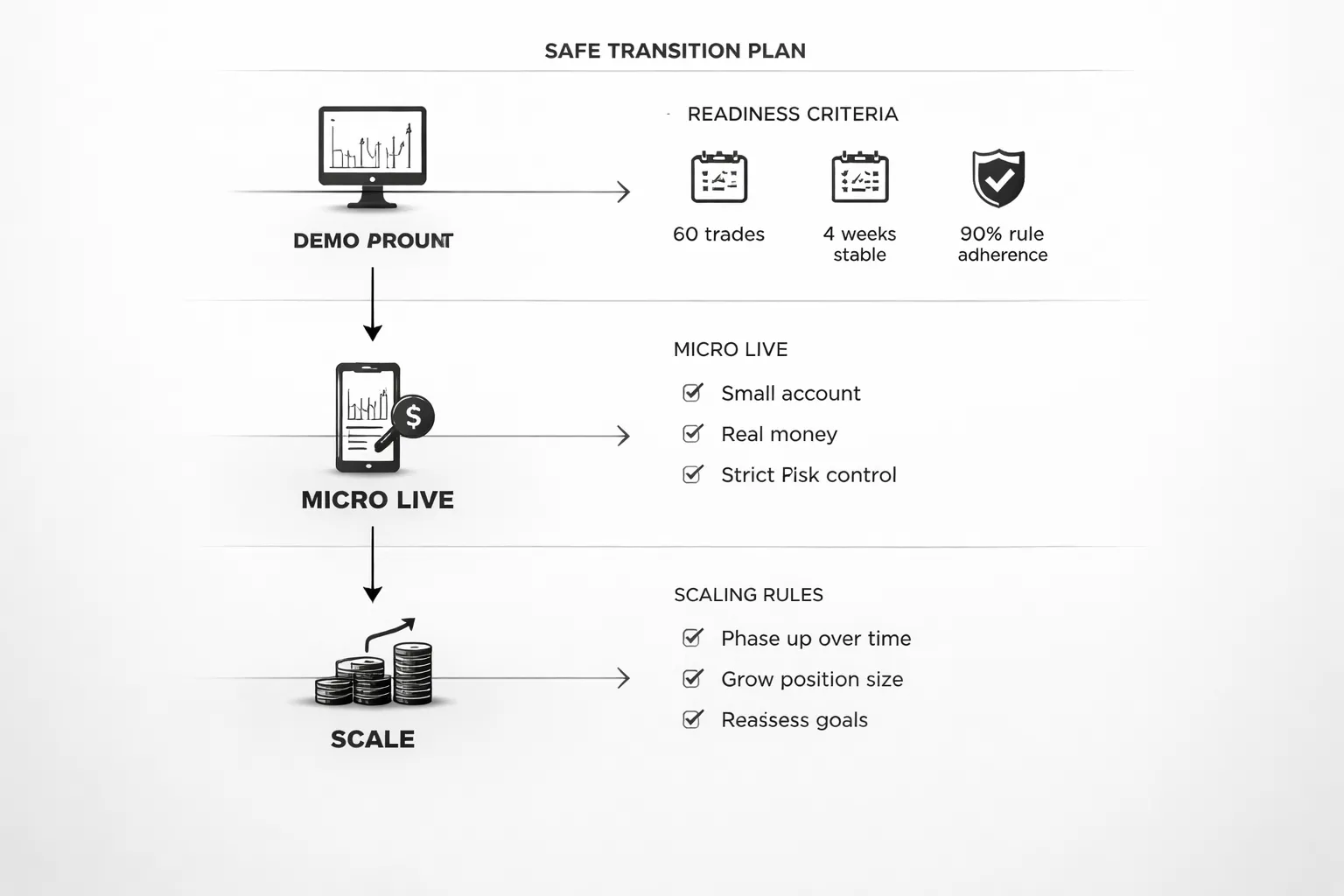
Readiness criteria, prove it with numbers
Go live only after you pass a minimum sample and your process stays stable.
- Sample size: 60 trades minimum on the same market, same session window, same risk model. Do not count trades you took outside plan.
- Time stability: 4 straight weeks with no rule changes.
- Rule adherence: At least 90% of trades follow your entry, stop, and exit rules. Track this as a yes or no per trade.
- Risk stability: Same risk per trade every time. No spikes. No doubling after a loss.
- Drawdown control: Your worst drawdown stays inside your written limit. If you set a 5% cap, you never breach it.
| Metric | Minimum to go live | What fails you |
|---|---|---|
| Trades logged | 60+ | Less than 60, or mixed strategies |
| Rule adherence | 90%+ | Frequent “close enough” trades |
| Weekly consistency | 4 weeks stable | Big swings tied to mood or news |
| Max drawdown | Within your cap | Breaches your cap even once |
| Execution errors | Under 10% | Late entries, missed stops, wrong size |
Micro-lot phase, protect capital while you adapt to real emotions
Demo proves logic. Live proves behavior. Start small so your emotions show up without blowing up your account.
- Risk per trade: 0.10% to 0.25% of account equity. Keep it fixed.
- Daily loss limit: 1R or 0.5% max, whichever is smaller. Stop for the day when hit.
- Weekly loss limit: 3R or 2% max. When hit, you go back to replay for the rest of the week.
- Trade cap: 1 to 3 trades per day. This blocks impulse trades.
- No new setups: Trade only your top one or two patterns. You want clean data.
Your goal in this phase is not profit. Your goal is identical execution with real spreads, slippage, and pressure.
Live trading checklists, reduce errors and execution surprises
Use short checklists. You need fewer decisions, not more confidence.
Before the session
- Confirm the pair, timeframe, and session window you tested.
- Check today’s high impact news times. Block the minutes you avoid.
- Confirm platform settings, one click trading, stop loss defaults, and position size tool.
- Record starting equity. Set your daily and weekly loss limits.
Before each trade
- Setup matches your written rules, yes or no.
- Entry location is valid. Stop location is valid. Target or exit rule is clear.
- Risk equals your fixed percent. No exceptions.
- Spread is within your limit. If spread spikes, skip the trade.
- Order type matches your test. Market orders behave differently than limits.
After each trade
- Screenshot chart at entry and exit.
- Log result in R, not dollars.
- Mark rule adherence. Mark execution error type if it happened.
- Stop trading after your cap, even if you feel “close.” If you struggle with this, review how to avoid overtrading in forex.
Scaling plan, increase size only after stable live proof
Scale based on behavior metrics, not your account balance.
- Stage 1, micro live: 0.10% to 0.25% risk. Run for 30 live trades minimum.
- Advance rule: Rule adherence stays at 90%+, execution errors stay under 10%, drawdown stays inside plan.
- Size step: Increase by one step only, for example 0.25% to 0.35%, or 0.35% to 0.50%.
- Hold period: Keep the new size for 20 trades before any further change.
| Trigger | Action | What you do next |
|---|---|---|
| 2 execution errors in 10 trades | Reduce size one step | Drill the error in replay for 20 reps |
| Daily loss limit hit | Stop for the day | Review decisions, no “make it back” trades |
| Weekly loss limit hit | Stop for the week | Replay only, rebuild proof |
| Drawdown breaches your cap | Go back to demo or replay | Fix the leak, then restart micro live |
| 30 live trades with stable metrics | Increase one step | Keep rules identical |
Do not scale and experiment at the same time. If you change your setup, reset the count and earn the next increase again.
Common mistakes when practicing forex (and how to fix them quickly)
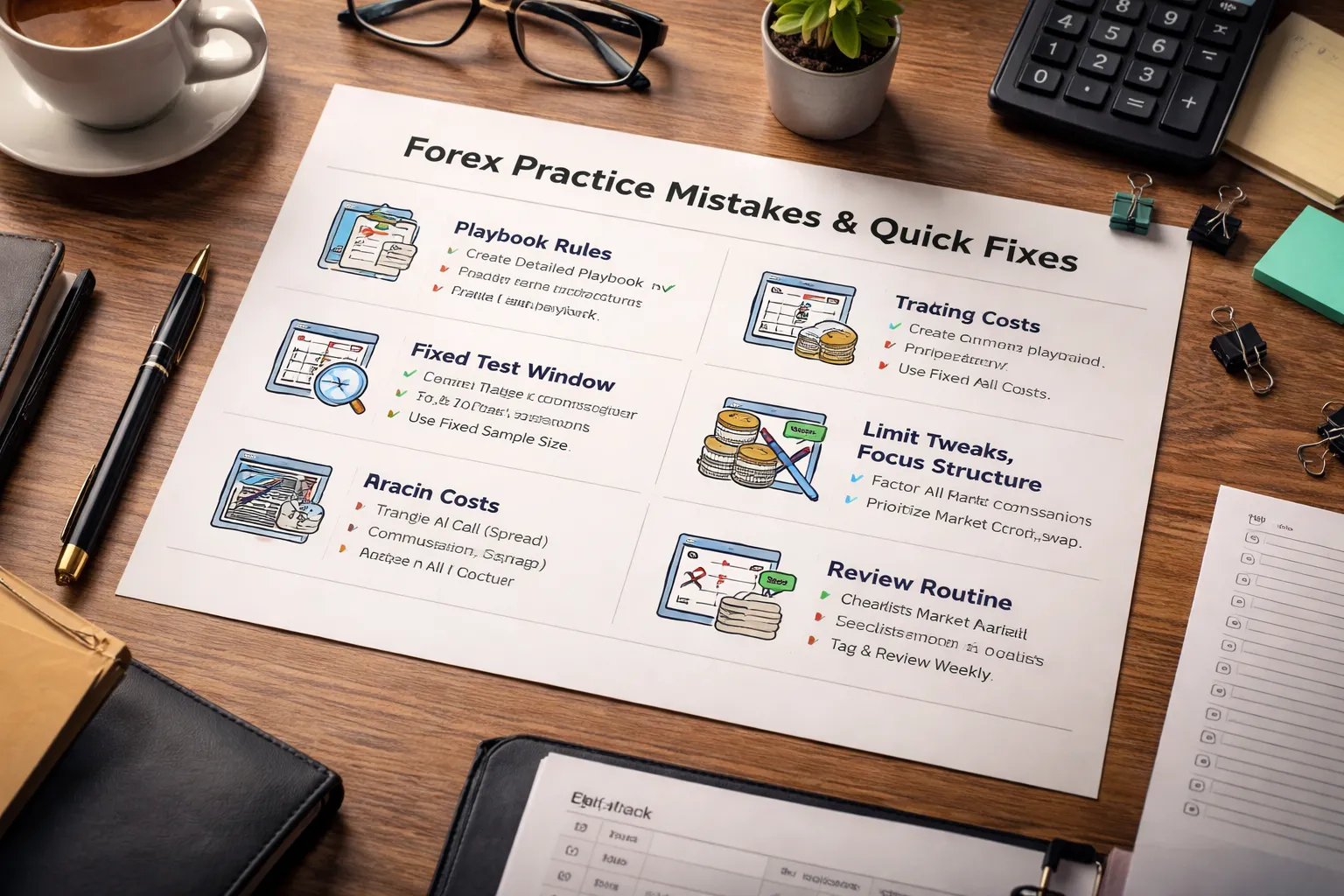
Treating practice like entertainment, replace randomness with a structured playbook
Random clicking builds random results. You need a playbook. One setup. One entry trigger. One exit plan. One risk model.
- Fix: Write a one page rule set. Trade only those rules in demo and replay.
- Fix: Predefine session, pairs, and timeframes. Example, London open only, 2 pairs only, M15 entries.
- Fix: Use a checklist before every order. If one item fails, you skip the trade.
- Fix: Set a daily max trades cap. Example, 3 trades. You stop after the cap.
Your goal in practice is rule compliance. Profit comes later.
Changing strategies mid-sample, set a testing window and stick to it
If you change your strategy every few trades, you never get clean data. You only get noise.
- Fix: Lock one version of your setup for a fixed sample. Use 30 to 50 trades minimum.
- Fix: Define what counts as a valid trade before you start the sample.
- Fix: Track results by version. If you change one rule, label it V2 and restart the count.
- Fix: Allow only one change at a time. Keep risk and management rules identical.
Do not optimize during the run. Optimize after the run.
Ignoring trading costs, spreads, swaps, and commission assumptions
Backtests and replays break when you ignore costs. Small edges disappear fast. Costs hit hardest on lower timeframes and high frequency styles.
- Fix: Set realistic spread and commission in your simulator. Match your broker account type.
- Fix: Model slippage. Add a small buffer to entries and exits, then retest.
- Fix: Include swaps if you hold overnight. Many strategies flip from green to red after financing.
- Fix: Track net R, not gross pips. Costs do not care about your pip count.
If your average win is close to your average spread plus commissions, your model is fragile.
Over-optimizing indicators, focus on market structure and repeatable setups
Indicator tweaking feels like progress. It often just fits the past. Your execution still fails in live conditions.
- Fix: Use indicators as filters, not as the setup. Price action and structure define the setup.
- Fix: Limit your chart to one or two tools. Too many signals create hesitation and late entries.
- Fix: Standardize settings and keep them fixed for the full sample. No per pair tuning.
- Fix: Name your pattern in plain language. Break of range, pullback to level, continuation from consolidation.
If you rely on one indicator cross, build a second layer based on context. Use a simple tool like moving averages for trend context, then execute from structure.
Not reviewing enough, the review is where improvement actually happens
Practice without review repeats the same mistakes. Review turns trades into feedback.
- Fix: Review after every session. Log screenshots of entry, stop, target, and outcome.
- Fix: Tag each trade. Setup type, time of day, pair, mistake type, rule break type.
- Fix: Track two scores. Performance and process. Example, R gained and checklist accuracy.
- Fix: Build a top three leaks list every week. Fix one leak next week, then retest.
Keep the loop tight. Trade, log, review, adjust one variable, then run the next sample.
FAQ
How long should you practice on a demo account?
Stay on demo until you log at least 100 to 200 trades on one setup. Hit your risk rules every trade. Keep drawdown within your limit. Then prove the same results on a small live account for another 30 to 50 trades.
Demo vs replay, which should you use?
Use demo for real-time execution and platform habits. Use replay to compress screen time and test many samples fast. Replay builds pattern recognition. Demo builds discipline under live conditions. Run both each week.
How much time do you need per day to practice?
Minimum 30 to 60 minutes. Spend 10 minutes on prep, 15 to 30 minutes on execution or replay, 10 to 20 minutes on logging and review. Consistency matters more than long sessions.
What is the best way to backtest a forex strategy?
Define one setup, one entry trigger, one stop rule, one exit rule. Replay 50 to 100 trades. Record R, win rate, average R, max drawdown, and rule accuracy. Change one variable only, then retest.
How do you know a strategy has an edge?
You see positive expectancy after costs. Track average win, average loss, win rate, and frequency. Calculate expectancy in R. Demand stable results across at least two market phases and two pairs. Avoid conclusions from small samples.
Should you practice multiple pairs and timeframes?
No. Start with one pair and one timeframe. Learn its rhythm and session behavior. Add a second pair only after you log 100 trades with clean execution and stable stats. Expanding too early hides your mistakes.
What should you track in a practice trading journal?
Log pair, session, setup tag, entry, stop, target, exit, and outcome in R. Add screenshots. Score checklist accuracy. Tag mistakes and rule breaks. Review weekly. Build a top three leaks list and fix one leak next week.
How do you avoid overtrading during practice?
Limit yourself to one setup and a max trades per day rule. Trade only during your chosen session window. Use a checklist gate. Stop after two rule breaks or a daily loss limit. Practice saying no more than yes.
When should you switch from demo to live?
Switch when you execute rules well, not when you feel confident. You need stable stats, low error rate, and controlled drawdowns on demo. Then go live with small size and the same rules for 30 to 50 trades.
What routine should a beginner follow?
Pick one session and one setup. Run a daily loop. Prep, trade or replay, log, review. Each week, audit your stats and mistakes. Fix one variable and retest. Use a clear beginner roadmap from this step-by-step guide.
Can you practice forex without risking money?
Yes. Use a demo account and a replay tool. Treat it like real trading. Use fixed risk per trade in percent, follow a checklist, and track R. If you ignore rules in practice, you will ignore them live.
Conclusion
You get good at forex the same way you get good at any skill. You do reps. You measure results. You fix one mistake at a time.
Keep your practice simple. Use one setup, one session, and one risk rule. Track R, win rate, and max drawdown. Review screenshots and notes the same day. Run a weekly audit and change one variable, then retest.
- Daily: 10 to 30 replay trades, follow your checklist, log every trade.
- Weekly: calculate your stats, tag your top 3 errors, pick one to eliminate.
- Monthly: keep what works, delete what does not, rebuild your rules in one page.
Final tip. Do not go live because you feel ready. Go live after your demo and replay results stay stable for at least 4 weeks with the same risk and the same rules. Then start small and keep the exact routine.
-
Stop Loss vs Take Profit: Differences, Examples & Best Practices
7 months ago -
Forex Trading Psychology Tips: How to Stay Disciplined and Consistent
7 months ago -
How to Set Stop Loss and Take Profit (Step-by-Step)
7 months ago -
Forex Order Types Explained: Market vs Limit vs Stop Orders
7 months ago -
Understanding Forex Candlestick Charts (Beginner Guide)
7 months ago
-
-
- Choosing a demo broker (spreads, execution model, leverage, realistic pricing)
- Platform setup checklist (chart templates, session times, alerts, hotkeys)
- Using economic calendars and news filters without becoming headline-driven
- Data integrity basics (why candles can differ across brokers and how to standardize)
-
- Define your trading profile: timeframe, sessions, and instrument universe
- Translate goals into measurable targets: risk per trade, max daily loss, and rule adherence
- Write a one-page trading plan: entry criteria, invalidation, and management rules
- Create a pre-trade checklist to reduce impulsive decisions
-
- The minimum viable journal: context, setup, execution, management, and emotions
- Key performance metrics: expectancy, win rate vs R-multiple, drawdown, and time-in-trade
- Process metrics that predict success: checklist score, plan compliance, and impulse frequency
- Building a “setup library”: screenshots, annotations, and outcome distributions
-
- Skills drills: targeted exercises to fix specific weaknesses
- Entry timing drill: candle-close entries vs limit entries and measuring slippage
- Stop-loss discipline drill: no-adjustment sessions and invalidation-only moves
- Trade management drill: standardized partials, trailing rules, and break-even logic
- Patience drill: maximum trades per day and only A+ setups
- News volatility drill: practicing around scheduled events with predefined rules
-
- Risk management practice, the fastest way to avoid blowing up when you go live
- Risk per trade and max loss limits, setting guardrails you can follow
- R-multiples and fixed fractional sizing, making results comparable across trades
- Correlation and exposure, avoiding hidden leverage across pairs
- Drawdown protocols, when to reduce size, pause, or return to replay practice
-
- Treating practice like entertainment, replace randomness with a structured playbook
- Changing strategies mid-sample, set a testing window and stick to it
- Ignoring trading costs, spreads, swaps, and commission assumptions
- Over-optimizing indicators, focus on market structure and repeatable setups
- Not reviewing enough, the review is where improvement actually happens
-
- How long should you practice on a demo account?
- Demo vs replay, which should you use?
- How much time do you need per day to practice?
- What is the best way to backtest a forex strategy?
- How do you know a strategy has an edge?
- Should you practice multiple pairs and timeframes?
- What should you track in a practice trading journal?
- How do you avoid overtrading during practice?
- When should you switch from demo to live?
- What routine should a beginner follow?
- Can you practice forex without risking money?
-
-
-
- Choosing a demo broker (spreads, execution model, leverage, realistic pricing)
- Platform setup checklist (chart templates, session times, alerts, hotkeys)
- Using economic calendars and news filters without becoming headline-driven
- Data integrity basics (why candles can differ across brokers and how to standardize)
-
- Define your trading profile: timeframe, sessions, and instrument universe
- Translate goals into measurable targets: risk per trade, max daily loss, and rule adherence
- Write a one-page trading plan: entry criteria, invalidation, and management rules
- Create a pre-trade checklist to reduce impulsive decisions
-
- The minimum viable journal: context, setup, execution, management, and emotions
- Key performance metrics: expectancy, win rate vs R-multiple, drawdown, and time-in-trade
- Process metrics that predict success: checklist score, plan compliance, and impulse frequency
- Building a “setup library”: screenshots, annotations, and outcome distributions
-
- Skills drills: targeted exercises to fix specific weaknesses
- Entry timing drill: candle-close entries vs limit entries and measuring slippage
- Stop-loss discipline drill: no-adjustment sessions and invalidation-only moves
- Trade management drill: standardized partials, trailing rules, and break-even logic
- Patience drill: maximum trades per day and only A+ setups
- News volatility drill: practicing around scheduled events with predefined rules
-
- Risk management practice, the fastest way to avoid blowing up when you go live
- Risk per trade and max loss limits, setting guardrails you can follow
- R-multiples and fixed fractional sizing, making results comparable across trades
- Correlation and exposure, avoiding hidden leverage across pairs
- Drawdown protocols, when to reduce size, pause, or return to replay practice
-
- Treating practice like entertainment, replace randomness with a structured playbook
- Changing strategies mid-sample, set a testing window and stick to it
- Ignoring trading costs, spreads, swaps, and commission assumptions
- Over-optimizing indicators, focus on market structure and repeatable setups
- Not reviewing enough, the review is where improvement actually happens
-
- How long should you practice on a demo account?
- Demo vs replay, which should you use?
- How much time do you need per day to practice?
- What is the best way to backtest a forex strategy?
- How do you know a strategy has an edge?
- Should you practice multiple pairs and timeframes?
- What should you track in a practice trading journal?
- How do you avoid overtrading during practice?
- When should you switch from demo to live?
- What routine should a beginner follow?
- Can you practice forex without risking money?
-
-
How to Place a Forex Trade Step by Step (Your First Trade Explained)
5 months ago -
Forex Trading vs Crypto Trading: Which Market Is Better for Beginners?
5 months ago -
Forex Lot Size Calculator: How to Use It to Size Trades Correctly
7 months ago -
How to Calculate Position Size in Forex (Position Sizing Formula + Examples)
7 months ago -
Forex Leverage Explained: How It Works, Pros, Cons & Examples
7 months ago
-
Forex Trading Platforms Comparison: MetaTrader vs cTrader vs TradingView
7 months ago -
Stop Loss vs Take Profit: Differences, Examples & Best Practices
7 months ago -
Is Forex Trading Legal in the United States? Rules, Regulators & What to Know
7 months ago -
Forex Market Hours & Trading Sessions Explained (Best Times to Trade)
7 months ago -
Forex Leverage Explained: How It Works, Pros, Cons & Examples
7 months ago