Forex Trading Psychology Tips: How to Stay Disciplined and Consistent

Most forex traders do not lose from bad analysis. They lose from bad decisions under stress. You take the wrong trade. You move a stop. You revenge trade. You overtrade. Your edge dies.
Trading psychology is the set of habits that keeps your execution stable when price moves fast and outcomes stay uncertain. Discipline and consistency come from systems, not willpower.
In this guide, you will learn how to control risk exposure, follow rules after a loss, avoid overconfidence after a win, and reduce decision fatigue. You will also learn what to track in a journal so you can spot the patterns behind your mistakes and fix them.
If you still need the basics, start with this beginner forex trading roadmap.
Key Takeaways
Key Takeaways
- In het kort: Build a system, then follow it.
- In het kort: Control risk first, your P and L follows.
- In het kort: Use rules to block revenge trading and overtrading.
- In het kort: Treat wins and losses the same, stick to process.
- In het kort: Reduce decisions with a checklist and fixed routines.
- In het kort: Journal numbers and context, then fix the patterns.
- Set risk per trade before you enter. Use a fixed percentage. Keep it the same after a loss.
- Define your max daily loss and max weekly loss. Stop trading when you hit it. Protect your decision quality.
- Trade fewer, cleaner setups. More trades increase error rate. Your edge needs repetition, not volume.
- Run a pre trade checklist. If one key rule fails, you skip the trade. No exceptions.
- Use hard stops and planned exits. Do not move stops to avoid being wrong. Do not widen risk.
- Track the basics in your journal. Setup type, timeframe, session, entry trigger, stop size in pips, risk in percent, R multiple, result, and rule compliance.
- Review in blocks of 20 to 50 trades. Look for 3 numbers, win rate, average win in R, average loss in R. Then adjust one rule at a time.
- Keep your reward targets tied to your risk plan. Use a clear risk reward ratio rule so you do not manage trades by emotion.
What Forex Trading Psychology Is (and Why It Matters More Than You Think)
The difference between strategy edge and execution edge
Your strategy edge is math. It comes from a repeatable setup, clear entries, clear exits, and stable costs.
Your execution edge is behavior. It comes from taking the same risk, following the same rules, and placing orders the same way each time.
You can have a solid strategy edge and still lose money if your execution edge is negative. Most traders do not fail because their setup is “bad.” They fail because they change size, move stops, skip signals, or take random trades.
Track both edges in your journal. You already track win rate, average win in R, and average loss in R. Add one more field, rule compliance, scored 0 or 1. This gives you a clean split between a strategy problem and an execution problem.
How emotions distort risk perception and timing
Emotions change what you think is “safe” and “worth it.” That shifts your timing.
- After a loss, you see risk everywhere. You cut winners early, you hesitate on valid entries, and you move stops tighter than your plan.
- After a win, you see less risk. You increase size, you enter late, and you hold losers longer because you expect a bounce.
- During a fast move, you chase. You buy tops, you sell bottoms, and you ignore your entry trigger because price looks like it will “get away.”
These actions change your R distribution. You shrink average win R and expand average loss R. Your strategy edge can disappear without any change in the market.
Why discipline beats willpower in fast-moving markets
Willpower fails under speed, stress, and uncertainty. Discipline works because you remove decisions.
Build discipline with constraints. Use fixed risk per trade. Use fixed stop logic. Use pre-set orders when possible. If you trade manually, define exactly when you place a market order versus a limit or stop order, based on your setup rules and liquidity. If you need a refresher, review market, limit, and stop orders.
Make the right action the default action. That is discipline. It protects you when price moves fast and your brain wants relief.
Common signs your psychology is hurting your results
- You change position size after wins or losses, even when your plan says not to.
- You move stops away to avoid taking a loss.
- You take profits early to “lock it in,” then watch price hit your target without you.
- You skip the next valid setup after a loss, then chase a worse entry later.
- You add trades outside your tested hours or session rules.
- You revenge trade, you trade bored, or you trade to make back a specific amount.
- Your compliance score drops, and your average loss in R rises at the same time.
When you see these patterns, do not change your strategy first. Tighten your process. Reduce trades. Reduce risk. Increase structure. Then review the next 20 to 50 trades and check if your numbers stabilize.
Core Psychological Traps That Break Discipline
Fear-based errors, cutting winners, hesitating, premature exits
Fear shows up as early exits and late entries. Your chart looks the same, but your behavior changes.
- Cutting winners. You take profit at 0.3R to 0.7R because price pulls back once. You cap expectancy even if your win rate stays high.
- Hesitating. You wait for extra confirmation that your plan does not require. You miss the entry, then you chase a worse price.
- Premature exits. You move take profit closer, or you close because of one candle. You turn planned 1.5R to 3R outcomes into small wins.
Fix it with rules you can audit. Predefine exit types, then track them.
- Mark each trade as “plan exit” or “fear exit.”
- Set a minimum hold rule, based on your setup, such as “no manual close before X minutes or before the next structure break.”
- Use fixed take profit and stop loss levels, do not adjust them without a written trigger. Use this process from how to set stop loss and take profit.
| Fear behavior | What it does to your stats | What to track |
|---|---|---|
| Early take profit | Lowers average win in R | Avg win (R), % winners < 1R |
| Late entry from hesitation | Worse R:R, more stop-outs | Entry quality score, slippage in pips |
| Manual close on noise | Higher win rate, lower expectancy | Expectancy, plan-exit rate |
Greed-driven mistakes, oversized positions, ignoring invalidation levels
Greed pushes you to break your own risk cap. It shows up as size changes and stop changes.
- Oversized positions. You raise risk after a “perfect” setup. One loss wipes out several normal wins.
- Ignoring invalidation. You keep the trade open after your stop level gets hit in real terms, even if you do not execute it. You convert a planned loss into an unplanned one.
- Moving the stop. You widen the stop to avoid being wrong. Your average loss in R climbs.
Fix it with hard constraints that sit outside your emotions.
- Set a max risk per trade and a max daily loss, then lock them. No exceptions.
- Require a written invalidation level before entry. If price hits it, you exit. You do not debate.
- Track “risk creep.” Compare planned R to realized R on losses.
| Greed behavior | What it does to your stats | What to track |
|---|---|---|
| Risk increase | Higher drawdown, higher variance | Risk per trade %, max DD |
| Stop widening | Higher average loss in R | Avg loss (R), % losses > 1R |
| No invalidation exit | Tail losses | Largest loss (R), “rule break” count |
Overconfidence after wins and the invincibility bias
Winning streaks change your standards. You feel safe. Your checklist gets shorter.
- You take marginal setups because the last ones worked.
- You trade more pairs and more timeframes, then lose focus.
- You stop reviewing because you “already know.”
Overconfidence shows up fast in your logs.
- Trade count increases while average R drops.
- Rule breaks rise after green days.
- Your win rate may hold, but expectancy falls because losers grow.
Fix it with a post-win protocol.
- After any day above a set threshold, such as +2R, reduce size or reduce trades for the next session.
- Require full checklist compliance on every trade. No “easy mode.”
- Run a 20-trade rolling review that compares “A setups” vs “B setups.” Remove the B group.
Revenge trading after losses and the urge to get it back
Revenge trading starts when you anchor to the last loss. You stop thinking in probabilities. You start thinking in recovery.
- You re-enter the same pair without a new signal.
- You increase size to recoup faster.
- You shorten your stop to “make it work,” then get chopped.
Revenge trading has a clear footprint.
- Time between trades drops.
- Setup quality drops.
- Losses cluster, and average loss rises.
Fix it with forced separation between loss and next decision.
- Set a cool-off rule after any loss, such as a time lock or a “one chart review” requirement.
- Limit re-entries, such as one re-entry max per idea, only if a fresh trigger prints.
- End the session at your daily loss limit. Do not negotiate.
FOMO and chasing moves after the best entry is gone
FOMO makes you buy high and sell low. You enter after expansion, when your stop needs to be wider and your target is closer.
- You enter mid-move because you fear missing the trend.
- You take low R:R trades, then you need a high win rate to survive.
- You skip your entry model and rely on “momentum feel.”
Fix it with predefined entry windows.
- Write what “too late” means in price terms, such as distance from level in pips or % of ATR.
- If the move leaves without you, log it as a valid miss. Do not convert it into a bad trade.
- Use alerts at levels. Stop watching every tick.
| FOMO behavior | What it does to your stats | What to track |
|---|---|---|
| Late entry | Lower R:R, more stop-outs | Planned R:R vs realized R:R |
| Chasing breakouts | More trades, lower edge | Trades per day, setup grade |
Confirmation bias and selectively reading market information
Confirmation bias makes you protect your idea. You search for support and ignore invalidation.
- You add indicators or timeframes until you find agreement.
- You ignore a level because it conflicts with your trade.
- You treat news and commentary as signals, even when your system does not.
Fix it with a two-column check that forces balance.
- Before entry, write 3 reasons for the trade and 3 reasons it can fail.
- Add one “kill switch” condition, based on price, not opinion.
- In review, tag each trade with “disconfirming info ignored” if you skipped a rule or a level.
| Bias pattern | Process symptom | Metric to audit |
|---|---|---|
| Cherry-picking signals | Checklist changes mid-session | Checklist compliance % |
| Ignoring invalidation | Late exits, widened stops | Avg loss (R), max loss (R) |
| Noise consumption | More trades, less selectivity | Trades per week, A-setup rate |
Build a Trading Plan That Protects You From Yourself
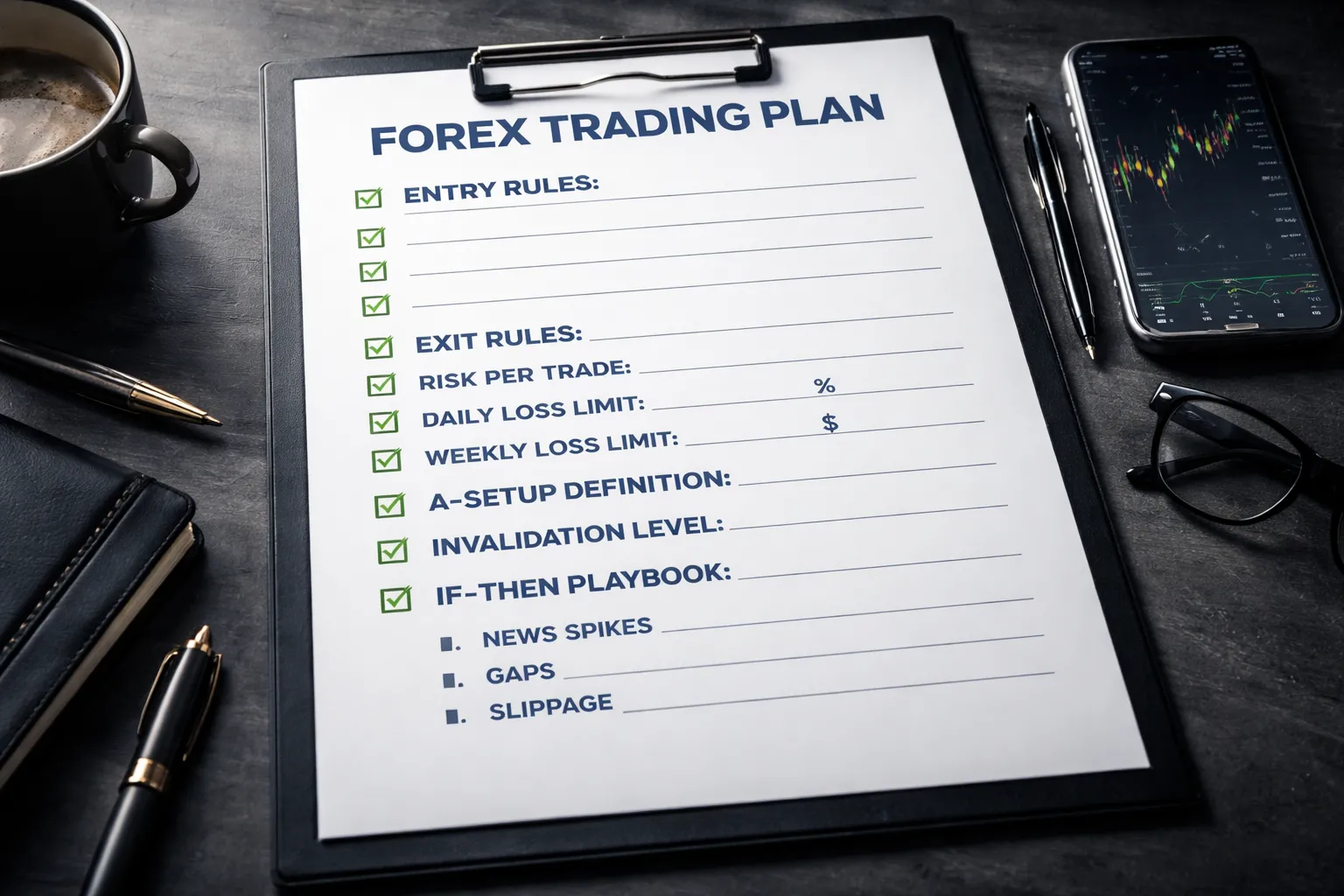
Non-negotiable rules: entries, exits, risk limits, and trade filters
Your plan must remove debate. You trade only when rules match. You stop when rules break.
- Entry rule. Define your trigger in one sentence. Example, “Enter on a retest of level X after a close above it on my trading timeframe.”
- Exit rule. Define two exits before you enter. One for profit, one for wrong.
- Risk per trade. Set a fixed percent or fixed R. Keep it constant. Many traders use 0.25% to 1% per trade.
- Daily and weekly loss limits. Stop trading at a set drawdown. Example, -2R per day, -6R per week.
- Trade filters. Ban low-quality trades. Filters can include session, spread, volatility, and trend alignment.
Audit the plan with numbers. Track checklist compliance %, average loss in R, max loss in R, trades per week, and A-setup rate.
Define your A-setup, and what to do when it is not there
Your A-setup is the only trade you must take. Everything else is optional. Most discipline problems come from trading B and C setups.
- Write a tight definition. Market condition, level type, trigger, stop logic, and minimum R target.
- Score it. Use a 0 to 5 checklist. Trade only at 4 or 5.
- When it is not there. Do one of these only, stand aside, journal, or set alerts. Do not “make a trade.”
Track your A-setup rate. If it drops, you drifted. Reduce trades. Tighten filters. Reset for one week.
Predefine invalidation: where your trade idea is proven wrong
You need a single price level that kills your idea. If price hits it, you exit. No debate. No widening.
- Place invalidation at structure. Behind the swing point or level that supports your thesis.
- Match size to stop. Set position size from stop distance and your fixed risk.
- Lock the stop before entry. If you cannot place it, you cannot take the trade.
Use a clear stop process. Use this guide if you need specifics, how to place a stop loss.
Create an if-then playbook for common scenarios (news spikes, gaps, slippage)
Stress makes you improvise. A playbook keeps you consistent.
- If high-impact news is within 30 to 60 minutes, then do not open new trades. Manage existing risk only.
- If spread widens beyond your limit, then stand down. Log it as “market conditions failed.”
- If you get slippage above X pips or above Y% of stop, then reduce size next trade, or pause for the day after one event.
- If price gaps through your stop, then accept the fill, record the gap size, and stop trading for a set cooldown period.
- If you miss an entry, then do not chase. Wait for the next planned trigger only.
Track these events. Count news trades taken. Measure average slippage in pips and as % of stop. Set a hard limit that forces a pause.
Align timeframes with personality (scalper vs swing trader fit)
Your timeframe must fit your attention, patience, and decision speed. Wrong fit creates rule breaks.
- If you check charts often, trade higher timeframes anyway. Use 1H to 4H for execution, daily for bias. Reduce noise.
- If you hate waiting, do not scalp to feel busy. Limit yourself to one session and a max trades per day rule.
- If you work a job, avoid lower timeframes. Use alerts and end-of-day routines.
- If you feel stressed during open trades, widen your timeframe, reduce size, and reduce frequency.
| Style | Typical holding time | Best fit | Rules to protect you |
|---|---|---|---|
| Scalper | Minutes | Fast decisions, strong execution | Max trades per day, spread limit, strict stop, no news window |
| Day trader | Hours | Session focus, routine-driven | Session hours, daily loss limit, one A-setup type |
| Swing trader | Days to weeks | Patience, low screen time | Weekly risk cap, alerts, no micromanaging, fixed review schedule |
Risk Management Habits That Create Emotional Stability
Position sizing that lowers stress
Your position size decides how you feel in the trade. Oversize and you watch every tick. You manage emotions instead of risk.
Pick a fixed risk per trade. Most retail traders stay in the 0.25% to 1% range. Newer traders should start at the low end.
- Step 1: Set your risk per trade as a percent of equity.
- Step 2: Place your stop where your idea fails, not where your fear feels better.
- Step 3: Size the position from the stop distance so the loss at the stop equals your planned risk.
This removes panic decisions. You already accepted the worst case before entry.
Daily and weekly loss limits that stop spirals
Loss streaks trigger revenge trading. A hard limit cuts the loop.
- Daily loss limit: 2R to 3R. Hit it, stop trading for the day.
- Weekly loss limit: 5R to 8R. Hit it, stop trading until your next scheduled review.
- Max losing trades: 3 in a row. Then pause, screenshot, journal, walk away.
Use platform risk controls if available. If not, set alerts and enforce it like a rule, not a mood.
Risk-of-ruin basics, survival comes first
You cannot compound if you blow up. Survival is your first objective.
Risk-of-ruin rises fast when you risk too much per trade. A few losses can cut your account so deeply that you change behavior. You tighten stops, you chase entries, you break rules.
- Lower risk per trade reduces drawdown size.
- Lower drawdowns reduce emotional pressure.
- Lower pressure improves execution, which protects expectancy.
Keep your risk small enough that a normal losing streak does not change your process.
R-multiples and expectancy, stop worshipping win rate
Track results in R, not pips or dollars. R equals your initial risk.
- -1R means you lost exactly what you planned.
- +2R means you made two times what you risked.
- 0R means you scratched the trade.
Focus on expectancy. Expectancy tells you what your method makes per trade over a large sample.
| Metric | Simple definition |
| Win rate | Percent of trades that win |
| Average win | Average R on winning trades |
| Average loss | Average R on losing trades |
| Expectancy | (Win rate x Avg win) minus (Loss rate x Avg loss) |
A strategy can win 40% of the time and still be profitable if winners are larger than losers. This mindset prevents you from forcing low quality setups just to “be right.”
Drawdowns, use a step-down protocol
Drawdowns feel personal when your size stays the same. A step-down plan keeps you stable.
- Trigger 1: Down 3R from peak. Cut risk per trade by 25% until you recover to the peak.
- Trigger 2: Down 6R from peak. Cut risk per trade by 50%. Trade only your top setup type.
- Trigger 3: Down 10R from peak. Stop live trading. Switch to sim or micro size. Do a full review.
Define the review checklist in advance. Check execution errors, rule breaks, and market conditions. Keep changes small. If you trade price action, keep the rules tight and simple, see our price action trading guide for beginners.
Forex Trading Psychology Tips for Staying Disciplined Day to Day
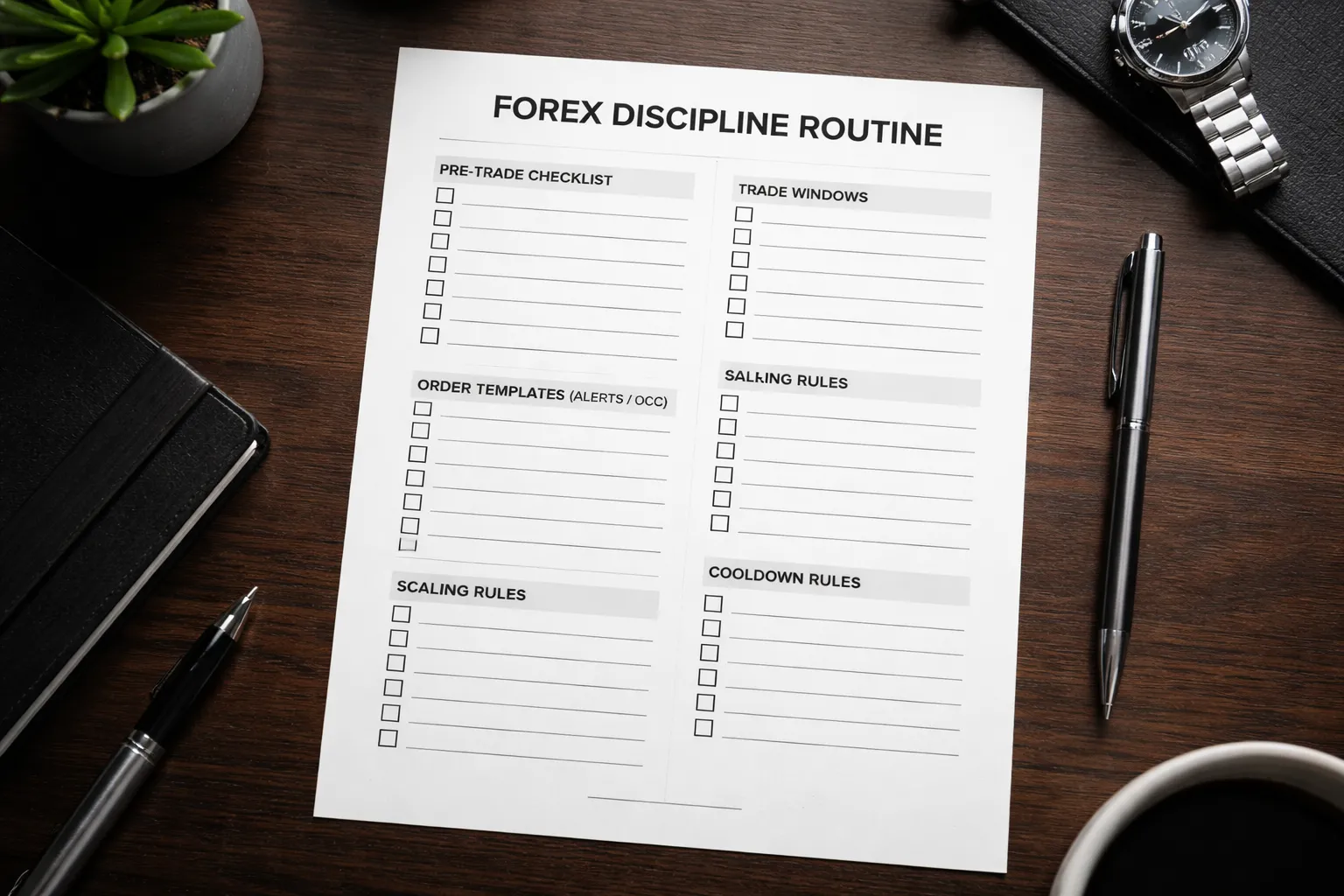
Use a pre-trade checklist to prevent impulsive clicks
Write the checklist. Print it. Use it before every order. If you skip a line, you do not trade.
- Market: Session, news in next 60 minutes, spread normal.
- Setup: Matches one of your approved patterns, clear invalidation level.
- Trend and levels: You marked the key level, you know what breaks your idea.
- Entry: Exact trigger, no “close enough” fills.
- Stop: Placed at the invalidation point, not at a comfort point. Review stop placement basics in stop loss vs take profit.
- Target: Predefined, based on structure, not hope.
- Risk: Fixed % or fixed $ per trade, position size calculated, max daily loss known.
- Order: OCO set, alerts set, no manual “watch and click” plan.
- State: You slept enough, you can follow rules for the next 30 minutes.
Set trade windows to avoid overtrading and screen fatigue
Pick the hours you trade. Trade only inside them. Outside them, you review or you walk away.
- Use 1 to 2 windows per day, 60 to 120 minutes each.
- Set a hard stop time. Close the platform when the window ends.
- Limit decisions. If no A-setup appears, you log “no trade” and end the window.
- Cap activity. Example, max 3 trades per window, max 5 per day.
Reduce decision load with templates: alerts, OCO orders, and predefined levels
Build templates once. Reuse them. This cuts errors when you feel rushed.
- Alert template: One at entry zone, one at invalidation, one at target zone.
- Order template: Bracket order with stop and take profit attached. Use OCO so one cancels the other.
- Level template: Mark HTF key level, intraday trigger level, stop level, target level before you watch price.
- Risk template: One position sizing method, one max risk per trade, one daily loss limit.
Adopt a one good trade mindset rather than forcing daily action
Judge the day by execution, not by P and L. Your job is one clean trade, or zero trades.
- Define “good trade” as a full checklist pass, correct size, correct stop, no rule breaks.
- Stop after one A-trade if you feel the urge to “press” the market.
- Track process stats, not stories. A-trades taken, A-trades skipped, rule breaks, and daily R.
Create rules for scaling in and out without emotional bargaining
Scaling needs fixed rules. If you decide in the moment, you will negotiate with yourself.
- Add only when right: Scale in only after price moves in your favor by X, and the setup re-triggers. Never add to a losing position.
- One add max: Limit to one add per trade, with a separate risk cap.
- Move stop by rule: Example, move stop to break even only after +1R and structure confirms, not after a random spike.
- Partial exits: Example, take 50% at +1R, trail the rest by a fixed swing rule. No changing targets mid-trade.
- Total risk cap: Initial risk plus add risk never exceeds your per-trade limit.
Implement a cooldown routine after big wins or losses
Big emotions distort your next decision. Use a forced reset.
| Trigger | Cooldown | Next step |
|---|---|---|
| After +3R day | Stop trading for 30 minutes, no chart watching | Journal the trades, end the day or reduce size by 50% |
| After -3R day | Stop trading for the day | Tag the errors, review checklist compliance, plan one fix |
| After one rule break | 15 minute break | Write what broke, write the prevention step, return only if calm |
Keep the routine mechanical. You do not debate it. You follow it.
Journaling and Review: Turn Emotions Into Data
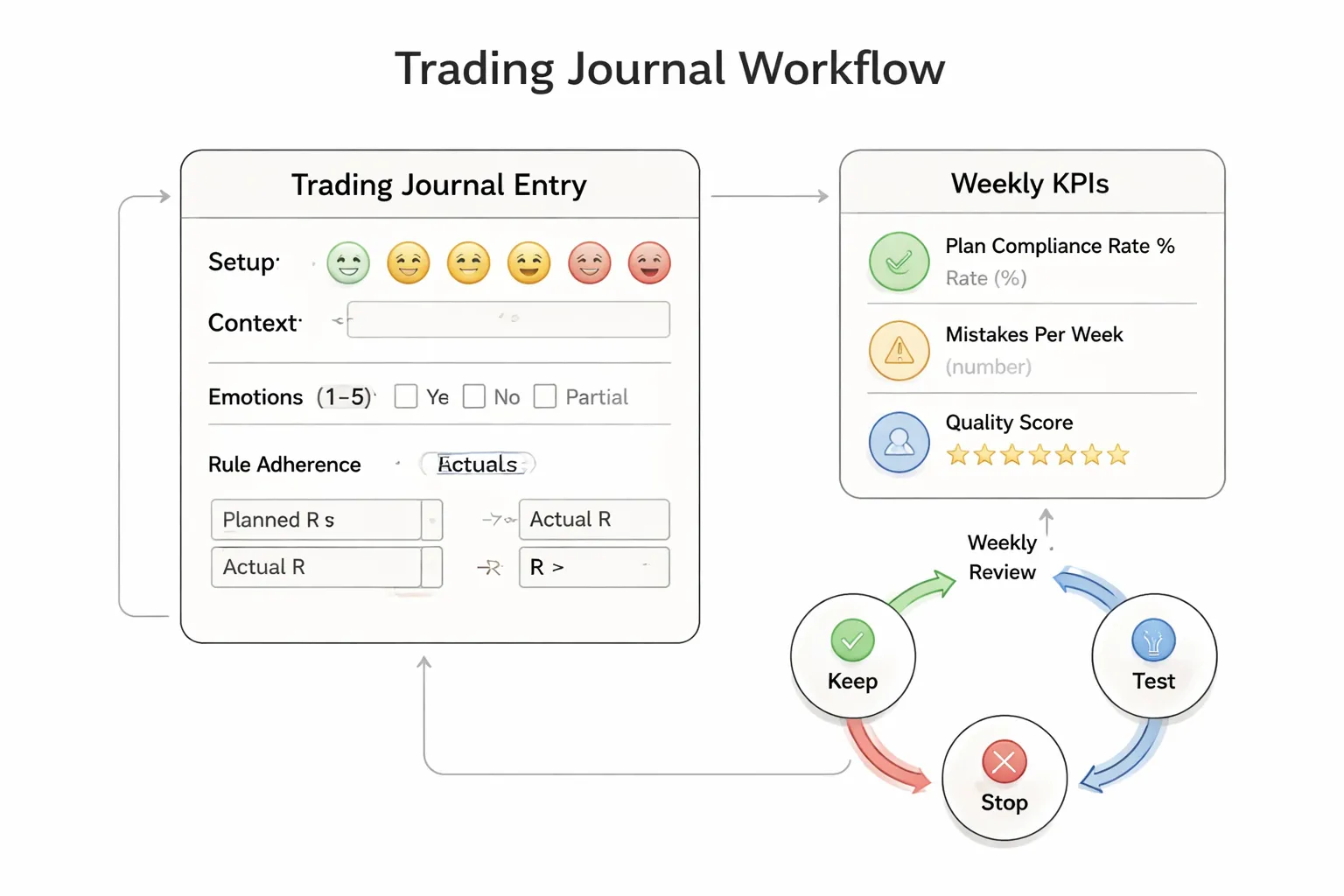
What to Record Beyond Price
Your journal must capture behavior, not stories. Price is the outcome. You track what you controlled.
- Setup and plan: strategy name, timeframe, entry trigger, stop location, target plan, and whether you used a fixed rule for exits. Link exits to a defined method like take profit levels.
- Context: session, news risk on the calendar, spread conditions, trend state by your rules, and market type by your rules.
- Risk: planned R, actual R, size changes, and reason for any size change.
- Execution quality: entry type, slippage, missed entry, late entry, partial fill, platform errors.
- Rule adherence: checklist pass or fail, and which rule failed. Log rule breaks even if the trade wins.
- Emotions: pre trade state, during trade state, post trade state. Use a 1 to 5 scale for stress, confidence, and FOMO.
Process KPIs You Track Each Week
Profit comes last. Process comes first. Track numbers that measure discipline.
- Plan compliance rate: trades that followed every rule divided by total trades.
- Mistakes per week: count each rule break. Do not bundle them.
- Quality score: a simple 0 to 3 score per trade.
| Score | Meaning | Action |
|---|---|---|
| 3 | All rules followed, clean execution | Keep as baseline |
| 2 | Rules followed, execution issues | Fix one execution step |
| 1 | One rule bent or rushed process | Reduce size, tighten routine |
| 0 | Rule break or impulse trade | Stop, review, prevent |
Screenshot-Based Review to Spot Repeated Patterns
Text lies. Screenshots show timing and structure.
- Before: one screenshot at decision time with your marked entry, stop, target, and checklist result.
- After: one screenshot at exit with notes on why you exited and whether you followed the exit rule.
- Tags: add 2 to 4 tags per trade, like late entry, moved stop, skipped checklist, revenge, overtrade, news risk.
- Pattern scan: sort by tags weekly. Look for clusters, not single events.
Weekly Review Structure: Keep, Stop, Test
Run a weekly review on the same day and time. Keep it short. Use your data.
- Keep: the top two behaviors that appear in your best quality trades.
- Stop: the top one mistake by frequency, and the top one mistake by damage in R.
- Test: one small change for next week. Write the exact rule and the end condition.
- Test rule format: “If X happens, I do Y.”
- End condition: “After 20 trades or 2 weeks, I keep it only if plan compliance rises by 10% and mistakes drop.”
Separate Variance From Bad Decisions
A good trade can lose. A bad trade can win. Your review must separate outcome from decision.
- Step 1, label the trade: A trade if it followed rules. B trade if it missed a minor step. C trade if it broke a rule.
- Step 2, isolate expectancy: analyze A trades only. Your edge lives there.
- Step 3, measure variance: track the win rate and average R of A trades across a fixed sample, like 30 trades. Do not change rules mid sample.
- Step 4, measure decision errors: count C trades and total R lost on C trades. This is preventable loss.
- Step 5, act on the right problem: if A trades perform near your historical stats, do nothing. If C trades rise, tighten the routine and reduce size. If A trades degrade across a full sample, review market filters and execution rules, then run one test.
Mental Frameworks Used by Consistent Traders
Probability mindset, think in series
You trade a distribution, not a single outcome. Your edge shows up over a sample. Your job is to execute the next trade the same way.
- Define your sample size. Use 20 to 50 trades per setup before you judge it.
- Track expectancy in R. Expectancy = (Win% x Avg Win R) - (Loss% x Avg Loss R).
- Keep risk per trade stable inside the sample. If you change size, you change the data.
- Judge process first. Judge P&L second.
| What you focus on | What you measure | What you do next |
|---|---|---|
| One trade result | Profit or loss in dollars | Change rules, revenge trade, hesitate |
| Trade series | Expectancy in R across 20 to 50 trades | Keep rules, adjust only after the sample |
Detach identity from results, treat losses as expenses
A loss does not grade you. It is a cost of running a strategy. You pay it to find out if your edge is present.
- Decide risk before entry. Treat that amount as spent the moment you click.
- Separate skill from outcome. A good trade can lose. A bad trade can win.
- Use routine language in your journal. Write, “followed plan, yes or no,” before you write feelings.
- Review preventable loss. If C trades create most of the damage, fix behavior, not the system.
Focus on controllables, execution over prediction
You cannot control price. You can control your filters, your entry trigger, your risk, and your exit rules.
- Write a short pre trade checklist. Market condition, setup present, level, trigger, stop, target, size.
- Measure execution error rate. Track rule breaks per 20 trades.
- Use hard rules for risk. Max risk per trade. Max daily loss. Max open risk.
- Reduce inputs that feed prediction. Limit news scanning and random opinions.
If your method uses technical triggers, keep them mechanical. For example, use one RSI rule set and do not tweak it mid sample. You can review and test later. Learn more about the RSI indicator settings and signals if you need a clean baseline.
Reframe missing a trade as protecting selectivity
Consistent traders do not try to catch every move. They protect their criteria. They skip trades that do not meet the plan.
- Define “eligible.” If a trade misses one rule, it is ineligible.
- Track skipped trades. Mark whether they were eligible or ineligible at the time.
- Measure FOMO cost with data. Count how many eligible trades you missed, then compare to your historical win rate and average R.
- Set an entry window. If price runs without your trigger, you stand down and wait for the next one.
| Event | Label | Action |
|---|---|---|
| Price moves without your trigger | Ineligible | Log it, no trade |
| All rules met, you froze | Eligible missed | Fix execution, reduce size, rehearse trigger |
Develop self talk that is specific, neutral, and actionable
Your inner dialogue should sound like a checklist. It should point to a decision you control. It should avoid blame and hype.
- Replace vague statements with concrete tasks. “I am terrible,” becomes “I violated the stop rule, next trade I place stop first.”
- Use time bound commands. “Wait for candle close,” “Set alert,” “Walk away for 5 minutes.”
- Keep one line for each trade state. Before entry, during trade, after exit.
- Write scripts for stress points. Loss streak, win streak, missed trade, near stop.
| Unhelpful self talk | Neutral replacement | Action |
|---|---|---|
| I need to make it back. | This is one trade in a series. | Next trade at normal size only. |
| The market is against me. | My filter may be off this week. | Finish the sample, then review A and C trades. |
| I cannot miss the next move. | My edge needs selectivity. | Trade only eligible setups. |
| I always mess up entries. | I entered early twice this sample. | Wait for trigger, set alert, reduce size. |
Handling Stress, Tilt, and Burnout in Forex
Recognize Early Tilt Signals Before Your Behavior Changes
Tilt starts in your body and attention before it shows up in your trades. Track signals you can measure.
- Speeding up. You click faster, move stops faster, and enter without waiting for your trigger.
- Narrow focus. You stop checking higher timeframes, spreads, and news windows.
- Rule editing. You change criteria mid-session to make a setup “fit”.
- Revenge impulse. You feel pressure to win back the last loss in the next trade.
- Body cues. Jaw tight, shallow breathing, shoulders up, hot face, sweaty palms.
Put a simple tilt score in your journal. Rate 0 to 3 for each: speed, focus, rule editing, revenge, body cues. If your total hits 6, you stop and run a reset. If it hits 8, you stop trading.
Breathing, Resets, and Short Interventions That Calm Your Nervous System
You do not need motivation. You need a fast downshift.
- Physiological sigh. Two short inhales through the nose, one long exhale through the mouth. Repeat 3 times.
- Box breathing. Inhale 4 seconds, hold 4, exhale 4, hold 4. Do 4 rounds.
- 90-second rule. Step away from the screen for 90 seconds. No charts. No phone. Let the stress peak and drop.
- Reset script. Say it out loud. “My job is process. Next decision follows the plan. No exceptions.”
- Environment break. Stand up. Drink water. Wash your face. Change rooms if possible.
Then run a 30-second checklist before you place any order: setup eligible, risk fixed, stop placed, take profit planned, spread acceptable. Use your saved levels and rules from your stop loss and take profit plan. If you cannot complete the checklist, you do not trade.
Sleep, Caffeine, and Decision Fatigue: Practical Performance Hygiene
Most “psychology problems” are fatigue problems. Fix the inputs.
- Sleep minimum. If you slept under 6.5 hours, trade smaller or do review only. Your impulse control drops fast with short sleep.
- Consistent wake time. Keep it within 60 minutes across the week. Your alertness becomes predictable.
- Caffeine cap. Keep total caffeine stable. Avoid increasing dose after a loss. Do not add caffeine late in the session.
- Food and hydration. Eat before active trading. Low blood sugar increases impatience. Keep water at the desk.
- Reduce decisions. Predefine watchlist, session times, max trades, and risk. Fewer choices means fewer mistakes.
Use a simple readiness check before the session. If you fail two items, you reduce risk by 50 percent or you stand down.
| Readiness item | Pass rule |
|---|---|
| Sleep | 6.5+ hours |
| Energy | Stable, no crash |
| Stress | Manageable, no urgency |
| Focus | Can read plan without skimming |
| Time | No distractions for next 60 minutes |
When to Stop Trading for the Day: Objective Stop Conditions
Stopping rules protect your edge when your execution slips. Make them mechanical.
- Daily loss limit hit. Stop when you reach your preset max loss. No “one more” trade.
- Max trades hit. Stop when you take your planned number of trades, even if you are down.
- Two rule breaks. Any two mistakes that violate your plan triggers a stop.
- Tilt score threshold. Stop at 8 on your tilt score. Reduce size or stop at 6.
- Execution drift. You miss alerts, chase price, or move stops twice in one session.
- After a big win. If you feel invincible, stop. Overconfidence creates sloppy risk.
Write the stop condition in your journal the moment it triggers. Then close the platform. Do not “monitor”. Monitoring pulls you back in.
Build Recovery Days Into Your Trading Week
Consistency needs planned downtime. You cannot grind clean decisions every day.
- Schedule one low-intensity day. Review, journal, and plan. No live trades unless A+ setups appear.
- Use a red day rule. After two consecutive losing days, take the next day off from execution.
- After high variance. If you hit an unusually large win or loss, take the next session as a reduced-risk day.
- Weekly shutdown. One day with no charts. No backtesting. Let your attention recover.
Track recovery like a metric. Log hours slept, caffeine, exercise, and screen time. Your goal is stable inputs. Stable inputs produce stable execution.
Trading During News, Volatility Spikes, and Uncertainty
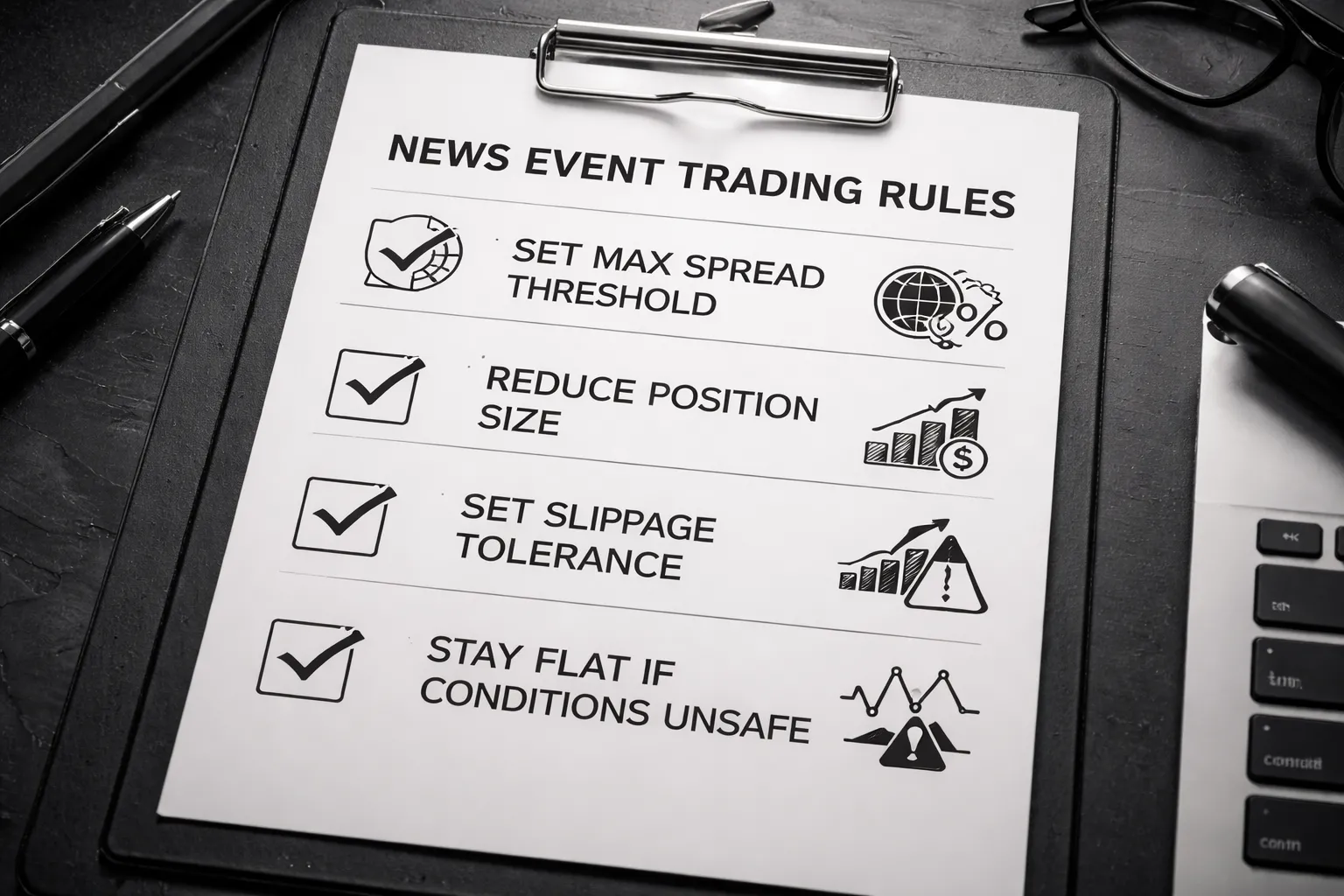
News-trading rules to avoid impulsive ‘casino’ trades
News spikes punish improvisation. You need fixed rules before the event.
- Trade only scheduled events. Use an economic calendar. No trades on surprise headlines.
- Define your window. Either trade the release, or wait for the first reaction to finish. Do not switch mid-event.
- Set a hard filter. If spread is above your limit, you do nothing.
- Use “one attempt” max. One entry, one exit plan. No re-entries during the same release window.
- Cap the day. One news trade per day. Stop after a win or loss.
- Pre-place orders or stay manual. Pick one method and keep it consistent. Mixing increases errors.
Adjusting size and stops when spreads widen
Volatility changes your true risk. Spread and slippage add to it. Your job is to keep risk stable.
- Measure typical spread for each pair and session. Log it.
- Set a max spread rule. Example, do not trade if spread is over 2 to 3 times your normal.
- Reduce size first. If your stop must widen to survive noise, cut position size to keep your account risk flat.
- Avoid tight stops near releases. They turn into coin flips when the spread expands.
- Assume worse fills. Use conservative risk inputs. Your platform’s “stop distance” is not your true loss in fast markets.
| Condition | Action |
|---|---|
| Spread is normal | Use your standard size and stop rules. |
| Spread is 2x normal | Cut size. Consider widening stop. Keep % risk constant. |
| Spread is 3x+ normal | Stay flat. Do not “test” small trades. |
Slippage planning: what to do when execution differs from plan
Slippage is part of the cost of trading volatility. Plan for it like a fee.
- Set a slippage tolerance in pips or as a percent of your stop. If the fill exceeds it, you exit and stand down.
- Use hard invalidation. If slippage places your entry too close to your stop, cancel the trade. Do not “hope” it works.
- Prefer limit entries for pullbacks. Market orders during spikes often fill at the worst point.
- Do not move the stop to “give it room”. That converts execution error into larger risk.
- Log expected vs actual. Track entry slippage, stop slippage, and spread at fill. Review by event type.
When staying flat is the most disciplined trade
You protect your edge by avoiding conditions that break your system.
- Skip if your setup needs clean structure. News often destroys support and resistance levels and invalidates trendline reads.
- Skip if you feel urgency. Urgency signals you want action, not a good trade.
- Skip if you cannot define risk in advance. If you cannot place a stop with a clear thesis, you do nothing.
- Skip if liquidity looks thin. Off-hours releases and holiday sessions can gap.
- Skip if you already hit your daily limit. Volatility tempts revenge trades.
If you need structure trades, focus on the sessions after the event. Use your normal tools again, like a simple moving average strategy that relies on smoother price action.
Post-event review to refine your volatility playbook
News trading improves through repeatable review. Keep it mechanical.
- Tag every trade. Event name, currency, time, and session.
- Record market conditions. Pre-event range in pips, spike size, spread peak, and first 5 to 15 minute candle range.
- Record execution. Planned entry, actual entry, slippage, and exit quality.
- Grade rule adherence. Yes or no. No “almost”.
- Update thresholds. Adjust max spread, slippage tolerance, and allowed windows based on your logs, not memory.
- Build an event profile. Some releases trend, others whipsaw. Trade only the ones that match your data.
Personalization: Match Psychology Tips to Your Trader Type
Beginner challenges: overtrading, learning overload, and strategy hopping
As a beginner, you do not have a psychology problem. You have a process problem. Fix the inputs.
- Overtrading. Set a hard trade limit per day and per session. Log every impulse trade. If you break the limit, you stop trading that day. Use a simple trigger, max two setups only. If you need help, read how to avoid overtrading.
- Learning overload. Run one system for 30 trades before you change anything. Keep one watchlist, one timeframe, one risk model. Save new ideas in a backlog. Test later.
- Strategy hopping. Define your “change rules” in advance. You only change a rule after a sample size. Use your journal to track rule adherence, not feelings.
Beginner discipline comes from fewer decisions. You improve faster when you trade less, but review more.
Intermediate challenges: drawdown management and inconsistency cycles
Intermediate traders lose consistency when they change behavior after a hit. You need drawdown rules that remove discretion.
- Define your drawdown ladder. Set steps like minus 2R, minus 5R, minus 8R. Assign actions to each step. Example, at minus 5R you cut risk per trade by 50 percent and reduce pairs.
- Control the “win then widen” cycle. After a good day, keep risk and size fixed for the next session. Do not “press” until your log proves a stable edge over the last 50 trades.
- Stop the “loss then revenge” cycle. After two rule-following losses, take a time stop. After one rule-breaking trade, end the session. Track which rule breaks start the spiral.
Your job is not to avoid drawdowns. Your job is to make your response to drawdown predictable.
Advanced challenges: complacency, risk creep, and over-optimization
Advanced traders drift when trading feels easy. Your edge dies from small exceptions.
- Complacency. Audit rule adherence weekly. Grade every trade yes or no. Track “small bends” like late entries, wider stops, and skipping filters. These become big leaks.
- Risk creep. Lock position sizing to an account rule. No increases after a hot streak. Allow size increases only after a scheduled review, and only if your last 100 trades match your expected metrics.
- Over-optimization. Limit changes to one variable per test. Keep a baseline system. Use out-of-sample checks. If a tweak improves results but increases complexity, reject it unless the gain is large and stable.
Advanced discipline means you treat your rules like a contract. You do not renegotiate mid-trade.
Personality alignment: introvert and extrovert routines, focus style
Your routine must fit how you focus. If it fights your temperament, you will break it under stress.
- If you are more introverted. Trade fewer pairs. Use longer windows. Block noise. Do reviews alone, then write one action for the next week. Use checklist execution to prevent overthinking.
- If you are more extroverted. You need structure to avoid stimulus chasing. Set fixed trade windows. Use a pre-trade script. Allow social input only after the session, not during it.
- If you focus best in short bursts. Use session blocks. Example, 60 to 90 minutes active, then stop. Use alerts and limit orders. Do not stare at charts for hours.
- If you focus best in deep work. Plan one longer session with strict entry criteria. Limit chart switching. Review with data, not opinions.
Do not copy another trader’s psychology tips. Copy their structure only if it matches your attention pattern.
Choosing markets and sessions that fit your life constraints
Most discipline failures come from trading when you should not trade. Your schedule sets your strategy.
- Match volatility to your availability. If you can only trade 30 minutes, focus on one session open and one or two pairs. If you can monitor longer, you can manage slower setups.
- Set a “no trade” list. Do not trade when you feel rushed, tired, or distracted. Do not trade during meetings, commuting, or childcare. Your log will show the damage.
- Pick pairs that behave consistently in your window. Use your journal to rank pairs by spread stability, slippage, and clean movement during your session. Cut the rest.
- Use time stops. If your setup needs active management but you cannot watch it, do not take it. Use bracket orders only when your rules support it.
Consistency comes from repeating the same conditions. Build your trading around your real life, not your ideal week.
| Trader type | Main risk | Best constraint | Non-negotiable metric |
|---|---|---|---|
| Beginner | Too many trades and too many systems | Two setups, one timeframe, trade limit | Rule adherence rate |
| Intermediate | Behavior changes in drawdown | Drawdown ladder and time stops | Max drawdown vs plan |
| Advanced | Exceptions, size drift, curve fitting | Scheduled audits and change limits | Edge stability over 100 trades |
A 30-Day Discipline and Consistency Plan (Practical Roadmap)
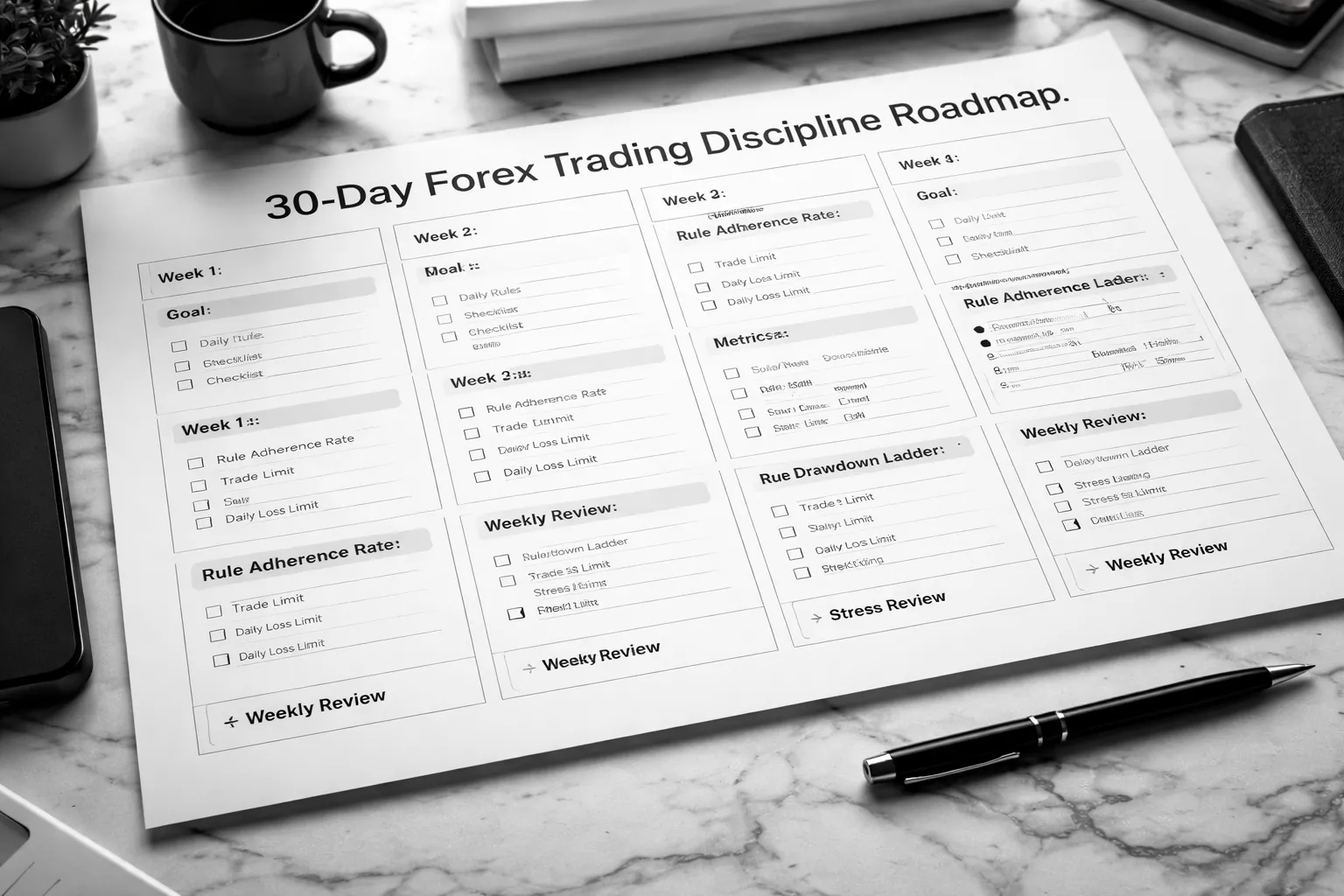
Week 1: Simplify rules and set risk guardrails
Your goal is control. You do not need more trades. You need repeatable execution.
- Pick two setups. Write entry, stop, and exit rules in 5 lines each. No extra filters.
- Pick one timeframe for execution. One chart, one decision pace.
- Set fixed risk per trade. Use 0.25% to 1.00% of account. Keep it constant for 30 days.
- Set a daily loss limit. Stop trading at -1R or -2R for the day. No exceptions.
- Set a weekly loss limit. Stop trading at -4R to -6R for the week. Review before resuming.
- Set a trade limit. Max 1 to 3 trades per day. If you hit the limit, you stop.
- Define “no trade” conditions. High impact news windows, spreads above your max, poor sleep, anger, or urgency.
- Choose one non-negotiable metric. Track rule adherence rate, percent of trades that followed every rule.
Target by end of Week 1, you can state your rules from memory, and you stop trading when your limits trigger.
Week 2: Checklist execution and reduce trade frequency
Your goal is fewer decisions and fewer mistakes. You will trade less to trade better.
- Use a pre-trade checklist. If one item fails, you do not place the trade.
- Require a 5-minute pause. When a setup appears, you wait 5 minutes, then re-check the rules.
- Batch your chart time. Two review blocks per day, 20 to 30 minutes each. No constant monitoring.
- Cut discretionary entries. You enter only at your defined trigger. No “close enough” trades.
- Standardize order placement. Same order type, same stop method, same position sizing method.
- Define your R. 1R equals the distance from entry to stop. Track outcomes in R, not money.
| Pre-trade checklist item | Pass criteria |
|---|---|
| Setup match | One of your two setups, no hybrids |
| Market condition | Matches your rules, trend or range as defined |
| Entry trigger | Exact trigger printed, no anticipation |
| Stop placement | Rule-based stop, not comfort-based |
| Position size | Fixed percent risk, calculated before entry |
| Risk-reward | Meets your minimum, log it |
| Daily limits | Not breached, trade count not exceeded |
| State check | Sleep, stress, and focus within your rules |
Keep your minimum risk-reward simple, and log it every time. If you need a refresher on the math, use this guide on risk-reward ratio.
Week 3: Journal upgrades and weekly review cadence
Your goal is fast feedback. You will measure process, then outcomes.
- Journal every trade in 3 minutes. Do it right after exit, not at night.
- Capture screenshots. One before entry, one at exit. Label them with date and setup.
- Log rule breaks as data. One line, what broke, why, and what you will change.
- Add a stress rating. 1 to 5 before the trade, and 1 to 5 after the trade.
- Run a weekly review. Same day, same time, 45 minutes. No chart hopping.
| Journal field | What you record |
|---|---|
| Setup | A or B, no other categories |
| Timeframe | Your single execution timeframe |
| Entry and stop | Price levels, stop distance, and 1R value |
| Planned exit | Target, trail rules, or time stop if used |
| Result | R gained or lost |
| Rule adherence | Yes or no, list any rule broken |
| State | Stress 1 to 5, focus 1 to 5, sleep hours |
| Notes | One sentence, what to keep or fix |
Weekly review checklist, count your trades, compute your rule adherence rate, list the top two rule breaks, and choose one fix for next week. Do not change the strategy rules yet.
Week 4: Optimize based on process metrics and stress signals
Your goal is stability. You will adjust the process, not chase performance.
- Audit your last 20 trades. Split them into “followed rules” and “broke rules.” Compare results in R.
- Raise standards if discipline is strong. If adherence is high, reduce trade count further, or tighten “no trade” rules.
- Install a drawdown ladder. At -3R you cut size by 25%. At -5R you cut size by 50%. At -6R you stop for the week.
- Use time stops. If price does not move in your favor within your defined window, you exit per rule.
- Respond to stress, not P and L. If stress ratings rise, shorten sessions, lower size, and reduce screens.
- Lock change limits. One change per week, max. Write it, test it, then keep or revert.
| Signal | What it usually means | What you do next |
|---|---|---|
| More trades than plan | Impulse, boredom, FOMO | Lower daily trade limit, add a 10-minute rule |
| Size drift | Revenge or overconfidence | Re-lock fixed risk percent for 2 weeks |
| Rule breaks in drawdown | Loss aversion, panic control | Activate drawdown ladder and time stop |
| High stress scores | Overexposure | Reduce watchlist, reduce sessions, reduce size |
| Good results with bad process | Random reinforcement | Treat as a failure, tighten checklist |
How to know the plan is working: measurable indicators
You track discipline first. You track profitability second.
- Rule adherence rate. Target 85% or higher by Day 30.
- Trade frequency stability. Trades per week stay within your limit. No spikes after losses.
- Loss limit compliance. Zero days where you breach daily or weekly limits.
- Size consistency. Position risk stays within your fixed percent. No unplanned increases.
- Reduced variance from mistakes. “Broke rules” trades drop each week, count and percent.
- Stress trend. Average stress rating falls, or stays stable during losing streaks.
- Edge stability. Over 30 days, your “followed rules” trades show consistent R performance versus your “broke rules” trades.
If the metrics improve, you keep the same system for another 30 days. If the metrics fail, you do not hunt new strategies. You fix the process, then re-test.
Pros and Cons of Popular Psychology Techniques (What Helps vs What Backfires)
Visualization
Helps when you rehearse actions, not outcomes. Visualize your pre-trade checklist, your entry trigger, your stop placement, your position size, and your exit rules. You train execution. Track it in your journal as a yes or no, followed rules.
Backfires when you visualize profits. Outcome-based visualization builds unrealistic confidence. It also pushes you to widen stops, skip confirmation, or add size. Your data will show it as higher rule breaks during high-confidence days and worse R on those trades.
- Use it: 60 seconds before your session. Rehearse the exact steps you will take after a loss and after a win.
- Stop using it: If your “felt confident” notes line up with impulsive trades and larger drawdowns.
Affirmations and positive thinking
Helps when you use process statements. Pick lines you can verify. “I only take A setups.” “I risk 0.5 percent per trade.” “I stop after 3 rule breaks.” These reduce decision fatigue because they point to rules.
Backfires when it becomes denial. “I am a winner” does not fix poor execution. It can also delay needed changes, because you avoid hard review. Watch for phrases that ignore evidence, “the market is wrong,” “it will come back,” “I deserve this trade.”
- Use it: As a trigger to open your checklist or sizing tool.
- Stop using it: If you write affirmations more than you review mistakes, or if you hold losers longer after repeating them.
Meditation and mindfulness
Helps when you use it to lower arousal. A short daily practice can reduce stress spikes, improve attention, and slow impulsive clicks. The key metric is stability, your stress rating stays flat during losing streaks.
Backfires with common beginner mistakes. You try to “clear your mind,” fail, then quit. Or you meditate after you tilt and treat it like a reset button. Or you use long sessions and skip review work.
- Use it: 5 to 10 minutes daily, same time. Add one 3-breath pause before placing any order.
- Stop using it: If you use it as a way to avoid journaling, or if you still revenge trade right after a “calm” session.
Accountability partners and communities
Helps when it adds structure. A partner can enforce rules and review your stats weekly. You share your plan before the session, then report followed rules percent, R, and rule breaks after. This tightens feedback loops.
Backfires when it adds noise. Most groups reward hot takes. Signals and chat drama push you into off-plan trades. You start copying, overtrading, and explaining losses to others instead of fixing your process.
- Use it: One partner, clear rules, fixed review time. No live trade calls.
- Stop using it: If your trade count rises without a rise in quality, or if you enter trades you cannot explain in your journal.
Automation tools
Helps when it removes mechanical errors. Use scripts, alerts, and order templates for position sizing, bracket orders, and session limits. You reduce fat-finger mistakes and make your risk rules harder to break. Pair this with basic risk management rules.
Backfires when you outsource thinking. You trust the tool more than your plan. You keep trading a broken system because the execution feels clean. Or you automate entries and ignore regime changes, spreads, and news conditions.
- Use it: Automate sizing and exits first. Keep entries manual until your data shows stable edge over 30 days.
- Stop using it: If you cannot explain why a trade exists, or if your “followed rules” trades lose because the rules no longer fit current conditions.
| Technique | What helps | What backfires | Track this |
|---|---|---|---|
| Visualization | Rehearse checklist and loss response | Rehearse profit and “being right” | Rule breaks on high-confidence days |
| Affirmations | Process statements tied to rules | Identity statements that ignore data | Hold time on losers, average R after affirmations |
| Meditation | Short daily baseline, pre-trade pause | Used as tilt cure, skipped reviews | Stress rating trend during drawdowns |
| Accountability | Weekly stats review, plan check-ins | Signal chasing, social pressure | Trade count vs followed rules percent |
| Automation | Sizing and bracket orders, fewer errors | Blind trust, stale rules | Error rate, max loss per day compliance |
When to Seek Professional Help or Coaching (E-E-A-T Safety and Limits)
Distinguishing normal trading stress from chronic anxiety
Stress comes with risk. It should drop after you close the platform.
Get more cautious when stress stays high outside trading hours, or it spills into sleep, appetite, focus, and relationships.
- Normal trading stress: spikes around entries and exits, fades after the session, you still follow your plan, you can review without avoidance.
- Concerning pattern: dread before the screen, panic during normal volatility, repeated revenge trades, avoidance of journaling, constant chart checking, trouble sleeping, irritability, numbness.
- Data check: track a daily stress rating from 1 to 10, and log hours of sleep. If your stress stays 7+ for two weeks, or sleep drops below your baseline for a week, reduce risk and pause new trades.
- Rule check: if your “followed rules percent” falls while trade count rises, you likely trade to regulate emotion, not to execute an edge.
What a reputable trading coach can and can’t do
A coach helps you execute a process. A coach does not predict markets for you.
- Can do: audit your journal, spot recurring execution errors, tighten pre-trade checklists, set position sizing rules, build review routines, create accountability and metrics.
- Can do: help you design constraints, max loss per day, max trades per day, “no trade after two losses,” and enforce them with check-ins.
- Can’t do: guarantee returns, promise win rates, or remove drawdowns. They cannot trade your account safely without regulated authorization.
- Can’t do: treat anxiety, depression, trauma, or addiction. They should refer you out when mental health issues show up.
Vet a coach like a professional service.
- Ask for a clear coaching scope, pricing, and cancellation policy.
- Ask what metrics you will track, and how progress gets measured.
- Look for process proof, journal templates, example reviews, risk rules, and a documented method of feedback.
- Prefer coaches who push risk control and fewer trades, not more signals.
Therapy and performance psychology: when it’s appropriate
Use therapy when trading triggers problems that extend beyond trading.
- Go now: panic attacks, persistent insomnia, thoughts of self-harm, substance use to trade or calm down, compulsive trading you cannot stop.
- Go soon: chronic anxiety, depression symptoms, anger you cannot control, or you keep breaking rules despite downsizing and taking breaks.
- Performance support: a licensed psychologist or therapist who works with performance can help with impulse control, stress tolerance, and recovery routines.
Bring data. It speeds up help.
- Your last 30 trades, with screenshots and rule compliance.
- Your daily stress rating, sleep, and caffeine or alcohol notes.
- Your “tilt” triggers, what happened right before you broke rules.
This site provides education, not medical advice. If you feel unsafe, contact local emergency services or a licensed professional in your area.
Red flags: gurus, unrealistic promises, and pressure tactics
- Guaranteed profits, fixed monthly returns, or “no losing weeks.”
- Pressure to act fast, “last chance,” countdown timers, and upsells after you buy.
- Claims of secret bank algorithms, insider access, or “risk-free” hedging.
- Refusal to discuss drawdowns, risk limits, or long losing streaks.
- No track record standards, no audited statement, only screenshots and testimonials.
- Signal groups that push high leverage, high frequency, and “make it back” trades.
- Isolation tactics, “ignore your friends,” “only listen to me,” “haters will doubt you.”
If you want a clean execution framework before you pay anyone, start with your chart rules and make them testable. Use a simple technical base from Technical Analysis in Forex Explained, then measure rule compliance before you chase new systems.
FAQ
What is trading psychology in forex?
Trading psychology is how you handle risk, uncertainty, and loss. It shows up in your execution. Your goal is simple. Follow your rules, size risk the same way, and avoid impulse trades. Track behavior, not feelings.
How do you stay disciplined in forex trading?
Use a written checklist. Trade only at planned times. Set a daily max loss and stop when you hit it. Pre-set entries, stops, and targets. Review rule compliance each week. Discipline comes from process, not motivation.
What should you do after a losing streak?
Reduce size or pause. Check if losses come from your edge or your behavior. Audit the last 20 trades for rule breaks. Stop any “make it back” trades. Resume only when you can follow your plan for a full week.
How do you avoid revenge trading?
Set a hard cooldown after any loss. Use a timer. Limit trades per session. Block the trade button until you complete your post-loss checklist. If you feel urgency, you stop. Urgency signals you are trading emotions, not rules.
How can you control overtrading?
Cap trades per day. Trade one or two setups only. Use session windows and skip low-liquidity hours. Track your best hours and cut the rest. If your journal shows lower expectancy after trade three, stop at two.
What is a good pre-trade checklist?
Market condition, setup type, entry trigger, stop location, target, and position size. Confirm risk per trade. Confirm news risk. Confirm you accept the loss. If one item fails, you pass. Keep the checklist short.
How much should you risk per trade?
Most retail traders do better with small, fixed risk. Start with 0.25 to 1 percent per trade. Keep it constant for at least 50 trades. Change risk only after you prove rule compliance and stable drawdowns.
How do you place a stop-loss without second-guessing?
Define invalidation before you enter. Place the stop at that level, then size the position to fit your risk. Do not move stops wider. Move to breakeven only if your plan says so. Use this stop-loss guide.
What trading journal stats matter most for psychology?
Rule compliance rate, average R per trade, max drawdown, and time of day results. Add “reason for entry” and “reason for exit.” Track mistakes as a separate category. Your goal is fewer errors, not more trades.
How do you handle FOMO in forex?
Define valid setups and accept missed trades as normal. Use alerts at your levels. Trade the next signal, not the last move. If price runs without your trigger, you skip it. FOMO drops when your rules stay strict.
How long does it take to build consistency?
Measure it in samples, not days. Aim for 50 to 100 trades with stable rules. Consistency means stable execution and controlled drawdowns. If your rules change each week, you reset the clock. Keep variables fixed.
Conclusion
Conclusion
Discipline comes from a small set of rules you follow every trade. You control your process, not outcomes. Keep your system stable long enough to measure it.
- Trade one plan. Fix your entry, stop, and target rules for the next 50 to 100 trades.
- Risk stays constant. Use the same risk per trade until your execution stays clean.
- Journal the right stats. Track rule compliance rate, average R per trade, and max drawdown.
- Cut decision points. Use stop and limit orders to remove heat-of-the-moment changes. See stop and limit orders.
- Review on schedule. Review after a fixed sample, not after a win or a loss.
Final tip. Score your discipline, not your P and L. If your rule compliance sits below 90 percent, reduce size and simplify your plan until you can execute it.
-
Stop Loss vs Take Profit: Differences, Examples & Best Practices
7 months ago -
How to Set Stop Loss and Take Profit (Step-by-Step)
7 months ago -
Forex Order Types Explained: Market vs Limit vs Stop Orders
7 months ago -
How to Start Forex Trading Step by Step (Beginner Roadmap)
7 months ago -
Understanding Forex Candlestick Charts (Beginner Guide)
7 months ago
-
- Fear-based errors, cutting winners, hesitating, premature exits
- Greed-driven mistakes, oversized positions, ignoring invalidation levels
- Overconfidence after wins and the invincibility bias
- Revenge trading after losses and the urge to get it back
- FOMO and chasing moves after the best entry is gone
- Confirmation bias and selectively reading market information
-
- Non-negotiable rules: entries, exits, risk limits, and trade filters
- Define your A-setup, and what to do when it is not there
- Predefine invalidation: where your trade idea is proven wrong
- Create an if-then playbook for common scenarios (news spikes, gaps, slippage)
- Align timeframes with personality (scalper vs swing trader fit)
-
- Use a pre-trade checklist to prevent impulsive clicks
- Set trade windows to avoid overtrading and screen fatigue
- Reduce decision load with templates: alerts, OCO orders, and predefined levels
- Adopt a one good trade mindset rather than forcing daily action
- Create rules for scaling in and out without emotional bargaining
- Implement a cooldown routine after big wins or losses
-
- Beginner challenges: overtrading, learning overload, and strategy hopping
- Intermediate challenges: drawdown management and inconsistency cycles
- Advanced challenges: complacency, risk creep, and over-optimization
- Personality alignment: introvert and extrovert routines, focus style
- Choosing markets and sessions that fit your life constraints
-
- What is trading psychology in forex?
- How do you stay disciplined in forex trading?
- What should you do after a losing streak?
- How do you avoid revenge trading?
- How can you control overtrading?
- What is a good pre-trade checklist?
- How much should you risk per trade?
- How do you place a stop-loss without second-guessing?
- What trading journal stats matter most for psychology?
- How do you handle FOMO in forex?
- How long does it take to build consistency?
-
- Fear-based errors, cutting winners, hesitating, premature exits
- Greed-driven mistakes, oversized positions, ignoring invalidation levels
- Overconfidence after wins and the invincibility bias
- Revenge trading after losses and the urge to get it back
- FOMO and chasing moves after the best entry is gone
- Confirmation bias and selectively reading market information
-
- Non-negotiable rules: entries, exits, risk limits, and trade filters
- Define your A-setup, and what to do when it is not there
- Predefine invalidation: where your trade idea is proven wrong
- Create an if-then playbook for common scenarios (news spikes, gaps, slippage)
- Align timeframes with personality (scalper vs swing trader fit)
-
- Use a pre-trade checklist to prevent impulsive clicks
- Set trade windows to avoid overtrading and screen fatigue
- Reduce decision load with templates: alerts, OCO orders, and predefined levels
- Adopt a one good trade mindset rather than forcing daily action
- Create rules for scaling in and out without emotional bargaining
- Implement a cooldown routine after big wins or losses
-
- Beginner challenges: overtrading, learning overload, and strategy hopping
- Intermediate challenges: drawdown management and inconsistency cycles
- Advanced challenges: complacency, risk creep, and over-optimization
- Personality alignment: introvert and extrovert routines, focus style
- Choosing markets and sessions that fit your life constraints
-
- What is trading psychology in forex?
- How do you stay disciplined in forex trading?
- What should you do after a losing streak?
- How do you avoid revenge trading?
- How can you control overtrading?
- What is a good pre-trade checklist?
- How much should you risk per trade?
- How do you place a stop-loss without second-guessing?
- What trading journal stats matter most for psychology?
- How do you handle FOMO in forex?
- How long does it take to build consistency?
-
How to Place a Forex Trade Step by Step (Your First Trade Explained)
4 months ago -
Forex Trading vs Crypto Trading: Which Market Is Better for Beginners?
4 months ago -
Forex Lot Size Calculator: How to Use It to Size Trades Correctly
6 months ago -
How to Calculate Position Size in Forex (Position Sizing Formula + Examples)
6 months ago -
Forex Leverage Explained: How It Works, Pros, Cons & Examples
6 months ago
-
Forex Trading Platforms Comparison: MetaTrader vs cTrader vs TradingView
7 months ago -
Stop Loss vs Take Profit: Differences, Examples & Best Practices
7 months ago -
Is Forex Trading Legal in the United States? Rules, Regulators & What to Know
7 months ago -
Forex Market Hours & Trading Sessions Explained (Best Times to Trade)
7 months ago -
Forex Leverage Explained: How It Works, Pros, Cons & Examples
6 months ago