CPI, Inflation and Forex: How Inflation Data Moves Currency Markets

CPI prints move currencies fast. You see it in the spread, the candle, and the next rate bet.
This guide breaks down the link between CPI, inflation, and forex. You will learn what headline, core, MoM, and YoY CPI mean. You will learn why the market reacts to the difference between actual and forecast, not the number alone. You will learn how CPI shifts interest rate expectations, bond yields, and central bank pricing. You will also learn which pairs tend to react most, what to watch in the release, and how to avoid common mistakes when trading the spike.
For execution rules and risk control around data drops, read how to trade forex news without getting wrecked.
- In het kort: CPI moves FX when it changes rate expectations, not when it prints a big number.
- You trade the surprise, actual versus forecast, plus any revisions.
- Core CPI usually matters more than headline for policy pricing.
- The first move often follows U.S. yields, then spreads into USD pairs and risk FX.
- Watch for whipsaws, wide spreads, and slippage in the first minutes.
- Plan entries and exits before the release, size smaller, and respect your stop.
- Focus on the gap: If CPI beats expectations, markets price higher rates. That tends to lift the currency. If CPI misses, markets price cuts sooner. That tends to hit the currency.
- Read the right line: Track Core CPI, the MoM print, and any sticky components. Headline can swing on energy and food and fade fast.
- Follow the chain: CPI changes the expected policy path. That shifts bond yields. FX reacts to the yield move and the rate differential.
- Know where it hits first: USD pairs often lead on U.S. CPI, especially EUR/USD, USD/JPY, and GBP/USD. USD/JPY can move hard because it tracks yield differentials.
- Respect microstructure: Liquidity drops at release time. Spreads widen. Stops fill worse than you expect. Your edge comes from timing and risk control, not speed.
- Avoid the common errors: Do not trade the headline only. Do not ignore revisions. Do not chase the first spike without a plan. Do not assume the first move will hold.
- Anchor to rates: If you want the cleanest framework, start with how interest rates affect currency pairs. Then map CPI into that rate story.
What CPI is and why it matters for forex markets
CPI in plain English: what it measures and what it misses
CPI tracks the price change of a fixed basket of goods and services that households buy. It reports inflation as a monthly change and a year over year change.
For forex, CPI matters because central banks react to inflation. Higher inflation pressure can raise the odds of rate hikes. Lower inflation pressure can raise the odds of cuts. Rates and rate expectations drive currency pricing.
CPI misses parts of the real world. It does not capture every household. It does not reflect your exact spending. It can lag fast shifts in demand and supply. It also struggles with quality changes, new products, and how people switch to cheaper alternatives.
Headline vs core vs trimmed-mean and median CPI
Traders care about the inflation signal, not the noise. Different CPI cuts try to separate the two.
- Headline CPI, includes everything. It moves hard when energy or food swings. It can drive short term volatility, especially when markets focus on cost of living and politics.
- Core CPI, strips out food and energy. It often tracks underlying services inflation better. Many central banks and rate traders lean on it for policy expectations.
- Trimmed-mean CPI, drops extreme price moves from both tails, then averages the rest. It reduces one-off spikes and gives a steadier trend.
- Median CPI, takes the middle price change in the basket. It can stay firm when a few categories fall sharply, which helps you spot broad inflation pressure.
In practice, your read should match the central bank focus. If the market trades the sticky core services story, a soft headline print from falling gasoline may not weaken the currency for long.
CPI vs PCE vs HICP vs CPIH: key inflation gauges across major economies
Forex reacts to the measure each central bank targets and the one rates traders price. Know the local benchmark.
| Economy | Main gauges you will see | What tends to matter for policy pricing |
|---|---|---|
| United States | CPI, Core CPI, PCE, Core PCE | The Fed targets PCE in its framework, but markets still trade CPI hard because it hits first and moves rates fast. |
| Eurozone | HICP, Core HICP | The ECB focuses on HICP. Country prints can move EUR before the aggregate if they shift expectations for the final release. |
| United Kingdom | CPI, Core CPI, CPIH | BoE targets CPI. CPIH adds owner occupiers’ housing costs, but CPI drives the main policy debate and pricing. |
| Canada | CPI, Core measures | BoC watches CPI and its preferred core trims. FX often reacts more to the core trims than the headline. |
| Japan | CPI, Core CPI, Core-core CPI | JPY can react to inflation when it changes the rate path and yield differentials, not just the print itself. |
If you trade GBP pairs, keep your framework tied to rates and growth drivers. See what moves GBP/USD for the bigger map.
How CPI is calculated: baskets, weights, seasonality, and substitution effects
CPI starts with a basket. The statistics agency picks categories, assigns weights, and tracks prices over time.
- Basket, a list of goods and services. Think rent, medical services, cars, food, energy, travel.
- Weights, each category gets a share based on household spending data. A change in weights can change the inflation path even if prices stay the same.
- Price collection, the agency samples prices across regions, stores, and providers. It then builds category indexes and a total index.
- Seasonal adjustment, many releases show seasonally adjusted and not seasonally adjusted versions. Seasonality can flip the month to month read. Traders often key off seasonally adjusted month to month for momentum.
- Substitution effects, people switch to cheaper items when prices rise. Fixed baskets can overstate inflation if they do not adapt fast. Method updates try to address this, but not perfectly.
- Shelter and services, big weights can dominate the index. When shelter inflation turns, it can drive the whole core trend for months.
For trading, you want to know what drove the surprise. A beat caused by used cars can fade. A beat caused by services and shelter can reprice the entire rate path.
Why CPI is a high-frequency macro catalyst
CPI hits on a fixed schedule. It arrives monthly. It lands before many slower macro series. It also feeds directly into rate expectations.
That combination makes CPI a repeatable catalyst. It can move front end yields in minutes. FX follows the yield move, then reassesses after the details and revisions.
Focus on three inputs. The surprise versus consensus, the composition inside the report, and the shift in the next central bank meeting odds. That is the chain from CPI to currencies.
How inflation data moves currencies: the transmission mechanism
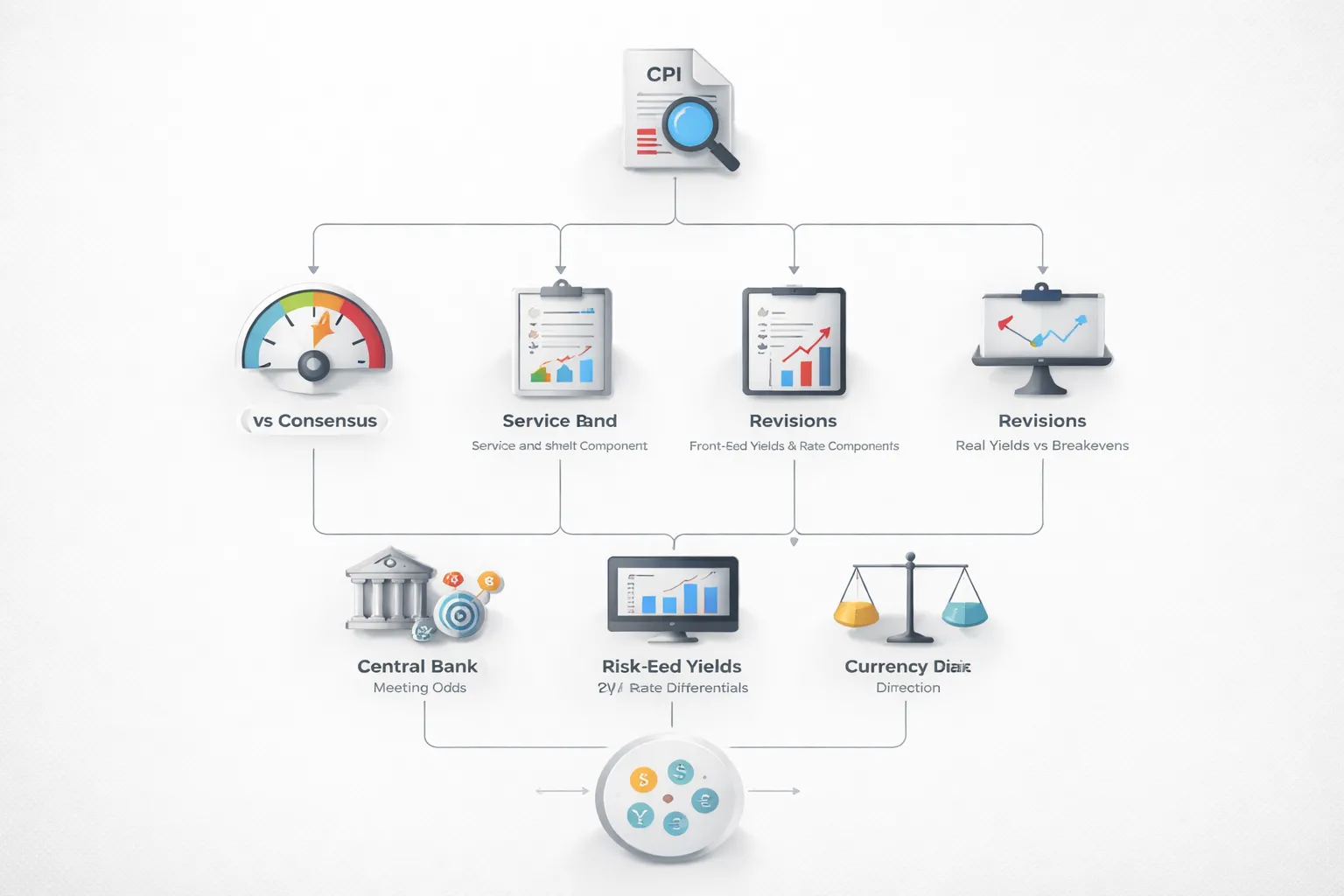
From inflation print to rate expectations, the policy reaction function
FX reacts to CPI because CPI changes what you think the central bank will do next.
Start with the surprise. Markets trade the gap between the print and consensus, not the level.
- Higher than expected CPI pushes expected policy rates up. That lifts short dated yields. Your currency often strengthens versus lower yield peers.
- Lower than expected CPI pulls expected policy rates down. That drops short dated yields. Your currency often weakens.
- As expected CPI shifts less. You then trade the details, revisions, and guidance risk.
Then map the print to the reaction function. Central banks care about persistence. They put more weight on what feeds future inflation.
- Core vs headline. Core usually matters more for policy.
- Services. Many banks treat services inflation as stickier than goods.
- Shelter and wages proxies. These often drive medium term inflation views.
- Revisions. A small revision can change the trend. Traders reprice quickly.
Interest-rate differentials and carry, why the front end of the curve matters most
Most CPI driven FX moves start at the front end. The 2 year area and money market pricing react first.
You trade the differential. If your country reprices to higher policy rates than another, your currency tends to gain.
- Front end yields anchor expected policy rates over the next few meetings.
- Carry depends on short rate spreads. A wider spread attracts flow into the higher yielding currency.
- Meeting odds matter more than long run inflation debates on release day. Watch the shift in the next meeting pricing.
Practical read. If CPI moves the 2 year spread, spot often follows. If spot moves without a matching spread move, expect mean reversion unless risk sentiment explains it.
Real yields and inflation breakevens, the FX impact beyond nominal rates
Nominal yields can rise for two different reasons. Real yields can rise, or inflation expectations can rise. FX can react differently.
- Real yield up. Tighter real financial conditions. That often supports the currency, especially in developed markets.
- Breakevens up with real yields flat. Markets see more inflation risk without tighter policy. That can weaken the currency over time, or cap gains after the first spike.
On hot CPI days, check which leg moved. If real yields lead, the currency move tends to hold better. If breakevens lead, the initial move can fade after the detail read.
Growth and risk sentiment channel, when “hot CPI” hurts the currency
Hot CPI can strengthen a currency through rates. It can also weaken it through risk.
You see the negative case when tighter pricing hits growth assets.
- Equities sell off hard, credit spreads widen, volatility jumps.
- Markets price policy error risk, recession odds rise.
- High beta currencies can drop even if local yields rise, because global risk takes control.
This shows up most in risk sensitive pairs. It can also hit countries with heavy external financing needs. They suffer when global funding costs jump.
Terms of trade and purchasing power, longer-term currency implications
CPI also matters because it changes your purchasing power and your trade position.
- Inflation above trading partners can erode competitiveness if wages follow. That can pressure the currency over time.
- Imported inflation from energy or food can worsen the trade balance for importers. That can weaken the currency in longer horizons.
- Commodity exporters can see the opposite if higher global prices lift export receipts, even if CPI runs hot.
This channel moves slower. It matters more for medium term trends than for the first 30 minutes after a CPI release.
Why the same CPI number can produce opposite moves in different regimes
CPI does not trade in a vacuum. The regime sets the sign and the durability of the move.
- Inflation fighting regime. Markets think the bank will hike or hold higher for longer. Hot CPI tends to support the currency via real yields and rate spreads.
- Growth scare regime. Markets focus on recession risk and funding stress. Hot CPI can hurt the currency if it triggers a risk off shock and hits domestic growth expectations.
- Credibility regime. If investors doubt the central bank will respond, hot CPI can weaken the currency through higher inflation expectations and weaker real rates.
- End of cycle regime. If cuts dominate the narrative, a firm CPI can lift the currency by pushing cuts out. A soft CPI can hurt by pulling cuts forward.
Your checklist on release. Compare the CPI surprise to the change in next meeting odds, the 2 year spread move, real yields versus breakevens, and the risk tape. That tells you which channel controls the trade.
Understanding the CPI release: forecast, surprise, and revisions
Consensus forecasts, whisper numbers, and market pricing (OIS, futures)
You trade the gap between the print and what the market already priced.
Start with three reference points.
- Consensus: the median economist forecast. It anchors headlines, but it can lag fast-moving trends.
- Whisper: the number traders share after checking early signals, like private inflation trackers, retailer price checks, and recent components. Whispers often sit above or below consensus when the setup feels one-sided.
- Market pricing: what rates markets imply before the release. Use OIS and short rate futures to see the expected policy path. That path often matters more than the consensus CPI line.
Your workflow. Write down consensus and the common whisper range. Then snapshot implied cuts or hikes for the next two meetings and the terminal rate. If CPI beats consensus but matches market pricing, FX can fade the first move.
Use the economic calendar correctly. Record the last three prints, the forecast, and the prior. Keep the same fields for every release. That is how you build your own bias filter. For a step-by-step setup, use this economic calendar workflow.
Surprise math: absolute vs standardized surprises and why volatility clusters
Most traders quote the surprise in points.
- Absolute surprise: actual minus forecast. Example, core CPI MoM prints 0.4% versus 0.3%, surprise equals +0.1pp.
That helps, but it ignores the regime.
- Standardized surprise: absolute surprise divided by the recent forecast error volatility. The same +0.1pp matters more when recent prints stay tight, and less when prints swing.
Volatility clusters because forecasters anchor to recent momentum. When inflation turns, errors rise. Then positioning grows. Then the next release produces larger moves even on similar surprises. Treat the first print in a new trend as higher risk, even if the consensus dispersion looks small.
Revisions and seasonal factor changes: the second-day move traders ignore
CPI does not always end at the headline print.
- Revisions: some CPI series can get corrected later, and related series can shift with updated inputs.
- Seasonal factors: statistical agencies can update seasonal adjustments, sometimes once a year. That can change the path of recent monthly prints.
Watch for two follow-through catalysts.
- Rates market reprice after details: desks digest the component table and recompute “supercore” style measures. The FX move can extend or reverse after the first hour.
- Re-anchoring of the trend: if seasonal updates lift the last few months of core, the market can treat it like an upside revision to the trend. That often shows up in the 2 year yield and front-end OIS before FX fully adjusts.
Your rule. If the headline reaction looks wrong versus the 2 year and real yields, wait. The second move often comes when the desk notes hit the tape.
Components that matter most: shelter, wages-linked services, energy, food
FX reacts to what CPI implies for policy, not to what shocks the grocery bill.
- Shelter: large weight and slow-moving. It drives persistence. If shelter runs hot, cuts get harder to price.
- Wages-linked services: markets track services ex housing or similar “supercore” proxies. They link to labor costs and trend inflation.
- Energy: high volatility and strong pass-through to headlines. It can move risk and terms of trade, but central banks often look through one-off energy swings.
- Food: politically sensitive, but often less policy-relevant unless it signals broad-based pressure.
On release, map the surprise to the driver. A hot headline from energy with a soft core can fade fast. A hot core driven by services can change the policy path and stick in FX.
Base effects and year-over-year optics: avoiding common interpretation errors
YoY CPI can mislead you on turning points.
- Base effects: YoY falls when last year had large monthly gains rolling out. YoY rises when last year had weak months rolling out. This can happen even if the current MoM trend stays unchanged.
- Optics risk: headlines focus on YoY, but traders price the forward path. MoM and 3 month annualized measures often drive the rates reaction.
Your checklist. If YoY drops but MoM core stays firm, do not assume a dovish read. If YoY jumps due to a weak base while current MoM stays soft, do not chase a hawkish read. Tie your decision to the path for the next two meetings, not the YoY headline.
Data quality and methodology shifts: how to handle structural breaks
CPI is a model plus surveys. It can change.
- Sample changes: item samples rotate, outlets change, and weights update. That can shift measured inflation without a real shift in pricing power.
- Method updates: agencies can alter seasonal adjustment, imputation, or category definitions. That creates structural breaks in time series.
How you protect your process.
- Use multiple cuts of inflation: headline, core, services-focused measures, and trimmed mean style proxies if available. If one series breaks, the cluster still guides you.
- Shorten your lookback: after a methodology change, reduce reliance on long history. Rebuild your “normal” forecast error and standardized surprise using the post-change window.
- Confirm with markets: if CPI prints odd but breakevens, real yields, and OIS do not validate, treat it as noise until more data arrives.
The goal stays simple. Identify whether CPI changed the expected policy path. Then trade the currency channel that controls that path.
CPI and central banks: policy expectations that drive FX
CPI and central banks: trade the expected policy path
FX rarely moves because CPI is “high” or “low.” It moves because CPI changes what the central bank can do next.
Your job is to map the CPI print into policy pricing. Focus on the first two hours after release, then the next session. Use rate markets as the scoreboard, OIS, front-end yields, and terminal rate pricing.
- Hawkish CPI surprise: front-end yields up, cuts priced out, terminal rate up. The currency tends to strengthen.
- Dovish CPI surprise: front-end yields down, cuts priced in, terminal rate down. The currency tends to weaken.
- No validation: CPI moves spot but OIS and real yields fade it. Treat it as positioning and liquidity, not a new macro signal.
Federal Reserve: CPI matters, PCE decides, services drive
The Fed targets PCE, not CPI. FX still trades CPI hard because CPI is timely and market moving. The key is whether the CPI detail shifts the path for the next few meetings.
- Watch core services ex housing: it lines up with “supercore” narratives. Sticky services inflation supports higher-for-longer pricing.
- Separate shelter from non-shelter: shelter lags. A softer shelter print can move CPI, but it may not change Fed conviction unless services and wages cool too.
- Track the 2 year yield and SOFR OIS: if they do not follow the CPI move, USD strength tends to fade.
Trade the channel the Fed watches. If CPI lowers the probability of the next cut, USD tends to catch a bid. If CPI brings forward cuts, USD tends to lose support.
ECB: HICP, energy pass-through, and fragmentation risk
The ECB trades off HICP, with extra sensitivity to energy and imported inflation. Energy shocks feed through to headline fast, then into expectations.
- Focus on core HICP and services: they matter most for the medium-term path.
- Energy and food drive headline swings: they can move EUR on the day, but the lasting move needs confirmation in core and wage indicators.
- Watch peripherals: if CPI pushes yields wider in Italy versus Germany, the ECB reaction function can shift. Fragmentation risk can cap hawkish pricing.
- Validate with EUR rates: ESTR OIS and the German front end should lead. If they do not reprice, spot follow-through often fails.
If you need a tighter mapping from macro releases to EUR/USD, use this guide on what moves EUR/USD.
Bank of England: persistence, wages, and UK sensitivity
UK inflation prints can hit GBP harder because the market prices the BoE off persistence, not one-off moves. Services inflation and wages often dominate the read-through.
- Services CPI: a key persistence proxy. A hot services print tends to keep cuts priced out.
- Wage link: CPI that aligns with strong pay data reinforces a slower easing path.
- Mortgage channel: UK household exposure to rate resets can amplify growth risks. If CPI cools fast, markets can price cuts quickly, GBP can drop.
Use SONIA OIS for the clean signal. GBP usually follows the front end when the move is real.
Bank of Japan: inflation under regime change
Japan can trade differently because the policy regime can shift. Inflation matters most when it changes the probability of normalization, not when it just prints above target.
- Underlying inflation and wages: sustainable inflation needs pay growth. CPI without wages can fail to move JPY rates pricing.
- Policy tools matter: changes in yield curve control settings, bond purchase guidance, or negative rate policy can dominate the FX response.
- JPY reacts to global yields too: CPI abroad can move USD/JPY through US-JP rate differentials even if Japan data is quiet.
For JPY, always pair the CPI read with rate differential moves. If US front-end yields rise and Japan does not follow, JPY often weakens.
RBA, BoC, SNB: small open economies and imported inflation
In smaller open economies, FX can feed inflation and inflation can feed FX. Imported inflation and tradables matter more.
- RBA: tradables inflation, rents, and services drive the debate. AUD can move with CPI, but it also tracks global risk and commodities. Confirm the CPI move in AU OIS.
- BoC: core measures and shelter matter, but energy and the CAD oil link can blur the signal. Use Canada OIS and US-Canada spreads to judge follow-through.
- SNB: inflation is often low. The reaction function can lean on the currency itself as a policy tool. A downside CPI surprise can revive easing expectations and weaken CHF, unless risk-off flows override.
These banks react fast when inflation looks imported and persistent. FX moves can become part of the inflation story. That feedback loop can extend trends.
Forward guidance, dot plots, and press conferences: how CPI becomes a story
CPI changes prices first, then it changes narratives. Central banks then confirm or reject that narrative through communication.
- Forward guidance: CPI that contradicts guidance creates larger FX moves because markets must reprice credibility and timing.
- Dot plots: CPI affects the next dot distribution through inflation confidence. The market trades the median, but FX often reacts to the balance of risks in the statement.
- Press conferences: CPI gives journalists and analysts a hook. When the chair leans into the CPI detail, the move can extend. When the chair downplays it, spot often mean reverts.
- Minutes and speeches: use them as validation. If officials echo the CPI signal, expect follow-through. If they push back, expect fades and range trade.
Keep it mechanical. CPI is an input. Policy expectations are the output. Trade FX when the output changes.
Typical forex price action around CPI: what to expect in real time
Pre-release behavior, compression, positioning, and false breaks
CPI days often start quiet. Dealers pull risk. Liquidity thins. Price compresses.
You usually see tighter ranges in the 60 to 120 minutes before the print. You also see more stop orders stack above and below the range. That setup invites false breaks.
- Compression: ATR drops into the release. Candle bodies shrink. Wicks increase.
- Positioning: If consensus leans one way, spot can drift in that direction pre-release. That drift can reverse fast after the number.
- False breaks: A small push through an obvious level can trigger stops, then snap back. Treat early pre-CPI breakouts with suspicion.
Release-minute microstructure, spreads, slippage, and liquidity gaps
The first 30 to 90 seconds are microstructure, not macro. Spreads widen. Depth disappears. Your fills get worse.
- Spread expansion: Major pairs can widen several times their normal spread. Crosses widen more.
- Slippage: Market orders and tight stops slip. Limit orders fill better but may not fill at all.
- Liquidity gaps: Price can jump through levels with no tradeable liquidity in between. You see this as “air pockets” on lower timeframes.
- Speed matters: The first impulse often completes before your platform updates on slower feeds.
If you trade the release, size for worst-case execution, not for your chart idea.
First move vs second move, why reversals are common
The first move is the knee-jerk. The second move is the policy repricing. You trade the second move more than the first.
- Headline vs core conflict: Headline beats but core misses, or the reverse. The first move chases the headline. The second move follows core and the details.
- Rates filter: FX often follows the 2-year yield reaction. If spot and 2-year diverge, spot often mean reverts.
- Expectation trap: A “beat” can still sell the currency if positioning expected a bigger beat.
- Revision and components: Shelter, services ex housing, and supercore style measures can change the read even if the top line looks clean.
Mechanical rule. If the rates market fades the first move, you respect the fade.
Cross-currency effects, USD pairs vs crosses and relative inflation surprises
USD CPI is a USD shock first. It spills into crosses through relative rates.
- USD pairs: You often get a cleaner impulse in EUR/USD, GBP/USD, USD/JPY, and AUD/USD because USD sits on one side.
- Crosses: EUR/GBP, AUD/JPY, and GBP/JPY react through two channels, the USD move and local rates moves. That adds noise.
- Relative surprise: Markets price different inflation paths. If US CPI surprises higher while Eurozone inflation trends lower, EUR/USD can move more than the US surprise alone suggests.
- Risk overlay: High inflation can mean tighter policy. It can also mean risk-off. That mix changes how commodity FX and JPY react.
Anchor on relative policy paths. Use the 2-year spread logic across regions.
Volatility patterns by pair, EUR/USD, GBP/USD, USD/JPY, AUD/USD examples
| Pair | Typical CPI reaction driver | What you often see |
|---|---|---|
| EUR/USD | US 2-year yields, DXY impulse | Fast spike, then a second leg if yields trend. Cleanest follow-through when 2-year and DXY agree. |
| GBP/USD | USD shock plus UK rate expectations | Bigger whipsaw risk than EUR/USD. Cable can overshoot then retrace if broader USD move stalls. |
| USD/JPY | US yields, risk sentiment | Can trend hard if US yields jump. Can reverse if equities dump and JPY safe-haven demand takes over. |
| AUD/USD | Risk tone, commodities, US real rates | Often underperforms on hot CPI if risk-off hits. Can lag the first minute, then accelerate with equities and metals. |
If you need a rates primer for this, read how interest rates affect currency pairs.
Correlation watchlist, DXY, 2-year yields, equities, gold, oil, and VIX
Keep one screen for correlations. You want confirmation. You want conflict flagged fast.
- DXY: The USD tape. If your USD pair move does not match DXY, expect chop.
- US 2-year yield: The cleanest CPI proxy. Higher 2-year usually supports USD. Lower 2-year usually pressures USD.
- Equities (S&P futures): Risk filter. Hot CPI can hit equities and spill into FX. Watch for the moment equities take control of the move.
- Gold: Often tracks real yields. Hot CPI that lifts real yields can pressure gold and support USD.
- Oil: Can distort inflation expectations. Big oil moves can pre-bias CPI trades and shift CAD reactions.
- VIX: Stress gauge. A VIX spike can strengthen JPY and CHF even if the USD should win on yields.
Simple workflow. Read the CPI surprise. Check 2-year yields. Confirm with DXY. Then decide if risk markets align or fight the rates signal.
Scenario analysis: mapping CPI outcomes to currency reactions
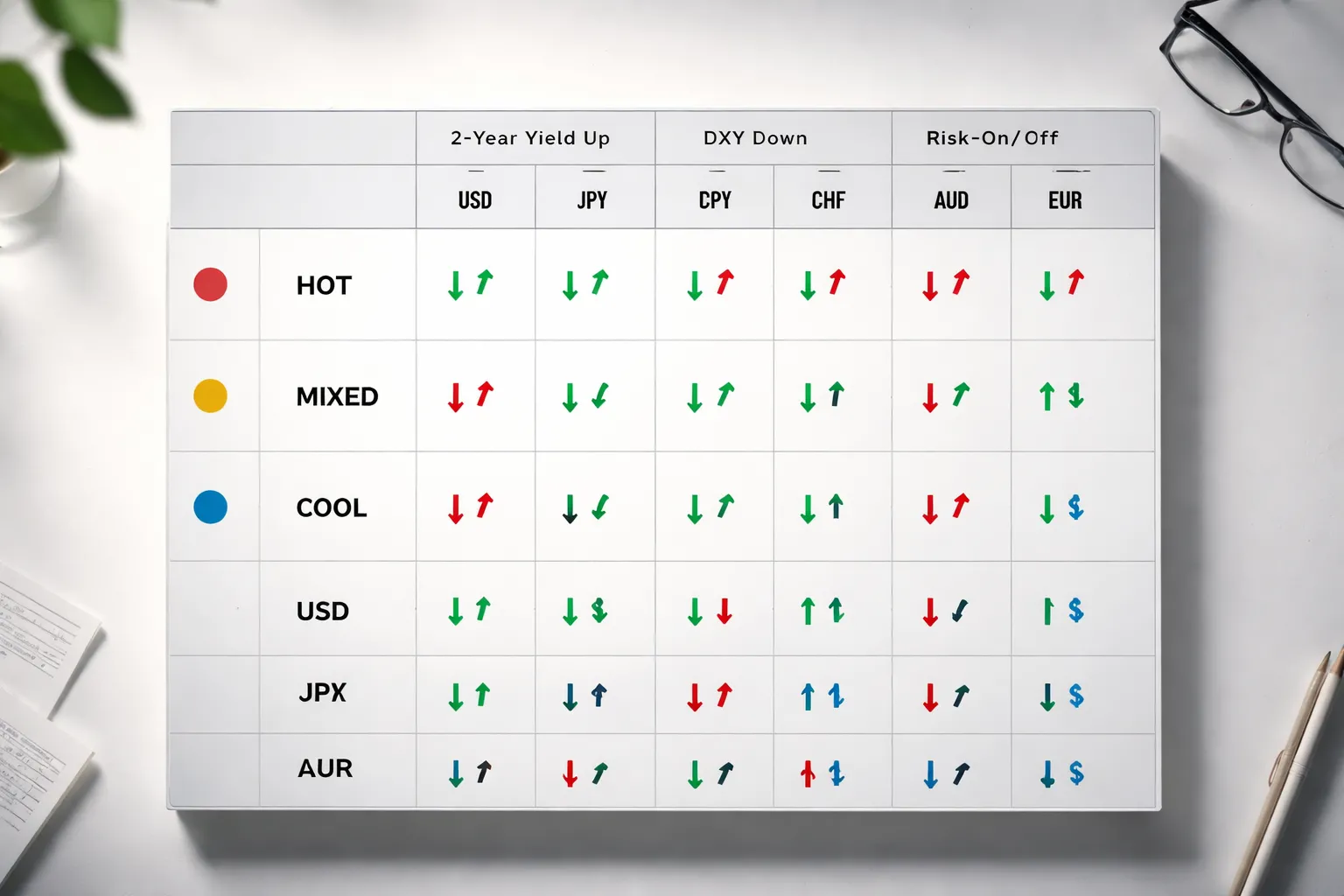
Hotter-than-expected CPI with hawkish pricing, conditions for currency strength
You want alignment. CPI beats. Rate cuts get priced out. Front-end yields jump. The currency strengthens.
- Signal 1, CPI surprise: Core CPI and core services ex shelter beat expectations. Month-on-month matters more than year-on-year.
- Signal 2, rates: 2-year yields rise fast. The move holds for 15 to 60 minutes, it does not fade on the first pullback.
- Signal 3, FX confirmation: DXY breaks above the pre-release range and holds. For pairs, watch the rate-sensitive legs first, USD/JPY and USD/CHF.
- Positioning check: If the market came in short USD, the move can extend. If the market came in long USD, the first spike can reverse.
Base case reaction. Higher real yields support USD. High beta FX, like AUD and NZD, tends to lag if risk does not join the move.
Hot CPI that triggers risk-off, when the currency weakens despite higher inflation
Hot CPI can still hurt the currency if the market trades it as a growth shock. This shows up as risk sells harder than yields rise.
- Rates split: 2-year yields jump, then stall. 10-year yields fall or flattening accelerates. That says growth fear, not clean hawkish repricing.
- Risk confirms: S&P drops, credit spreads widen, VIX spikes. JPY and CHF can strengthen even if US yields look supportive.
- FX pattern: USD can lose to safe havens and still beat cyclical currencies. You often see USD/JPY down while EUR/USD and AUD/USD also fall.
Practical read. If VIX leads and yields stop rising, treat the CPI as risk-off first and rate story second.
Cool CPI with dovish repricing, how downside surprises tend to travel
Cool CPI works best when it forces a clean reprice in the front end. You want lower 2-year yields and a softer currency.
- Signal 1: Core CPI misses. Core services ex shelter cools. Supercore slows on a 3-month annualized basis.
- Signal 2: 2-year yields drop and stay down. The market adds cuts or pulls forward the first cut.
- Signal 3: DXY breaks down through support. EUR and GBP catch a bid if their local rate expectations do not turn dovish at the same time.
- Risk overlay: Equities often rally. That can lift AUD, NZD, and EM FX, which can exaggerate USD weakness.
Downside surprises can cascade. Lower yields weaken the currency, weaker currency can ease financial conditions, easier conditions can reinforce the risk-on move.
Mixed prints (headline down, core up), interpreting conflicting signals
Mixed CPI prints create two trades. One fades fast. The other sticks. You need to decide which the market will pay for.
- Rule 1: FX usually follows core, not headline, when the core move shifts the policy path.
- Rule 2: Headline still matters if it changes near-term inflation expectations, energy-driven breakevens, or consumer sentiment.
- What to watch: If core is up and 2-year yields rise, treat it as hawkish even if headline fell. If yields ignore core, the market does not trust the print.
- Time horizon: Headline can drive the first 1 to 5 minutes. Core and rates drive the next hours and days.
Distribution matters, why a few sticky components can outweigh the top-line
The top-line number can mislead you. The market pays for persistence. It looks for sticky buckets that the central bank targets.
- Sticky inflation signal: Services inflation runs hot, especially core services ex shelter. Wages-sensitive categories matter.
- False comfort signal: A big goods disinflation print can mask sticky services. Used cars and apparel can swing but often mean-revert.
- Shelter problem: Shelter can lag private rents. A soft shelter print can fade if the market expects re-acceleration.
- How you apply it: If the beat comes from a few sticky components, expect a stronger yield response and a more durable FX move.
Relative surprises, trading the spread between two countries’ inflation prints
FX trades differences. Your edge comes from the inflation spread and the rate spread, not one CPI print in isolation.
- Map CPI to rate paths: Compare how each CPI changes the expected policy rate over the next 6 to 12 months.
- Trade the cleanest expression: If US CPI beats and Eurozone CPI misses, EUR/USD has a clearer downside bias than a broad USD basket.
- Synchronize calendars: When prints land days apart, the first move can reverse after the second release. Size and timing matter more than the initial direction.
- Confirm with spreads: Watch 2-year yield differentials, US minus Germany for EUR/USD, US minus Japan for USD/JPY.
If you want pair-specific drivers, use what moves EUR/USD as your checklist, then plug the CPI surprise into the rate differential story.
Trading and investing approaches for CPI-driven forex moves (not financial advice)
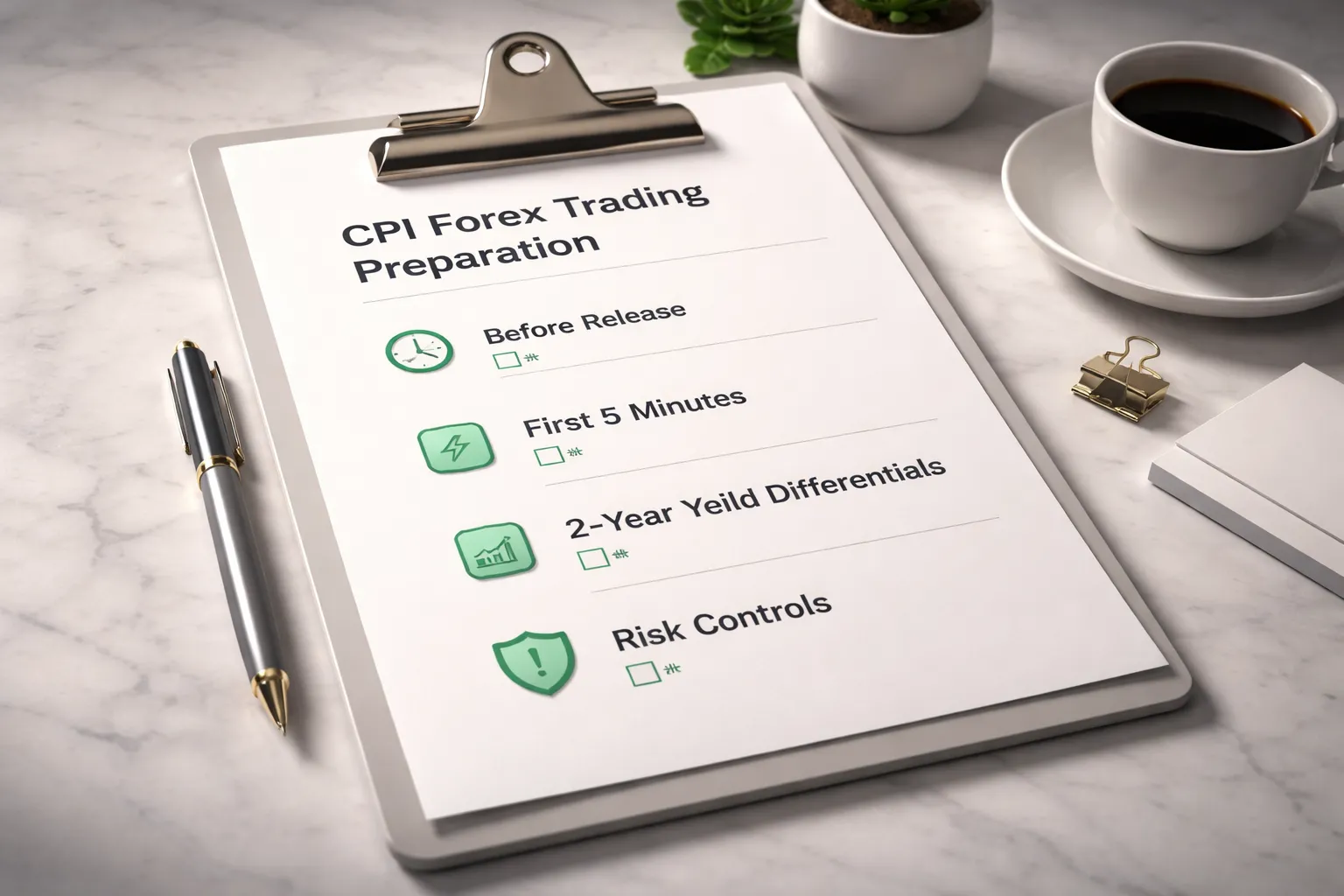
Event-driven spot strategies, breakout vs fade frameworks
Start with a rule. CPI trades fail when you improvise after the number hits.
- Define the surprise. Compare actual vs consensus for core CPI MoM first, then headline. Map it to rates, not “inflation is up.” Stronger core usually lifts front-end yields and supports the currency with the higher expected policy path.
- Trade the pair that matches the rate story. Use 2-year yield differentials as your filter. If US 2-year minus Germany widens, EUR/USD tends to fall. If US 2-year minus Japan widens, USD/JPY tends to rise.
Breakout framework. You trade expansion when you expect a clean repricing.
- When it fits. Big surprise, clear rate implication, liquid conditions, no larger event hours later.
- How you execute. Use stop entries above and below the pre-release range. Keep size small, spreads can widen. Use a time stop, if price does not follow through fast, you exit.
- Where it breaks. Whipsaw in the first minutes, revisions, or a conflicting second release in the same week.
Fade framework. You trade mean reversion when you expect the first move to overreact.
- When it fits. The move runs into a major level, yields do not confirm, or price spikes on thin liquidity.
- How you execute. Wait for the first impulse to stall, then enter on a retest with a tight invalidation point beyond the extreme.
- Where it breaks. Genuine regime shift, the move keeps trending with yields and equities aligned.
Risk control. You need hard limits.
- Cap loss per release. One CPI can erase weeks of small gains.
- Avoid revenge trades. If you miss the move, you skip it.
- Know your broker behavior. Slippage and rejected orders can rise during the first seconds.
Options approaches, straddles, strangles, and risk reversals for CPI
Options let you express volatility and skew, not just direction. You still need to manage premium and timing.
- Long straddle. You buy a call and a put at the same strike. You want a large move in either direction. You lose if realized move stays below implied move.
- Long strangle. You buy an out-of-the-money call and put. It costs less than a straddle but needs a larger move to pay.
- Risk reversal. You buy a call and sell a put, or the reverse. You express directional bias and the market’s skew around CPI. You take tail risk on the sold option.
| Setup | Best use | Main risk | What to watch |
|---|---|---|---|
| Long straddle | You expect a big CPI repricing | Implied vol too high, move disappoints | Implied vs realized move, bid-ask width |
| Long strangle | You expect a very large move | Needs a bigger break-even | Distance to strikes, spot gaps |
| Risk reversal | You want directional exposure with skew | Losses can grow fast on the short leg | Skew shifts, spot through sold strike |
- Timing matters. Implied vol often rises into CPI and falls after. If you buy vol late, you can lose even if spot moves.
- Match tenor to the event. Use expiries that actually cover the release window you trade.
- Plan exits. Decide if you take profit on the spike, hold for follow-through, or cut when vol crush hits.
Carry and macro positioning, use inflation trends, not one print
One CPI print moves price. A trend changes policy. If you invest or swing trade, focus on the trend signals.
- Track the 3-month and 6-month annualized pace. It often matters more than YoY in turning points.
- Separate core from headline. Headline drives headlines, core drives rate expectations more often.
- Link inflation trend to the reaction function. Some central banks tolerate higher inflation if growth weakens. Others do not.
- Use carry as a secondary input. Carry works best when the policy path stays stable. It fails when inflation forces repricing.
Positioning approach. You scale in when inflation trend and rate differentials align. You reduce when the trend breaks across several releases, not when you see one noisy number.
Hedging currency exposure for businesses and investors around CPI dates
CPI dates can widen ranges and spreads. If you run FX exposure, you hedge for stability, not prediction.
- Know your exposure. Map receipts and payments by currency and date. Size the hedge to the cash flow, not your view.
- Stagger execution. Split hedges across days to reduce event timing risk.
- Use forwards for known cash flows. Simple, direct hedge, clear notional match.
- Use options for uncertain cash flows. You pay premium for flexibility. You avoid being forced into a bad level after a CPI shock.
- Set guardrails around CPI. Tighten internal limits, increase approval thresholds, and avoid market orders in the release minute.
Time horizon selection, scalp, day trade, swing, macro allocation
Pick a horizon that fits how CPI transmits into price.
- Scalp minutes. You trade spreads, speed, and liquidity. You need strict stops and fast exits. You focus on the first reaction and order flow.
- Day trade hours. You trade follow-through after the initial spike. You wait for yields to confirm and for spreads to normalize.
- Swing days to weeks. You trade the repricing of the rate path. You care about 2-year differentials and central bank communication after the release.
- Macro allocation months. You trade inflation regime and growth divergence. You care about trend measures and policy reaction, not the first 15 minutes.
Do not mix horizons. If you enter as a scalp, you exit as a scalp. If you enter as a swing, you tolerate noise and use wider invalidation.
Execution checklists, orders, alerts, fail-safes
- Before CPI. Confirm release time and consensus. Mark key levels. Note other risk events the same day. Set maximum loss and maximum number of attempts.
- Set alerts. Spot levels, 2-year yield levels, and yield differential thresholds that match your pair.
- Order plan. Choose stop entries or limit entries. Avoid market orders in the first seconds. Predefine stop placement and take-profit logic.
- Spread filter. If spreads exceed your limit, you do not trade. Your edge disappears when costs jump.
- Slippage plan. Assume worse fills. Reduce size. Use fewer trades, not more.
- Confirmation. Require alignment between price and rates. If yields reverse, you cut the trade.
- Post-release review. Log the surprise, the yield move, the FX move, and your execution quality. Adjust rules, not emotions.
- Calendar discipline. Keep your week planned with an economic calendar so CPI does not blindside your positions. See how to use the forex economic calendar.
Not financial advice. CPI trading involves fast moves, widening spreads, and gap risk. Use sizing and limits you can sustain.
Risk management for CPI trading: avoiding the common blow-ups
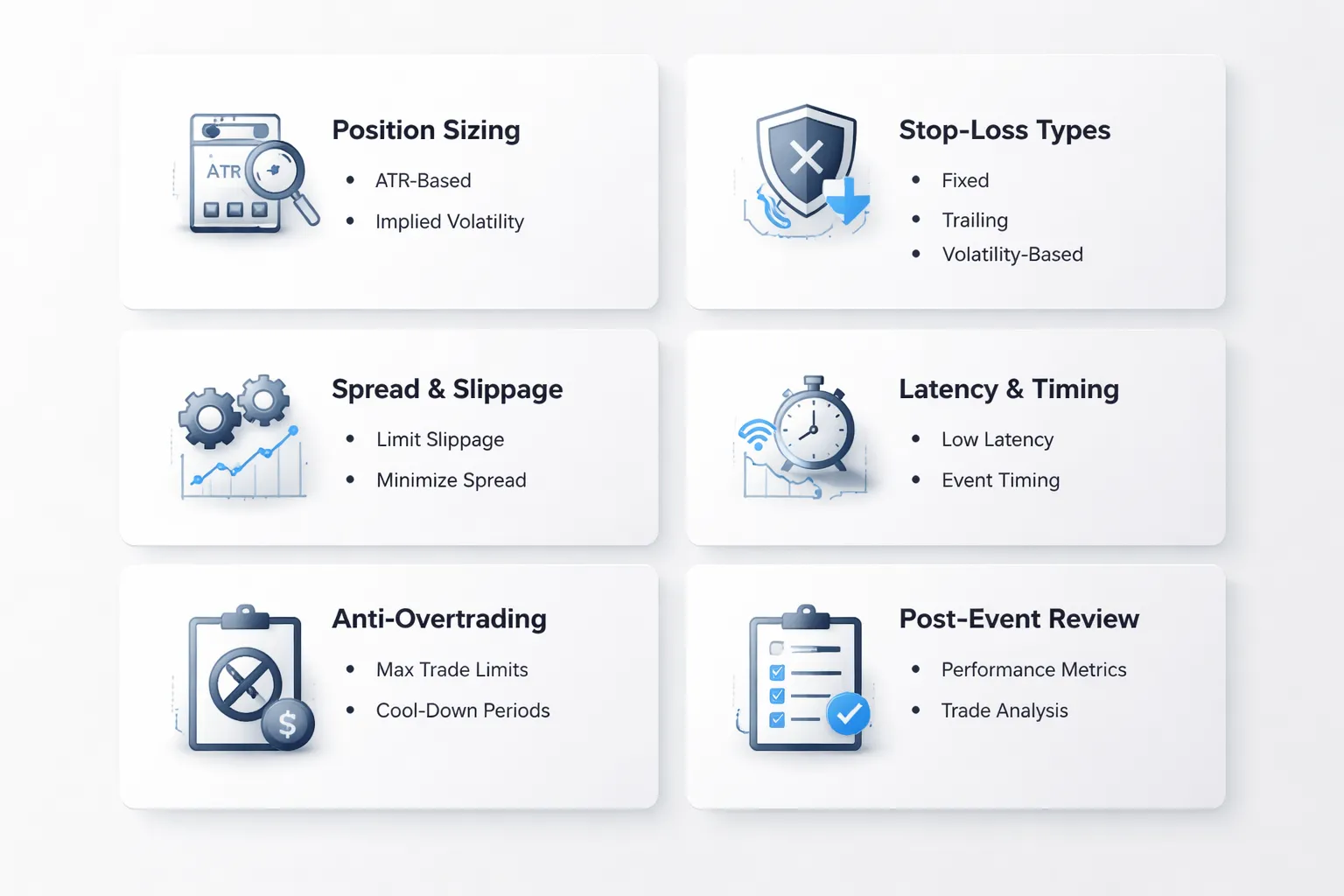
Position sizing with volatility, ATR and implied vol
CPI releases compress a week of movement into minutes. Your normal size can become oversized.
Size your trade to a fixed cash risk per idea. Then convert that risk into position size using expected volatility.
- ATR-based sizing: Use a 14-day ATR on the pair and treat CPI day as a multiplier. Many traders use 1.5x to 3x normal ATR as the working range for CPI. Set your stop distance from that range, then size down so the dollar risk stays constant.
- Implied-vol based sizing: If you track 1-week ATM implied vol, treat a CPI release as a vol event. When implied vol rises, cut size. A simple rule works, size is inversely proportional to implied vol. If implied vol doubles versus last month’s median, halve your size.
- Cap leverage: Put a hard ceiling on event leverage. CPI can gap through stops. Lower leverage reduces ruin risk.
| Input | Rule | Outcome |
|---|---|---|
| Cash risk per trade | Fixed, same every CPI | Prevents one release from dominating P and L |
| Stop distance | ATR x CPI multiplier, or vol-based range | Aligns stop with expected noise |
| Position size | Cash risk divided by stop distance | Keeps risk stable as volatility changes |
Stop-loss placement in fast markets, hard stops, mental stops, hedges
You need a plan that survives spread spikes and one-way bursts.
- Hard stops: Best when you cannot watch every tick. Place stops where your thesis breaks, not where the chart looks neat. Expect slippage. Build it into your max loss.
- Mental stops: Only for traders with fast execution and strict discipline. In CPI speed, mental stops often turn into hope. If you use them, define the exit price in advance and execute instantly.
- Hedges: A hedge can limit damage if you cannot exit cleanly. Example, you hold USD exposure in one pair and offset part of it in a correlated pair during the event window. Keep it simple. Complex hedges fail under stress.
- Time stops: If the move does not confirm quickly, exit. CPI fades happen. A timed exit reduces death by a thousand cuts.
Managing slippage and widening spreads, broker and venue considerations
During CPI, spreads widen and fills degrade. Your strategy must assume worse execution.
- Trade smaller: Slippage scales with size. Size down until your typical slippage stays inside your risk budget.
- Avoid tight stop entries: Stops and stop limits can trigger on spread, then fill at poor prices. If you trade breakouts, use wider triggers and smaller size.
- Know your execution model: Some venues re-quote. Some slip more. Some widen spreads earlier. Test them on prior CPI releases and log the numbers.
- Use limits with intent: Limits control price but risk non-fill. That can be fine if your edge relies on mean reversion and you accept missed trades.
- Reduce pair complexity: Stick to the most liquid pairs around the release. Liquidity drops harder in crosses.
News feed and latency, why timing disadvantages matter
CPI is a latency game. If you trade the first seconds, you compete with faster players.
- Accept your place in the queue: Retail platforms and standard feeds often see the number later. By then, the first move can be done.
- Shift your edge to the second phase: Trade the re-price, the pullback, or the trend after the first spike. You need fewer speed advantages.
- Pick one workflow: Either you pre-place conditional orders with strict risk, or you wait for the first minute and trade structure. Mixing both creates errors.
- Do not chase the headline: CPI details matter, core, shelter, supercore, revisions, and the market’s prior positioning. If you cannot process that fast, do not trade the first tick.
Build your CPI logic inside your broader macro framework. Keep your fundamentals process tight. See what actually moves prices.
Overtrading and revenge trading after whipsaws, process safeguards
CPI whipsaws trigger impulse trades. Your job is to block them.
- Set a daily loss limit: After you hit it, you stop. No exceptions. CPI days can produce multiple false breaks.
- Set a max trade count: Example, two attempts per pair. After two losses, you are done on that pair.
- Use a cooldown timer: After any stop-out, wait a fixed period before re-entry. This breaks the chase loop.
- Pre-commit your scenarios: Write A, B, and C before the release. If none trigger, you do nothing.
- Separate analysis from execution: Your plan decides. Your platform executes. Do not edit rules mid-spike.
Post-event review, measuring edge and improving the playbook
You improve your CPI trading by measuring it. You do not improve it by remembering it.
- Track the surprise: Log headline, core, and any revision versus consensus and versus whisper if you use one.
- Track rates first: Log the 2-year yield move and the first 5-minute change. FX often follows rates.
- Track FX in phases: Measure the 1-minute spike, the 15-minute follow-through, and the 2-hour drift.
- Track execution: Record spread at entry, slippage, and fill speed. Separate strategy losses from execution losses.
- Score your rules: Did you follow size limits, loss limits, and scenario triggers. This matters more than the outcome.
- Update one rule at a time: Change sizing, or entry timing, or stop logic, not all three. Keep the test clean.
| Metric | What to record | Why it matters |
|---|---|---|
| Surprise size | Actual minus consensus, headline and core | Links outcomes to inputs |
| Rates reaction | 2-year yield change, 5m and 60m | Checks the macro transmission |
| FX reaction | Pair move, 1m, 15m, 2h | Shows whether you trade the right phase |
| Execution cost | Spread, slippage, missed fills | Defines true expectancy |
Real-world examples and mini case studies
USD reaction case study, CPI surprise, 2-year yield jump, and a DXY impulse
You see the cleanest CPI to FX chain in the US. CPI prints. Front-end rates reprice. USD follows.
- Input: CPI surprise size, actual minus consensus, headline and core.
- Transmission: US 2-year yield reaction in the first 5 minutes and by 60 minutes.
- Output: DXY impulse and follow-through, 1 minute, 15 minutes, 2 hours.
Hot CPI usually does two things fast. It lifts the 2-year yield. It pushes DXY higher. Cold CPI does the reverse.
| Step | What you measure | What you often see on a hot CPI |
|---|---|---|
| Surprise | Core CPI, actual minus consensus | USD reacts more to core than headline |
| Rates | US 2-year yield, 5m and 60m | Fast jump, then either adds or fades |
| FX | DXY, 1m, 15m, 2h | Impulse move, then trend if yields hold |
| Execution | Spread and slippage at release | Worst costs in the first minute |
Practical read. If the 2-year spikes and holds after 15 to 60 minutes, the USD move has fuel. If yields mean-revert fast, the first DXY spike often fades.
GBP case study, inflation persistence vs recession fears and the pound’s response
GBP trades inflation and growth at the same time. That creates mixed signals around CPI.
- Persistence story: Services inflation stays high. Wage growth stays firm. Markets price a higher and longer Bank of England path. GBP can rally even if risk sentiment feels heavy.
- Recession story: CPI prints hot but activity data looks weak. Traders worry the BoE cannot follow through. GBP can pop on the headline, then give it back as growth fear takes over.
What you track. UK rates, especially the 2-year gilt yield, but also the curve shape. If front-end yields rise while longer yields do not, markets price policy tightness and future slowdown. GBP strength can be brief in that setup.
| UK CPI backdrop | Rates signal you watch | GBP reaction you plan for |
|---|---|---|
| Sticky services, firm wages | 2-year gilt yields rise and hold | More durable GBP bid |
| Hot print, weak growth narrative | 2-year up, curve flattens | Spike then fade risk |
| Cooling inflation, improving risk mood | 2-year down, curve steepens | GBP can hold even with lower yields |
JPY case study, US CPI through the lens of yield differentials and BOJ policy
JPY often trades the US CPI release more than Japan CPI. The driver is the yield gap, US yields versus Japan yields.
- Hot US CPI: US front-end yields jump. The US-Japan differential widens. USD/JPY tends to push higher.
- Cold US CPI: US yields drop. The differential narrows. USD/JPY tends to drop.
But BOJ policy can cap or amplify the move. If markets think the BOJ will tolerate weaker JPY, USD/JPY can trend. If markets price higher odds of BOJ tightening or intervention risk, USD/JPY can reverse even with firm US data.
Use a simple checklist. First, read the 2-year US yield reaction. Second, check Japan 10-year stability and BOJ headlines. Third, trade the differential, not the CPI print in isolation. For a deeper framework, see what moves USD/JPY.
Emerging markets, why inflation shocks can trigger larger FX moves
EM FX can move more on inflation shocks. Liquidity is thinner. Local rates can reprice harder. Risk premia can gap.
- Higher carry, higher crash risk: A CPI miss can flip carry trades into forced exits.
- Credibility matters: If the central bank lacks trust, hot CPI raises devaluation fear. FX can gap, not trend smoothly.
- External funding stress: Hot US CPI can lift US yields, tighten global financial conditions, and pressure EM currencies even if local inflation is stable.
How you trade it. You respect execution cost. You size smaller. You avoid market orders at the second of release. You focus on where local rates and sovereign spreads move right after the print.
What past inflation regimes teach, 1970s-style inflation vs disinflation cycles
Inflation regime changes your default FX playbook.
- 1970s-style inflation: Inflation stays high and unstable. Central banks chase. Short-end yields swing. FX reacts hard to each inflation print because policy uncertainty stays high.
- Disinflation cycles: Inflation trends down. Markets shift from inflation fear to growth fear. CPI still moves FX, but the biggest moves can come when CPI changes the expected end point of cuts, not just the next hike.
Your takeaway. You trade surprises against the regime. In high and sticky inflation, you give more weight to core and services. In disinflation, you watch whether CPI changes the timing and depth of rate cuts. You validate both with the 2-year yield reaction.
Content gaps and advanced insights competitors miss
Nowcasting and alternative data, what markets may know before the release
CPI day rarely starts at 8:30. It starts weeks earlier.
- Energy. Track weekly gasoline and diesel prices, and crude moves. Headline CPI can swing on energy even when core stays firm.
- Food. Watch wholesale food indices and freight costs. They bleed into retail with a lag.
- Shelter leading data. Use private rent trackers and asking-rent indices. They move first, CPI shelter prints later.
- Used cars and goods. Follow auction prices and shipping rates. Goods disinflation often shows up there before CPI.
- Payroll and wages. Wage growth does not enter CPI directly, but it drives services inflation through labor cost pressure.
Your edge comes from mapping the alternative series to CPI components, then checking how much the market already priced. If your nowcast matches consensus, you do not have an information edge. You need a positioning edge or a regime edge.
Sticky inflation indicators, shelter lags, rent measures, and services ex-housing
Most CPI explainers stop at headline versus core. You need the sticky parts.
- Shelter lags are long. CPI shelter often follows turning points in market rents by many months. That lag can keep core elevated even when new leases cool.
- Know the rent measures. Private asking-rent series lead, CPI rent and owners’ equivalent rent trail. When private rents fall but CPI shelter stays hot, markets can fade the print if they trust the lag story.
- Services ex-housing is the policy tell. It captures labor intensive services. When it runs hot, cuts get pushed out even if goods deflate.
- Watch three-month annualized. Year over year moves slowly. Short-run annualized rates show re-acceleration early.
Your job is to separate “sticky but lagging” from “sticky and accelerating.” The first can cap the rally in bonds. The second can reset the rate path and hit FX hard.
Second-order effects, how CPI impacts trade balances and corporate earnings
CPI changes more than rates. It changes cash flows and cross-border flows.
- Real rate differentials. A hot CPI can lift real yields in one country versus another. That pulls capital in, and supports the currency even if growth slows.
- Import demand and trade balance. Hot inflation can compress real consumption later. That can reduce imports and improve the trade balance with a lag, which can support the currency.
- Terms of trade. Energy importers suffer when energy-driven CPI rises. Their currencies can weaken even if their central bank talks tough.
- Earnings channel. If CPI implies margin pressure, equities can drop. Risk-off can lift funding currencies and hit high beta FX, even when rate differentials point the other way.
Do not treat CPI as a one-factor event. You trade the dominant channel for the regime, then you monitor the second channel for reversals.
Positioning metrics, CFTC, dealer gamma, and why options flows matter on CPI day
Consensus tells you the expected number. Positioning tells you the expected reaction.
- CFTC futures positioning. Use it to spot crowded USD longs or shorts. Crowds amplify moves when CPI breaks the narrative, and they mute moves when the surprise confirms it.
- Risk reversals and implied vols. Skew shows which direction traders paid for protection. When skew leans hard, the spot move can squeeze the other side on a mild surprise.
- Dealer gamma. In high gamma, dealers hedge in ways that dampen moves. In low gamma, moves can trend and extend.
- Large option strikes near spot. Big strikes can magnet price into the cut, then release after. That matters for your entry timing.
Your practical step. Before CPI, write down the crowded side from CFTC and skew. After CPI, if spot moves against the crowd and the 2-year yield confirms, you expect follow-through.
Intermarket confirmation signals, rates first, then FX, how to read the sequence
On clean CPI days, rates lead and FX follows.
- Step 1, 2-year yield. It prices the policy path. If it does not move, the FX move often fades.
- Step 2, front-end OIS or futures pricing. Check how many cuts or hikes got added or removed. This explains the move better than the CPI print itself.
- Step 3, DXY versus high beta FX. If USD rallies with rising front-end yields, it is a rate story. If USD rallies with falling equities and tighter credit, it is a risk story.
- Step 4, curve shape. A move that steepens via higher front-end yields differs from a move that steepens via falling long-end yields. FX reacts differently because growth expectations differ.
Sequence matters. When FX moves first and rates lag, you treat the first move as fragile until yields confirm.
Building a CPI calendar and expectations dashboard for ongoing monitoring
You need a repeatable system, not a one-off trade plan.
- Calendar. Track CPI release dates, blackout periods, and key speakers before and after. Use your forex economic calendar as the base, then add CPI component checkpoints.
- Consensus and whisper. Record median forecasts for headline and core, plus any widely cited whisper. Save the prior print and the last three releases.
- Component grid. List shelter, services ex-housing, core goods, energy. Add a note for the likely driver this month.
- Market pricing. Save pre-release 2-year yield level, implied cuts or hikes, and the nearest meeting pricing. This is your benchmark for “surprise.”
- Options setup. Note 1-day implied move, key strikes, and skew. This tells you the move the market already paid for.
- Reaction log. After the release, log the first 5-minute and 60-minute moves in 2-year yields, DXY, and your pairs. Write one sentence on the dominant channel, rates or risk.
This dashboard forces discipline. You stop trading the number. You trade the change in the path, confirmed by front-end rates.
Frequently Asked Questions
What is CPI in simple terms?
CPI tracks how consumer prices change over time. Headline CPI includes everything. Core CPI strips out food and energy. Markets trade the difference versus consensus and the implied move, not the level alone.
Which CPI number moves FX most, headline or core?
Core CPI usually matters more for rate expectations because it is less noisy. Headline can dominate when energy and food shocks change the near-term inflation path and shift front-end yields fast.
Why does CPI move currencies so fast?
CPI shifts expected central bank policy. That reprices front-end rates and the yield spread versus other countries. FX then moves with the new rate path, often within minutes of the release.
What matters more, the YoY or the MoM print?
MoM often drives the first move because it signals current momentum. YoY sets the narrative and can matter more when it breaks a trend. Watch both, then map the result to the next two to three policy meetings.
What is a “CPI surprise”?
A surprise is the gap between actual CPI and market expectations. Use consensus and the distribution of forecasts, not one number. A small surprise can still move FX if positioning and implied volatility are tight.
How do you know if the market already priced the CPI risk?
Check the 1-day implied move into the release and compare it to typical post-CPI moves. Then watch options skew and key strikes. If spot stays inside implied, the market paid for the event and got it.
What should you watch first after the CPI release?
- 2-year yields: confirms the rate path change.
- DXY: shows broad USD response.
- Your pair: reacts last, after rates and USD tone.
How long do CPI-driven FX moves last?
Most direction shows in the first 5 to 15 minutes. Follow-through depends on whether 2-year yields keep the move into the next hour. If yields mean-revert, FX often mean-reverts too.
Why do bad CPI numbers sometimes strengthen the currency?
If CPI misses but risk assets rally hard, high beta currencies can gain versus safe havens. Or the miss can reduce recession fear and support risk. Your read must separate the rates channel from the risk channel.
Which pairs react most to US CPI?
Pairs with USD as the base driver react most, like EUR/USD, USD/JPY, GBP/USD, and AUD/USD. USD/JPY is often the cleanest rates expression because it tracks US front-end yields closely.
How can you trade CPI without gambling on the number?
Predefine scenarios and size for volatility. Wait for confirmation in 2-year yields and DXY. Trade the path change, not the headline. Use an economic calendar to prep timing and consensus.
Conclusion
Conclusion
CPI moves FX through rates. Your edge comes from tracking the repricing, not guessing the print.
- Focus on core CPI and services, they drive the policy debate more than energy swings.
- Trade the path change, watch 2-year yields, OIS pricing, and DXY for confirmation before you commit size.
- Use pairs that express rates cleanly, USD/JPY often tracks front-end US yields best.
- Predefine scenarios, map hot, in-line, and soft outcomes to likely yield moves, then set levels and max loss before the release.
- Respect liquidity, spreads widen at the print, use limit orders or wait for the first spike to settle.
Final tip, keep a simple CPI playbook. Update it after each release with the number, the 2-year move, and the FX follow-through. Over time you will see which surprises matter and which ones fade. If you need the bigger framework, read inflation and exchange rates explained.
-
How Interest Rates Affect Currency Pairs (With Real Examples)
6 months ago -
Fundamental Analysis in Forex Explained (What Actually Moves Prices)
6 months ago -
What Moves EUR/USD? The Biggest Drivers You Should Watch
6 months ago -
Inflation and Exchange Rates Explained (Why Currencies Rise or Fall)
6 months ago -
How to Trade Forex News (NFP, CPI, FOMC) Without Getting Wrecked
6 months ago
-
- From inflation print to rate expectations, the policy reaction function
- Interest-rate differentials and carry, why the front end of the curve matters most
- Real yields and inflation breakevens, the FX impact beyond nominal rates
- Growth and risk sentiment channel, when “hot CPI” hurts the currency
- Terms of trade and purchasing power, longer-term currency implications
- Why the same CPI number can produce opposite moves in different regimes
-
- Consensus forecasts, whisper numbers, and market pricing (OIS, futures)
- Surprise math: absolute vs standardized surprises and why volatility clusters
- Revisions and seasonal factor changes: the second-day move traders ignore
- Components that matter most: shelter, wages-linked services, energy, food
- Base effects and year-over-year optics: avoiding common interpretation errors
- Data quality and methodology shifts: how to handle structural breaks
-
- CPI and central banks: trade the expected policy path
- Federal Reserve: CPI matters, PCE decides, services drive
- ECB: HICP, energy pass-through, and fragmentation risk
- Bank of England: persistence, wages, and UK sensitivity
- Bank of Japan: inflation under regime change
- RBA, BoC, SNB: small open economies and imported inflation
- Forward guidance, dot plots, and press conferences: how CPI becomes a story
-
- Pre-release behavior, compression, positioning, and false breaks
- Release-minute microstructure, spreads, slippage, and liquidity gaps
- First move vs second move, why reversals are common
- Cross-currency effects, USD pairs vs crosses and relative inflation surprises
- Volatility patterns by pair, EUR/USD, GBP/USD, USD/JPY, AUD/USD examples
- Correlation watchlist, DXY, 2-year yields, equities, gold, oil, and VIX
-
- Hotter-than-expected CPI with hawkish pricing, conditions for currency strength
- Hot CPI that triggers risk-off, when the currency weakens despite higher inflation
- Cool CPI with dovish repricing, how downside surprises tend to travel
- Mixed prints (headline down, core up), interpreting conflicting signals
- Distribution matters, why a few sticky components can outweigh the top-line
- Relative surprises, trading the spread between two countries’ inflation prints
-
- Event-driven spot strategies, breakout vs fade frameworks
- Options approaches, straddles, strangles, and risk reversals for CPI
- Carry and macro positioning, use inflation trends, not one print
- Hedging currency exposure for businesses and investors around CPI dates
- Time horizon selection, scalp, day trade, swing, macro allocation
- Execution checklists, orders, alerts, fail-safes
-
- Position sizing with volatility, ATR and implied vol
- Stop-loss placement in fast markets, hard stops, mental stops, hedges
- Managing slippage and widening spreads, broker and venue considerations
- News feed and latency, why timing disadvantages matter
- Overtrading and revenge trading after whipsaws, process safeguards
- Post-event review, measuring edge and improving the playbook
-
- USD reaction case study, CPI surprise, 2-year yield jump, and a DXY impulse
- GBP case study, inflation persistence vs recession fears and the pound’s response
- JPY case study, US CPI through the lens of yield differentials and BOJ policy
- Emerging markets, why inflation shocks can trigger larger FX moves
- What past inflation regimes teach, 1970s-style inflation vs disinflation cycles
-
- Nowcasting and alternative data, what markets may know before the release
- Sticky inflation indicators, shelter lags, rent measures, and services ex-housing
- Second-order effects, how CPI impacts trade balances and corporate earnings
- Positioning metrics, CFTC, dealer gamma, and why options flows matter on CPI day
- Intermarket confirmation signals, rates first, then FX, how to read the sequence
- Building a CPI calendar and expectations dashboard for ongoing monitoring
-
- What is CPI in simple terms?
- Which CPI number moves FX most, headline or core?
- Why does CPI move currencies so fast?
- What matters more, the YoY or the MoM print?
- What is a “CPI surprise”?
- How do you know if the market already priced the CPI risk?
- What should you watch first after the CPI release?
- How long do CPI-driven FX moves last?
- Why do bad CPI numbers sometimes strengthen the currency?
- Which pairs react most to US CPI?
- How can you trade CPI without gambling on the number?
-
- From inflation print to rate expectations, the policy reaction function
- Interest-rate differentials and carry, why the front end of the curve matters most
- Real yields and inflation breakevens, the FX impact beyond nominal rates
- Growth and risk sentiment channel, when “hot CPI” hurts the currency
- Terms of trade and purchasing power, longer-term currency implications
- Why the same CPI number can produce opposite moves in different regimes
-
- Consensus forecasts, whisper numbers, and market pricing (OIS, futures)
- Surprise math: absolute vs standardized surprises and why volatility clusters
- Revisions and seasonal factor changes: the second-day move traders ignore
- Components that matter most: shelter, wages-linked services, energy, food
- Base effects and year-over-year optics: avoiding common interpretation errors
- Data quality and methodology shifts: how to handle structural breaks
-
- CPI and central banks: trade the expected policy path
- Federal Reserve: CPI matters, PCE decides, services drive
- ECB: HICP, energy pass-through, and fragmentation risk
- Bank of England: persistence, wages, and UK sensitivity
- Bank of Japan: inflation under regime change
- RBA, BoC, SNB: small open economies and imported inflation
- Forward guidance, dot plots, and press conferences: how CPI becomes a story
-
- Pre-release behavior, compression, positioning, and false breaks
- Release-minute microstructure, spreads, slippage, and liquidity gaps
- First move vs second move, why reversals are common
- Cross-currency effects, USD pairs vs crosses and relative inflation surprises
- Volatility patterns by pair, EUR/USD, GBP/USD, USD/JPY, AUD/USD examples
- Correlation watchlist, DXY, 2-year yields, equities, gold, oil, and VIX
-
- Hotter-than-expected CPI with hawkish pricing, conditions for currency strength
- Hot CPI that triggers risk-off, when the currency weakens despite higher inflation
- Cool CPI with dovish repricing, how downside surprises tend to travel
- Mixed prints (headline down, core up), interpreting conflicting signals
- Distribution matters, why a few sticky components can outweigh the top-line
- Relative surprises, trading the spread between two countries’ inflation prints
-
- Event-driven spot strategies, breakout vs fade frameworks
- Options approaches, straddles, strangles, and risk reversals for CPI
- Carry and macro positioning, use inflation trends, not one print
- Hedging currency exposure for businesses and investors around CPI dates
- Time horizon selection, scalp, day trade, swing, macro allocation
- Execution checklists, orders, alerts, fail-safes
-
- Position sizing with volatility, ATR and implied vol
- Stop-loss placement in fast markets, hard stops, mental stops, hedges
- Managing slippage and widening spreads, broker and venue considerations
- News feed and latency, why timing disadvantages matter
- Overtrading and revenge trading after whipsaws, process safeguards
- Post-event review, measuring edge and improving the playbook
-
- USD reaction case study, CPI surprise, 2-year yield jump, and a DXY impulse
- GBP case study, inflation persistence vs recession fears and the pound’s response
- JPY case study, US CPI through the lens of yield differentials and BOJ policy
- Emerging markets, why inflation shocks can trigger larger FX moves
- What past inflation regimes teach, 1970s-style inflation vs disinflation cycles
-
- Nowcasting and alternative data, what markets may know before the release
- Sticky inflation indicators, shelter lags, rent measures, and services ex-housing
- Second-order effects, how CPI impacts trade balances and corporate earnings
- Positioning metrics, CFTC, dealer gamma, and why options flows matter on CPI day
- Intermarket confirmation signals, rates first, then FX, how to read the sequence
- Building a CPI calendar and expectations dashboard for ongoing monitoring
-
- What is CPI in simple terms?
- Which CPI number moves FX most, headline or core?
- Why does CPI move currencies so fast?
- What matters more, the YoY or the MoM print?
- What is a “CPI surprise”?
- How do you know if the market already priced the CPI risk?
- What should you watch first after the CPI release?
- How long do CPI-driven FX moves last?
- Why do bad CPI numbers sometimes strengthen the currency?
- Which pairs react most to US CPI?
- How can you trade CPI without gambling on the number?
-
How to Place a Forex Trade Step by Step (Your First Trade Explained)
4 months ago -
Forex Trading vs Crypto Trading: Which Market Is Better for Beginners?
4 months ago -
Forex Lot Size Calculator: How to Use It to Size Trades Correctly
6 months ago -
How to Calculate Position Size in Forex (Position Sizing Formula + Examples)
6 months ago -
Forex Leverage Explained: How It Works, Pros, Cons & Examples
6 months ago
-
Forex Trading Platforms Comparison: MetaTrader vs cTrader vs TradingView
6 months ago -
Stop Loss vs Take Profit: Differences, Examples & Best Practices
6 months ago -
Is Forex Trading Legal in the United States? Rules, Regulators & What to Know
6 months ago -
Forex Market Hours & Trading Sessions Explained (Best Times to Trade)
6 months ago -
Forex Leverage Explained: How It Works, Pros, Cons & Examples
6 months ago