What Moves GBP/USD? Key Fundamentals and Market Drivers
GBP/USD moves when the market reprices the UK outlook versus the US outlook. Rates, inflation, growth, and risk sentiment drive that repricing. So do surprises. So do expectations.
This guide breaks down the core fundamentals that move GBP/USD day to day and over longer cycles. You will learn which data prints matter most, how Bank of England and Federal Reserve decisions transmit into the exchange rate, and why US dollar flows can override UK news. You will also learn how to map each driver to a simple checklist you can use before major releases.
If you want the wider framework, start with fundamental analysis in forex.
Key Takeaways
- In het kort:
- GBP/USD moves on the gap between BoE and Fed policy. Rate expectations matter more than the last rate hike.
- Inflation prints drive those expectations. Watch UK CPI and US CPI, plus wage growth and services inflation.
- Growth and jobs data steer the next policy step. Track UK GDP, PMIs, retail sales, and US jobs, especially NFP and unemployment.
- US dollar flows can override UK news. Risk-off days often lift USD and push GBP/USD down.
- Political and fiscal shocks hit the pound fast. Budget headlines, elections, and stability risk change GBP risk premium.
- Market pricing sets the bar. Compare the release to consensus and the recent trend, not to the prior number.
- Your edge comes from preparation. Link each release to the BoE or Fed reaction function and trade the surprise.
Use this pre-release checklist:
- Check what the market prices for the next 3 to 6 months of BoE and Fed moves.
- Note the key inflation measure in focus, headline CPI, core CPI, services CPI, or wages.
- Mark the highest impact growth and jobs releases for each side.
- Scan USD drivers first on major US data days.
- Define two scenarios, stronger than expected and weaker than expected, and your GBP/USD bias for each.
For the inflation channel, see inflation and exchange rates.
GBP/USD basics: what the pair represents and why it moves
GBP/USD basics, what the pair represents
GBP/USD quotes the British pound in US dollars.
GBP is the base currency. USD is the quote currency.
If GBP/USD trades at 1.2700, one pound costs 1.27 dollars.
When GBP/USD rises, GBP strengthens and USD weakens. You need more dollars to buy one pound.
When GBP/USD falls, GBP weakens and USD strengthens. You need fewer dollars to buy one pound.
Think in two legs. Anything that lifts expected UK rates versus US rates tends to push GBP/USD up. Anything that lifts expected US rates versus UK rates tends to push it down.
Why GBP/USD moves so fast
GBP/USD reacts hard to macro data because both sides have deep, liquid rate markets.
USD is the global reserve and funding currency. It moves on US growth, inflation, and Treasury yields. It also moves on global risk conditions and demand for dollars.
GBP is more high beta within G10. It tends to swing more on UK-specific surprises, especially inflation, wages, and BoE pricing. It can also react to UK politics and fiscal headlines.
The cleanest driver is the rate spread. Watch the front end first. Track how markets reprice the next few BoE and Fed meetings after each data release.
If you want a framework, start with fundamental analysis in forex and anchor every view to rates, growth, and inflation.
Time horizons that matter
- Intraday, minutes to hours: Data surprises and central bank headlines drive the move. GBP/USD often tracks changes in 2 year yields and rate expectations. Liquidity drops around London fix, US open, and major releases, spreads can widen.
- Swing, days to weeks: The story matters. You trade the path of inflation, jobs, and growth. You also trade shifting BoE and Fed reaction functions. Risk sentiment can dominate for stretches, especially when equity and credit volatility rises.
- Long term, months to years: Relative inflation trends, real yield differentials, growth gaps, and external balances matter. Watch the UK current account sensitivity to energy prices, and the US role as the world’s safe asset hub. Long cycles often follow sustained policy divergence and productivity trends.
Key participants and what they do
- Banks and dealers: They make prices and manage inventory. Flow drives short bursts, especially around fixes and data. Their hedging can amplify moves when volatility spikes.
- Asset managers: They shift allocations across UK and US bonds and equities. These rebalances can set multi week trends. They react to relative yield and growth outlooks.
- Corporates: Importers and exporters hedge cash flows. Their orders cluster at specific levels and dates. Their hedging can cap rallies or slow selloffs.
- Hedgers, pensions, insurers: They run systematic hedging programs tied to portfolio size and valuation levels. These flows can hit at month end and quarter end.
- Speculators: Macro funds and CTAs push the move when a theme looks clean. They add momentum when price breaks key levels and volatility stays contained.
| Driver | Typical GBP/USD impact | What you watch |
|---|---|---|
| BoE vs Fed policy path | Primary trend driver | Next 2 to 6 meetings, OIS pricing, 2 year yield spread |
| UK inflation and wages | High impact on GBP | Core and services CPI, average earnings, labor market tightness |
| US growth and inflation | High impact on USD | Core PCE, CPI, payrolls, ISM, retail sales |
| Risk sentiment and dollar demand | Can dominate short periods | Equity volatility, credit spreads, global stress events |
| Politics and fiscal headlines | Event risk, more on GBP | UK budget, elections, fiscal credibility signals |
Interest rates and monetary policy differentials (BoE vs Fed)
Interest rates and monetary policy differentials (BoE vs Fed)
GBP/USD trades like a spread. You track the price of money in the UK versus the US. When the market prices higher US rates relative to UK rates, USD tends to strengthen and GBP/USD tends to fall. When the market prices higher UK rates relative to US rates, GBP tends to strengthen and GBP/USD tends to rise.
Rate expectations and yield spreads
FX usually moves on expectations, not the headline decision. Watch the front end of the curve first. The 2-year UK gilt yield versus the 2-year US Treasury yield often acts as the cleanest policy proxy. The 5-year spread matters when markets price a longer policy path.
- Higher US yields vs UK yields: capital seeks higher short-term return in USD, GBP/USD faces downside pressure.
- Higher UK yields vs US yields: return advantage shifts to GBP, GBP/USD gets support.
- Fast spread moves: drive the sharpest intraday swings, especially around CPI, jobs, and central bank events.
Central bank reaction functions
You need to know what each central bank prioritizes. That tells you how they will react to the next inflation or growth surprise.
- Fed: markets focus on inflation persistence and labor strength. Sticky core inflation and strong payrolls usually push rate expectations up.
- BoE: markets weigh inflation against weaker growth and housing sensitivity. Wage growth and services inflation can force a hawkish stance even when activity data looks soft.
When the Fed looks willing to keep rates higher for longer while the BoE looks close to easing, GBP/USD usually trades lower. Reverse that setup and GBP/USD usually trades higher.
Forward guidance and communication
Central bank communication moves GBP/USD because it reshapes the expected path, not just the next meeting.
- Statements and press conferences: watch language changes on inflation risks, growth risks, and timing.
- Minutes: look for shifts in the balance of opinion and how close the committee is to a turn.
- Speeches: treat them as policy trial balloons. One influential speaker can reprice the next few meetings.
Track these events with an economic calendar so you know when repricing risk is highest.
Quantitative tightening, quantitative easing, and liquidity
Rates set the price of money. Balance sheets affect the supply of liquidity.
- QT: drains reserves and can tighten financial conditions. US QT can support USD when it raises global dollar funding stress.
- QE: adds liquidity and can suppress yields. That can weaken the currency if it reduces real returns and pushes investors outward.
- Relative stance matters: if the Fed tightens liquidity faster than the BoE, USD can stay supported even if rate cuts start to come into view.
Real yields vs nominal yields
Nominal yields can mislead you. FX cares about purchasing power and real return.
- Nominal yields up because inflation expectations rise: real yields may not improve, currency support can fade fast.
- Nominal yields up because real yields rise: the currency usually gets cleaner support.
- Watch market inflation pricing: breakevens and survey expectations help you judge whether a yield move is real or inflation-driven.
The policy “surprise” factor
GBP/USD can move in the opposite direction of the rate decision when the decision matches consensus but the details shift expectations.
- Decision vs path: a hike with dovish guidance can weaken the currency. A hold with hawkish guidance can strengthen it.
- Vote split and dissent: a tighter vote can signal a turn before the data shows it.
- New forecasts: changes in inflation and growth projections often move the curve more than the headline rate.
- Positioning: if the market leans one way, even a small surprise can trigger a large move through stop runs and fast repricing.
| What to watch | Why it matters for GBP/USD |
|---|---|
| 2-year gilt minus 2-year Treasury | Best quick read on expected policy differential, drives short-term FX moves. |
| 5-year spread | Captures “higher for longer” repricing and medium-term path shifts. |
| OIS implied path for BoE vs Fed | Shows how many cuts or hikes the market prices and when. |
| Real yield moves and breakevens | Separates true return support from inflation noise. |
| Guidance, minutes, vote split | Often the real surprise, changes the expected path. |
| QT pace and funding conditions | Affects USD liquidity and risk sentiment, can dominate in stress. |
Inflation dynamics that reprice GBP/USD
UK CPI vs US CPI, the parts that move rate pricing
GBP/USD reacts when inflation data changes the expected BoE path versus the Fed path. Headline inflation matters, but core and policy relevant components move rates faster.
- UK CPI: Services CPI and core CPI tend to shift BoE expectations most. They track domestic pressure and wages.
- US CPI: Core CPI and supercore style measures, core services ex housing, often drive Fed pricing. Markets also watch shelter because it is large and sticky, but it lags.
- Asymmetry: The UK has a higher sensitivity to services and wage driven inflation. The US has more focus on broad core and labor driven services inflation.
When UK services inflation re accelerates while US core cools, the rate spread can reprice in favor of GBP. Reverse it and GBP/USD usually leans lower.
Wage growth and services inflation, the persistent inputs
Central banks cut when they trust inflation will stay down. Wages and services decide that trust.
- UK: Watch regular pay growth, private sector pay, and services CPI. If wage growth stays high, the BoE stays cautious even if headline CPI falls.
- US: Watch average hourly earnings, Employment Cost Index, and services inflation gauges. Sticky labor cost signals keep the Fed restrictive.
- Trading implication: Wage and services data often matter more than one hot goods print. They change the terminal rate and the timing of cuts.
Inflation surprises vs trend, revisions and base effects
You need to separate a one month surprise from a trend shift. Markets trade the difference.
- Base effects: Year on year prints can fall because last year was high. That can look like progress even if monthly momentum stays firm.
- Monthly momentum: Focus on 1m and 3m annualized rates for core and services. They show current pressure.
- Revisions: UK and US data can get revised. A revision that changes the last few months can reprice the entire path, even if the latest print looks normal.
- How to read the shock: If the surprise comes from volatile items, markets fade it. If it comes from services or wages, markets reprice rates and GBP/USD moves harder.
If you trade CPI releases, use a rules based plan for sizing, stops, and slippage. See how to trade forex news without getting wrecked.
Market based inflation measures, breakevens and inflation swaps
Markets price inflation before the CPI print. That forward pricing can lead GBP/USD.
- Breakevens: Use 2y and 5y inflation breakevens to gauge where investors price average inflation. Rising breakevens can push nominal yields up, but real yields decide the currency impulse.
- Inflation swaps: Short dated inflation swaps react quickly to energy, taxes, and supply shocks. They help you see whether a CPI risk is already priced.
- Cross market signal: Compare UK versus US inflation pricing. If UK inflation swaps move up relative to US, BoE cuts get priced out faster, GBP tends to catch a bid.
Second round effects, inflation hits demand and growth
Inflation does not just move rates. It also changes growth expectations, and that changes currency demand.
- Real income squeeze: Higher inflation with weak wage gains cuts real spending. That can drag UK growth and hurt GBP even if inflation stays high.
- Policy trade off: If inflation stays sticky while growth slows, markets can price stagflation risk. That can widen credit spreads and weaken risk sentiment, which often supports USD.
- Terms of trade: Energy driven inflation can act like a tax on the UK as an importer. That can weigh on GBP if it worsens the external balance.
Track inflation, wages, and growth together. When inflation pushes rates up but breaks demand, GBP/USD can move in two steps, first on yields, then on growth risk.
Growth and labor-market data that the market trades
US nonfarm payrolls and unemployment, why USD often reacts first and hardest
NFP is the US macro release that most directly shifts Fed expectations in one print. It hits yields fast. GBP/USD often follows US rates first.
Focus on the parts traders reprice.
- Payrolls vs consensus, the initial knee jerk often tracks the surprise size.
- Unemployment rate, a drop can matter more than a payroll beat if it signals tighter labor.
- Average hourly earnings, wage heat can lift the USD even if job growth slows.
- Participation rate, rising participation can cool wage pressure and cap USD strength.
- Revisions, big prior month revisions can flip the story after the headline move.
Trading takeaway. Treat NFP as a rates event first. If it shifts the first Fed cut or hike pricing, USD usually moves across the board and drags GBP/USD with it.
UK labor data, earnings and claimant count, how it feeds BoE pricing
UK wage data often matters more than UK jobs counts. The BoE watches services inflation and wage growth. That makes earnings prints a direct input into rate expectations.
- Average weekly earnings, higher wage growth can lift GBP by pushing markets toward tighter BoE pricing.
- Unemployment rate, a rise can weigh on GBP if it supports earlier cuts.
- Claimant count change, a faster rise signals stress and can hit GBP through growth risk.
- Vacancies, falling vacancies can signal cooling before unemployment rises.
Trading takeaway. When UK wages run hot while US wages cool, GBP/USD can rise even if UK growth looks weak. When wages roll over, GBP tends to lose its rate support.
GDP releases and revisions, read momentum, not the headline
GDP prints move GBP/USD when they change the recession narrative or the BoE path. The market cares about trend and composition more than one month noise.
- Monthly GDP in the UK can move GBP on momentum shifts, especially after a run of weak prints.
- Quarterly GDP matters more for global macro funds and medium term positioning.
- Revisions can matter as much as the new print, they change the story and the baseline.
- Domestic demand vs net trade, demand driven growth supports GBP more than one off export swings.
Trading takeaway. If GDP beats but consumption and business investment stay weak, GBP upside often fades. If revisions lift the prior trend, GBP can hold gains.
PMIs and business surveys, why forward-looking data can move GBP/USD more
PMIs lead GDP and hiring. They hit before hard data and can shift rate expectations early. That is why GBP/USD can react more to a PMI miss than to a later GDP miss.
- Services PMI matters most for the UK since services dominate output.
- Composite PMI gives a cleaner growth signal than manufacturing alone.
- Prices paid and employment components link directly to inflation and labor momentum.
- New orders often lead the next few months of activity.
Trading takeaway. Use PMIs to map the next move in growth and wages. If surveys weaken while inflation stays sticky, GBP can face a bad mix, slower growth with less room for BoE cuts.
Retail sales and consumer confidence, signals for demand and recession risk
Consumer data helps you judge how fast higher rates bite. It matters most when the market worries about recession or when inflation looks set to fall.
- Retail sales volumes signal real demand, watch ex-fuel for a cleaner read.
- Control group style measures in US data can matter for GDP tracking and yields.
- Consumer confidence moves FX when it points to a turning point in spending and jobs.
Trading takeaway. Weak retail and falling confidence can pull down GBP through growth risk, even if inflation still looks high. Strong US consumer data can lift USD by pushing yields up and delaying cuts.
Plan your week around these releases. Use an economic calendar, set alerts for the top tier prints, and compare the surprise to current rate pricing, not last month’s reaction.
Fiscal policy, debt, and macro credibility
UK budgets and gilt market sensitivity
GBP trades with a fiscal risk premium. You see it in gilts first, then in FX.
When the UK budget signals higher borrowing with weak funding detail, gilt yields can jump. GBP often falls at the same time. Markets read the move as higher term premium and higher policy risk.
Track three items around fiscal events.
- Debt interest cost sensitivity. The UK has a meaningful share of inflation linked gilts. Higher inflation can raise projected debt service fast.
- Borrowing path. Compare the deficit and debt trajectory to the last OBR forecast. The change matters more than the level.
- Gilt auction and demand signals. Watch bid to cover, tail, and dealer take down. Weak demand can force higher yields and pressure GBP.
Trading takeaway. If gilts sell off on fiscal credibility, treat GBP as the release valve. You usually fade early GBP strength into the event, or you wait for the gilt market reaction and trade the follow through.
US fiscal dynamics, deficits, issuance, and the USD liquidity channel
US deficits matter through Treasury issuance and liquidity conditions. More issuance can lift term premium. Higher yields can support USD, even if the growth story stays mixed.
Issuance also interacts with dollar liquidity. When the Treasury rebuilds its cash balance at the TGA, it can drain reserves from the banking system. Tighter liquidity can support USD and tighten global financial conditions.
Watch these data points.
- Treasury Quarterly Refunding announcements. Note changes in coupon sizes and the mix between bills and coupons.
- Bill share and TGA trends. Large TGA rebuilds can coincide with firmer USD.
- Real yields. GBP/USD often tracks the US UK real yield spread more than headline deficit talk.
Trading takeaway. If US yields rise on supply and term premium, USD can rally without a clean macro surprise. You trade it like a rates led move, not a risk on move.
Debt ceiling episodes and shutdown risk
US debt ceiling fights and shutdown risk hit markets through uncertainty, funding stress, and risk sentiment. FX can react even when the economic impact looks small.
In debt ceiling periods, watch front end Treasury bill pricing. Dislocations near the projected X date can lift volatility and push safe haven flows. The USD reaction can vary. Often you get USD strength versus risk FX, while high beta pairs drop. GBP can weaken if risk sentiment turns.
Shutdown risk works differently. It can delay US data releases and distort the near term macro signal. That can reduce confidence in rate pricing and widen ranges in GBP/USD.
Trading takeaway. Treat these events as volatility catalysts. Cut leverage, widen stops, and use options levels as reference points when spot liquidity thins.
Rating actions and sovereign risk perception
Rating changes rarely move GBP/USD by themselves. Outlook changes can matter when they confirm an existing stress narrative.
They matter most when they link to near term funding constraints or institutional credibility.
- UK risk. A negative outlook paired with widening gilt spreads versus peers can raise the GBP risk premium.
- US risk. A downgrade can still lift yields through term premium. USD can stay firm if higher yields dominate, or weaken if the move triggers broad risk aversion.
Trading takeaway. Do not trade the headline. Trade the follow through in rates, especially 10 year yields, real yields, and the UK US spread.
Policy mix analysis, when fiscal loosening forces tighter monetary policy
Fiscal and monetary policy interact through inflation, demand, and the funding channel. Loose fiscal can keep demand high and inflation sticky. Central banks then need tighter policy for longer.
This affects GBP/USD through two paths.
- Rate path repricing. If UK fiscal loosening lifts UK inflation risk, BoE cuts can price out. GBP can rise if gilts rally or if the rate differential shifts in the UK favor.
- Credibility penalty. If loosening looks unfunded, gilts can sell off and GBP can fall, even if the BoE turns more hawkish.
Your job is to separate growth support from credibility damage. Use the reaction function. If yields rise and GBP rises, markets price a tighter BoE path. If yields rise and GBP falls, markets price a credibility premium. That second regime tends to persist.
Keep your framework simple. Read the budget. Watch gilts. Then check how the front end rate curve reprices. If you need a refresher on process, use fundamental analysis in forex explained.
Political and geopolitical catalysts
UK elections and leadership changes
UK politics moves GBP through the policy premium. When markets cannot price the next fiscal and regulatory path, they demand more compensation to hold UK assets. You see it fast in GBP/USD.
- Typical pattern: implied GBP volatility rises into polling dates, then drops after results if the outcome looks governable.
- Transmission channel: politics changes the expected budget stance, which reprices gilts, then reprices the BoE path, then hits GBP.
- What to track: polling averages, seat projections, manifesto costings, and the gilt curve reaction on headline days.
- Red flag regime: GBP sells off while gilt yields rise. Markets price political risk and a credibility premium, not growth.
Brexit-related developments
Brexit risk still matters because it changes trade costs and long run growth assumptions. It also changes sentiment around UK investability.
- Trade frictions: customs checks, rules of origin, and sector specific barriers hit export expectations. The market tends to mark down GBP on higher frictions.
- Regulatory divergence: divergence can raise compliance costs and reduce capital inflows. Alignment headlines often support GBP at the margin.
- Sentiment shifts: negotiations create binary windows. You often get sharp spikes in GBP crosses first, then GBP/USD follows as USD liquidity takes over.
- Watch list: UK EU summit calendars, legal text releases, implementation deadlines, and enforcement disputes.
US elections and policy agendas
US politics moves the USD side through growth, inflation, and risk premia. It also changes expectations for Fed policy constraints.
- Tariffs: tariff threats usually lift USD on risk off and safe haven demand, even if tariffs raise US inflation risk. GBP tends to behave as higher beta and can lag.
- Taxation and spending: larger deficits can push Treasury yields higher. Then you judge USD with the same reaction function, higher yields with stronger USD signals tighter policy, higher yields with weaker USD signals a term premium shock.
- Fed independence narratives: pressure on Fed credibility can weaken USD on risk premium concerns. In stress, USD can still rise on haven demand, so confirm with real yields and credit spreads.
- What to track: election odds, fiscal proposals with credible scoring, and the 2 year Treasury yield reaction on debate and policy headline days.
Geopolitical shocks
Geopolitics usually hits GBP/USD through global risk appetite and energy. In most shocks, USD wins first.
- Risk off flows: investors buy USD and Treasuries. GBP often sells because it trades like a risk sensitive currency.
- Energy channel: spikes in oil and gas can change UK inflation expectations and the BoE path. That can lift yields but still hurt GBP if the shock looks stagflationary.
- Confirm the regime: check DXY, VIX, credit spreads, and front end rate pricing. If risk gauges spike and GBP falls, treat it as risk off, not a UK story.
Event risk mapping
Political headlines create binary outcomes. Your edge comes from planning the branches and measuring what the market already priced.
- Step 1, define the event window: debate, vote, court ruling, summit, or budget statement. Note the time and liquidity conditions.
- Step 2, list two to four scenarios: base case, upside, downside, tail risk. Write the policy consequence for each.
- Step 3, map the trade through markets: scenario, gilts and Treasury reaction, front end rate repricing, then GBP/USD direction.
- Step 4, check pricing: use options implied volatility, risk reversals, and GBP/USD positioning proxies. If vol already sits high, the bar for follow through rises.
- Step 5, set execution rules: predefine invalidation levels, max slippage, and whether you trade the first move or wait for the rate curve to confirm.
- Step 6, review after: compare the actual curve move to your map, then update your playbook for the next headline cycle.
If you need to connect headline shocks to rate repricing, review how interest rates affect currency pairs.
Risk sentiment and global macro regimes
USD safe-haven behavior
GBP/USD often trades as a risk gauge. In risk-off, the USD can rally even if US data looks soft.
Watch for three conditions. You get the cleanest USD safe-haven move when all three align.
- Global USD demand: corporates and funds rush to hold dollars, repay USD debt, and meet margin calls.
- Liquidity preference: investors sell what they can, not what they want. They buy cash and short bills.
- Hedging flow: global investors hedge foreign assets back into USD, which creates steady USD buying.
In that regime, UK-specific positives can fail to lift GBP. Your read should start with global stress, then move to local UK drivers.
Equities, VIX, and credit spreads
Risk proxies help you filter noise. They do not predict every tick, but they flag when GBP/USD will ignore domestic data.
- Equities: falling global equity futures often line up with GBP weakness versus USD. Use S&P 500 and STOXX futures as quick checks.
- VIX: a rising VIX usually means demand for protection and tighter risk limits. That tends to pressure GBP/USD.
- Credit spreads: widening US investment grade and high yield spreads signal tightening financial conditions. That often supports USD and hits GBP.
Practical rule. If equities fall, VIX rises, and credit spreads widen on the same day, trade GBP/USD like a risk-off product. If only one moves, respect the rate story more.
Global growth cycles
GBP can behave like a pro-cyclical currency. It often does better when global growth expectations rise and markets add risk.
- Risk appetite channel: GBP benefits when investors rotate into higher beta assets and reduce USD cash holdings.
- Trade and Europe link: UK growth expectations often move with Europe. Weak Eurozone data can bleed into GBP even when UK data looks stable.
- Commodity and cyclicals: when industrial demand slows, global cyclicals drop and GBP can follow.
Use PMI trends, global earnings revisions, and major equity indices to confirm the regime. If growth expectations roll over, you should assume more downside sensitivity in GBP/USD.
Carry trades and funding stress
Carry works when volatility stays low and funding stays easy. It breaks when funding costs jump or margins tighten.
- Carry unwind: traders cut leveraged long positions when volatility spikes. They sell GBP and buy USD for safety and funding.
- Dollar funding: stress in USD funding markets forces global deleveraging. That can lift USD across the board and push GBP/USD lower.
- Basis and swap signals: watch cross-currency basis, OIS spreads, and front-end funding rates. A sudden move often leads FX.
If you see funding stress, reduce position size. Widen your expected ranges and prioritize liquidity over precision.
Crisis playbook
In shocks, drivers compress. Three forces dominate.
- Liquidity: bid-ask spreads widen and depth disappears. GBP/USD can gap through levels, then mean revert.
- Hedging: real money and corporates hedge quickly. Flow can overpower macro logic for hours or days.
- Policy: central bank communication, swap lines, and emergency facilities can flip the USD move fast. Focus on actions, not speeches.
| Shock signal | What it often means for GBP/USD | What to monitor first |
|---|---|---|
| Equities down hard, VIX up, credit spreads wider | USD strength, GBP weakness | S&P futures, VIX, IG and HY spreads |
| Funding stress and margin pressure | Fast USD bid, disorderly moves | Front-end rates, cross-currency basis, FRA-OIS style measures |
| Coordinated policy support | USD strength can fade, GBP stabilizes | Swap lines, facility terms, Treasury bill yields |
If you also trade risk regimes through other USD pairs, see what moves USD/JPY for a clean risk-on versus risk-off reference frame.
Commodity and energy effects (often overlooked)
Energy price shocks and the UK inflation, trade, and BoE channel
The UK imports a large share of its energy. When oil or gas jumps, your GBP/USD risk rises through four links.
- Inflation: Higher wholesale gas and power feed into CPI, sometimes fast through the utilities cap and fuel, then slower through services.
- Real incomes: Households spend more on energy, they cut other spending. Growth expectations drop. GBP can soften even if CPI rises.
- Trade balance: The import bill climbs. The current account can worsen. That tends to pressure GBP, especially if external financing looks fragile.
- BoE pricing: Markets must choose between inflation control and recession risk. If traders price more hikes, GBP can bounce. If traders price a growth hit and an earlier cut cycle, GBP can sell off.
What to watch in practice, Brent and European gas, UK CPI energy components, UK trade balance, and SONIA OIS forwards around the next 2 to 8 meetings.
Oil and gas versus USD, dollar pricing and cross-asset flows
Energy trades in dollars. A sharp move in oil or LNG often creates USD demand through invoices, hedging, and collateral.
- Importer hedging: UK and European energy buyers may hedge future USD payments. That can lift USD on spikes, even before macro data prints.
- Risk regime: Energy shocks can tighten global financial conditions. If equities and credit wobble, USD can catch a safe-haven bid, GBP can lag.
- Rate spillovers: Higher energy can lift global inflation risk. US yields can rise with inflation premia. That can widen the rate gap against the UK and weigh on GBP/USD.
Track Brent, WTI, and front-month TTF or UK NBP gas, then check if the move lines up with DXY, US 2-year yields, and credit spreads.
Terms of trade, why energy spikes hit import-heavy economies
Terms of trade drive currency pressure. When import prices rise faster than export prices, the UK needs more foreign currency to buy the same energy.
- Mechanics: Higher energy import costs worsen the income balance and trade balance unless export prices rise too.
- Relative shock matters: GBP/USD reacts more when the UK faces a larger energy squeeze than the US. The US has more domestic energy supply, so the hit can be smaller.
- Second-round effects: If firms raise prices, CPI stays high. If firms absorb costs, margins fall and hiring slows. Either path can undermine GBP.
Useful data, UK terms of trade indices, trade in goods, and revisions to OBR or BoE growth and inflation forecasts.
Transmission lag, why FX can react later than the headline move
Energy shock timing rarely matches the FX timing. The market often waits for confirmation in data and policy.
- Immediate: Spot reacts to the risk move, USD funding demand, and rate repricing in SONIA and Treasuries.
- Weeks: CPI and PMI prints shift expectations. GBP/USD may trend after the first round of data validates the shock.
- Months: BoE guidance, updated forecasts, and wage data drive the durable move. The currency often follows the policy path, not the initial energy spike.
Use an economic calendar to map the energy move to the next CPI, wage, and BoE dates. Then compare market pricing, SONIA OIS forwards, UK 2-year gilts, and GBP/USD.
External balances and capital flows
Current account and trade balance, when deficits matter for sterling
The UK usually runs a current account deficit. That alone does not weaken GBP. It matters when you need steady foreign funding and that funding looks less reliable.
- Deficit plus weak inflows equals pressure. Watch the current account release, then check if portfolio inflows still cover the gap.
- Energy import shocks widen the trade deficit. If gas and oil prices rise and UK export prices do not keep up, the trade balance can drag GBP, especially if rate expectations stop helping.
- Look at the financing mix. A deficit funded by stable long-term buyers looks safer than one funded by short-term flows.
- Use levels and surprises. GBP reacts more to a large miss versus forecasts than to the absolute deficit number.
Portfolio flows into UK and US equities and bonds
GBP/USD often follows where global capital earns the best risk-adjusted return. You should track yield differentials and growth differentials, then map them to likely flow direction.
- Bonds. If US yields rise faster than UK yields, unhedged buyers tend to prefer USD assets. If UK yields rise relative to Treasuries and hedging costs stay manageable, gilts can attract inflows.
- Equities. If US growth and earnings revisions lead, global equity flows can support USD. If UK assets rerate and UK-specific risk falls, GBP can benefit, even with a trade deficit.
- Watch the front end. GBP/USD tends to respond to 2-year yield spreads because they proxy BoE versus Fed paths.
- Confirm with positioning and auctions. Check gilt auctions, Treasury auctions, and CFTC positioning to see if price moves match real demand.
FDI and M&A, how large deals move GBP/USD short term
Big cross-border deals can move GBP/USD for days or weeks. You care most when the deal forces immediate currency conversion.
- Inbound M&A. A foreign buyer acquiring a UK target can create GBP demand if the buyer converts funds into GBP near completion.
- Outbound M&A. A UK buyer purchasing abroad can create GBP selling if the buyer funds the purchase in foreign currency.
- Deal timing drives the move. Announcements move expectations, completion dates move cash.
- Check deal structure. All-cash deals have a cleaner FX footprint than stock swaps.
Hedging behavior, why hedged versus unhedged flows change the FX impact
Flows do not always translate into spot FX demand. Hedging can mute or reverse the impact.
- Unhedged buying moves spot. A foreign investor buying gilts unhedged must buy GBP. That supports GBP/USD.
- Hedged buying shifts the action to forwards. If the investor buys gilts then sells GBP forward, the spot impact can fade quickly.
- Hedging costs matter. When USD hedging costs rise, non-US investors often hedge more aggressively. That can support USD via forward demand even if they buy UK assets.
- Look at the basis and forward points. They tell you when the hedge is expensive and when investors may change hedge ratios.
If you want a practical workflow, use an economic calendar to line up balance of payments releases with major rate and inflation events. Then compare yield spreads, forward pricing, and the spot reaction.
UK financial center dynamics, London flow and GBP liquidity
London sits at the center of global FX and cross-border finance. That affects GBP in two ways.
- Liquidity can absorb shocks. GBP often trades with tight spreads in normal conditions, which can delay a break until a real catalyst hits.
- Risk events can force fast repricing. When global leverage reduces, London-based funds can cut exposure across assets. That can lift USD demand and hit GBP.
- Time-of-day matters. Large moves often start or accelerate during London hours when liquidity and information flow peak.
- Funding stress shows up quickly. Watch money market conditions, repo, and swap spreads. Stress can spill into GBP/USD even without new UK data.
Market microstructure: why GBP/USD can move without news
Liquidity by session, and why timing moves price
GBP/USD trades 24 hours, but liquidity changes by session. Thin liquidity makes small flows look like big moves.
- Asia: Wider spreads and fewer real-money flows. Price reacts more to stop orders and options hedging. Moves can extend on low depth, then reverse in London.
- London: Deepest liquidity for GBP. Banks, asset managers, and hedge funds execute size. Breakouts often start here because order books refresh and information hits at once.
- New York: USD liquidity peaks. US data, rates trading, and risk moves can reprice the pair fast. Late NY can thin out again and exaggerate moves.
- London and New York overlap: Highest turnover. If you see a sharp trend with stable spreads, it often starts in the overlap because large players can execute without showing their hand.
Order flow, stop runs, and why clean charts can still jump
Most short-term GBP/USD moves come from order flow, not headlines. When one side of the book pulls liquidity, price gaps through levels.
- Stop clusters: Traders stack stops above prior highs and below prior lows. When price hits them, market orders hit the book and accelerate the move.
- Liquidity sweeps: A single large order can clear multiple price levels in a thin book. You see fast candles with little retrace.
- Fixing flows: The 4pm London fix can trigger large benchmark demand. This can push GBP/USD for 5 to 15 minutes even with no new data.
Options hedging and gamma around key strikes
Options can pin GBP/USD or make it trend. You need to watch where large strikes sit and how dealers hedge.
- High gamma zones: Near large strikes, dealer hedging can dampen moves. Price chops and mean reverts because hedges lean against the move.
- Low gamma zones: Away from strikes, hedging support fades. Breakouts travel further because there is less mechanical counterflow.
- Strike magnets: If spot sits close to a big strike near expiry, flow can pull price back toward it, especially in London morning.
Positioning and sentiment you can track
Positioning tells you if the market feels crowded. Crowded trades unwind fast and can move GBP/USD without any UK catalyst.
- COT reports: Watch non-commercial GBP futures positioning. Extremes raise squeeze risk. A shift in USD risk appetite can force a fast reset.
- Risk reversals: GBP/USD 25-delta risk reversals show demand for GBP calls versus puts. A sharp swing often signals hedging pressure, not new information.
- Dealer and flow proxies: Track spot-volume spikes, widening intraday spreads, and persistent one-way tape during overlap hours. These often signal forced flow, such as margin reduction.
Technical levels that matter in real execution
Levels matter because they shape orders. Dealers, CTAs, and systematic funds place entries, exits, and hedges around the same marks.
- Prior day high and low: Common stop and breakout triggers. A break often pulls trend followers in.
- Weekly and monthly highs and lows: Key for systematic and macro funds. These levels attract larger stops and bigger rebalances.
- Moving averages: The 50-day and 200-day matter because many models reference them. Crosses can shift positioning, not just sentiment.
- Round numbers: 1.2500, 1.2600, 1.3000 often hold large option strikes and resting orders. You see hesitation, then fast runs once they break.
Seasonality and month-end, when flows beat fundamentals
Rebalancing can move GBP/USD even if macro data stays quiet. These flows follow calendars, not narratives.
- Month-end: Equity and bond hedging adjustments can create USD demand or supply. The effect often concentrates into the last few London sessions of the month.
- Quarter-end: Larger benchmark and hedging shifts can overpower near-term macro signals. Trends can extend into the fix and reverse the next day.
- UK and US holidays: Thin books plus rebalancing can create outsized moves. You should size down when liquidity drops.
Volatility regimes and how they change price behavior
Implied volatility shapes trading ranges and breakout odds. When implied vol rises, the market expects larger daily moves and hedging flows intensify.
- Low implied vol: Tighter ranges and more mean reversion. Breakouts fail more often because dealers can absorb flow.
- Rising implied vol: Wider intraday swings and cleaner trends. Stops sit further out, then trigger in waves once price reaches them.
- Vol spikes: Gaps and poor fills become common around key levels. You should expect slippage and faster reversals.
If you also trade majors like EUR/USD, the same microstructure forces apply, but the liquidity profile and option strike map differ. See what moves EUR/USD for a direct comparison.
A practical framework to analyze what moves GBP/USD
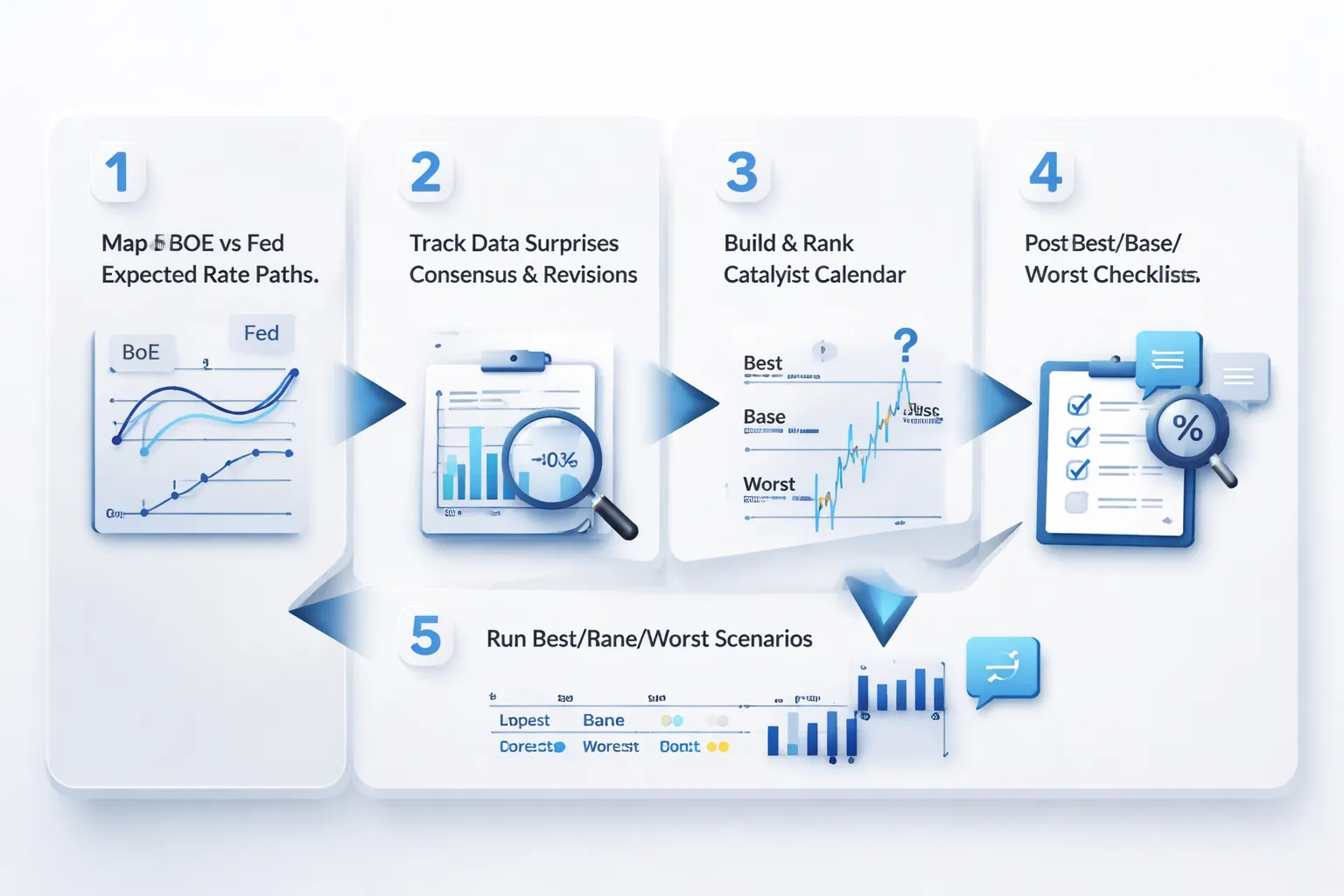
Start with the rate story, price the BoE vs Fed path
GBP/USD often follows the expected gap between the BoE and the Fed. Your first job is to map what the market already prices, then track what changes.
- Pull the priced path. Use OIS curves or short-sterling and SOFR futures to estimate expected policy rates for the next 3, 6, and 12 months.
- Write the spread. Track the expected policy rate differential, BoE minus Fed, at the same horizons.
- Match horizons to your trade. Short-term trades often react to the next 1 to 3 meetings. Swing trades react to the 6 to 12 month path.
- Flag what would force repricing. Inflation persistence, labor tightness, growth breaks, and explicit central bank guidance shifts.
| Input you track | What it tells you | What tends to move GBP/USD |
|---|---|---|
| BoE priced rate path | UK terminal rate and cut timing expectations | Hawkish repricing supports GBP |
| Fed priced rate path | US terminal rate and cut timing expectations | Hawkish repricing supports USD |
| BoE minus Fed differential | Net carry and policy gap narrative | Widening supports GBP, narrowing supports USD |
| Front-end rate volatility | How jumpy the market is around meetings and data | High vol raises whipsaw risk and slippage |
Use a data-surprise approach, track consensus vs actual and revisions
Most “news” is the gap between the print and expectations. You need a simple, repeatable way to measure surprise and persistence.
- Build a two-country surprise log. Track UK CPI, UK wages, UK jobs, UK PMI, UK GDP, and the same US set.
- Record four numbers. Consensus, actual, prior, and revised prior.
- Score the surprise. Use actual minus consensus, then normalize by a typical miss size for that release.
- Respect revisions. A big revision can matter more than the headline surprise, especially for labor and GDP series.
- Link surprise to rates first. Watch how UK front-end yields and US front-end yields react. GBP/USD usually follows the rate move.
| Release | What the market usually trades | Common GBP/USD reaction channel |
|---|---|---|
| UK CPI | Services CPI and core details | BoE repricing, GBP bid on upside |
| UK wages and jobs | Pay growth trend and inactivity | BoE path, higher wages can lift GBP |
| US CPI | Core and supercore proxies | Fed repricing, USD bid on upside |
| US payrolls | Jobs, wages, and revisions | Rates and risk tone, USD can dominate |
| PMIs | Direction and surprises vs trend | Growth narrative, smaller but fast moves |
Build a catalyst calendar, rank events by impact and current sensitivity
Do not treat every event the same. Rank them by how much they move GBP/USD, then adjust for the current macro regime.
- Start with a base rank. BoE decision, Fed decision, UK CPI, US CPI, US payrolls, UK wages.
- Add regime sensitivity. If inflation drives policy, CPI ranks higher. If growth fear dominates, PMIs and GDP climb.
- Include political and fiscal risk. UK budgets, elections, and major policy U turns can move UK risk premium fast.
- Mark known liquidity traps. London fix, major expiries, and thin post-data windows can amplify swings.
- Use one tool consistently. Track upcoming events and consensus in an economic calendar, then annotate it with your own impact rank.
| Event type | Typical impact | When it jumps a tier |
|---|---|---|
| BoE and Fed meetings | High | Guidance shifts, dot plot shock, split votes, press conference tone change |
| Inflation data | High | Policy credibility in focus, sticky services inflation, energy pass-through surprises |
| Labor data | Medium to high | Wage-driven inflation narrative, sharp revision cycles |
| Growth data and surveys | Medium | Recession risk, fiscal tightening, credit stress |
| Politics and fiscal | Event-driven | Funding questions, credibility shocks, election uncertainty |
Scenario analysis, translate best, base, worst cases into price levels
Pre-commit to scenarios before the release. This stops you from chasing the first spike.
- Define the three paths. Best case for GBP, base case, worst case for GBP.
- Attach rate outcomes. For each scenario, write the likely move in BoE pricing, Fed pricing, or both.
- Map to key levels. Use recent swing highs and lows, round numbers, and known liquidity pools.
- Assign an invalidation level. Pick the level that proves your scenario wrong, not the level that “feels safe.”
- Plan execution rules. Decide if you need a close above a level, a retest, or a rates confirmation before entry.
| Scenario | Rates implication | GBP/USD translation |
|---|---|---|
| Best case for GBP | BoE reprices more hawkish, or Fed reprices more dovish | Break and hold above resistance, next liquidity zone becomes target |
| Base case | Small repricing, narrative unchanged | Fade extremes, mean reversion around prior range |
| Worst case for GBP | BoE reprices dovish, or Fed reprices hawkish | Breakdown below support, prior lows become magnets |
Post-release checklist, what changed in the narrative
After the print, you need a fast read on whether the move can last. Focus on what the market will carry into the next session.
- Did rates confirm the FX move. If GBP/USD rose but UK front-end yields fell, treat it as fragile.
- Which detail drove it. Core, services, wages, revisions, or guidance lines. Write the one sentence driver.
- Did the expected path shift. Note changes in the next meeting odds and the 3 to 12 month differential.
- Did positioning get squeezed. Fast, one-way candles with poor pullbacks often signal stops, not new conviction.
- Did the market change its next focus. A hot CPI can turn the next labor print into the main risk, and vice versa.
- What level now matters. Mark the post-event high and low, then the level that held on the first pullback.
Common pitfalls and how to avoid them
Confusing correlation with causation in macro headlines
Headlines move fast, your model should move slow. A print can coincide with a GBP/USD rally and still not be the cause. Check what else hit the tape in the same hour, Fed speakers, UK politics, risk assets, and rate pricing.
- Start with rates. If GBP/USD pops but the UK UST 2-year yield spread does not move, you likely saw positioning or USD flow, not a UK fundamental reprice.
- Verify with OIS. Look for a shift in the next meeting odds and the 3 to 12 month path, not just a spot spike.
- Separate surprise from narrative. A beat matters only if it changes the central bank path the market already priced.
Overweighting the latest print instead of the trend and the reaction function
One data point rarely resets the outlook. Inflation, wages, and growth trends drive policy. Policy drives the rate differential. Rate differential drives GBP/USD over time.
- Track 3-month and 6-month annualized trends. Use them to judge whether the latest print confirms or breaks the run rate.
- Map the reaction function. Ask what the BoE and Fed have signaled they care about most, then weight your inputs to that.
- Use a simple rule. If the data surprise does not change the expected path of cuts or hikes, fade the impulse or wait for levels to hold.
Ignoring market expectations, why “good news” can still weaken GBP
Price moves on the gap between expectations and reality. “Good” can be fully priced. “Less good than hoped” can hit hard.
- Anchor to consensus and whisper. Compare the release to survey median and to market chatter from the prior days.
- Watch revision risk. A headline beat with prior revisions down often fails to sustain.
- Read the first 5 to 15 minutes. If you see fast one-way candles with poor pullbacks, you often got stops and cleanup, not new conviction.
- Check the focus. After a hot CPI, the next labor print can become the main risk. When focus shifts, the same data has a different impact.
Misreading USD moves, separating broad DXY strength from GBP-specific factors
GBP/USD can fall even when the pound holds up elsewhere. That is usually USD strength. Do not blame the UK story by default.
- Cross-check GBP crosses. If GBP is flat or up versus EUR and JPY while GBP/USD drops, you are trading USD, not GBP.
- Check DXY and UST yields. Broad USD strength often aligns with higher front-end yields and risk-off flows.
- Use a two-bucket read. Put each move into USD beta or GBP idiosyncratic. Trade size should be smaller when you do not know the bucket.
Risk management basics, sizing, leverage awareness, and event hedging considerations
Most losses come from size and timing, not analysis. GBP/USD can gap on UK politics, CPI, jobs, and central bank surprises. Plan for that before you click.
- Size to the stop. Set invalidation first, then choose position size so a stop-out costs a small, fixed percent of your account.
- Respect leverage. High leverage turns normal intraday swings into forced exits. Keep margin use low enough to survive a spike.
- Define event rules. Before CPI, payrolls, or a BoE or Fed decision, decide if you will cut risk, hedge, or stay flat.
- Mark post-event levels. Use the post-event high and low, then the level that held on the first pullback. Trade only if price respects them.
- Avoid revenge trades. If you miss the move, you miss it. Wait for a clean pullback and a clear rate-pricing confirmation.
For a cleaner framework on how inflation feeds into currency pricing, read inflation and exchange rates.
Frequently Asked Questions
What moves GBP/USD the most day to day?
Rate expectations. Watch SONIA and SOFR futures, and 2-year UK and US yields. Then watch top-tier data, CPI, jobs, GDP. Political headlines matter when they change growth or rate pricing. Risk sentiment often amplifies moves through USD demand.
Does the Bank of England or the Fed matter more for GBP/USD?
Both. The pair tracks the expected policy gap. If UK rates reprice higher versus US, GBP/USD tends to rise. If US rates reprice higher versus UK, it tends to fall. Focus on the change in expectations, not the decision itself.
Which economic releases hit GBP/USD hardest?
US Non-Farm Payrolls, US CPI, and Fed meetings. For the UK, CPI, wages, and BoE meetings lead. Surprise versus consensus drives the move. The bigger the miss, the faster the repricing in front-end yields.
How does inflation data move GBP/USD?
Inflation moves rate pricing. Hotter prints push expected hikes or fewer cuts, supporting that currency. Cooler prints do the opposite. Track core measures, services inflation, and wages. Use inflation and exchange rates for the full framework.
Why does GBP/USD sometimes fall on good UK data?
Markets trade relative outcomes. UK data can beat, yet US data or Fed pricing can improve more. Or the UK beat was already priced in. Check the move in UK US 2-year yield spread after the release. Price follows the spread.
How do risk sentiment and equities affect GBP/USD?
Risk-off often supports USD through safe-haven demand and tighter financial conditions. That can pressure GBP/USD even with stable UK data. Risk-on can lift GBP/USD if USD funding demand fades. Confirm with DXY, S&P 500, and credit spreads.
What time of day is GBP/USD most active?
London session and the London New York overlap. UK data hits early London. US data hits during New York morning. Liquidity improves, spreads tighten, and yield moves transmit faster. Avoid thin hours if you trade news or tight stops.
What is the cleanest way to track the fundamental driver?
Follow rate pricing first. Use 2-year UK and US yields, and front-end futures. Then check the catalyst, data surprise, central bank messaging, or risk move. If yields do not confirm, treat the price move as fragile.
What are the main risks when trading GBP/USD news?
Slippage, spread widening, and headline whipsaws. You can get the direction right and still lose on execution. Reduce size, predefine invalidation, and trade only after spreads normalize. If price breaks and fails, exit fast.
Conclusion
Conclusion
GBP/USD moves when rate expectations change. Track the BoE and Fed reaction functions, then watch the data that can shift them. Inflation, wages, and services prices matter most for the UK. Jobs, inflation, and growth surprises matter most for the US.
Use one framework. Ask what changes the next 1 to 3 policy meetings, then look for confirmation in yields. If GBP-US yield spreads do not move with price, treat the move as weak.
Keep your process tight on news. Know the consensus, the prior, and the market pricing before the release. Use an economic calendar to plan your week and avoid surprise risk.
Final tip. Trade the driver, not the candle. Define your invalidation level first, size for slippage, and exit fast when price breaks and fails.
-
How Interest Rates Affect Currency Pairs (With Real Examples)
7 months ago -
Fundamental Analysis in Forex Explained (What Actually Moves Prices)
7 months ago -
What Moves EUR/USD? The Biggest Drivers You Should Watch
7 months ago -
How to Trade Forex News (NFP, CPI, FOMC) Without Getting Wrecked
7 months ago -
Inflation and Exchange Rates Explained (Why Currencies Rise or Fall)
7 months ago
-
-
- US nonfarm payrolls and unemployment, why USD often reacts first and hardest
- UK labor data, earnings and claimant count, how it feeds BoE pricing
- GDP releases and revisions, read momentum, not the headline
- PMIs and business surveys, why forward-looking data can move GBP/USD more
- Retail sales and consumer confidence, signals for demand and recession risk
-
- Liquidity by session, and why timing moves price
- Order flow, stop runs, and why clean charts can still jump
- Options hedging and gamma around key strikes
- Positioning and sentiment you can track
- Technical levels that matter in real execution
- Seasonality and month-end, when flows beat fundamentals
- Volatility regimes and how they change price behavior
-
- Start with the rate story, price the BoE vs Fed path
- Use a data-surprise approach, track consensus vs actual and revisions
- Build a catalyst calendar, rank events by impact and current sensitivity
- Scenario analysis, translate best, base, worst cases into price levels
- Post-release checklist, what changed in the narrative
-
- Confusing correlation with causation in macro headlines
- Overweighting the latest print instead of the trend and the reaction function
- Ignoring market expectations, why “good news” can still weaken GBP
- Misreading USD moves, separating broad DXY strength from GBP-specific factors
- Risk management basics, sizing, leverage awareness, and event hedging considerations
-
- What moves GBP/USD the most day to day?
- Does the Bank of England or the Fed matter more for GBP/USD?
- Which economic releases hit GBP/USD hardest?
- How does inflation data move GBP/USD?
- Why does GBP/USD sometimes fall on good UK data?
- How do risk sentiment and equities affect GBP/USD?
- What time of day is GBP/USD most active?
- What is the cleanest way to track the fundamental driver?
- What are the main risks when trading GBP/USD news?
-
-
- US nonfarm payrolls and unemployment, why USD often reacts first and hardest
- UK labor data, earnings and claimant count, how it feeds BoE pricing
- GDP releases and revisions, read momentum, not the headline
- PMIs and business surveys, why forward-looking data can move GBP/USD more
- Retail sales and consumer confidence, signals for demand and recession risk
-
- Liquidity by session, and why timing moves price
- Order flow, stop runs, and why clean charts can still jump
- Options hedging and gamma around key strikes
- Positioning and sentiment you can track
- Technical levels that matter in real execution
- Seasonality and month-end, when flows beat fundamentals
- Volatility regimes and how they change price behavior
-
- Start with the rate story, price the BoE vs Fed path
- Use a data-surprise approach, track consensus vs actual and revisions
- Build a catalyst calendar, rank events by impact and current sensitivity
- Scenario analysis, translate best, base, worst cases into price levels
- Post-release checklist, what changed in the narrative
-
- Confusing correlation with causation in macro headlines
- Overweighting the latest print instead of the trend and the reaction function
- Ignoring market expectations, why “good news” can still weaken GBP
- Misreading USD moves, separating broad DXY strength from GBP-specific factors
- Risk management basics, sizing, leverage awareness, and event hedging considerations
-
- What moves GBP/USD the most day to day?
- Does the Bank of England or the Fed matter more for GBP/USD?
- Which economic releases hit GBP/USD hardest?
- How does inflation data move GBP/USD?
- Why does GBP/USD sometimes fall on good UK data?
- How do risk sentiment and equities affect GBP/USD?
- What time of day is GBP/USD most active?
- What is the cleanest way to track the fundamental driver?
- What are the main risks when trading GBP/USD news?
-
How to Place a Forex Trade Step by Step (Your First Trade Explained)
5 months ago -
Forex Trading vs Crypto Trading: Which Market Is Better for Beginners?
5 months ago -
Forex Lot Size Calculator: How to Use It to Size Trades Correctly
7 months ago -
How to Calculate Position Size in Forex (Position Sizing Formula + Examples)
7 months ago -
Forex Leverage Explained: How It Works, Pros, Cons & Examples
7 months ago
-
Forex Trading Platforms Comparison: MetaTrader vs cTrader vs TradingView
7 months ago -
Stop Loss vs Take Profit: Differences, Examples & Best Practices
7 months ago -
Is Forex Trading Legal in the United States? Rules, Regulators & What to Know
7 months ago -
Forex Leverage Explained: How It Works, Pros, Cons & Examples
7 months ago -
Forex Market Hours & Trading Sessions Explained (Best Times to Trade)
7 months ago