Forex Copy Trading Explained: How It Works, Costs, Risks and Best Practices
Forex copy trading lets you link your account to another trader and auto-copy their trades in real time. You choose who to follow, set your risk, then your platform mirrors entries, exits, and position size based on your settings.
This guide explains how forex copy trading works, what you pay, where losses come from, and how to set guardrails. You will learn how sizing and leverage change outcomes, how fees and spreads cut returns, what to check in a trader’s track record, and which controls matter most, like max drawdown, stop copying rules, and diversification across providers.
If your goal is to trade other people’s capital instead, read how a forex prop firm works.
- In het kort: Forex copy trading links your account to a provider, then your broker replicates trades based on your sizing rules.
- In het kort: Your results differ from the provider because of spreads, slippage, execution speed, and leverage.
- In het kort: Fees stack fast. Count performance fees, management fees, commissions, swaps, and wider spreads.
- In het kort: Losses come from drawdowns, overleverage, concentrated pairs, and holding risk through news.
- In het kort: Set guardrails before you start. Use max drawdown limits, stop copying rules, and position caps.
- In het kort: Vet the track record with data. Check length, max drawdown, average leverage, consistency, and open risk.
- In het kort: Diversify across providers and strategies. Avoid putting your full balance behind one trader.
Copy trading can save time, but it does not remove risk. You still control sizing, leverage, and when you stop.
Track net performance, not headline returns. Compare results after all fees, spreads, and swaps.
Use conservative risk settings first. Increase size only after you see how the strategy behaves in your account.
Choose platforms and providers with clear costs, robust controls, and transparent reporting. See our best forex copy trading platforms comparison.
What is forex copy trading (and how it differs from social trading)?
Plain-English definition and who it’s for
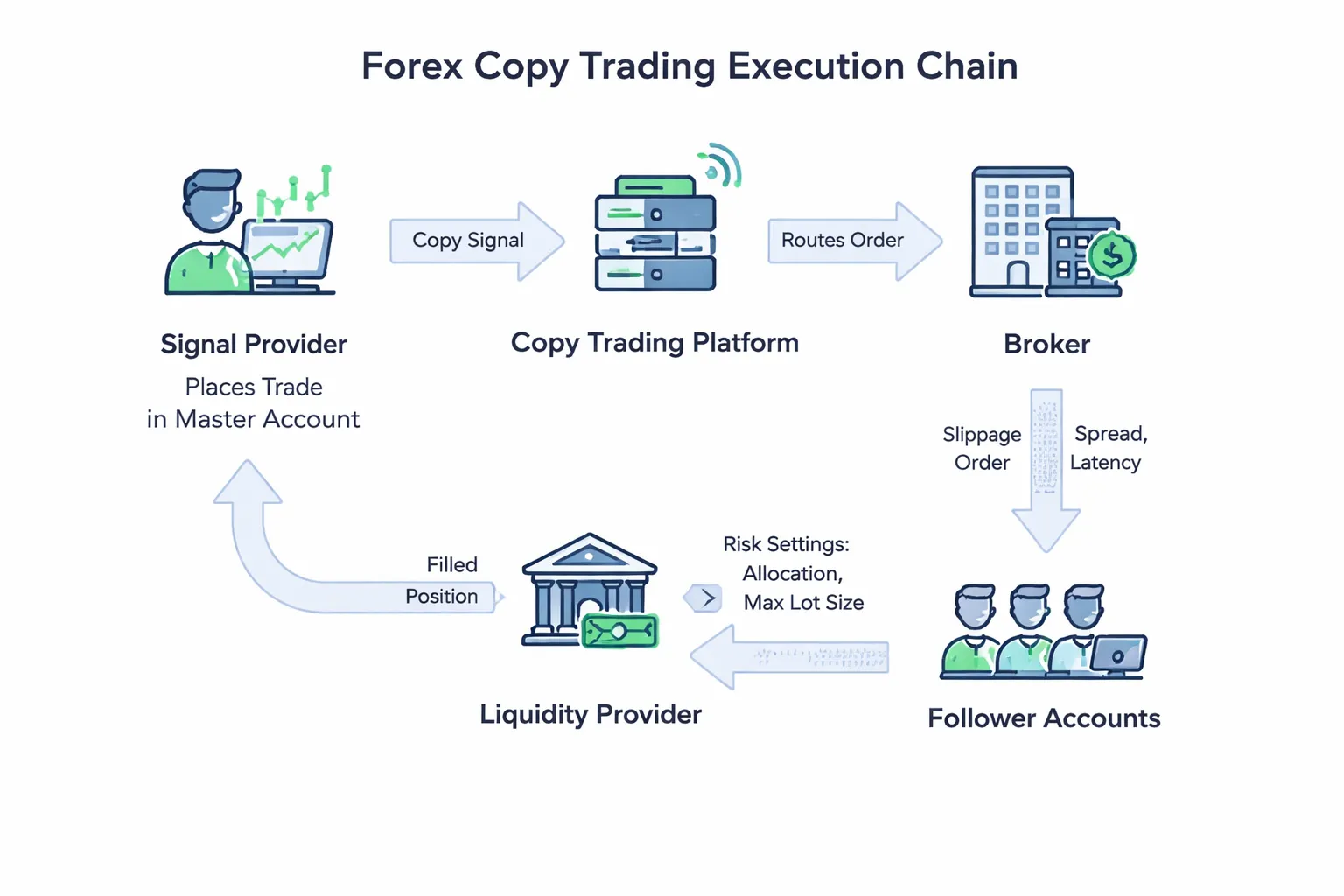
Forex copy trading lets you link your trading account to another trader’s account and copy their trades automatically. When they open, modify, or close a position, your account attempts to do the same based on your settings.
It fits you if you want market exposure without placing each trade manually, or you want to follow a rule-based approach with preset risk controls. It does not fit you if you cannot accept drawdowns, cannot monitor risk weekly, or expect “set and forget” returns.
Copy trading vs social trading vs mirror trading vs PAMM/MAM
- Copy trading. You copy a specific trader’s positions. You usually control allocation, max lot size, leverage limits, and stop copying.
- Social trading. You get ideas, commentary, and performance feeds. You may copy, but the core feature is discovery and discussion, not execution.
- Mirror trading. You copy a fixed strategy or algorithm, not a person. Trades follow predefined rules, often with less discretion and fewer changes over time.
- PAMM. You invest into a pooled account. The manager trades one master account, then the broker allocates profits and losses to investors by share. You cannot control trade-by-trade risk.
- MAM. One manager trades multiple client accounts from a master interface. Allocation can vary by client. Like PAMM, you usually have limited control over each position.
Key participants in the chain
- You (the follower). You choose who to copy, set risk limits, and fund the account. You take the losses.
- The signal provider. They trade their own account or a master account. Their incentives can include performance fees, volume rebates, or subscriptions.
- The broker or platform. They host the copying system, route orders, apply leverage, and charge spreads, commissions, swaps, and sometimes copy fees.
- The liquidity provider. They supply prices and fills. This affects slippage, rejected orders, and spread widening during fast markets.
What “automatic execution” really means, and what it doesn’t
Automatic execution means the platform sends an order from your account when the provider’s trade triggers. It does not mean you get the same entry price, the same spread, or the same fill speed.
- You can get different results. Your fill can differ due to slippage, wider spreads, market gaps, or low liquidity.
- Risk can change. If you use proportional sizing, your lot size changes as your balance changes. If you use fixed sizing, your percentage risk changes as your balance moves.
- Stops and limits can fail in gaps. A stop loss can fill worse than the stop price in fast markets.
- Platform rules still apply. Minimum lot size, margin requirements, max leverage, FIFO rules in some jurisdictions, and execution settings can block or alter copied trades.
- It still needs oversight. You must monitor drawdown, open exposure, and changes in the provider’s behavior, such as holding times, lot sizes, or pairs traded.
If you want to compare tools and controls across providers, use our best forex copy trading platforms comparison.
How forex copy trading works step by step
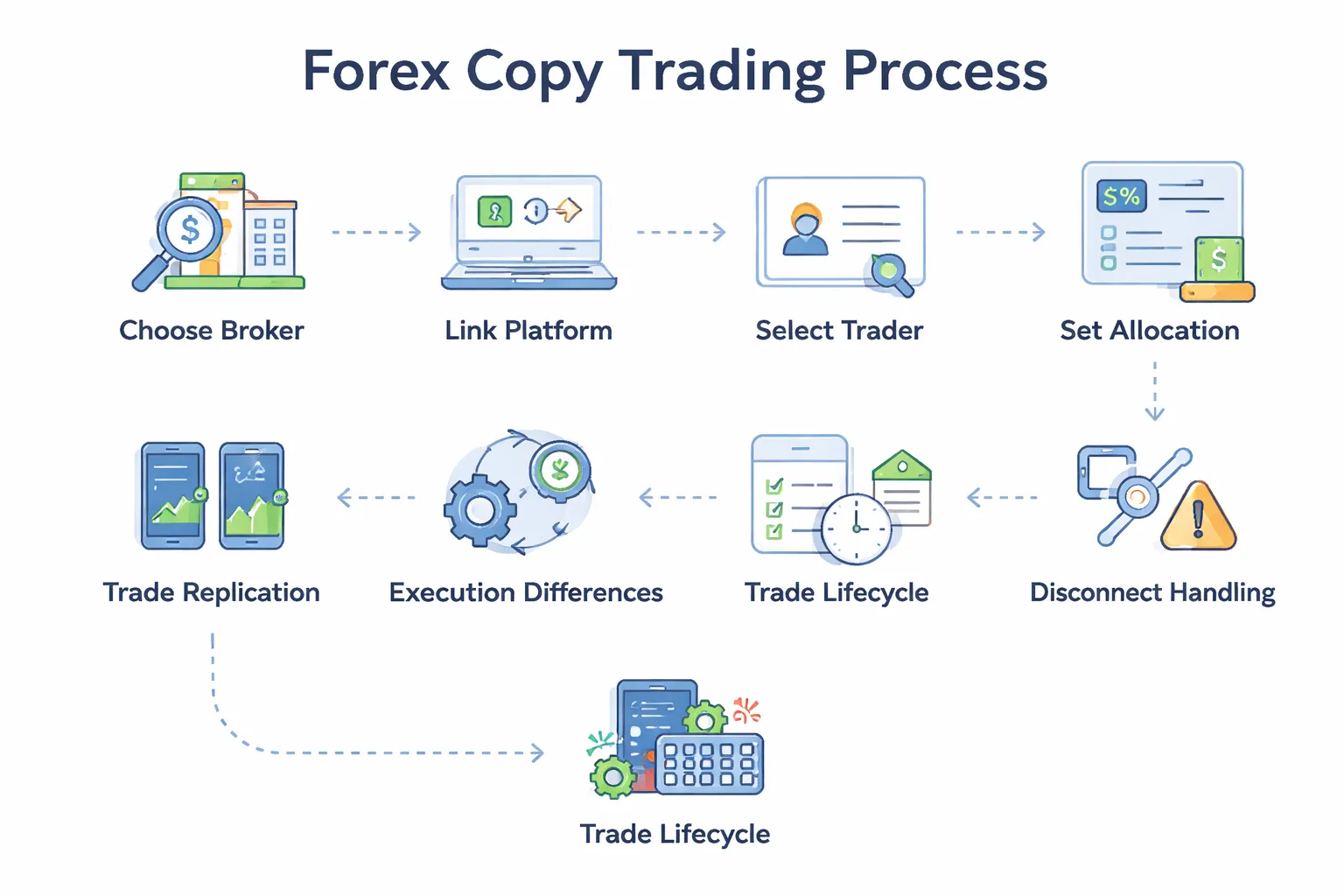
Account setup: broker choice, platform linking, verification, and funding
- Pick a broker that supports copy trading. Check the supported platform and account type, such as MT4, MT5, cTrader, or a broker-native app. Confirm your region’s limits on leverage, hedging, and trade size.
- Create the trading account. Complete KYC. Upload ID and proof of address. Wait for approval.
- Link the copy service. You either connect inside the broker app, link via an investor password, or authorize through an API token. Use read only access if you want monitoring without trade rights.
- Set base risk controls. Define max allocation, max open trades, and an equity stop if the platform supports it. Set notifications for drawdown and margin level.
- Fund your account. Deposit in the account currency when possible. If you convert, track FX conversion and withdrawal fees. Keep a cash buffer to avoid margin calls during volatility.
Choosing a trader: discovery tools, filters, and shortlisting criteria
- Use platform discovery tools. Most platforms rank providers by return, drawdown, followers, and AUM. Start with filters instead of leaderboards.
- Filter for risk first. Prioritize max drawdown, average leverage, and average holding time. Remove traders with frequent deep equity dips or high margin use.
- Check trade behavior. Look at typical lot size, pairs traded, session timing, and whether the trader scales into losers. Confirm they still trade the same style.
- Validate the track record. Prefer longer history with stable position sizing. Short, high return curves often hide tail risk.
- Review costs and rules. Confirm performance fees, spreads, commissions, and any high water mark. Check minimum deposit and whether you can stop copying without penalties.
- Shortlist and test small. Start with a small allocation and watch live execution for at least a few weeks of normal market conditions.
If you need a deeper checklist, use our guide on how to choose a copy trading provider.
Allocation methods: fixed amount, equity percentage, and multiplier or risk ratio
- Fixed amount. You assign a cash amount to the strategy, such as $500. The platform sizes trades based on that sub allocation. Your risk stays capped to that slice, but sizing can drift if equity changes.
- Equity percentage. You allocate a percent of your account equity, such as 20%. The copy size adjusts as your balance changes. This keeps exposure proportional, but it can increase size after gains and reduce size after losses.
- Multiplier or risk ratio. You copy at 0.5x, 1x, or 2x the provider’s size. This ties your risk to the provider’s behavior. Use small multipliers unless you match their account size, leverage, and margin rules.
- Guardrails you should set. Cap max lot per trade, cap max total lots, cap max open positions, and set a hard equity stop if available. Treat these as non negotiable.
Trade replication mechanics: order types, partial fills, and netting vs hedging accounts
- Signal to order. The provider places a trade. The platform reads it and sends an order to your broker using your allocation rules.
- Order type mapping. Market orders usually copy fastest. Limit and stop orders may copy with different entry prices if your broker uses different tick data or minimum distance rules.
- Partial fills. Your order can fill in pieces in fast markets or on thin liquidity. You may end up with a different average entry than the provider.
- Netting vs hedging. In netting accounts, opposite positions merge into one net position. In hedging accounts, buys and sells can coexist. If the provider hedges but your account nets, the platform may close or reduce positions instead of opening a hedge.
- FIFO constraints. Some jurisdictions enforce FIFO. If the provider scales in and out, your broker may close positions in a different order than the provider.
Execution differences: slippage, latency, and price feed variations
- Slippage. Your fill price can differ from the provider’s, especially during news, session opens, and low liquidity periods. Negative slippage increases losses and reduces gains.
- Latency. Time delays come from the provider terminal, the copy server, and your broker execution. Even a small delay can change results on short holding strategies.
- Price feed variation. Brokers can show different bid ask quotes. That changes entry, stop loss triggers, and take profit triggers.
- Spread and commission differences. A provider with low spreads can trade more often. If your costs are higher, the same strategy can flip from profit to loss.
Lifecycle of a copied trade: open, modify, scale in or out, close, and what happens on disconnects
- Open. The platform sends your entry order based on the provider action and your allocation rules. Your broker confirms the fill and your position appears in your terminal.
- Modify. If the provider moves stop loss or take profit, the platform attempts the same update on your account. Broker rules can block edits, such as minimum stop distance or freeze levels.
- Scale in. If the provider adds to the position, you add too, unless you hit your max exposure limits. Your average entry price changes.
- Scale out. If the provider partially closes, you should also partially close. On netting accounts, the system may reduce the net size instead of closing a specific ticket.
- Close. When the provider exits, the platform sends a close order on your account. If your trade copied late, you may close at a worse price.
- Disconnects. If your connection drops, your open trades remain at the broker. New trades and modifications may not copy. When you reconnect, some platforms sync positions, others do not. You must check for orphan trades and mismatched stops.
Example scenario: a copied EUR/USD trade from start to finish
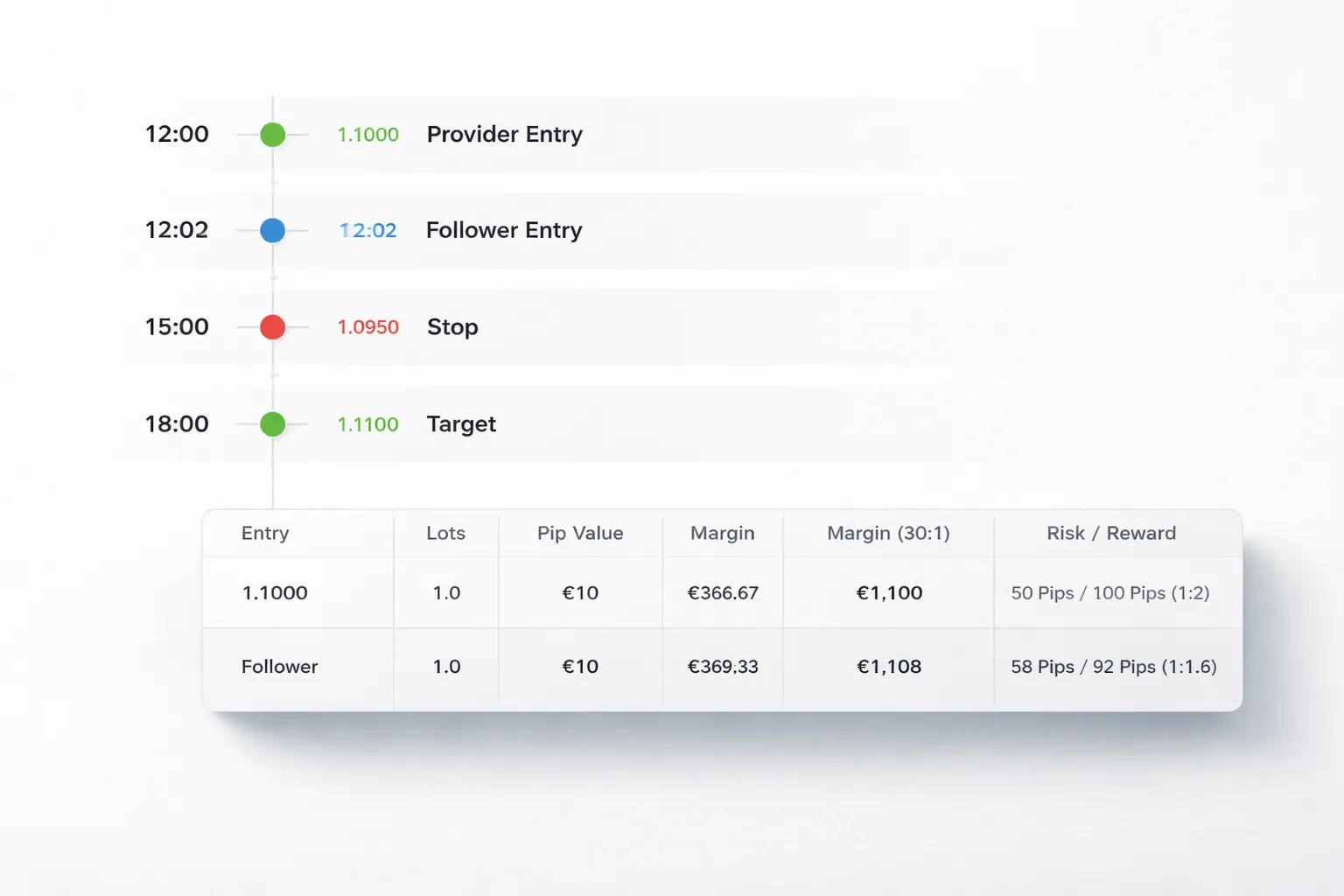
Numerical walkthrough with position sizing and pip value
Assume the provider buys EUR/USD at 1.1000 with a 50 pip stop at 1.0950 and a 100 pip target at 1.1100.
The provider uses a $10,000 account and risks 1% or $100 on the trade.
Risk per pip equals $100 divided by 50 pips, so $2 per pip.
On EUR/USD, 1 standard lot equals about $10 per pip. A $2 per pip position equals 0.20 lots.
Your copy account has $2,000. You set allocation at 20% of your balance, so $400 tracks the provider.
Your scaling factor equals $400 divided by $10,000, so 0.04.
Your copied position size equals 0.20 lots times 0.04, so 0.008 lots.
At 0.008 lots, your pip value is about $0.08 per pip.
If price hits the stop 50 pips lower, your loss is about 50 times $0.08, so $4 plus spread and any commission.
If price hits the target 100 pips higher, your gain is about 100 times $0.08, so $8 minus costs.
| Item | Provider | You (copied) |
|---|---|---|
| Account balance | $10,000 | $2,000 |
| Allocation to copy | N/A | $400 |
| Risk (1%) | $100 | Scales via allocation |
| Stop size | 50 pips | 50 pips (if copied correctly) |
| Position size | 0.20 lots | 0.008 lots |
| Approx pip value | $2.00 per pip | $0.08 per pip |
Your costs can differ from the provider. Your broker spread, commission, and swap can change the net result. Your fill price can also differ due to latency and slippage.
How leverage and margin change the same copied position
Leverage does not change pip value. Lot size does.
Leverage changes margin, so it changes whether you can hold the copied trade during volatility.
Assume EUR/USD at 1.1000 and your copied size is 0.008 lots, or 800 EUR notional. Notional in USD is about 800 times 1.10, so $880.
- At 30:1 leverage, margin is about $880 divided by 30, so $29.33.
- At 10:1 leverage, margin is about $880 divided by 10, so $88.
If you copy multiple providers or the provider pyramids into trades, margin can stack fast. Lower leverage raises your margin use. That increases the chance of margin warnings or forced closes during drawdowns.
What happens if the provider adds to the trade or moves the stop loss
Assume EUR/USD moves in the provider’s favor to 1.1030. The provider adds 0.10 lots.
Your platform copies the add as 0.10 lots times 0.04, so 0.004 lots.
Your total position becomes 0.008 plus 0.004, so 0.012 lots. Your pip value rises to about $0.12 per pip.
Now the provider moves the stop from 1.0950 up to 1.1005.
- If your platform copies stop updates, your downside shrinks fast. Your worst case loss drops because the stop sits closer.
- If your platform fails to sync, you keep the old 1.0950 stop. Your risk stays larger than the provider’s intended risk.
- If you joined late, your entry may sit higher. A moved stop can even lock in a loss on your account if your entry is above the provider’s entry by enough pips.
Check your open trades after every add, partial close, and stop change. Do not assume the platform synced. If you want more control, compare copy trading with paid forex signals, where you place and manage the orders yourself.
Scenario analysis: follower joins late and the impact on entry price
Assume the provider buys EUR/USD at 1.1000, but you start copying 30 seconds later.
Price has already moved to 1.1008. Your platform enters you at 1.1008.
Your stop still copies at 1.0950. Your stop distance is now 58 pips, not 50.
Your position size might still copy as 0.008 lots because the platform scales by balance, not by risk distance.
Your risk in dollars increases because the stop is farther away in pips.
- Planned risk at 50 pips: 50 times $0.08 equals about $4.
- Actual risk at 58 pips: 58 times $0.08 equals about $4.64.
Your reward also changes. If the provider targets 1.1100, your upside is 92 pips, not 100.
- Planned reward at 100 pips: 100 times $0.08 equals about $8.
- Actual reward at 92 pips: 92 times $0.08 equals about $7.36.
Late entry cuts your reward and raises your risk. Your risk to reward worsens even if the provider trade works as planned.
Mitigation is simple. Use max slippage controls if your platform supports them. Set a rule to skip copying if price has moved more than a set number of pips from the provider entry. Reduce allocation when volatility spikes.
Costs and fees in copy trading (what you’ll actually pay)
Trading costs: spreads, commissions, swaps, and financing
You pay normal trading costs on every copied trade. Copying changes who picks the trades, not how your account gets charged.
- Spread. You buy at the ask and sell at the bid. The gap is your instant cost. It varies by broker, account type, time of day, and volatility.
- Commission. Common on RAW or ECN style accounts. You pay per lot per side, or per round turn. Some platforms show it separately, others blend it into pricing.
- Swap or rollover. You pay or receive overnight interest when you hold positions past the broker cutoff time. High rate pairs and CFD products can make swap the largest cost if the provider holds for days.
- Financing on CFDs. Indices, metals, oil, and crypto CFDs often carry financing charges. If the provider swings these products, expect daily holding costs.
Fast scalpers suffer most from spread and commission. Swing traders suffer most from swap and financing.
Platform and provider costs: subscriptions, performance fees, and management fees
Many copy platforms charge you on top of trading costs. Read the fee page and the provider profile. Do not assume fees are included in the spread.
- Subscription. Fixed monthly fee for access to a provider. You pay whether you profit or not. This suits high frequency strategies because the fee does not scale with volume.
- Performance fee. A percentage of profit. Common ranges sit around 10 to 30 percent, but the number matters less than the calculation method.
- Management fee. A percentage of your allocated equity, billed monthly or annually. This fee hits you even during flat or losing periods.
- Volume fees and markups. Some platforms charge per lot copied, or add a markup to spread or commission. This can be hard to spot unless you compare execution reports.
Profit sharing models: high-water mark, crystallization, and common structures
Performance fees often use rules borrowed from managed accounts. These rules decide when the provider gets paid.
- High-water mark. The provider earns a performance fee only on new net profits above your prior peak equity. This helps protect you from paying twice after a drawdown.
- Fee crystallization. The platform locks in the performance fee on a schedule, often monthly or quarterly. After crystallization, the high-water mark resets to the new peak. If the account drops later, you do not get the fee back.
- Per-trade profit share. The platform takes a cut of each winning trade. This can pay fees even if later losses erase gains. It can also encourage frequent trading.
- Net profit share. The platform charges based on net profit over a period. This aligns better with your result if the period is long enough and it uses a high-water mark.
Prefer net profit share with a high-water mark and clear crystallization rules. Avoid per-trade profit share unless you accept higher fee drag and more incentive issues.
Hidden cost drivers: slippage, execution markups, and frequent trading strategies
These costs do not sit on a neat fee line, but they can dominate your outcome.
- Slippage. Your fill differs from the provider fill. You already saw how a late entry can cut reward and raise risk. Slippage compounds when the provider trades news, thin sessions, or large position sizes.
- Execution markups. Some setups route copied trades through a dealing layer, add spread, or apply worse pricing than your normal account. Compare your average spread and commission before and after you start copying.
- High turnover strategies. Scalping and grid styles can generate many trades. Each trade pays spread and often commission. Small average profit per trade cannot survive high friction for long.
- Stop hunting by structure. Tight stops plus copying delay leads to more stop outs on your account than on the provider account. The strategy can look stable on the provider and unstable on your feed.
If you want a deeper risk breakdown beyond fees, read this copy trading forex guide.
Cost checklist: how to estimate monthly costs before following anyone
Do a simple cost model. Use the provider trade history and your broker pricing. Estimate with conservative slippage.
- Step 1, set your allocation. Decide the dollar amount you will copy with and the leverage you will allow.
- Step 2, estimate monthly volume. From the provider history, total the lots per month you would have copied at your allocation.
- Step 3, price spread and commission. Use your typical spread in pips for the traded pairs and your commission per lot. Convert to dollars using pip value and lot size.
- Step 4, estimate holding costs. From average holding time, estimate how many nights positions stay open. Multiply by expected swap or financing per lot.
- Step 5, add platform fees. Add subscription and any management fee. For performance fees, apply the percentage to a realistic net profit, then stress test with lower returns.
- Step 6, add slippage buffer. Add a fixed pips per trade, then convert to dollars using lot size. Use a higher buffer for news traders and thin session traders.
- Step 7, compare to expected edge. Your expected monthly return must exceed total friction by a wide margin. If the strategy averages small monthly gains, fees can erase them.
| Cost item | How it is charged | What to collect before you follow |
|---|---|---|
| Spread | Per trade | Typical spread by pair and session |
| Commission | Per lot | Commission per lot per side or round turn |
| Swap, financing | Per night held | Swap table and typical holding time |
| Subscription | Monthly | Fee amount and billing terms |
| Performance fee | Percent of profit | High-water mark, crystallization schedule, net vs per-trade basis |
| Management fee | Percent of equity | Rate, billing frequency, equity definition |
| Slippage | Execution difference | Average slippage per trade in pips, max slippage controls |
| Markup | Wider spread or extra fee | Trade receipts and pricing comparison vs non copied trades |
Risks and limitations you must understand before copying
Market risk and leverage risk in FX
FX moves fast. Leverage makes small moves matter.
- Leverage multiplies outcomes. A 1% adverse move becomes a 10% loss at 10:1 leverage, before fees and slippage.
- Margin calls happen without warning. Your broker can close positions when margin drops below requirements. You may not control which trades get closed first.
- Overnight and weekend gaps bypass stops. Price can open past your stop, and you get filled at the next available price.
- Account currency and pair selection add hidden exposure. Copying USD pairs from a non USD base account creates extra conversion P and L and swap effects.
Strategy risk: overfitting, martingale and grid systems, tail risk
Many track records look strong until conditions change.
- Overfitting breaks in new regimes. A strategy tuned to one period can fail when volatility, spreads, or correlations shift.
- Martingale and grid systems hide risk. They often show high win rates by adding to losers. Losses cluster rarely, then arrive large.
- Tail risk can wipe months of gains. One trend day, one central bank surprise, or one liquidity vacuum can trigger a cascade of stops or margin calls.
- Short history misleads. A few months of results can exclude the worst market conditions.
Drawdown risk: peak-to-trough losses and recovery time reality
Copy trading fails most often because you quit during drawdowns or you cannot recover.
- Drawdown is the real cost. A 30% drawdown needs about a 43% gain to get back to break even. A 50% drawdown needs 100%.
- Recovery time can exceed your patience. Even a good strategy can take months to recover from a deep drawdown.
- Providers can scale risk after losses. Some increase position size to recover faster, which can deepen the next drawdown.
- Your copy size changes the profile. If your balance differs from the provider, rounding, minimum lot size, and leverage caps can change risk per trade.
Liquidity and execution risk: gaps, news spikes, and stop-loss behavior
You do not get the provider’s fills. You get yours.
- Slippage spikes in fast markets. During news, execution can slip by multiple pips or more, and stop orders can fill far from the trigger.
- Stops do not guarantee exit price. A stop becomes a market order once triggered. The fill depends on available liquidity.
- Copy delay matters. Even a one to five second delay can change entry price on short term systems.
- Different brokers, different prices. Spread, commissions, markups, and liquidity providers change outcomes, especially for scalping.
Provider risk: style drift, account changes, and incentive misalignment
The provider controls the strategy. You accept the changes.
- Style drift changes risk. A swing trader can shift to intraday scalping, or a low risk approach can shift to aggressive averaging.
- Account changes can break copying. The provider can change broker, leverage, symbol set, or trade size. Your platform may not match.
- Incentives do not match yours. A performance fee can push risk taking. A subscription seller can prioritize marketing over risk controls.
- Provider capital may be small. Some trade tiny accounts for a high percentage return, which does not scale well to larger followers.
Concentration and correlation risk across “different” traders
You can copy several traders and still hold one crowded bet.
- Many strategies trade the same pairs. EURUSD, GBPUSD, USDJPY, and XAUUSD often dominate.
- Correlation rises in stress. In risk off moves, multiple pairs can move together. Diversification benefits shrink when you need them most.
- Shared exposures hide in different charts. Long EURUSD and short USDCHF both express a short USD view. They can lose together.
- Limit overlap. Track net exposure by currency, and cap total risk per currency theme.
Operational risk: outages, API disconnects, and account setting mismatches
Copy trading depends on software, servers, and settings. Failures happen.
- Disconnects create orphan trades. The provider closes a trade, your account misses the close, and you stay exposed.
- Platform outages freeze action. You may not enter, modify, or close when volatility spikes.
- Setting mismatches change risk. Different leverage, hedging rules, FIFO rules, or symbol names can cause partial execution or rejected orders.
- Risk controls may not sync. Provider uses an equity stop, you do not, and you take deeper losses.
Regulatory and legal risk: unlicensed signals and jurisdiction differences
Rules differ by country. Enforcement also differs.
- Signal activity may require authorization. Some jurisdictions treat trade signals, copy services, or managed accounts as regulated activity.
- Disputes cross borders. If the provider sits offshore, you may have limited practical recourse.
- Disclosures vary. Past performance reporting standards differ. You may not get audited results or full risk metrics.
- Check licensing and terms. Use a documented provider selection process, see how to choose a copy trading provider.
How to evaluate copy traders using robust performance metrics
What to prioritize in performance metrics
Start with risk. Returns mean little if the equity curve breaks.
- Maximum drawdown (MDD). Prioritize low and stable MDD over peak gains. Compare MDD to average monthly return. A trader with 10% MDD and 3% average monthly return often fits better than 40% MDD and 6% return.
- Profit factor. Use it to gauge edge quality. Profit factor equals gross profit divided by gross loss. Many strategies look fragile below 1.2. Stronger profiles often hold above 1.4 while keeping drawdown contained.
- Sharpe and Sortino. Prefer risk adjusted returns. Sharpe penalizes all volatility. Sortino penalizes downside volatility. Sortino helps when a strategy trends and shows upside spikes.
- Expectancy. This tells you what you earn per unit of risk over time. Expectancy depends on win rate and average win versus average loss. A high win rate with tiny wins can still produce negative expectancy.
| Metric | What it measures | What to watch |
|---|---|---|
| Max drawdown | Worst peak to trough loss | Deep MDD, slow recovery, repeated deep dips |
| Profit factor | Gross profit divided by gross loss | High PF from a few outsized wins, unstable month to month |
| Sharpe, Sortino | Return per unit of risk | Good return with poor ratios, ratios inflate on short samples |
| Expectancy | Average outcome per trade | Positive expectancy that collapses when spread and slippage rise |
Consistency signals that matter
You want repeatable performance, not one lucky stretch.
- Monthly distribution. Look at the full set of monthly returns. You want many small green months and a few controlled red months. Avoid profiles with long flat periods and rare explosive spikes.
- Win rate versus payoff ratio. Judge them together. A 70% win rate can still lose money if average loss is larger than average win. A 35% win rate can work if payoff ratio stays high and losses stay capped.
- Trade frequency. Too few trades makes stats weak and increases luck. Too many trades can mean scalping that breaks once your slippage differs from the trader’s feed.
Red flags in track records
- Short history. Skip records built on a few weeks or a single market regime. Favor longer samples that include calm and volatile periods.
- Survivorship bias. Leaderboards show winners. Many blown accounts disappear. Treat top ranks as marketing, then validate with hard risk data.
- Cherry picked periods. Watch for charts that start after a drawdown or exclude early losses. Demand full history from account inception.
Risk profile diagnostics
Copy trading fails when the trader’s risk model clashes with your risk limits and your execution.
- Average stop size. Check typical stop distance in pips and in percent of equity. Very tight stops can fail with small pricing differences. No stop, or huge stops, often signals martingale or hope based risk.
- Time in trade. Fast scalping increases execution risk and fee drag. Long holds increase swap exposure and weekend gap risk.
- Exposure by pair and session. Concentration increases blow up risk. Check if most risk sits in one pair, one currency, or one session. Heavy exposure during illiquid hours can widen spreads and worsen fills.
Behavioral cues you can spot in the data
- Revenge trading patterns. Look for a cluster of trades right after a loss, larger size, shorter decision time, or a sharp increase in frequency. Equity curves often show a fast drop after a clean run.
- Increasing leverage after losses. This shows up as rising position size during drawdowns. It can also show as bigger average loss size late in a losing streak. Treat it as a hard stop signal.
Verification and transparency checks
Only trust numbers you can verify.
- Audited statements. Prefer brokers or third parties that provide verified history. Unverified screenshots do not count.
- Real versus demo accounts. Demo fills hide slippage and liquidity limits. Favor real money records with clear broker and account type details.
- Third party tracking. Use independent tracking that shows open trades, balance, equity, drawdown, and full trade list. If the trader hides key fields, walk away.
If you want to compare risk rules across programs, review how drawdown limits work in a forex prop firm setup, then map those limits to your copy trading risk cap.
Best practices for safer forex copy trading
Set rules before you start: goals, time horizon, and acceptable drawdown
Write your rules down before you connect funds.
- Goal: income, growth, or learning. Pick one primary goal. It sets your risk budget.
- Time horizon: at least 3 to 6 months for evaluation. Short windows reward luck and punish normal variance.
- Max drawdown: set a hard limit for your account, then set a tighter limit for the copied allocation. Many traders fail after a 20% to 30% drawdown. Keep your cap lower than the trader’s historical worst drawdown.
- Loss you can accept: define a dollar amount you can lose without changing your plan. If you cannot state it, your size is too big.
Position sizing guardrails: allocation caps and maximum lot constraints
Most copy trading blowups come from oversizing. Fix sizing first.
- Allocation cap: fund the copy account with a slice of your total capital. Keep the rest unlinked.
- Per-trader cap: avoid giving one trader full control of your risk. Spread across traders or keep unused cash idle.
- Copy ratio: match risk, not balance. If the platform offers risk-based copying, use it. If it only offers balance scaling, reduce the multiplier.
- Max lot constraint: set a platform cap per trade and per symbol. This protects you from sudden lot spikes, martingale steps, or symbol changes.
- Leverage discipline: avoid high effective leverage even if the broker allows it. High leverage turns normal drawdowns into margin events.
Risk controls to enable: equity stop, max daily loss, and stop-copy rules
Use platform controls. Do not rely on the trader to manage your account risk.
- Equity stop: set an account-level stop that closes positions and blocks new ones when equity hits your max loss line.
- Max daily loss: cap the day. This limits damage from news spikes, revenge trading, and grid expansions.
- Stop-copy rules: stop copying when the trader breaks your constraints, even if the trader later recovers.
- Max open trades: cap exposure creep. Too many concurrent positions can hide true risk.
- News filter: if the trader claims to avoid news, verify behavior. If your platform supports it, block copying around high impact events for the traded pairs.
Diversification framework: combining uncorrelated styles (trend, mean reversion, news-avoidant)
Diversification only helps when returns come from different drivers.
- Trend: fewer trades, larger moves, can suffer in ranges.
- Mean reversion: many trades, small targets, can suffer in breakouts and trends.
- News-avoidant: reduces event risk, may miss fast opportunities, often steadier during scheduled releases.
Combine styles with different holding times and different pairs. Avoid copying two traders who trade the same pairs with similar entries. Check overlap in symbols, average trade duration, and worst days.
Monitoring cadence: what to check weekly vs monthly
Monitor like a risk manager. Keep it mechanical.
- Weekly checks: equity curve vs your max drawdown line, current drawdown, largest position size, leverage used, number of open trades, any rule breaks, slippage and execution quality.
- Monthly checks: rolling 3 month return, rolling 3 month drawdown, profit factor trend, win rate and payoff ratio stability, exposure by pair, average holding time drift, fee totals.
Do not judge the trader by one week. Do judge them by repeated breaches of your risk rules.
When to stop copying: predefined triggers and performance regime changes
Set stop conditions in advance. Follow them.
- Hard stop: your copied allocation hits the max drawdown limit.
- Process stop: the trader changes strategy signals, adds new high volatility pairs, increases average lot size, or shifts from short holds to long holds without notice.
- Risk stop: new equity lows with rising leverage, growing trade count, or wider stop behavior.
- Data stop: missing history, hidden open trades, or inconsistent reporting across broker statements and tracking.
- Regime stop: the trader’s edge depends on conditions that no longer hold, such as low volatility mean reversion during a high volatility trend phase.
If you want a baseline for core mechanics and risk points, review copy trading forex explained and align your stop rules to the exact platform settings you use.
Tax and recordkeeping basics: export trade logs and document fee categories
Copy trading creates many small transactions. Build a recordkeeping habit.
- Export logs: download full trade history monthly, including timestamps, symbols, size, price, swap, and commissions.
- Save statements: keep broker monthly statements and platform performance reports. Store them in a single folder per year.
- Track fees by category: spreads, commissions, swaps, performance fees, management fees, subscription fees, and any deposit or withdrawal charges.
- Note allocations: record when you changed copy ratios, added funds, or stopped copying. These events explain performance shifts.
Choosing a platform or broker: what to look for (E-E-A-T checklist)
Use this checklist before you fund an account. Treat it like due diligence. Save screenshots and PDFs in the same folder as your statements.
Regulation and client protections
- Regulator and license match your account. Confirm the exact legal entity on the broker site and your onboarding contract. Check the license on the regulator register. Do not rely on a logo in the footer.
- Segregation of client funds. Look for clear wording that client money sits in segregated accounts, separate from the broker’s operating funds. If the broker also runs a dealing desk, treat segregation as mandatory.
- Negative balance protection. You need written confirmation that your account cannot go below zero, especially if you copy high leverage providers or trade during news.
- Compensation scheme and complaints path. Check if your jurisdiction offers an investor compensation fund, and which ombudsman or dispute body applies. Write down the official escalation steps.
- Money handling rules. Read deposit and withdrawal policies for limits, processing times, and any “source of funds” requirements that can delay payouts.
Execution quality
- Average spreads by pair and session. Do not accept “from 0.0 pips.” Ask for typical spreads on the pairs you will copy, during London and New York, and during rollover.
- Slippage statistics. The platform should publish slippage data, positive and negative, plus the percentage of orders with slippage. If it does not, assume worse fills in fast markets.
- Order handling model. Identify if the broker uses STP, ECN, or a dealing desk. Then confirm how they route copied orders. Your goal is consistent fills, not marketing labels.
- Execution speed and re-quotes. Look for published execution times and re-quote rates. If you see frequent “price changed” messages in demo, expect the same live.
- Stop loss and take profit integrity. Verify whether copied trades transmit SL and TP instantly, and whether the broker enforces minimum stop distances.
Copy features that matter
- Risk multipliers and position sizing options. You need more than “copy 1:1.” Look for equity-based sizing, fixed-lot sizing, and a multiplier per provider.
- Drawdown limits. Set hard limits at the follower level, per provider, and per portfolio if available. Your platform should let you stop copying when you hit a max loss or max drawdown.
- Trade synchronization controls. You need rules for how to join mid-trade, how to handle partial closes, and what happens when your account cannot match margin.
- Latency and fill mismatch controls. Check whether the platform uses market orders for copying, whether it supports maximum slippage, and whether it scales out when your fill differs.
- Provider change management. You need a clean way to stop copying, close only copied positions, or keep positions open without the provider.
- Risk alerts. Require notifications for leverage spikes, open exposure by pair, margin level drops, and provider drawdown breaches.
Transparency standards
- Full fee disclosure. You should see spreads, commissions, swaps, platform fees, subscription fees, performance fees, and withdrawal charges in one place. If fees sit in separate PDFs, assume you will miss some.
- Provider verification. Prefer providers with verified live accounts, verified track records, and clear trading history. Treat “demo” or “unverified” as marketing, not evidence.
- Performance reporting quality. You need max drawdown, time-under-water, trade count, average holding time, and monthly returns. Avoid systems that show only total return.
- Conflict-of-interest policy. The platform should state whether providers get paid for referrals, whether the broker pays volume rebates, and whether anyone benefits from higher turnover.
- Audit trail. You should be able to export trades and account history. You need timestamps, prices, swaps, commissions, and order IDs.
Support and reliability
- Uptime history. Ask for published status pages and past incident reports. If the platform hides outages, expect them during volatility.
- Withdrawal process. Test a small withdrawal early. Track request time, processing time, fees, and any extra KYC steps.
- Support responsiveness. Check support hours, live chat availability, and response times. You need fast answers when copying breaks or margin spikes.
- Dispute resolution. Confirm how to file a complaint, what evidence they require, and typical timelines. Keep chat transcripts and ticket IDs.
- Data continuity. Verify whether trade history and provider stats stay available if you pause copying or change account type.
| Checklist item | What to collect | What “good” looks like |
|---|---|---|
| Regulation | License number, legal entity name, regulator register link | Top-tier regulator, entity matches your contract |
| Client protections | Segregation statement, negative balance protection terms | Clear wording, applies to your account type |
| Execution | Typical spreads, slippage stats, execution model | Published data, low re-quotes, consistent fills |
| Copy controls | Risk multiplier options, drawdown limit settings, sync rules | Hard limits, granular sizing, predictable sync behavior |
| Transparency | Fee table, provider verification method, export options | All fees visible, verified track records, easy exports |
| Reliability | Status page, incident history, withdrawal test results | Public uptime reporting, smooth withdrawals |
Common mistakes beginners make in forex copy trading
Chasing recent returns instead of evaluating risk-adjusted performance
Beginners sort leaderboards by last 7 or 30 days. They copy the hottest curve. That usually means the highest recent risk.
- Ignore short windows. Use at least 6 to 12 months of history, across different market regimes.
- Check max drawdown first. A 40 percent drawdown with a 60 percent return is not “better” than a 15 percent drawdown with a 25 percent return.
- Look for stable position sizing. Sudden jumps in lot size often signal revenge trading, martingale, or a last-minute “push.”
- Watch average win vs average loss. Many blowups come from small frequent wins and rare large losses.
- Verify fees in net performance. Performance fees, spreads, and slippage can turn a marginal edge negative.
Copying too many traders, or only one, without correlation awareness
More traders does not always mean more diversification. Many providers trade the same pairs at the same time. One trader also creates single-point failure.
- Avoid cloned strategies. If several providers all trade EURUSD and XAUUSD around the same sessions, you stack the same risk.
- Cap your exposure by currency. Three “different” traders long GBP pairs can equal one oversized GBP bet.
- Limit the number of active systems. Too many signals increases trade frequency, spreads paid, and sync errors.
- Use allocation rules. Set fixed percentage allocations and hard max lot limits per provider.
Using excessive leverage because the provider “usually wins”
High win rate often hides tail risk. Providers can win 90 percent of trades and still wipe you out with one move.
- Do not match leverage blindly. Your account size, broker margin, and execution differ from the provider.
- Set a risk multiplier below 1. Start small, then scale only after you see real drawdowns on your account.
- Respect margin usage. Keep free margin high enough to survive spreads widening and short-term spikes.
- Plan for gaps. Weekend gaps and news spikes can skip stops and create losses larger than expected.
If you want guardrails that mimic funded trading constraints, review prop firm challenge rules and apply similar drawdown and sizing limits to your copy setup.
Ignoring news risk and holding through major economic releases
Some providers trade through high-impact events. Others avoid them. If you do not know which, you take random volatility.
- Check the provider’s behavior around releases. Look at past trades on NFP, CPI, FOMC, ECB, and BOE days.
- Expect spread expansion. Your fill price can differ from the provider even if you copy instantly.
- Use a calendar block. Pause copying during major releases if your platform supports it.
- Reduce risk before events. Lower multipliers and cap open positions when volatility risk rises.
Changing settings midstream, multipliers, manual interventions, and stop-loss overrides
Beginners interfere after a few losses. They change multipliers, close trades manually, or override stops. They break the strategy logic.
- Do not “turn up” risk to recover. That converts a drawdown into a blowup.
- Avoid partial manual closes. You can desync the account and create unmatched hedges or doubled exposure.
- Do not move or remove stops. If the provider uses wide stops by design, your tighter stop changes expected outcomes.
- Change one variable at a time. Adjust allocation or multiplier, then wait long enough to measure the impact.
- Use platform limits instead of emotions. Hard max loss, max open trades, and drawdown stops enforce discipline.
FAQ
Is forex copy trading profitable?
It can be, but it depends on the provider, your risk settings, and market conditions. Many retail CFD accounts lose money, some brokers disclose rates near 78%. Treat copy trading as a strategy you must manage, not a guaranteed return.
How much money do you need to start?
You need enough to meet the broker’s minimum deposit and still size trades safely. If the provider trades 0.10 lots on a $10,000 model account, copying it on $500 forces higher leverage. Underfunded accounts blow up faster.
What fees will you pay?
Common costs include spread and commissions, swap or financing, and a performance fee or subscription. Some platforms add a markup. Costs hit every trade, so high frequency systems suffer most. Ask for an all-in cost estimate per lot.
Can you lose more than your deposit?
Yes, on leveraged products like CFDs, losses can exceed your deposit if your broker account allows it. Use negative balance protection if available. Set a hard max loss and stop copying if your drawdown limit triggers.
Does copying happen instantly?
No. You face latency, requotes, and partial fills. You can also get different prices due to slippage. This matters most in news spikes and scalping. Choose providers with slower trade frequency and wider trade windows if execution varies.
What is a copy multiplier and when should you use it?
A multiplier scales the provider’s position size. Use it to match risk to your equity, not to chase returns. Start at 1.0 or lower. Increase only after a long enough sample, and after you confirm drawdown behavior.
Should you change the provider’s stop loss or take profit?
Avoid it. Changing stops alters the system’s math and can turn winners into losers. If the provider uses wide stops, your tighter stop will cut trades early. If you want tighter risk, reduce allocation or multiplier instead.
How do you choose a copy trading provider?
Focus on max drawdown, time in market, trade count, and worst losing streak. Prefer stable equity curves over short spikes. Avoid martingale, grid, and heavy averaging unless you accept deep drawdowns. Verify results on the same broker type.
How many providers should you copy at once?
Two to four is enough for most accounts. More providers can create hidden correlation, doubled exposure, and higher margin use. Track net exposure by currency. Cap total open trades and total margin, then enforce limits on the platform.
Is copy trading regulated?
Rules vary by country and broker. Some regulators treat copy trading as investment advice, others treat it as an execution tool. Use regulated brokers where possible. Do not rely on a provider’s claims, rely on broker and regulator oversight.
Can you use copy trading to learn forex?
Yes, if you journal every copied trade. Track entry, stop distance, holding time, and news context. Compare your results to the provider’s. You learn risk control faster than signal hunting. If you want structured rules, read our guide to forex prop firms.
Conclusion
Forex copy trading saves time, but it does not remove risk. You still face leverage, slippage, spreads, and provider drawdowns. Your results can differ from the trader you copy because of execution, timing, and account settings.
Keep your process simple. Use small allocation sizes. Set a hard max drawdown you will not breach. Avoid martingale and grid systems unless you can prove the risk with long, audited data. Prefer regulated brokers and providers with verified track records.
Your final step is a pre-flight checklist. Run it before you connect funds. If one item fails, do not copy.
- Proof: verified performance, full trade history, and clear risk stats, not screenshots.
- Costs: spread and swap impact, plus fees, on your account type.
- Risk limits: your max allocation, your max daily loss, and your max total drawdown.
- Strategy fit: average stop size, average holding time, and worst historical drawdown match your tolerance.
- Controls: ability to pause copying, close all, and cap lot size.
- Oversight: regulated broker, clear terms, and transparent provider identity.
If you want a shortlist of safer options and fee breakdowns, use our best forex copy trading platforms comparison.
-
Best Forex Copy Trading Platforms (Features, Fees & Safety Compared)
8 months ago -
Forex Prop Firm Challenge Rules Explained (Drawdown, Targets, Payouts)
8 months ago -
Best Forex Prop Firms (Top Firms Compared)
8 months ago -
Copy Trading Forex Explained: How It Works, Pros, Cons & Risks
8 months ago -
Forex Signals: Are They Worth It? (What to Know Before You Buy)
8 months ago
-
- Account setup: broker choice, platform linking, verification, and funding
- Choosing a trader: discovery tools, filters, and shortlisting criteria
- Allocation methods: fixed amount, equity percentage, and multiplier or risk ratio
- Trade replication mechanics: order types, partial fills, and netting vs hedging accounts
- Execution differences: slippage, latency, and price feed variations
- Lifecycle of a copied trade: open, modify, scale in or out, close, and what happens on disconnects
-
- Trading costs: spreads, commissions, swaps, and financing
- Platform and provider costs: subscriptions, performance fees, and management fees
- Profit sharing models: high-water mark, crystallization, and common structures
- Hidden cost drivers: slippage, execution markups, and frequent trading strategies
- Cost checklist: how to estimate monthly costs before following anyone
-
- Market risk and leverage risk in FX
- Strategy risk: overfitting, martingale and grid systems, tail risk
- Drawdown risk: peak-to-trough losses and recovery time reality
- Liquidity and execution risk: gaps, news spikes, and stop-loss behavior
- Provider risk: style drift, account changes, and incentive misalignment
- Concentration and correlation risk across “different” traders
- Operational risk: outages, API disconnects, and account setting mismatches
- Regulatory and legal risk: unlicensed signals and jurisdiction differences
-
- Set rules before you start: goals, time horizon, and acceptable drawdown
- Position sizing guardrails: allocation caps and maximum lot constraints
- Risk controls to enable: equity stop, max daily loss, and stop-copy rules
- Diversification framework: combining uncorrelated styles (trend, mean reversion, news-avoidant)
- Monitoring cadence: what to check weekly vs monthly
- When to stop copying: predefined triggers and performance regime changes
- Tax and recordkeeping basics: export trade logs and document fee categories
-
- Chasing recent returns instead of evaluating risk-adjusted performance
- Copying too many traders, or only one, without correlation awareness
- Using excessive leverage because the provider “usually wins”
- Ignoring news risk and holding through major economic releases
- Changing settings midstream, multipliers, manual interventions, and stop-loss overrides
-
- Is forex copy trading profitable?
- How much money do you need to start?
- What fees will you pay?
- Can you lose more than your deposit?
- Does copying happen instantly?
- What is a copy multiplier and when should you use it?
- Should you change the provider’s stop loss or take profit?
- How do you choose a copy trading provider?
- How many providers should you copy at once?
- Is copy trading regulated?
- Can you use copy trading to learn forex?
-
-
- Account setup: broker choice, platform linking, verification, and funding
- Choosing a trader: discovery tools, filters, and shortlisting criteria
- Allocation methods: fixed amount, equity percentage, and multiplier or risk ratio
- Trade replication mechanics: order types, partial fills, and netting vs hedging accounts
- Execution differences: slippage, latency, and price feed variations
- Lifecycle of a copied trade: open, modify, scale in or out, close, and what happens on disconnects
-
- Trading costs: spreads, commissions, swaps, and financing
- Platform and provider costs: subscriptions, performance fees, and management fees
- Profit sharing models: high-water mark, crystallization, and common structures
- Hidden cost drivers: slippage, execution markups, and frequent trading strategies
- Cost checklist: how to estimate monthly costs before following anyone
-
- Market risk and leverage risk in FX
- Strategy risk: overfitting, martingale and grid systems, tail risk
- Drawdown risk: peak-to-trough losses and recovery time reality
- Liquidity and execution risk: gaps, news spikes, and stop-loss behavior
- Provider risk: style drift, account changes, and incentive misalignment
- Concentration and correlation risk across “different” traders
- Operational risk: outages, API disconnects, and account setting mismatches
- Regulatory and legal risk: unlicensed signals and jurisdiction differences
-
- Set rules before you start: goals, time horizon, and acceptable drawdown
- Position sizing guardrails: allocation caps and maximum lot constraints
- Risk controls to enable: equity stop, max daily loss, and stop-copy rules
- Diversification framework: combining uncorrelated styles (trend, mean reversion, news-avoidant)
- Monitoring cadence: what to check weekly vs monthly
- When to stop copying: predefined triggers and performance regime changes
- Tax and recordkeeping basics: export trade logs and document fee categories
-
- Chasing recent returns instead of evaluating risk-adjusted performance
- Copying too many traders, or only one, without correlation awareness
- Using excessive leverage because the provider “usually wins”
- Ignoring news risk and holding through major economic releases
- Changing settings midstream, multipliers, manual interventions, and stop-loss overrides
-
- Is forex copy trading profitable?
- How much money do you need to start?
- What fees will you pay?
- Can you lose more than your deposit?
- Does copying happen instantly?
- What is a copy multiplier and when should you use it?
- Should you change the provider’s stop loss or take profit?
- How do you choose a copy trading provider?
- How many providers should you copy at once?
- Is copy trading regulated?
- Can you use copy trading to learn forex?
-
-
How to Place a Forex Trade Step by Step (Your First Trade Explained)
5 months ago -
Forex Trading vs Crypto Trading: Which Market Is Better for Beginners?
5 months ago -
Forex Lot Size Calculator: How to Use It to Size Trades Correctly
7 months ago -
How to Calculate Position Size in Forex (Position Sizing Formula + Examples)
7 months ago -
Forex Leverage Explained: How It Works, Pros, Cons & Examples
7 months ago
-
Forex Trading Platforms Comparison: MetaTrader vs cTrader vs TradingView
8 months ago -
Stop Loss vs Take Profit: Differences, Examples & Best Practices
8 months ago -
Is Forex Trading Legal in the United States? Rules, Regulators & What to Know
8 months ago -
Forex Market Hours & Trading Sessions Explained (Best Times to Trade)
8 months ago -
Forex Leverage Explained: How It Works, Pros, Cons & Examples
7 months ago