Forex Signals: Are They Worth It? (What to Know Before You Buy)
Forex signals tell you what to trade, when to enter, where to place a stop, and where to take profit. You pay for them, or you get them free with a broker. Some traders use signals to save time. Others use them because they do not have a tested strategy.
This guide helps you decide if signals fit your trading. You will learn how signal providers track performance, how marketing claims often hide losses, and what costs hit you in real trading, spreads, slippage, and missed fills. You will also learn what to check before you buy, including risk per trade, drawdown history, and whether results come from live accounts. If you prefer to follow traders instead of manual signals, read our how to choose a copy trading provider guide.
Key Takeaways
Key Takeaways
- In het kort: Most signal results look better on paper than in your account, spreads, slippage, and missed fills cut returns.
- In het kort: Treat marketing claims as unverified until you see live, broker-linked proof and full trade history.
- In het kort: Your risk settings decide the outcome, if the provider risks 5% per trade and you risk 1%, your results will not match.
- In het kort: Focus on drawdown and risk per trade, not win rate or monthly screenshots.
- In het kort: Signals can help only if execution is fast, rules are clear, and reporting is transparent.
- Ask for a verified track record from a live account, with all trades, dates, and position sizes.
- Check the worst peak-to-trough drawdown and how long recovery took.
- Confirm the average risk per trade and the stop loss policy. If stops change mid trade, you need to know.
- Compare claimed entry prices to what you can get at your broker. Wide spreads and news spikes can ruin edge.
- Look for costs beyond the subscription, spreads, commissions, slippage, and the time you spend executing.
- Avoid services that hide losses by deleting signals, cherry-picking pairs, or showing only “pips” without lot size.
- If you prefer to follow trades automatically, use a provider with audited stats and strict risk controls, see our Forex Copy Trading Explained guide.
Forex signals explained: what they are (and what they aren’t)
What forex signals are
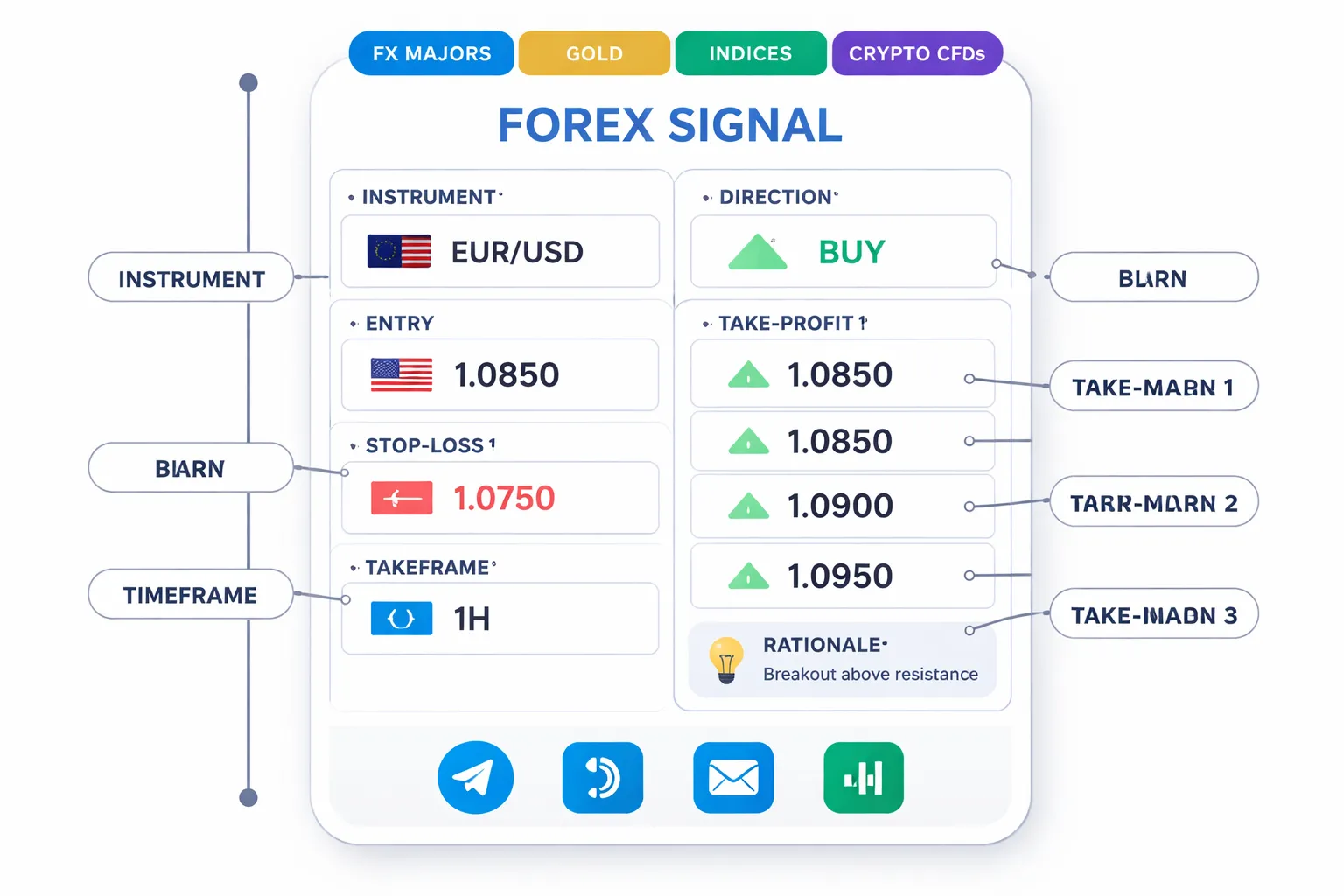
A forex signal is a trade instruction you can copy. You get a setup, levels, and basic risk parameters. You execute it in your own account, manually or with automation.
Signals are not a guarantee. They do not remove execution risk, slippage, or spread costs. They do not fit your account size unless the provider gives position sizing rules you can follow.
What a typical signal includes
- Instrument, example EUR/USD, XAU/USD, NAS100.
- Direction, buy or sell.
- Entry, a price level, or a zone, or a market entry.
- Stop-loss, the exit level if the trade fails.
- Take-profit, one target or several partial targets.
- Timeframe, scalp, intraday, swing, or an expiry time.
- Rationale, a short reason such as breakout, support bounce, news reaction, or indicator condition.
If any of these are missing, you do not have a complete signal. You have a suggestion.
Signals vs trade ideas vs analysis
Clear signals tell you what to do and where to get out. Vague calls leave the hard parts to you.
| Type | What you get | What it means for you |
|---|---|---|
| Signal | Entry, stop-loss, take-profit, timeframe | You can execute and measure it |
| Trade idea | Bias plus a rough level, sometimes a target | You must build the plan, risk, and exits |
| Market analysis | Context, levels, scenarios, no trigger | You still need a strategy and timing |
Spot vague calls fast. Watch for entries like “buy now” with no stop. Watch for wide zones with no invalidation level. Watch for edits after price moves.
Who creates signals
- Discretionary analysts, humans who read price action, news, and sentiment. Quality depends on process and discipline. Results can change with stress, fatigue, and market regime.
- Algorithmic systems, rule based models that trigger entries and exits. You need proof they handle spreads, slippage, and changing volatility.
- Mixed teams, a model finds candidates and a human filters them. This can improve selectivity. It can also hide discretion that you cannot audit.
Where signals get delivered
- Telegram or Discord, fast distribution, easy to edit or delete messages. You need a public, time-stamped record.
- Apps, push notifications, tracking dashboards, sometimes broker integration.
- Email, slower, better for swing trades, worse for fast markets.
- MT4 or MT5, signals inside the platform via plugins or the built-in Signals marketplace. Execution can be faster. You still face spread and slippage.
- Broker portals, signals bundled with accounts. Treat them as marketing until you verify performance and costs.
Common asset coverage and why it matters
- FX majors and minors, EUR/USD, GBP/USD, USD/JPY, AUD/USD, EUR/GBP. These usually have tighter spreads and deeper liquidity. Execution tends to be more stable.
- Gold, often XAU/USD. It can move fast and gap around news. Stops need more room. Position sizing matters more.
- Indices, NAS100, SPX500, DAX. They can spike at market open and around earnings. Spreads widen outside core hours.
- Crypto CFDs, BTC/USD, ETH/USD. Weekend moves and gaps can hit stops. Fees and spreads vary by broker.
Asset coverage tells you how sensitive results are to broker conditions. A provider who posts tight-stop scalps on volatile instruments needs near perfect execution. That rarely transfers to your account.
Are forex signals worth it? A decision framework for buyers
Are forex signals worth it, a decision framework for buyers
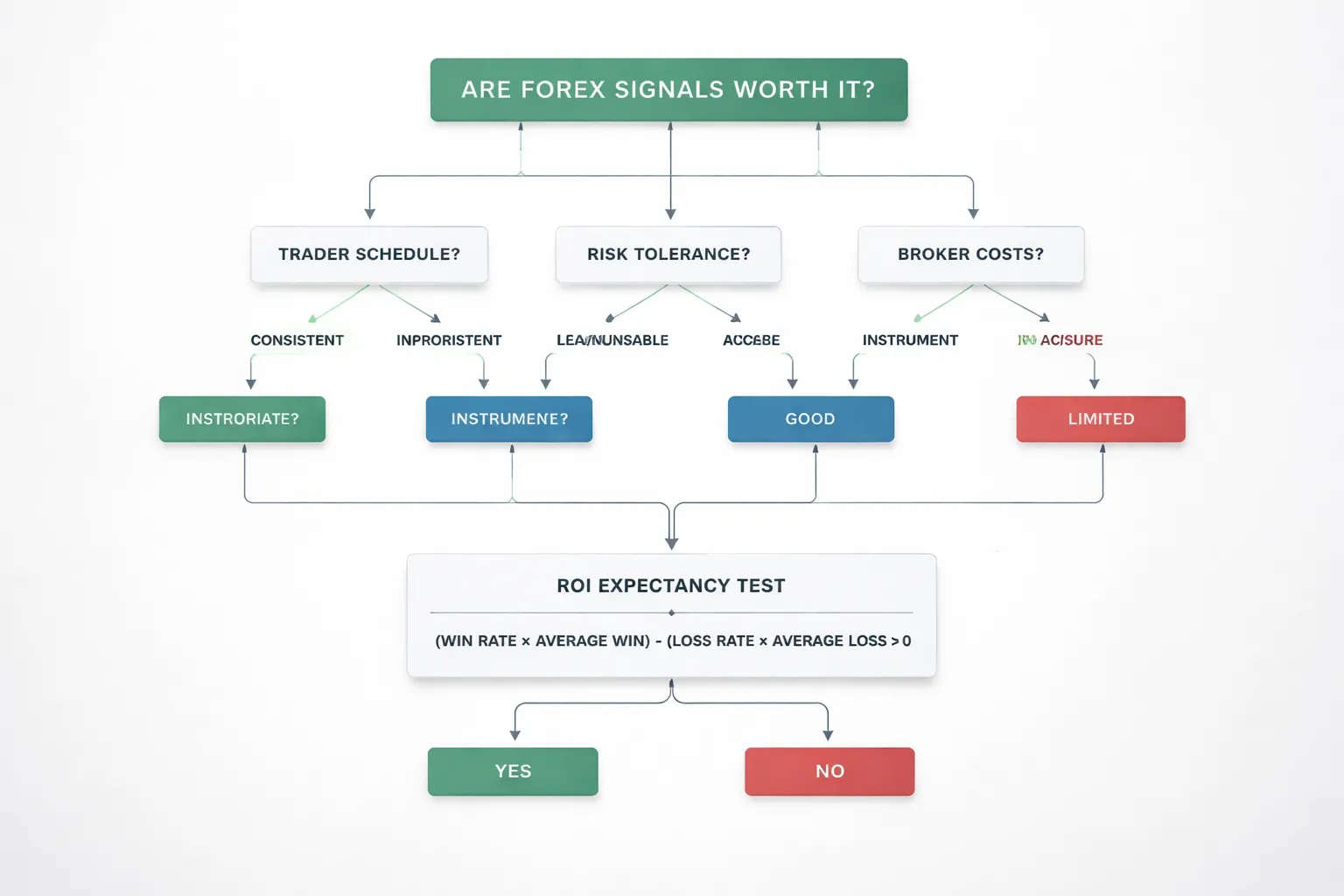
Signals only work if you can execute them. Your broker costs, your schedule, and your risk rules decide the outcome more than the provider’s marketing.
When signals may add value
- You need structure as a beginner. You use signals as a template, entry, stop, take profit, and position size. You journal every trade. You do not improvise.
- You have limited time. You cannot scan charts all day. You can still place orders fast and manage risk.
- You want a second opinion. You already trade your own plan. You only take signals that match your setup and risk.
- You trade specific sessions. You only trade London open, New York overlap, or a single instrument. You pick a provider who trades the same hours and pairs.
When signals are usually a bad fit
- You trade on impulse. Signals become a trigger to overtrade. You chase missed entries.
- You have no risk plan. You do not cap daily loss. You do not set per trade risk. You move stops.
- You trade very small capital. Fees and spreads eat the edge. Minimum lot sizes force you to risk too much per trade.
- You expect certainty. You cannot handle drawdowns. You stop after losses and start after wins.
Costs to count beyond the subscription
- Spread. You pay it on every entry and exit. Wider spreads hit tight stops and short targets.
- Commission. Common on raw spread accounts. Add it to every trade cost.
- Swap and financing. Overnight holds can flip a “winner” into a loser, especially on CFDs and high yield differentials.
- Slippage. Fast markets fill you worse than the posted price. This matters most at news, session opens, and on volatile pairs.
- Missed trades. Late alerts, work meetings, sleep, poor connection. Your results diverge from the track record.
Match signals to your profile
- Risk tolerance. If you cannot accept a 10 percent drawdown, do not follow a system that can hit it. Ask for max drawdown and worst losing streak.
- Leverage. A signal that risks 2 to 5 percent per trade can blow up fast with high leverage. Cap your risk per trade. Most retail traders stay safer at 0.25 to 1 percent.
- Schedule. If signals come during your sleep, you will miss fills and management. Choose swing signals with wide stops, or use pending orders only.
- Instrument access. If your broker has high spreads on gold, indices, or crypto CFDs, avoid providers who scalp those markets. Execution differences will dominate performance.
A simple ROI test, the expectancy you need after costs
Use this test before you pay. It forces you to price in fees and execution.
- Step 1, estimate your all-in cost per trade. Include spread, commission, average slippage, and average swap if you hold overnight.
- Step 2, express that cost in R. R equals your stop size. If your stop is 20 pips and your all-in cost is 2 pips, your cost is 0.10R.
- Step 3, compute required edge. Expectancy in R equals (win rate x average win in R) minus (loss rate x average loss in R) minus cost in R. Average loss in R is 1 if you use the stated stop.
| Input | Example |
|---|---|
| Win rate | 50% |
| Average win | 1.0R |
| Average loss | 1.0R |
| All-in cost | 0.10R |
| Expectancy | (0.50 x 1.0) - (0.50 x 1.0) - 0.10 = -0.10R |
This example loses even with a 50 percent win rate. You need at least one of these to be true, higher win rate, larger average win than loss, or lower cost in R. Tight-stop scalps fail this test fast because costs become a large share of R.
If you want a hands-off approach, compare signals to copy trading. Execution and sizing still matter, but the workflow differs.
How forex signal services make money (and where incentives can conflict)
Subscription models vs “lifetime access” pricing tricks
Most signal services earn money from recurring subscriptions. That model rewards retention, not accuracy. A provider can stay profitable with average signals if they keep enough users paying.
“Lifetime access” often works as a pricing anchor. You see a high one-time price next to a monthly plan. The goal is to push you toward the plan that maximizes cash flow. Some “lifetime” offers also exclude key channels, limit instruments, or require future “platform fees.” Read the terms.
- Monthly plan: Incentive to market constantly and reduce churn. Results can become secondary.
- Annual plan: Incentive to lock you in before performance slips.
- Lifetime plan: Incentive to front-load revenue, then reduce support and updates over time.
Affiliate and referral commissions with brokers and prop firms
Many signal providers earn affiliate revenue when you open an account through their link. The payout can be a one-time CPA, a revenue share based on your spread and commission, or both. That creates a clear conflict. The provider can earn more when you trade more, even if you lose.
The same applies to prop firms. A provider can push you toward firms with the highest referral payouts, not the best rules, pricing, or execution. If signals encourage high frequency trading, the broker and affiliate both benefit from more volume.
If a provider recommends a specific broker or prop firm, you need full disclosure. You also need a reason that relates to your edge, such as spreads on your pairs, execution quality, and rule fit. If you want a baseline on how prop firms work, read what a forex prop firm is.
Upsells and funnels: mentorship, VIP rooms, and account management red flags
Signals often serve as the entry product. The real profit comes from upsells. Common upsells include “VIP” rooms, one on one mentoring, funded account coaching, trade copiers, and higher frequency “premium” signals.
- VIP tier: Creates artificial scarcity, then blames losses on “not having the full feed.”
- Mentorship: Can be real, but many packages sell motivation instead of process, logs, and risk control.
- Account management: High risk. Many jurisdictions require licensing. “Send us your login” or “we trade for you” is a major red flag.
When the business depends on upsells, the incentive shifts. The provider needs you to feel close to success, but not fully independent. Dependency sells. Competence cancels.
Performance marketing tactics: curated screenshots, cherry-picked months, survivorship bias
Signal marketing rarely shows a complete track record. Screenshots of winning trades do not prove anything. They hide position sizing, stop placement, spread, slippage, and skipped losses.
- Curated screenshots: Show pips, hide risk. Pips without R mean nothing.
- Cherry-picked months: A strong streak becomes the headline, a bad quarter disappears.
- Survivorship bias: You only see providers who lasted. Many failed accounts never post results.
- Edited “MyFXBook style” widgets: Easy to game if you control what gets shared and when.
You want verified performance that includes open and closed trades, drawdown, and consistent position sizing rules. If they cannot show it, assume it does not exist.
Why transparency about conflicts of interest is an E-E-A-T must-have
A signal service can still be useful, but you must understand how it gets paid. Transparent providers disclose revenue sources, affiliate relationships, and who benefits from your trading volume.
Look for clear disclosures on the sales page and inside the community. You want plain language, not buried footnotes. If the service makes money from your activity with a broker or prop firm, treat every recommendation as marketing until proven otherwise.
Benefits of using forex signals (realistic advantages)
Time efficiency and decision structure for busy traders
Signals can cut your prep time. You outsource scanning, level marking, and news checks. You still decide whether to take the trade.
A good service gives you a repeatable decision flow. Entry, stop, take profit, timeframe, and a short reason. You can accept, reduce size, or skip without rebuilding the analysis from zero.
- Useful when: you trade part-time, you only watch the market at set hours, you want predefined levels.
- Less useful when: you already run a tested system and you can execute it consistently.
Market coverage and diversification across pairs and sessions
Most retail traders watch too few pairs. Or they watch too many and miss the clean setups. Signals can widen your coverage without keeping 12 charts open.
This matters across sessions. London and New York often drive the largest moves. Asia can offer range trades and breakout setups on specific pairs. A provider that covers multiple sessions can surface opportunities you would not see live.
- Broader pair exposure: majors, crosses, and selected exotics, if spreads and liquidity make sense.
- Different behavior by session: your trade list can match when you are actually available to execute.
- Practical diversification: you can pick uncorrelated pairs instead of stacking the same USD risk.
Exposure to professional workflows (if explanations and journals are provided)
Most signal channels fail as teaching tools. The ones that help you improve share the process, not just the entry price.
Look for trade notes, pre-trade checklists, post-trade reviews, and a visible journal. You learn how the provider defines trend, key levels, invalidation, and what makes a setup low quality.
- Trade plan format: bias, setup type, trigger, invalidation level, targets, time stop.
- Review format: screenshot before and after, what changed, what would invalidate the idea next time.
- Execution rules: when to avoid trades, news filters, spread rules, and session filters.
Rule-based risk prompts: stops, position sizing, and invalidation levels
Signals can force structure around risk. That is the main realistic advantage for many traders.
If the provider includes a clear stop loss and an invalidation level, you can define risk before you enter. If they give a target and expected trade duration, you can plan the exit instead of improvising.
- Stops and invalidation: you know where the idea is wrong. You can set a hard stop, not a mental stop.
- Position sizing: you can size by risk per trade, not by emotion. Example, 0.5 percent to 1 percent risk, based on stop distance and pip value.
- R multiple thinking: you can judge whether the setup offers enough upside for the risk before you click buy or sell.
Use risk prompts as guardrails. Do not copy size. Your account size, leverage, and drawdown limits differ, especially if you trade a prop evaluation. Review the rules first, see prop firm challenge rules.
Idea generation and reducing “analysis paralysis”
Signals can act as a shortlist. You stop bouncing between indicators and timeframes. You focus on a defined set of ideas.
This helps when you hesitate to pull the trigger, or when you overanalyze and miss entries. A signal gives you a starting point, then you validate it with your own rules.
- Fewer charts: you review a small set of trade plans instead of scanning everything.
- Faster validation: you check trend, level quality, volatility, and news, then decide.
- Cleaner execution: you enter with a plan, not a feeling.
Types of forex signal providers (and how to evaluate each)
Human analyst signals
You get trades from a person who reads charts and news. This can help in messy markets where rules break.
- Strengths: Can adapt to one-off events, can explain the trade logic, can adjust risk when volatility spikes.
- Weaknesses: Speed limits, fatigue, inconsistency, and “style drift” after a losing streak.
- Consistency challenge: One analyst can trade multiple pairs and timeframes. Quality drops when volume rises.
How to evaluate.
- Ask for a full trade log with timestamps, pair, entry, stop, target, and exit.
- Check if alerts arrive before the move, not after it.
- Measure results net of spread and slippage. Use your broker’s typical spread, not a best case.
- Look for stable position sizing rules. “Risk 1 percent per trade” beats random lot sizes.
- Review drawdowns. If the provider hides them, you cannot size risk.
Algorithmic and EA-driven signals
You get signals from a rules-based system. It can scale and it does not get tired. The main risk is regime change.
- Regime risk: A system built for trends can bleed in ranges, and a mean reversion system can blow up in breakouts.
- Over-optimization: Many EAs fit past data. They look strong in backtests, then fail live.
- Execution sensitivity: Small delays, wider spreads, and different liquidity can erase the edge.
How to evaluate.
- Demand long live results on a real-money account, not only backtests.
- Compare backtest vs live. Large gaps signal curve fitting or execution fragility.
- Check the trading frequency. High-frequency signals need low latency and tight spreads.
- Inspect risk limits. You want a hard stop policy and a max daily loss policy.
- Watch for martingale and grid behavior. These can hide risk until one move wipes months of gains.
Copy trading and social trading
You mirror another trader’s positions. This reduces manual work. It adds new risks you cannot ignore.
- Control: You give up timing control. Your fills can lag. Your risk can drift from the master account.
- Fees: You can pay spread markups, performance fees, management fees, or platform fees. These stack.
- Selection risk: Rankings often favor recent winners and high leverage.
How to evaluate.
- Focus on maximum drawdown, recovery time, and average leverage, not only return.
- Check trade history length. A few months of wins means little.
- Review whether the trader holds through deep floating losses. This matters more than win rate.
- Confirm the copier settings. Use fixed risk per trade or conservative multiplier, and set equity stop limits.
- Verify fee math with your account size. A strong trader can turn weak after fees.
If you want a deeper checklist, read how to choose a copy trading provider.
Hybrid education plus signals
You pay for signals plus training. This can work if the education reduces your dependence over time. Most do not.
- What learning value should look like: Clear setup rules, examples across market conditions, and post-trade reviews.
- Red flags: Vague “market structure” talk, no invalidation levels, and no journal of misses.
- Outcome to aim for: You can explain why the trade exists, where it fails, and how it fits your risk plan.
How to evaluate.
- Ask for a sample lesson and a sample week of signals with recaps.
- Check if they teach risk sizing, stop placement, and expectancy, not only entries.
- Look for tracked execution metrics. Entry to stop distance, average R multiple, and slippage assumptions.
- Make sure signals do not contradict the teaching. If they do, you will copy without learning.
Community and peer groups
You get trade ideas from a group chat or forum. The upside is variety. The downside is noise.
- Moderation: Good groups enforce templates. Pair, timeframe, entry, stop, target, and reason.
- Accountability: Good groups require follow-ups. Entry posted, exit posted, result logged.
- Noise filtering: Bad groups flood your day with opinions and hindsight charts.
How to evaluate.
- Check the signal-to-noise ratio for one week. Count actionable setups vs chatter.
- Look for a shared tracking sheet with all calls, wins, losses, and drawdowns.
- Confirm rule enforcement. No stop, no post. No exception.
- Protect your focus. Mute channels and follow only the formats that match your plan.
How to vet a forex signals provider: a due diligence checklist
Track record standards
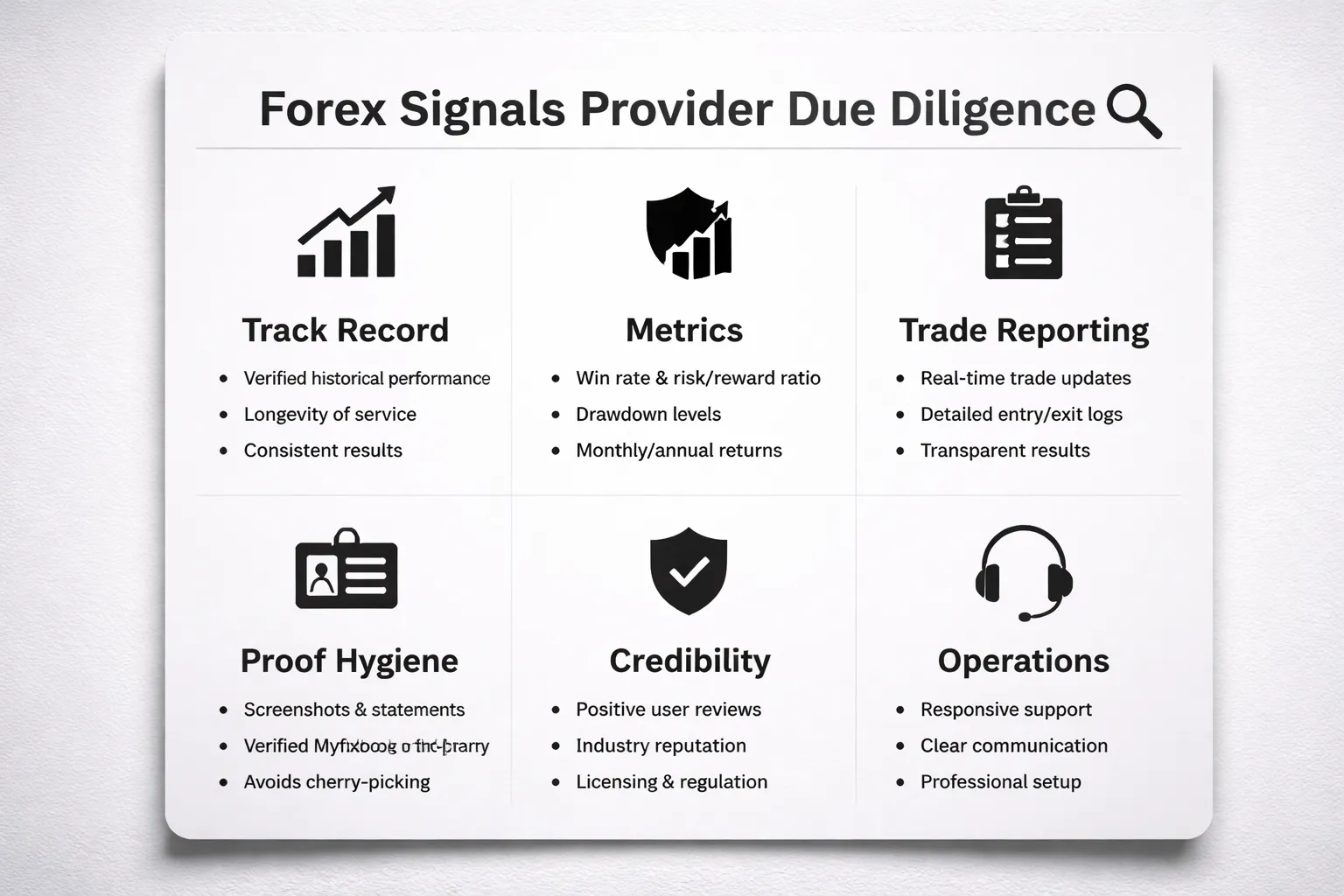
Ask for proof you can audit. Skip marketing screenshots.
- Third-party verification: Require a live, third-party tracked account. Myfxbook, FX Blue, or a broker statement export you can cross-check. No “signals results” PDF.
- Duration: Minimum 6 to 12 months of continuous history. One strong month means nothing.
- Full-history access: You need every trade, not a weekly recap. Confirm the history includes closed trades, open trades, and deposits or withdrawals.
- Same market and method: If they claim “London scalps,” the record should show that session, those pairs, and that holding time.
- Execution assumptions: Ask what spread and slippage they assume. If their track record ignores costs, treat the results as inflated.
Metrics that matter
You want survival metrics, not highlight numbers.
- Sample size: Look for 100 plus trades in the tracked history. Fewer trades means the stats wobble.
- Consistency: Check if gains come from a few outlier wins. A single oversized winner can mask weak execution.
Trade reporting quality
Poor signal formats cause poor fills. You pay the spread on confusion.
- Entry method: They must specify market, limit, or stop entry. They must include the exact trigger. Example, “Buy stop 1.08420 on break and retest.”
- Stop logic: “No SL” means no process. They should state where the stop goes and why, structure, ATR, time stop, or invalidation level.
- Take profit plan: Require targets, partials, and management rules. If they move targets without rules, results become untestable.
- Position sizing rules: They should publish a fixed risk model. Example, “0.5 percent per trade, max 1.5 percent per day.” If lot sizes jump without a reason, expect blowups.
- Timing rules: Ask how long a signal stays valid. Old signals get filled late and lose money.
Proof hygiene
Most fake performance uses the same tricks. You can spot them fast.
- Edited screenshots: Watch for missing timestamps, cropped account numbers, inconsistent fonts, blurred areas, and cut off trade IDs.
- Selective reporting: Compare the chat history to the “results” channel. If you see wins reposted and losses missing, you found the business model.
- Hindsight charts: If entries appear after the move, ignore them. Require pre-call messages with time and price.
- Deletion behavior: Check if they delete old messages. Telegram and Discord show edit marks or gaps. Frequent edits mean the record shifts.
- Account switching: Ask if they use one account for tracking. Multiple accounts often hide drawdowns.
Provider credibility signals
You do not need fame. You need accountability and a documented process.
- Clear identity: Real name, business entity, and a way to reach them off-platform. Anonymous sellers disappear when performance breaks.
- Trading experience: Ask for a short timeline, instruments traded, and approach. If they cannot explain their edge in plain terms, they do not have one.
- Publicly documented process: They should publish rules, risk limits, and what makes them stop trading. Process beats opinions.
- Conflicts of interest: Ask if they earn from broker referral links. If yes, check if they push high leverage or overtrading.
- Realistic claims: Avoid guarantees, fixed monthly returns, and “no loss” language. Serious traders talk in probabilities and drawdowns.
If you want a parallel framework for delegated trading, read how to choose a copy trading provider.
Customer support and operations
Execution fails when operations fail. Treat this like a service contract.
- Response time: Test support before you pay. Ask one specific question about risk, then time the reply.
- Update cadence: Require a clear schedule. They should state when they post setups, when they post management updates, and when they post results.
- Outage handling: Ask what happens if Telegram, Discord, or their phone goes down. They should have a backup channel and a rule for trade management during outages.
- Change control: If they change strategy, they must disclose it before they trade it. Silent shifts make the track record useless.
- Refund terms: Read the policy. If it forbids refunds under all conditions, assume the burden stays on you.
What to ask before you buy: questions that reveal quality fast
Strategy type, and when it fails
Make them name the strategy. Trend following, mean reversion, breakout, or hybrid. If they cannot label it, they cannot explain it.
- Trend: tends to bleed in ranges and during choppy sessions. Ask how they filter sideways markets.
- Mean reversion: tends to get hit in strong trends and during news spikes. Ask what stops a “martingale drift” where they keep averaging down.
- Breakout: tends to fail in false breaks and low liquidity hours. Ask how they avoid stop hunts around obvious levels.
Ask for one recent month where it underperformed and why. You want a specific market condition, not a story.
Typical stop size and holding time, and fit with your broker and schedule
Force numbers. Average stop in pips, typical take profit, and average time in trade.
- If the stop is 5 to 12 pips, spreads and slippage can erase edge on many brokers.
- If they scalp around rollover, you pay wider spreads and swaps can flip expected return.
- If they hold for days, swaps matter and weekend gaps become risk.
- If alerts come during your work hours and they require fast entries, you will miss fills.
Ask which pairs they trade most. Then compare to your broker’s average spread and execution quality on those pairs.
How risk per trade is defined
Do not accept “low risk” as an answer. You need a sizing rule you can apply.
- Percent risk: “We risk 0.5 percent per trade.” Ask if that means on the stop distance, not on a guess.
- Fixed lots: dangerous across different account sizes. It pushes small accounts into high leverage.
- Volatility-based sizing: uses ATR or similar. Ask which lookback and how often they recalibrate.
Ask for a sample calculation with a 1,000 USD account, including stop size and lot size. If they cannot compute it cleanly, you cannot control downside.
How they handle major news (NFP, CPI, FOMC)
News rules must be explicit. Trading through high-impact releases without rules is gambling with spread expansion and slippage.
- Avoid: no new entries X minutes before, and no entries until spreads normalize.
- Adjust: smaller size, wider stops, or limit orders only. Ask the exact settings.
- Trade: ask how they handle fills when spreads blow out and stops slip.
Ask whether they keep trades open into the event. If yes, ask the max exposure rule and how they cap gap risk.
Real-world fill assumption and expected slippage
Signals look best on paper. Your result depends on your fill. Make them state assumptions.
- Ask if results assume market orders, limit orders, or both.
- Ask the assumed spread per pair, in pips, and the assumed slippage, in pips.
- Ask whether the posted entry price is “signal time” or “average follower fill.” These differ.
- Ask how they treat partial fills and missed trades in their reporting.
If they scalp for small targets and ignore slippage, the track record will not survive live execution.
Refund policy or trial, and the exact terms
Get the terms in writing. Screenshot the page. Save the email.
- Ask if they offer a trial. Confirm price, duration, and whether it renews automatically.
- Ask what qualifies for a refund. Define the window in days and the process.
- Ask if they exclude refunds for “digital services” or “used content.” Many do.
- Ask if chargebacks trigger a ban and loss of access. That matters if you rely on open trades.
If you want a more hands-off setup than manual alerts, use a service built for execution and risk rules, not chat messages. See copy trading forex explained.
How to use forex signals safely (process + risk controls)
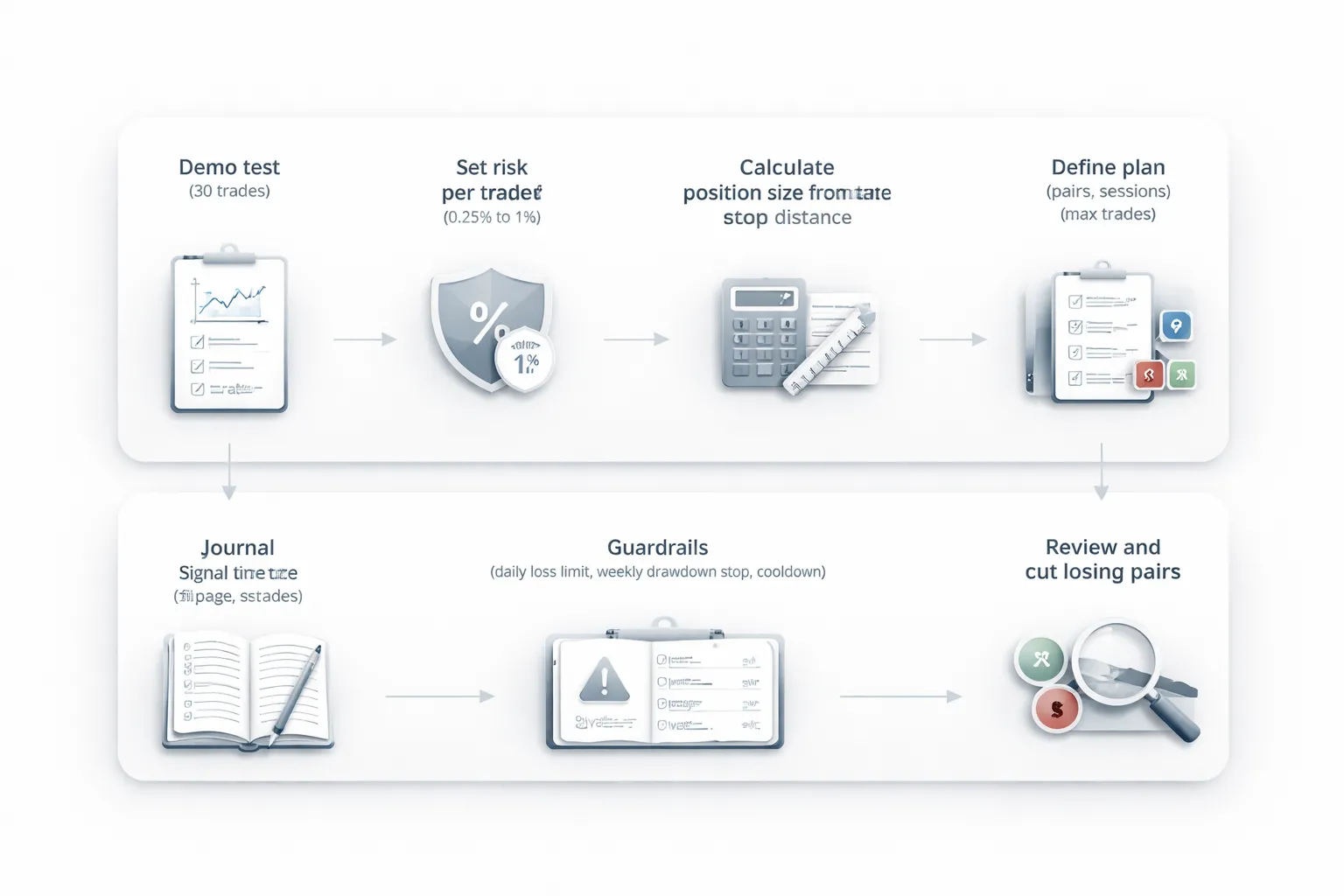
Start on demo first
Run the signals on a demo account before you risk money. Test the parts that break most users, execution, timing, and discipline.
- Trade the same broker, platform, and chart time zone you will use live.
- Copy entries, stops, and targets exactly. Do not “improve” them.
- Record slippage in pips on every fill, entry and exit.
- Track delays, when the signal arrives vs when you can execute.
- Test at least 30 trades. More is better.
If you cannot follow the rules on demo, you will not follow them live.
Position sizing basics
Your risk settings matter more than the signal. Start with a fixed risk per trade and a hard leverage cap.
- Risk per trade: keep it small, 0.25% to 1% of account equity.
- Leverage cap: set a maximum effective leverage and stick to it. Many blowups start with over-leverage, not bad entries.
- Stop placement alignment: size the position from the stop distance. Do not pick a lot size first.
| Input | Rule |
|---|---|
| Account equity | Use current equity, not starting balance |
| Risk per trade | 0.25% to 1% per trade |
| Stop distance | Use the signal stop. If none, skip the trade |
| Lot size | Calculate from risk and stop distance |
Create a signal-following plan
Signals fail when you treat them like entertainment. Write a simple plan and follow it.
- Pairs: pick 3 to 6 pairs you can monitor. Avoid adding new pairs mid-week.
- Sessions: define your trading hours. If you cannot trade London or New York, avoid strategies that depend on those moves.
- Max trades: set a cap per day and per week. It limits overtrading when the feed gets busy.
- Filters: decide in advance what you will skip, high-impact news windows, wide spreads, low liquidity hours.
Use a trade journal
You cannot manage what you do not measure. Journal every signal, even the ones you skip.
- Tag each trade with the provider name and signal ID, if available.
- Log signal time, your entry time, and your fill price.
- Store screenshots of the chart at entry and exit.
- Note any deviation, late entry, smaller stop, bigger size, manual close.
- Track outcomes in R, not dollars. It keeps results comparable across position sizes.
After 30 to 50 trades, review which pairs, sessions, and setups lose money. Cut them.
Set guardrails
Guardrails stop a bad day from becoming a bad month. Put them in writing and follow them without exceptions.
- Daily loss limit: stop trading after a fixed loss, such as 2R or 3R in one day.
- Weekly drawdown stop: pause for the rest of the week after a fixed equity drop, such as 5%.
- Cooldown rules: after 2 losses in a row, take a break for a set time or skip the next signal.
- One position per pair: avoid stacking exposure in the same direction across correlated pairs.
If you want automated execution with risk rules, read copy trading forex explained.
Avoid common mistakes
- Moving stops: do not widen stops to “give it room.” That turns a planned loss into an uncontrolled loss.
- Adding to losers: do not average down unless the strategy states it and you tested it on demo.
- Copying without understanding: know the stop, the invalidation point, and the max risk before you enter. If the signal lacks those, skip it.
- Chasing late entries: if price already moved, do not force it. Late entries change risk and reward.
- Ignoring spreads and news: a good setup can fail if spread spikes or news hits during entry.
Common scams and red flags in forex signals
Guaranteed returns, “no loss” claims, and unrealistic monthly percentages
Forex has variance. Any provider that sells certainty sells fiction.
- “Guaranteed profit” or “no loss” claims. Real trading has losing streaks.
- Fixed monthly returns like 20 percent, 50 percent, or “daily income.” Returns do not arrive on a schedule.
- Win rate obsession with no mention of risk to reward. A 95 percent win rate can still blow up if losers run big.
- Cherry-picked screenshots and no full statement. You need a complete track record, not highlights.
Pressure tactics: limited slots, countdown timers, and DMs pushing deposits
Good services do not rush you. Scams do.
- “Only 20 seats” and a timer that resets after you refresh.
- DM selling that pushes you to deposit now, then “get signals after.”
- Urgent upsells for VIP, “insider,” or “whale” rooms right after you join.
- Payment methods that block chargebacks like crypto only, gift cards, or “friends and family.”
Lack of risk disclosure or refusal to share drawdown periods
If you do not know the downside, you cannot size your trades.
- No clear rules for stop loss, position size, and max daily or weekly loss.
- No disclosure of maximum drawdown and how long it lasted. Drawdown length matters as much as depth.
- Only “pips gained” reporting. Pips ignore lot size, leverage, and account risk.
- Refusal to show a verified statement or a full export of trades. You need enough data to see streaks, not single wins.
If you trade prop firm rules, drawdown control decides survival. Read these prop firm drawdown rules before you follow any signal that ignores risk limits.
Martingale and grid averaging disguised as “high accuracy”
Many “high accuracy” signal rooms win small and lose huge. They hide it with averaging.
- Adding to losers as price moves against you, often with bigger size each time.
- No stop loss or “mental stop.” The real stop becomes margin call.
- Basket closes that exit all positions at a small net profit after deep floating loss.
- Recovery trades after a loss, with higher lot size to “get it back.”
| What they say | What it often means | Your risk |
|---|---|---|
| “98% win rate” | Small targets, rare large losses | One trend move can wipe months |
| “No SL, safer” | They avoid taking a loss on paper | Loss becomes unlimited |
| “We manage DD” | They average down until it snaps back | Drawdown can exceed your limits |
Broker manipulation claims used as excuses for poor results
Bad fills happen. “The broker hunted us” as the default explanation is a tell.
- They blame stop hunts for every loss, but show no plan to reduce the risk.
- They push you to a specific broker with their referral link, then claim all other brokers “cheat.”
- They avoid discussing slippage, spread widening, and news volatility as normal market mechanics.
- They use blame to dodge accountability, instead of improving entries, stops, and timing.
Unregulated account management or requests for remote access to your trading platform
Signals should tell you what to do. They should not take control of your money or your computer.
- They offer to trade your account for you, with no license, no contract, and no regulated setup.
- They ask for MT4 or MT5 password, investor login, or API keys with withdrawal rights.
- They request remote access through AnyDesk or TeamViewer “to set it up.”
- They push you into depositing to an account they control or a pooled wallet.
Keep execution on your side. If you want automation, use tools that limit permissions and keep custody in your name.
Signals vs learning: choosing the right path for your goals
Buying convenience vs building competence, what you’re really paying for
Signals buy you decisions. Learning builds your decision process.
When you pay for signals, you pay for three things.
- Time compression. You skip market prep and wait for an alert.
- Borrowed conviction. You outsource the plan so you feel less doubt.
- A framework. Entry, stop, target, and sometimes position size.
You do not buy skill. You do not buy execution quality. You do not buy discipline.
Your results still depend on fills, spreads, slippage, and whether you follow the risk rules. Most signal sellers cannot control those for you.
A blended approach, using signals as training wheels with structured review
If you use signals, treat them as study material. Do not treat them as a business you run blindly.
Set a simple review loop.
- Before entry. Write the reason you took it in one line. Note the setup type and market session.
- Execution. Record entry price, stop, target, and actual spread at entry.
- Risk. Fix risk per trade, for example 0.25 to 1.0 percent. Do not change it because you feel confident.
- After exit. Screenshot the chart. Mark what invalidated the trade or what confirmed it.
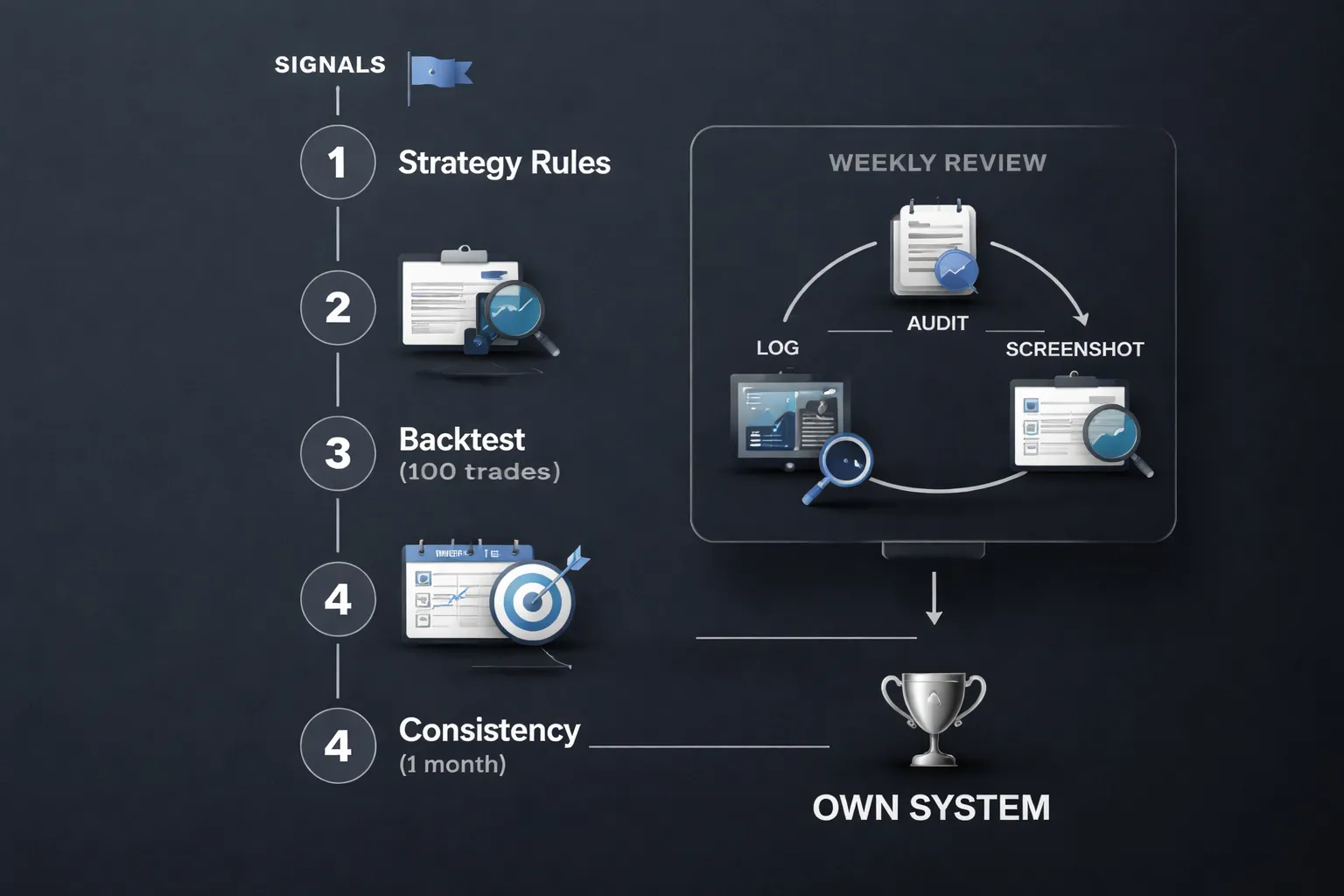
- Weekly audit. Count wins, losses, average R, and max drawdown. Separate signal quality from your execution errors.
This turns signals into feedback. You learn what conditions they trade well and where they fail.
If you want a hands-off format, compare it with copy trading so you understand the extra layer of execution risk and control. See Forex Copy Trading Explained.
Milestones to graduate from signals, strategy rules, backtest, forward test, and consistency
Graduate when you can replace the alert with rules you can follow.
| Milestone | What “done” looks like |
|---|---|
| Strategy rules | Clear entry trigger, stop placement, target logic, and a no-trade filter. You can explain it in under 10 lines. |
| Backtest | At least 100 trades on the same pair and timeframe, logged with R results. You track win rate, average win, average loss, and max drawdown. |
| Forward test | 4 to 8 weeks on demo or micro size. Same rules, no discretion. You log slippage and spread impact. |
| Consistency | One month minimum with stable risk, no rule breaks, and drawdown within your limit. You can stop trading when conditions do not match. |
Signals can still help after this, but they become a second opinion. They do not drive your account.
Opportunity cost, time spent following signals vs studying one setup deeply
Signals feel efficient because the alert arrives fast. The hidden cost is shallow learning.
If you follow many signals across pairs, you spend time on execution and emotion control. You spend less time on one repeatable setup.
Studying one setup has compounding returns.
- You learn the common failure modes.
- You learn when to reduce size or skip trades.
- You learn what spread and session do to outcomes.
- You build a process you can test and improve.
If you can only trade part-time, narrow harder. Pick one pair, one session, one setup. Track 50 to 100 trades. Your edge comes from repetition and clean data, not from more alerts.
Alternatives to paid forex signals (often better value)
Price alerts (free, fast, and under your control)
Most paid signals reduce to “price reached level X, take trade.” You can automate that part.
- Set alerts at your levels, not someone else’s. Prior highs and lows. Session highs and lows. Key round numbers.
- Use a simple checklist before you act. Trend. Nearby liquidity. Spread at that time. News risk in the next hour.
- Track alert-to-trade stats. Count how many alerts produce valid setups, and how many become trades.
Economic calendar alerts (avoid the landmines)
Many signal losses come from trading into scheduled volatility. You can filter that out in advance.
- Use calendar alerts for high-impact releases on the currencies you trade. CPI. Jobs. Central bank decisions. Rate statements.
- Define a blackout window you follow every time. Example, no new entries 15 to 30 minutes before and after high-impact news.
- Write down what you do during news. Reduce size. Widen stops. Skip. Pick one rule set and stick to it for 50 trades.
Volatility and session tools (trade when your edge exists)
Execution quality changes by hour. Spreads widen. Liquidity thins. Your results change with it.
- Mark your trading session. London. New York. Overlap. Do not mix sessions in one dataset.
- Use ATR and simple range stats to set realistic targets and stops. If today’s range is already spent, reduce expectations or skip.
- Watch live spread for your pair. If spread is 2x normal, your “edge” may be gone.
Broker research (fix the hidden leak)
If your fills are poor, signals cannot save you. You need clean execution first.
- Compare average spreads, commissions, and swap for your pair. Small differences compound across many trades.
- Check execution policies. Market execution. negative balance protection. stop-out level. slippage rules.
- Test with a small account. Record actual spread at entry, slippage, and stop fills around active hours.
Institutional reports and free educational trade plans
You can get better market context for free than most signal channels provide.
- Read central bank statements, meeting minutes, and speeches. They move FX more than chart patterns.
- Use bank and research desk commentary to understand drivers. Rates. inflation. risk sentiment. positioning.
- Follow free, rules-based trade plans from reputable educators. Focus on the logic, invalidation, and risk plan, not the entry price.
Copy trading with transparent statistics (and the limits of past performance)
Copy trading can beat paid signals if you demand clean data and keep control of risk.
- Require verified track records, long sample size, and full trade history. Avoid accounts that hide trades or show only weekly gains.
- Check max drawdown, average loss, worst day, and time to recover. You must survive the bad runs.
- Do not trust return charts alone. Look for consistency across months, not one hot streak.
- Set your own risk cap. Use equity stops. Limit leverage. Stop copying if rules break.
- Learn the mechanics and risks first. See best forex copy trading platforms.
Simple rule-based strategies plus journaling (faster skill acquisition)
If you want long-term value, build one small system and measure it. Signals skip the measurement step. You should not.
- Pick one setup with clear rules. Entry trigger. stop placement. target logic. time stop.
- Backtest it on recent data, then forward-test for 50 to 100 trades. Same pair. same session. same risk.
- Journal every trade with screenshots and tags. Setup type. session. spread. news proximity. execution notes.
- Calculate basic stats. Win rate. average win. average loss. expectancy. max drawdown. You need numbers, not opinions.
Work with a coach or mentor focused on process, not “calls”
A good coach does not sell entries. They build your decision process and your risk habits.
- Pay for review, not signals. Trade plans. journaling feedback. risk limits. execution fixes.
- Use recorded screen sessions to audit your actions. Entry timing. stop placement. position sizing. rule breaks.
- Set measurable goals. Fewer rule violations. tighter risk ranges. consistent session adherence. cleaner data.
- Leave if the mentor avoids statistics, pushes urgency, or refuses to define a repeatable method.
| Alternative | What you get | Main risk | Best use |
|---|---|---|---|
| Price alerts | Timely prompts at your levels | Overtrading alerts | Execution of one setup |
| Calendar alerts | News filters and planned risk | Ignoring the blackout rules | Reducing random losses |
| Volatility and session tools | Better timing and realistic targets | Mixing sessions and regimes | Consistent datasets |
| Broker research | Lower costs and better fills | Chasing bonuses over execution | Protecting expectancy |
| Institutional and free plans | Macro drivers and structured ideas | Information overload | Context for your setup |
| Copy trading | Delegated execution with stats | Drawdowns, strategy drift | Hands-off exposure with limits |
| Rules plus journaling | Measurable edge development | Quitting before enough trades | Skill building |
| Process coaching | Faster feedback loops | Paying for “calls” in disguise | Fixing behavior and risk |
Practical buyer’s guide: picking a service and setting expectations
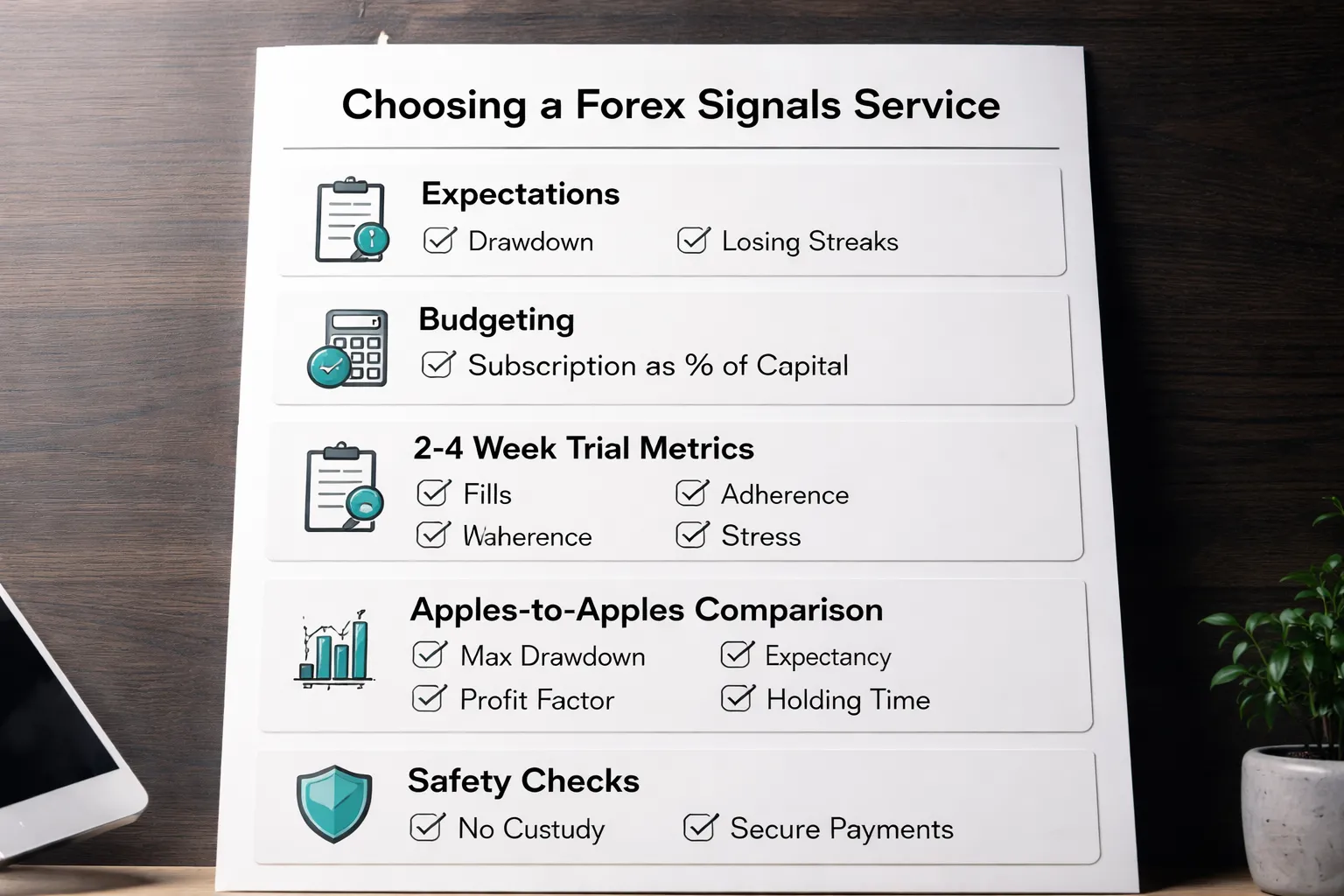
Reasonable performance expectations: drawdowns, losing streaks, and variance
Start with risk, not returns. Any signal stream that trades often will show variance. You will see losing days, losing weeks, and drawdowns even in good periods.
- Expect drawdowns. A service can look clean for months, then drop fast. Plan for a peak-to-trough drawdown that lasts weeks.
- Expect losing streaks. If the win rate sits near 45 to 60 percent, streaks happen. Size your risk so a run of losses does not force you to quit.
- Expect performance drift. Market conditions change. Providers change sizing, pairs, and trade frequency. Your results can diverge from screenshots.
- Expect execution gaps. Spread, slippage, and latency matter most on tight stops and news trades. Your fill quality drives your outcome.
Set a minimum standard for survival. Your account should handle the provider’s typical drawdown plus a buffer. If you cannot tolerate that, do not subscribe.
Budgeting: what percentage of capital a subscription should represent
Treat the subscription as overhead. If the fee pressures you to increase leverage, you picked the wrong service or the wrong account size.
- Keep it small. Aim for the monthly fee to stay under 1 to 2 percent of the capital you allocate to following the signals.
- Cap your exposure. Allocate a separate sub-account or a fixed portion of your bankroll. Do not mix it with long-term funds.
- Match fee to activity. Low trade frequency needs a lower fee. High frequency needs strong reporting and tight execution, or the edge leaks out.
- Avoid long lock-ins. Do not prepay 6 to 12 months unless you already tracked the service through a full drawdown cycle.
Trial period plan: what to measure in 2–4 weeks
A short trial will not prove an edge. It will show whether the service works in real life, with your broker, your schedule, and your risk rules.
- Signal quality. Clear entry, stop, take profit, and invalidation. No edits that rewrite history. No vague “watch levels” sold as signals.
- Timeliness. Time from alert to entry matters. Log the timestamp. Track how often price already moved past the entry.
- Fill realism. Record your entry price versus the posted price. Track average slippage in pips and in percent of your stop size.
- Adherence. Count how many trades you took exactly as specified. Note every manual override and why you did it.
- Risk consistency. Check if position sizing rules stay stable. Watch for sudden leverage increases after losses.
- Results that matter. Track net pips and net R multiple, after spread and commissions. Ignore gross pips.
- Stress and time cost. Note sleep disruption, screen time, and decision fatigue. If following signals harms your routine, it will break in a drawdown.
Use a demo or micro lot account during the trial. You test the process first. You scale only after you can execute it cleanly.
How to compare providers apples-to-apples: standardized metrics and reporting
Most comparisons fail because providers report different things. Force the same scorecard on every service you evaluate.
| Metric | What to request | What it tells you |
|---|---|---|
| Verified track record | Third-party verified statement or investor-style report, with full trade list | Reduces screenshot marketing and cherry-picking |
| Max drawdown | Peak-to-trough equity drawdown, plus date range | Capital survival requirement |
| Profit factor | Gross profit divided by gross loss, same period | Edge strength, sensitive to costs |
| Expectancy | Average R per trade, after costs | Whether the system makes money per unit of risk |
| Win rate and payoff | Win percentage and average win to average loss | Streak risk and drawdown shape |
| Trade frequency | Trades per week, by pair and session | Whether you can follow it and whether costs will eat it |
| Holding time | Median and range | Exposure to swaps, news, and slippage |
| Cost assumptions | Spread, commission, and slippage assumption used in reporting | Whether results survive real execution |
- Require the same time window. Compare at least 6 to 12 months when possible.
- Separate gross from net. If they cannot show net after costs, treat performance as unproven.
- Watch risk spikes. A smooth curve can hide martingale or grid sizing. Check average leverage and worst trade size.
- Match your method. If you want delegated execution, read our guide on how to choose a copy trading provider.
Compliance and safety: privacy, payment security, and avoiding custodial arrangements
Signals should not require custody of your funds. You should keep control of your broker account at all times.
- Avoid custody. Do not send deposits to a signal seller. Do not join “managed accounts” without clear legal structure and regulated oversight.
- Use secure payment methods. Prefer credit card or reputable processors with dispute options. Avoid crypto-only payments unless you accept limited recourse.
- Limit permissions. If you use a trade copier, use read-only access for reporting. If you use API keys, restrict scopes and rotate keys.
- Protect your identity. Do not share full account numbers, broker passwords, or ID documents unless a regulated firm requires it for compliance.
- Check marketing claims. Avoid guaranteed returns, “no loss” claims, and pressure tactics. Treat these as disqualifiers.
- Keep records. Save invoices, chat logs, and performance exports. You need an audit trail when results diverge.
Frequently Asked Questions
What are forex signals?
Forex signals tell you what to trade and when. A signal usually includes the pair, direction, entry, stop loss, and take profit. Some add time window, risk per trade, and updates. Signals come from humans, algorithms, or a mix.
Are forex signals worth paying for?
They can help if you use them as a tool, not a crutch. Value depends on verified results, your execution, and fees. If a provider cannot show audited, time stamped performance and clear risk rules, you pay for marketing.
Can you make money using signals?
Yes, but results vary. Your fills, spreads, slippage, and discipline change outcomes. A profitable signal can turn unprofitable with poor execution or wrong position sizing. Treat every signal as an input, then apply your risk rules.
What is a realistic win rate for signals?
Win rate alone means little. A 40 percent win rate can work with larger average wins than losses. A 70 percent win rate can fail with occasional large losses. Track expectancy, max drawdown, and average R multiple.
What proof should a signal provider show?
Ask for broker verified statements, not screenshots. Look for a long track record, consistent position sizing, and disclosed instruments. Check max drawdown and worst month. Confirm results include fees, spreads, and slippage assumptions.
What are the biggest risks with signals?
Execution mismatch, risk mismatch, and fake performance. A provider may trade different leverage or spreads than you. Copying signals can also create overtrading. If signals lack a stop loss or sizing rule, you carry the tail risk.
Do free signals work?
Some do, many exist to sell a course, broker, or paid room. Judge them the same way as paid signals. Demand clear rules, timestamps, and performance tracking. If the provider deletes losing calls or edits posts, walk away.
Should you use signals with a prop firm account?
Only if the signals fit strict drawdown and news rules. Prop rules can punish slippage and overnight holds. Read the firm terms first. Use small size until you see real fill quality. See best Forex prop firms.
How do you size trades when following signals?
Use fixed risk per trade, based on stop loss distance. Many traders use 0.25 to 1 percent risk. Ignore signal lot sizes unless they match your account, leverage, and drawdown limits. If no stop exists, you cannot size safely.
How do you test a signal service before buying?
Start with a demo or a small live account. Track at least 50 trades. Log entry time, fill price, stop, take profit, and result in R. Compare your results to the provider’s claimed results to measure slippage and drift.
What are red flags that a signal service is a scam?
Guaranteed returns, “no loss” claims, pressure sales, and hidden track records. Another red flag is constant account resets or multiple “master” accounts. If they refuse broker verified proof or push you to share passwords, leave.
Conclusion
Conclusion
Forex signals can help if you treat them as inputs, not answers. They can also drain your account if you follow them blindly. Your edge comes from execution, position sizing, and discipline, not from a message feed.
Before you pay, test the service like a strategy. Track every trade. Include spread, commission, and slippage. Compare your net results to their claims. If you cannot verify performance with broker-backed proof, walk away.
Your final check is simple. Only buy signals you can execute with your rules, your risk limits, and your schedule. If you want a more hands-off route, read our forex copy trading guide first.
- Risk: Set a hard max loss per trade and per day, then stick to it.
- Proof: Demand verified results and a full trade history, not screenshots.
- Fit: Match trade frequency, session, and holding time to your availability.
- Process: Paper trade, then go small, then scale only after clean data.
-
Best Forex Copy Trading Platforms (Features, Fees & Safety Compared)
7 months ago -
Forex Prop Firm Challenge Rules Explained (Drawdown, Targets, Payouts)
7 months ago -
Best Forex Prop Firms (Top Firms Compared)
7 months ago -
What Is a Forex Prop Firm? How Prop Trading Works for Forex
7 months ago -
Copy Trading Forex Explained: How It Works, Pros, Cons & Risks
7 months ago
-
- Subscription models vs “lifetime access” pricing tricks
- Affiliate and referral commissions with brokers and prop firms
- Upsells and funnels: mentorship, VIP rooms, and account management red flags
- Performance marketing tactics: curated screenshots, cherry-picked months, survivorship bias
- Why transparency about conflicts of interest is an E-E-A-T must-have
-
- Time efficiency and decision structure for busy traders
- Market coverage and diversification across pairs and sessions
- Exposure to professional workflows (if explanations and journals are provided)
- Rule-based risk prompts: stops, position sizing, and invalidation levels
- Idea generation and reducing “analysis paralysis”
-
- Execution risk, latency, slippage, and requotes
- Risk management mismatch, fixed stops vs your account size
- Overtrading and signal overload
- Dependency and stalled skill growth
- Psychological stress, FOMO, revenge trading, and blame
- Data quality issues, backtests without spreads, curve fitting, and fake metrics
- Hidden costs that eat your edge
-
- Guaranteed returns, “no loss” claims, and unrealistic monthly percentages
- Pressure tactics: limited slots, countdown timers, and DMs pushing deposits
- Lack of risk disclosure or refusal to share drawdown periods
- Martingale and grid averaging disguised as “high accuracy”
- Broker manipulation claims used as excuses for poor results
- Unregulated account management or requests for remote access to your trading platform
-
- Buying convenience vs building competence, what you’re really paying for
- A blended approach, using signals as training wheels with structured review
- Milestones to graduate from signals, strategy rules, backtest, forward test, and consistency
- Opportunity cost, time spent following signals vs studying one setup deeply
-
- Price alerts (free, fast, and under your control)
- Economic calendar alerts (avoid the landmines)
- Volatility and session tools (trade when your edge exists)
- Broker research (fix the hidden leak)
- Institutional reports and free educational trade plans
- Copy trading with transparent statistics (and the limits of past performance)
- Simple rule-based strategies plus journaling (faster skill acquisition)
- Work with a coach or mentor focused on process, not “calls”
-
- Reasonable performance expectations: drawdowns, losing streaks, and variance
- Budgeting: what percentage of capital a subscription should represent
- Trial period plan: what to measure in 2–4 weeks
- How to compare providers apples-to-apples: standardized metrics and reporting
- Compliance and safety: privacy, payment security, and avoiding custodial arrangements
-
- What are forex signals?
- Are forex signals worth paying for?
- Can you make money using signals?
- What is a realistic win rate for signals?
- What proof should a signal provider show?
- What are the biggest risks with signals?
- Do free signals work?
- Should you use signals with a prop firm account?
- How do you size trades when following signals?
- How do you test a signal service before buying?
- What are red flags that a signal service is a scam?
-
- Subscription models vs “lifetime access” pricing tricks
- Affiliate and referral commissions with brokers and prop firms
- Upsells and funnels: mentorship, VIP rooms, and account management red flags
- Performance marketing tactics: curated screenshots, cherry-picked months, survivorship bias
- Why transparency about conflicts of interest is an E-E-A-T must-have
-
- Time efficiency and decision structure for busy traders
- Market coverage and diversification across pairs and sessions
- Exposure to professional workflows (if explanations and journals are provided)
- Rule-based risk prompts: stops, position sizing, and invalidation levels
- Idea generation and reducing “analysis paralysis”
-
- Execution risk, latency, slippage, and requotes
- Risk management mismatch, fixed stops vs your account size
- Overtrading and signal overload
- Dependency and stalled skill growth
- Psychological stress, FOMO, revenge trading, and blame
- Data quality issues, backtests without spreads, curve fitting, and fake metrics
- Hidden costs that eat your edge
-
- Guaranteed returns, “no loss” claims, and unrealistic monthly percentages
- Pressure tactics: limited slots, countdown timers, and DMs pushing deposits
- Lack of risk disclosure or refusal to share drawdown periods
- Martingale and grid averaging disguised as “high accuracy”
- Broker manipulation claims used as excuses for poor results
- Unregulated account management or requests for remote access to your trading platform
-
- Buying convenience vs building competence, what you’re really paying for
- A blended approach, using signals as training wheels with structured review
- Milestones to graduate from signals, strategy rules, backtest, forward test, and consistency
- Opportunity cost, time spent following signals vs studying one setup deeply
-
- Price alerts (free, fast, and under your control)
- Economic calendar alerts (avoid the landmines)
- Volatility and session tools (trade when your edge exists)
- Broker research (fix the hidden leak)
- Institutional reports and free educational trade plans
- Copy trading with transparent statistics (and the limits of past performance)
- Simple rule-based strategies plus journaling (faster skill acquisition)
- Work with a coach or mentor focused on process, not “calls”
-
- Reasonable performance expectations: drawdowns, losing streaks, and variance
- Budgeting: what percentage of capital a subscription should represent
- Trial period plan: what to measure in 2–4 weeks
- How to compare providers apples-to-apples: standardized metrics and reporting
- Compliance and safety: privacy, payment security, and avoiding custodial arrangements
-
- What are forex signals?
- Are forex signals worth paying for?
- Can you make money using signals?
- What is a realistic win rate for signals?
- What proof should a signal provider show?
- What are the biggest risks with signals?
- Do free signals work?
- Should you use signals with a prop firm account?
- How do you size trades when following signals?
- How do you test a signal service before buying?
- What are red flags that a signal service is a scam?
-
How to Place a Forex Trade Step by Step (Your First Trade Explained)
5 months ago -
Forex Trading vs Crypto Trading: Which Market Is Better for Beginners?
5 months ago -
Forex Lot Size Calculator: How to Use It to Size Trades Correctly
7 months ago -
How to Calculate Position Size in Forex (Position Sizing Formula + Examples)
7 months ago -
Forex Leverage Explained: How It Works, Pros, Cons & Examples
7 months ago
-
Forex Trading Platforms Comparison: MetaTrader vs cTrader vs TradingView
7 months ago -
Stop Loss vs Take Profit: Differences, Examples & Best Practices
7 months ago -
Is Forex Trading Legal in the United States? Rules, Regulators & What to Know
7 months ago -
Forex Leverage Explained: How It Works, Pros, Cons & Examples
7 months ago -
Forex Market Hours & Trading Sessions Explained (Best Times to Trade)
7 months ago