Forex Signals: Are They Worth It? Pros, Cons and How to Evaluate Providers

Forex signals tell you what to trade, when to enter, and where to exit. You get them from a person, a team, or software. Some signals help you stay structured. Many waste your time and money.
This guide shows you how to judge signals like a trader, not a follower. You will learn the real pros and cons, the risks most providers downplay, and the metrics that matter. You will also get a checklist to compare services, spot fake track records, and test results in your own account conditions.
If you want options beyond signals, read our copy trading forex guide.
In het kort:
- Forex signals can save time, but they do not remove market risk.
- Most signal results look better on paper than in your account due to spread, slippage, and execution delay.
- Signals fail when the risk model does not match your account size, leverage, and drawdown tolerance.
- Ignore win rate. Track expectancy, max drawdown, and how the provider handles losing streaks.
- Demand proof you can verify, broker statements, timestamped history, and consistent position sizing rules.
- Test signals on your broker and trade size before you pay or scale.
- Avoid providers that sell hype, hide losses, or refuse to share full trade history.
- If you want automation with clearer accountability, use this guide on how to choose a copy trading provider.
What Are Forex Signals (and What They Are Not)
Forex signals are trade instructions you receive from a person, team, or algorithm. You get a suggested setup, you decide if you take it, then you place the trade in your own account.
Signals can help you spot opportunities faster. They do not remove risk. They do not guarantee fills at the quoted price. They do not replace your risk rules.
Typical components of a forex signal
- Pair and direction: Example, EUR/USD buy, GBP/JPY sell.
- Entry: Exact price, entry zone, or pending order level.
- Stop-loss: The exit level if the trade goes against you.
- Take-profit: One target or multiple targets.
- Timeframe and expiry: Scalp, intraday, swing, plus when to cancel if not triggered.
- Position size guidance: Either a fixed lot size or a risk rule like 0.5 percent per trade.
- Trade rationale: A short reason, trend, level, pattern, news catalyst, or indicator trigger.
- Management rules: When to move stop to break-even, partial close rules, trailing stop rules.
Common delivery formats
- Telegram or Discord: Fast and simple, but easy for providers to edit, delete, or cherry-pick.
- Mobile apps: Push alerts, journals, and stats, quality varies by vendor.
- Email: Slower, better for swing signals and longer writeups.
- MT4 or MT5 copier: Trades mirror to your account through software, you still carry execution and broker risk.
- API or webhooks: Routes alerts into your own automation, requires technical setup and monitoring.
Signals vs trade ideas vs copy trading
| Type | What you receive | Who executes | Who controls risk | Main failure point |
|---|---|---|---|---|
| Signals | Entry, stop, target, timing | You | You | Your fill, your sizing, your discipline |
| Trade ideas | Market view and levels, often no exact stop or target | You | You | Too much interpretation, inconsistent execution |
| Copy trading | Trades placed by a master account | Software copies automatically | Shared, provider sets trades, you set allocation and limits | Follower settings, slippage, provider drawdowns |
If you want signals with less manual work, learn how trade replication works in forex copy trading.
What forex signals are not
- They are not a trading system: A system includes rules for risk, market selection, and performance review.
- They are not a substitute for risk management: You still choose lot size, max daily loss, and exposure limits.
- They are not an execution service: Spread, slippage, and latency can change results.
- They are not proof of edge: A few winning weeks do not show long-term expectancy.
Where signals fit in your trading plan
- Confirmation tool: You use them as a second opinion against your own setup rules.
- Alerting system: You use them to monitor more pairs, then you validate entries with your checklist.
- Education aid: You study the rationale, track outcomes, and learn how setups behave across market conditions.
For signals to help, you need clear rules before you follow them. Define your risk per trade, your max drawdown, and the hours you can execute. Then judge each signal against those constraints.
Forex Signals: Are They Worth It for Your Trading Goals?
When signals can add value
- Time constraints: Signals work best when you can trade in set windows. You get alerts, you execute, you log the result. If you can only check charts twice a day, focus on swing signals with wider stops and fewer decisions.
- Structured learning: Signals can speed up pattern recognition if you treat them as study material. You record the setup, the stop distance, the session, and the outcome. After 50 to 100 trades, you will see if the edge holds in your market and broker conditions.
- Market monitoring support: Signals help you watch more pairs and events. They can flag breakouts, news moves, and level tests. You still need your filter, spread limits, and risk rules before you place an order.
When signals are usually a bad fit
- Inconsistent schedule: If you miss entries or manage trades late, your results will diverge from the provider’s track record. Late fills turn a good risk to reward plan into a poor one.
- Low discipline: Signals fail fast when you move stops, skip stops, or increase size after losses. A signal cannot protect you from your own execution errors.
- Unrealistic ROI expectations: If you need high monthly returns to “make it worth it,” you will overleverage. Most blowups come from position size, not from a bad entry.
Matching signals to your constraints
You need fit. Not hype. Check these factors before you follow any provider.
- Account size: Small accounts force higher leverage to feel progress. That raises liquidation risk and makes drawdowns harder to recover. Use signals only if you can keep risk per trade stable, even after a loss streak.
- Leverage: If the provider assumes high leverage, the same trade can become dangerous on your account. Map each signal to a fixed percent risk model, not to “lots” or “recommended size.”
- Broker spreads and commissions: Costs hit short-term signals the hardest. A 1 to 2 pip spread can erase the edge on scalps and tight stops. Compare the provider’s average stop and target size to your all-in trading costs.
- Holding time: Match the signal timeframe to your availability. Scalping needs fast execution and low latency. Intraday needs monitoring. Swing trading needs patience and wider stops. If you want hands-off exposure, review forex copy trading instead of manual signals.
A quick self-assessment checklist
If you cannot meet most items, signals will add stress and cost. If you can, signals can function as structured inputs, not as a substitute for your trading system.
Pros of Forex Signals (Realistic Benefits)
Speed and Convenience
Signals reduce screen time. You rely on alerts instead of scanning charts for hours.
- Faster reactions to planned setups. You get an entry, stop, and target in one message. You can place orders in minutes.
- Fewer charts to monitor. You follow a short watchlist from the provider instead of tracking dozens of pairs.
- Clear timing. Many providers specify session, trigger conditions, and invalidation levels. That cuts hesitation.
Market Exposure
Signals can widen your coverage. You see trades across pairs and sessions you would miss alone.
- More instruments. A provider may track majors, crosses, and gold, plus multiple timeframes. You get access to that pipeline.
- More setup types. You learn how one bias turns into different executions, breakout, pullback, or retest.
- Better idea flow. Even when you skip the trade, the alert can flag a level or theme worth tracking.
Structure for Beginners
Good signals show what a complete trade plan looks like. That matters if your process is still loose.
- Defined risk points. Entry, stop, and take profit force you to think in R, not in pips or money.
- Position sizing discipline. Providers that publish risk per trade push you toward consistent sizing.
- Trade management examples. Partial exits, break-even rules, and trailing logic give you templates to test.
- Repeatable format. The same alert structure each time helps you build a checklist and reduce errors.
Accountability Support (When Provided)
Some services add tools that improve execution and review. This is where signals can help your process, not just your entries.
- Journaling prompts. You record why you took or skipped the signal, your fill price, and your result.
- Community review. You compare execution, slippage, and timing with other members. You spot recurring mistakes.
- Post-trade analysis. The provider reviews winners and losers, explains invalidations, and tracks drawdown cycles.
- Performance tracking. Some publish monthly stats, win rate, average R, max drawdown, and number of trades.
If you want a shortlist to test, use a curated comparison of best forex signal providers and filter by track record detail, risk rules, and alert format.
Cons and Risks You Must Account For
Execution risk, slippage, spread widening, latency
Your result will not match the provider’s result. Even if you copy the same entry and stop.
- Slippage: fast moves can fill you worse than the quoted price. Your stop can slip too, which increases loss.
- Spread widening: spreads often expand during news, rollover, low-liquidity sessions, and market opens. Your entry costs more, and stops trigger sooner.
- Latency: a 10 to 60 second delay can turn a good entry into a chase. Many signals work on tight timing.
- Different fills: different brokers, account types, execution models, and liquidity providers lead to different prices.
What to do: track your own average slippage and spread cost per trade. Compare your fill price to the alert price. If the gap breaks the strategy, you should not follow it.
Risk management mismatch, sizing, stops, drawdown tolerance
Signals rarely match your account constraints. Risk rules decide survival.
- Position sizing conflicts: the provider might risk 2 to 5 percent per trade. Your account may only tolerate 0.25 to 1 percent.
- Stop placement mismatch: a provider may use wide stops, hidden mental stops, or flexible invalidation. You may use hard stops and get clipped.
- Drawdown gaps: you may quit at 10 percent drawdown. The provider may keep trading through 25 percent drawdown waiting for recovery.
- Correlation risk: multiple signals can stack the same USD or JPY exposure across pairs. Your total risk can spike without you noticing.
What to do: force every alert through your risk template. Cap total open risk, cap exposure per currency, and set a max daily and weekly loss limit you will obey.
Performance manipulation, cherry-picked trades, deleted losses, backtest-only marketing
Many providers sell a story, not a system. They control what you see.
- Cherry-picked wins: they post the clean setups and ignore the messy ones.
- Deleted losses: they edit channels, remove losing calls, or relabel them as “missed” or “no entry.”
- Backtest-only claims: they market equity curves without live fills, slippage, or real spreads.
- Selective accounting: they count partial profits but ignore full stop-outs, or they report win rate without average win and average loss.
What to do: demand a time-stamped trade log with entries, stops, targets, and updates. Require a third-party verified statement or an auditable history. If they refuse, treat the performance as marketing.
Dependency and skill stagnation
Signals can make you dependent. You stop thinking in probabilities and risk.
- Outsourced decision-making: you take trades you do not understand, so you cannot adapt when conditions change.
- No feedback loop: you do not build a process for review, journaling, and rule improvement.
- Provider drift: the trader can change style, timeframes, or risk without warning. Your results can break overnight.
What to do: write down the entry trigger, invalidation, and management rules for each trade you take. If you cannot explain why the trade exists, skip it.
Psychological drag, FOMO, revenge trades, overtrading
Constant alerts can damage discipline. Your execution degrades.
- FOMO: you chase late entries after you see the move.
- Revenge trading: you increase size after a loss to “get it back.”
- Overtrading: high alert volume pushes you into marginal setups and correlated positions.
- Alert addiction: you stop waiting for your best conditions and trade the notification, not the chart.
What to do: set a maximum trades per day and a maximum open positions limit. Turn off non-critical notifications. Trade only during your planned hours.
Regulatory and scam risk, unlicensed sellers, fake proof, impersonation
The signal space attracts scammers. You must verify identity and claims.
- Unlicensed activity: some sellers cross into regulated advice without oversight or compliance.
- Fake testimonials: purchased reviews, edited screenshots, and paid “results” posts.
- Impersonation channels: copycat Telegram and WhatsApp accounts that steal deposits or sell fake VIP access.
- Payment traps: crypto-only payments, no refunds, and pressure to “upgrade” for better signals.
What to do: verify the official domain and social handles, then confirm the payment path matches. Avoid providers that ask for account login details. If you want automation, use vetted copy trading platforms with clearer controls and audit trails.
How Forex Signal Providers Commonly Misrepresent Performance
The ‘pips’ illusion
Many providers sell results in pips. Pips alone do not tell you what happened to an account.
- Lot size matters. 50 pips on 0.01 lots and 50 pips on 5.00 lots are different outcomes.
- Pair and pip value matter. A pip does not equal a fixed dollar amount across pairs and account currencies.
- Stop size matters. 30 pips gained with a 300 pip stop is poor risk control, even if the pip total looks good.
- Leverage hides risk. High leverage can inflate pip totals while pushing margin close to a wipeout.
Ask for results in percentages, with risk per trade, average stop distance, and maximum drawdown. If they only show pips, you cannot price the risk.
Win rate traps
High accuracy can still lose money. Providers inflate win rate by taking small profits and holding losses.
- Poor risk to reward. Many wins at +5 to +15 pips, then one loss at -150 to -300 pips.
- Move stops, remove stops. They “manage” trades by widening risk after entry. You see the win, you miss the danger.
- Hidden drawdowns. They post closed winners but ignore open floating losses that sit for days or weeks.
Evaluate expectancy, not win rate. You need average win, average loss, and drawdown. A system can win 80 percent and still blow up.
Equity curve cosmetics
Some providers make performance look smooth by controlling what you see.
- Selective time windows. They start the track record after a major drawdown, then claim “consistent growth.”
- Survivorship bias. They delete losing channels, reset accounts, or rename groups. Only the surviving curve stays public.
- Cherry-picked trades. They show “best of” results from multiple accounts, then market it as one strategy.
Ask for full history from day one, including every trade. If they cannot show uninterrupted performance, treat the curve as marketing.
No audit trail
If you cannot verify trades, you cannot trust the stats.
- No time-stamped entries. They post signals after the move, then claim perfect timing.
- No broker statements. Screenshots prove nothing. They can edit them in minutes.
- No third-party tracking. A verified, read-only performance link with deposits, withdrawals, and open trades reduces manipulation.
Require time-stamped calls, entry, stop, target, and the exact instrument. Ask for a verified statement or tracking page that shows open floating PnL and full trade history.
Martingale and grid masking
Martingale and grid methods often produce long win streaks. They also carry tail risk that can wipe your account.
- Position size doubling. They add size after losses to force a small rebound profit. Risk escalates fast.
- No real stop loss. They use “mental stops” or wide emergency stops. The account absorbs deep drawdowns.
- Margin pressure. A trend day or news spike can trigger margin calls before price retraces.
Look for these signs: increasing lot sizes in a losing sequence, multiple entries clustered around the same price, and claims like “almost never loses.” If you want automation, learn how controls differ on copy trading platforms that show allocations, risk limits, and longer audit trails.
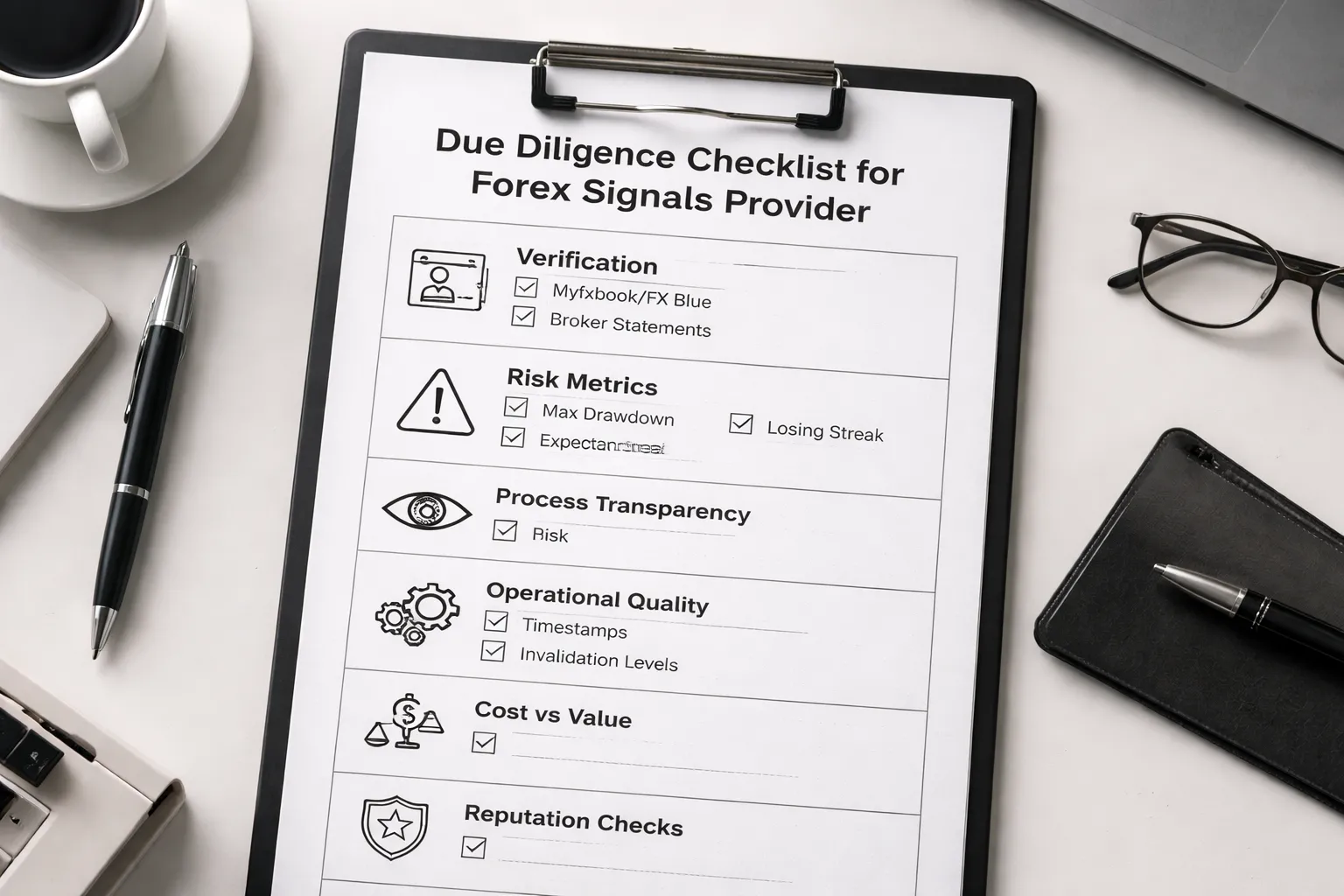
How to Evaluate a Forex Signals Provider (Due Diligence Checklist)
Verification Standards (Proof You Can Audit)
Start with third-party tracking. Treat screenshots as marketing.
- Myfxbook or FX Blue link. You need a public, clickable page, not a cropped image. Check the track record length, open trades, and whether the account shows real-time updates.
- Verified track record and trading privileges. Look for both badges. Track record verification ties results to the broker feed. Trading privileges verification proves the provider controls the account.
- Real account, not demo. Demo fills can look clean. Real accounts show spread, swaps, and real slippage.
- Broker statements as backup. Ask for monthly statements in PDF from a regulated broker. Match dates and balances to the tracker.
- Know third-party limits. Trackers can hide risk with low update frequency, hidden open trades, or account resets. Some providers also run multiple accounts and only publish the winner.
Risk Metrics That Matter (Ignore Win Rate)
Focus on how the strategy loses, not how often it wins.
- Max drawdown. Check both percentage and currency. Compare max drawdown to monthly return. If drawdown can wipe several months of gains, the edge is thin.
- Average R multiple. R means reward versus risk per trade. You want an average R that stays positive after costs. A provider should state typical stop size and target logic so you can estimate R.
- Expectancy. Expectancy = (win rate × average win) minus (loss rate × average loss). Ask for the numbers, not a chart. Low win rate can work if wins are larger than losses. High win rate fails if losses spike.
- Losing streaks. You need the worst historical streak, and a realistic assumption it can repeat. Size your risk so you survive that streak without changing rules.
- Costs included. Results must include spread, commission, and swaps. If they trade around rollover, swaps can flip a “winning” system negative.
Trade Process Transparency (How They Decide)
You need enough detail to judge fit and execution risk.
- Strategy logic at a high level. Trend, mean reversion, breakout, or news. If they refuse to say, you cannot assess drawdown behavior.
- Session preferences. London and New York behave differently than Asia. Session choice impacts spread, volatility, and follow-through.
- Market conditions to avoid. They should name conditions they skip, such as high-impact news minutes, low-liquidity hours, or choppy ranges. If they claim they trade “all conditions,” expect unstable risk.
- Instrument list and max concurrent trades. More pairs can mean hidden correlation risk. Many trades at once can turn one theme into a large directional bet.
Operational Quality (Signals You Can Execute)
Execution gaps destroy edge. Operational discipline reduces that gap.
- Time-stamps. Each signal needs a clear time and time zone. Late signals are a common failure point.
- Entry method. Market, limit, or stop entry. If they use “enter now” without a price band, you cannot control slippage.
- Clear invalidation level. Every trade needs a stop loss or a hard exit rule. “Mental stop” means you carry provider risk.
- Updates and management rules. Define when they move stops, scale out, or close early. Random trade management breaks your stats.
- Frequency and cadence. You need a stable schedule. If signals spike during drawdowns, they may chase losses.
- Execution assumptions. Ask what spread and latency they assume. If their results rely on tight spreads, your broker choice becomes part of the system.
Cost vs Value (Math, Not Hope)
Price matters less than whether the numbers work on your account.
- Size your account for the fee. If you pay $100 per month and expect 3 percent per month, you need about $3,300 just to cover the fee before taxes and slippage.
- Use realistic expectancy. Base it on net performance, after costs. Then haircut it for slippage and missed trades. If the edge disappears after a small haircut, you have no margin of safety.
- Check risk per trade guidance. If they suggest 3 to 5 percent risk per trade, the fee may look cheap because the risk is extreme.
- Refund and terms. Avoid long lock-ins. Avoid “lifetime” plans tied to private channels that can vanish.
Reputation Checks (Signals of Integrity)
Reputation does not prove performance. It can reveal fraud patterns.
- Domain history. Check domain age and ownership changes. Frequent rebrands often follow blown accounts and negative reviews.
- Social proof quality. Look for full trade logs, broker-verified tracking links, and consistent posting over time. Ignore comment screenshots and vague testimonials.
- Community red flags. Watch for deleted criticism, “VIP” pressure tactics, affiliate spam, and claims of inside info. Honest providers show losses and explain them.
- Conflicts of interest. If they push a specific broker or prop firm link, assume incentives. Judge the signals on audited results, not partnerships.
- Cross-check shortlists. Use a comparison page to validate claims and features, see our best forex signal providers list.
Questions to Ask Before You Pay (Interview Script)
Use this script on a sales call, in DMs, or by email. Ask for numbers, samples, and screenshots. If they refuse, walk away.
Stop size and targets (RR range) across recent trades
- What is your typical stop size in pips? Ask for the median and the 80% range from the last 50 to 100 trades.
- How do you set targets? Fixed pips, structure-based, ATR-based, or scaling out.
- What is your typical risk to reward per trade? Ask for the average and the distribution, not a single number.
- Do you move stops? Break-even rules, trailing rules, and when you reduce risk.
- Show five full examples. Entry, stop, targets, time in trade, and final R multiple.
News events, rollovers, and high-volatility sessions
- Do you trade during high-impact news? List which events you avoid, and how many minutes before and after.
- What is your rule for spreads and slippage? Maximum spread allowed, and what you do if the fill is worse than planned.
- How do you handle rollover and swaps? Holding rules for Wednesday rollover, and how swaps affect pair selection.
- Which sessions do you trade? London, New York, Asia, overlaps, and why.
- What happens on spike days? Ask for one example where volatility broke the setup, and how they adapted.
Full publishing and immutable history
- Do you publish every signal? Including canceled trades, partial closes, and manual exits.
- Where is the track record stored? Ask for a link that shows time stamps. You want proof they did not edit after the fact.
- Can you export the history? CSV, Myfxbook, FX Blue, or a broker statement.
- Do you show losing streaks? Ask for the longest streak and the dates.
- What is your verification level? Verified trading account, not a demo, not a screenshot collage.
Position sizing model for different account sizes
- What risk per trade do you recommend? Get a percent range and when to use each level.
- Do you size by stop distance? Fixed fractional, fixed lot, volatility-based, or tiered lots.
- How do you handle small accounts? Minimum account size to follow without over-leverage, and minimum lot size assumptions.
- Do you allow multiple open trades? Ask for a cap on total account risk across all positions.
- Show sizing examples. Same signal sized for $500, $5,000, and $50,000 accounts.
Worst drawdown and recovery time
- What is your worst peak-to-trough drawdown? Ask for the exact percent and the date range.
- How long did recovery take? Days and number of trades to reach a new equity high.
- What changed after that period? Rules, pairs, session filters, or risk limits.
- What is your current drawdown? If they only talk about past wins, you lack the full picture.
- What should a subscriber expect? Typical monthly return range, typical monthly drawdown range, and worst-case scenario.
| What you ask for | What a serious provider shares | Red flag |
|---|---|---|
| Last 50 to 100 trades | Export or verified log with timestamps | Screenshots only, missing losers |
| Median stop and typical RR | Ranges and distributions | One “perfect” RR claim |
| News and spread rules | Written rules and examples | “We always win news” claims |
| Sizing and total risk cap | Percent-based model, clear limits | High leverage encouraged |
| Worst drawdown and recovery | Exact dates, depth, time to recover | No drawdown data, blame-shifting |
If you want benchmarks to compare answers, use our best forex signal providers list before you pay.
How to Test Signals Safely Before Committing Real Money
Start with a demo or micro account
Test signals in a demo first. Then switch to a micro account. You need real spreads, real execution, and real slippage data.
- Demo goal: check signal timing, clarity, and frequency. You should understand every message without guessing.
- Micro goal: measure fills. Use the same broker, account type, and platform you plan to trade live.
- Match the provider’s setup: same pairs, same session, same timeframe, same entry type. If they trade during news, you must test during news.
- Track fill quality: note slippage on market entries, stop losses, and take profits. Many providers look good on paper and fail on execution.
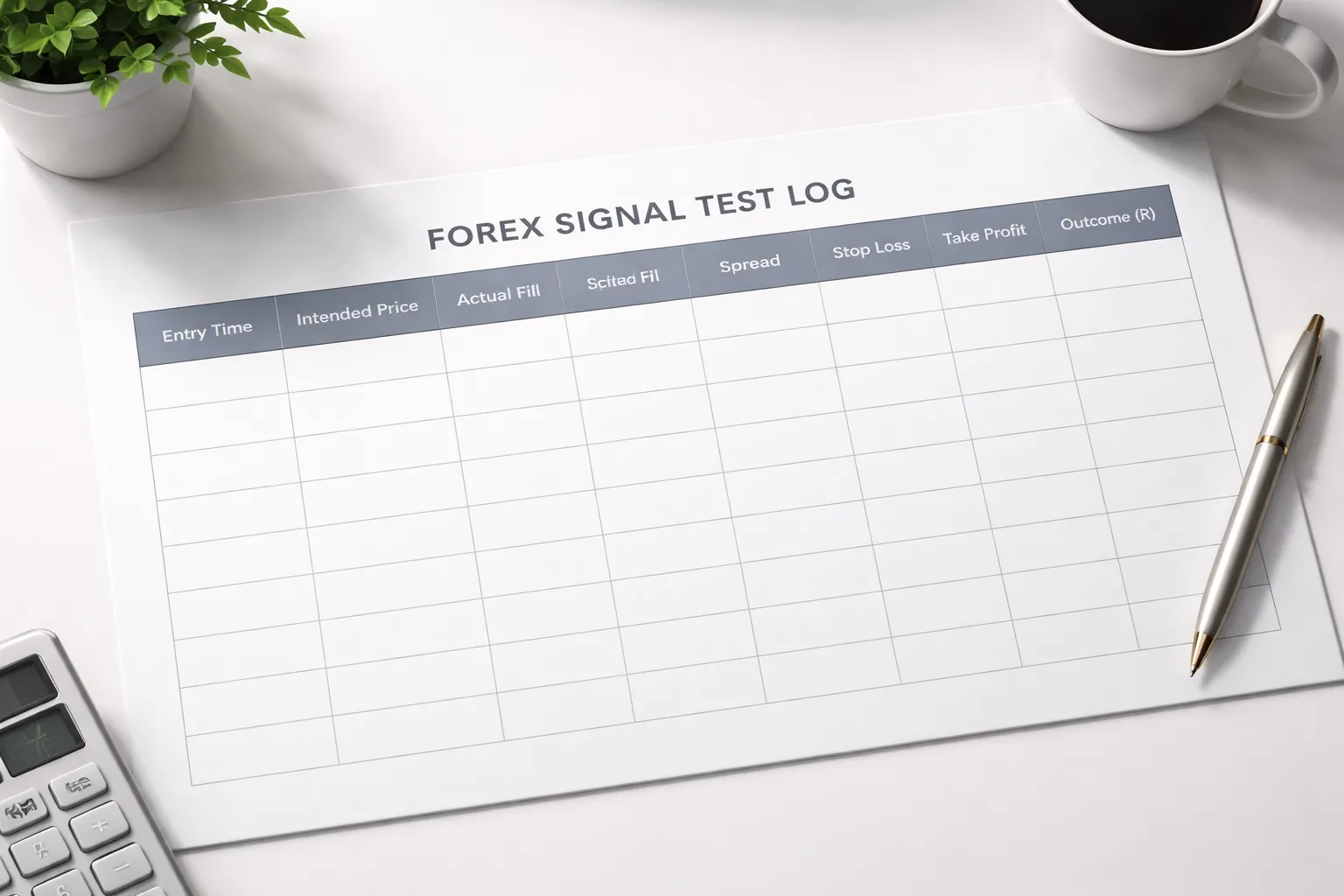
Build a tracking sheet that shows what really happened
Do not rely on screenshots or posted results. Record your own numbers.
| Field | What to record |
| Signal ID | Date, pair, direction, timeframe |
| Entry time | When the signal arrived, your local time |
| Intended price | Provider entry price or entry zone midpoint |
| Actual fill | Your executed price, include order type |
| Spread | Spread at entry, and at exit if relevant |
| Slippage | Actual fill minus intended price, in pips |
| Stop and target | Exact SL, TP, and any trailing rules |
| Outcome in R | Profit or loss divided by initial risk |
| Notes | Missed trade, late signal, edits, partial closes |
Use R because it normalizes results. It stops one oversized win from hiding weak execution.
Define a minimum sample size
One good week means nothing. Variance can fake skill.
- Minimum: 30 trades to spot obvious issues.
- Better: 50 to 100 trades to judge consistency.
- Include different conditions: range days, trend days, high spread periods, and major news windows if they trade them.
- Reject cherry-picked periods: do not start your test on a strong streak and stop after a drawdown starts.
Set hard risk rules before you place trade one
Your test must protect your account from one bad week and from signal providers who average down.
- Per-trade risk cap: 0.25% to 1% of account equity per trade. Pick one number and stick to it.
- Daily loss limit: stop trading for the day at 1% to 3% loss. No exceptions.
- Max open trades: cap total exposure. Example, no more than 2 to 4 open positions at once.
- Correlation rule: treat highly correlated pairs as one trade. Long EURUSD and long GBPUSD can fail together.
- No martingale: do not increase size to “recover.” If the provider suggests it, end the test.
If you plan to use signals for a prop evaluation, align these limits with typical challenge rules. Use this guide to understand the constraints: prop firm challenge rules and drawdown limits.
Evaluate after the test using five numbers
Do not grade signals by win rate. Grade them by expectancy, drawdown, and repeatability.
- Expectancy (in R): average R per trade. Positive expectancy with controlled drawdown matters more than a high win rate.
- Max drawdown: peak-to-trough loss during the test. Compare it to your risk tolerance and any account limits.
- Profit factor: gross profit divided by gross loss. A high number with a tiny sample does not count.
- Execution drag: average slippage plus spread impact. If drag flips expectancy negative, the service fails for your broker.
- Consistency: results across sessions and market regimes. If all gains come from one pair or one week, treat it as unstable.
Commit real money only if the numbers stay solid after fees, spreads, and slippage, and the drawdown stays inside your limits.
Choosing the Right Type of Signal Service
Manual signals vs copy trading
Manual signals give you control. You choose the broker, lot size, timing, and whether to skip a trade. You can adjust for news, spread spikes, and your own risk limits.
Copy trading gives you execution speed. It also removes your discretion. If the provider increases leverage or trades during thin liquidity, your account follows.
- Control: Manual wins. You can cap risk per trade and avoid bad fills.
- Learning: Manual wins if the provider explains entries, exits, and invalidation. Copy trading often teaches nothing.
- Execution: Copy wins on speed, but you still face slippage, spread widening, and platform latency.
- Risk alignment: Manual lets you match position size to your account. Copy trading can drift if the provider trades a different balance or uses martingale.
If you trade under strict rules, check how the signal style fits your limits. Many traders use signals to practice for a prop firm challenge, but copy trading can break drawdown rules fast.
Swing signals vs scalping signals
Swing signals hold longer. They tolerate higher spreads and commissions because the target size is larger. They also need fewer decisions per day.
Scalping signals rely on small edges. Costs can erase them. Spread, commission, and slippage matter more than the win rate.
- Cost sensitivity: Scalping is highly sensitive. If your all-in cost is 1.2 pips and the average target is 4 pips, costs eat 30 percent before slippage.
- Broker fit: Scalping needs tight spreads, fast execution, and stable pricing. Swing works on more brokers.
- Schedule: Scalping demands you watch entries. Swing can work with alerts and end-of-day checks.
- Data to demand: Ask for median hold time, average target in pips, and average slippage. If they cannot show this, assume the edge is fragile.
Single-provider vs community analysts
A single provider gives you one process. It is easier to audit. You can track one set of rules, one risk model, and one performance record.
A community model gives you diversification. It also adds noise. Different analysts use different risk, timeframes, and assumptions.
- Consistency: Single-provider services usually stay more consistent. You can spot drift faster.
- Diversification: Communities can reduce dependence on one trader, but only if they enforce position sizing and publishing standards.
- Accountability: Single-provider is clearer. Communities can hide weak analysts behind group results.
- How to evaluate: Require analyst-level stats, not just a combined feed. If they only show “group performance”, treat it as marketing.
Paid vs free signals
Free signals often monetize through affiliate links, broker referrals, or upsells. That can distort incentives. The provider may push high trade frequency to generate commissions.
Paid signals can still mislead. The difference is what you can demand. A paid service should provide clean records, defined risk rules, and support.
- Incentives: Free services often earn from your activity. Paid services earn from retention, which can reward more stable risk.
- Transparency: Paid should provide full trade logs, timestamps, and stop-loss and take-profit levels. Free usually provides less detail.
- Support: Paid services should answer execution and sizing questions. If they refuse, the fee buys you nothing.
- Trial structure: Prefer short trials with full access to history. Avoid “lifetime” deals that hide weak performance behind time.
| Service type | Best for | Main risk | Non-negotiable checks |
|---|---|---|---|
| Manual signals | Traders who want control and learning | Late entries and inconsistent execution | Clear rules, full trade log, sizing guidance |
| Copy trading | Hands-off execution with strict provider filters | Risk drift and sudden drawdowns | Max drawdown controls, leverage limits, stop placement data |
| Swing | Busy schedules, higher cost environments | Large drawdowns during trends and news | Average hold time, worst-case DD, news policy |
| Scalping | Low-cost brokers and fast execution | Costs flip expectancy negative | All-in cost model, slippage stats, session filters |
Alternatives to Forex Signals (Often Better ROI Long-Term)
Alerts Based on Your Strategy: Price Levels, Indicators, and Economic Calendar Triggers
Build alerts around your rules. You get the same speed benefit as signals, without outsourcing decisions.
- Level alerts. Set alerts at prior day high and low, weekly open, key support and resistance, and session highs and lows.
- Volatility alerts. Trigger when ATR expands past your threshold, or when the daily range hits a percentage of its 20-day average.
- Indicator state alerts. Use simple, testable conditions, like MA slope direction, RSI regime, or a breakout and retest filter.
- Time and session filters. Alert only during the hours you trade. Skip low-liquidity periods if your fills suffer.
- Economic calendar triggers. Alert 30 to 60 minutes before high-impact events on your pairs. Add a second alert at release time.
Track outcomes. Log how often alerts lead to valid setups, how often you skip them, and your average slippage around news. That data improves your rules faster than a signal feed.
Mentorship and Structured Courses: Paying for Skill Instead of Entries
Signals sell entries. Training builds a process. Process compounds.
- Demand structure. A fixed curriculum, homework, and review calls. Avoid open-ended chat rooms.
- Demand proof of teaching. Ask for a sample lesson and marked-up trade reviews. Teaching quality matters more than a win-rate claim.
- Measure outputs. Fewer rule breaks, tighter loss distribution, consistent position sizing, and stable monthly variance.
- Build a test plan. One setup, one market set, one risk model. Run 50 to 100 trades, then adjust.
If you plan to trade with firm capital later, pick training that matches common firm constraints like daily loss limits and trailing drawdown mechanics. Read forex prop firm challenge rules and red flags before you commit to a style that fails those limits.
Trading Journals and Playbooks: Building Repeatable Execution Habits
Your edge lives in execution. Journals expose leaks. Playbooks reduce decisions.
- Journal the minimum that matters. Setup tag, entry reason, stop logic, target logic, position size, time of day, spread, slippage, and outcome in R.
- Track rule adherence. Mark every trade as followed rules or broke rules. Separate the two in reports.
- Review weekly. Identify your top two profitable setups and your top two losing mistakes. Cut the mistakes first.
- Create a playbook card. Entry checklist, invalidation point, management rules, and when you do nothing.
| Journal Metric | What It Tells You | Action |
|---|---|---|
| Expectancy (R) | Edge per trade after costs | Drop setups with negative expectancy |
| Profit factor by setup | Which patterns pay | Trade fewer patterns, increase quality |
| MAE and MFE | Stop and target fit | Adjust stops to structure, not emotion |
| Rule-break rate | Process stability | Reduce size until rule-breaks fall |
| Costs per trade | Spread plus commissions plus slippage | Filter sessions, adjust order types |
Copy Trading With Risk Controls: Equity Stop-Outs, Max Lot Caps, and Diversification
Copy trading can beat signals because it copies full execution. You still need hard limits. You cannot outsource risk.
- Equity stop-out. Set an account-level stop, like -5% to -10%, then stop copying. Do not widen it after losses.
- Max lot caps. Cap per-trade and total exposure. Prevent a copier from scaling you into margin stress.
- Max open trades. Limit stacking and correlated positions across pairs.
- Diversification rules. Copy 2 to 4 strategies with different holding times and drivers. Avoid multiple systems that all buy and sell the same USD risk.
- Latency and slippage checks. Compare master fill price versus your fill price. Stop if slippage flips expectancy negative.
- Drawdown governance. Pause copying after a predefined drawdown, then require a recovery plan or a new high watermark.
Use copiers that support per-provider risk scaling and equity guardrails. Treat performance claims as marketing until you see multi-month, broker-verified history, plus worst-case drawdown and cost assumptions.
Red Flags and Scam Tactics to Watch For
Guaranteed profits, “no loss” claims, and unrealistic monthly ROI promises
Serious providers talk in probabilities, not certainty. Treat these claims as a hard stop.
- “Guaranteed” returns. FX has variable spreads, slippage, news gaps, and execution limits. Nobody controls your fill.
- “No loss” systems. This usually means martingale, grid, or averaging down. Losses show up later as one large drawdown.
- Fixed monthly ROI targets. Promises like 10% to 30% per month ignore changing volatility and regime shifts. Ask for max drawdown, worst month, and longest losing streak, broker-verified.
- Cherry-picked proof. Screenshots of a few winners, no full trade log, no costs. You need net results after spreads, commissions, and typical slippage.
Pressure sales: countdown timers, “VIP limited seats,” and aggressive upsells
High-pressure tactics aim to stop you from checking evidence. A good service lets performance sell itself.
- Fake urgency. Resetting countdown timers, “last 10 spots,” or “price doubles tonight” pushes impulse buys.
- Bait pricing. Low entry offer, then paid “VIP,” “gold,” “sniper,” or “news” add-ons for basic features.
- Paywall for proof. They hide the track record until after payment, or they show only a “VIP” history you cannot verify.
- No refund, no dispute. Crypto-only payments, friends-and-family transfers, or vague terms that block chargebacks.
Refusal to show drawdowns: hiding losing streaks or deleting messages
Drawdowns define whether a strategy fits your risk limits. If they hide losses, you cannot manage risk.
- No equity curve. They show wins, not the full balance line over time.
- No losing streak stats. You need worst streak in trades and in days, plus max consecutive loss size with their risk rules.
- Message cleanup. Deleted losing calls, edited entries after the move, or “update” posts that overwrite the original signal.
- Selective reporting. They post “TP hit” but ignore stopped trades, partial fills, and breakeven exits.
Ask for a complete export of signals with timestamps, entries, stops, targets, and outcomes. Compare it to price history and spread at that time.
Broker kickback incentives: pushing high-spread brokers or shady IB links
Some signal sellers earn more from your trading volume than from subscriptions. That misaligns incentives.
- One broker only. They require you to use a specific broker, or they refuse support unless you register through their link.
- High spreads and loose execution. Wider spreads and slippage help the broker, not you. Your expectancy drops.
- Offshore, weak regulation. You get limited recourse if orders fail, withdrawals stall, or prices look off.
- Volume pushing. They favor high-frequency scalps that look good on paper but die after costs, while they collect rebates.
If you plan to use signals for a funded account, align this check with the broker and rule set your firm allows, see our guide to prop firm challenge rules and red flags.
Identity tricks: cloned channels, fake verification badges, and impersonation
Impersonators target new users and steal payments. You need a verification routine.
- Cloned groups. Same name, same logo, slight handle change. They DM you first and push payment fast.
- Fake badges. “Verified” images, edited screenshots, or purchased checkmarks that do not confirm ownership.
- Impersonated admins. Lookalike usernames that copy the support account, then send wallet addresses.
- Redirect scams. Short links to fake login pages, fake Myfxbook pages, or fake broker portals.
Verify identity on at least two official channels. Confirm the payment method inside the provider’s public profile, not in DMs. Treat any unsolicited message as hostile.
FAQ
What is a forex signal?
A forex signal is a trade idea. It usually includes the pair, direction, entry, stop loss, and take profit. Some providers add time windows, risk per trade, and setup logic. You still place the trade and manage execution, unless you use automation.
Are forex signals legal?
It depends on your country and how the provider operates. Selling “education” differs from giving personalized investment advice. Many regions require licensing for managed accounts or advice. Ask for the legal entity name, jurisdiction, and compliance status before you pay.
Are forex signals worth it?
They can help if you already trade and need structured ideas. They waste money if you follow blindly. Judge them on verified results, risk control, and execution rules. If you cannot match the provider’s spreads, leverage, and trade times, results will diverge.
How accurate are forex signals?
Accuracy alone means little. A 40 percent win rate can work with strong risk to reward. A 70 percent win rate can fail with large losers. Track expectancy, drawdown, and loss streaks. Demand a full trade history, not just weekly screenshots.
What proof should a provider show?
Ask for a third party verified track record with trading permissions and a long history. You want open and closed trades, deposits, and withdrawals visible. If they hide the broker, lot sizes, or history, treat it as marketing, not evidence.
What time period is enough to judge performance?
Use at least 6 to 12 months and 200 or more trades, if possible. Include different market regimes. Favor stable returns and controlled drawdowns over short spikes. One strong month proves nothing. A long flat period with low drawdown can still be acceptable.
What metrics matter most?
- Max drawdown, both percentage and duration.
- Expectancy, average outcome per trade after costs.
- Profit factor, gross profit divided by gross loss.
- Risk per trade, typical stop size and sizing method.
- Trade frequency, and whether results rely on rare wins.
How do I evaluate a signal provider fast?
- Verify identity and official channels.
- Check a verified record, not screenshots.
- Compare their spreads and execution to yours.
- Review drawdowns and loss streaks.
- Read rules for stops, sizing, and missed entries.
What red flags matter most?
- Guaranteed returns, fixed monthly profits, or “no loss” claims.
- Unverified results, cropped screenshots, or deleted losing trades.
- Martingale, grid, or “recovery” sizing with no hard stop.
- Pressure to pay in crypto only, or via DMs.
- Refusal to share risk rules and broker details.
How much should I risk per signal?
Keep it small. Many traders use 0.25 to 1 percent per trade. Lower it if the provider has long losing streaks or high drawdowns. Size positions using your stop loss distance, not their lot size. Never scale up during a losing run.
Why do my results differ from the provider’s?
Execution changes outcomes. Slippage, spreads, swaps, and latency reduce edge. Different broker feeds shift entries and stops. Missed alerts create worse prices. Copying without matching account type, leverage, and session timing often breaks the strategy.
Should I use copy trading instead of manual signals?
Copying reduces missed entries but adds platform and execution risk. You still need controls for max lot size, equity stops, and trade filters. Read our guide on copy trading in forex before you connect funds.
Can I test signals before paying?
Yes. Use a demo or small live account for at least 4 weeks. Log every trade with time received, entry filled, spread, and slippage. Compare to the provider’s published history. If the gap stays large, the service will not translate to your setup.
Do free forex signals work?
Sometimes, but quality varies. Many free channels monetize through broker affiliates, upsells, or hype posts. Treat them like any paid service. Demand transparent rules and verifiable results. If the provider will not show proof, assume the edge does not exist.
What should a good signal message include?
- Pair, direction, and entry type, market or limit.
- Stop loss, take profit, and invalidation level.
- Risk guidance, percent or R based.
- Time window for entry and cancellation rule.
- News filter, and rules for moving stops.
How do I avoid signal scams?
Verify identity on at least two official channels. Never pay from a DM request. Confirm payment details inside the provider’s public profile. Avoid short links to logins or “Myfxbook” pages. Treat unsolicited messages as hostile and report impersonators.
What is a fair price for forex signals?
Price depends on proof and support. Low cost does not mean low risk. High cost does not mean quality. Judge value by verified performance after costs, your ability to execute, and clear risk rules. If refunds and terms look vague, walk away.
Conclusion
Forex signals can save time, but they do not remove risk. Your results depend on execution speed, spreads, slippage, and whether the provider controls drawdowns. Most services fail on proof, process, or both.
If you use signals, treat them as a tool, not a plan. Set hard limits before you subscribe. Cap risk per trade. Cap weekly loss. Stop when the provider breaks rules or changes sizing.
- Require proof you can audit. Verified track record, full trade history, and results after fees and realistic costs.
- Match the method to your account. Same sessions, same instruments, same leverage, and clear stop loss and take profit rules.
- Test small, then scale. Track fill quality, average slippage, and max drawdown on your broker before increasing size.
- Walk fast on red flags. No verification, vague terms, pressure tactics, or “guaranteed” claims.
Final tip. Run a 30 trade trial with fixed risk and strict journaling. If the edge does not survive your real costs and your execution, drop the service. If you want more control than signals allow, use forex copy trading with a platform that shows verified stats, risk controls, and full trade history.
-
Best Forex Copy Trading Platforms (Features, Fees & Safety Compared)
8 months ago -
Forex Prop Firm Challenge Rules Explained (Drawdown, Targets, Payouts)
8 months ago -
Copy Trading Forex Explained: How It Works, Pros, Cons & Risks
8 months ago -
Best Forex Prop Firms (Top Firms Compared)
8 months ago -
Forex Signals: Are They Worth It? (What to Know Before You Buy)
8 months ago
-
- Execution risk, slippage, spread widening, latency
- Risk management mismatch, sizing, stops, drawdown tolerance
- Performance manipulation, cherry-picked trades, deleted losses, backtest-only marketing
- Dependency and skill stagnation
- Psychological drag, FOMO, revenge trades, overtrading
- Regulatory and scam risk, unlicensed sellers, fake proof, impersonation
-
- Alerts Based on Your Strategy: Price Levels, Indicators, and Economic Calendar Triggers
- Mentorship and Structured Courses: Paying for Skill Instead of Entries
- Trading Journals and Playbooks: Building Repeatable Execution Habits
- Copy Trading With Risk Controls: Equity Stop-Outs, Max Lot Caps, and Diversification
-
- Guaranteed profits, “no loss” claims, and unrealistic monthly ROI promises
- Pressure sales: countdown timers, “VIP limited seats,” and aggressive upsells
- Refusal to show drawdowns: hiding losing streaks or deleting messages
- Broker kickback incentives: pushing high-spread brokers or shady IB links
- Identity tricks: cloned channels, fake verification badges, and impersonation
-
- What is a forex signal?
- Are forex signals legal?
- Are forex signals worth it?
- How accurate are forex signals?
- What proof should a provider show?
- What time period is enough to judge performance?
- What metrics matter most?
- How do I evaluate a signal provider fast?
- What red flags matter most?
- How much should I risk per signal?
- Why do my results differ from the provider’s?
- Should I use copy trading instead of manual signals?
- Can I test signals before paying?
- Do free forex signals work?
- What should a good signal message include?
- How do I avoid signal scams?
- What is a fair price for forex signals?
-
-
- Execution risk, slippage, spread widening, latency
- Risk management mismatch, sizing, stops, drawdown tolerance
- Performance manipulation, cherry-picked trades, deleted losses, backtest-only marketing
- Dependency and skill stagnation
- Psychological drag, FOMO, revenge trades, overtrading
- Regulatory and scam risk, unlicensed sellers, fake proof, impersonation
-
- Alerts Based on Your Strategy: Price Levels, Indicators, and Economic Calendar Triggers
- Mentorship and Structured Courses: Paying for Skill Instead of Entries
- Trading Journals and Playbooks: Building Repeatable Execution Habits
- Copy Trading With Risk Controls: Equity Stop-Outs, Max Lot Caps, and Diversification
-
- Guaranteed profits, “no loss” claims, and unrealistic monthly ROI promises
- Pressure sales: countdown timers, “VIP limited seats,” and aggressive upsells
- Refusal to show drawdowns: hiding losing streaks or deleting messages
- Broker kickback incentives: pushing high-spread brokers or shady IB links
- Identity tricks: cloned channels, fake verification badges, and impersonation
-
- What is a forex signal?
- Are forex signals legal?
- Are forex signals worth it?
- How accurate are forex signals?
- What proof should a provider show?
- What time period is enough to judge performance?
- What metrics matter most?
- How do I evaluate a signal provider fast?
- What red flags matter most?
- How much should I risk per signal?
- Why do my results differ from the provider’s?
- Should I use copy trading instead of manual signals?
- Can I test signals before paying?
- Do free forex signals work?
- What should a good signal message include?
- How do I avoid signal scams?
- What is a fair price for forex signals?
-
-
How to Place a Forex Trade Step by Step (Your First Trade Explained)
6 months ago -
Forex Trading vs Crypto Trading: Which Market Is Better for Beginners?
6 months ago -
Forex Lot Size Calculator: How to Use It to Size Trades Correctly
8 months ago -
How to Calculate Position Size in Forex (Position Sizing Formula + Examples)
8 months ago -
Forex Leverage Explained: How It Works, Pros, Cons & Examples
8 months ago
-
Forex Trading Platforms Comparison: MetaTrader vs cTrader vs TradingView
8 months ago -
Stop Loss vs Take Profit: Differences, Examples & Best Practices
8 months ago -
Is Forex Trading Legal in the United States? Rules, Regulators & What to Know
8 months ago -
Forex Market Hours & Trading Sessions Explained (Best Times to Trade)
8 months ago -
Forex Leverage Explained: How It Works, Pros, Cons & Examples
8 months ago