Forex Prop Firm Challenge Explained: Rules, Payouts, Drawdowns and Red Flags

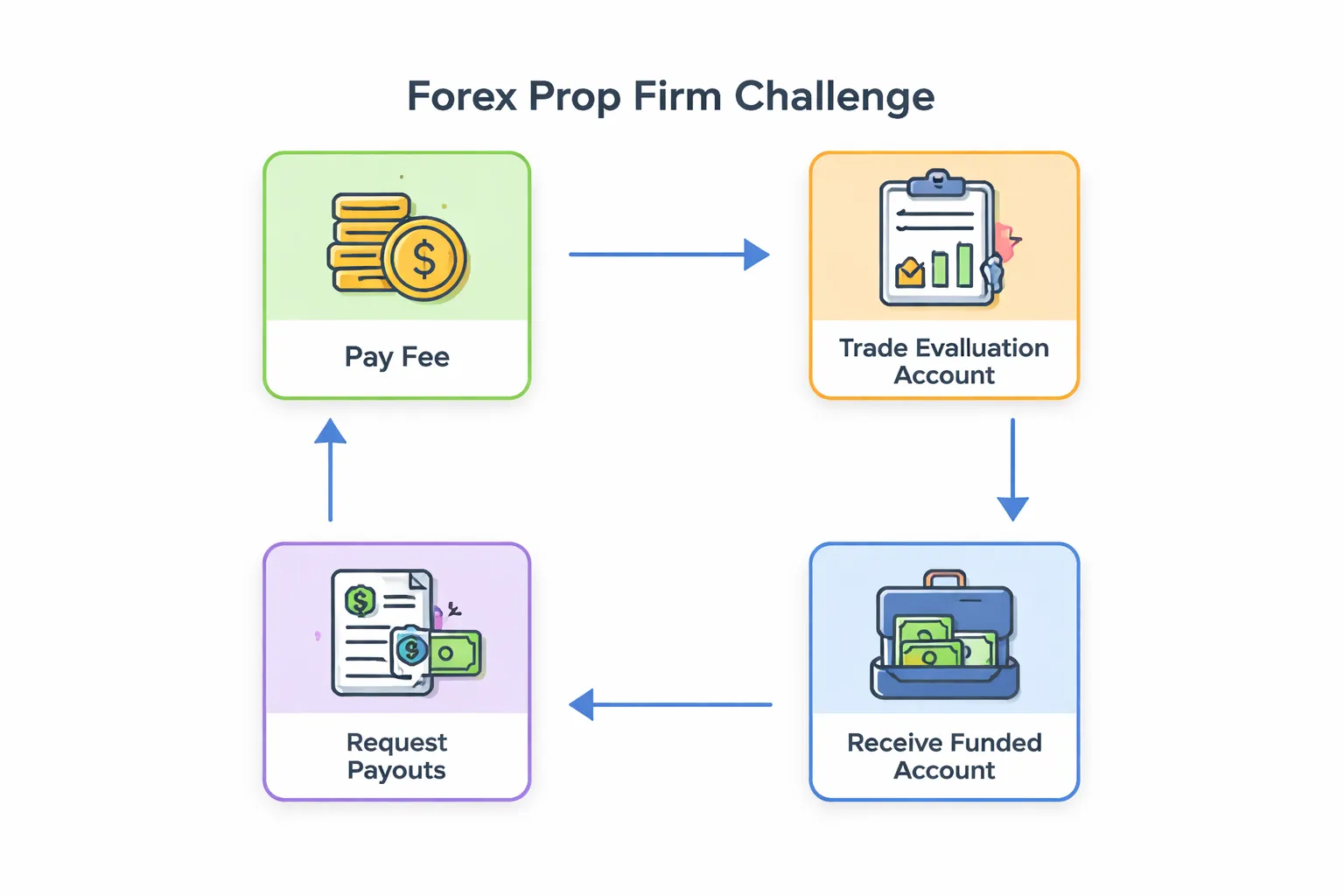
Most forex prop firms gatekeep funding with a challenge. You trade a demo account under strict rules. You pay a fee. If you hit profit targets without breaking limits, the firm offers a funded account and a payout split.
This guide explains how challenges work, what rules matter, and where traders get trapped. You will learn common profit targets and time limits, how daily and max drawdown rules get calculated, what payout terms look like, and which red flags signal a bad deal. You will also see how to compare offers so you can avoid hidden restrictions, unfair resets, and payout delays. If you need the basics first, read what a forex prop firm is.
Key Takeaways
- In het kort: Treat the challenge as a rule test, not a trading contest.
- In het kort: Profit targets drive behavior, size your risk so you can survive normal losing streaks.
- In het kort: Daily drawdown rules can kill you fast, know the exact calculation method before you trade.
- In het kort: Max drawdown decides your true room to trade, focus on equity based limits and trailing logic.
- In het kort: Payout terms matter as much as split, check timing, minimums, and profit eligibility rules.
- In het kort: Red flags show up in the fine print, avoid firms with vague rules and slow, conditional payouts.
- Rules beat returns. One breach ends the account. Track your limits like you track your P and L.
- Know the two drawdowns. Daily drawdown hits intraday swings. Max drawdown limits your full cycle of trades.
- Ask how drawdown gets measured. Equity vs balance, end of day vs real time, and trailing vs fixed change the risk by a lot.
- Assume targets push you into overtrading. Use a fixed risk per trade and cap total exposure across pairs.
- Time limits shape your strategy. Short deadlines reward higher variance. Longer windows reward patience and tighter risk.
- Payout math has more than the split. Check payout schedule, first payout delay, minimum payout, and whether open trades count.
- Watch for hidden restrictions. News bans, weekend holds, lot caps, scaling rules, and “consistency” clauses can block payouts.
- Compare offers with a checklist. Rules, calculation method, fees and resets, execution quality, payout history, and support response time.
- Start from the business model. If you want the foundation, read what a forex prop firm is.
Forex prop firm challenge explained: what it is and why it exists
The basic concept: evaluation first, funding later
A forex prop firm challenge is a paid evaluation. You trade a demo or simulated account under strict rules. You try to hit a profit target without breaking drawdown limits.
If you pass, the firm offers a “funded” account. You keep a share of the profits based on the payout split. You still trade under rules. If you break them, the firm can close the account and stop payouts.
The challenge sets the terms. Targets. Max daily loss. Max total loss. Minimum trading days. News and weekend rules. Position size limits. Some firms also add consistency rules that cap how much profit you can make in a single day.
If you want the exact rule mechanics, see our prop firm challenge rules breakdown.
How retail prop challenges differ from traditional prop desks
Traditional prop desks hire traders. They give you capital, tools, and risk oversight. They pay a salary or draw, then a performance cut. They care about your long-term risk-adjusted return.
Retail prop firms sell challenges to the public. Many do not place your trades in the market during evaluation. Some never copy trades to live liquidity, even after funding. You can still get paid, but the “funding” often means internal risk limits and a profit-share contract, not access to firm balance sheet capital.
Traditional desks select first, then fund. Retail prop firms sell access first, then filter with rules.
Why firms use challenges
- Risk filtering. Tight drawdowns and rule sets remove high-variance traders fast. The firm reduces payout volatility and operational risk.
- Fee revenue. Challenge fees create cash flow. Resets and retries increase revenue per trader. This matters most for firms that do not copy trades to live markets.
- Liquidity and execution control. The firm controls pricing, spreads, commissions, slippage settings, and allowed instruments. That lets them shape trader behavior and limit exposure during volatile periods.
Common challenge formats
- One-step. One profit target, one rule set. Higher fee. Faster path to “funding,” less time to prove stability.
- Two-step. Step 1 has a higher target. Step 2 has a lower target and often stricter drawdown handling. This is the most common structure.
- Three-step. Smaller targets per phase. More checkpoints. More time and more opportunities to fail due to rule friction.
- Instant funding. No target to pass. You pay more upfront and start on a funded-style account with tight risk limits. Many plans reduce leverage and cap risk per day.
| Format | What you pay for | Typical trade-off |
|---|---|---|
| One-step | Speed | Higher fee, higher pressure to perform fast |
| Two-step | Standard evaluation | More time, more rule exposure |
| Three-step | More gradual targets | Longest path, more chances to violate rules |
| Instant funding | Immediate access to payouts | Higher upfront cost, tight limits from day one |
How a typical forex prop firm challenge works (step-by-step)
Account sizes, fees, and what you’re actually buying
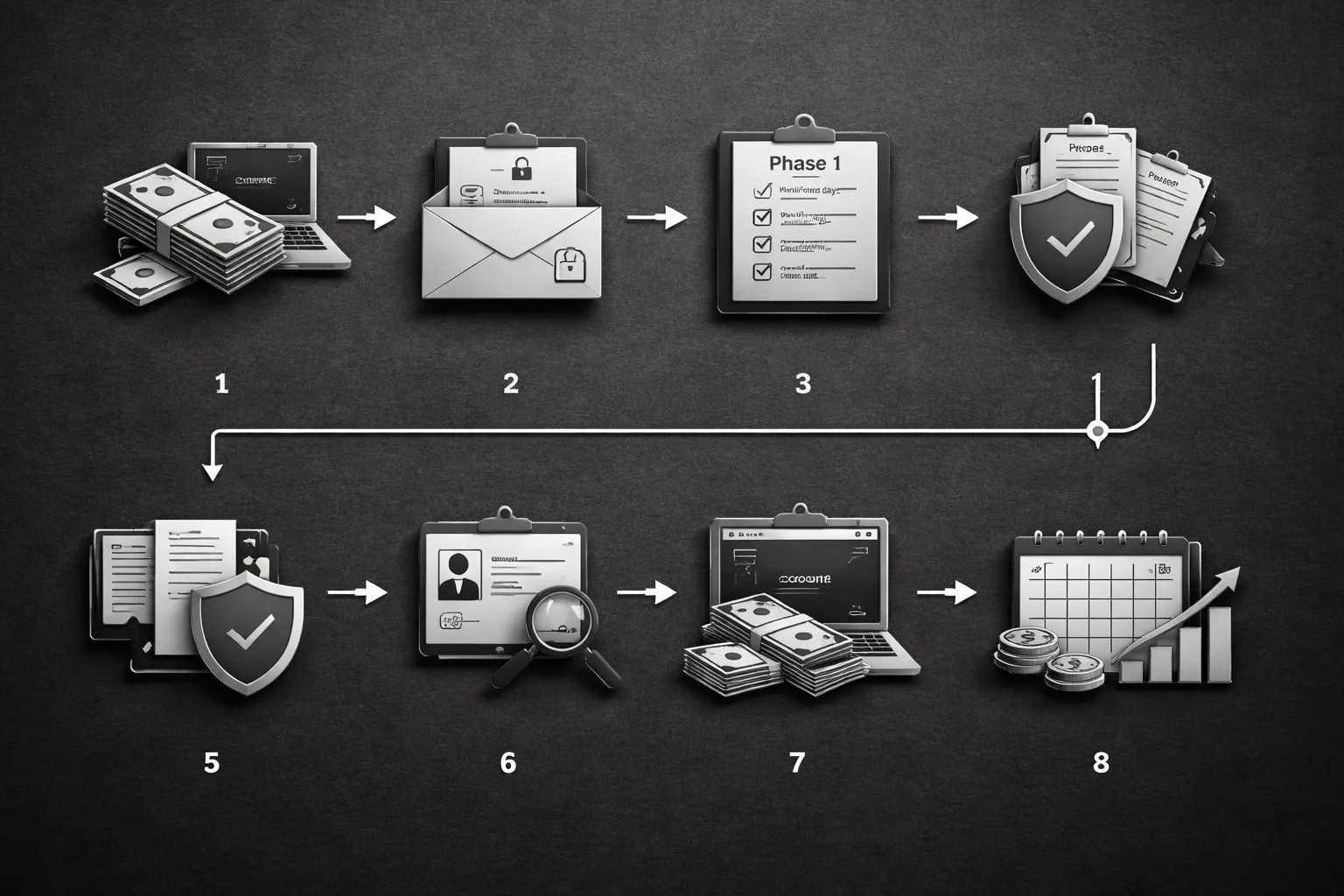
You pick a “virtual” account size. Common sizes range from $5,000 to $200,000. The size sets your profit target and your drawdown limits. It also sets your potential payout later, if the firm pays on the funded stage.
You pay an upfront fee. Many firms price it by account size. You do not buy equity in a firm. You buy access to a rule set, a data feed, and the chance to qualify for a funded account under that firm’s terms. Treat it like a performance test with strict risk controls.
- Account size. Changes the dollar value of every rule, target, and limit.
- Fee. Covers evaluation access. Some firms refund it after your first payout, some do not.
- Platform and broker. You often must use the firm’s chosen platform or liquidity provider.
- Rule package. Daily drawdown, max drawdown, news rules, weekend holds, and lot caps can matter more than the target.
The evaluation timeline: minimum days, maximum days, and extensions
You start the evaluation after you pay and receive login credentials. Most challenges track your results by trading day. “Trading day” means any day you place at least one trade. Holding a position without opening or closing activity may not count, depending on the firm.
- Minimum trading days. Often 3 to 10 days. You can hit the target early but still must meet the minimum day rule.
- Maximum calendar days. Common caps run 30 to 60 days per phase. Some firms removed time limits, but still enforce inactivity rules.
- Extensions. Some firms sell extra days or offer a free extension if you end near the target and stayed within drawdown. Others offer no extensions.
Each phase usually ends in one of three outcomes. You pass, you fail by breaching a rule, or you time out. Timeouts can happen even if you are profitable, if you miss the profit target or minimum days by the deadline.
Verification and KYC: when it happens and why it can delay payouts
After you pass the evaluation, the firm reviews your account. They check rule compliance and your trading activity. Some firms also run automated checks for trade copying, account mirroring, or prohibited strategies.
KYC often happens at one of two points. Right after you pass, or right before your first payout. If you wait until the payout stage, expect delays.
- Identity checks. ID, selfie, proof of address, and sometimes a payment method match.
- Country restrictions. Some regions trigger extra checks or rejection.
- Name and payment mismatch. Using someone else’s card, wallet, or bank details often blocks payouts.
- Compliance queues. High volume periods can push reviews from hours to days.
Plan for KYC early. Use matching details across your account profile and payment method. It reduces payout friction later. For a deeper overview of how these firms operate, see how forex prop trading works.
From pass to funded: scaling plans, leverage changes, and account migration
If you pass, the firm issues a funded account. Sometimes you trade a simulated account with profit-based payouts. Sometimes you get a live account. The firm rarely makes the structure clear in the sales pitch, so read the agreement.
- Account migration. You may move to a new login, new server, or new broker. Spreads, commissions, and execution can change.
- Leverage changes. Many firms lower leverage on funded accounts. Lower leverage reduces your position sizing flexibility under the same drawdown limits.
- Scaling plans. Growth usually depends on payout history and rule compliance. A common model increases your notional balance after 2 to 4 payouts, if you stay within drawdown and meet a profit threshold.
- Payout cycle. Firms set payout windows, often every 14 to 30 days. Some require a minimum profit amount before you can request.
After funding, the game shifts. The target may disappear, but the drawdown rules stay. Your job becomes survival plus steady returns. Most traders fail here by sizing too large after the first payout.
Core rules you’ll see in most challenges (and how to interpret them)
Prop firm rules look simple until you read the definitions. Most failures come from one line, how the firm measures loss, time, and “strategy.” Treat every rule as a calculation method, not a guideline.
Profit target rules, how targets interact with drawdown limits
Most challenges set a profit target between 8% and 10% for Phase 1, and 4% to 5% for Phase 2. You must hit the target without breaking daily or total drawdown. That forces a risk ceiling.
Do the math before you trade. If you have a 10% target, a 5% daily loss limit, and a 10% total loss limit, one bad day can end the account, and two bad days always will. You cannot “grind back” if the limits sit close to the target.
- Interpretation: A tight drawdown-to-target ratio means you need low variance, smaller position sizes, and fewer trades.
- Watch for: Targets that look normal but pair with aggressive equity drawdown rules that trigger faster than you expect.
Daily loss limits, balance vs equity and intraday threshold mechanics
Daily loss rules come in two types, balance-based and equity-based. Balance uses closed P and L. Equity includes floating P and L. Equity rules are stricter because an open drawdown can fail you before you close.
Many firms calculate the daily limit from start-of-day balance or equity at the broker server reset. Others use “rolling 24 hours.” You need the exact reset time.
- Balance daily loss: You can dip intraday as long as you close above the limit.
- Equity daily loss: One wick can breach the limit and fail the account, even if price snaps back.
- Mechanic to confirm: Reset time, timezone, and whether the limit uses prior day close or current day high-water mark.
Total loss limits, what counts and common traps
Total drawdown also comes in balance-based and equity-based form. Some firms use a fixed maximum loss from starting balance. Others use a trailing drawdown that follows your peak equity or peak balance.
Trailing drawdown is the main trap. When you grow the account, the stop line rises. Your “room” can stay the same, or even shrink relative to your open risk.
- Fixed drawdown: Simple. You always know the fail level.
- Trailing drawdown: The fail level moves up after you profit. A pullback after a big win can breach it.
- Realized vs floating: If equity-based, floating losses count. If balance-based, they do not, until you close.
Minimum trading days, how firms define a “trading day”
Minimum trading days force you to spread performance. A “trading day” usually means you opened at least one trade that day. Some firms require a trade to close that day. Some require a minimum holding time.
- Confirm: Open-only counts or close required.
- Confirm: One micro trade counts or they enforce a minimum lot size.
- Trap: You hit the profit target early, then get forced into extra days and take avoidable risk.
Consistency rules, daily profit caps, profit distribution limits, and “no one-day pass” policies
Consistency rules limit how much of your total profit can come from one day or one trade. Common thresholds cap the best day at 20% to 50% of total profits. Some firms cap the best trade. Others cap daily profit outright.
This changes your approach. One high-conviction day can fail you even if you followed risk rules.
- Daily profit cap: Your equity can stop counting after you hit a limit. You keep trading but the system rejects excess gains.
- Profit distribution: If one day makes too much of the total, you must add more profitable days to dilute it.
- No one-day pass: You cannot complete a phase from a single spike move.
Position sizing restrictions, lot caps, exposure limits, and correlated pairs
Some firms cap lots per symbol. Others cap total exposure across all open trades. Many treat correlated pairs as one combined exposure.
- Lot caps: You cannot scale the way you would on a personal account. Plan entries around the cap.
- Exposure limits: The firm may limit total margin use or total notional value.
- Correlation rules: EURUSD plus GBPUSD plus EURGBP can count as the same theme risk, and breach exposure.
- Trap: You hedge with a correlated pair and the firm still counts full exposure on both sides.
Holding rules, weekend holds, swap and rollover exposure, and market closures
Many firms restrict holding over the weekend. Some allow it only on certain instruments. Others allow holds but tighten rules around rollover, swap, and liquidity gaps.
- Weekend hold bans: You must close before a cutoff time on Friday, based on server time.
- Rollover risk: Spread widening can trigger equity drawdown breaches during the swap window.
- Market closures: Holiday gaps can violate drawdown even if you used a stop loss.
News and event trading rules, allowed, restricted, or prohibited windows
News rules range from fully allowed to strict blackout windows. A common restriction blocks opening trades 2 to 10 minutes before and after high-impact events. Some also restrict closing trades, or any execution during the window.
- Allowed: You can trade events, but slippage still counts against drawdown.
- Restricted window: You cannot open new positions during the window. Some firms also ban modifying stops and limits.
- Prohibited: Any profit from news trades can get removed, or the account can fail.
- Trap: The firm uses its own calendar and server timestamp. Your local calendar can be off.
Automation rules, EA bots, copy trading, trade mirroring, and API usage
Automation rules decide whether you can use an EA, a trade copier, or an API connection. Many firms allow EAs but ban “commercial signal copying” across many accounts, or mirroring from a master account at scale.
- EAs: Allowed at some firms, restricted at others. Some require that you own the code or license.
- Copy trading: Often allowed only between your own accounts. Some ban copying from third-party providers.
- Mirroring: Identical trades across many accounts can trigger risk flags and payout denial.
- API: Some firms ban API trading due to latency and execution advantages.
If you plan to follow signals or mirror trades, read the fine print on “trade copying” and “account management.” One clause can void your payout. For background, see what to check before you follow anyone.
Prohibited strategies, latency arbitrage, tick scalping, hedging loopholes, reverse trading
Firms ban strategies that exploit execution, pricing, or rule gaps. They also ban patterns that look like you trade against the firm’s risk model.
- Latency arbitrage: You exploit feed delays or bridge lag. Firms detect this by timestamp and fill analysis.
- Tick scalping: Very short hold times that rely on spread quirks and micro moves. Many firms label this “toxic flow.”
- Hedging loopholes: You open offsetting trades to freeze equity, dodge drawdown, or game trailing limits.
- Reverse trading: You place opposite trades across accounts to guarantee one winner and chase payouts.
- Trap: The firm can void profits, deny payout, or terminate accounts even if you stayed inside drawdown numbers.
Drawdowns explained (the math that decides pass or fail)
Static drawdown, fixed threshold and why it is easier to model
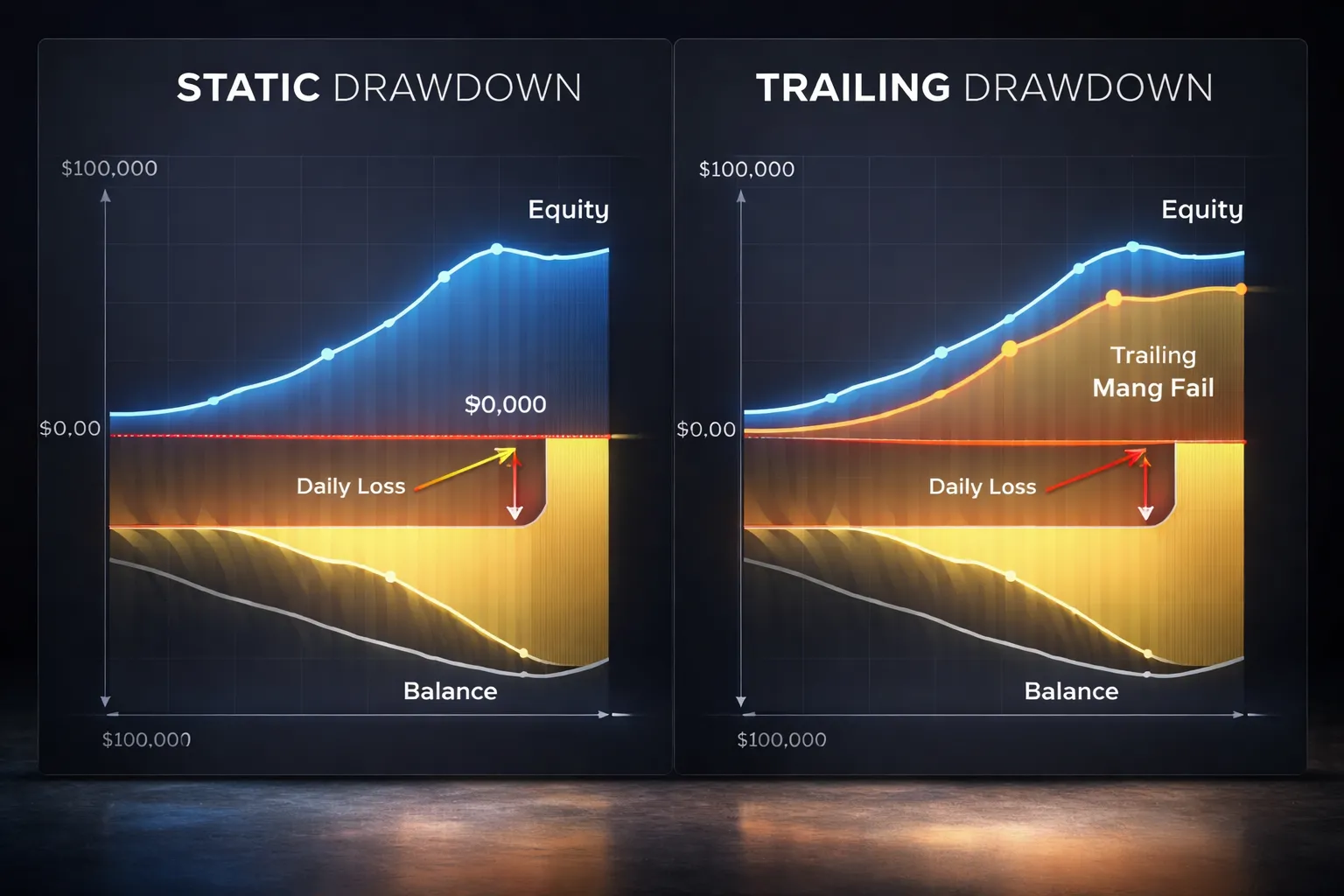
Static drawdown uses a fixed floor. The floor does not move up when you make profits.
Example. You start with a 100,000 balance. Max drawdown is 10% fixed. Your hard floor is 90,000 for the whole phase.
- Pass math is simple. Your worst allowed equity or balance is always 90,000.
- Profits do not tighten risk. If you reach 105,000, your floor stays 90,000.
- Modeling is clean. You can plan position size from a constant max loss in dollars.
Trailing drawdown, how the high-water mark moves against you
Trailing drawdown moves the floor up as your account hits new highs. The firm tracks a high-water mark, then applies a buffer.
Example. 10% trailing drawdown on a 100,000 account.
- You hit a new peak equity of 110,000.
- Your new trailing floor becomes 99,000.
- If you later drop to 98,999, you fail even though you are above the starting balance.
Trailing drawdown punishes giveback. It can force you to reduce risk after a good run, even if your strategy expects normal pullbacks.
Equity vs balance drawdown, floating P&L and stop-out surprises
Balance drawdown uses closed trades only. Equity drawdown includes floating profit and loss.
- Balance rule. You can sit in open drawdown without failing until you close, but you can still hit margin stop-out.
- Equity rule. A spike can fail you mid-trade because equity dips below the limit for a second.
If the rule uses equity, your true limit is your worst intrabar excursion. That includes spread widening, slippage, and news wicks.
Daily drawdown vs max drawdown, one violation ends the account
Firms usually run two independent kill switches.
- Daily drawdown. A one-day loss cap, often based on start-of-day equity or balance, sometimes with a reset time.
- Max drawdown. A total loss cap for the whole account, static or trailing.
You must satisfy both at all times. You can respect max drawdown and still fail on daily drawdown. One breach is enough.
Worked examples, what a 10% max loss means at different equity levels
Assume a 100,000 starting account and 10% max drawdown. Numbers below show your fail line.
| Peak equity reached | Fail line with 10% static | Fail line with 10% trailing |
|---|---|---|
| 100,000 | 90,000 | 90,000 |
| 105,000 | 90,000 | 94,500 |
| 110,000 | 90,000 | 99,000 |
| 120,000 | 90,000 | 108,000 |
With trailing drawdown, every new high reduces your allowed giveback in dollars. Your best run can make the account more fragile.
Practical monitoring, how to track drawdown in-platform and with a spreadsheet
Track the rule the firm enforces, not the one you prefer.
- In-platform. Watch equity in real time. Add an alert at your fail line. Use the trade tab to monitor floating P&L and margin level.
- Journal view. Record end-of-day balance, end-of-day equity, and the day’s realized P&L. Note the firm reset time.
- Spreadsheet. Keep four cells: Start balance, peak equity, trailing fail line, and current equity. Update peak equity whenever you print a new high.
Spreadsheet formulas you can use.
- Peak equity: =MAX(previous_peak, current_equity)
- Static fail line: =start_balance*(1-max_dd)
- Trailing fail line: =peak_equity*(1-max_dd)
- Buffer to failure: =current_equity - fail_line
If you trade from signals, you still own the risk. Size each trade to the smallest remaining buffer, daily or max. Use a checklist, and vet any provider the same way you vet a strategy. See forex signals, are they worth it.
Payouts and profit splits: what you really get paid and when
Profit split structures, what the headline percentage hides
Most firms market a profit split, 70/30, 80/20, or 90/10. The split only applies after you meet payout conditions. Those conditions decide what you really earn.
- 70/30. Common on smaller accounts, instant funding models, or firms with loose rules. Expect tighter payout gates.
- 80/20. The standard. Still read payout timing, minimum days, and consistency rules.
- 90/10. Often linked to scaling, add-ons, or higher tiers. You usually need a payout track record first.
Check for qualifiers that reduce your effective split.
- Profit split applies only to “approved” profits. Some firms remove profits made during news, high slippage, or “abnormal” conditions.
- Consistency rules. They cap any single day’s profit as a percent of total profits at payout time. You may need to keep trading after a big day to “dilute” it.
- Minimum trading days. You can hit the target fast and still wait until you log enough days.
- Max lot limits and risk caps. They block the style that produced your best results.
- Profit split changes after scaling. Some firms raise the split, others reset conditions or tighten rules.
Withdrawal schedules, when you can actually take money out
Payout timing matters more than the profit split. A high split with a slow schedule pays less in practice.
- First payout timing. Common windows include 7 days, 14 days, or 30 days after funding, or after your first billing cycle.
- Payout frequency. Weekly, biweekly, or monthly. Faster cycles reduce your exposure to firm failure risk.
- Minimum payout threshold. Many firms require a minimum amount, like $50, $100, or $500. Small accounts can get trapped below the threshold.
- Balance buffer rules. Some firms require you to keep a minimum balance above drawdown lines after the withdrawal.
- Review period. Some firms add “manual review” that delays payment. Treat open-ended reviews as a risk signal.
| Term | What it changes | What to check |
|---|---|---|
| First payout date | How fast you de-risk the firm | Calendar days vs trading days, and start point |
| Payout frequency | Cash flow and compounding speed | Fixed schedule vs “request anytime” |
| Minimum threshold | Whether small profits get paid | Threshold per payout, and whether it resets |
| Withdrawal impact | Risk of violating drawdown after payout | Does max drawdown recalc from start balance or current balance |
Performance fees vs commissions and spreads, your net profit
Your payout is a share of net profit, after trading costs. Firms can change your net result without touching the profit split.
- Spread markups. A wider spread is a silent fee. It hurts scalping and tight-stop systems the most.
- Commissions per lot. Compare the advertised commission to what you see in the platform. Check round-turn cost on your main pairs.
- Swap and financing. If you hold positions overnight, swap can turn a winning system into a break-even one.
- Slippage rules. Some firms void trades if slippage exceeds a threshold, or blame you for “latency arbitrage.”
- Fees for add-ons. Higher profit splits, faster payouts, or higher leverage often cost extra. Treat them like a subscription. Include them in your expected value.
Track net performance like a business. Log gross P and L, commissions, spreads, swap, and challenge fees. Then compute your realized payout rate.
Scaling plans and pay bumps, how firms reward consistency
Scaling looks simple, trade well and get more capital. The rules usually focus on risk control and payout history, not just returns.
- Milestones. Many plans require one or more payouts before any increase.
- Consistency. Firms often require a max daily profit percentage, a minimum number of trading days, and no breaches in the prior period.
- Capital increases. Typical steps include 10 to 25 percent bumps, then larger jumps after multiple payout cycles.
- Split increases. Some firms raise the split from 80/20 to 85/15 or 90/10 after a set number of payouts.
- Reset risk. Some firms reset trailing drawdown baselines or add new constraints when you scale. Read the scaling terms like a new contract.
If you want a clean plan for passing and then staying payout-eligible, use this step-by-step plan to pass a prop firm challenge.
Payout methods and fees, and the chargeback problem
How you get paid affects cost, speed, and clawback risk.
- Bank transfer. Slower. Often higher fees. Better paper trail. Lower reversal risk once settled.
- Crypto. Fast. Fees vary. You take price risk between approval and conversion. Some firms use crypto to avoid chargebacks and banking scrutiny.
- E-wallets. Fast and convenient. Some providers can freeze funds during disputes or compliance checks.
Ask what fees apply on both sides. Some firms pay sending fees but you pay receiving fees. Some deduct conversion spreads. Confirm whether payouts come from the firm directly or through a payment processor.
Taxes and documentation, treat payouts like contractor income
Most retail prop firm payouts function like contractor income, not wages. The firm usually does not withhold taxes for you.
- Invoices. Some firms require you to generate an invoice for each payout. Keep a copy with payout confirmations.
- 1099 and local equivalents. US traders may receive a 1099, or you may receive nothing and still owe taxes. Non-US traders face local rules.
- Recordkeeping. Save contracts, rulebooks, payout statements, platform reports, and proof of challenge fees. Track dates, amounts, and payout method IDs.
- Entity and residency issues. If you trade through a company or from abroad, document beneficial ownership and tax residency. Firms may request KYC updates.
Do not wait until year-end. Build a folder per account and per payout cycle. Clean records protect you if the firm disputes profits or if your bank asks questions.
Execution and trading conditions that affect your results
Spreads, commissions, and swaps, why a “cheap” account can be expensive
Your costs come from three places, spread, commission, and swap. Firms market “raw spreads” or “zero commission” accounts. The total cost can still be high.
- Spread. You pay it on entry and exit. Wider spreads hit tight stops and high frequency systems.
- Commission. You pay per lot, per side, or round turn. Convert it into pips so you can compare accounts.
- Swap. You pay or earn it at rollover. Many prop accounts apply a markup. Some “swap-free” accounts add a fixed fee or widen spreads.
Track your all-in cost per instrument. Use a simple conversion for majors.
| Item | What to check | How it hurts challenge results |
|---|---|---|
| Spread | Average and worst-case during your trading hours | More stop-outs, lower R:R, harder to hit targets |
| Commission | Per lot, per side vs round turn, minimum ticket fees | Scalping edge disappears, breakeven rate rises |
| Swap | Long and short swaps, triple swap day, swap policy on indices and metals | Overnight holds turn negative, equity drawdown grows |
Rule of thumb for EURUSD on a standard lot. About $10 equals 1 pip. A $7 round-turn commission equals about 0.7 pips. Add the spread and you get your real cost.
Slippage and requotes, what normal looks like during volatility
Slippage decides if your plan survives news, opens, and fast moves. You will see it even with good brokers. You need to know what is acceptable.
- Normal slippage. Small and mixed. Some fills better, some worse. It clusters during high volume events.
- Bad slippage. Mostly one-way against you. It shows up in calm markets. It grows on small order sizes.
- Requotes. They should be rare on modern execution. Frequent requotes signal weak liquidity or dealer intervention.
Log every trade with requested price, filled price, time, and session. Then summarize by symbol and hour. If your average slippage stays negative in quiet hours, treat it as a red flag.
Liquidity and order types, market vs limit vs stop and fill quality
Order type changes your fill quality and your risk during the challenge.
- Market orders. You get filled, but price can move. Use them when entry certainty matters more than price.
- Limit orders. You control price, but you may miss the trade. You can still get slippage on fast markets, especially on limit take profits.
- Stop orders. You enter on momentum, but you pay the worst spreads and the worst slippage during spikes.
Check if the firm uses MT4, MT5, cTrader, or a web platform. Execution differs by platform and bridge. Ask for the liquidity model. A firm can run B-book style risk controls even on “demo” challenge feeds.
Watch for these fill issues.
- Stop orders that trigger early because spreads expand.
- Limit orders that do not fill even when price touches your level.
- Partial fills on larger sizes, then worse prices on the remainder.
Server time, session spreads, and rollover behavior
Server time controls your daily candle close, your indicators, and your rollover. It also controls when a “trading day” starts for daily drawdown rules.
- Daily reset time. Confirm the exact server reset used for daily loss and daily drawdown.
- Session spreads. London and New York usually run tighter. Asia can widen on some pairs. The Sunday open and Monday rollover can spike.
- Rollover. Spreads often widen near rollover, and swaps post at that time. Triple swap can hit on a specific weekday based on the broker’s schedule.
If your strategy holds through rollover, test it on the firm’s feed first. One bad spread spike can trigger an equity drawdown breach even if price never hit your stop.
For the rule side of daily and overall drawdowns, keep your definitions aligned with the firm’s terms, and cross-check them with your logs. Use prop firm challenge rules as your baseline.
Symbol lists and contract specs, lot sizing, margin, and stop level requirements
Two firms can list the same symbol and still enforce different contract specs. Small differences can break your sizing and your risk limits.
- Contract size. Confirm units per lot for FX, metals, indices, and crypto. Some CFDs use non-standard sizing.
- Tick size and tick value. Your stop distance and your expected loss depend on it.
- Minimum and maximum lot. This affects scaling and recovery sizing. It also affects copy or trade management tools.
- Margin and leverage. Higher margin means you hit margin limits sooner. It can force smaller positions and slow target progress.
- Stop level. Some symbols require a minimum distance for stops and limits. Tight stop systems fail if stop level is high.
- Trading hours. Some symbols close earlier or pause daily. You can get trapped in positions if the market goes “close only.”
Before you start, open the contract specification window for every symbol you trade. Save screenshots. If the firm changes specs mid-challenge, you can prove the change and adjust fast.
Pros, cons, and who prop challenges are (and aren’t) for
Benefits for disciplined traders, capital access and structured risk
If you already trade with tight execution and fixed risk, a challenge can be a fast way to access larger notional size without adding your own deposits.
- Capital leverage without personal ruin. You risk the fee, not your account balance. The trade-off is strict limits.
- Built-in risk rails. Daily loss limits and max drawdown force position sizing discipline. If you tend to overtrade, the rules can stop you early.
- Repeatable operating model. Same targets, same limits, same payout cycle. You can treat it like a production process.
- External accountability. Clear rules reduce decision drift. You either comply or you fail.
Downsides for newer traders, rule friction, psychology, and fee drag
For most new traders, the biggest enemy is not the market. It is the rule set. Small mistakes become account-ending events.
- Rule friction breaks good systems. News bans, minimum stop distances, lot caps, limited symbols, and trading hour restrictions can invalidate your edge.
- Daily loss limits amplify noise. A normal losing streak can hit the daily cap before your strategy has time to recover. You then sit out the best rebound days.
- Fee drag is real. If you fail and retry, the fees act like negative carry. Your break-even win rate rises because you must pay to keep playing.
- Target pressure changes your behavior. Profit targets plus time limits can push you into higher risk per trade, more trades, or lower quality setups.
- Compliance risk. One mistake can void a payout, even if you made money. This includes lot sizing errors, holding through restricted events, or hitting a soft limit that triggers closure.
When a personal account may be better, flexibility and long-term expectancy
A personal account often wins if your edge needs time, flexibility, or specific trade management rules.
- You trade for expectancy, not for targets. A real edge plays out over many samples. Challenge targets force short-term performance.
- You need freedom on risk. You can scale down during drawdowns, pause, or change instruments without violating a rule.
- You hold trades longer. Swing systems often collide with weekend rules, news rules, or daily drawdown rules.
- You want predictable costs. With your own account you pay spreads, commissions, and swap. You avoid reset fees and rule-triggered forfeits.
- You can compound without payout gates. Prop models often limit scaling, enforce payout schedules, and apply consistency rules that block aggressive compounding.
- You prefer delegation. If you want to follow another trader, consider forex copy trading instead of forcing your style into a challenge template.
Realistic success expectations, pass rates, variance, and survivorship bias
Expect most traders to fail. Treat marketing screenshots as outliers.
- Pass rates are low. Publicly disclosed numbers vary by firm and rules, but realistic first-try pass rates often land in the low single digits to low double digits. Harder rules push it lower.
- Variance dominates small samples. A challenge is a short performance window. Even a profitable trader can fail due to normal drawdowns, spread widening, or a few slippage events.
- Survivorship bias distorts what you see. You see funded screenshots and payout posts. You do not see the large pool of resets, rule breaches, and quiet failures.
- Payout odds differ from pass odds. Passing does not guarantee you keep the account. Many traders pass with elevated risk, then breach drawdown rules during the first payout cycle.
- Model the whole pipeline. Your real expected value depends on fee, probability of pass, probability of first payout, payout split, and the chance of breaching rules later.
How to choose a prop firm challenge safely (due diligence checklist)
Transparency signals
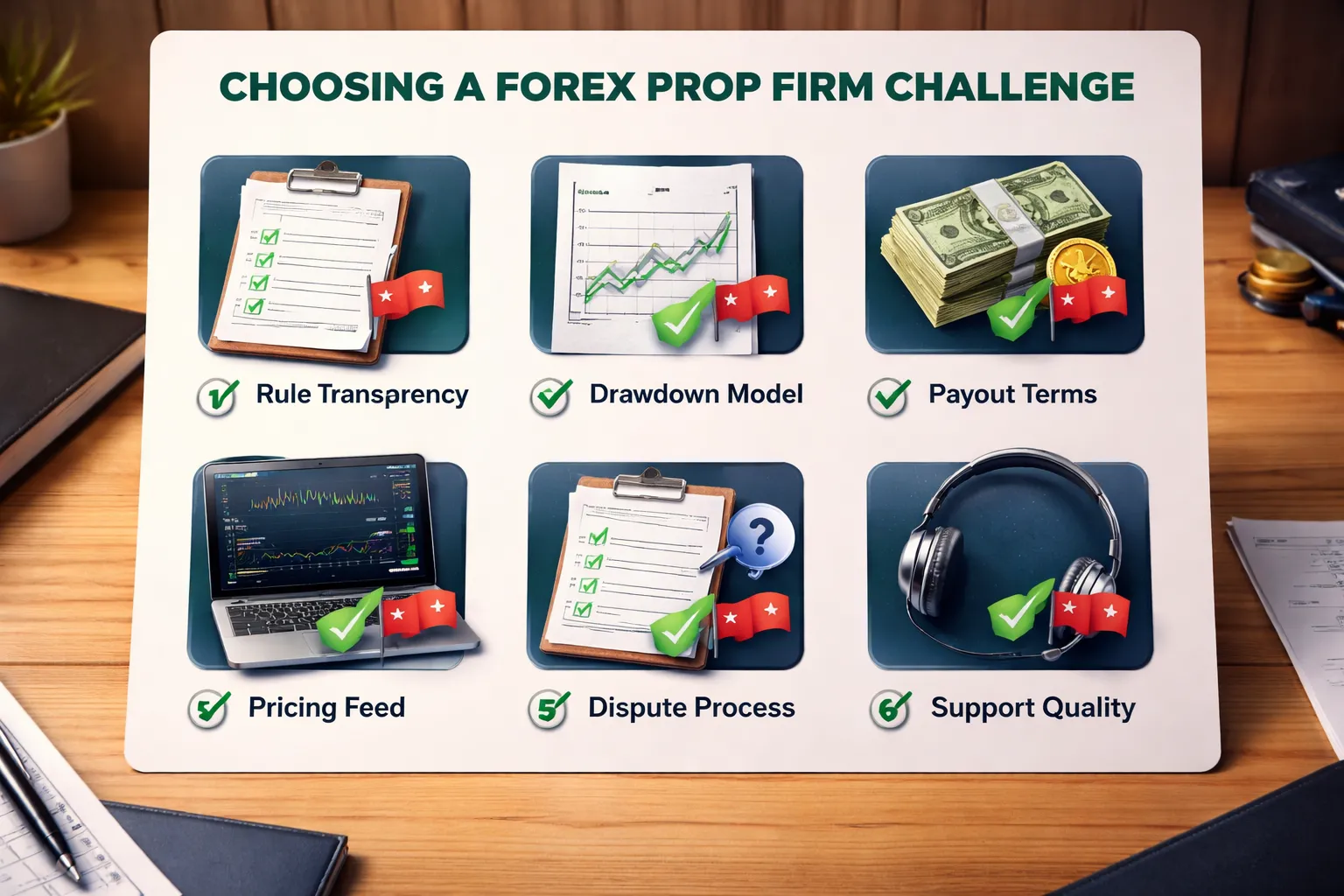
- Published rulebook. You need a single, dated document. It must define profit target, drawdown type, daily loss, consistency rules, news rules, weekend rules, and prohibited strategies.
- Clear breach definitions. The rulebook must state what triggers a breach, when it triggers, and what price source it uses. It must say if equity or balance drives each limit. It must define the time zone for daily limits.
- Live dashboards. You should see real time equity, max loss limits, and remaining drawdown. You also need a full trade log with timestamps and prices.
- Reset and retry terms. Check price, when you can reset, and whether they void open trades. Avoid vague “case by case” language.
- Public rule change policy. Look for version history. Avoid firms that can change rules mid cycle without notice.
Company credibility
- Ownership and legal entity. Find the registered company name, jurisdiction, and address. Match it to the website footer, invoices, and terms.
- Track record. Check how long the brand and domain have existed. New domains, frequent rebrands, or cloned sites raise risk.
- Trader feedback patterns. Ignore single reviews. Look for repeated specifics, payout delays, “breach on spike,” rule changes, forced slippage, or support going silent after denial.
- Payment rails. Stable firms support cards or reputable processors, plus standard tax or KYC steps before payout. “Crypto only” can still be legitimate, but it increases your recovery risk.
Broker model and data integrity
- Who provides pricing. You need the platform, the broker name, and the liquidity or price feed source if they disclose it. If they run a simulator, they should say so.
- Spread and execution policy. Check typical spreads on majors during liquid hours and news. Check if they widen spreads during rollover and events.
- Dispute process. You need a written method to challenge a breach. It should include required evidence, a timeline, and the data they will use to decide.
- Audit trail. The best setups give you downloadable statements, server time, and order level details. You need this when a breach depends on a single tick.
Support quality
- Response times. Test them before you pay. Ask one rule question that requires a precise answer. Measure time to first response and time to resolution.
- Escalation path. You need a way to escalate a dispute beyond front line chat. Look for a support ticket system and a compliance or billing contact.
- Written confirmations. Get rule clarifications in writing. Save screenshots or emails. If support refuses to confirm anything, assume you have no protection.
Terms that matter most
- Payout eligibility. Check minimum trading days, profit split, payout schedule, and if you must end the period flat. Check if they block payouts after “high risk” trading even if you followed the rules.
- Discretion clauses. Watch for “we may deny payout at our sole discretion,” “simulated profits,” “unusual trading,” or “to protect our business.” The broader the clause, the higher your payout risk.
- Account termination language. Look for termination without cause, retroactive breach findings, and the ability to void trades after the fact.
- Consistency rules. If they limit single day profit, lot size growth, or require “steady” returns, you need a numeric definition. Vague consistency rules let them reject payouts.
- News and EA rules. Confirm if they ban trading around red news, restrict EAs, restrict copy trading, or require strategy disclosure.
Comparing offers without getting fooled
Most comparisons hide risk in the drawdown model and payout terms. Normalize every offer with the same inputs.
- Convert drawdown to usable risk. Static balance drawdown gives you more room as you gain. Trailing equity drawdown tightens as you profit. Treat trailing drawdown as lower effective leverage.
- Compute net payout, not split. Use fee plus any activation or data fees. Then estimate your expected net after the split. A higher split can still pay less if rules cut payout frequency.
- Compare the whole pipeline. Use pass rate, first payout rate, and survival rate past payout one. If the firm hides these, assume they are weak.
- Standardize account size. Compare cost per 1,000 of drawdown, not headline account size. A “200k” with tight trailing drawdown can behave like a smaller account.
- Check rule friction. Add penalties for minimum days, restricted instruments, prohibited holding, and strict consistency caps. These reduce your real edge.
| Checklist item | What you want to see | Red flag |
|---|---|---|
| Rule clarity | Equity vs balance defined, time zone defined, breach examples | Vague “risk abuse” and undefined consistency rules |
| Drawdown model | Static or clearly specified trailing, dashboard shows limits live | Trailing rules buried in FAQs, no live limit display |
| Payout terms | Clear schedule, clear eligibility, objective denial criteria | Sole discretion payout denial, retroactive rule claims |
| Execution and pricing | Named broker or feed, dispute workflow with timeline | “Our prices are final,” no dispute path |
| Support | Ticketing, escalation, written confirmations | Chat only, no written commitments |
If you rely on a third party strategy, run the same due diligence you would use when picking a signal service. Use this guide on best Forex signal providers as a baseline for vendor checks.
Red flags and common scams in retail prop challenges
Vague or changing rules
Bad firms keep rules flexible so they can fail you after the fact. You pay the fee, trade, then hit a hidden tripwire.
- “We can deny for any reason” clauses. Look for language that lets them cancel accounts, void profits, or refuse payouts without a specific breach.
- Rule changes mid-challenge. They update max lot size, news rules, drawdown method, or trading hours after you start.
- Undefined terms. “Gambling,” “toxic flow,” “HFT,” “latency abuse,” or “grid” with no measurable definition.
- No clear dispute process. No ticketing, no timestamps, no written outcome, no timeline.
Unverifiable payouts and fake proof
Scammy firms market payouts without proving you can get paid under normal conditions.
- Cherry-picked testimonials. Screenshots of dashboards, DMs, or edited invoices without transaction proof.
- No proof of payment method. They never show real transfer references, processor receipts, or consistent payout history.
- “Pending” payout culture. Many public posts about delayed payouts, extra checks, or repeated compliance reviews.
- Private payout terms. They hide payout eligibility rules behind support chat or after you purchase.
Execution manipulation signs
Some firms fail traders through execution that does not match normal market behavior.
- Abnormal spikes. Your chart prints wicks that do not appear on reputable feeds at the same timestamp.
- One-sided slippage. You get negative slippage on entries and exits, but never positive slippage.
- Spread widening at key moments. Spreads blow out around your stop levels more than on comparable brokers.
- Frequent “off quotes” and requotes. These appear during volatility, then disappear when you are not in profit.
- Execution stats not disclosed. No published policy for slippage, liquidity source, or order handling.
Paywall traps to access payouts
Some firms let you pass, then add costs to unlock withdrawals.
- Required add-ons. Paid data packages, platform fees, “pro” accounts, or verification charges tied to payout access.
- Mandatory upgrade. You must buy a bigger account or subscription before your first withdrawal.
- Processor fees pushed to you. High withdrawal fees, forced crypto rails, or forced conversion spreads.
Impossible constraints designed to make you fail
Look for rule sets that force you into high risk trading.
- Tight daily drawdown with a high profit target. Example pattern: 4 to 5 percent daily limit with an 8 to 10 percent target.
- Short durations. Few trading days combined with strict limits. You cannot wait for clean setups.
- Trailing drawdown that punishes profits. Your allowed loss shrinks or trails equity in a way that makes scaling hard.
- Forced trading rules. Minimum trade count, mandatory trading days, or lot caps that block normal risk control.
Copy-trading crackdowns and retroactive violations
Some firms use copying rules as a payout denial tool. They flag you after you become eligible.
- Retroactive “copy trading” violations. They approve your trading for weeks, then label it copying at payout time.
- Loose definitions. “Similar strategy,” “mirrored trades,” or “common entry timing” without clear thresholds.
- Group punishment. They void your account because another trader used a similar system.
- No appeal evidence. They refuse to share trade-matching logic or timestamps used to accuse you.
If you use copying tools, read this guide on forex copy trading and document your execution chain.
Chargeback pressure and payment friction
High pressure billing often shows up with firms that expect disputes.
- “No refunds” on day one. Even when you have not placed a trade.
- Chargeback threats. They warn you that a dispute triggers bans, doxxing, or public accusations.
- Weird payment routing. Multiple merchant names, personal payment links, crypto-only pushes, or constant processor changes.
- Upsell after failure. They push “reset fees” and instant rebuys instead of clear coaching or rule clarity.
Aggressive affiliate marketing and unrealistic income claims
Many retail prop brands run on affiliate volume. That does not automatically mean fraud, but it changes incentives.
- Influencer-heavy acquisition. More payout hype than rule transparency, execution quality, or risk disclosures.
- Unrealistic income claims. “Daily payouts,” “guaranteed funding,” or “replace your job” messaging.
- Discount funnels and urgency. Constant flash sales, countdown timers, and “last chance” offers every week.
- Affiliate-first support. Fast sales replies, slow compliance replies, slow payout replies.
Quick red flag checklist
| Red flag | What you should see instead |
|---|---|
| Rules can change any time | Versioned rules, clear effective dates, and grandfathering for active accounts |
| Payout proof is only screenshots | Consistent payout history, clear methods, published timelines, written approvals |
| Spikes and one-sided slippage | Disclosed execution policy and a dispute path with evidence and timestamps |
| Fees to unlock withdrawals | All costs shown upfront, no mandatory upgrades for payout eligibility |
| Targets and limits force overtrading | Targets, drawdowns, and time limits that allow normal risk control |
| Retroactive copy-trading accusations | Clear thresholds, consistent enforcement, and an appeal process |
| Threats around chargebacks | Normal refund policy, clear dispute channel, professional billing |
| Affiliate hype and income claims | Transparent stats, realistic risk statements, and product-first documentation |
Practical strategies to pass without breaking rules
Risk framework, per-trade risk, daily stop, weekly loss cap
You pass challenges by surviving the rules. Start with your loss limits, then work backward.
- Per-trade risk: keep it small and fixed. Many challenge blowups come from one oversized trade.
- Daily stop: set a hard cut for the day, below the firm’s daily loss rule. Stop trading when you hit it.
- Weekly loss cap: treat your weekly cap as your true max drawdown, even if the firm only enforces daily and total.
Planning math you can use.
- If the firm allows 5% daily loss, use a 2% to 3% personal daily stop.
- If the firm allows 10% max loss, cap your plan at 6% to 8%. Give yourself room for variance.
- Risk per trade should fit your daily stop. Example, if your daily stop is 2%, limit yourself to 4 trades at 0.5%, or 6 trades at 0.33%. Do not exceed the day’s “risk budget.”
Position sizing examples, fixed fractional vs volatility-based
Use sizing that stays stable when spreads widen and volatility jumps.
- Fixed fractional: you risk the same percent each trade. Simple. Works when your stop placement stays consistent.
- Volatility-based: you size from stop distance. Best for mixed instruments and changing volatility.
Fixed fractional example.
- Account: $100,000.
- Risk: 0.50% per trade, $500.
- If your stop is 25 pips, you size so that 25 pips equals $500. If the stop must be 50 pips, cut size so 50 pips still equals $500.
Volatility-based example using ATR logic.
- Define stop as 1.5 x ATR(14).
- If ATR expands, your stop distance increases, your position size decreases. Your dollar risk stays constant.
- This reduces random stop-outs that trigger revenge trades and rule breaks.
Trade selection, avoid low-quality setups and overtrading
Challenges punish noise trading. You need fewer trades with clearer edges.
- Trade only your top 1 to 3 setups. Park everything else.
- Skip the first minutes after high-impact news if your rules do not handle spread spikes.
- Avoid “make it back” trades after a loss. This creates size creep and daily limit hits.
- Limit trades per day. A hard cap forces selection and reduces tilt.
Simple filter you can enforce.
- Enter only when you have a clear stop location, a planned target, and a reason the trade works now.
- Require minimum reward-to-risk that fits your win rate. If you do not know your win rate, assume you are average and do not rely on huge RR claims.
Managing open risk, partials, moving stops, reduce correlation
Open trades can violate rules even when your entry was fine.
- Partials: scale out at preplanned levels. This reduces exposure and smooths equity swings.
- Stop management: move stops only with structure, not with fear. Define rules like “move to break-even after price closes beyond X.”
- Correlation control: do not stack the same bet across pairs. EURUSD, GBPUSD, and XAUUSD can move together on USD flows.
Correlation rule you can apply.
- Limit total USD exposure. Example, no more than 1.0% combined risk across all trades driven by the same currency theme.
- If you already risk 0.5% on EURUSD, do not add 0.5% on GBPUSD unless you accept they can lose together.
Psychology under constraints, drawdown pressure and target chasing
Challenges create a bad incentive. You feel forced to hit a target fast. You are not.
- Trade your process. Let the target come from repetition, not from one big day.
- Reduce size after drawdown. Do not “hold size to get back faster.”
- Use a cooldown rule. After two losses, stop for a set time. Protect your daily limit.
Target chasing pattern to avoid.
- You increase frequency, widen stops, or remove stops.
- You flip bias without a rule.
- You trade outside your best hours.
Using journaling and metrics, expectancy, MAE/MFE, rule compliance
You need numbers that tie to the rules. Track what the firm can disqualify, then track what makes you profitable.
- Expectancy: average outcome per trade. Use R-multiples so it stays comparable across sizes.
- MAE: maximum adverse excursion. It shows how close you come to your stop and whether stops are too tight.
- MFE: maximum favorable excursion. It shows what you leave on the table and whether exits cut winners early.
- Compliance rate: percent of trades that followed your rules. This matters more than win rate in a challenge.
| Metric | What you record | What you fix |
|---|---|---|
| Expectancy (R) | Avg win (R), avg loss (R), win rate | Stop trading setups with negative expectancy |
| MAE | Worst drawdown during trade | Adjust stop placement, avoid noisy entries |
| MFE | Max unrealized profit | Improve take-profit logic, reduce early exits |
| Rule compliance | Size, stop use, session, news filter, max trades | Remove decisions that cause violations |
If you want to reduce rule risk further, choose firms with clear sizing, drawdown, and payout terms. Use a shortlist from best forex prop firms before you pay for another attempt.
Challenge scenarios and examples (so you can sanity-check your plan)
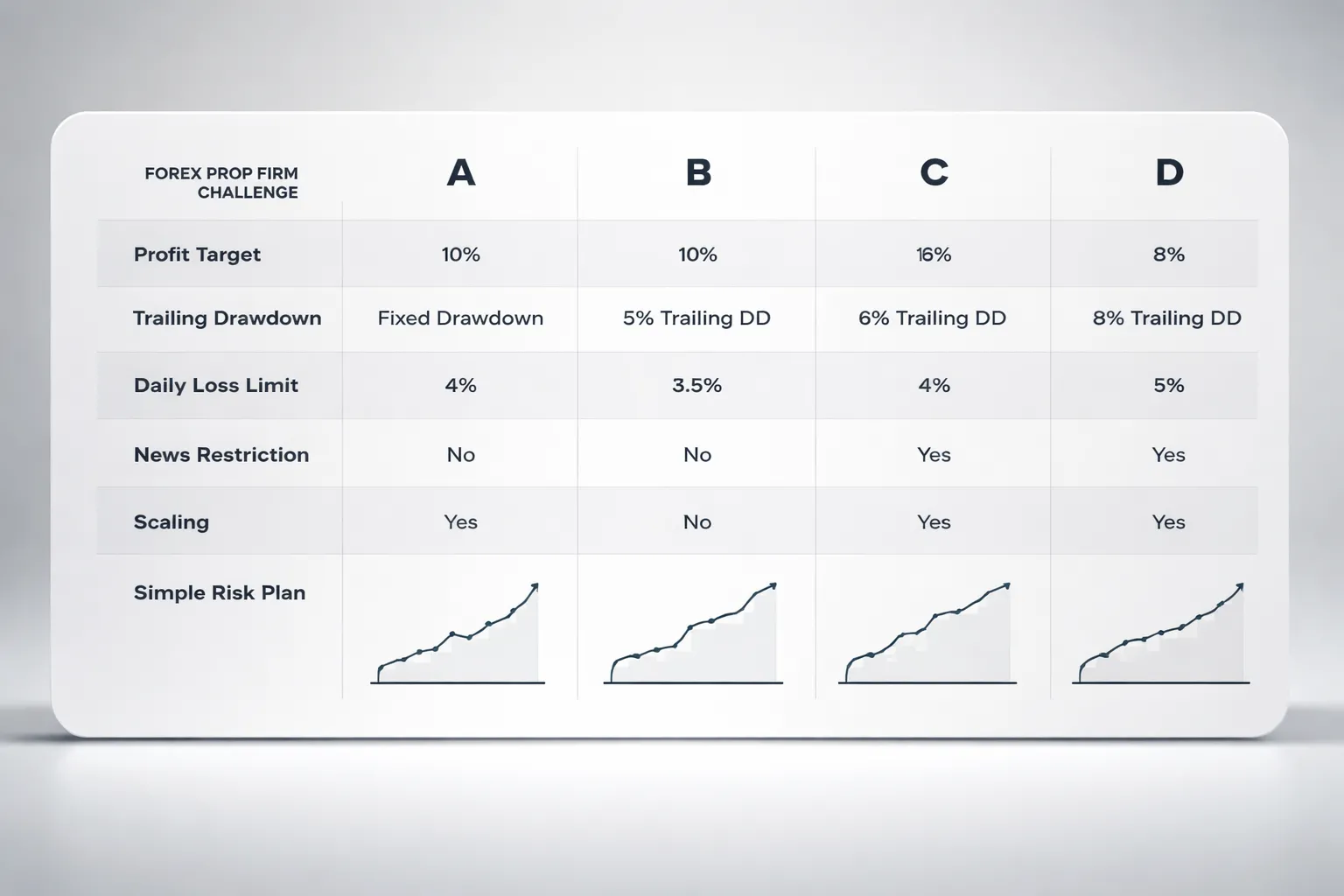
Scenario A: Two-step challenge with trailing drawdown and a strict daily limit
This is the hardest combo. Trailing drawdown punishes fast early gains and oversized positions. A strict daily loss limit punishes clustering trades.
- Assume: $100,000 account. Step 1 target 8%. Step 2 target 5%. Trailing drawdown 10% of peak equity. Daily loss limit 5%.
- Key mechanic: As equity hits a new high, your max loss line moves up. Your “risk budget” shrinks if you keep trading the same size after a run-up.
| Equity high | Trailing DD (10%) | Max loss line | Room before breach |
|---|---|---|---|
| $100,000 | $10,000 | $90,000 | $10,000 |
| $106,000 | $10,600 | $95,400 | $10,600 |
| $108,000 | $10,800 | $97,200 | $10,800 |
Now add the daily limit. If the firm uses intraday equity for daily loss, a temporary drawdown can fail you even if you finish the day green.
- Sanity-check: cap daily risk so two normal losses cannot hit the daily limit. Example, if daily limit is 5%, keep planned daily loss under 2% to 2.5%.
- Trade count control: if you take many small trades, you can still stack losses and breach the daily limit. Set a max losses per day, not just max risk per trade.
- After a big win: reduce size. Your trailing line moved up, but your probability of mean reversion also rose. Protect the high watermark.
Scenario B: No time limit, but a higher profit target, how pace changes risk
No time limit lowers pressure. A higher target increases exposure to random drawdowns. Your edge needs enough samples without hitting the max loss rules.
- Assume: $50,000 account. Target 12%. Max drawdown 10%. Daily loss 5%. No time limit.
- Math you need: target is $6,000. Max total loss allowed is $5,000. You must reach the target with less room than the target itself.
| Plan | Risk per trade | Expected net per 20 trades at 0.3R avg | Downside if you hit 10 losses in a row |
|---|---|---|---|
| Fast pace | 1.0% | +6.0% | -10.0% |
| Slow pace | 0.5% | +3.0% | -5.0% |
Fast pace can finish quickly. It can also fail quickly. Slow pace needs more trades, but it keeps you away from the cliff edge.
- Sanity-check: pick a risk level where a bad week cannot end the account. If your strategy can see 6 to 10 trade losing streaks, 1% risk per trade can be fatal under a 10% max drawdown.
- Rule-fit: if the firm enforces minimum trading days, slow pace helps. If it enforces inactivity rules, plan a steady cadence.
- Execution: with no time limit, you can skip marginal setups. Your best edge becomes selection, not frequency.
Scenario C: News restrictions, planning around CPI, NFP, and FOMC weeks
Some firms block trading during high-impact news, or they void profits made inside the restricted window. Others allow trading but ban holding through the release. You need a calendar-based plan.
- Common restriction patterns: no opening trades 2 to 10 minutes before and after. No holding positions during the event. No trading the affected pairs.
- High-impact clusters: CPI and FOMC often sit in the same week. NFP adds a second volatility spike.
| Event | Typical market effect | Simple plan |
|---|---|---|
| CPI | Fast USD repricing, spreads widen | Flatten USD pairs before the window, resume after spreads normalize |
| FOMC rate and presser | Two volatility waves, initial move and reversal risk | Skip the full session, trade next day continuation only |
| NFP | Liquidity vacuum, slippage, whipsaw | Avoid market orders, consider no-trade day if your edge needs tight fills |
- Sanity-check: if your edge depends on news spikes, do not pick firms with news bans. If your edge is technical and fill-sensitive, news bans can protect you.
- Operational rule: schedule “flat times” on your calendar. Treat them like hard stops. Do not rely on memory.
- Holding risk: if the rule bans holding through events, reduce position size or close earlier. Do not widen stops to “survive” the spike, that can break max loss rules faster.
Scenario D: Scaling plan, keeping drawdown stable as capital increases
Scaling changes your psychology and your execution. You must keep risk stable in percentage terms, and stable in process terms.
- Assume: you pass a $25,000 account, then scale to $50,000, $100,000, and $200,000 based on profit splits and milestones.
- Main failure mode: you keep the same lot size you used to “feel” the trade. Your percentage risk drops, then you overtrade to compensate. Or you raise lot size too fast and hit daily limits.
| Account | Risk per trade | $ risk per trade | Daily loss limit (5%) | Planned max daily loss (2%) |
|---|---|---|---|---|
| $25,000 | 0.5% | $125 | $1,250 | $500 |
| $50,000 | 0.5% | $250 | $2,500 | $1,000 |
| $100,000 | 0.5% | $500 | $5,000 | $2,000 |
| $200,000 | 0.5% | $1,000 | $10,000 | $4,000 |
- Sanity-check: lock a fixed percent risk per trade and a fixed max losses per day. Scale only the dollar size.
- Process stability: keep the same instruments, sessions, and setup filters for the first 20 to 50 trades after a scale-up. Do not “upgrade” your strategy and your size at the same time.
- Drawdown control: add a personal equity stop tighter than the firm’s. Example, stop trading for the week at -3% even if the firm allows -5% daily and -10% total.
- Consistency test: if your results worsen as size rises, your issue is execution or liquidity, not the model. Reduce size until your stats recover.
Use these scenarios to pressure-test your numbers before you buy another attempt. If you need a full checklist, use this step-by-step plan to pass a forex prop firm challenge and map it to the firm’s exact rules.
FAQ
What is a forex prop firm challenge?
It is a paid evaluation. You trade under strict rules to prove you can hit a profit target without breaking drawdown, lot size, or trading limits. If you pass, the firm offers a funded account and pays you a profit split.
How do profit targets work?
You must reach a set percentage gain, often 8% to 10%, while staying within drawdown limits. Targets apply to closed trades only. Some firms require a minimum number of trading days, which forces slower pacing and smaller risk per trade.
What is the difference between daily drawdown and max drawdown?
Daily drawdown caps your loss in a single day, often 4% to 5%. Max drawdown caps your total loss, often 8% to 12%. Daily drawdown usually resets at a fixed server time, not your local midnight.
Are drawdowns calculated on balance or equity?
Firms can use balance, equity, or a trailing method. Equity-based rules count floating loss, which makes holding trades riskier. Trailing drawdown tightens as you gain. Always confirm the exact formula before you trade.
How do payouts and profit splits work?
You receive a percentage of net profits, often 70% to 90%. Payouts happen on a schedule, such as biweekly or monthly, and only after you meet minimum withdrawal rules. Read the fee, refund, and scaling terms in writing.
What trades or styles get you disqualified?
Common bans include latency arbitrage, trade copying between accounts, prohibited EAs, and placing trades during restricted news windows. Some firms also restrict weekend holding, martingale, and high-risk lot jumps. Treat any vague rule as a risk.
Do you need a minimum number of trading days?
Many challenges require 3 to 10 trading days. This rule stops one lucky day from passing. If you trade too large early, you fail on drawdown. Use steady position sizing and aim to pass with margin.
Can you use an EA or copy trading?
Some firms allow EAs, some ban them, and many require that you own the code or license. Copy trading often triggers account linkage rules. If you rely on automation, choose from firms with clear EA and copier policies.
What are the biggest red flags in a prop firm challenge?
Watch for hidden trailing drawdown, unclear daily reset time, payout delays, rule changes without notice, and vague “consistency” clauses. If support cannot explain a rule with numbers and examples, you risk a denial later.
How do you pick a reputable firm?
Start with rule clarity, payout history, broker and liquidity details, and realistic risk limits. Avoid firms that market huge payouts but restrict execution. Use this comparison of the best forex prop firms to shortlist by rules and costs.
Conclusion
A forex prop firm challenge is a rules test, not a trading contest. You win by protecting equity and following limits every day.
- Read the rulebook like a contract. Focus on max daily drawdown, max total drawdown, profit target, minimum trading days, and what counts as a breach.
- Model your worst day. Set a per-trade and per-day loss cap that stays below the firm’s limit after spreads and slippage.
- Trade for payouts, not screenshots. Check payout split, payout schedule, withdrawal rules, and any scaling requirements before you pay a fee.
- Screen for denial risk. Avoid vague consistency rules, execution restrictions, and any clause that lets the firm change terms mid-cycle.
Final tip. Treat every challenge as a compliance job. If a firm cannot explain each rule with numbers and examples, walk away. If you want an alternative path that reduces rule risk, review copy trading forex before you commit.
-
Best Forex Copy Trading Platforms (Features, Fees & Safety Compared)
8 months ago -
Forex Prop Firm Challenge Rules Explained (Drawdown, Targets, Payouts)
8 months ago -
Copy Trading Forex Explained: How It Works, Pros, Cons & Risks
8 months ago -
Best Forex Prop Firms (Top Firms Compared)
8 months ago -
Forex Signals: Are They Worth It? (What to Know Before You Buy)
8 months ago
-
- Profit target rules, how targets interact with drawdown limits
- Daily loss limits, balance vs equity and intraday threshold mechanics
- Total loss limits, what counts and common traps
- Minimum trading days, how firms define a “trading day”
- Consistency rules, daily profit caps, profit distribution limits, and “no one-day pass” policies
- Position sizing restrictions, lot caps, exposure limits, and correlated pairs
- Holding rules, weekend holds, swap and rollover exposure, and market closures
- News and event trading rules, allowed, restricted, or prohibited windows
- Automation rules, EA bots, copy trading, trade mirroring, and API usage
- Prohibited strategies, latency arbitrage, tick scalping, hedging loopholes, reverse trading
-
- Static drawdown, fixed threshold and why it is easier to model
- Trailing drawdown, how the high-water mark moves against you
- Equity vs balance drawdown, floating P&L and stop-out surprises
- Daily drawdown vs max drawdown, one violation ends the account
- Worked examples, what a 10% max loss means at different equity levels
- Practical monitoring, how to track drawdown in-platform and with a spreadsheet
-
- Profit split structures, what the headline percentage hides
- Withdrawal schedules, when you can actually take money out
- Performance fees vs commissions and spreads, your net profit
- Scaling plans and pay bumps, how firms reward consistency
- Payout methods and fees, and the chargeback problem
- Taxes and documentation, treat payouts like contractor income
-
- Spreads, commissions, and swaps, why a “cheap” account can be expensive
- Slippage and requotes, what normal looks like during volatility
- Liquidity and order types, market vs limit vs stop and fill quality
- Server time, session spreads, and rollover behavior
- Symbol lists and contract specs, lot sizing, margin, and stop level requirements
-
- Vague or changing rules
- Unverifiable payouts and fake proof
- Execution manipulation signs
- Paywall traps to access payouts
- Impossible constraints designed to make you fail
- Copy-trading crackdowns and retroactive violations
- Chargeback pressure and payment friction
- Aggressive affiliate marketing and unrealistic income claims
- Quick red flag checklist
-
- Risk framework, per-trade risk, daily stop, weekly loss cap
- Position sizing examples, fixed fractional vs volatility-based
- Trade selection, avoid low-quality setups and overtrading
- Managing open risk, partials, moving stops, reduce correlation
- Psychology under constraints, drawdown pressure and target chasing
- Using journaling and metrics, expectancy, MAE/MFE, rule compliance
-
- What is a forex prop firm challenge?
- How do profit targets work?
- What is the difference between daily drawdown and max drawdown?
- Are drawdowns calculated on balance or equity?
- How do payouts and profit splits work?
- What trades or styles get you disqualified?
- Do you need a minimum number of trading days?
- Can you use an EA or copy trading?
- What are the biggest red flags in a prop firm challenge?
- How do you pick a reputable firm?
-
-
- Profit target rules, how targets interact with drawdown limits
- Daily loss limits, balance vs equity and intraday threshold mechanics
- Total loss limits, what counts and common traps
- Minimum trading days, how firms define a “trading day”
- Consistency rules, daily profit caps, profit distribution limits, and “no one-day pass” policies
- Position sizing restrictions, lot caps, exposure limits, and correlated pairs
- Holding rules, weekend holds, swap and rollover exposure, and market closures
- News and event trading rules, allowed, restricted, or prohibited windows
- Automation rules, EA bots, copy trading, trade mirroring, and API usage
- Prohibited strategies, latency arbitrage, tick scalping, hedging loopholes, reverse trading
-
- Static drawdown, fixed threshold and why it is easier to model
- Trailing drawdown, how the high-water mark moves against you
- Equity vs balance drawdown, floating P&L and stop-out surprises
- Daily drawdown vs max drawdown, one violation ends the account
- Worked examples, what a 10% max loss means at different equity levels
- Practical monitoring, how to track drawdown in-platform and with a spreadsheet
-
- Profit split structures, what the headline percentage hides
- Withdrawal schedules, when you can actually take money out
- Performance fees vs commissions and spreads, your net profit
- Scaling plans and pay bumps, how firms reward consistency
- Payout methods and fees, and the chargeback problem
- Taxes and documentation, treat payouts like contractor income
-
- Spreads, commissions, and swaps, why a “cheap” account can be expensive
- Slippage and requotes, what normal looks like during volatility
- Liquidity and order types, market vs limit vs stop and fill quality
- Server time, session spreads, and rollover behavior
- Symbol lists and contract specs, lot sizing, margin, and stop level requirements
-
- Vague or changing rules
- Unverifiable payouts and fake proof
- Execution manipulation signs
- Paywall traps to access payouts
- Impossible constraints designed to make you fail
- Copy-trading crackdowns and retroactive violations
- Chargeback pressure and payment friction
- Aggressive affiliate marketing and unrealistic income claims
- Quick red flag checklist
-
- Risk framework, per-trade risk, daily stop, weekly loss cap
- Position sizing examples, fixed fractional vs volatility-based
- Trade selection, avoid low-quality setups and overtrading
- Managing open risk, partials, moving stops, reduce correlation
- Psychology under constraints, drawdown pressure and target chasing
- Using journaling and metrics, expectancy, MAE/MFE, rule compliance
-
- What is a forex prop firm challenge?
- How do profit targets work?
- What is the difference between daily drawdown and max drawdown?
- Are drawdowns calculated on balance or equity?
- How do payouts and profit splits work?
- What trades or styles get you disqualified?
- Do you need a minimum number of trading days?
- Can you use an EA or copy trading?
- What are the biggest red flags in a prop firm challenge?
- How do you pick a reputable firm?
-
-
How to Place a Forex Trade Step by Step (Your First Trade Explained)
6 months ago -
Forex Trading vs Crypto Trading: Which Market Is Better for Beginners?
6 months ago -
Forex Lot Size Calculator: How to Use It to Size Trades Correctly
8 months ago -
How to Calculate Position Size in Forex (Position Sizing Formula + Examples)
8 months ago -
Forex Leverage Explained: How It Works, Pros, Cons & Examples
8 months ago
-
Forex Trading Platforms Comparison: MetaTrader vs cTrader vs TradingView
8 months ago -
Stop Loss vs Take Profit: Differences, Examples & Best Practices
8 months ago -
Is Forex Trading Legal in the United States? Rules, Regulators & What to Know
8 months ago -
Forex Market Hours & Trading Sessions Explained (Best Times to Trade)
8 months ago -
Forex Leverage Explained: How It Works, Pros, Cons & Examples
8 months ago