Best Forex Signal Providers (Top Services Compared)
Forex signals tell you what to trade, when to enter, and where to exit. You get a pair, direction, entry price, stop loss, and take profit levels. Some providers send manual alerts from a human analyst. Others push algorithmic signals from indicators and pattern tools.
This guide compares top forex signal providers and signal-enabled brokers. You will learn which services fit your trading style, how each provider delivers signals, what markets and timeframes they cover, and what you pay. You will also see the key metrics that matter, including verified track record, average risk per trade, win rate versus risk to reward, alert speed, and execution method.
If you want a hands-off approach, read our copy trading forex guide first. Signals still require you to place and manage trades, and results depend on your broker spreads, slippage, and discipline.
Key Takeaways
Key Takeaways
- In het kort: Signals are only as good as the proof behind them, and your execution.
- Prioritize providers with a verified track record. Avoid screenshot based results.
- Judge performance by risk to reward and drawdown, not win rate alone.
- Keep risk per trade small and consistent. Your sizing matters more than the entry.
- Check alert speed and delivery method. Delayed signals can flip a good setup into a bad fill.
- Match signals to your broker conditions. Spreads, slippage, and execution model change outcomes.
- Know what you get. Some services sell entries only, others include stop loss, take profit, and trade management rules.
- Start with a demo or small account. Track results over at least 30 to 50 trades before you scale.
- Read our guide on whether forex signals are worth it before you pay.
What Forex Signals Are (And How They Work in Real Trading)
What a Forex Signal Is
A forex signal tells you what to trade, where to enter, and where to exit. You get it as an alert or as an auto trade. You still carry the risk in your account.
Most providers generate signals from technical analysis, news filters, or rule-based models. Some use discretionary traders. Some use algorithms. What matters is the exact trade plan you receive and how it fits your broker conditions.
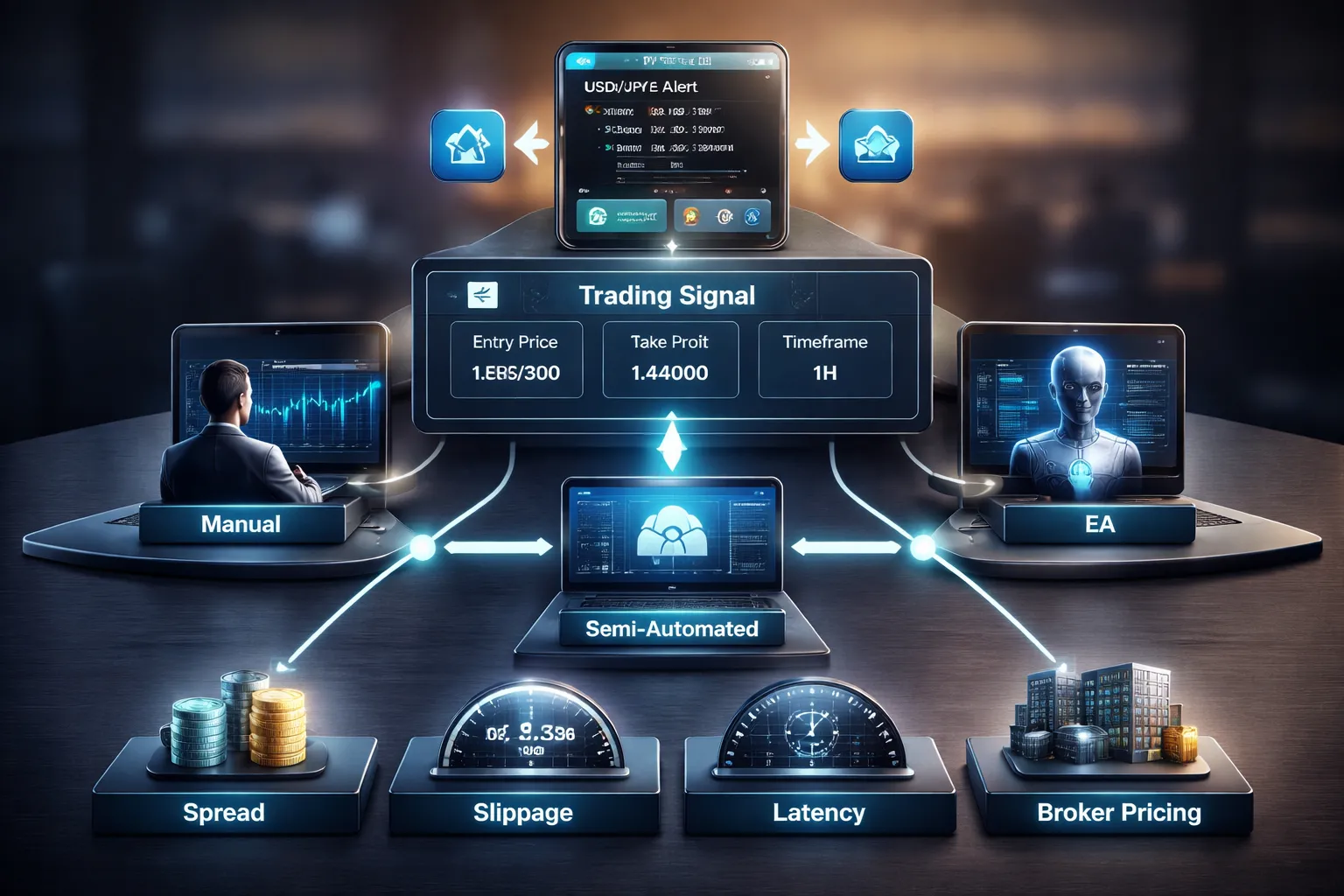
Signal Components You Should See
- Instrument: The market, like EUR/USD, GBP/JPY, XAU/USD, NAS100, or BTC/USD CFD.
- Direction: Buy or sell.
- Entry: A price level or zone. Some use market entry, others use limit or stop orders.
- Stop-loss: The exit price if the trade goes against you. This defines risk.
- Take-profit: A target price. Many signals use one target, others use multiple targets.
- Timeframe: Scalping, intraday, swing. It sets your holding time and your exposure to spreads and swaps.
- Setup rationale: A short reason, like trend direction, support and resistance, breakout level, or news event risk window. This helps you judge if the trade still makes sense when you receive it.
How You Receive Signals
- Telegram or Discord: Fast delivery and group chat. Noise can be high. You must filter updates and edits.
- SMS or email: Simple and reliable. Often slower. Bad fit for short-term entries.
- Mobile apps: Push notifications and trade history in one place. Some apps include position sizing tools.
- Platform plug-ins: Signals inside MT4, MT5, cTrader, or TradingView. Lower copy errors. Execution still depends on your broker.
Execution Models in Real Trading
- Manual alerts: You place the trade yourself. You control sizing and timing. You can miss entries during fast moves.
- Semi-automated trade managers: You approve entries, then the tool sets stop-loss, take-profit, and trailing rules. This reduces mistakes and speeds up order placement.
- Fully automated EAs: The system trades for you based on the signal feed or its own rules. This removes hesitation. It also increases dependency on latency, VPS quality, and broker execution.
If you want hands-off execution, compare signals to forex copy trading platforms. Copy trading ties results more tightly to execution and fees, so testing matters.
Asset Coverage and What Changes in Risk
- Major pairs: Often tighter spreads and deeper liquidity. Slippage usually stays lower in normal conditions.
- Minor and exotic pairs: Wider spreads and thinner liquidity. Stops hit more often from spread spikes and gaps.
- Gold (XAU/USD): Larger point value and fast swings. Stops need more room. News moves can be sharp.
- Indices: Session-driven volatility. Gaps can appear at open. Spreads can widen around major events.
- Crypto CFDs: High volatility and weekend moves. Spreads can be wide. Execution quality varies more by broker.
Why Results Vary Between Traders
| Factor | What happens | What you can do |
|---|---|---|
| Spreads | Higher spreads raise your break-even and cut the effective reward to risk. | Test signals on your exact account type. Avoid scalping signals if your spreads stay wide. |
| Slippage | Your fill price shifts during fast moves. Stops and targets trigger at worse levels. | Use limit orders when the signal allows. Trade liquid sessions. Avoid high-impact news if the provider does not filter it. |
| Latency | Delay between signal, order placement, and broker fill changes entry quality. | Use a VPS near your broker for EAs. Keep manual execution fast and simple. |
| Broker pricing model | Different markups, commissions, and execution rules change net results. | Calculate all-in cost per trade. Compare live fills to quoted prices over 30 to 50 trades. |
Best Forex Signal Providers Compared (Top Picks by Use Case)
Use case decides the right provider. Match signals to your execution speed, risk limits, and time you can monitor trades. The picks below focus on what matters in real trading, clarity, risk controls, and proof.
| Use case | Best fit | What to look for | Watch-outs |
|---|---|---|---|
| Most traders | Balanced signal service | Clear entry, stop, target, risk per trade, and update rules | Vague “buy now” calls, no stop, no sizing |
| Beginners | Education-first provider | Trade plan, reasoning, and sizing examples | Heavy leverage culture, martingale grids |
| Swing traders | Higher timeframe signals | H4 to D1 setups, wider stops, fewer alerts | Overtrading on lower timeframes |
| Scalpers | Fast, high-frequency alerts | Exact entries, strict stop rules, spread assumptions | Slippage, news spikes, broker restrictions |
| Automated workflows | Copy and API friendly platforms | MT4 or MT5 tools, copier, webhooks, clean logs | Hidden markups, unstable bridges |
| Budget | Low-cost subscription signals | Basic transparency and consistent formatting | No track record, no risk guidance |
| Free | Community and broker add-ons | Use as ideas, then validate your own entry | Cherry-picked wins, no accountability |
Best overall for most traders, balanced frequency, clarity, and risk controls
Pick a provider that gives you a complete order ticket. You need entry, stop loss, take profit, and a clear invalidation level. You also need a fixed risk rule, such as 0.5 to 1.0 percent per trade.
- Best fit, you trade part-time, you want 2 to 10 signals per week, you can place orders within minutes.
- Minimum spec, entry type (market or limit), stop in pips, target in pips, and a note on where to trail or take partials.
- Proof standard, timestamped history, instrument, entry, stop, target, result, and maximum drawdown over the same period.
- Red flags, no stop, “re-enter until it works”, or results posted without losses.
Best for beginners, education-first signals with clear reasoning and position sizing help
As a beginner, you need fewer signals and more structure. Your goal is repeatable execution. You need sizing help that matches your account size and stop distance.
- Best fit, you want 1 to 5 signals per week and you want the why, not just the entry.
- What good looks like, a short setup note, key level, invalidation level, and a sizing table or calculator guidance.
- Risk rule, cap daily loss, cap weekly loss, and stop trading after two consecutive losses.
- Avoid, providers that normalize 5 to 20 percent risk, or push “recover the loss” trades.
Best for swing traders, lower frequency, higher timeframes, and wider stops
Swing signals must match your holding period. You will face swaps, weekend gaps, and longer stop distances. You need providers that plan around those facts.
- Best fit, you hold trades for days to weeks and you can tolerate drawdown inside a wide stop.
- Signal spec, timeframe, key structure level, stop beyond structure, and target based on next major level.
- Execution tip, use limit orders when possible, your spread matters less than your entry discipline.
- Performance check, evaluate in R multiple, not pips. Wide stops can look “bad in pips” but good in R.
Best for scalpers, higher frequency, tighter execution requirements, and realistic expectations
Scalping signals break fast. If you cannot execute within seconds to a minute, skip them. Your broker conditions can flip a profitable idea into a loss.
- Best fit, you trade during a tight spread session, you can watch the chart, and you have fast order entry.
- What you need, exact entry zone, hard stop, and a strict rule for “no trade” spreads.
- Reality check, win rate means little without average win versus average loss. Ask for both.
- Hard limits, avoid news scalps unless the provider posts slippage assumptions and broker type.
Best for automated workflows, MT4/MT5 tools, APIs, and copy integration options
If you want automation, optimize for integration first. Manual alerts do not scale. You need reliable delivery, logging, and control over risk.
- Best fit, you want alerts routed into MT4 or MT5, or you want to copy a trader with fixed risk rules.
- Must-have controls, max lot size, max open trades, equity stop, and symbol filters.
- Operational checks, latency from alert to execution, reconnection behavior, and duplicate trade protection.
- Integration note, if you use copying, read a clear guide to copy trading forex and set hard risk caps.
Best budget option, low-cost subscriptions with acceptable transparency
Cheap can work if the provider stays consistent and honest. You trade smaller. You focus on process, not hype.
- Best fit, you want simple alerts and you can do your own sizing and journal.
- Minimum transparency, full history, fixed rules, and no edits to past signals without a log.
- Cost trap, “low monthly fee” plus upsells for the real signals, or paid VIP channels.
- How to test, follow on demo for 30 trades, then go live with the smallest size for another 30 trades.
Best free option (with caveats), where free signals can work and where they fail
Free signals work best as a watchlist. Use them to find levels and themes. Do not use them as blind entries.
- Where free can work, higher timeframe ideas, major support and resistance levels, and scheduled trade plans.
- Where free fails, scalping calls, late entries, missing stops, and “close in profit” messages without numbers.
- Your rule, if the signal lacks a stop and a clear invalidation point, you skip it.
- Verification, compare posted entries to real-time charts and record slippage and spread at execution.
Evaluation Criteria: How We Rate the Best Forex Signal Providers
Performance proof you can verify
You rate a provider by what you can audit. Screenshots do not count.
- Myfxbook or FX Blue: You look for a public link, not a cropped image. You check the connection status, track record length, and trading privileges.
- Broker statements: You prefer PDF statements from a known broker, with account number masked but trade IDs intact. You compare statement fills to chart time stamps.
- What you distrust: Deleted losing trades, “VIP channel” results only, equity curves without open trade drawdown, and performance shown in pips without position size. You also flag martingale grids that hide risk until the account breaks.
Risk metrics that matter
You do not judge by win rate. You judge by damage control and repeatability.
- Max drawdown: You record both balance and equity drawdown. You treat equity drawdown as the real number.
- Average R multiple: You calculate average R per trade, based on the stated stop. If they do not publish stops, you cannot compute R, you downgrade them.
- Profit factor: You want gross profit divided by gross loss. You compare it across at least 200 trades or 6 months, whichever is longer.
- Recovery factor: You divide net profit by max drawdown. Higher is better, but you still check if the curve relies on one outlier month.
Signal quality indicators
You score each signal like a checklist. If it fails one core item, you skip it.
- Clarity: Entry, stop, take profit, and invalidation level. No “close in profit” without price and time.
- Consistency: Same format every time. Same risk language. Same update rules for partials, break even, and stop moves.
- Trade rationale: One or two lines. Setup type, key level, and trigger. No long essays, no vague confidence talk.
- Market context: Session, trend bias, and nearby support and resistance. You also check if they avoid major news or plan around it.
Operational reliability
Good calls fail if delivery fails.
- Delivery uptime: You track missed days and channel outages. You want a stable Telegram, app, email, or platform feed.
- Alert speed: You measure the delay from posted time to your device. Fast matters for scalps and breakout entries.
- Time zone coverage: You match signals to your trading window. London and New York coverage usually beats random 24 hour posting.
Execution feasibility
You grade how tradable the signals are on real spreads.
- Typical stop size: Tight stops mean more stop outs under normal noise. Wide stops mean bigger account swings. You check if the stop matches the timeframe.
- Target distance: You compare average target to average stop. You want a plan that does not need a 90 percent win rate to survive.
- Spread sensitivity: You note pairs, sessions, and entry types. Market orders on exotic pairs, at rollover, or during news get downgraded.
- Slippage tracking: You log your fill versus the posted price. Repeated large gaps mean you cannot replicate results.
Cost transparency
You rate pricing by what you pay over a year, not the headline monthly fee.
- Subscription tiers: You check what changes by tier, number of signals, access to analysis, and whether results shown match the tier you buy.
- Refunds: You look for clear refund terms and a simple process. “No refunds” is not an auto-fail, but it lowers trust.
- Upsells: You flag paid mentorship pushes, “account management” offers, and pressure to upgrade after a losing week.
- Hidden costs: You check required brokers, affiliate links, higher spread accounts, and add-on tools. If they steer you into copy trading, compare it with a dedicated guide on forex copy trading platforms.
Support and community
You score support like a service desk, not a chat room.
- Response SLAs: You want stated hours and typical response times. You test support with a billing and a trading question.
- Moderation: You look for rules against fake results, spam, and harassment. Unmoderated groups turn into hype channels.
- Educational depth: You value playbooks, risk rules, and post-trade reviews. You downgrade vague “psychology” content that avoids numbers.
Compliance and ethics
You treat trust as a risk control.
- Disclaimers: You expect clear risk warnings and “not financial advice” language. Missing disclaimers signals carelessness.
- Regulated entities: If they claim regulation, you verify the legal name, license number, and jurisdiction. If they are not regulated, you expect them to say so.
- Marketing red flags: Guaranteed returns, “risk-free” claims, rented supercar ads, leaderboard cherry-picking, and pressure to deposit fast. You also flag providers who hide their trade history after a drawdown.
Manual vs Automated Forex Signals: Pros, Cons, and Setup Requirements
Manual Forex Signals: What You Need, Where You Slip, How to Fix It
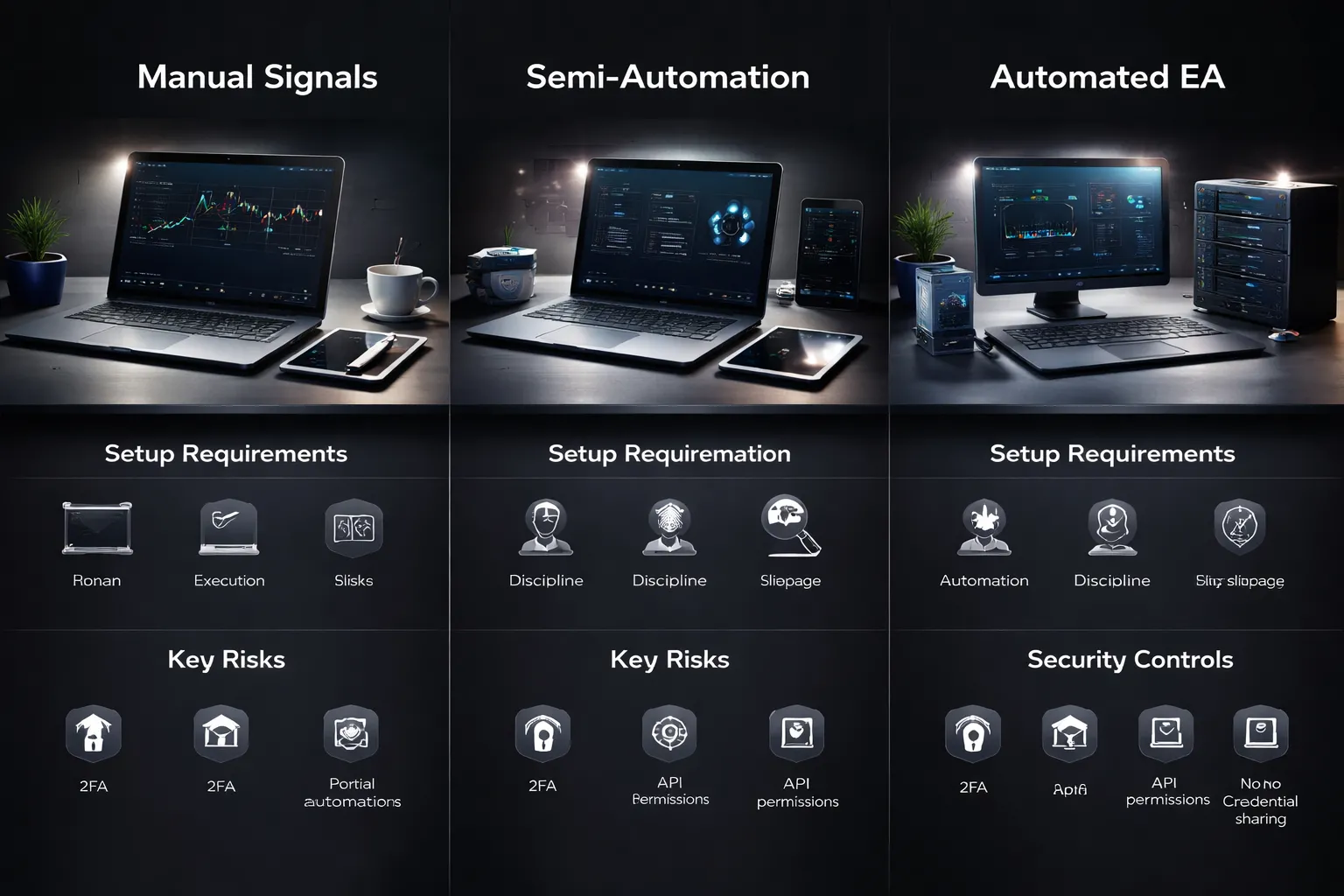
Manual signals mean you read an alert and place the trade yourself. You control entries, sizing, and exits. You also carry the execution risk.
- Discipline demands: fast response, consistent sizing, and rule-based exits. If you miss one step, results drift from the provider.
- Common mistakes: late entries after price moves, widening stops, skipping stop-loss, doubling risk after a loss, and taking every alert with no filter.
- How to reduce errors: set fixed risk per trade, pre-set SL and TP levels, use broker-side stop orders, and use pending orders when the signal gives a clear entry zone.
- Setup requirements: a platform with one-click trading, alerts routed to your phone, and a simple position size tool. Keep a checklist next to your trade ticket.
Automated Signals via EAs: VPS, Broker Fit, and Live Trading Traps
Automation means an EA places and manages trades from signal rules or from a signal feed. It removes hesitation. It also removes human judgment.
- VPS needs: run the EA on a VPS close to your broker server. You want stable uptime and low latency. Home Wi-Fi is a weak link.
- Broker compatibility: confirm platform support (MT4, MT5, cTrader), hedging rules, FIFO rules, minimum stop distance, and symbol naming. Check spreads on the target pairs during your trading hours.
- Execution reality: slippage, requotes, spread spikes, and partial fills can break a strategy that looks clean in tests. News minutes are the stress test.
- Backtest vs live pitfalls: backtests often assume ideal fills and stable spreads. They may ignore swap, commissions, and variable execution. Forward test on a demo, then a small live account with the same broker and leverage.
- Setup requirements: a verified EA build, logged trade permissions, defined risk limits in code, and a monitoring plan. Automation still needs oversight.
Semi-Automation: Trade Managers, Pending Orders, and Risk Templates
Semi-automation keeps your decision-making and automates repeatable tasks. It often gives the best control-to-effort ratio.
- Trade managers: auto-calc lot size by risk, place SL and TP, move stop to break-even, and trail stops by rules. You keep the entry decision.
- Pending orders: set buy stop, sell stop, or limit orders at signal levels. You reduce late entries and remove impulse clicks.
- Risk templates: save presets for 0.25%, 0.5%, and 1% risk, and keep them consistent across pairs. Tie each template to max daily loss and max open risk.
- Setup requirements: a reliable trade manager tool, a written risk sheet, and fixed rules for when you skip signals. If you plan to qualify for funded accounts, align your rules with common prop constraints, see our best forex prop firms breakdown.
Security Basics: API Keys, Permissions, and No Password Sharing
- Use least privilege: if you use an API, start with read-only. Enable trading only if you must. Disable withdrawals on API keys when the broker allows it.
- Separate access: never share your broker login or investor password with a signal seller. Use official copy modules or sub-accounts if you want delegation.
- Lock down accounts: enable 2FA, use a password manager, and whitelist IPs on the VPS if your broker supports it.
- Track changes: keep logs of API key creation, EA installs, and platform permissions. Revoke keys you do not use.
How to Choose the Right Provider for Your Trading Style
Match signal timeframe to your schedule
Pick a provider whose entry timing fits your day. Timeframe drives everything, fill quality, stop size, and how often you must act.
- Scalping signals (M1 to M15): You need fast execution and constant monitoring. If you trade from a phone or you step away often, you will miss entries and chase late fills.
- Day trade signals (M15 to H1): You can check a few times per session. You still need alerts that hit fast, and you need a broker with stable spreads around news.
- Swing signals (H4 to D1): You can review once or twice per day. You can place pending orders and walk away. You need wider stops and patience.
Ask the provider how they publish entries. If they send “market buy now” calls, you take more slippage. If they use limit entries with invalidation levels, you get clearer control.
Pair selection alignment
Trade pairs your broker prices well, and that you can tolerate. Many signal losses come from spread and volatility mismatch, not bad direction.
- Majors: Lower spreads and deeper liquidity. Better fit for most accounts and most signal styles.
- Minors: More movement, wider spreads, more gap risk around sessions and news.
- Exotics: High spreads, sharp spikes, and higher swap costs. Avoid unless you accept higher variance and you can size down.
Check the provider’s history by pair. You want consistent performance across a small, repeatable watchlist, not random pair-of-the-week trades.
Risk profile fit
Risk style matters more than win rate. You need to match the provider’s drawdown profile to your limits and your psychology.
- Conservative: Lower leverage, fewer open trades, smaller average stop, and clear invalidation. Expect slower growth and fewer signals.
- Aggressive: Higher leverage, more exposure, and deeper drawdowns. Expect streaks. Expect larger equity swings.
- Position sizing: Look for fixed risk per trade, such as 0.5% to 2%. Avoid providers who scale lots without a rule, or who “double to recover.”
Ask for maximum historical drawdown, average risk per trade, and worst losing streak. If they refuse, treat that as a no.
If you run signals to meet third-party rules, align with those limits first. Use a provider whose risk fits your daily loss cap and max drawdown, especially if you trade with prop firms.
Broker and platform compatibility
You need clean routing from signal to order. Friction creates late entries and inconsistent results.
- MT4: Common for EAs and copier tools. Check if the provider supports your copier, and if they trade symbols that match your broker naming.
- MT5: Better for some brokers and fills, but not every signal seller supports it well. Confirm before you pay.
- cTrader: Strong execution for many brokers. Signals often arrive via copy features or external alerts. Confirm automation options.
- TradingView alerts: Good for discretionary execution. Weak for fast signals unless you integrate alerts to an auto-trader.
- Mobile-only: Choose swing or slower intraday signals. Avoid “enter now” calls that require instant action.
Also verify time zone, session coverage, and whether the provider trades during major news. Your broker spreads can widen and break tight-stop strategies.
Account size considerations
Your balance must support the provider’s typical stop size without forcing oversized risk. Small accounts fail because traders cannot size down enough.
| Typical stop size | Practical minimum for 1% risk per trade | Why |
|---|---|---|
| 10 to 20 pips | $200 to $500 | Lets you use micro lots and keep risk near 1% without rounding up. |
| 25 to 50 pips | $500 to $2,000 | Wider stops need smaller position size to avoid 2% to 5% risk. |
| 75 to 150 pips | $2,000 to $10,000 | Swing signals need room, small accounts often cannot size low enough. |
Confirm the provider’s average stop size, not their best examples. Then test position sizing on your broker’s contract specs. If you cannot place a small enough lot, the signal will force higher risk than you planned.
Pricing, Value, and ROI: What You’re Really Paying For
Typical Pricing Models
Signal pricing falls into four buckets. Each shifts risk from the seller to you.
- Monthly subscription. Common range is $20 to $200 per month. You pay whether you trade or not. You also pay during drawdowns.
- Lifetime access. Common range is $200 to $2,000. You prepay years of service up front. Your risk is provider churn, strategy decay, and support drop-off.
- Per-signal or pay-per-alert. You pay per trade idea, often $1 to $20 each, or in credit packs. It can control costs if you trade less. It can also push you to trade more to justify the spend.
- Performance fee. You pay a percent of profits, often 10% to 40%. Some add a base fee too. This model only works if results get verified and fees apply after a clear high-water mark.
Break-Even Math: What It Takes to Just Cover Costs
Start with your fixed costs. Then subtract trading friction. Only then count the pips.
- Service fee. Your monthly subscription, or your monthly equivalent if you bought lifetime access.
- Spreads and commissions. They hit every trade. Providers quote “pips” but you pay all-in costs.
- Slippage. Signals arrive late. Your entry differs from the provider’s screenshot. News spikes make it worse.
Use a simple break-even formula.
- Break-even pips per month = (service cost + total trading costs) ÷ (pip value per standard lot × lots traded)
Example with round numbers.
- Account: $2,000. Risk plan: 1% per trade, $20 risk.
- Typical stop: 50 pips. Position size: $20 ÷ 50 = $0.40 per pip, about 0.04 lots on pairs where 1 lot is ~$10 per pip.
- Fee: $100 per month.
- If your effective cost is 1.2 pips per trade and you take 25 trades, friction is ~30 pips.
- You need $100 + (30 pips × $0.40) = $112 in gains.
- At $0.40 per pip, break-even is $112 ÷ $0.40 = 280 pips per month.
This is why small accounts struggle with paid signals. Your pip value is small. The subscription stays the same. If the provider trades often, friction grows. If the provider uses wide stops, your lot size drops more.
If you want a deeper decision framework, read what to know before you buy forex signals.
Red-Flag Pricing Tactics
- Huge discounts that never end. “90% off today” that repeats every week. It signals weak retention, or a funnel built on urgency.
- VIP pressure. Upsells for “institutional signals” or “private group” access with no change in transparency, execution rules, or verification.
- Unrealistic guarantees. Fixed monthly returns, “no losing months,” or “99% win rate.” Real trading has drawdowns. High win rates often hide large losers.
- Price tied to account size. “Pay more if you have more capital” can make sense in managed accounts. For signals, it often just captures surplus without adding value.
- Bundled add-ons to justify price. News feeds, chat rooms, and “education” that do not improve your execution or risk control.
Refund Policies and Trials: Terms That Protect You
Signals are hard to refund after you receive them. Fair terms still exist. Look for clear limits.
- Free trial with full access. Best case. It lets you test timing, fills, and stop sizes on your broker.
- Short paid trial. A low-cost 7 to 14 day plan beats a forced 3-month commitment.
- No long lock-ins. Avoid “minimum 3 months” unless the provider shares audited results and consistent execution rules.
- Plain refund rules. If they offer refunds, terms should state the time window, what counts as “used,” and how you request it.
- Cancellation that works. You should cancel in one place. If you must “message an admin,” expect delays.
- Proof over promises. A provider who will not share time-stamped history, average stop size, and realistic fill assumptions should not demand prepaid trust.
| Model | What you pay | Main risk to you | Best use case |
|---|---|---|---|
| Monthly | Fixed fee | Paying through drawdowns | Testing a provider over 1 to 3 months |
| Lifetime | Large upfront fee | Provider disappears or degrades | You have strong proof and want long-term access |
| Per-signal | Variable by activity | Overtrading to “get value” | You trade selectively and want cost control |
| Performance fee | Percent of profits | Misreported performance, unclear fee rules | Verified tracking with high-water mark terms |
Scams and Red Flags: How to Avoid Bad Forex Signal Providers
Unverifiable track records: edited screenshots, private statements, and cherry-picked months
Bad providers hide behind “proof” you cannot audit. Screenshots and forwarded emails prove nothing. Private broker statements can come from demo accounts or small accounts that do not match the risk shown in marketing.
- Edited screenshots: Look for missing timestamps, cropped order IDs, and no account equity curve. If they refuse to share a live, read-only link, treat it as unverified.
- Private statements: Ask for a third-party verified record. You want a public, time-stamped history with deposits, withdrawals, and open trades included.
- Cherry-picked months: Promoters show the best streak and hide the rest. Ask for at least 6 to 12 months of continuous results, including drawdowns and flat periods.
Misleading metrics: win rate without R:R, martingale/grid hiding in “high accuracy” claims
Marketing loves one number. Your account dies from what that number hides.
- Win rate without risk to reward: A 90% win rate means nothing if average loss is 5x the average win. Demand average win, average loss, expectancy, and max drawdown.
- Martingale and grid tactics: Many “high accuracy” services stack positions as price moves against them. This inflates win rate until one trend wipes months of gains. Watch for repeated entries, widening exposure, and no hard stop loss.
- Drawdown games: Some providers reset tracking after a blowup, then relaunch. Check if the track record shows the full life of the account, not a fresh start.
Marketing hype triggers: guaranteed profits, “zero drawdown,” and luxury lifestyle sales
Signals come with uncertainty. Anyone selling certainty sells lies.
- Guaranteed profits: No legit provider can promise returns. Markets change, spreads change, execution changes.
- “Zero drawdown” claims: Every strategy has drawdown. Zero drawdown usually means they hide losing trades, average down, or move stops.
- Lifestyle sales: Cars, watches, and rented villas do not improve trade quality. If the pitch focuses on status, not risk controls, walk away.
Community manipulation: fake testimonials, deleted losing trades, and selective reporting
Some providers run their community like a funnel. They control the narrative to keep churn low.
- Fake testimonials: Look for vague praise, no broker proof, and identical writing across profiles. Prioritize reviews that show full trade history, not single wins.
- Deleted losing trades: Telegram and Discord let admins delete posts. If signals “disappear” after losses, you cannot track performance.
- Selective reporting: Many channels post wins in pips and ignore losses in dollars. Some ignore spread, slippage, and commissions. You need net results after costs.
Payment and security risks: chargeback limitations, crypto-only payments, and data exposure
Scams often show up in how they take money and handle your data.
- Chargeback limitations: Bank transfer and some payment processors give you weak dispute options. Credit card payments usually give you better protection.
- Crypto-only payments: Crypto payments can block refunds and make the seller hard to trace. Treat “crypto only” as a major risk, unless the provider has strong verification and a clear refund policy.
- Data exposure: Never share broker logins, investor passwords, or ID documents in chat. Use separate emails for subscriptions. Assume public groups get scraped.
If you want a safer alternative to signals, use platforms that support transparent performance stats and built-in controls. See our guide to forex copy trading platforms.
How to Test a Forex Signal Provider in 30 Days (Step-by-Step)
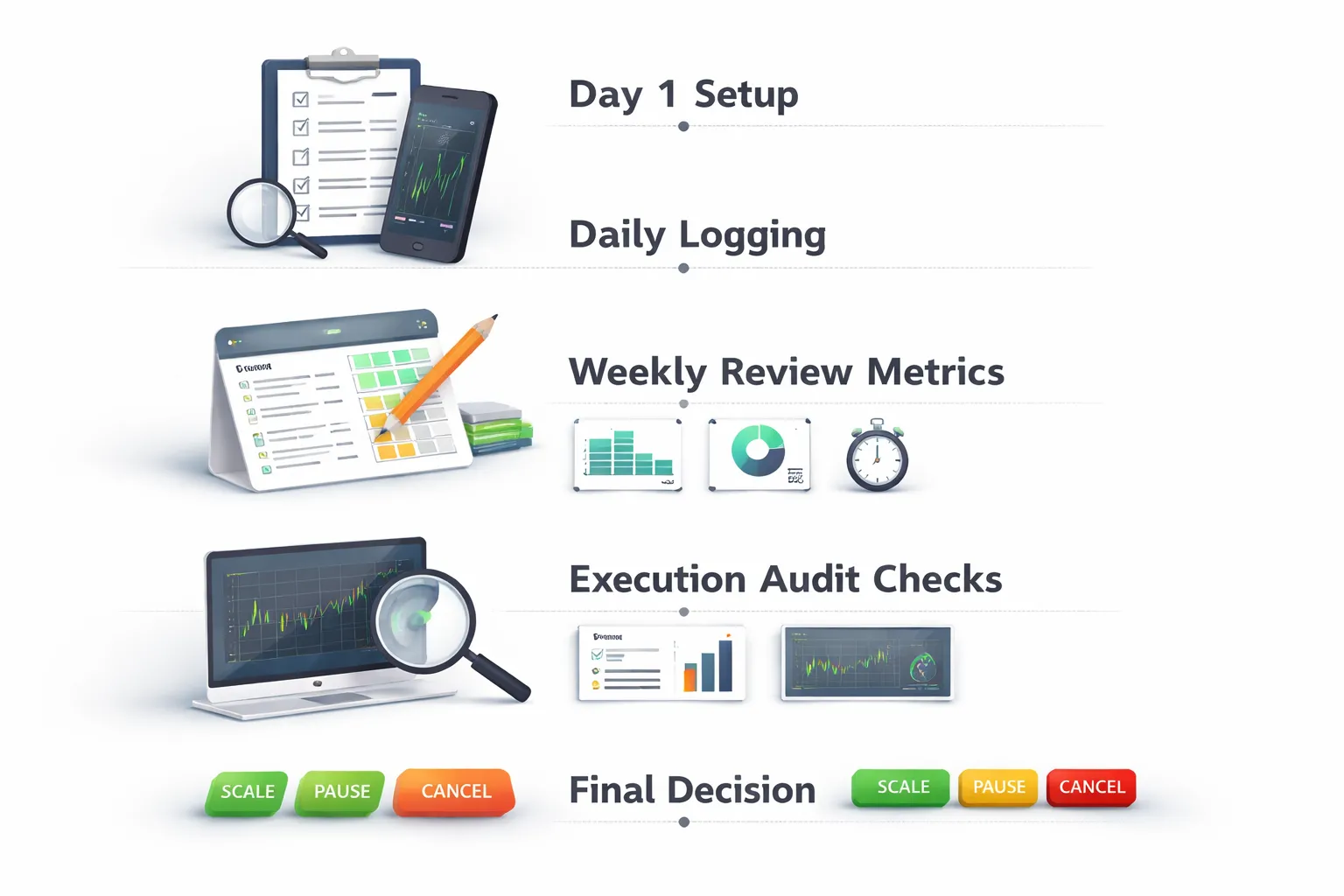
Day 1 Setup (Demo vs Small Live, Broker Matching, Logging Template)
Pick a test account type. Use a demo if you only want to test signal logic. Use a small live account if you want real spreads, slippage, and emotions.
- Demo test: Best for speed and safety. Weak for slippage and execution realism.
- Small live test: Best for real fills. Keep size small enough that one bad week does not change your behavior.
Match the provider’s trading environment.
- Trade the same pairs they trade most.
- Use the same session focus if stated, London, New York, or overlap.
- Use the same account type, spread-only vs commission, and the same platform if possible.
- Set leverage and margin so you never hit a margin call in the test.
Define execution rules before you start. This stops you from rewriting history.
- Max allowed entry delay, for example 30 seconds.
- Max allowed slippage, for example 1.0 pip on majors, 2.0 on crosses.
- Hard risk cap per trade, for example 0.25 to 1.00 percent.
- No signal stacking. One position per signal unless the provider states scaling rules.
Build a simple logging template. Use a spreadsheet. Log every signal you receive, even if you skip it.
Tracking Process (Spreadsheet Fields, Screenshots, Slippage Measurement)
Track inputs and outcomes. If you cannot track it, you cannot judge it.
Take two screenshots per trade. Store them in a folder with the trade ID.
- At entry: Signal message plus your ticket or chart entry.
- At exit: Closed trade details plus chart.
Measure slippage the same way every time. Use pips. For buys, slippage equals your fill minus provider entry. For sells, slippage equals provider entry minus your fill. Record it, do not explain it away.
Performance Review (Expectancy, Drawdown Tolerance, Consistency Checks)
Run a weekly review. Do not wait until day 30.
Calculate expectancy in R. Use your filled trades, not the provider’s claimed results.
- Win rate: wins divided by total trades.
- Average win (R): mean R of winners.
- Average loss (R): mean absolute R of losers.
- Expectancy (R): (win rate x avg win) minus (loss rate x avg loss).
Set a drawdown tolerance before the test. Base it on your risk per trade and your psychology.
- If you risk 0.5 percent per trade, a 10R drawdown equals about 5 percent equity drawdown.
- If you cannot tolerate 5 percent, lower risk or reject the service.
Check consistency. A provider can look good with one lucky week.
- Weekly expectancy: You want similar values across weeks.
- Trade distribution: Returns should not come from one outlier trade.
- Regime sensitivity: Note if results collapse during news weeks or range markets.
If you want more criteria for vetting, read how to evaluate whether forex signals are worth it.
Execution Audit (Entry Timing, Stop Placement, Rule Compliance)
Audit execution quality, not just P and L. Bad signals often fail on rules and timing.
- Entry timing: Count how many signals become invalid before you can enter. Mark them as untradeable.
- Stop placement: Check if stops sit inside normal noise. Track stop distance in pips and as ATR if you use it.
- TP logic: Log if targets sit at obvious liquidity, prior highs, or arbitrary round numbers.
- Updates: Track how often the provider moves SL or TP after entry. Note if changes come late.
- Rule compliance: Compare each signal to the provider’s stated rules. Flag any “exceptions.”
Track operational risk.
- Late signals and edits that change the trade after price moves.
- Missing stop losses or vague exits.
- Overtrading spikes after losses.
- Signals during major news without a clear plan.
Decision Framework (Scale, Pause, Cancel)
Use a rules-based decision at day 30. Do not decide based on your last trade.
- Scale: Positive expectancy over at least 30 trades, drawdown stayed inside your limit, and slippage stayed inside your cap. Increase size slowly, for example 10 to 25 percent, then retest for two more weeks.
- Pause: Expectancy near zero, results depend on one big win, or you see repeated execution issues. Keep logging, but do not add capital.
- Cancel: Negative expectancy, drawdown breaks your limit, or the provider violates basic risk rules, missing stops, constant edits, or deletes losing calls.
Cancel fast if the provider asks for broker logins, investor passwords, or remote access. That is not a trading edge.
Risk Management When Using Signals (The Part Most Traders Skip)
Position Sizing Methods (So One Bad Signal Cannot Hurt You)
Signals do not manage your risk. You do. Pick one sizing method and follow it on every trade.
- Fixed fractional. Risk a fixed percent of your equity per trade. Most retail traders stay at 0.25% to 1.0%. If your account is $5,000 and you risk 0.5%, your max loss per trade is $25.
- Volatility-based. Size the trade from the stop distance. Wider stops mean smaller position size. Use ATR or the provider stop, but never tighten the stop just to increase size.
- Maximum risk per day. Set a daily loss cap and stop when you hit it. A common range is 1% to 3% of equity. This protects you when multiple signals cluster in the same session.
| Rule | Simple setting | What it prevents |
|---|---|---|
| Risk per trade | 0.25% to 1.0% of equity | Account damage from one bad call |
| Max loss per day | 1% to 3% of equity | Spiral losses during choppy days |
| Max loss per week | 3% to 8% of equity | Slow bleed from a broken strategy |
Drawdown Controls (Hard Stops For Your Behavior)
Most blowups come from rule breaks, not bad signals. Put limits in place before you trade.
- Stop trading rules. Pause trading after 3 losses in a row, or after you hit your daily loss cap. Resume the next day with normal size, not higher size.
- Max open trades. Limit exposure. A practical cap is 1 to 3 open trades at once. If a provider sends 6 trades, you skip the rest.
- Correlation limits. Treat highly correlated pairs as one bet. Long EURUSD plus long GBPUSD often equals one USD short. Cap total risk across correlated trades to the same as a single trade.
If you trade under strict rules, review prop firm challenge drawdown rules and align your limits to the tighter standard.
Handling Losing Streaks (Adjust, Do Not Chase)
Losing streaks happen even with a real edge. Your job is to survive them with the same process.
- Do not increase risk to win it back. Keep the same percent risk, or cut it in half until results stabilize.
- Do not add “makeup trades”. Only take signals that match your execution plan, broker, and session.
- Use a step-down rule. After 3 consecutive losses, reduce risk by 50%. After 6, pause for 24 to 48 hours and review execution, spreads, and slippage.
- Separate signal quality from your fill quality. Track entry price vs signal price, stop distance, and spread at entry. A good signal can turn bad if your costs double.
News and Event Risk (Where Slippage Kills Good Signals)
High impact news can break any backtest. You need rules for when the market moves too fast for clean execution.
- Event blackout windows. Avoid new entries 15 to 30 minutes before and after NFP, CPI, FOMC, ECB, BOE, and rate decisions. If you must trade, reduce size.
- Spread widening protection. Do not enter if spread is above your limit. Use a simple threshold, like 2x your normal spread for that pair and session.
- Stop and limit order discipline. Do not move stops wider during news. If a provider edits stops repeatedly during events, treat it as a risk violation.
- Weekend and rollover rules. Avoid holding short-term signal trades into the weekend. Watch rollover time, spreads often spike and stops get hit on noise.
News rules feel conservative. They protect you from the worst fills, the worst gaps, and the fastest account damage.
Tools and Integrations That Improve Signal Results
Charting and confirmation: TradingView, MT4/MT5 indicators, and price action filters
Signals improve when you add a fast confirmation layer. You reduce bad entries and stop chasing late moves.
- TradingView check. Match the signal direction to structure. Use a higher timeframe trend filter, then confirm the entry timeframe setup. If price sits inside a tight range, size down or skip.
- Key levels first. Mark daily high and low, weekly high and low, prior session range, and obvious swing points. Avoid taking signals straight into nearby support or resistance.
- Simple indicator guardrails in MT4/MT5. Use one trend filter and one volatility filter. Example: a moving average direction filter plus ATR to stop you from trading when range is too small to cover spread and slippage.
- Price action filters. Reject entries if the signal triggers after a spike candle, if the candle closes back inside the prior range, or if the stop must sit inside recent noise. Accept entries when the breakout closes outside the level and retests with a clean rejection.
- Spread check. If spread jumps above your normal baseline, treat it like a news event. Skip, or wait for spreads to normalize.
Alert automation: webhooks, bots, and notification redundancy
Speed matters. So does reliability. Build alerts that reach you even when one channel fails.
- Webhook routing. Push TradingView alerts to a webhook endpoint, then fan out to Telegram, Discord, SMS, or email. You keep one source of truth and multiple outputs.
- Bot formatting. Standardize the message. Include pair, direction, entry, stop, target, timeframe, and timestamp. Add a unique trade ID so you can match alerts to fills and journal records.
- Redundancy rule. Use at least two notification paths. Example: Telegram plus email. If you trade intraday, add a third path like push notifications on a second device.
- Quiet hours. Set do-not-disturb exceptions for your trading app. Keep critical alerts allowed. Missed entries lead to late fills and broken risk.
- Failure testing. Run a weekly test alert. Confirm delivery time. Log delays. If delivery drifts, fix it before it costs you money.
Execution stack: VPS, low-latency brokers, and limit vs market order choices
Execution decides your real results. A good signal with bad fills turns into a bad system.
- VPS for stability. Run MT4 or MT5 on a VPS close to your broker server region. You reduce disconnects and execution lag. You also avoid home internet outages during volatility.
- Broker reality check. Track average spread, slippage, and rejected orders by pair and session. If your broker widens spreads hard at rollover, stop trading that window.
- Order type selection. Use market orders when speed matters and spread is normal. Use limit orders when the signal expects a pullback and you can accept missing the trade.
- Limit order guardrails. Place limits at planned levels, not at the current price. Cancel unfilled limits after the setup expires. Old orders get filled in the wrong context.
- Stop placement discipline. Place stops where the setup fails, not where the loss feels smaller. If the signal requires a tight stop in a noisy pair, skip it.
- Prop firm constraints. If you trade under strict drawdown rules, slippage and gaps matter more than win rate. Read how forex prop firms work before you follow high-frequency signals.
Journaling and analytics: trade journaling apps and KPI dashboards
You cannot fix what you do not measure. Journal every signal trade like a system test.
- Minimum fields. Provider name, pair, session, timeframe, entry type, intended entry, filled entry, stop, target, position size, spread at entry, slippage, and reason codes for any deviation.
- Core KPIs. Win rate, average win, average loss, expectancy, profit factor, max drawdown, and average R multiple. Track these per pair and per session, not just in total.
- Execution KPIs. Median slippage, worst slippage, stop-out rate near rollover, and fill time from alert to order. These metrics explain why your results differ from the provider.
- Signal quality breakdown. Separate trades you took exactly as sent from trades you modified. If modified trades outperform, your filters add value. If they underperform, remove them.
- Monthly cut rules. Pause any provider or pair that breaches a preset drawdown or expectancy threshold. You protect capital and stop slow bleed.
Frequently Asked Questions
What are forex signals?
Forex signals are trade instructions for a currency pair. They usually include direction, entry, stop loss, and take profit. Some add timeframes, risk per trade, and reasoning. You follow them manually or through automation if your broker and platform support it.
How do signal providers make money?
Most charge a monthly fee. Some earn IB rebates from brokers, sell courses, or run managed accounts. Ask for a full revenue disclosure. If a provider gets paid per lot you trade, expect volume bias. Track your trade count and costs.
What proof of performance should you require?
Ask for a verified track record with timestamps and full history. You need win rate, average win and loss, profit factor, max drawdown, and expectancy per trade. Compare results after spreads and slippage. Screenshots and cherry-picked months do not help.
Which metrics matter most when you compare providers?
- Expectancy: average gain per trade after costs.
- Max drawdown: worst peak-to-trough loss.
- Profit factor: gross profit divided by gross loss.
- Trade frequency: signals per week and holding time.
- Cost drag: spread, commissions, swaps.
How many months of data do you need?
Use at least 6 to 12 months. More is better if the style changes across regimes. Ignore short streaks. Validate across high and low volatility periods. If the provider cannot share enough history, treat results as unproven.
Why do your results differ from the provider?
Execution differences cause gaps. You face different spreads, slippage, swaps, and latency. Lot sizing and missed alerts change outcomes. If you modify entries or exits, you change the system. Log every trade and separate exact signals from modified trades.
Should you use signals for prop firm challenges?
Only if the risk rules match the challenge. Many signals break daily loss or max drawdown limits. Run the provider on a demo with the same rules first. Keep risk per trade small. If you want an alternative, use copy trading.
Are free forex signals worth it?
Some are fine for learning and idea flow. Most lack verified stats and risk controls. Free signals often monetize through broker kickbacks or upsells. Treat them as untested. Use micro size and track expectancy after costs before you scale.
Can you automate forex signals?
Yes, if the provider supports API, EA, or platform integrations. Automation reduces missed trades, but it can increase slippage in fast markets. You still need risk caps, max daily loss, and pause rules. Test on demo with your broker first.
What risk settings should you use with signals?
Set fixed risk per trade, usually 0.25 to 1.0 percent. Cap daily loss and weekly drawdown. Limit correlated pairs. Avoid martingale and grid sizing. Use hard stops. If a provider removes stops, treat it as a red flag.
What are common red flags in signal services?
- No verified history, only screenshots.
- Unrealistic monthly return claims.
- No stated stop loss or risk per trade.
- Martingale, grid, or heavy averaging down.
- Pressure to use one broker or high leverage.
How should you audit a provider each month?
Calculate expectancy, drawdown, and cost drag for your account. Split exact-copy trades from modified trades. If modified trades do worse, stop filtering. Set monthly cut rules, pause any pair or provider that breaches your thresholds. Protect capital first.
Conclusion
Conclusion
Signals can help, but they do not remove risk. Your edge comes from how you size, filter, and stop.
Pick a provider you can measure. Demand a full trade log, clear rules, and a track record that matches your market and holding time. Avoid martingale, grid, and averaging down. Avoid any service that pushes one broker or high leverage.
- Trade small first. Use a fixed risk per trade. Keep leverage low.
- Track performance net of costs. Include spread, commission, swaps, and subscription fees.
- Separate exact-copy trades from your edits. Keep the better set, cut the worse set.
- Set hard monthly cut rules. Pause any pair or provider that breaks your drawdown or expectancy limits.
Final tip. Treat signals like any other strategy. Audit monthly, protect your downside, and scale only after you see stable results in your own account. If you plan to trade under strict limits, review forex prop firm challenge rules before you follow signals live.
-
Best Forex Copy Trading Platforms (Features, Fees & Safety Compared)
7 months ago -
Forex Prop Firm Challenge Rules Explained (Drawdown, Targets, Payouts)
7 months ago -
Best Forex Prop Firms (Top Firms Compared)
7 months ago -
What Is a Forex Prop Firm? How Prop Trading Works for Forex
7 months ago -
Copy Trading Forex Explained: How It Works, Pros, Cons & Risks
7 months ago
-
- Best overall for most traders, balanced frequency, clarity, and risk controls
- Best for beginners, education-first signals with clear reasoning and position sizing help
- Best for swing traders, lower frequency, higher timeframes, and wider stops
- Best for scalpers, higher frequency, tighter execution requirements, and realistic expectations
- Best for automated workflows, MT4/MT5 tools, APIs, and copy integration options
- Best budget option, low-cost subscriptions with acceptable transparency
- Best free option (with caveats), where free signals can work and where they fail
-
- Unverifiable track records: edited screenshots, private statements, and cherry-picked months
- Misleading metrics: win rate without R:R, martingale/grid hiding in “high accuracy” claims
- Marketing hype triggers: guaranteed profits, “zero drawdown,” and luxury lifestyle sales
- Community manipulation: fake testimonials, deleted losing trades, and selective reporting
- Payment and security risks: chargeback limitations, crypto-only payments, and data exposure
-
- Day 1 Setup (Demo vs Small Live, Broker Matching, Logging Template)
- Tracking Process (Spreadsheet Fields, Screenshots, Slippage Measurement)
- Performance Review (Expectancy, Drawdown Tolerance, Consistency Checks)
- Execution Audit (Entry Timing, Stop Placement, Rule Compliance)
- Decision Framework (Scale, Pause, Cancel)
-
- What are forex signals?
- How do signal providers make money?
- What proof of performance should you require?
- Which metrics matter most when you compare providers?
- How many months of data do you need?
- Why do your results differ from the provider?
- Should you use signals for prop firm challenges?
- Are free forex signals worth it?
- Can you automate forex signals?
- What risk settings should you use with signals?
- What are common red flags in signal services?
- How should you audit a provider each month?
-
- Best overall for most traders, balanced frequency, clarity, and risk controls
- Best for beginners, education-first signals with clear reasoning and position sizing help
- Best for swing traders, lower frequency, higher timeframes, and wider stops
- Best for scalpers, higher frequency, tighter execution requirements, and realistic expectations
- Best for automated workflows, MT4/MT5 tools, APIs, and copy integration options
- Best budget option, low-cost subscriptions with acceptable transparency
- Best free option (with caveats), where free signals can work and where they fail
-
- Unverifiable track records: edited screenshots, private statements, and cherry-picked months
- Misleading metrics: win rate without R:R, martingale/grid hiding in “high accuracy” claims
- Marketing hype triggers: guaranteed profits, “zero drawdown,” and luxury lifestyle sales
- Community manipulation: fake testimonials, deleted losing trades, and selective reporting
- Payment and security risks: chargeback limitations, crypto-only payments, and data exposure
-
- Day 1 Setup (Demo vs Small Live, Broker Matching, Logging Template)
- Tracking Process (Spreadsheet Fields, Screenshots, Slippage Measurement)
- Performance Review (Expectancy, Drawdown Tolerance, Consistency Checks)
- Execution Audit (Entry Timing, Stop Placement, Rule Compliance)
- Decision Framework (Scale, Pause, Cancel)
-
- What are forex signals?
- How do signal providers make money?
- What proof of performance should you require?
- Which metrics matter most when you compare providers?
- How many months of data do you need?
- Why do your results differ from the provider?
- Should you use signals for prop firm challenges?
- Are free forex signals worth it?
- Can you automate forex signals?
- What risk settings should you use with signals?
- What are common red flags in signal services?
- How should you audit a provider each month?
-
How to Place a Forex Trade Step by Step (Your First Trade Explained)
5 months ago -
Forex Trading vs Crypto Trading: Which Market Is Better for Beginners?
5 months ago -
Forex Lot Size Calculator: How to Use It to Size Trades Correctly
7 months ago -
How to Calculate Position Size in Forex (Position Sizing Formula + Examples)
7 months ago -
Forex Leverage Explained: How It Works, Pros, Cons & Examples
7 months ago
-
Forex Trading Platforms Comparison: MetaTrader vs cTrader vs TradingView
7 months ago -
Stop Loss vs Take Profit: Differences, Examples & Best Practices
7 months ago -
Is Forex Trading Legal in the United States? Rules, Regulators & What to Know
7 months ago -
Forex Leverage Explained: How It Works, Pros, Cons & Examples
7 months ago -
Forex Market Hours & Trading Sessions Explained (Best Times to Trade)
7 months ago