How to Choose a Copy Trading Provider: What to Check Before You Follow Anyone

Copy trading lets you mirror another trader’s positions in your account. Your results depend on the provider you choose and the controls you set. Most losses come from hidden risk, weak execution, and unclear fees.
This guide shows you what to check before you follow anyone. You will learn how to verify track record quality, spot risk signals in the equity curve, and read key metrics like max drawdown, leverage, and trade duration. You will also learn how to assess broker regulation, platform reliability, slippage, and copy settings that limit damage. You will know what fees apply, how providers get paid, and what conflicts to avoid. If you want platform-by-platform comparisons, see our best forex copy trading platforms guide.
- In het kort: Check a full track record, not a highlight period.
- In het kort: Focus on max drawdown, leverage, and holding time, not win rate.
- In het kort: Reject equity curves with sharp, smooth climbs and rare pullbacks.
- In het kort: Match position sizing and risk to your account size and limits.
- In het kort: Verify broker regulation, custody, and how the platform handles execution.
- In het kort: Model slippage and spreads, your results will differ from the provider.
- In het kort: Use copy controls, max allocation, stop copying, equity stop, and max open trades.
- In het kort: Understand fees and incentives, performance fees can push risk-taking.
- In het kort: Diversify across providers and keep a kill switch for fast drawdowns.
Your checklist is simple. Demand verifiable history. Read risk metrics first. Stress-test execution and slippage. Lock down copy settings before you fund the account.
If you want a deeper primer on setup, costs, and risk controls, read our forex copy trading explained guide.
What a “copy trading provider” really is (and what you’re actually buying)
Provider types, broker-native vs third-party networks
A copy trading provider is not the trader. It is the system that connects your account to someone else’s trades.
You buy access to three things. Trade replication, performance reporting, and the rules that decide how orders hit the market.
- Broker-native social trading, the broker runs the copy system inside its own platform. Your account, pricing, and execution all sit under one roof. You still carry market risk. You also take platform risk if the broker’s copy engine fails.
- Third-party signal or copy networks, a separate app or service connects to your broker account. You add another layer. That layer can add fees, latency, and mapping errors between instruments.
Your decision here changes what you can verify and who you can hold responsible when execution differs from the provider’s track record.
Strategy manager vs signal seller vs PAMM or MAM
Copy trading labels hide real differences in control and liability. Read the fine print before you fund.
- Strategy manager, you allocate funds to a named strategy inside a copy platform. You usually control sizing, max risk, and stop conditions. You take full profit and loss on your account.
- Signal seller, you receive trade ideas and you or your software executes them. You control execution, but you also carry full responsibility for missed fills, delays, and mistakes.
- PAMM, your money joins a pooled allocation. The manager trades a master account and the system allocates results by share. You get less control over position-level settings.
- MAM, one manager account places trades across many sub-accounts. It can support more allocation rules than PAMM. You still rely on the manager’s execution and your broker’s allocation engine.
In copy trading, you own the risk. In PAMM or MAM, you also accept more operational dependency on the manager’s setup and the broker’s allocation method.
What you’re actually buying
You are buying a risk transfer. The provider takes trades. You take the drawdowns.
Returns come from four main inputs. You should identify them before you follow.
- Leverage, higher leverage can inflate short-term returns and accelerate margin calls. Check average leverage and worst-case exposure.
- Holding time, short holding times depend on tight spreads and fast fills. Longer holding times depend more on swap costs and trend capture.
- Instrument selection, the risk profile changes by market. FX majors differ from gold, indices, crypto, and small-cap CFDs. Correlation spikes during stress.
- Follower execution, your fills can differ from the provider’s fills. Slippage, spread widening, and partial fills can turn a clean curve into a volatile one.
Common misconceptions that cost you money
- “Top ranked” means safe. Rankings often reward recent returns, not survival. A strategy can rank high after a lucky run with high leverage.
- “Verified” means comparable. A verified track record can still come from different spreads, different leverage caps, and different execution speed than you will get.
- “Low drawdown” means low risk. Some systems hide risk with rare, deep losses. Look for exposure, stop usage, and loss clustering, not just max drawdown.
- “Copying is hands-off.” You still need rules. Set allocation limits, max open trades, and an equity stop. Review weekly.
If you want to compare how platforms handle execution, fees, and safety controls, use our copy trading platforms comparison.
Safety and legitimacy checks before performance
Regulation and licensing, verify before you look at returns
Start with the platform or broker. A copy trading app can look polished and still route you to an unregulated entity.
- Get the legal name and license number. Do not rely on brand names.
- Check the regulator register. Use the regulator site, not a badge on the provider page.
- Match the details. Legal entity name, trading name, website domain, and address should line up.
- Confirm permissions. The license must cover brokerage or dealing, not just marketing or software.
- Check warnings. Search the regulator warnings list for the brand and related domains.
| What to verify | What you want to see | What should stop you |
|---|---|---|
| License status | Authorised, active, correct entity | Pending, revoked, clone, or “appointed rep” with no trading permission |
| Domains | Official domain listed on the register or firm page | Different domain, redirects, or “new website” excuses |
| Products allowed | CFDs, FX, securities as relevant | License does not cover the product you will trade |
Client fund protections, where your money sits and who controls it
Copy trading risk starts with custody. You need to know who holds your funds, how they segregate them, and what happens if you go negative.
- Segregation. Look for client money held in segregated accounts, separate from company operating funds.
- Custody model. Prefer funds held at a regulated broker or custodian in your name, not pooled under the provider.
- Negative balance protection. Confirm it applies to your account type and jurisdiction. Read the terms, not the marketing page.
- Withdrawal path. You should withdraw to accounts in your name. Avoid setups that pay “to any wallet.”
- Compensation scheme. If the jurisdiction offers it, confirm eligibility and limits. Do not assume coverage.
Keep the provider away from deposits and withdrawals. You want copying permissions, not money handling permissions.
Jurisdiction and dispute resolution, what happens when things break
Jurisdiction controls your rights. It also controls how hard it is to recover funds after a dispute.
- Identify the contracting entity. Your terms should name a specific company and country.
- Check the dispute path. Look for a clear complaints process, timelines, and an external ombudsman or arbitration venue.
- Know the governing law. Offshore law can limit remedies, even if the service targets your country.
- Record keeping. The provider should supply trade logs, timestamps, and pricing data you can export.
If the terms say disputes must go through a private forum you cannot access, treat it as a risk premium you pay up front.
Platform security basics, stop account takeovers and permission creep
Security issues can wipe you out faster than a bad strategy. Lock down access before you connect any copy service.
- 2FA. Turn on app based 2FA. Avoid SMS if better options exist.
- Withdrawal controls. Use address whitelisting where available. Enable withdrawal confirmations and cooling off periods.
- Account permissions. Grant the minimum rights needed. Copy needs trade execution, not withdrawals or profile changes.
- API access. Use read and trade only keys. Never allow withdrawal enabled API keys. Rotate keys if you stop copying.
- Session and device controls. Review login history. Kill unknown sessions. Set alerts for new logins and withdrawals.
If you need a refresher on how copy setups, permissions, and risk controls work, read our forex copy trading explained guide.
Red flags checklist, reasons to walk away
- Guaranteed returns. Any fixed monthly profit claim signals fraud or extreme risk.
- Pressure tactics. “Limited slots,” countdown timers, and pushy DMs point to churn, not skill.
- Unverifiable identity. No legal name, no company number, no regulator footprint, no consistent history.
- Hidden terms. Fees, performance cuts, or withdrawal rules that appear after deposit.
- Control over funds. They ask for remote access, wallet seed phrases, or deposits to their accounts.
- Affiliate driven hype. Most content focuses on referrals, not execution quality and risk limits.
- Missing track record integrity. No third party verification, no raw trade history export, no slippage reporting.
Run these checks first. If a provider fails any one of them, performance numbers do not matter.
Performance analysis that goes beyond ROI screenshots
Track record quality
Ignore ROI screenshots. Demand a complete, audited record. You need enough data to see how the provider behaves under stress.
- Minimum history length. Prefer 12 to 24 months of live, real-money results. Avoid brand new accounts and recent “reset” accounts.
- Trade count. Look for at least 200 to 500 closed trades. Fewer trades can hide variance and luck.
- Market regimes covered. You want exposure to trending and ranging periods, high and low volatility, major news weeks, and drawdown phases. If the curve only shows a calm period, you do not have a test.
- Data integrity. Require a third-party verified statement, a raw trade export, and basic execution fields, entry time, exit time, size, instrument, swap, commissions, and slippage.
Risk-adjusted metrics that matter
Return means little without context. Copy trading fails when risk explodes. These metrics show risk.
- Max drawdown. Check peak-to-trough drawdown and average drawdown. Map it to your tolerance and to your copy multiplier.
- Volatility of returns. Large swings signal unstable sizing. You want a smooth distribution, not a lottery profile.
- Profit factor. Gross profit divided by gross loss. Many providers look “good” until costs hit. A profit factor near 1.0 leaves no room for slippage and fees.
- Expectancy per trade. Average profit per trade after costs. Positive expectancy with a reasonable trade count matters more than one big month.
Consistency signals
You copy a process, not a highlight reel. Consistency shows up in distributions and streak behavior.
- Monthly return distribution. Count how many months end positive, flat, and negative. Watch for one or two outlier months that create most of the total return.
- Win-rate versus payoff ratio. High win-rate with small average wins and large average losses often points to risk hiding. Low win-rate with large wins can work, but it must show controlled losses.
- Losing streak behavior. Track the longest losing streak and the deepest losing run. Check what the provider did next, reduced size, stayed steady, or increased leverage to “get it back.”
Tail-risk and blow-up patterns
Most copy accounts die from one pattern, adding risk when trades go wrong. You can spot it in the trade log.
- Martingale and grid fingerprints. Repeated adds in the same direction at worse prices, rising position count, and bigger size per add. Equity looks stable until it gaps lower.
- Averaging down. Look for sequences where loss grows and size increases. If the provider calls it “position building,” treat it as averaging unless risk stays capped.
- Over-leverage. Large lot sizes relative to balance, frequent high margin usage, and drawdowns that recover fast only when price snaps back. This profile breaks during trends.
- Gap and news exposure. Holding oversized risk into major releases, weekends, or illiquid sessions raises tail risk. You see it in trade timestamps and holding periods.
Benchmarking
Judge performance against simple alternatives and against peers taking similar risk.
- Compare to passive options. If the provider cannot beat cash yield after fees and drawdown, you take risk for no edge.
- Compare to similar-risk providers. Line up max drawdown and return side by side. A provider with the same return and half the drawdown wins.
- Check fee drag. Spread, commission, platform fees, and performance fees reduce your net result. Run the numbers with conservative slippage.
- Stress your copy settings. Your copy multiplier and stop-out rules can change the profile. Validate how drawdown scales before you fund. Use the risk controls covered in this forex copy trading guide.
Risk fit: matching a provider to your goals and constraints
Define your risk budget
Start with your maximum acceptable drawdown. Write it as a hard number, not a feeling. Many followers set it between 10% and 25%. Your number depends on your cash flow and temperament.
- Account drawdown limit: The worst peak-to-trough loss you will tolerate before you stop copying.
- Time horizon: A 15% drawdown in a week hits harder than the same drawdown over six months. Match the provider’s typical recovery time to your patience.
- Liquidity needs: If you may need the money in the next 3 to 12 months, avoid providers with deep or frequent drawdowns and long holding periods. You want the option to exit without locking in a bad moment.
Then convert your drawdown limit into a position sizing rule. If a provider has a 30% historical max drawdown and your limit is 15%, your copy size should start near 0.5x. Treat that as a ceiling until live results prove otherwise.
Instrument and leverage alignment
What the provider trades changes your risk as a follower. It affects spreads, gap risk, financing costs, and how fast losses can compound.
- Forex: Often tight spreads and deep liquidity. Risk comes from leverage and correlated pairs. Swap and rollover can matter for longer holds.
- Indices: Larger overnight gaps and session opens can hurt stops. Volatility clusters around macro releases.
- Crypto: High volatility, weekend moves, and frequent gaps on some venues. Slippage can spike during liquidations.
- CFDs: Broker execution quality and financing rates can drive a wedge between provider results and yours.
- Futures: Contract sizing and margin rules can force larger step changes in exposure. Rollover and tick size affect fills.
Check the provider’s average leverage and worst-case leverage. If they run 10x and you can only tolerate 3x behavior, no setting will fix the mismatch. Move on.
Trading style compatibility
Style determines whether copying works in real time. It also determines what can break.
- Scalping: Needs fast execution and low spread. Small delays can flip a winner into a loser. Avoid copying scalpers if your platform adds latency or uses wide markups.
- Swing trading: Trades last days to weeks. Slippage matters less, but swap, financing, and weekend gaps matter more. You need patience during flat periods.
- News trading: Performance can depend on getting filled near the provider’s price. Spreads widen during releases. Stops can fail. Expect sharp equity swings.
Look for a style that matches your schedule. If you cannot monitor risk during high-impact events, avoid providers whose edge depends on them.
Correlation awareness
Following multiple providers does not mean diversification. Many providers make the same bet with different wrappers.
- Same instrument exposure: Three providers long USD at the same time equals one larger USD trade.
- Same regime dependency: Trend followers can all fail in choppy markets. Mean reversion traders can all fail in strong trends.
- Same risk engine: Grid, martingale, and heavy averaging down often look different, then break the same way.
Check overlap by reviewing their top traded symbols and the direction they usually lean. If their equity curves dip at the same time, treat them as one risk bucket. Size them as one.
Stress test scenarios
Decide your actions before the drawdown hits. Use fixed rules.
| Drawdown | What it usually means | Your pre-set action |
|---|---|---|
| 10% | Normal variance for many active providers. Slippage and fees can explain part of it. | Reduce size if the provider is outside their historical pattern. Otherwise hold size and keep monitoring. |
| 20% | Either a bad regime or a risk shift. Recovery can take months. | Cut exposure by 25% to 50%. Stop adding funds. Recheck leverage, trade frequency, and open risk. |
| 40% | System failure, extreme leverage, or tail event. Many accounts never recover. | Stop copying. Withdraw what you can. Only re-enter after a full review and a long stable period. |
Run this test across your full copy portfolio, not one provider. Your real risk is the combined drawdown. If you need a platform that lets you set tight controls and review provider risk in one place, use this copy trading platforms comparison.
How the copy system works (and why execution can change your outcome)
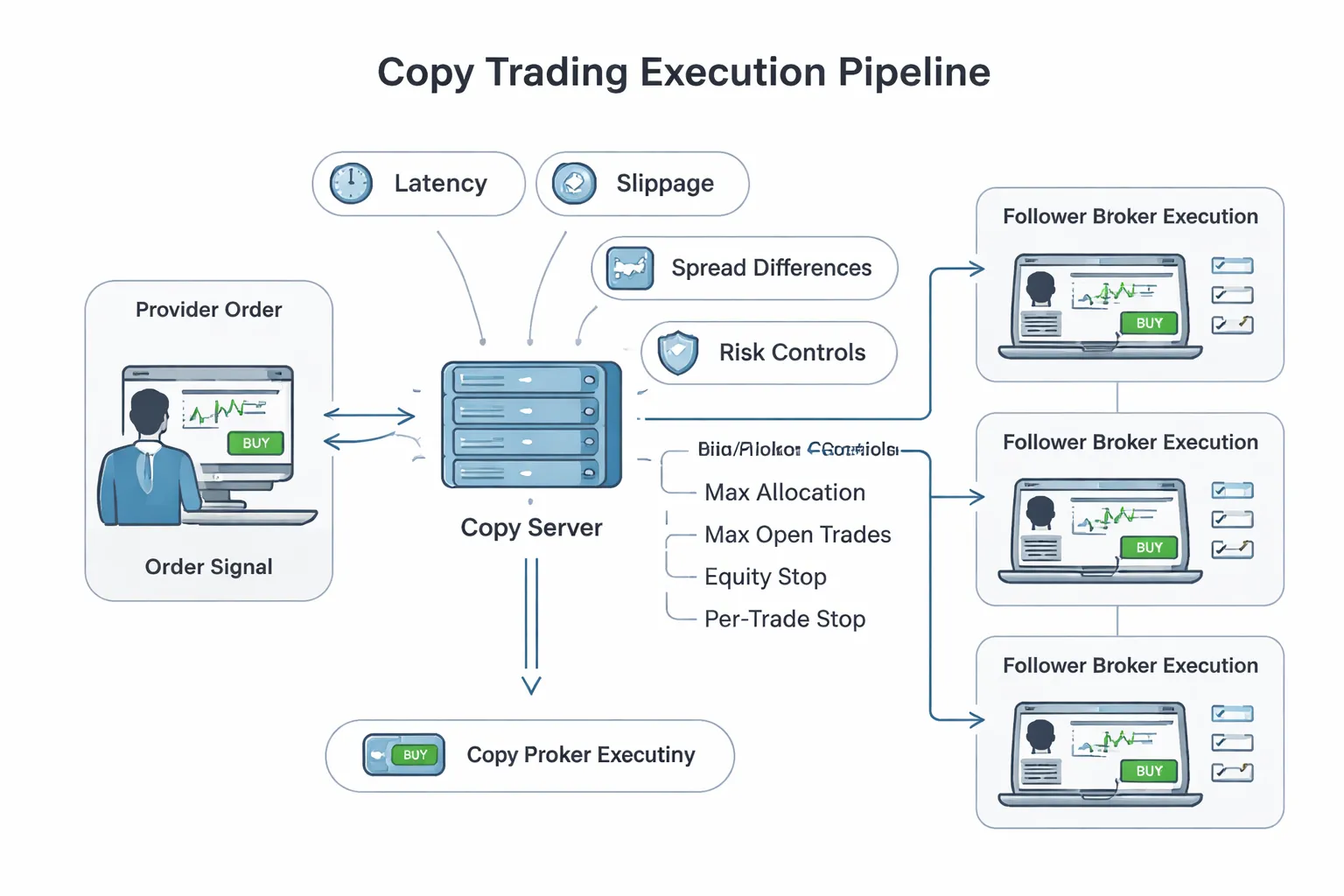
Copy methods explained
Copy trading is not one system. The copy method decides your position size, your margin use, and your drawdown path.
- Mirror trading. The platform tries to replicate the provider’s exact orders. Same symbol, same direction, same order type. Your lot size often scales by balance or equity. Small account differences still change risk.
- Proportional allocation. You assign a percent or amount to one provider. The system sizes trades using that allocation, not your full account. This is cleaner for multi-provider portfolios, but it still depends on how the platform calculates exposure.
- Fixed lot copying. You set a fixed size per trade, such as 0.10 lots, regardless of what the provider does. This can cap risk, but it can also break the strategy. The provider may scale in and out. Your fixed size can over-risk small stops or under-risk large ones.
- Equity-based sizing. The system sizes each trade from your current equity, often as a ratio to the provider’s equity. This adjusts after wins and losses. It can reduce the chance you keep copying at oversized risk after a drawdown, but it can also lock in a downsize if you lose early.
Before you copy, find out which sizing rule the platform uses, and how it handles rounding. Lot step limits, min trade size, and margin rules can force different exposure than the provider.
Slippage and latency
You will not get the provider’s fills. Execution differences change your outcome.
- Latency. The provider enters at time A. Your account enters at time B. Fast markets can move several pips between those timestamps.
- Slippage. Market orders fill at the best available price. If liquidity is thin, your fill gets worse. Stops can slip more than entries.
- Spread differences. Your account may have wider spreads than the provider due to account type, broker, or instrument mapping. Wider spreads raise break-even and increase stop-outs.
- Price feed differences. Two brokers can quote different highs and lows. That changes whether your stop triggers.
Ask for data. You want platform stats that show average follower slippage versus provider fills, split by instrument and time of day. If the platform hides this, you copy blind.
Order support
Many strategies rely on order mechanics that some copy systems do not support. Missing features change risk.
- Partial closes. Providers may scale out. Some systems copy only full close events. You can end up holding size the provider already reduced.
- Multiple take-profits. Providers may set TP1, TP2, TP3. Some systems support one take-profit only. That changes the exit profile.
- Trailing stops. If trailing logic runs on the provider side only, you may not trail at the same pace. If it runs on the server, check if it uses bid or ask, and whether it trails from entry or from peak.
- Hedging vs netting. Hedging accounts can hold long and short on the same symbol. Netting accounts merge positions into one. A hedge-based strategy can collapse into a single net position with different stops and margin use.
Confirm support in writing. If the provider uses scaling, multiple exits, or hedging, and your copy layer cannot mirror it, you do not copy the strategy. You copy a distorted version.
Risk controls you must have
Your controls must sit above the provider. You need hard limits the provider cannot override.
- Max allocation. Cap the amount or percent of equity assigned to the provider. This prevents one provider from consuming your margin and blocking other trades.
- Max open trades. Limit simultaneous positions. This reduces grid and martingale blowups. Set it per provider and across your whole account if possible.
- Equity stop. Define a hard equity level or max drawdown for that provider allocation. The system should stop copying and optionally close positions when hit. Treat it like a rule set, similar to how funded accounts enforce drawdown limits in prop firm challenge rules.
- Per-trade stop rules. Set maximum stop distance, maximum risk per trade, or a hard stop-loss requirement. If the provider opens trades without a stop, you need a forced stop at your rule level.
Do not accept a platform that only offers “copy amount” and nothing else. You need controls that cut risk during the trade, not after the damage.
Pause, disconnect, and close logic
Stopping the copy link does not always stop your risk. You must know what happens to open positions.
- Pause copying. The system stops opening new trades, but it may still manage existing ones. Some platforms keep syncing stop-loss and take-profit updates. Others freeze all updates.
- Disconnect. If the connection drops, your positions stay open at the broker. You may lose follow-up actions like stop adjustments, partial closes, and exits.
- Close logic. Some platforms let you close all copied positions at market when you stop. Others leave them running. Some close only positions from that provider and keep manual trades untouched.
- Provider closes, you do not. If your order fails, you can end up with orphan positions. You need alerts and auto-retry rules.
Set your default behavior before you copy. Decide whether “stop copying” means freeze, close, or keep managing. Then test it with small size during live market hours.
Fee and cost comparison (the part most investors underestimate)
Fee and cost comparison (the part most investors underestimate)
Your provider can trade well and you can still lose money after costs. You need to price the full stack. Broker costs. Provider fees. Platform charges. Currency and funding fees.
Direct trading costs: spreads, commissions, financing, and borrow fees
- Spreads: You pay the difference between bid and ask on every entry and exit. High turnover strategies amplify this. You need the typical spread for the exact instrument and session the provider trades.
- Commissions: Some brokers charge a fixed amount per lot or per side. Add it for both open and close. Check if copy trades use the same account type as your manual trades.
- Financing and swaps: You pay or earn overnight funding on leveraged products. Holding time drives this cost. A provider with low trade count can still rack up high swaps if they hold for days.
- Borrow fees: Shorts on stocks and some CFDs can incur borrow costs. Rates change. Hard-to-borrow names can turn a good signal into a net loss.
Provider fees: performance fee vs management fee vs subscriptions
- Performance fee: You pay a percentage of profits, often monthly. This reduces compounding because you remove capital after winning periods. You also pay even if your broker costs were high and your net gain was small.
- Management fee: You pay a fixed annual percentage of assets. This fee hits in flat markets and down markets. It punishes long holding periods and low volatility strategies.
- Subscription fee: You pay a fixed amount per month. This hurts small accounts most. It creates a break-even threshold you must clear before you profit.
Ask how fees apply when you add or remove funds mid-month. Ask if fees calculate on gross profit or net profit after trading costs. Many platforms use gross.
Hidden costs: conversion fees, funding fees, platform fees, inactivity
- Conversion fees: If the provider trades in a different base currency than your account, you pay conversion on deposits, withdrawals, and sometimes on P and L. Small conversions add up over time.
- Deposit and withdrawal fees: Cards, wires, and wallets can carry fees on both sides. Some platforms also add a markup on FX conversion during funding.
- Platform fees: Some copy platforms charge for access, data, or advanced risk controls. Treat these as fixed monthly overhead.
- Inactivity charges: If you pause copying and leave the account idle, you may pay a monthly fee. This matters if you rotate providers or trade seasonally.
Incentive alignment: high-water marks, clawbacks, and risk-taking
- High-water mark: You pay performance fees only on new net profits above your prior peak. This protects you from paying twice for the same recovery. Require it.
- Clawbacks: Some models offset future performance fees after drawdowns, or adjust payouts when gains reverse. This reduces the incentive to spike risk after losses.
- Risk incentives: A pure performance fee with no high-water mark encourages aggressive swings. So does a short evaluation window, like weekly leaderboards. You want a model that rewards consistency, not lottery outcomes.
Cost calculator approach: estimate total cost using your turnover and holding time
Build a simple estimate before you follow anyone. Use the provider’s average trades per month and average holding time.
| Input | What to use |
| Monthly turnover | Total notional traded per month divided by your account equity. |
| Average spread cost | Typical spread in points multiplied by your trade size and trade count. |
| Commission | Per lot or per side, multiplied by opens and closes. |
| Financing and swaps | Swap rate per day multiplied by position size and average holding days. |
| Provider fee | Performance fee on profits, or monthly subscription, plus any management fee. |
| Other fees | Conversion, funding, platform, and inactivity costs. |
Then stress test it. Run two scenarios. One with the provider’s average month. One with a flat month. Fixed costs still hit. If fixed costs wipe out your expected edge, you need a different provider or a larger account. For a deeper breakdown of common copy trading charges, see how copy trading fees and costs work.
Transparency and due diligence on the provider
Verification hierarchy, what proof counts
Start with evidence. Rank it. Reject anything that fails basic verification.
- Audited statements. Best case. You get an independent audit report, the auditor name, the reporting period, and the exact performance and risk numbers. You can confirm the audit firm exists and that the document matches the provider’s account type.
- Broker-verified trading history. Next best. You see a live or archived track record tied to a real broker feed. You can check deposits and withdrawals, open trades, closed trades, leverage, and timestamps. You can compare equity curve vs balance curve for hidden cash flows.
- Platform analytics with verifiable source. Acceptable only if the platform connects directly to the broker and shows trade-level data. Summary charts alone are not enough.
- Screenshots and PDF exports. Do not count. You cannot validate timing, edits, missing trades, or account resets.
Look for trade-level history. Check at least 6 to 12 months. Check worst drawdown and how long it lasted. Check whether the account survived fast markets.
Strategy clarity, rules, limits, and failure modes
You need clarity on how the strategy makes and loses money. If the provider cannot explain it in plain terms, skip them.
- Entry logic. Trend, mean reversion, breakout, news, arbitrage, or grid. You should know what triggers a trade and what markets and sessions they trade.
- Exit logic. Fixed stop and target, trailing stop, time-based exit, hedging, or averaging. You should know when they take losses and when they cut winners.
- Risk limits. Max risk per trade, max open positions, max total exposure, and a hard stop for daily or weekly loss. You should also see how they size positions when volatility rises.
- Leverage and margin use. You need typical and peak margin levels. High returns with high margin can break fast.
- When it fails. Every approach has a weak regime. Mean reversion fails in strong trends. Breakouts fail in chop. Grid and martingale fail in one-way moves. You need the provider to state this and show how they cap damage.
Match the strategy to your account settings. If the provider trades instruments you cannot hold overnight, or uses leverage you cannot match, your results will diverge.
Trade commentary and communication cadence
You do not need hype. You need predictable updates and specific information.
- Schedule. Weekly recap and monthly report. Immediate notice for abnormal drawdown or rule changes.
- Content. Current exposure, risk level, and what would trigger de-risking. A plain breakdown of losing streaks and what changed, if anything.
- Trade notes. Short notes on major trades, especially outsized losses or gains. No cherry-picked winners.
- Disclosure. Slippage, spreads, and execution limits during volatile periods. You need to know when copying will lag.
If communication stops during drawdowns, treat that as a warning. You need the provider to stay available when performance is worst.
Skin in the game, alignment of incentives
Check whether the provider trades their own capital under the same conditions as followers.
- Provider capital. Ask for the provider’s own account size, the percentage of their net worth is not required, the amount is. Verify it where possible.
- Same strategy, same risk. Confirm they run the same settings, same instruments, and same leverage. If they trade lower risk than followers, you take the real hit.
- Payout structure. Performance fees can push risk-taking. Prefer structures with high-water marks and clear loss recovery rules.
- Follower capacity. If too much follower money copies a strategy, fills get worse. Ask if they cap allocations or close the strategy to new followers.
Operational maturity, continuity, and change control
You copy a process. You also copy the provider’s operations. Weak operations create avoidable losses.
- Team vs individual. A team can cover outages and monitoring. An individual can disappear. You need to know who watches risk when the trader is offline.
- Continuity plan. Ask how they handle platform downtime, VPS failure, broker issues, and major news events. Ask what happens if the lead trader cannot trade.
- Execution setup. Check broker, account type, typical spreads, and whether they use EA tools. Execution quality drives copy results.
- Change disclosure. Require advance notice for changes to instruments, leverage, holding times, or risk per trade. Require a written change log with dates.
- Record retention. The provider should keep trade history and monthly reports. You should be able to review older periods, not just the best months.
Before you commit, compare platforms on verification, controls, and protections. Use this guide to best forex copy trading platforms as a baseline checklist.
Building a copy-trading portfolio (instead of following one “star” trader)
Building a copy-trading portfolio (instead of following one “star” trader)
Most blowups come from concentration. One provider, one style, one regime shift. Build a small portfolio of providers. Set hard limits. Review it on a schedule.
Diversification rules of thumb
- Number of providers: Start with 3 to 5. Fewer raises concentration risk. More increases overlap and monitoring load.
- Capital caps: Cap any one provider at 25% to 35% of your copy account. If a provider uses high leverage or holds through news, cap them lower.
- Style mix: Combine different holding times and instruments when possible. Avoid 5 providers who all scalp the same FX pairs at the same hours.
- Correlation check: If two providers show similar equity curves and drawdowns, treat them as one exposure and cut total allocation.
- Rebalancing frequency: Rebalance monthly. Do not rebalance daily or weekly. You will chase noise and lock in bad timing.
Allocation frameworks
Pick one sizing method. Apply it the same way each rebalance. Keep it simple.
- Equal weight: Split capital evenly across providers. Use this when you have limited data or providers have similar risk controls.
- Risk parity: Allocate more to lower volatility providers and less to higher volatility providers. Use a simple proxy such as 90-day max drawdown or 90-day return volatility from equity curve.
- Drawdown-based sizing: Size by pain. Give smaller weights to providers with deeper or faster drawdowns. Increase only after they prove stability over a full market cycle.
| Framework | How you size | Best use | Main risk |
|---|---|---|---|
| Equal weight | Same % to each provider | Early stage portfolio, clean execution | You ignore risk differences |
| Risk parity | Inverse to volatility or drawdown | Mixed styles, clear risk metrics | Underestimates tail risk and leverage jumps |
| Drawdown-based | Smaller % to deeper drawdowns | Capital preservation focus | You may size down right before recovery |
Rotation criteria
Rotation needs rules. Use triggers. Do not improvise during stress.
- Reduce: Cut allocation when the provider hits 50% to 70% of their historical max drawdown, or when leverage and position size rise versus their own history.
- Pause: Stop copying after a hard breach of your limits, such as max drawdown, max open risk, or trading during restricted events you set in advance.
- Replace: Replace after repeated rule breaks, a large deviation from stated style, or a second major drawdown without a clear process change you can verify.
- Cool-off window: After a pause, wait 2 to 4 weeks of new trades before restarting. You want evidence, not promises.
Ongoing monitoring
You track drift. You track risk creep. You track style changes. Use a fixed checklist each week and each month.
- Drift detection: Compare the last 30 days to the last 90 to 180 days. Watch holding time, average stop size, trade frequency, win rate, and exposure by instrument.
- Risk creep: Flag any increase in average leverage, larger loss per trade, wider stops, more simultaneous positions, or higher overnight and weekend exposure.
- Style changes: Watch for shifts like scalper to swing, FX to indices, or normal stops to martingale and grid behavior. Treat unannounced shifts as a risk event.
- Execution quality: Track your slippage versus the provider’s stated fills if the platform reports it. Consistent slippage can break an otherwise solid edge.
- Provider overlap: Review combined exposure across providers. Correlation often rises in stress. Reduce when everyone leans the same way.
Record-keeping
Keep a decision log. It stops you from rewriting history. It also improves your process over time.
- What to log: Provider name, allocation, reason for adding, key risk limits, expected style, and what would trigger a reduce, pause, or replace.
- What to store: Monthly statements, equity curve snapshots, drawdown stats, and any provider communications about strategy changes.
- How to review: Once per month, write one paragraph on what worked and what failed. Change one rule at a time. Date it.
- Where to start: Use your platform checklist from best forex copy trading platforms to standardize what you collect for every provider.
Step-by-step checklist: how to choose a copy trading provider (practical workflow)
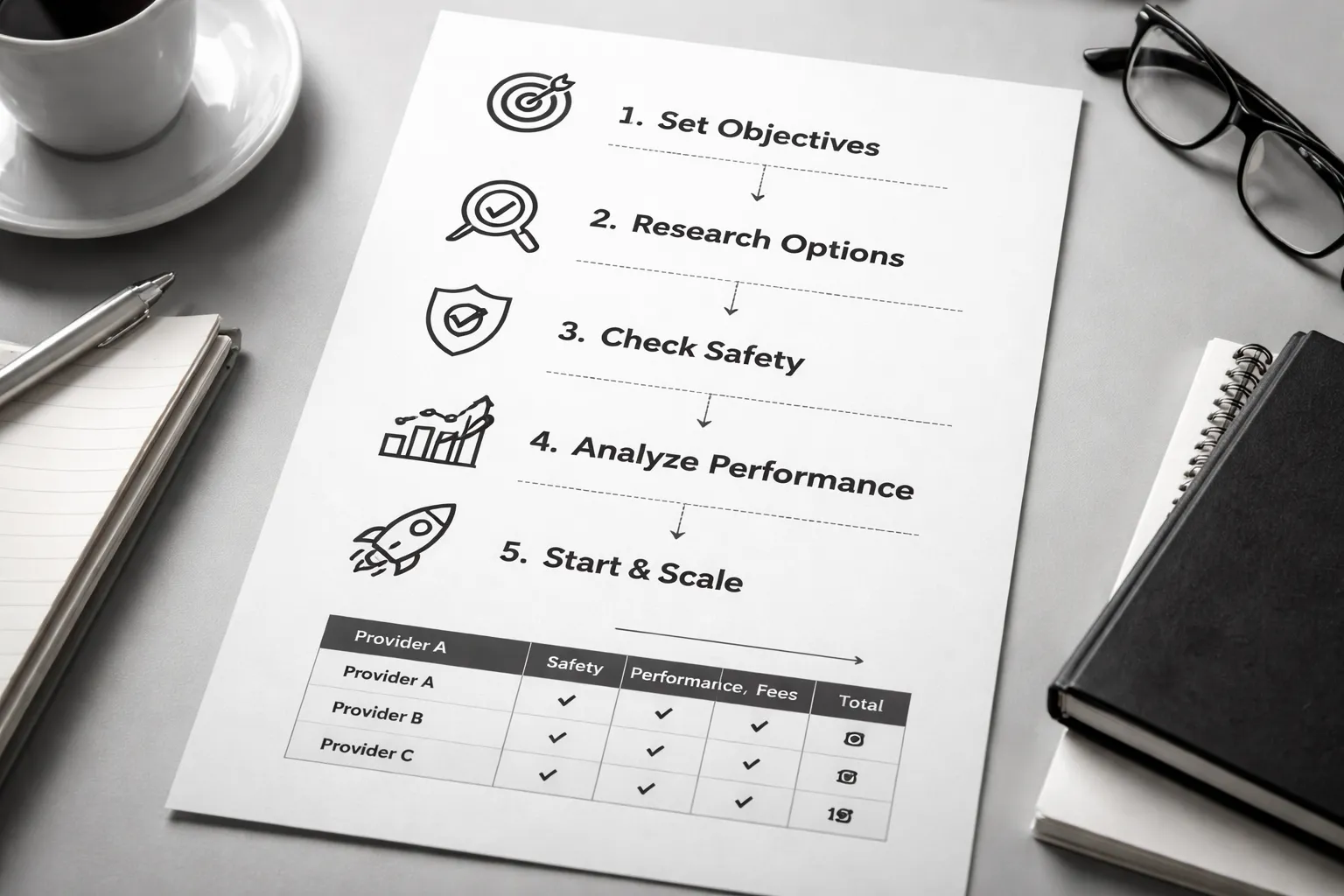
Step 1: Set objectives and non-negotiables
Start with a one-page spec. If a provider fails any non-negotiable, you stop.
- Goal: income, growth, or capital preservation. Pick one primary goal.
- Timeframe: day trading, swing, or long-term. Match it to how often you can review.
- Risk limit: set your max acceptable drawdown for this allocation. Write a hard stop level.
- Instruments: FX only, indices, metals, crypto, or mixed. Avoid products you do not understand.
- Leverage cap: define your max leverage exposure. If the platform hides it, treat it as a fail.
- Holding rules: allow or ban weekend holds, news trading, and high swap exposure.
- Ethics and compliance: no unregulated offshore entities, no fake track records, no “guaranteed” claims.
- Cost ceiling: max spread markup, performance fee, and platform fees you will accept.
Step 2: Shortlist platforms and providers using safety and transparency filters
Filter for safety first. Performance comes later.
- Regulation and entity clarity: confirm the broker, legal entity, and license in your region. Match names, not brands.
- Segregation and cash controls: check how client funds get held and how withdrawals work.
- Track record verification: prefer verified accounts with broker-linked history, not screenshots.
- History length: require a minimum live track record, ideally 12 months or more. Avoid “new star” profiles.
- Data completeness: you need open trades, closed trades, position sizing, and full equity curve access.
- Execution model disclosure: find spreads, commissions, slippage policy, and whether copying uses market orders.
- Conflict checks: identify who earns what. Watch for providers paid to take more risk to rank higher.
- Provider identity and communication: you need a clear bio, method summary, and change logs. Silence is a risk signal.
- Platform controls: require max drawdown stop, equity stop, and per-trade size controls.
Step 3: Analyze metrics and trade behavior, including worst periods
Do not judge by returns. Judge by return path and survival risk.
- Max drawdown and recovery time: record peak-to-trough drawdown, and how long it took to recover.
- Worst month and worst week: isolate the worst periods. Read the trade list for those dates.
- Return consistency: check how many profitable months exist and how large the losing months are.
- Risk per trade: estimate typical stop size and position size. Look for sudden jumps.
- Concentration: count exposure by pair or asset. One-instrument dependency raises regime risk.
- Average hold time: match it to your tolerance for swaps, gaps, and weekend risk.
- Martingale and grid signals: watch for adding to losers, increasing lot size after losses, or dense order clusters.
- Stop-loss behavior: confirm the provider uses stops, and does not “mental stop” into large floating losses.
- Profit factor and win rate context: treat high win rate as a warning if losses come in rare large spikes.
- Fee impact: subtract all fees and realistic slippage from results. If the edge disappears, you pass.
If you want a benchmark for provider evaluation versus paid tips, compare your findings to the criteria used in forex signals: are they worth it.
Step 4: Run a small pilot allocation and validate execution differences
Assume your results will differ from the provider. Prove the gap before you scale.
- Start small: allocate a fixed pilot amount you can lose within your plan.
- Match settings: copy ratio, max open trades, and risk caps should mirror your spec from Step 1.
- Log execution quality: track spread, slippage, and fill time versus the provider stats.
- Check trade mapping: confirm you receive the same entries and exits, and that partial closes replicate correctly.
- Watch correlation risk: if the provider opens many positions that move together, your drawdown can spike fast.
- Audit risk spikes: flag any day where exposure or lot size breaks the pattern.
- Test withdrawals: withdraw a small amount during the pilot. You want proof the plumbing works.
Step 5: Scale cautiously with hard risk limits and a review schedule
Scaling works when you keep rules stable. You change size, not discipline.
- Scale in steps: increase allocation in small tranches only after a clean pilot period.
- Hard stops: set an equity stop and a max drawdown stop at the account level.
- Provider stop rules: pause copying after a predefined loss streak, drawdown breach, or behavior change.
- Diversify with intent: add a second provider only if the strategy and instruments differ.
- Monthly review: store statements, equity snapshots, drawdown stats, and provider notes. Write one paragraph. Change one rule at a time.
- Exit plan: define what makes you stop copying. Include a max time to recover from drawdown.
Printable checklist: quick scoring template for side-by-side comparisons
Score each item from 0 to 2. 0 means fail, 1 means unclear, 2 means confirmed. Total the score and keep notes.
| Category | Check | Score (0-2) | Your notes |
|---|---|---|---|
| Safety | Regulated entity you can verify | ||
| Safety | Clear fees and conflicts disclosed | ||
| Transparency | Verified live track record, 12+ months | ||
| Transparency | Full trade history and equity curve access | ||
| Risk | Max drawdown within your limit | ||
| Risk | Worst month explained by normal behavior, not a blowup | ||
| Behavior | No martingale, no grid escalation, no hidden risk | ||
| Execution | Pilot slippage and fills acceptable versus provider | ||
| Controls | Equity stop, max drawdown stop, and position limits available | ||
| Process | Monthly review routine set, exit rules written |
Pros, cons, and who copy trading is (not) for
Main advantages
- Time savings. You outsource trade selection and execution. You still set limits and review results, but you stop watching charts all day.
- Learning by observation. You can study position sizing, holding times, and how the provider behaves during drawdowns. You learn faster when you compare their actions to your own rules.
- Diversified exposure. You can split capital across multiple providers or systems. This can reduce reliance on one approach, if the providers trade different instruments and styles.
Key drawbacks
- Dependency risk. Your results depend on someone else’s decisions, discipline, and continuity. If the provider changes behavior, pauses trading, or takes hidden risk, your account takes the hit.
- Execution mismatch. Your fills will differ from the provider’s. Smaller accounts, wider spreads, slower routing, and different leverage can turn a “good” curve into a mediocre one. Watch the gap between the provider’s published return and your mirrored return.
- Fee drag. Performance fees, spreads, commissions, and platform fees stack. A provider can look strong before fees and average after fees. You need net results, not marketing returns.
Behavioral risks that break most followers
- Chasing leaderboards. You join after a hot month. You buy peak risk. Many top-ranked providers got there by taking more exposure, not by having a stable edge.
- Panic disconnects. You stop copying mid-drawdown. You lock in losses and miss the recovery that often follows the system’s worst period.
- Overconfidence after short streaks. You increase allocation after a few winning weeks. Then variance hits and the drawdown lands when your size is largest.
Who copy trading is for, and who it is not for
| Better fit | Poor fit |
|---|---|
| You can follow written risk limits and stick to them. | You change settings often and react to every loss. |
| You accept that drawdowns happen and you can hold through them. | You need smooth weekly gains or you will quit. |
| You measure net performance in your account, after fees and slippage. | You rely on platform rankings and screenshots. |
| You can diversify across uncorrelated providers and cap exposure. | You plan to put most of your capital behind one trader. |
| You treat copy trading as a rules-based allocation, not entertainment. | You treat it like a shortcut to fast income. |
Better alternatives for some users
- ETFs and indexing. If your goal is long-term growth with low effort and low costs, broad index exposure often beats high-fee, high-turnover approaches.
- Robo-advisors. If you want automated rebalancing and risk targeting, a robo portfolio can give you structure without trader dependency.
- Paper trading. If you are still learning execution and risk, practice first. Track slippage, spreads, and how you react to drawdowns without paying tuition.
- Managed accounts. If you want delegation with clearer accountability, a regulated manager with defined mandates can fit better than a social leaderboard.
- Signals. If you want discretion and control over entries, compare forex signal providers instead of full auto-copy.
FAQ
Is copy trading regulated?
It depends on the provider and the broker. Check the broker’s license, regulator, and client money rules. Check if the strategy provider gives advice or only publishes trades. If the platform avoids naming regulators, walk away.
What performance numbers matter most?
Focus on max drawdown, time in drawdown, and monthly return distribution. Check trade count, average hold time, and longest losing streak. Prefer results over at least 12 months. Ignore one-month spikes and leaderboard rank.
How do I spot a risky strategy fast?
Look for martingale, grid averaging, and no stop losses. Watch for high win rate with rare big losses. Check leverage and margin use. If returns stay smooth while exposure stays high, expect a cliff later.
What fees should I expect?
Common costs include spreads, commissions, platform fees, and performance fees. Some providers add markups or require subscriptions. Ask for the full fee schedule in writing. Compare net returns after all costs, not gross returns.
How much money should I allocate to one trader?
Start small. Cap a single provider at a level you can lose without changing your plan. Many traders use 10 to 30 percent per provider, split across several styles. Increase only after you see a full drawdown cycle.
Why do my results differ from the provider’s?
Execution differs. You face slippage, spreads, swaps, and latency. Your broker feed and order size can change fills. Copy settings can also distort risk. Track your fill price vs the master’s and measure average slippage per trade.
What copy settings should I use first?
Use fixed risk or fixed lot sizing. Set a max daily loss and an equity stop. Limit open trades and max leverage. Disable copying if margin level drops below your threshold. Avoid “match master size” until you test with small size.
Can I stop copying and exit safely?
Yes, if the platform lets you close positions independently. Check if unfollowing auto-closes trades or leaves them open. Confirm you can set a close-all rule. Avoid providers who lock funds or restrict withdrawal during open baskets.
How many providers should I follow?
Two to five is enough. Choose uncorrelated styles and pairs. Avoid five traders doing the same EURUSD intraday strategy. Track correlation using weekly returns. Replace providers based on risk drift, not short-term underperformance.
Is copy trading better than a prop firm challenge?
They solve different problems. Copy trading buys execution from someone else. A prop challenge tests your own system and discipline. If you want structure and rules, read this step-by-step prop firm challenge plan.
What due diligence checklist should I run before I follow?
- Verify broker regulation and fund protection.
- Check 12+ months track record and trade count.
- Review max drawdown and time to recover.
- Look for stop-loss use and leverage limits.
- Confirm full fee schedule and net performance.
- Test with small capital and track slippage.
Conclusion
Pick the provider that makes risk and costs measurable. If you cannot verify regulation, trade history, and drawdown control, do not connect your account.
- Start small. Mirror with the minimum size for at least 30 trading days.
- Track the gap. Compare provider results vs your filled price, fees, and net return.
- Set hard limits. Cap allocation per provider and stop copying after a predefined drawdown.
- Diversify. Use 2 to 3 uncorrelated providers, avoid stacking the same strategy.
- Re-check monthly. Validate that performance still comes from the same risk profile, not higher leverage.
If you want a baseline for evaluating paid trade ideas, read what to check before you buy forex signals.
-
Best Forex Copy Trading Platforms (Features, Fees & Safety Compared)
8 months ago -
Forex Prop Firm Challenge Rules Explained (Drawdown, Targets, Payouts)
8 months ago -
Copy Trading Forex Explained: How It Works, Pros, Cons & Risks
8 months ago -
Best Forex Prop Firms (Top Firms Compared)
8 months ago -
Forex Signals: Are They Worth It? (What to Know Before You Buy)
8 months ago
-
- Regulation and licensing, verify before you look at returns
- Client fund protections, where your money sits and who controls it
- Jurisdiction and dispute resolution, what happens when things break
- Platform security basics, stop account takeovers and permission creep
- Red flags checklist, reasons to walk away
-
- Fee and cost comparison (the part most investors underestimate)
- Direct trading costs: spreads, commissions, financing, and borrow fees
- Provider fees: performance fee vs management fee vs subscriptions
- Hidden costs: conversion fees, funding fees, platform fees, inactivity
- Incentive alignment: high-water marks, clawbacks, and risk-taking
- Cost calculator approach: estimate total cost using your turnover and holding time
-
- Step 1: Set objectives and non-negotiables
- Step 2: Shortlist platforms and providers using safety and transparency filters
- Step 3: Analyze metrics and trade behavior, including worst periods
- Step 4: Run a small pilot allocation and validate execution differences
- Step 5: Scale cautiously with hard risk limits and a review schedule
- Printable checklist: quick scoring template for side-by-side comparisons
-
- Is copy trading regulated?
- What performance numbers matter most?
- How do I spot a risky strategy fast?
- What fees should I expect?
- How much money should I allocate to one trader?
- Why do my results differ from the provider’s?
- What copy settings should I use first?
- Can I stop copying and exit safely?
- How many providers should I follow?
- Is copy trading better than a prop firm challenge?
- What due diligence checklist should I run before I follow?
-
-
- Regulation and licensing, verify before you look at returns
- Client fund protections, where your money sits and who controls it
- Jurisdiction and dispute resolution, what happens when things break
- Platform security basics, stop account takeovers and permission creep
- Red flags checklist, reasons to walk away
-
- Fee and cost comparison (the part most investors underestimate)
- Direct trading costs: spreads, commissions, financing, and borrow fees
- Provider fees: performance fee vs management fee vs subscriptions
- Hidden costs: conversion fees, funding fees, platform fees, inactivity
- Incentive alignment: high-water marks, clawbacks, and risk-taking
- Cost calculator approach: estimate total cost using your turnover and holding time
-
- Step 1: Set objectives and non-negotiables
- Step 2: Shortlist platforms and providers using safety and transparency filters
- Step 3: Analyze metrics and trade behavior, including worst periods
- Step 4: Run a small pilot allocation and validate execution differences
- Step 5: Scale cautiously with hard risk limits and a review schedule
- Printable checklist: quick scoring template for side-by-side comparisons
-
- Is copy trading regulated?
- What performance numbers matter most?
- How do I spot a risky strategy fast?
- What fees should I expect?
- How much money should I allocate to one trader?
- Why do my results differ from the provider’s?
- What copy settings should I use first?
- Can I stop copying and exit safely?
- How many providers should I follow?
- Is copy trading better than a prop firm challenge?
- What due diligence checklist should I run before I follow?
-
-
How to Place a Forex Trade Step by Step (Your First Trade Explained)
6 months ago -
Forex Trading vs Crypto Trading: Which Market Is Better for Beginners?
6 months ago -
Forex Lot Size Calculator: How to Use It to Size Trades Correctly
7 months ago -
How to Calculate Position Size in Forex (Position Sizing Formula + Examples)
7 months ago -
Forex Leverage Explained: How It Works, Pros, Cons & Examples
7 months ago
-
Forex Trading Platforms Comparison: MetaTrader vs cTrader vs TradingView
8 months ago -
Stop Loss vs Take Profit: Differences, Examples & Best Practices
8 months ago -
Is Forex Trading Legal in the United States? Rules, Regulators & What to Know
8 months ago -
Forex Market Hours & Trading Sessions Explained (Best Times to Trade)
8 months ago -
Forex Leverage Explained: How It Works, Pros, Cons & Examples
7 months ago