How to Pass a Forex Prop Firm Challenge: A Practical Step-by-Step Plan

Forex prop firm challenges fail traders for one reason, they break the rules. Most challenges use the same core targets, hit a profit goal while staying under a max daily loss and a max overall drawdown. You need a plan that protects your downside first.
This guide shows you how to pass a forex prop firm challenge step by step. You will learn how to read the rules, set a fixed risk per trade, cap daily exposure, choose setups that fit the time limit, and track performance so you do not drift. You will also learn how to avoid the common violations that end accounts fast, overtrading, widening stops, and chasing losses.
If you still need the basics, start with what a forex prop firm is.
- In het kort: Treat the challenge like a risk exercise, your job is to survive the rules first and hit the target second.
- Read your firm’s rules line by line, then write them as numbers you can trade, max daily loss, max overall drawdown, profit target, minimum days, and lot limits.
- Fix your risk per trade and keep it small. Do not scale up after wins. Do not “make it back” after losses.
- Cap your daily exposure, stop trading after a set loss or a set number of trades. This prevents rule breaks from tilt and overtrading.
- Trade fewer, cleaner setups that fit the time window. Skip low quality entries. You do not need constant action.
- Use hard stops and preplanned exits. Do not widen stops. Do not average down.
- Track every trade and review weekly. Watch your average loss, win rate, and max drawdown. Cut what causes violations fast.
- Build a “no trade” list, news spikes, illiquid sessions, revenge trades, and any setup you cannot explain in one sentence.
- Choose a plan that matches the rules, not your ego. If you need rule specifics, read the prop firm challenge rules breakdown.
How a Forex Prop Firm Challenge Works (and Why Most Traders Fail)
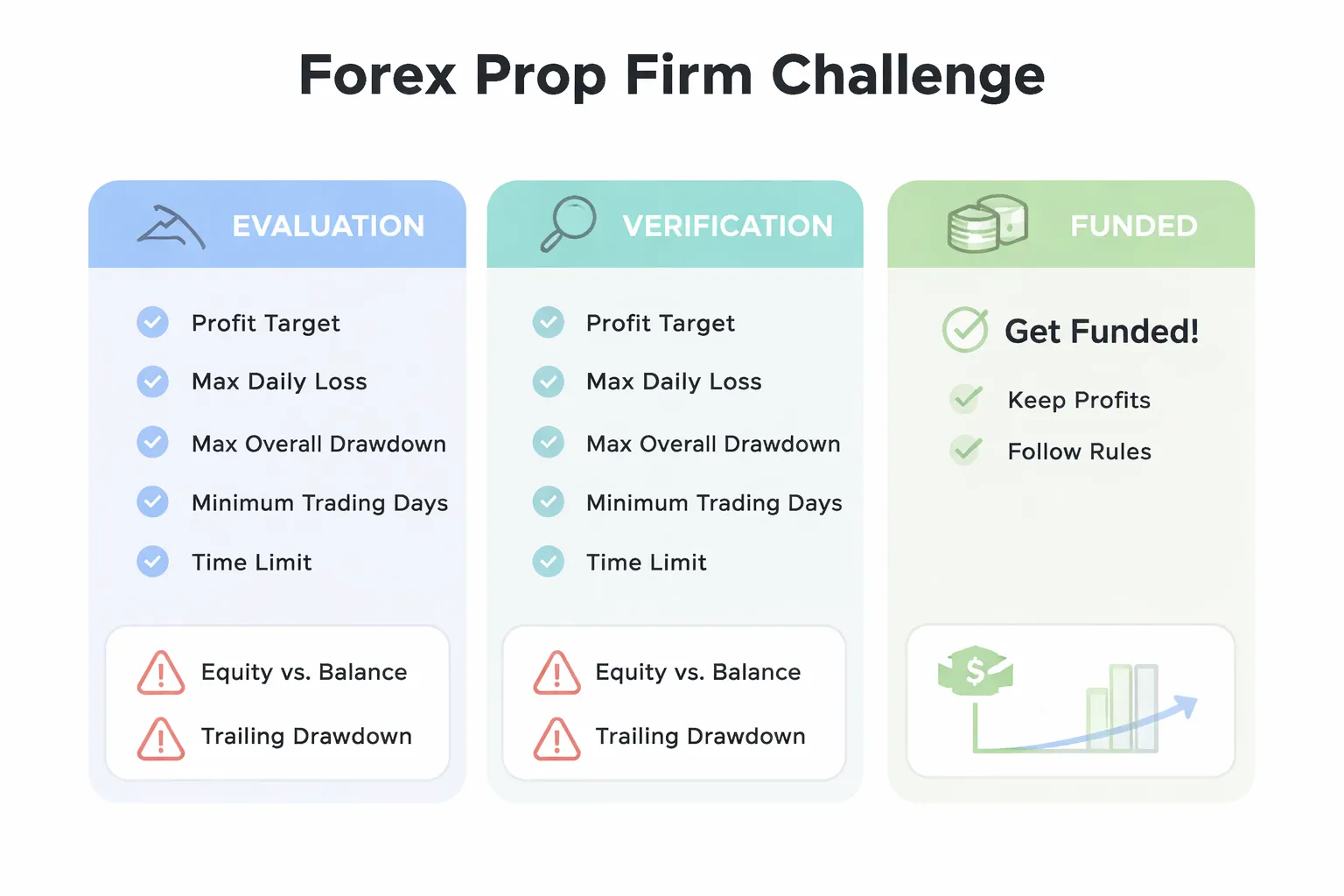
How the Challenge Works
You trade a demo account under real risk rules. The firm scores you on rule compliance, not on how smart your entries look.
Most challenges use fixed targets and hard loss limits. You must hit the target before you hit a drawdown rule. One violation fails the account.
Typical Objectives You Must Hit
- Profit target: Often 6 to 10 percent in the evaluation stage. Some firms drop it in later stages.
- Max daily loss: Usually 3 to 5 percent. Many firms calculate it from equity, not balance.
- Max overall drawdown: Often 8 to 12 percent. Some use a static cap, others use a trailing cap.
- Minimum trading days: Commonly 3 to 10 days. You cannot pass in one good day even if you hit the target.
- Time limit: Some firms require you to pass within 30 to 60 days. Others have no deadline.
Common Hidden Failure Points
- Equity vs balance: Balance updates when you close trades. Equity moves with floating profit and loss. If the rule uses equity, an open drawdown can fail you even if you plan to close later.
- Trailing drawdown: Your max loss limit can move up as your equity rises. You can “profit” your way into a tighter stop-out level. One pullback can then break the rule.
- Daily loss reset time: Some firms reset at broker midnight, not your local day. A late loss and an early loss can stack inside one “day” by their clock.
- Time limits and minimum days: Traders force setups to “use the days” or to “beat the clock.” That usually causes overtrading and rule breaks.
- Prohibited strategies: Many firms restrict news trading, latency arbitrage, tick scalping, grid or martingale, and trade copying between accounts. Some ban holding during major news, or require a minimum stop distance.
- Execution details: Slippage, spreads, and commissions count. Tight stops and high leverage magnify small execution costs into daily loss violations.
Evaluation vs Verification vs Funded Stage
Firms split the path into stages. Each stage changes the pressure points.
- Evaluation: Highest profit target. Same drawdown rules. You feel forced to “perform.” Most failures happen here.
- Verification: Lower target in many programs. Traders relax and take sloppy risk, or they keep the same aggression and hit drawdown.
- Funded: Payout rules start. Some firms tighten risk, add consistency requirements, or apply different drawdown math. Your goal shifts from passing to steady monthly returns.
Before you start, read the rules line by line and confirm how the firm calculates loss limits, especially trailing drawdown and equity-based daily loss. Use this prop firm challenge rules guide if you need a clean breakdown.
Why Most Traders Fail
- They trade for the target, not for the rules. They size up to “get it done,” then one normal losing streak breaks daily loss.
- They ignore drawdown math. They think in pips and setups. The challenge grades you in percent and thresholds.
- They let one trade decide the account. They revenge trade after a loss, or they hold and hope to avoid closing a red day.
- They overtrade to meet minimum days. Low quality trades add random losses and push you into violations.
- They underestimate execution. Spreads widen, news spikes, and stops slip. Tight risk plans break in live conditions.
What Prop Firms Actually Test
- Risk discipline: You keep losses small and controlled, even after wins and even after losses.
- Process consistency: You repeat the same sizing, same session, same setups. You do not change your system mid-challenge.
- Rule compliance: You avoid the behaviors that trigger violations, equity dips, daily limits, and restricted trading windows.
Step 1 — Choose the Right Challenge and Read the Rules Like a Lawyer
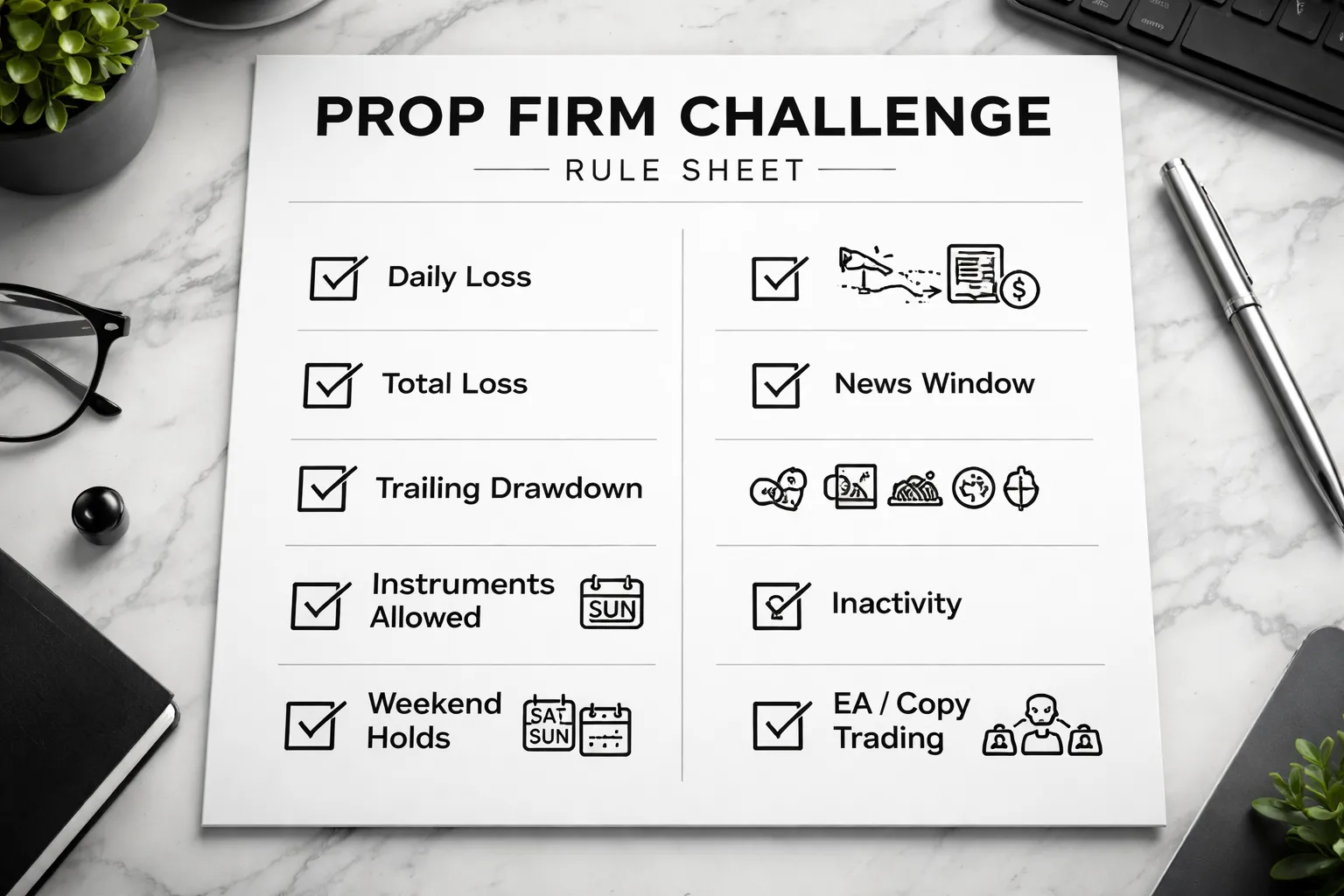
Step 1, Choose the Right Challenge and Read the Rules Like a Lawyer
Your strategy does not fail most challenges. Your rule interpretation does.
Before you place a trade, pick a challenge you can trade with your normal risk and schedule. Then read every rule page. Save screenshots. Download the PDF. If support answers a rule question, keep the ticket.
Build your plan around rules first, setups second.
Rule checklist to copy into your trading plan
- Daily loss limit: Define the exact trigger. Some firms use end of day balance, some use intraday equity. Write the dollar value and the reset time in your broker server time.
- Total loss limit: Write the maximum allowed drawdown and whether it uses balance, equity, or a trailing method.
- Trailing drawdown: Confirm if it trails on balance high, equity high, or both. Confirm if it stops trailing after you reach a threshold.
- Profit target and minimum days: Write the target percent, the minimum trading days, and what counts as a “day”.
- Scaling rules: Write the conditions to increase size, the required profit, the max lot cap, and if scaling applies in evaluation, funded, or both.
- Inactivity rule: Write the maximum days without trading and what actions count. Some firms require an executed trade, not a login.
- Weekend holds: Write if you can hold positions over the weekend. If allowed, write the cutoff time and if pending orders must be removed.
- Max open trades and max lots: Write any caps on concurrent positions, symbols, or total exposure.
- Consistency rule: If they limit single day profit share, lot variability, or “over risk”, write the exact wording and ask support for examples.
Trailing drawdown explained with simple examples
Trailing drawdown is the rule that eliminates traders who scale up after a run of wins.
Example 1, trailing on balance high.
- Account size: $100,000.
- Max trailing drawdown: 10%.
- You start with a drawdown floor at $90,000.
- You grow the balance to $104,000.
- The floor trails up to $93,600.
- If equity or balance hits $93,600, you fail.
What this changes for your sizing. Your “risk budget” shrinks if you trade near the floor. If you keep risking a fixed percent of the original account, one normal losing streak can hit the trailing floor.
Example 2, trailing on equity high.
- You have an open trade floating +$3,000.
- Equity prints a new peak.
- The trailing floor moves up immediately.
- If price reverses, you can violate the rule without closing a trade.
What this changes for your sizing. You must treat floating profit as fragile. Avoid oversized positions that create big equity swings. Use smaller lots, faster partials, or tighter exposure caps when you approach a new equity peak.
Practical rule for your plan. Set a hard “max loss from peak” smaller than the firm limit. Example, if the firm allows 10% trailing, you cap your peak to trough drawdown at 6%.
If you need a full breakdown of common drawdown models and how firms calculate them, read this prop firm challenge rules guide.
Instrument and session restrictions
Many failures come from trading the wrong product, at the wrong time, on the wrong account type.
- FX majors and minors: Usually allowed. Check spread markups and whether the firm blocks certain crosses.
- Exotics: Often restricted or priced with wide spreads. If allowed, cap size. Slippage can spike your daily loss in one move.
- Indices: Often allowed, sometimes with higher margin or lot limits. Check whether they restrict cash indices around opens.
- Metals: Gold rules differ by broker. Check contract size and swap. Confirm if XAUUSD has special max lots.
- Crypto: Common restrictions include weekend trading bans, higher spreads, or total prohibition.
- Session rules: Some firms restrict trading during rollover, market open windows, or low liquidity hours. Write the exact time blocks.
Match your challenge to your edge. If you only trade London session EURUSD and GBPUSD, avoid a ruleset that pushes you into indices or late US hours to “find trades”.
Execution constraints you must treat as hard limits
- News trading: Firms may ban opening trades X minutes before and after red news. Some also ban closing. Write the events covered and the time window.
- Copy trading: Some firms allow it with limits, others ban it. If you use copying, confirm the rule and keep your execution logs. If you rely on third party tools, you also need clean provider risk controls.
- Martingale and grid: Many firms ban any averaging down or fixed step grids. If your system adds positions, write clear criteria tied to structure, not price distance.
- Latency arbitrage: Any strategy that exploits feed delay gets flagged. Avoid “fast execution” tactics that depend on price mismatch.
- EA policies: Some firms allow EAs, some require disclosure, some ban them. If you automate, confirm VPS rules, max orders, and whether they ban trade management bots.
- Trade duration and scalping: Some firms restrict minimum hold time or target “tick scalping”. If you scalp, confirm the minimum seconds rule if it exists.
- Account sharing and logins: Many firms ban multiple IP patterns or shared credentials. Keep access simple and consistent.
| Rule area | What to write in your plan | What to set as your internal limit |
|---|---|---|
| Daily loss | Dollar trigger, equity or balance, reset time | 70% to 80% of firm limit |
| Total loss | Method used, trailing behavior, stop trailing condition | 60% to 70% of firm limit |
| News | Event list source, time window, open and close rules | Wider buffer than required |
| Instruments | Allowed symbols, max lots per symbol, margin rules | Trade your top 2 to 5 symbols only |
| Weekend holds | Cutoff time, pending order policy, crypto rules | Flat by Friday close unless your edge needs holds |
Finish this step with one output. A one page rules sheet. If a rule can fail you, it goes on the sheet in plain numbers and exact times.
Step 2 — Build a Passing Plan Backwards From the Numbers
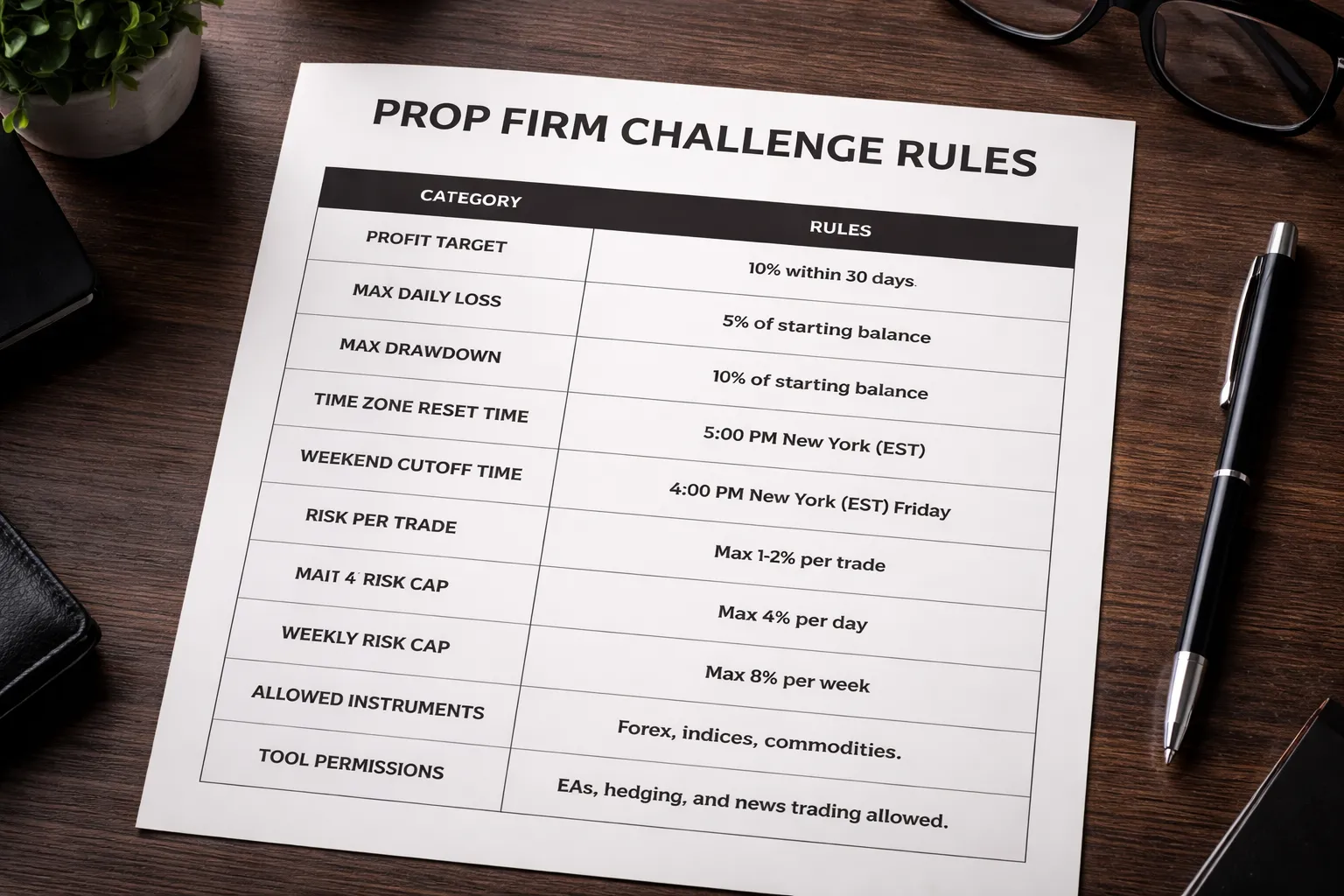
Step 2. Build a Passing Plan Backwards From the Numbers
Start with the fail conditions. Work backwards into daily limits and a schedule you can follow.
You do not need big days. You need clean days. Your plan must survive a losing streak.
Translate targets into daily goals without forcing trades
Money targets make you chase. Process targets keep you selective. Use process KPIs as the main scoreboard. Use the profit target as a ceiling, not a daily demand.
- Set a time window, not a trade quota. Example, trade only London open to New York mid session.
- Cap decision points. Example, max 2 trade ideas per day, max 3 entries total.
- Track execution KPIs. R multiple, rule compliance, session discipline, planned versus impulse entries.
- Use a minimum quality filter. If your setup is not present, you do nothing.
- Use a daily stop condition. You stop after your max loss, or after your first rule break, or after hitting your daily profit cap.
Daily target math still matters. It tells you the pace you need. It does not tell you to trade.
Set internal circuit breakers tighter than the firm limits
The firm gives you a cliff. You build guardrails before the cliff.
- Drawdown buffer. Keep at least 20 to 30 percent of the allowed drawdown unused at all times.
- Daily loss buffer. Stop at 70 to 80 percent of the firm daily loss limit.
- Max open risk. Keep total open risk below your daily risk limit, even if the firm allows more.
- Correlation cap. Avoid stacking the same USD risk across pairs. Treat it as one position.
- News lockout. No new trades inside your defined minutes around red folder events for your symbols.
If you copy trades, your circuit breakers must include follower slippage and execution drift. See forex copy trading explained.
Define a max risk per day and per week that survives a losing streak
Build the model around your worst normal stretch. Assume you can lose 6 to 10 trades in a row without breaking rules.
| Item | Rule | Why it works |
|---|---|---|
| Risk per trade | 0.25% to 0.50% of starting balance | Lets you take enough samples without hitting limits |
| Max losses per day | 2 full stop outs, then stop | Prevents revenge trades |
| Daily risk cap | 0.75% to 1.25% | Survives a bad day and keeps you in the game |
| Weekly risk cap | 2.5% to 4.0% | Stops you from digging a hole you cannot exit |
| Profit lock rule | After +1.0% week to date, cut daily risk in half | Protects progress and reduces blow ups |
Keep risk stable. Do not increase size to catch up. Catching up breaks accounts.
Create a time plan, when to push, pause, and stop for the month
Most failures come from overtrading late in the month. You need a calendar rule set.
- Push days. Only when you are below max weekly risk, within your best session, and your last 20 trades show rule compliance.
- Pause triggers. Pause for 24 hours after 2 stop outs in a day, any rule breach, or a platform issue.
- Stop for the week. Stop when you hit your weekly risk cap, or when you hit your weekly profit lock and feel the urge to press.
- Stop for the month. If you reach the profit target, stop trading. If you get within one good day of the target, cut risk by 50%.
- End of week rule. Flatten by Friday close unless your written edge requires holds and the firm allows it.
One page rules sheet
If a rule can fail you, it goes here. No opinions. Only numbers and exact times.
| Category | Rule in plain numbers | Your setting |
|---|---|---|
| Profit target | Target, _______% or $______ by end date ________ | Stop trading when hit |
| Max daily loss | Firm limit, _______% or $______ based on ________ (equity or balance) | Internal stop at _______% of firm limit |
| Max overall drawdown | Firm limit, _______% or $______ based on ________ (equity or balance) | Keep buffer, do not use last _______% |
| Trailing drawdown | Yes or no. If yes, trail method ________. Updates at ________ (real time, end of day, end of trade) | Never risk more than _______% once trail tightens |
| Minimum trading days | Minimum ______ days. Min lots per day ______. Rules on “micro trades” ______ | Schedule, ______ days per week |
| Time zone | Server time zone, ________. Daily reset at ________:______ | Trade window, ________:______ to ________:______ |
| News rules | Restricted events ________. No trade window, ______ minutes before to ______ minutes after | Hard lockout enabled |
| Weekend holds | Must be flat by Friday at ________:______ server time. Pending orders allowed after ________:______ yes or no | Flat rule, yes |
| Max lot size | Max lots per symbol ______. Max total lots ______. Scaling rules ______ | Personal max lots, ______ |
| Instruments allowed | Allowed symbols list ________. Crypto allowed, yes or no. Indices allowed, yes or no | Trade only these 2 to 5 symbols, ________ |
| Risk per trade | Max risk per position, _______% or $______ | Set at _______% |
| Daily risk cap | Max loss you allow per day, _______% or $______ | Stop after ______ losses or at $______ |
| Weekly risk cap | Max loss you allow per week, _______% or $______ | Stop trading for week if hit |
| Stop after rule breach | Any breach ends trading for ______ hours | Set at ______ hours |
| Copy trading, EA, hedging | Allowed, yes or no for each. Hedging rules ________. Grid and martingale banned, yes or no | Tools used, ________ |
| Account monitoring | Equity limit triggers on floating loss, yes or no. Breach counts on equity or closed PnL, ________ | Track both equity and balance |
Print this sheet. Keep it next to your screen. If it is not on the sheet, it is not a rule.
Step 3 — Risk Management Blueprint (The Core of Passing)
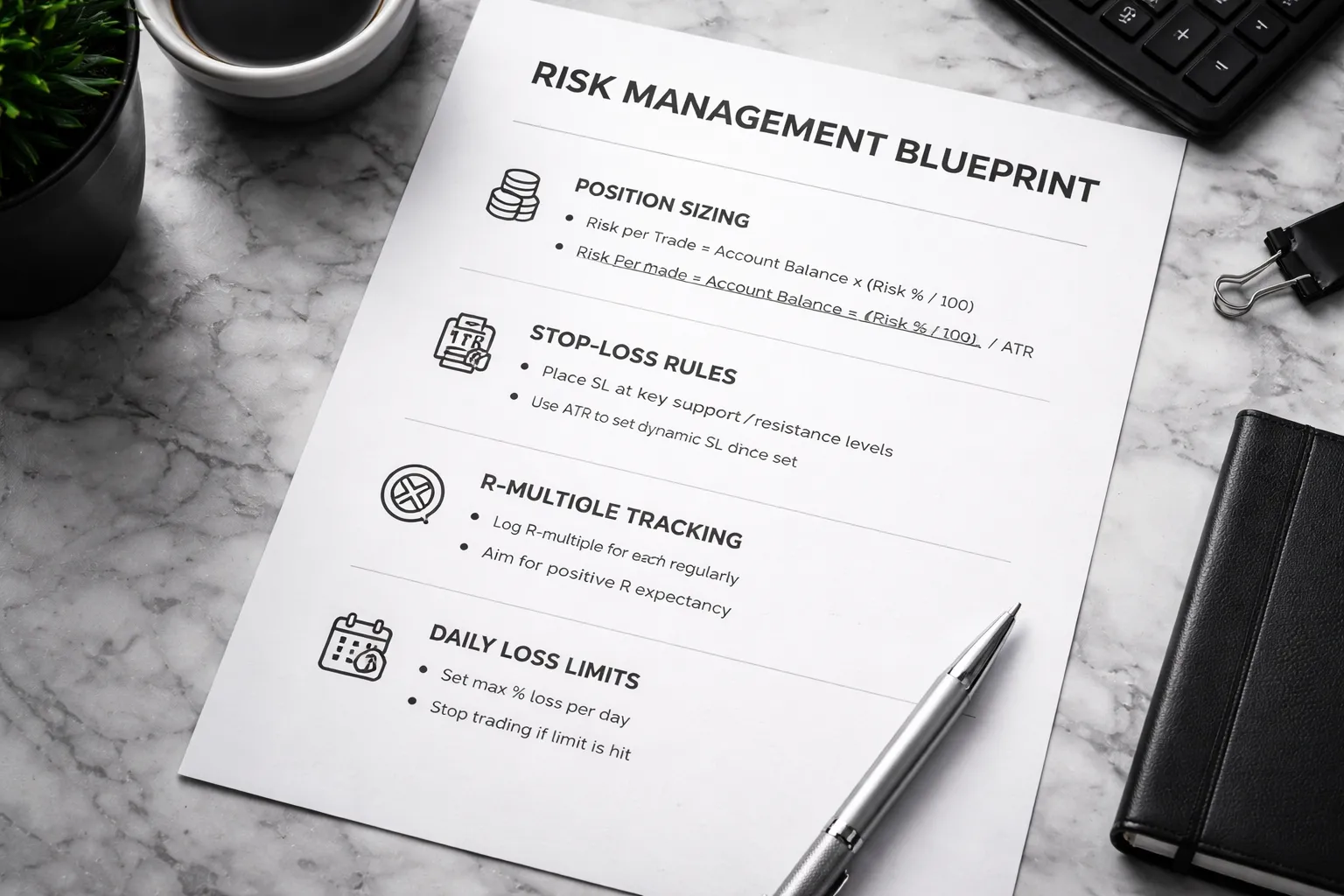
Step 3, Risk Management Blueprint (The Core of Passing)
Your edge does not matter if your risk breaks the rules. Build a risk plan that survives losing streaks and spread spikes. Then execute it the same way every day.
Position sizing method, pick one and lock it
Prop challenges punish inconsistency. Your lot size must follow a formula. No exceptions.
- Fixed fractional sizing (simple and stable)
- Risk a fixed percent of your account per trade, example 0.25 percent to 1.00 percent.
- Use it when your stop sizes stay within a normal range.
- It keeps your drawdown curve smooth, which protects your daily limit.
- Volatility based sizing using ATR (more stable across market regimes)
- Set the stop distance using ATR, then size the position to keep risk constant.
- Use it when volatility shifts often, example during news weeks or session opens.
- It reduces the chance that a wider stop turns into a larger dollar loss.
| Method | What stays constant | Main benefit | Main risk |
|---|---|---|---|
| Fixed fractional | Percent risk per trade | Easy to execute and audit | Stop sizes can drift, which changes trade quality |
| ATR based | Percent risk and volatility adjustment | More consistent outcomes across volatility | Needs clean ATR settings and discipline |
Baseline numbers that fit most challenges, 0.25 to 0.50 percent risk per trade for aggressive targets, 0.10 to 0.25 percent if the firm has tight daily drawdown or equity based triggers. Confirm your exact limits using your prop firm challenge rules sheet.
Stop loss placement, match your setup logic
Your stop must sit where your trade idea fails. Do not use an arbitrary pip count.
- Structure based stops
- Place the stop beyond the swing high or swing low that defines the setup.
- Give room for spread and normal noise, but do not hide a bad entry with a huge stop.
- Best for breakout, pullback, and trend continuation setups.
- ATR informed stops
- Use a multiple of ATR to avoid getting clipped in high volatility.
- Example, stop distance equals 1.0 to 1.5 times ATR for the timeframe you trade.
- Best for session opens and pairs with frequent spikes.
Rule, if you cannot define the invalidation level in one sentence, skip the trade. If you move a stop wider after entry, count it as a rule breach in your journal, even if the firm allows it.
R multiple framework, trade outcomes in R
R is your unit of risk. If you risk 0.50 percent per trade, then 1R equals 0.50 percent. This keeps you focused on process, not money swings.
- Why R reduces overtrading
- You stop chasing random setups for small wins.
- You measure performance by quality, not by being busy.
- You can set a daily plan in R, which aligns with drawdown limits.
- Practical R rules for challenges
- Only take trades with a clear path to at least 2R.
- Use partials only if they are written in your plan, example take 50 percent at 1R and trail the rest.
- Track your week by total R, wins, losses, and average R per trade.
| Metric | Target range | Why it matters in a challenge |
|---|---|---|
| Average loss | -1R | Keeps losers contained and predictable |
| Average win | +1.5R to +3R | Lets you grow without high trade volume |
| Weekly net | +2R to +6R | Progress without pressing into drawdown rules |
Daily loss protection tactics, stop the bleed
You fail most challenges from one bad day. Build hard daily guardrails.
- Max trades per day
- Set a cap, example 2 to 4 trades.
- When you hit the cap, stop trading, even if the market looks good.
- Max consecutive losses
- Stop after 2 consecutive losses. Stop after 3 if your risk per trade is 0.10 to 0.25 percent.
- Consecutive losses often signal poor conditions or poor focus.
- Mandatory cool off windows
- After any loss, wait 15 to 30 minutes before the next trade.
- After two losses, stop for the session or switch to simulation only.
- Remove the trigger, close the platform, and write one line on what changed.
Daily risk ceiling rule, set a personal daily max loss below the firm limit. If the firm daily loss is 5 percent, your cap can be 2 percent to 3 percent. This buffer protects you from slippage, spread widening, and equity based drawdown triggers.
Step 4 — Use a Simple Strategy You Can Execute Perfectly
Pick one market model and stay with it
Choose one model you can repeat under pressure. Use it for the whole challenge.
- Trend continuation. Trade with the higher time frame direction. Enter on a pullback to a level. Exit into momentum.
- Range mean reversion. Fade extremes at defined boundaries. Keep targets modest. Use tight invalidation.
- Breakout retest. Wait for a break, then a retest of the level. Enter only after the retest holds.
For most challenge accounts, trend continuation or breakout retest fits best. You avoid constant countertrend exposure and you reduce time in drawdown.
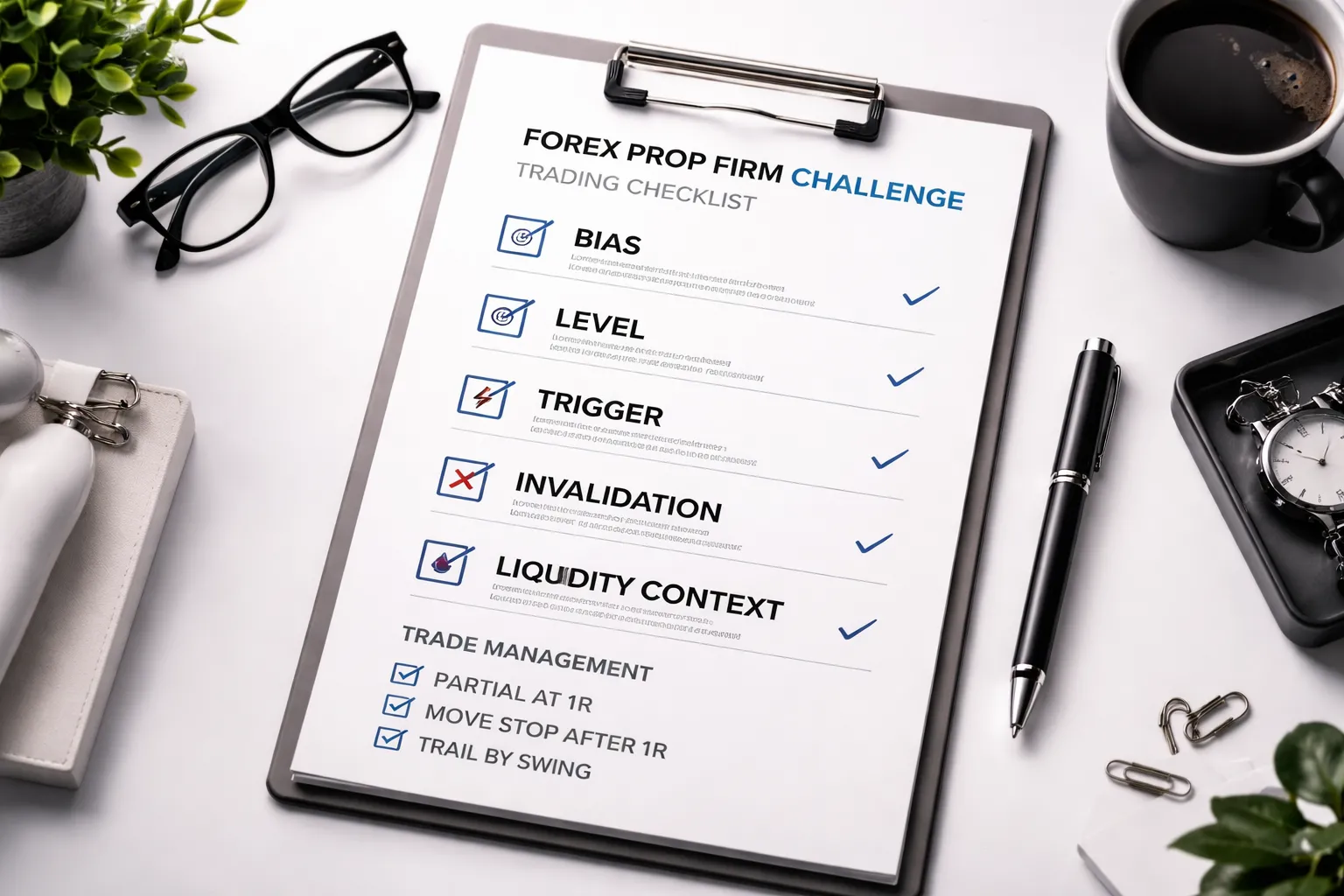
Use a strict entry checklist
Write the checklist. Print it. Do not trade without all boxes checked.
- Bias. Define direction from a higher time frame. Use one rule, for example price above a 200 EMA on H1 and higher highs, higher lows.
- Level. Mark one clear level, prior day high or low, London range high or low, last swing, or weekly open. Do not use vague zones.
- Trigger. Specify one trigger candle or structure break on your entry time frame, for example M5 close back above the level after a sweep.
- Invalidation. Place the stop at the point your idea is wrong, not where it feels smaller. Use a fixed rule, for example beyond the sweep high or low plus spread.
- Liquidity context. Note if price just ran a prior high or low, or hit a session extreme. Avoid entering right into obvious resting orders.
Example plan, breakout retest
| Item | Rule |
|---|---|
| Bias | Trade in the direction of H1 structure. No trades against it. |
| Level | Prior day high or low, or London range high or low. |
| Trigger | Break and close beyond the level on M15. Then retest on M5 and rejection close back in trend direction. |
| Invalidation | Stop beyond the retest swing plus spread. If that is too wide, skip the trade. |
| Take profit | First target at 1R. Final target at next major level or 2R, whichever comes first. |
Trade management rules you can follow every time
Most traders fail challenges from bad management, not bad entries. Set rules that protect your daily loss cap.
- Partial vs full exits. Use one method. Simple option, take 50 percent off at 1R, move stop to entry only after the partial fills, then trail the rest behind the last M5 swing.
- Moving stops. Do not move stops early. Early breakeven creates many small losses and missed winners. Move to breakeven only after 1R is touched or a clear swing forms in your favor.
- Letting winners run. Let the remaining size run only when structure stays intact. If price closes back below the retest level in a long, or above it in a short, exit.
- Time stop. If price does nothing after your trigger, exit. Use a fixed rule, for example close the trade if no progress within 3 to 6 candles on your entry time frame.
What to avoid during challenges
- Strategy hopping. Changing models after one loss creates random results. Track 20 to 30 trades before you judge a strategy.
- Over-optimization. Do not add filters to fix the last trade. More rules usually reduce execution quality and increase hesitation.
- Signal chasing. Avoid copying alerts and jumping into late moves. If you rely on signals, understand the downside first with what to know before you buy forex signals.
- Expanding size to catch up. Keep risk per trade fixed. The challenge punishes recovery trading through daily loss limits and trailing drawdown.
Step 5 — Create a Daily Trading Routine That Prevents Mistakes
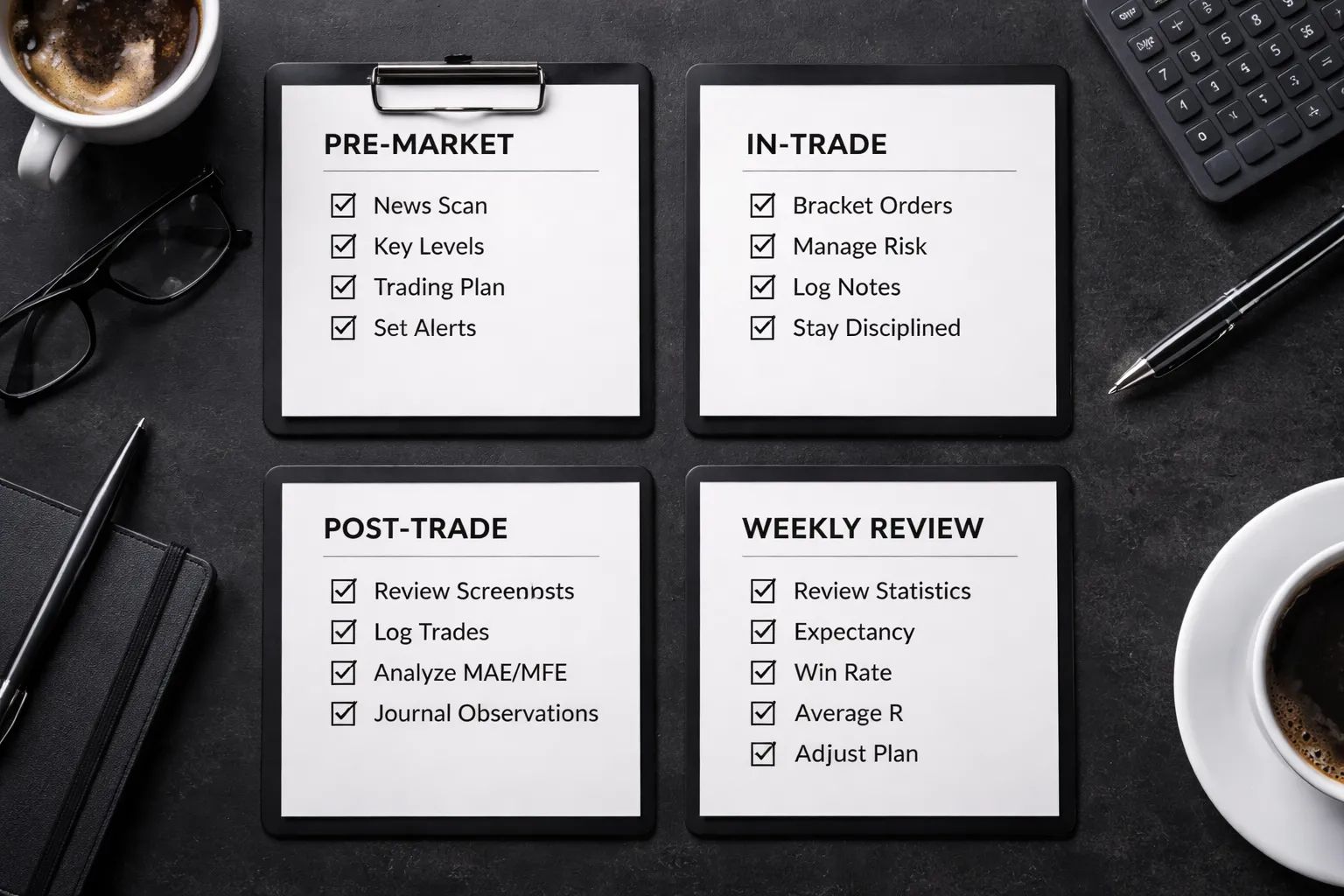
Pre-market routine
Your goal is to start the session with a fixed plan. You reduce impulse trades and rule breaks.
- News scan, 3 minutes. Check the economic calendar for red events, your pairs, and your session. Mark no-trade windows, usually 10 to 15 minutes before and after high impact releases. If your prop firm uses trailing drawdown, treat news spikes as higher risk.
- Key levels, 5 minutes. Mark prior day high and low, Asia range, London high and low, and the most recent swing high and low on your execution timeframe. Add round numbers and obvious supply and demand zones only.
- Session plan, 3 minutes. Write one sentence. Example, “Trade London breakout only, one retest max, stop if I hit two losses.” Keep it visible.
- Risk settings, 2 minutes. Set fixed risk per trade and a hard daily stop. Pre-calc position size for two stop distances you use most. Load them into a position size calculator or a sheet. Keep risk constant even after a loss.
In-trade routine
Your execution process must prevent simple errors. Most challenge failures come from one oversized trade or one rushed entry.
- Use alerts before you watch price. Place alerts at your levels. Wait for the alert, then check your setup. Do not stare at ticks.
- Use bracket orders. Enter with stop loss and take profit attached. If your platform supports OCO, use it. You cut the chance of forgetting a stop.
- Execution hygiene checklist.
- Confirm account type and symbol, especially on similar tickers.
- Confirm order type, market vs limit vs stop.
- Confirm size, then read it out loud, lots or units.
- Confirm stop distance in pips and cash risk before you click.
- Do not move the stop farther. If the stop is wrong, exit and re-enter with correct size.
- Limit management actions. Allow one planned scale out or one planned trailing method. No random edits. Every extra click increases mistakes.
Post-trade routine
Log fast. Grade hard. Move on.
- Screenshot pack. Save one before entry, one at entry with orders visible, one at exit. Name files by date, pair, and outcome.
- Rule grading. Score each trade with simple tags. A setup can lose and still pass the grade.
| Item | Tag | Rule |
|---|---|---|
| Setup valid | Yes or No | Matches your written criteria |
| Risk correct | Yes or No | Fixed R, no oversize |
| Entry timing | Good or Late | No chasing after the move |
| Stop placement | Planned or Random | Stop based on structure, not emotion |
| Management | Followed or Deviated | No unplanned edits |
- Quick review note, 60 seconds. Write one line, “What caused the entry,” and one line, “What I will repeat or stop.” Keep it short. If you relied on alerts from others, log it. Signals can hide bad timing and slippage risk, see what to know before you buy forex signals.
Weekly review
Run a weekly review on the same day. Use numbers, not feelings. If you do not measure it, you cannot fix it.
- Expectancy. Track in R, not dollars. Formula, Expectancy = (Win rate × Avg win R) − (Loss rate × Avg loss R). You want positive expectancy before you increase frequency.
- Win rate. Track by setup type and session. A high win rate with small winners can still fail if losses stay full size.
- Average R. Track average win R and average loss R. Most traders fail challenges because average loss creeps above 1R through stop moving and partial exits.
- Max adverse excursion (MAE). Record the worst heat in R before the trade resolves. High MAE means your entries are late, your stops are too tight, or you trade during unstable periods.
- Rule break count. Count rule breaks per 20 trades. Your goal is zero. If you see repeats, change the routine, not the strategy.
Step 6 — Master Challenge Psychology (Without “Mindset” Fluff)
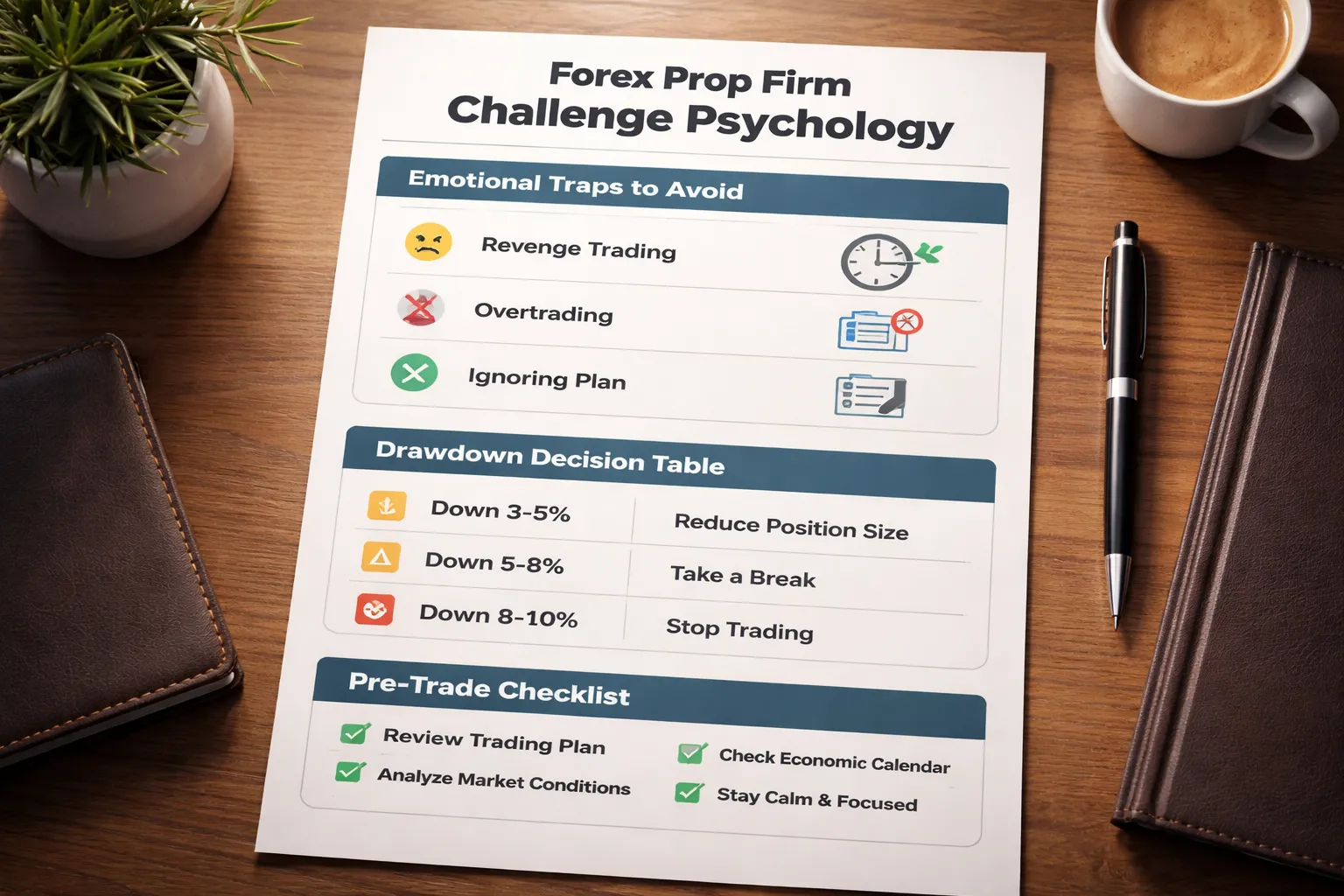
Common Emotional Traps You Can Measure
You do not need motivation. You need triggers, limits, and a response plan. Track these three traps like risk metrics.
- Revenge trading. Trigger, a loss that feels unfair, a stopped trade that later runs, a rule break you want to erase. Usual pattern, you increase frequency, widen stops, or take lower quality setups. Fix, after any loss above your normal loss size, stop trading for 30 minutes and log the trade before the next order.
- Fear of missing out. Trigger, a move starts without you, price breaks out fast, social feeds show big wins. Usual pattern, you chase entries, you accept worse R, your MAE increases. Fix, use one entry rule that forces pullback or retest. If you miss the first move, you wait for the second. No exception.
- Profit target obsession. Trigger, you are close to the challenge target, you start calculating what one trade can do. Usual pattern, you take bigger size, hold losers, cut winners, you stop following your plan. Fix, hide the target on your screen. Focus on process metrics, rule break count, average loss in R, and MAE. Let the target be the output.
Decision Rules for Drawdowns
You need hard rules that remove negotiation. Tie them to your equity curve and your rule breaks, not your feelings. Use the prop firm limits as a ceiling, then set stricter internal limits. If you do not know your exact challenge rules, review them on our prop firm challenge rules guide.
| Condition | Your action | Duration |
|---|---|---|
| Down 1R on the day | Cut size to 50% of normal risk per trade | Rest of day |
| Down 2R on the day | Stop trading for the day, journal and screenshot | Until next session |
| Two rule breaks in one day | Stop trading, rewrite checklist, remove the trigger | 24 hours |
| Three consecutive losing trades | Pause and review entries for MAE and late fills | Minimum 60 minutes |
| Down 4R for the week | Stop for the week unless your plan requires fewer trades | Until next week |
Keep the rules simple. Your goal is to protect decision quality. A pause prevents the next mistake, which is usually bigger than the last.
Handling a Winning Streak Without Breaking Rules
Winning creates a different problem. You start to believe the next trade is safer. That belief causes size creep and sloppy entries.
- Lock risk, not confidence. Keep risk per trade fixed for the full challenge. Increase size only after the challenge, not during it.
- Cap daily upside. Set a daily profit cap in R. Example, stop after +2R or +3R. This prevents giving back gains through boredom trades.
- Do not widen the playbook. Trade the same setups. Do not add new pairs, news trades, or lower timeframes because you feel ahead.
- Audit after green days. Review winners for rule breaks. Many traders break rules on winning trades and call it skill.
Focus Systems That Remove Discretion Under Stress
Stress makes you improvise. Your system must make improvisation hard.
- Pre-trade checklist. Keep it short and binary. Example, setup matches plan, entry level defined, stop level defined, target defined, risk in R within limit, no major news in the next 15 minutes, spread within limit.
- Order constraints. Use pending orders with preset stop and take profit. Use a platform template that auto-fills your position size based on fixed risk.
- Time constraints. Trade only a fixed window. Outside the window you cannot place orders. This cuts impulse trades and late-session revenge trades.
- Trade limit. Set a max trades per day. Example, three trades. After that, you are done. You protect your edge and reduce overtrading.
- One-screen rule. Keep only what you need, price, levels, news timer, and your checklist. Remove PnL if it changes your behavior.
Psychology improves when your process leaves fewer choices. You win the challenge by making rule breaks impossible, not by trying to feel calm.
Step 7 — Trade Around High-Impact News and Volatility Spikes
Step 7, Trade Around High-Impact News and Volatility Spikes
News spikes break prop firm accounts. They do it fast. You avoid them with a schedule, a plan, and hard rules.
Set up your news calendar
Use one calendar and one timezone. Set alerts 60 minutes and 15 minutes before each high-impact event. Block those windows on your trading day.
These events move FX the most:
- Central bank rate decisions, Fed, ECB, BoE, BoJ, SNB, RBA, RBNZ, BoC.
- FOMC statement and press conference, plus dot plot when released.
- US CPI, headline and core.
- US Non-Farm Payrolls, payrolls, unemployment rate, average hourly earnings.
- GDP, especially US and major economies in risk-off regimes.
- PMI surprises can move EUR and GBP during fragile sentiment.
Also tag these as high risk even when calendars label them medium:
- Speeches by the Fed Chair, ECB President, BoE Governor.
- Unexpected headlines, geopolitics, interventions, emergency statements.
If you do not fully understand your firm’s trading rules around news, spreads, and drawdown math, read this guide on prop firm challenge rules and drawdowns.
Pick one of three safe approaches
Choose one approach before the event. Do not decide in the last minute.
- Stand aside. No new entries 30 to 60 minutes before. No trades until 10 to 20 minutes after. This fits most challenge traders.
- Reduce size. Cut risk to 25 to 50 percent of your normal R. Widen stops only if your strategy requires it. Keep the same invalidation level.
- Trade only post-event confirmation. Wait for the first spike to finish. Let the first 5 to 15 minute candle close. Trade the pullback or break with a defined structure. Skip if price stays chaotic.
Understand spreads and slippage
During high-impact releases, spreads widen. Liquidity thins. Your stop can fill worse than your stop price.
This causes stop-outs even when your direction is correct:
- The spread jumps and prints through your stop level.
- Your stop triggers in a fast move and fills several pips away.
- Price whips both sides before choosing a direction.
Your fix is simple. Avoid holding tight stops into the release. Avoid market orders in the first seconds after the number. Avoid moving stops closer to “reduce risk”. That often increases stop-outs.
Select the right session for your strategy
Session choice controls volatility, spread behavior, and follow-through.
| Session | What you get | What it implies |
|---|---|---|
| Asia | Lower volatility, more range, fewer clean breaks | Better for range rules. Use tighter targets. Avoid forcing breakouts. |
| London | High liquidity, strong trends, fast moves at open | Best for breakout and trend rules. Expect stop hunts around key levels. |
| New York | Big moves on US data, reversals after London trend, high volatility at open | Best if you can follow a news plan. Avoid the first minutes after major releases. |
Lock your trading hours. Trade one session by default. Add a second only if your rules stay consistent.
Step 8 — Execution, Platforms, and Broker-Like Details That Can Fail You
Step 8, Execution, Platforms, and Broker-Like Details That Can Fail You
Your edge can survive a bad day. It may not survive bad execution. Prop rules punish small mistakes because they stack, one trade at a time.
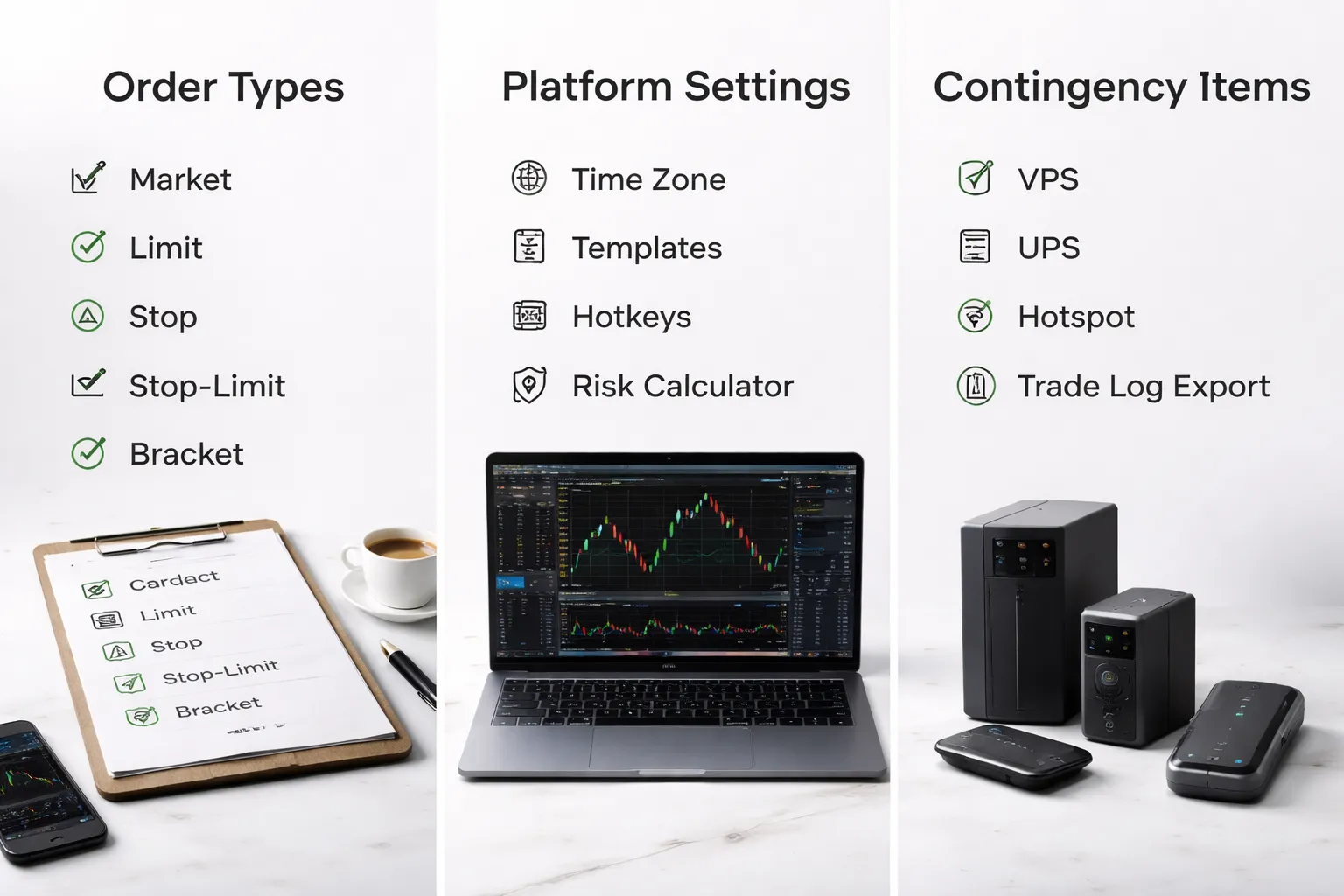
Order types and protection
Use the simplest order that matches your plan. Complexity creates gaps between what you expect and what fills.
- Market orders. You get filled fast. You accept slippage. Use them when your setup needs certainty of entry more than price precision, like news filters that still allow entry after the first spike.
- Limit orders. You control price. You may miss trades. Use them when your edge depends on price location, like pullbacks to a level.
- Stop orders. You confirm momentum. You can get slipped in fast moves. Size down when spreads widen.
- Stop-limit orders. You cap your entry price. You risk no fill, then price runs without you. That can break your statistics because the setup records as a loss of opportunity, not a loss of money. Use only if missing the trade costs less than a bad fill.
- Bracket orders. Use them every time. Place entry with stop loss and take profit in one action. This cuts “naked trades” that violate max loss rules during a platform freeze.
- Guaranteed protection does not exist on most prop feeds. Treat stops as best-effort in gaps and spikes. Your plan must survive slippage.
| Situation | Best default | Main risk | Rule to apply |
|---|---|---|---|
| Fast market, wide spreads | Market or stop with smaller size | Slippage | Cut risk per trade by 30 to 50 percent when spread exceeds your threshold |
| Level-based entry | Limit with bracket | Missed fills | No chasing. One re-try max at next planned level |
| Breakout entry | Stop with bracket | Stop hunts then reversal | Require close beyond level or a trigger filter in your rules |
Partial fills, requotes, and slippage in your journaling
Prop challenges grade your PnL curve. Your journal must reflect real fills, not your intended price.
- Record fill price, not signal price. Your stats must use executed entry and executed exit.
- Track slippage in pips and money. Add two fields, entry slippage and exit slippage. Review weekly.
- Log spread at entry. Spread explains many “bad trades” that were fine setups.
- Handle partial fills as separate lots. If you get 0.30 filled, then 0.20 later, treat it as two entries. Your average entry price hides risk timing.
- Note requotes and rejects. Mark them as execution errors, not strategy errors. If they cluster at the same times, change your trading window or order type.
- Measure execution quality. Keep a simple metric, average slippage per trade and percentage of trades with slippage worse than X pips. If that number rises, your risk model breaks.
Platform settings you must lock
Most challenge failures come from small platform mismatches. Fix them before you trade live size.
- Time zone. Match the platform time to your session plan and your news calendar. If you use New York time in your rules, set charts and journal to New York time.
- Chart templates. Use one template per strategy. Save it. Remove extra indicators. If you need more than two templates, you run too many playbooks.
- Hotkeys and one-click trading. Disable one-click if you make fat-finger errors. If you use hotkeys, test them in demo until you can place a bracket order without thinking.
- Default order size. Set it to the smallest unit you trade. Never leave the last size loaded.
- Risk calculator. Use a tool that sizes by stop distance and account rule limits. You must size off the max daily loss and max loss, not just a percent of balance.
- Price alerts. Use alerts for levels so you do not stare at ticks and overtrade.
If you rely on external trade ideas, keep them separate from execution. Many traders fail by copying entries without matching stops and risk. If you use help, vet it first, see what to know before you buy forex signals.
Connectivity and contingency
Execution risk rises when your connection fails. The challenge does not care why you lost control of a trade.
- Use a VPS if you trade around news or manage trades actively. Place the platform near the broker server region when possible. Reduce latency swings.
- Have power backup. A basic UPS buys minutes to close or hedge. Without it, you accept random rule breaks during outages.
- Have internet backup. Use a mobile hotspot. Test it once, do not assume it works.
- Know your emergency actions. Save the broker or platform close-all shortcut. Know how to close positions from mobile.
- Log trades outside the platform. Export fills daily. Keep screenshots of entries and exits for disputes. Store them in a dated folder.
- Write a failure checklist. If the platform freezes, you do the same steps every time, check connection, check open positions, close risk, then document.
Step 9 — A Practical 14–30 Day Step-by-Step Schedule to Pass
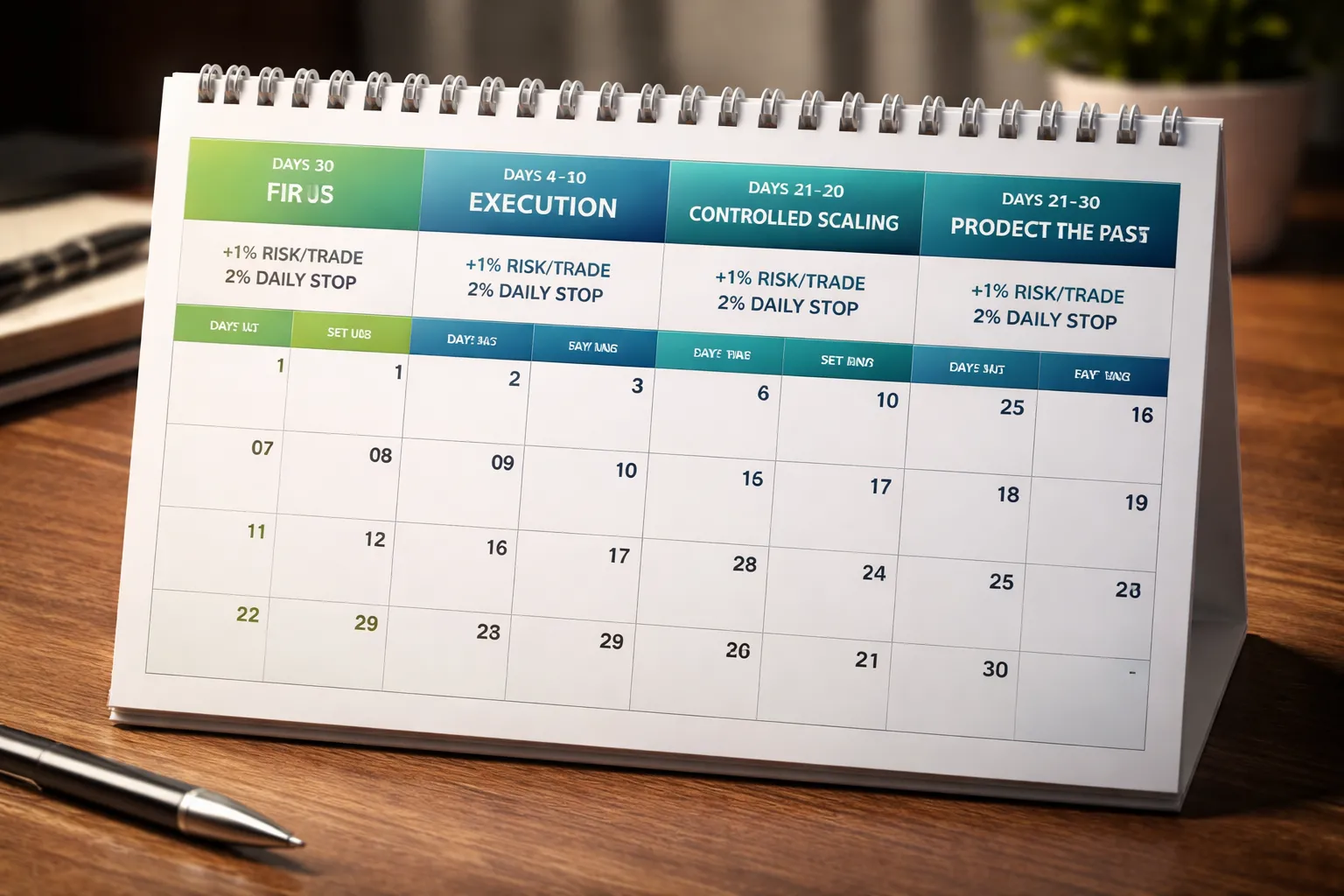
Step 9. A Practical 14 to 30 Day Step-by-Step Schedule to Pass
This schedule assumes you already chose one strategy and one market window. You will not test new indicators, new timeframes, or new pairs during the challenge. You will execute a plan. You will protect drawdown first.
Days 1 to 3. Rule audit, sizing model, and strategy constraints
- Day 1. Write the rules in numbers. List profit target, max daily loss, max overall drawdown, min trading days, news rules, weekend rules, and lot limits. Put them on one page. If a rule is unclear, confirm it before you place a trade. Use this guide on prop firm challenge rules if you need a checklist.
- Day 1. Set your daily risk cap under the firm limit. If the firm allows 5% daily loss, cap your plan at 2% to 2.5%. If the firm allows 10% overall, plan around 6% to 7%. You need room for slippage, spreads, and mistakes.
- Day 1. Build your position sizing model. Fix risk per trade and stop size logic. Example model:
- Risk per trade: 0.25% to 0.50%.
- Max trades per day: 1 to 3.
- Hard daily stop: minus 1.0% to minus 1.5% or 2 losing trades, whichever comes first.
- Weekly stop: minus 3% to minus 4%, then pause and review.
- Day 2. Lock strategy constraints. Define setup rules in plain language. Define entry trigger, stop placement, target logic, and time stop. Define what you will not trade, including:
- No countertrend trades.
- No widening stops.
- No adding to losers.
- No revenge trades after a loss.
- No trading during major red news if your rules forbid it, or if spreads spike on your broker.
- Day 2. Define invalidation rules. If the setup breaks, you exit. You do not “wait for it to come back”. Write the exact condition that forces a close.
- Day 3. Back-check with your own data. Pull 20 to 50 past examples from charts. Tag wins and losses. You are not optimizing. You are confirming that the setup has a repeatable edge and realistic stop sizes.
- Day 3. Run a pre-trade checklist and post-trade checklist. Keep it short. You must complete it on every trade. If you skip it, you skip the trade.
Days 4 to 10. Execution phase with conservative sizing and strict daily stop rules
- Trade small first. Use 0.25% to 0.35% risk per trade for the first week. Your goal is clean execution and rule compliance, not fast profit.
- Use one entry method. If you trade breakouts, trade only breakouts. If you trade pullbacks, trade only pullbacks. Mixed logic creates random outcomes.
- Stop trading after your daily limit. If you hit your hard daily stop, you stop. If you hit a daily profit threshold, you also stop. A simple cap works:
- Stop for the day at plus 0.8% to plus 1.2%.
- Stop for the day at minus 1.0% to minus 1.5%.
- Track two metrics daily. Your rule compliance rate and your average R. If compliance drops, size stays small or goes smaller.
- Do not move goalposts. Do not change targets to “secure profit”. Do not cut winners early unless your plan says so. Consistency beats improvisation.
- Review every night. Export fills. Log entry, stop, target, and screenshot. Mark each trade as A, B, or C quality. You only take A trades tomorrow.
Days 11 to 20. Scale only if metrics validate
You scale when your process proves stable. You do not scale because you feel behind.
- Scaling requirements. Meet all of these before you increase risk:
- At least 20 trades logged.
- Rule compliance at 90% or higher.
- No single day close to the max daily loss.
- Positive expectancy in your log, or at least break-even with clean execution.
- Scale in steps. Increase risk per trade by one small step only. Example:
- From 0.30% to 0.40% per trade.
- Then from 0.40% to 0.50% only after another 10 to 15 trades.
- Keep the same daily stop. Do not raise your daily loss cap because you sized up. Your daily stop protects your account. It also protects your mindset.
- Use a drawdown trigger to cut size. If you drop 1.5% to 2% from your equity peak, cut risk by 25% to 50% for the next 5 trades.
- Stop trying to “catch up”. If you are below target, you extend the schedule. You do not raise lot size to force the pass.
Final days. Protect the pass and avoid giving it back near the target
- Shift to defense when you are close. At 70% to 80% of the profit target, cut risk per trade by 30% to 50%. Your job changes. You now protect equity.
- Reduce trade frequency. Trade only your best session and best setup. Skip marginal entries. One good trade is enough.
- Lower your daily loss cap. If you are near the target, cap daily loss at minus 0.5% to minus 1.0%. You can finish in more days. You cannot finish if you violate a rule.
- Avoid high spread windows. Skip rollover, thin liquidity hours, and major news spikes. Slippage near the finish can break the account.
- Do not change your strategy to “lock it in”. Traders fail near the target because they switch tools. You keep the same playbook and reduce size.
- Stop trading after you meet the target. Take screenshots, export fills, and confirm the account status. Do not place a “victory trade”.
| Day range | Primary goal | Risk per trade | Hard stop rules |
|---|---|---|---|
| 1 to 3 | Rules, sizing, constraints | 0% live, planning only | No live experiments |
| 4 to 10 | Clean execution | 0.25% to 0.35% | Minus 1.0% to minus 1.5% daily, stop after 2 losses |
| 11 to 20 | Controlled scaling | 0.35% to 0.50% if validated | Cut size after 1.5% to 2% peak to trough drawdown |
| Final 3 to 10 days | Protect the pass | Reduce by 30% to 50% | Lower daily loss cap, reduce trades |
Common Mistakes That Cause Challenge Failure (and How to Fix Them)
Overtrading to hit the profit target faster
This fails more challenges than bad analysis. You trade too often. You stack correlated positions. You give back clean gains in one sloppy hour.
- Cause: You treat the target like a deadline. You force trades outside your plan.
- Typical result: More exposure minutes, more spread and slippage paid, more random losses. Your daily loss cap gets hit faster.
- Fix: Set a hard trade limit. Use 1 to 3 trades per day. Stop after 2 losses. Stop after 1 win if it hits your planned R multiple.
- Fix: Block “revenge hours”. If you lose in the first hour, pause for 60 minutes. No charts.
- Fix: Track “trades per day” like a risk metric. If it rises, your discipline drops.
| Behavior | What it does to your stats | Rule to prevent it |
|---|---|---|
| Adding extra setups after a loss | Increases variance, raises chance of daily breach | Max 2 losing trades per day, then stop |
| Taking “B” setups | Lowers win rate and expectancy | Trade only tagged “A” in your journal |
| Trading multiple pairs at once | Hidden correlation, larger real risk | One pair or one theme per session |
Ignoring equity-based limits and trailing drawdown mechanics
Many failures come from confusing balance with equity. Your platform can close you out on floating loss. Your trailing drawdown can tighten after you make gains.
- Cause: You watch closed P and L only. You ignore open drawdown and equity dips.
- Typical result: You “pass” on balance, then fail on equity during a pullback or news spike.
- Fix: Calculate your real max loss from the strictest number, daily loss, max loss, trailing equity. Trade off that.
- Fix: Add an internal buffer. Keep 10% to 20% of the allowed drawdown unused at all times.
- Fix: Reduce size after new equity highs. Trailing rules punish givebacks from peaks.
- Fix: Keep a live “equity stop” on your screen. If equity hits it, you close everything and stop trading.
If you do not know which rule is equity-based, read the terms first. Use this guide for the exact mechanics and rule types: prop firm challenge rules and drawdowns.
Moving stops, widening risk, and “one trade to fix it” behavior
This is how a small red day turns into a breach. You move your stop. You increase lot size. You try to erase the loss with one big trade.
- Cause: You tie your self-control to P and L. You trade your emotions, not your rules.
- Typical result: Your average loss grows. Your risk per trade stops being real. Your plan becomes meaningless.
- Fix: Place stop and target first. Then place the entry. No stop, no trade.
- Fix: Use hard platform stops. Do not rely on mental stops.
- Fix: If you move a stop once, you end the session. Treat it as a rule breach.
- Fix: Use fixed risk per trade. Do not “double to recover”. Your next trade stays at base size or smaller.
| Red flag | What to do |
|---|---|
| You feel urgency after a loss | Step away for 15 minutes. Re-check your daily loss buffer. |
| You want to widen the stop “just a bit” | Close the trade or keep the stop. No edits that increase risk. |
| You plan a bigger trade to get back to even | Cut size by 30% to 50% for the next trade. |
Trading unfamiliar pairs or sessions due to boredom
Boredom creates bad risk. You switch pairs. You trade thin liquidity. You chase movement in sessions you do not understand.
- Cause: You measure progress by activity. You feel you must “do something”.
- Typical result: Wider spreads, worse fills, different volatility, and stops that make no sense for that market.
- Fix: Trade a short approved list. 1 to 3 pairs maximum for the whole challenge.
- Fix: Lock your sessions. If you tested London only, you trade London only.
- Fix: If no setup appears, you stop. A flat day protects your drawdown.
Breaking rules accidentally: lot size errors, holding through restricted periods, prohibited strategies
Many traders fail without realizing it. The breach comes from a simple operational mistake.
- Lot size errors: You misread contract size, decimals, or leverage. Fix: Use a position size calculator and save presets. Do a “micro order” check on day 1.
- Holding through restricted periods: You hold into major news or market close when rules forbid it. Fix: Add alerts for red-folder events, rollover, Friday close, and weekend. Flatten early.
- Prohibited strategies: You use latency, arbitrage, tick scalping, or trade copying when it violates terms. Fix: Read the rule list once, then build a checklist you confirm before each session.
- EA or copier mistakes: You forget a bot is running, or copy settings scale size wrong. Fix: Disable all automation for the challenge unless the firm allows it in writing.
| Pre-trade checklist | Minimum standard |
|---|---|
| Lot size matches risk | Risk stays within your planned 0.25% to 0.50% |
| Stops and limits placed | Stop is live on platform, no “mental” risk |
| Calendar checked | No restricted news or holding windows |
| Rules confirmed | No prohibited tools, no restricted instruments |
After You Pass: Staying Funded and Scaling Without Blowing the Account

Rule Changes in Funded Accounts: Payouts, Consistency Requirements, Risk Parameters
Funded rules often change. The challenge rules are not the funded rules. Read the funded agreement line by line before your first live trade.
- Payout rules. Many firms require a minimum number of trading days, a minimum profit, and a clean equity curve to approve payouts. Some cut payout size if you exceed daily risk limits, even if you stay within max drawdown.
- Consistency rules. Common limits include a max profit day cap, a rule that one day cannot make more than a set percent of total profits, or a requirement that profits come from multiple days.
- Risk parameters. Daily loss and max loss still apply, but execution rules get tighter. Some firms treat floating loss as part of the limit. Some disallow holding during news windows. Some restrict instruments, leverage, or lot sizes.
- Order behavior. Copy trading, trade mirroring, EAs, or trade managers may require approval. If you plan to use any copying, vet the setup first, use this checklist for choosing a copy trading provider.
Adjust your plan to the funded account, not your habits. If a rule is unclear, get it in writing.
Payout Planning: Drawdown Buffers, Withdrawing vs Compounding, Performance Cycles
Your main job now is to avoid rule breaches. A payout means nothing if you lose the account next week.
- Keep a drawdown buffer. Do not trade at the edge of the daily limit. Keep a hard buffer you never use. A practical target is to risk small enough that 3 to 5 losing trades cannot hit the daily loss limit.
- Separate profit from risk capital. Treat open profit as unrealized until payout clears. Do not increase size because you had a good week.
- Withdraw vs compound. Use a simple rule. Withdraw a fixed share of each approved payout. Leave the rest to grow the buffer and reduce stress. If the firm scales based on balance or equity, compounding helps, but only if it does not push you into larger daily swings.
- Trade in cycles. Run your account in payout cycles, for example from payout to payout. Set a cycle goal that fits your strategy’s normal variance. If your edge needs time, do not force daily profits.
Plan around your lowest volume months. Your strategy will not print every week.
Scaling Plan: When to Request Increased Capital and How to Prove Consistency
Scaling starts with proof. Firms scale traders who look repeatable and low risk.
- Hit clean payout milestones. Most firms scale after 2 to 4 payouts with no rule warnings. Do not request a scale after one strong run if your distribution looks unstable.
- Show stable risk. Keep risk per trade fixed. Avoid sudden jumps in lot size. Your size should map to a set percent risk, not to your mood or recent results.
- Track a short scaling dashboard. Log risk per trade, average stop size, win rate, average R, max intraday drawdown, and number of trades. A tight log makes your case fast if a firm asks questions.
- Scale in steps. Increase size only after a full cycle of stable execution. Treat each step as a new account. If your drawdowns widen, step back.
| Scale trigger | Minimum proof to aim for | What to avoid |
|---|---|---|
| Request higher allocation | 2 to 4 approved payouts, no breaches, stable risk per trade | One big day driving most profits |
| Increase lot size | One full payout cycle with similar drawdown and similar trade count | Doubling size after a streak |
| Add a second strategy | One strategy profitable across multiple market conditions | Mixing systems that overlap risk |
Long-Term Sustainability: Maintaining Edge, Updating Playbooks, Continuous Review
You stay funded by running a process. You blow accounts by freelancing.
- Keep one core setup. Trade the same playbook until you have enough sample size to judge it. Too many setups increase errors and correlation.
- Review weekly, not hourly. Track rule compliance daily. Review performance weekly. Change rules monthly. Frequent tinkering kills expectancy.
- Update the playbook with evidence. Make one change at a time. Log the before and after. If the change does not improve results or reduce drawdown, revert.
- Control exposure. Cap total risk across correlated pairs. If EURUSD and GBPUSD move together, treat them as one position group.
- Protect execution quality. Avoid trading when spreads widen. Avoid thin liquidity sessions if your edge depends on tight fills. Record slippage and commissions, adjust targets if needed.
- Maintain compliance habits. Use the same pre trade checklist you used in the challenge. Funded accounts punish small mistakes.
Run the account like a business. Your edge is your process, your risk, and your compliance.
FAQ
What rules matter most during a prop firm challenge?
Know the max daily drawdown, max total drawdown, profit target, minimum trading days, and news rules. Check if drawdown uses balance or equity. Confirm if open floating loss counts. Read the rule PDF, then build your risk plan around the strictest number.
How much should you risk per trade?
Keep it small. Many traders use 0.25 to 0.50 percent per trade. Cap daily risk at 1 percent. If your strategy needs larger swings, your challenge size is too big or your setup is not stable enough.
How long should it take to pass?
Aim for weeks, not days. Most failures come from rushing the profit target. Plan for steady gains, then stop when your daily plan is done. Your schedule should match your win rate, average R, and the target.
Should you trade news events?
Only if your strategy was built for news and your rules allow it. Spreads can widen fast. Slippage can break your risk cap. If you trade news, reduce size, use hard stops, and avoid thin liquidity releases.
What is the safest way to hit the profit target?
Trade your best setup only. Cut trade count. Keep risk fixed. Stop after a preset daily loss or gain. Use a simple weekly target, like 1 to 2 percent, then let time do the work.
What timeframes work best for challenges?
Use the timeframe that matches your tested edge. Many traders do better on H1 to H4 because noise is lower and overtrading drops. If you trade M5 to M15, set strict session limits and a max trades per day rule.
What causes most challenge failures?
Oversizing. Revenge trades. Trading outside your session. Moving stops. Holding losers to avoid a loss. Ignoring spread and slippage. Breaking daily drawdown after one bad streak. Fix process first, then look at strategy.
Can you use an EA, signals, or copy trading?
Only if the firm allows it. Even if allowed, you stay responsible for risk and rule breaches. Vet any provider with real track records and worst case drawdown. If you want the basics, read how forex prop firms work.
How do you handle drawdown limits in real time?
Track equity, not hope. Set platform alerts at 50 and 75 percent of your daily limit. Stop trading when you hit the first hard threshold. Do not try to win it back the same day.
Should you hold trades overnight or over the weekend?
Check the rules first. Overnight holds add swap costs and gap risk. Weekend holds add gap risk only. If your edge needs holds, size down and reduce correlated exposure. If you day trade, close before rollover and major session changes.
What should you do after you pass and get funded?
Lower risk first. Many traders cut size by 25 to 50 percent for the first month. Keep the same checklist and session rules. Track slippage, spreads, and execution changes. Protect the account, then scale.
Conclusion
Conclusion
Passing a forex prop firm challenge comes down to math and process. You control risk per trade, daily exposure, and your trade frequency. You do not control the market.
Keep your plan simple. Trade one or two liquid pairs. Use fixed risk. Stop when you hit your daily loss limit. Avoid news spikes unless you have tested rules for them.
Your final tip, treat the challenge like a risk audit. Every trade must fit your checklist. If it fails one rule, skip it. If you feel forced to trade, you are already off plan.
If you need a clean refresher on the constraints that matter most, review prop firm challenge rules and align your risk model to the drawdown math.
-
Best Forex Copy Trading Platforms (Features, Fees & Safety Compared)
8 months ago -
Forex Prop Firm Challenge Rules Explained (Drawdown, Targets, Payouts)
8 months ago -
Copy Trading Forex Explained: How It Works, Pros, Cons & Risks
8 months ago -
Best Forex Prop Firms (Top Firms Compared)
8 months ago -
Forex Signals: Are They Worth It? (What to Know Before You Buy)
8 months ago
-
- Step 2. Build a Passing Plan Backwards From the Numbers
- Translate targets into daily goals without forcing trades
- Set internal circuit breakers tighter than the firm limits
- Define a max risk per day and per week that survives a losing streak
- Create a time plan, when to push, pause, and stop for the month
- One page rules sheet
-
- Step 9. A Practical 14 to 30 Day Step-by-Step Schedule to Pass
- Days 1 to 3. Rule audit, sizing model, and strategy constraints
- Days 4 to 10. Execution phase with conservative sizing and strict daily stop rules
- Days 11 to 20. Scale only if metrics validate
- Final days. Protect the pass and avoid giving it back near the target
-
- Overtrading to hit the profit target faster
- Ignoring equity-based limits and trailing drawdown mechanics
- Moving stops, widening risk, and “one trade to fix it” behavior
- Trading unfamiliar pairs or sessions due to boredom
- Breaking rules accidentally: lot size errors, holding through restricted periods, prohibited strategies
-
- Rule Changes in Funded Accounts: Payouts, Consistency Requirements, Risk Parameters
- Payout Planning: Drawdown Buffers, Withdrawing vs Compounding, Performance Cycles
- Scaling Plan: When to Request Increased Capital and How to Prove Consistency
- Long-Term Sustainability: Maintaining Edge, Updating Playbooks, Continuous Review
-
- What rules matter most during a prop firm challenge?
- How much should you risk per trade?
- How long should it take to pass?
- Should you trade news events?
- What is the safest way to hit the profit target?
- What timeframes work best for challenges?
- What causes most challenge failures?
- Can you use an EA, signals, or copy trading?
- How do you handle drawdown limits in real time?
- Should you hold trades overnight or over the weekend?
- What should you do after you pass and get funded?
-
- Step 2. Build a Passing Plan Backwards From the Numbers
- Translate targets into daily goals without forcing trades
- Set internal circuit breakers tighter than the firm limits
- Define a max risk per day and per week that survives a losing streak
- Create a time plan, when to push, pause, and stop for the month
- One page rules sheet
-
- Step 9. A Practical 14 to 30 Day Step-by-Step Schedule to Pass
- Days 1 to 3. Rule audit, sizing model, and strategy constraints
- Days 4 to 10. Execution phase with conservative sizing and strict daily stop rules
- Days 11 to 20. Scale only if metrics validate
- Final days. Protect the pass and avoid giving it back near the target
-
- Overtrading to hit the profit target faster
- Ignoring equity-based limits and trailing drawdown mechanics
- Moving stops, widening risk, and “one trade to fix it” behavior
- Trading unfamiliar pairs or sessions due to boredom
- Breaking rules accidentally: lot size errors, holding through restricted periods, prohibited strategies
-
- Rule Changes in Funded Accounts: Payouts, Consistency Requirements, Risk Parameters
- Payout Planning: Drawdown Buffers, Withdrawing vs Compounding, Performance Cycles
- Scaling Plan: When to Request Increased Capital and How to Prove Consistency
- Long-Term Sustainability: Maintaining Edge, Updating Playbooks, Continuous Review
-
- What rules matter most during a prop firm challenge?
- How much should you risk per trade?
- How long should it take to pass?
- Should you trade news events?
- What is the safest way to hit the profit target?
- What timeframes work best for challenges?
- What causes most challenge failures?
- Can you use an EA, signals, or copy trading?
- How do you handle drawdown limits in real time?
- Should you hold trades overnight or over the weekend?
- What should you do after you pass and get funded?
-
How to Place a Forex Trade Step by Step (Your First Trade Explained)
6 months ago -
Forex Trading vs Crypto Trading: Which Market Is Better for Beginners?
6 months ago -
Forex Lot Size Calculator: How to Use It to Size Trades Correctly
8 months ago -
How to Calculate Position Size in Forex (Position Sizing Formula + Examples)
8 months ago -
Forex Leverage Explained: How It Works, Pros, Cons & Examples
8 months ago
-
Forex Trading Platforms Comparison: MetaTrader vs cTrader vs TradingView
8 months ago -
Stop Loss vs Take Profit: Differences, Examples & Best Practices
8 months ago -
Is Forex Trading Legal in the United States? Rules, Regulators & What to Know
8 months ago -
Forex Market Hours & Trading Sessions Explained (Best Times to Trade)
8 months ago -
Forex Leverage Explained: How It Works, Pros, Cons & Examples
8 months ago