Non-Farm Payrolls (NFP) Forex Trading Guide: What to Expect and How to Trade It

Non-Farm Payrolls, NFP, is the US jobs report that can move the dollar in seconds. It prints once a month and often triggers spreads, slippage, and fast reversals across major pairs. If you trade news, you need a plan before the release.
This guide shows you what NFP measures, which numbers matter most, and why the market reacts. You will learn how to read the release, compare it to forecasts, and map likely USD scenarios. You will also learn practical ways to trade it, including when to stay flat, how to size risk, and how to handle execution around the spike. Use an economic calendar to track the release time and the consensus estimate.
Key Takeaways
- In het kort: NFP moves the USD because it shifts rate expectations.
- Trade the gap between the actual print and the consensus forecast, not the headline alone.
- Check the unemployment rate and average hourly earnings, they often decide the second move.
- Expect whipsaws in the first minutes, spreads widen and fills slip.
- Use smaller size, wider stops, or stay flat if execution quality drops.
- Wait for a 5 to 15 minute range to form if you want cleaner entries.
- Plan scenarios before the release and map them to your USD pairs.
- Respect revisions, they can flip the message of the headline.
- Track the release time and estimates on your calendar, then set alerts.
- If you trade news often, use this framework to trade forex news without getting wrecked.
Your checklist: forecast vs actual, earnings, unemployment, revisions, spreads, and a hard max loss for the session.
What Non-Farm Payrolls (NFP) is and why it moves forex markets
What the report measures
Non-Farm Payrolls is the monthly U.S. jobs report from the Bureau of Labor Statistics. It prints on the first Friday of most months at 8:30 a.m. New York time.
For forex, four lines matter most.
- Payrolls change. Net jobs added or lost in the prior month, excluding farm workers. This is the headline that hits first.
- Unemployment rate. The percent of the labor force without a job and actively looking. It can move opposite the headline if the labor force shifts.
- Participation rate. The share of working age people in the labor force. It changes how you should read the unemployment rate.
- Average hourly earnings. Wage growth. It often drives the cleanest rate reaction because it feeds inflation pressure.
You also need the revisions. The report revises the prior one or two months. A big revision can outweigh the fresh headline.
Why NFP moves forex markets
NFP is a fast proxy for U.S. growth. Growth drives rates. Rates drive the dollar.
Traders translate the report into a Fed path.
- Strong payrolls and strong earnings usually push U.S. yields up. USD tends to strengthen.
- Weak payrolls and slowing earnings usually pull yields down. USD tends to weaken.
- A lower unemployment rate with falling participation can look less bullish than it seems. It can fade fast.
This is why the same headline can produce different FX moves. The market trades the implied rate path, not the jobs number in isolation. If you need the macro link between inflation, rates, and currency pricing, read how inflation and exchange rates connect.
Pairs and assets that react most
The biggest, cleanest reactions cluster around USD liquidity and rate sensitivity.
- EUR/USD. Deep liquidity, tight spreads outside the spike. Often the benchmark NFP FX move.
- GBP/USD. High beta to USD swings. Can overshoot and snap back harder than EUR/USD.
- USD/JPY. Tracks the U.S. yield move closely. This pair can trend if yields trend.
- XAU/USD. Trades real yields and USD. Strong NFP can hit gold through higher yields and a firmer dollar.
- U.S. indices. Often whip first, then pick a direction once rates settle. Strong jobs can be risk-on or risk-off depending on what it implies for Fed cuts.
- U.S. Treasury yields. The source move. Watch 2-year and 10-year. FX often follows them.
Typical volatility patterns
NFP price action tends to fall into repeatable templates. Your job is to identify which one you got, fast.
- Initial spike. A sharp move in the first seconds to minutes. Liquidity thins, spreads widen, and stops trigger.
- Whipsaw. Price snaps one way on the headline, then reverses when traders read earnings, unemployment, participation, and revisions. This is common.
- Trend day. A clean move that holds, usually when the report shifts rate expectations. You see follow-through in yields, then FX continues in the same direction.
Volatility often peaks right at release, then compresses, then expands again when New York traders reposition after the first read.
How NFP differs from ADP, JOLTS, and weekly claims
These releases help you frame expectations, but they do not carry the same price impact as NFP.
| Release | What it measures | How to use it for NFP |
|---|---|---|
| ADP | Private payroll estimate based on ADP data | Signal for direction risk, but it often diverges from NFP. Treat it as a scenario input, not a predictor. |
| JOLTS | Job openings, quits, hires | Helps you judge labor tightness and wage pressure. It matters more for the Fed narrative than for headline payroll guesses. |
| Weekly claims | New unemployment benefit claims | Best for spotting turning points. A steady trend up can warn of a softer NFP cycle. |
NFP stays the main event because it bundles jobs, wages, and unemployment in one high impact release, with instant implications for U.S. yields and Fed pricing.
NFP release schedule, data sources, and how to read the numbers
NFP release schedule, and where to check the exact time
NFP comes from the U.S. Bureau of Labor Statistics, in the Employment Situation report.
The release hits on the first Friday of most months, at 8:30 a.m. Eastern Time. If the first Friday falls on a holiday, the date can shift.
Do not rely on memory. Check the time every month on:
- Economic calendars, from your broker, TradingView, or major financial news terminals. Confirm the timezone setting in your calendar.
- Official source, the BLS release page and PDF for “The Employment Situation”. Use it as the final reference if calendars disagree.
The three numbers you read first, and why they move FX
Skip the headline commentary. Read the table values fast. Start with these three:
- Total Nonfarm Payrolls (headline jobs), the month over month change in payroll employment. This is the first shock number. It drives the first move in USD and yields.
- Unemployment rate (U-3), from the household survey. It shapes the “tight or loose” labor story. A rising unemployment rate can soften a strong payroll print, and vice versa.
- Average hourly earnings, usually shown as month over month and year over year. This is the wage inflation signal. FX cares because wage pressure can change Fed rate pricing.
Then check participation rate and average weekly hours. They often explain why payrolls and unemployment disagree.
Revisions, the hidden number that can beat the headline
NFP is not one number. It is a new print plus changes to prior months.
The report revises the last two months of payrolls. A big upward or downward revision can outweigh the current headline in the market reaction.
What you do:
- Record the new headline print.
- Add the net revisions for the prior two months.
- Judge the “three month impulse” instead of the single print.
If the headline beats expectations but revisions cut the prior months hard, you often see whipsaw price action.
Seasonality and statistical noise, why “good or bad” is not always clear
NFP has noise. Weather, strikes, shifting school calendars, and seasonal adjustment can distort the monthly change.
A single strong or weak print can reverse the next month. That matters for your trade timing.
- Prefer the trend over 3 months, not one print.
- Treat a surprise driven by hours worked or participation as different from a surprise driven by payrolls and wages.
- Expect April, May, and year end periods to carry larger seasonal effects.
The market trades the Fed path, not your “jobs are good” headline. Tie the data back to rates and pricing. If you need a refresher on that link, read fundamental analysis in forex.
Benchmarking and methodology basics, establishment vs household survey
NFP blends two surveys. They do not measure the same thing.
- Establishment survey, payroll jobs. This drives the headline Nonfarm Payrolls number and average hourly earnings. It counts jobs, not people. One person with two jobs counts twice.
- Household survey, people. This drives the unemployment rate, participation rate, and employment level. It counts employed people, not payroll slots.
Expect gaps between the two. You trade the implication, not the conflict.
Also watch for the annual benchmark revision, when the BLS aligns payroll estimates with more complete unemployment insurance tax records. That can shift the historical path without warning, and it can change how you read the last year of prints.
Market expectations: forecast, consensus, and the concept of “surprise”
Consensus vs whisper numbers, and why you can still get wrong-footed
Before NFP, you will see a forecast range and a consensus. The range shows how uncertain the market is. The consensus is the average or median of surveyed estimates. Most headlines trade off the consensus.
You also need to respect whisper numbers. These are unofficial expectations shared by desks, large funds, and fast-money traders. They often reflect late information, like ADP, claims, hiring surveys, and positioning.
This is why the market can react “wrong.” Price may already reflect the whisper number, not the published consensus. If the print beats consensus but misses the whisper, you can still see USD sold and yields drop.
- Wide forecast range often means bigger two-way risk, even with a “near-consensus” print.
- Tight forecast range can create violent moves on a modest miss, because traders feel certain.
- Late narrative shifts matter, for example “soft landing” to “recession risk,” even if consensus barely moves.
How to estimate surprise size and likely reaction zones
Think in terms of surprise. Surprise equals actual minus expected. Your job is to judge whether the surprise is large enough to force repricing in rates, then in FX.
Use a simple pre-plan:
- Define the expected number you will trade against. Pick consensus or your own blend of consensus and whisper.
- Mark reaction zones around that expectation, for example a small miss, a medium miss, and a large miss.
- Map each zone to a rates outcome, for example “yields up,” “yields down,” or “mixed.”
You also need context from the other NFP components. A payroll beat with hotter wages can still support USD. A payroll beat with softer wages and a higher unemployment rate can still hit USD.
| Release mix | Typical rates read | Typical USD bias |
|---|---|---|
| Payrolls beat, wages firm, unemployment steady or lower | Front-end yields up, cuts priced out | USD supported |
| Payrolls beat, wages soft, unemployment higher | Conflicting, curve may bull-steepen | USD mixed |
| Payrolls miss, wages firm | Stagflation fear, rates can chop | USD mixed, risk-sensitive pairs swing |
| Payrolls miss, wages soft, unemployment higher | Yields down, cuts priced in | USD pressured |
Why the same NFP number can move the dollar differently in different macro regimes
NFP does not trade in a vacuum. The same print can produce opposite moves depending on what the market cares about that month.
- Inflation regime. If inflation runs hot, the market reacts hardest to wages and anything that keeps the Fed tight.
- Growth scare regime. If recession risk dominates, the market reacts hardest to unemployment and downside payroll momentum.
- Policy turning-point regime. Near the first cut or the final hike, small surprises can move rate expectations more than usual.
If you want cleaner NFP reads, anchor your plan to what drives the Fed path. That usually means inflation and the labor market together. See inflation and exchange rates for the core link between pricing pressure, rates, and USD.
Risk-on and risk-off context, when yields and equities matter more than FX
On some NFP days, FX takes its cue from rates and equities, not from the headline jobs number.
- If yields lead, watch the 2-year and 5-year first. USD usually follows the front end.
- If equities lead, you can see classic risk moves, like JPY and CHF strength on risk-off, and AUD and NZD strength on risk-on, even if USD direction looks messy.
- If both move together, trends can extend and spreads can widen. Slippage risk rises.
This is where traders get trapped. They focus on payrolls, but the market prices a Fed path shift through yields, then expresses risk appetite through equities. Your FX trade should respect both.
Pre-event positioning clues, options implied volatility and risk reversals
Options tell you what the market expects for the move, and which direction traders fear.
- Implied volatility shows expected movement. If implied vol is elevated, the market already expects a big swing. You need a bigger surprise for follow-through.
- Implied move gives a rough range. Traders often use it as a first target for the initial spike and a reference for fade risk.
- Risk reversals show directional skew, the market pays more for calls or puts. A strong USD call skew can signal USD-up hedging, which can set up a squeeze if NFP disappoints.
Combine these with spot positioning and recent trend. If the market leans one way and options skew matches it, you should expect a sharper reversal on a contrary surprise.
Pre-NFP preparation checklist for forex traders
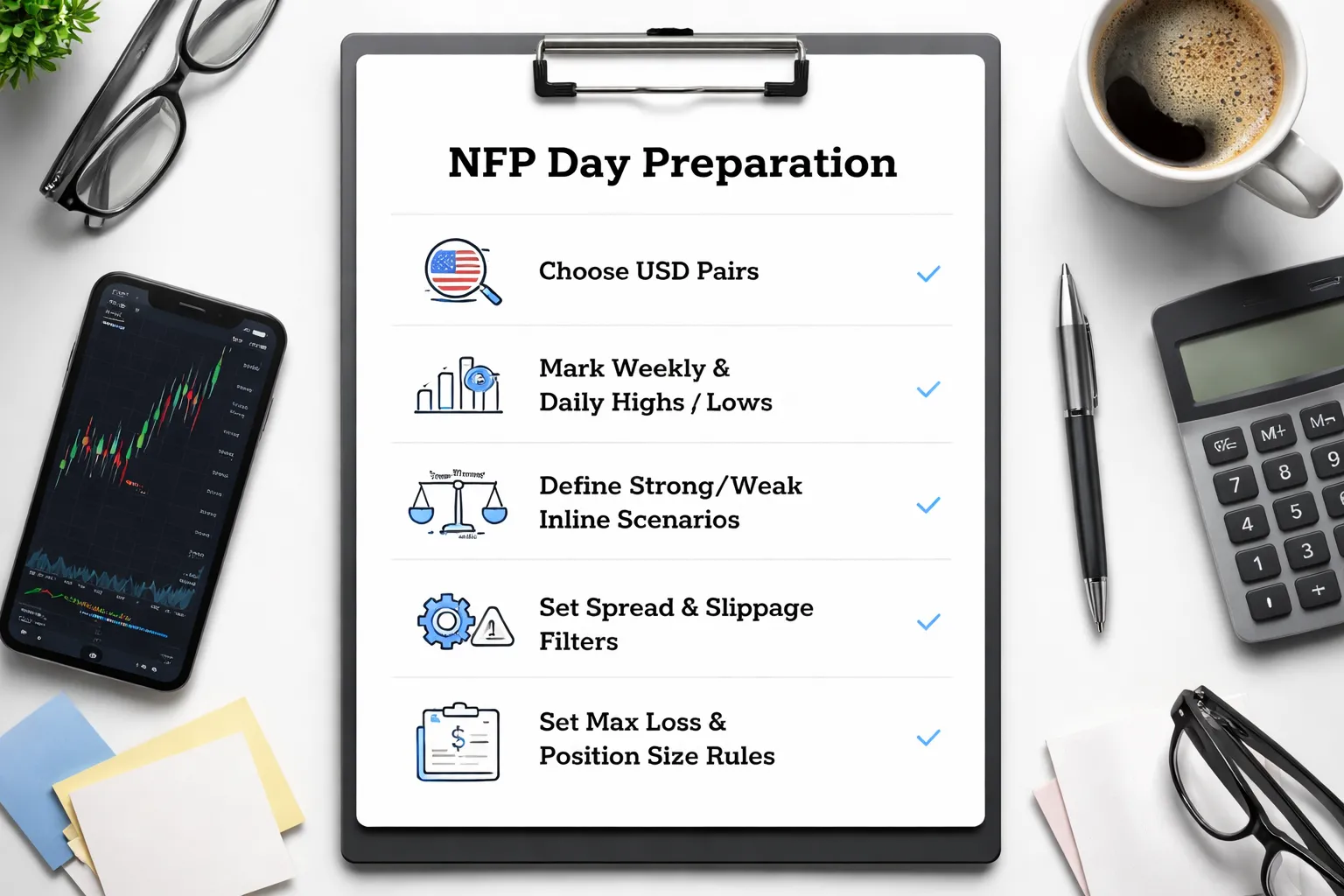
Choosing the right pairs for your strategy and broker conditions
Pick pairs where you can execute. Volatility means nothing if spreads blow out and fills fail.
- Start with USD majors: EUR/USD, USD/JPY, GBP/USD, AUD/USD. They react fast and usually keep tighter pricing than crosses.
- Avoid thin pairs: exotics and many crosses can gap, requote, or widen spreads enough to ruin your edge.
- Match pair to your thesis: if you trade rates and risk sentiment, focus on USD/JPY. If you trade broad USD direction, use EUR/USD or DXY proxies.
- Check your broker: average spread and max spread during past NFP, execution type, stop level rules, and whether they allow stops and limits close to price.
- Choose one primary pair: one clean plan beats five half-plans. Add a second pair only if it serves a different scenario.
Mapping key technical levels
Mark levels that liquidity targets. NFP often runs stops first, then picks direction.
- Weekly high and low: main breakout and stop zones.
- Prior day high and low: the first area price tests on the spike.
- Asia range and London range: common pre-release compression zones.
- Session open levels: New York open and London open often act as pivots.
- Obvious swing highs and lows: last 2 to 5 major turning points on H1 and H4.
- Liquidity pools: equal highs, equal lows, and tight consolidation edges. Expect stop runs into them.
- Event-day ATR: know a normal move size for the pair. Use it to judge if the first impulse already overshot.
Planning scenarios: strong, weak, inline outcomes and decision rules
Write rules before the print. Do not improvise in the first 60 seconds.
- Define your “strong” and “weak” bands: use consensus and your own thresholds. Include unemployment rate and average hourly earnings. They can override the headline.
- Set three playbooks:
- Strong USD scenario: buy USD on a clean break and hold above a key level, or wait for a retest after the first spike.
- Weak USD scenario: sell USD on a clean break and hold below a key level, or fade the spike only after structure forms.
- Inline scenario: expect chop and mean reversion. Trade smaller or skip.
- Add decision rules: trade only if spread stays under your limit, price closes beyond your level on your trigger timeframe, and the follow-through does not reverse immediately.
- Pre-define “no trade” filters: conflicting earnings and unemployment signals, price already at weekly extremes, or prior positioning looks crowded and unstable.
- Know the release time and revisions: revisions can flip the message. Confirm the full report fast using your economic calendar.
Execution planning: spreads, slippage, requotes, and platform stability
Your plan must fit real execution. NFP punishes fragile order flow.
- Test your platform: log in early, confirm margin, confirm data feed, and keep charts on low load layouts.
- Decide your order type: market orders get you in, but increase slippage risk. Limit orders control price, but often miss fills. Stop entries can trigger on a spike and fill badly.
- Set a spread filter: if spread exceeds your number, you do nothing. This rule saves accounts.
- Plan for slippage: assume worse fills than normal. Reduce size to compensate.
- Watch for requotes and order rejects: if they appear, stop trading that release. Execution conditions changed.
- Record broker behavior: note max spread, slippage, and fill speed. Use it to choose pairs and methods next month.
Setting risk limits: max loss per event, daily stop, and position sizing
Set hard limits. You trade the next NFP only if you survive this one.
- Max loss per event: cap your total loss across all NFP trades. Keep it small. If you hit it, you stop.
- Daily stop: set a second cap for the day. NFP can spill into a revenge-trading session.
- Position sizing: size from worst-case stop distance plus expected slippage, not from a tight stop you hope to get filled.
- Limit concurrent trades: correlated USD pairs stack risk. Treat them as one position.
- Define your maximum number of attempts: one or two trades per release. After that, you stand down.
- Use simple exits: one target and one stop, or scale once. Complex management fails when price jumps.
How to trade NFP: strategy frameworks (with pros/cons)
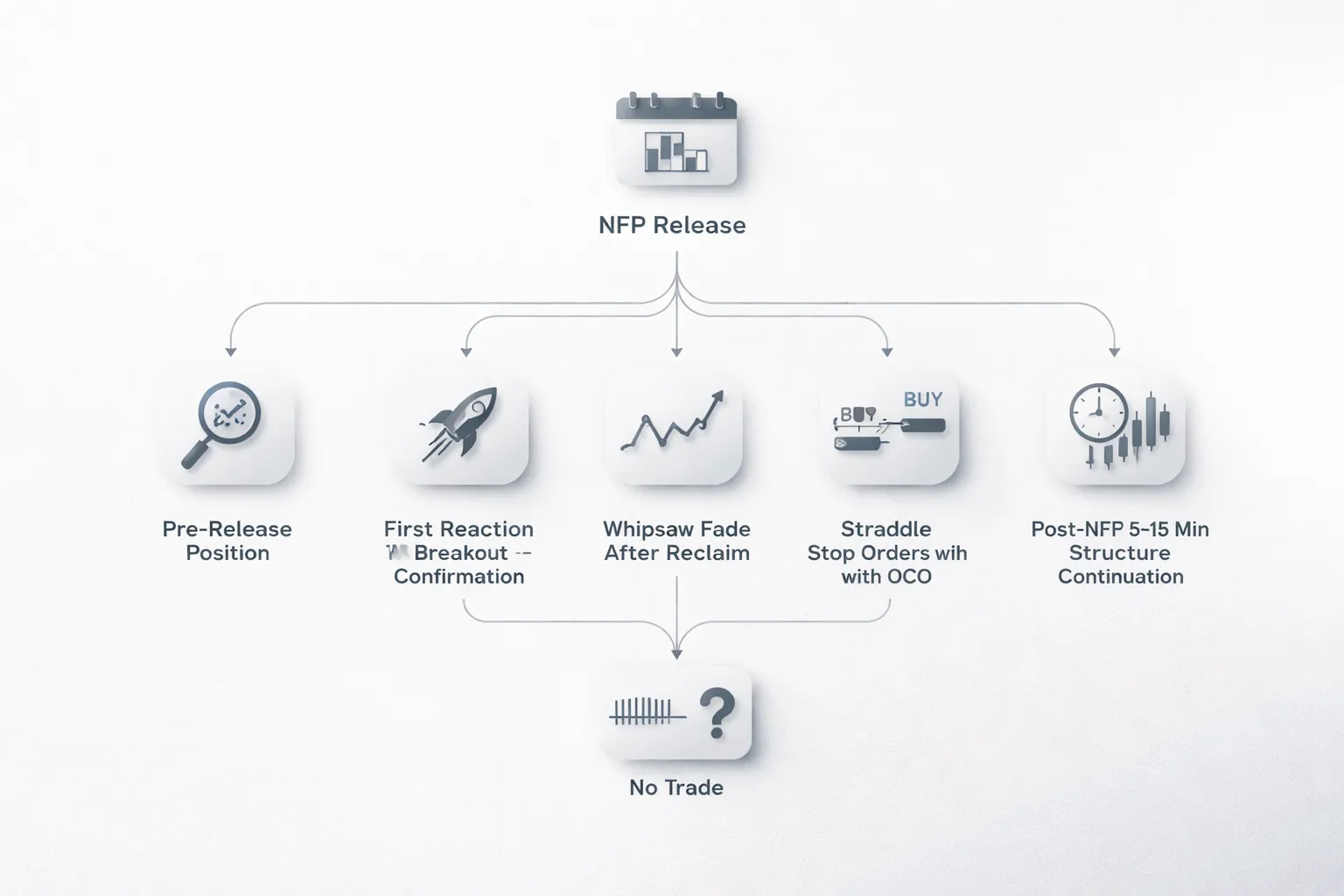
Pre-release positioning (macro bias trades)
You take a position before the release based on a macro view and a scenario map. You do not trade the number. You trade the likely path after the number.
- When it is justified: You have a clear USD regime, rates lead FX, and recent data lines up with your bias. Your plan defines outcomes for strong, weak, and mixed NFP.
- How to frame it: Use higher timeframes. Mark the weekly and daily levels. Pick one USD pair. Keep size small. Place a stop that survives the first spike.
- What you avoid: Tight stops, adding into the spike, and holding multiple correlated USD positions.
| Pros | Cons |
|---|---|
| Best fills and normal spreads before the event. | You can get hit by a one minute spike even if the later trend matches your view. |
| You ride a continuation move if the data confirms the regime. | You must absorb slippage if stops trigger during the release. |
| Simple plan, one entry, one stop, one target. | Requires strong context, not a guess. |
Breakout trading after the first reaction (confirmation and invalidation)
You wait for the first impulse. You enter only if price accepts beyond a key level.
- Confirmation criteria: Price breaks a pre-marked level, then holds above it for at least one full one minute close. The pullback does not reclaim the breakout level. Range expands versus the pre-release range.
- Entry framework: Enter on the first pullback that respects the level, or enter on the next one minute close above the level.
- Invalidation: A one minute close back inside the pre-break range, or a fast reclaim of the broken level. You exit. You do not wait for a second chance inside chop.
- Stop placement: Beyond the broken level plus a buffer for slippage. Do not use micro-stops on a news candle.
| Pros | Cons |
|---|---|
| You avoid gambling on the initial spike direction. | You pay with worse entry price if the move does not pull back. |
| Clear invalidation based on structure. | False breaks are common in the first 1 to 3 minutes. |
| Works well on trend days. | Spreads can still be wide right after the release. |
Fade and mean-reversion for whipsaws (when it works, when it fails)
You fade the first move when the market cannot hold the breakout. You target a return toward the pre-release midpoint or the origin of the spike.
- When it works: The first spike breaks a level, then immediately snaps back and closes inside the prior range. Follow-through fails on the next candle. Liquidity returns and spreads normalize.
- Execution: Wait for the reclaim. Do not short the top or buy the bottom blindly. Enter after a one minute close back inside the range. Place the stop beyond the spike extreme.
- Targets: Pre-release midpoint, then the opposite side of the pre-release range. Take one clean target. Do not over-manage.
- When it fails: Trend days with strong follow-through. Revisions and wage surprises can keep price one-directional. If price re-breaks the level and holds, you stand down.
| Pros | Cons |
|---|---|
| Good reward if the first move traps breakout traders. | Hard stop distances, you must size down. |
| Clear trigger, reclaim and close back inside. | Fast markets can skip your entry and tag your stop. |
| Works in mixed prints and indecision. | Fails badly when the release starts a clean trend. |
Straddle and stop-order tactics (slippage control and false breaks)
You place buy stop and sell stop orders around a level before the release. You aim to catch the first directional burst.
- Core rule: Your broker can fill you far from your stop price. You must assume slippage and wider spreads.
- Placement framework: Put orders beyond the pre-release range edge, not inside it. Use a wider trigger distance so random noise does not activate both sides.
- OCO setup: If one side triggers, you cancel the other side fast. You do not let both sides fill.
- False break filter: Require a one minute close beyond the level before you accept the position. If your order triggers but price closes back inside, exit.
- Slippage control: Use smaller size. Avoid market orders. Consider skipping straddles if your broker widens spreads aggressively at news time.
| Pros | Cons |
|---|---|
| You can catch the move even if it runs without pullback. | Highest slippage risk and worst fills. |
| Simple rules if you automate OCO. | You can get triggered on both sides in a whipsaw. |
| Useful if you cannot watch the screen. | Broker execution quality becomes the main edge. |
Post-NFP trend continuation setups (wait for 5 to 15 minute structure)
You ignore the first spike. You trade the structure that forms after volatility cools.
- What you wait for: A 5 to 15 minute range forms. Spreads normalize. Price respects a clear higher low or lower high.
- Entry triggers: Break and retest of the 5 to 15 minute range, or a pullback into a key level with rejection and follow-through.
- Stops and targets: Stop beyond the structure low or high. Target the next higher timeframe level. Keep it simple.
- Best conditions: The release aligns with the prevailing rates narrative. Price holds the new direction through multiple candles.
| Pros | Cons |
|---|---|
| Lower slippage and more stable spreads. | You miss the first large part of the move. |
| Cleaner levels and clearer invalidation. | Some NFP moves fully mean-revert before structure forms. |
| Fits discretionary trading and risk control. | Requires patience and strict filters. |
No-trade approach (when you stand aside)
Sometimes the best NFP trade is no trade. You protect your account for the next clean setup.
- Stand aside if spreads stay wide: If spreads remain elevated after the first few minutes, your risk model breaks. You skip.
- Stand aside in unclear regime: If USD drivers conflict, you have no edge. Read more on how to trade forex news without getting wrecked.
- Stand aside on mixed signals: Payrolls, unemployment rate, and wages point in different directions and price chops without acceptance.
- Stand aside if structure never forms: Fast spikes, immediate reversals, then range chop. You do not force a trade.
- Stand aside if execution is poor: Requotes, delayed fills, or abnormal slippage in recent releases. You change venue or you skip.
Risk management for NFP day (the rules that keep you in the game)
Sizing for event risk, use volatility, not hope
NFP changes the math. Your normal position size breaks when range expands and spreads widen.
- Risk a fixed percent per trade. Keep it small. Many traders cap NFP risk at 0.25 to 0.50 percent of account equity per attempt.
- Size from stop distance, not from lot comfort. If your stop needs to be 30 to 80 pips because swings jump, your lot size must shrink.
- Use ATR as a reality check. Take the 14 day ATR on the pair. If today’s first minute candles already cover a large chunk of ATR, treat it as maximum volatility and cut size further.
- Use a volatility multiplier. If your normal stop is 1R based on structure, multiply the stop by 1.5 to 3.0 for NFP and reduce lots so the dollar risk stays the same.
Simple rule. If you must widen the stop, you must reduce size. If you cannot reduce size enough, you skip.
Stop-loss placement during spikes, hard stops, mental stops, time stops
NFP punishes sloppy stops. You need one clear method and you need to follow it.
- Hard stop. You place it in the market. Use it when you cannot watch every tick. Put it beyond the level that invalidates the setup, not at the obvious round number where liquidity clusters.
- Mental stop. You close manually if price hits your invalidation. Use it only if you can execute fast and your platform is stable. If you hesitate once, you switch back to hard stops.
- Time stop. You exit if price fails to move within a set time window. NFP winners usually move early. If you get chop for 5 to 15 minutes after entry, you cut it and preserve capital.
Do not widen stops after entry. If the stop was too tight, the trade was wrong size or wrong timing.
Managing leverage and margin, avoid forced liquidations
On NFP, the threat is not only direction. It is margin.
- Run lower leverage than usual. Leave margin headroom for spread spikes and mark to market swings.
- Assume spreads can jump. If your broker normally shows 0.8 pips, plan for several times that during the release window.
- Avoid stacking correlated positions. Long EURUSD and long GBPUSD is still one USD trade. Your exposure adds up fast.
- Keep free margin high. If a single spike can trigger a margin call, you are oversized. Reduce lots or do not trade.
Partial profits and scaling out as volatility normalizes
NFP moves often come in waves. You want to get paid early and reduce exposure.
- Take partials at predefined levels. Common options are 1R, prior session high or low, or a measured move based on the first impulse leg.
- Move to break even with rules. Do it after acceptance, not on the first spike. A premature break even move gets you chopped out.
- Scale out as spreads normalize. When 1 minute candles shrink and price starts to respect levels again, you can trail with structure instead of panic exits.
Plan your exits before the release. You do not improvise in the first 60 seconds.
Common broker frictions, slippage, widened spreads, and stop hunting myths
Most NFP damage comes from microstructure, not conspiracies.
- Slippage is normal. Market orders fill at available prices. On news, liquidity thins and fills move.
- Spreads widen for a reason. Dealers and LPs protect inventory when price gaps. Your stop can trigger earlier because the bid or ask jumps.
- Stop hunting is usually a story. Price runs obvious highs and lows because many stops sit there and liquidity sits there. That is mechanics, not a targeted attack.
- Test your broker on small size. Track average slippage, max spread, and execution delays across several releases. If the numbers stay ugly, change venue or skip NFP.
Trading plan constraints, limit attempts and force cool-downs
NFP invites revenge trading. You need hard limits.
- Set a max number of attempts. Two trades is enough for most retail accounts. If you miss the move, you miss it.
- Set a daily loss cap. Example, stop trading after 1R to 2R of losses. NFP can hit that fast.
- Use cool-down periods. After any stop out, wait 5 to 15 minutes before the next decision. Let spreads and structure settle.
- Define your trade window. Many traders restrict entries to a short window after the release and stop later entries. Late setups often turn into mean reversion chop.
- Put the release time in your workflow. Use an economic calendar and lock your plan before the number hits.
These rules do one job. They keep you solvent so you can trade the next event.
Interpreting complex NFP outcomes (when the headline isn’t enough)
Strong jobs but weak wages, why USD reaction can be muted or reversed
Markets trade the Fed path. Payrolls matter, wages often matter more.
- Strong headline NFP supports growth. It does not guarantee higher rates.
- Soft average hourly earnings lowers inflation pressure. It can pull yields down.
- Result you can get a brief USD spike, then a fade as rate expectations reset.
Practical read. If payrolls beat but wages miss, watch the front end of the Treasury curve and Fed funds pricing. If yields do not confirm, do not chase the first USD move.
Rising unemployment with strong payrolls, understanding participation effects
You can see strong job gains and a higher unemployment rate in the same report. The household survey drives unemployment. The establishment survey drives payrolls.
- Participation rate up, more people start looking for work. Unemployment can rise even with solid hiring.
- Employment up but labor force up more, unemployment ticks higher. That is not a shock by itself.
- Market reaction depends on whether higher unemployment signals slack or just re-entry.
What to check. If participation rises and wages stay firm, markets often treat the unemployment uptick as less bearish. If unemployment rises while participation falls, markets read it as deterioration.
Hot wages vs soft payrolls, inflation focus and Fed reaction function
This mix can flip the usual logic. Soft jobs suggest slower growth. Hot wages suggest sticky inflation.
- Wages hot, markets reprice cuts lower or later. USD can strengthen even if payrolls miss.
- Wages cool, markets bring cuts forward. USD can weaken even if payrolls are fine.
- Key driver is the inflation narrative, not the jobs headline.
Use a simple filter. If earnings print above consensus and the prior trend, assume the bar for USD weakness rises. If you want the macro link, use how inflation data moves currency markets as your framework.
Big revisions and how they change the narrative
The first number is not the whole report. Revisions can erase the surprise.
- Upward revisions turn a small miss into an effective beat.
- Downward revisions can make a beat look hollow.
- Two-month revision total often matters more than the current print for trend traders.
Rule to use. Combine the headline with the net revision. If the net pushes the three-month average in the opposite direction of the headline reaction, expect whipsaw and mean reversion.
When markets prioritize other data (CPI week, FOMC proximity, geopolitical shocks)
Some Fridays, NFP is not the main input.
- CPI next week, traders limit exposure. NFP moves fade faster.
- FOMC is close, markets trade guidance risk. A decent NFP may not change the meeting odds.
- Geopolitical risk and risk sentiment can override domestic data. Safe haven flows can dominate.
Your job is to map the priority. Check what the market already prices for the next meeting and the next CPI. If pricing barely shifts after NFP, do not force a macro trade. Treat it as a volatility event, not a trend signal.
| Outcome mix | Market focus | Common FX behavior | Your priority check |
|---|---|---|---|
| Payrolls beat, wages miss | Rates path softens | USD spike then fade | 2Y yield, Fed funds pricing |
| Payrolls strong, unemployment up | Participation vs slack | Chop, then trend if narrative is clear | Participation rate, U-6, wages |
| Payrolls miss, wages hot | Inflation risk stays | USD holds or strengthens | Earnings surprise, 2Y yield reaction |
| Big negative revisions | Trend downgrade | Reversal after first move | Net revisions, 3-month avg |
| CPI or FOMC dominates | Event risk hierarchy | Smaller follow-through | Next-event pricing, implied vol |
Practical examples: NFP trading scenarios and decision trees
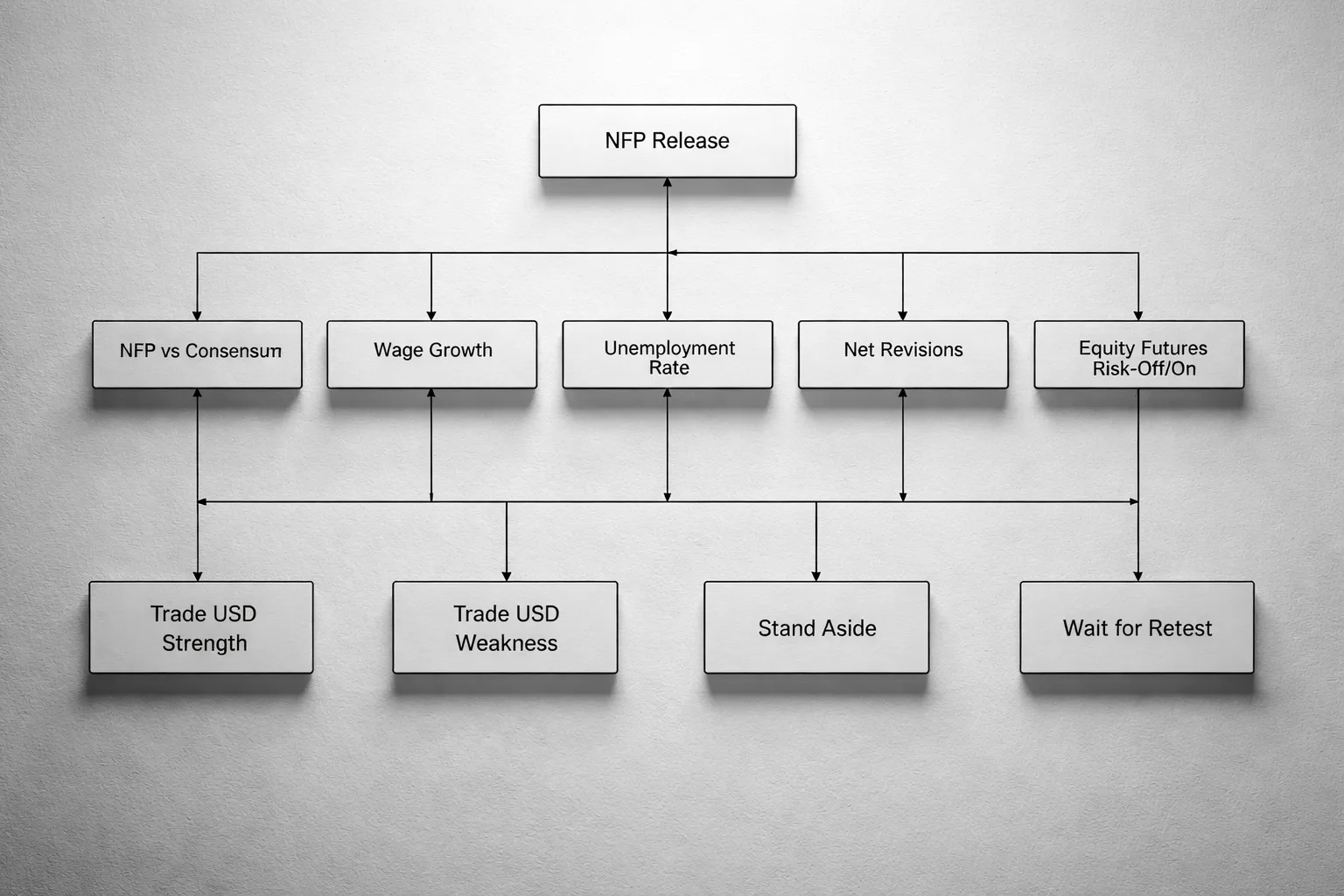
Scenario 1: Upside surprise with rising yields, USD strength playbook
Your base case here is simple. Strong payrolls plus firm wages pushes the front end higher. The 2-year yield matters most. It prices the Fed path.
- Pre-release check: Mark the pre-NFP range on DXY or your USD pair. Note the current 2-year yield, and the direction over the last 30 minutes.
- Trigger condition: NFP above consensus, unemployment rate flat or down, and/or average hourly earnings above consensus. Then watch 2-year yields pop and hold.
- Pair selection: Prefer pairs where yield differentials drive clean moves. USD/JPY often trends when US yields rise. EUR/USD often sells when the US rate path reprices.
- Decision tree:
- If 2-year yields spike and hold, then trade with USD strength, use pullbacks to levels.
- If 2-year yields spike then fade fast, then reduce size or stand down, the first move can reverse.
- If payrolls beat but wages miss, then expect a weaker follow-through, wait for a second candle confirmation.
- If payrolls beat and revisions are negative, then treat it as a mixed print, trade smaller or wait for a retest.
- Execution focus: You want alignment, headline, wages, revisions, and yields pointing the same way.
Scenario 2: Downside surprise with risk-off flows, USD mixed outcomes by pair
Weak payrolls can trigger risk-off. That can support USD on safe-haven demand. It can also weaken USD if markets price faster cuts. Your pair choice decides the result.
- Pre-release check: Note equity futures direction and current implied volatility. Mark key support and resistance on your pair.
- Trigger condition: NFP below consensus, unemployment rate up, and weak wages. Then watch if equities drop and credit spreads widen. If yields drop hard, rate-cut pricing dominates.
- Pair behavior guide:
- EUR/USD: Can rise if US yields fall faster than Eurozone yields. Can fall if global risk-off boosts USD demand.
- USD/JPY: Can drop on falling US yields and risk-off yen demand. It often moves more cleanly than EUR/USD in risk-off.
- AUD/USD and NZD/USD: Often sell in risk-off. They act as a stress gauge.
- Decision tree:
- If yields dump and equities dump, then prioritize USD/JPY downside and AUD/USD downside setups, avoid forcing a EUR/USD call.
- If yields dump but equities stabilize fast, then expect a cleaner USD-negative move, EUR/USD may trend up.
- If the first 1 to 3 minutes show whipsaw, then wait for the 5-minute close, trade the break of that range.
- Execution focus: Separate rate shock from risk shock. Use yields to read rates. Use equities to read risk.
Scenario 3: Inline print, big revisions, how to avoid chop
Inline headline prints create chop. Revisions often carry the real message. Traders react late, then reverse.
- What creates chop: NFP near consensus, unemployment unchanged, wages mixed, and a large revision to prior months.
- What to do first: Add current month NFP to net revisions for the prior two months. Compare that total to consensus.
- Trend filter: Check the 3-month average payrolls after revisions. This often drives the sustained move.
- Decision tree:
- If headline is inline but net revisions are large negative, then treat it as a miss, wait for the first spike to fade, then look for a reversal setup.
- If headline is inline but net revisions are positive and wages firm, then treat it as a beat, look for USD strength after the initial noise.
- If CPI or FOMC sits within the next 7 to 10 days, then expect smaller follow-through, take faster profits, avoid wide targets.
- Execution focus: Do not trade the headline. Trade the total message, then trade the yield reaction.
Example entry and exit logic using levels and candle confirmation
Use a ruleset. Keep it the same each release. Change only the pair and the levels.
- Step 1, map levels: Mark Asia range high and low, London high and low, and the prior day high and low.
- Step 2, define the no-trade window: No market orders in the first 30 to 60 seconds. Spreads and slippage peak here.
- Step 3, wait for confirmation: Use a 1-minute or 5-minute close. You want a close outside the pre-NFP range, plus follow-through on the next candle.
- Step 4, entry model A, breakout retest:
- Price breaks the range and closes outside.
- Price retests the broken level within the next 5 to 20 minutes.
- You enter on the first bullish or bearish close that rejects the level.
- Step 5, stop placement: Put the stop beyond the rejection swing, or back inside the pre-NFP range. Choose one method and stick to it.
- Step 6, target logic: First target at the next higher timeframe level, such as prior day high or low. Take partials. Move stop to reduce tail risk only after structure forms.
- Step 7, exit on invalidation: If price closes back inside the pre-NFP range after your entry, exit. Do not wait for hope.
If you need a framework for pair selection and drivers, use what moves EUR/USD as your baseline.
How to journal NFP trades and evaluate edge over multiple releases
You do not prove an edge on one Friday. You prove it over a sample.
- Minimum sample: Track at least 12 releases. Twenty-four gives cleaner stats.
- Log the data context: Consensus, actual, unemployment rate, wages, net revisions, and the 3-month average after revisions.
- Log the market reaction: 2-year yield direction in the first 5 minutes and first 30 minutes. DXY direction. S&P futures direction.
- Log your execution: Pair, entry time, entry method, spread at entry, stop distance, slippage, and whether your order type caused the fill issues.
- Tag the regime:
- Rates-dominant, yields lead, USD follows.
- Risk-dominant, equities lead, FX crosses react.
- Next-event dominant, CPI or FOMC caps follow-through.
- Score your rules: Did you respect the no-trade window. Did you wait for the candle close. Did you trade with yield direction.
- Measure outcomes: Expectancy per release, win rate, average win to average loss, and max adverse excursion. Track results by scenario tag.
- Remove noise: If most losses come from the first minute, ban the first minute. If most losses come from inline prints, require revisions plus yield confirmation.
Tools and resources to trade NFP more effectively
Economic calendars, alerts, and real-time news feeds
Your edge on NFP starts with timing. Use a calendar that shows the exact release time, forecast, prior, and revision. Set alerts for T minus 30 minutes, 10 minutes, and 1 minute. Block your no-trade window on your phone and platform.
- Economic calendars: Use them to plan. Do not use them to predict direction.
- Alerts: Set one for the release time and one for five minutes after. The second alert helps you avoid impulse trades.
- Real-time news feeds: Speed matters, but cost rises fast. Free feeds lag. Paid feeds can hit in seconds. If your strategy needs the first move, pay for speed. If you wait for a candle close or yield confirmation, a slower feed can work.
Pick one feed and stick to it. Mixing sources creates timestamp confusion in your journal.
Futures and yield dashboards to confirm direction
NFP reprices rates. Rates drive the dollar. Build a simple dashboard and check it every release.
- DXY or USD index futures: Use it as a clean USD signal when your pair has mixed drivers.
- U.S. 2Y yield: Treat it as the front end rate expectation gauge. It often reacts first.
- U.S. 10Y yield: Use it to spot curve moves. A 2Y up and 10Y flat can signal a different regime than both up.
- S&P 500 futures: Optional. Helps when the market reads the report as risk-on or risk-off.
Write your confirmation rule in one line. Example, you only buy USD when DXY and the U.S. 2Y both break in the same direction after the first spike. For pair-specific context, keep a reference guide on what moves GBP/USD.
Options-based indicators for range planning
Use options to plan size and stops. Options give you the market’s priced range. You do not need to trade options to use this data.
- Implied move: Convert 1 day implied volatility into an expected point move. Use it to cap your target and avoid chasing late.
- Expected range bands: Mark the implied high and low for the day. Treat them as stretch zones. Breaks can trend. Rejections can mean mean reversion.
- Risk sizing: If implied range doubles versus normal, cut size or widen stops. Do not keep normal size with news volatility.
Backtesting limits for news, and how to forward test correctly
Most retail backtests lie on NFP. Historical candles hide the real spread, slippage, and execution delays. Tick history often misses broker conditions. Your results look stable until you trade live.
- Assume slippage: Add a fixed slippage and a spread multiplier in your test. If the edge disappears, the edge was thin.
- Use event replay: If your platform supports tick replay, test entries on the same timestamps you will use live.
- Forward test in a small live account: Demo fills do not match. Trade micro size for 10 to 20 releases. Log the fill price, spread, and time to fill.
- Tag scenarios: Strong beat, strong miss, inline with revision, yield divergence, first-minute spike, second-wave continuation.
- Measure execution: Track average slippage, worst slippage, and how often stops fill beyond your stop price.
Broker selection for NFP trading
Your broker can decide your outcome more than your setup. NFP punishes weak execution.
- Execution model: Prefer transparent market execution with clear slippage rules. Avoid brokers that routinely reject orders or re-quote during news.
- Typical spreads versus news spreads: Ask for data. Many brokers advertise tight averages, then widen hard at the release. Record your own spread at T minus 1 minute, T plus 10 seconds, and T plus 2 minutes.
- Stop and limit behavior: Stops trigger at the stop level but fill at available liquidity. Limits can miss in fast moves. Test both with small size.
- News policies: Read the terms. Some brokers increase margin, limit leverage, or block trading around major releases.
- Platform stability: A freeze during the first minute is a trade you cannot manage. Stress test on prior news days.
Keep a broker scorecard. Rate it on spread blowout, slippage, rejects, and platform uptime. If the broker fails two releases in a row, stop using it for NFP.
Common NFP mistakes and how to avoid them
Trading the number instead of the reaction
The print does not trade in a straight line. Price trades the gap versus expectations, the revision, and the unemployment rate. It also trades positioning and liquidity.
If you buy USD because NFP beats forecast, you can still lose. A hot headline can come with weaker average hourly earnings. A beat can get sold if the market already priced it in.
- Fix: Define your trigger as price behavior, not the headline. Example, trade only after the first impulse and a pullback holds a level.
- Fix: Track the full release set. NFP, unemployment rate, participation, average hourly earnings, revisions.
- Fix: Set a time filter. If you do not get your setup within X minutes, you skip the trade.
Overtrading during whipsaws, revenge loops and stop conditions
NFP creates fast reversals. A loss feels like bad luck, then you click again. That loop kills accounts.
- Fix: Cap the number of attempts. One trade, or two max. After that, you stop.
- Fix: Cap the daily loss. Example, stop at 1R or 2R. No exceptions.
- Fix: Add a volatility stop. If spreads exceed your limit, or slippage exceeds your limit, you do not trade.
- Fix: Log every click. If you cannot explain the entry in one sentence, it is impulse.
| Rule-based stop condition | Hard rule |
|---|---|
| Max losing trades | 1 to 2 |
| Max loss for the day | 1R to 2R |
| Spread limit | Do not trade above your tested max spread |
| Slippage limit | Stop if fills exceed your tested slippage threshold |
| Time limit | Stop after X minutes if no clean setup forms |
Ignoring correlated markets and misreading USD moves
On NFP, USD pairs often follow rates first. Watch US Treasury yields. They can explain why USD rises or falls even when the headline looks clear.
- Yields: Rising yields often support USD. Falling yields often pressure USD. Watch the 2-year for policy expectations.
- Equities: A strong jobs print can lift stocks if it signals growth, or drop stocks if it signals higher rates. That changes risk tone fast.
- Gold: Gold often moves opposite real yields. If gold and yields both rise, you may face a messy, two-driver tape.
- JPY and CHF: Risk-off can strengthen JPY and CHF even if USD data beats.
Use one quick dashboard. USD index or a USD basket, 2-year yield, S&P 500 futures, gold. This keeps you from forcing a story onto EUR/USD. For the broader driver map, see what moves EUR/USD.
Placing orders too close to price
Spreads spike. Quotes gap. Your stop order becomes a market order at the worst moment. Your limit order fills on a wick and then price snaps back.
- Fix: Give price room. Place stops and limits beyond the normal noise you see on prior NFP releases.
- Fix: Avoid tight brackets. Tight OCO orders near price often create accidental fills in the first seconds.
- Fix: Use smaller size if you must trade the first minute. You pay for speed with slippage risk.
- Fix: Prefer post-spike entries. Let the spread normalize before you place new orders.
Holding large positions into the weekend without a plan
NFP usually hits on Friday. If you hold size into the close, you take weekend gap risk. News can hit when markets close, then Monday opens far from your stop.
- Fix: Set a Friday cut-off time. Reduce or close before liquidity dries up.
- Fix: If you swing the trade, size it for a gap. Assume your stop may not fill where you set it.
- Fix: Define your weekend plan in advance. Hold, hedge, or exit. Write it down before the release.
- Fix: Avoid adding late. Late Friday adds often turn a good week into a bad Monday open.
FAQ
What time does NFP come out?
NFP prints on the first Friday of each month at 8:30 a.m. New York time. Revisions to prior months release at the same time. Confirm the exact date and time in your forex economic calendar.
Which NFP numbers move FX the most?
Watch payroll change, unemployment rate, and average hourly earnings. Markets also react to revisions, participation rate, and hours worked. The surprise versus consensus matters more than the headline level.
Which pairs react the most to NFP?
USD pairs lead. EUR/USD, GBP/USD, USD/JPY, and XAU/USD often show the largest first moves. Pick pairs with tight spreads on normal days and known behavior on your broker during news.
Should you trade before the release?
Avoid new positions into the print unless you have a tested plan. Spreads can widen and price can whip. If you hold a position, cut size, tighten risk, or hedge before liquidity drops.
How big can spreads get on NFP?
Spreads can jump several times above normal for seconds to minutes. Your broker, pair, and liquidity conditions decide the size. Plan entries and stops assuming worse fills and wider costs than usual.
Do stop losses protect you during NFP?
Stops can slip. Fast moves can skip your price, especially on thin liquidity. Size for slippage. Keep risk per trade small. If you need strict risk, trade after the first spike settles.
What is the safest way to trade NFP?
Trade after the initial volatility. Wait for spread normalization and a clear direction on lower timeframes. Use smaller size. Set a hard invalidation level and a realistic target based on post-release range.
How long does NFP volatility last?
The first 1 to 5 minutes often deliver the biggest move. Secondary moves can hit over the next 30 to 90 minutes as yields and equities react. The trend can extend into the New York session if the surprise is large.
What if NFP is strong but USD drops?
Check earnings, unemployment, and revisions. A strong headline with weak wages can still hit USD. Also watch rate expectations and risk sentiment. If yields fall or risk-on surges, USD can weaken even on good jobs data.
Can you hold NFP trades over the weekend?
Yes, but treat it as gap risk. Friday liquidity fades, then Monday can open far from your stop. If you hold, reduce size and accept that your stop may fill worse than planned.
Do you need to trade NFP to make money in FX?
No. NFP offers volatility, not edge. If you do not have a tested method for news conditions, skip it. You can trade cleaner setups on normal sessions with tighter spreads and better fills.
Conclusion
Conclusion
NFP is a volatility event. It does not give you an edge by itself.
Spreads widen. Liquidity drops. Slippage rises. Your plan must assume worse fills than normal. If your strategy needs tight stops and clean execution, you skip the first minutes.
Trade NFP only when you can define three things before the number hits. Your trigger, your risk cap, your exit.
- Trigger: the exact condition that puts you in, based on the release and the first market reaction.
- Risk cap: a fixed dollar loss limit for the entire event. Use smaller size than normal.
- Exit: a hard stop, a time stop, and a profit rule that does not rely on perfect fills.
Your final check is the calendar. Confirm the release time, forecast, prior, and any linked risks like unemployment rate and earnings. Use a proper forex economic calendar and treat the event like a scheduled liquidity shock.
If you cannot write your plan in one paragraph, do not trade it. Wait for post NFP structure, then trade when spreads normalize and price prints clean levels.
-
How Interest Rates Affect Currency Pairs (With Real Examples)
6 months ago -
Fundamental Analysis in Forex Explained (What Actually Moves Prices)
6 months ago -
What Moves EUR/USD? The Biggest Drivers You Should Watch
6 months ago -
Inflation and Exchange Rates Explained (Why Currencies Rise or Fall)
6 months ago -
How to Trade Forex News (NFP, CPI, FOMC) Without Getting Wrecked
6 months ago
-
- NFP release schedule, and where to check the exact time
- The three numbers you read first, and why they move FX
- Revisions, the hidden number that can beat the headline
- Seasonality and statistical noise, why “good or bad” is not always clear
- Benchmarking and methodology basics, establishment vs household survey
-
- Consensus vs whisper numbers, and why you can still get wrong-footed
- How to estimate surprise size and likely reaction zones
- Why the same NFP number can move the dollar differently in different macro regimes
- Risk-on and risk-off context, when yields and equities matter more than FX
- Pre-event positioning clues, options implied volatility and risk reversals
-
- Choosing the right pairs for your strategy and broker conditions
- Mapping key technical levels
- Planning scenarios: strong, weak, inline outcomes and decision rules
- Execution planning: spreads, slippage, requotes, and platform stability
- Setting risk limits: max loss per event, daily stop, and position sizing
-
- Pre-release positioning (macro bias trades)
- Breakout trading after the first reaction (confirmation and invalidation)
- Fade and mean-reversion for whipsaws (when it works, when it fails)
- Straddle and stop-order tactics (slippage control and false breaks)
- Post-NFP trend continuation setups (wait for 5 to 15 minute structure)
- No-trade approach (when you stand aside)
-
- Sizing for event risk, use volatility, not hope
- Stop-loss placement during spikes, hard stops, mental stops, time stops
- Managing leverage and margin, avoid forced liquidations
- Partial profits and scaling out as volatility normalizes
- Common broker frictions, slippage, widened spreads, and stop hunting myths
- Trading plan constraints, limit attempts and force cool-downs
-
- Strong jobs but weak wages, why USD reaction can be muted or reversed
- Rising unemployment with strong payrolls, understanding participation effects
- Hot wages vs soft payrolls, inflation focus and Fed reaction function
- Big revisions and how they change the narrative
- When markets prioritize other data (CPI week, FOMC proximity, geopolitical shocks)
-
- Scenario 1: Upside surprise with rising yields, USD strength playbook
- Scenario 2: Downside surprise with risk-off flows, USD mixed outcomes by pair
- Scenario 3: Inline print, big revisions, how to avoid chop
- Example entry and exit logic using levels and candle confirmation
- How to journal NFP trades and evaluate edge over multiple releases
-
- What time does NFP come out?
- Which NFP numbers move FX the most?
- Which pairs react the most to NFP?
- Should you trade before the release?
- How big can spreads get on NFP?
- Do stop losses protect you during NFP?
- What is the safest way to trade NFP?
- How long does NFP volatility last?
- What if NFP is strong but USD drops?
- Can you hold NFP trades over the weekend?
- Do you need to trade NFP to make money in FX?
-
- NFP release schedule, and where to check the exact time
- The three numbers you read first, and why they move FX
- Revisions, the hidden number that can beat the headline
- Seasonality and statistical noise, why “good or bad” is not always clear
- Benchmarking and methodology basics, establishment vs household survey
-
- Consensus vs whisper numbers, and why you can still get wrong-footed
- How to estimate surprise size and likely reaction zones
- Why the same NFP number can move the dollar differently in different macro regimes
- Risk-on and risk-off context, when yields and equities matter more than FX
- Pre-event positioning clues, options implied volatility and risk reversals
-
- Choosing the right pairs for your strategy and broker conditions
- Mapping key technical levels
- Planning scenarios: strong, weak, inline outcomes and decision rules
- Execution planning: spreads, slippage, requotes, and platform stability
- Setting risk limits: max loss per event, daily stop, and position sizing
-
- Pre-release positioning (macro bias trades)
- Breakout trading after the first reaction (confirmation and invalidation)
- Fade and mean-reversion for whipsaws (when it works, when it fails)
- Straddle and stop-order tactics (slippage control and false breaks)
- Post-NFP trend continuation setups (wait for 5 to 15 minute structure)
- No-trade approach (when you stand aside)
-
- Sizing for event risk, use volatility, not hope
- Stop-loss placement during spikes, hard stops, mental stops, time stops
- Managing leverage and margin, avoid forced liquidations
- Partial profits and scaling out as volatility normalizes
- Common broker frictions, slippage, widened spreads, and stop hunting myths
- Trading plan constraints, limit attempts and force cool-downs
-
- Strong jobs but weak wages, why USD reaction can be muted or reversed
- Rising unemployment with strong payrolls, understanding participation effects
- Hot wages vs soft payrolls, inflation focus and Fed reaction function
- Big revisions and how they change the narrative
- When markets prioritize other data (CPI week, FOMC proximity, geopolitical shocks)
-
- Scenario 1: Upside surprise with rising yields, USD strength playbook
- Scenario 2: Downside surprise with risk-off flows, USD mixed outcomes by pair
- Scenario 3: Inline print, big revisions, how to avoid chop
- Example entry and exit logic using levels and candle confirmation
- How to journal NFP trades and evaluate edge over multiple releases
-
- What time does NFP come out?
- Which NFP numbers move FX the most?
- Which pairs react the most to NFP?
- Should you trade before the release?
- How big can spreads get on NFP?
- Do stop losses protect you during NFP?
- What is the safest way to trade NFP?
- How long does NFP volatility last?
- What if NFP is strong but USD drops?
- Can you hold NFP trades over the weekend?
- Do you need to trade NFP to make money in FX?
-
How to Place a Forex Trade Step by Step (Your First Trade Explained)
4 months ago -
Forex Trading vs Crypto Trading: Which Market Is Better for Beginners?
4 months ago -
Forex Lot Size Calculator: How to Use It to Size Trades Correctly
6 months ago -
How to Calculate Position Size in Forex (Position Sizing Formula + Examples)
6 months ago -
Forex Leverage Explained: How It Works, Pros, Cons & Examples
6 months ago
-
Forex Trading Platforms Comparison: MetaTrader vs cTrader vs TradingView
6 months ago -
Stop Loss vs Take Profit: Differences, Examples & Best Practices
6 months ago -
Is Forex Trading Legal in the United States? Rules, Regulators & What to Know
6 months ago -
Forex Market Hours & Trading Sessions Explained (Best Times to Trade)
6 months ago -
Forex Leverage Explained: How It Works, Pros, Cons & Examples
6 months ago