How to Avoid Overtrading Forex (Signs, Causes & Fixes)

Overtrading is one of the fastest ways to turn a workable forex edge into a losing account. You take too many trades, you trade too often, or you increase size after wins or losses. Costs pile up. Spreads and commissions eat expectancy. Mistakes rise when you chase price or trade tired.
This guide breaks overtrading into clear parts. You will learn the most common signs, the root causes behind them, and fixes you can apply today. You will also learn how to set hard limits for trades per day, risk per trade, and session time, plus when to stop trading after a drawdown or a win streak. If your risk control is weak, start with how to place a stop loss in forex.
Key Takeaways
Key Takeaways
- In het kort: Overtrading is too many trades, too much risk, or too much screen time, all driven by weak rules.
- You spot it fast. More trades after a loss, revenge entries, and breaking your own setup rules.
- The main causes are FOMO, boredom, tilt, and chasing losses or a win streak.
- Overtrading usually shows up as worse entries, wider stops, larger position sizes, and higher costs.
- Fix it with hard limits. Max trades per day, max risk per trade, and a fixed session timer.
- Stop conditions matter. Set a daily loss limit and a rule to stop after a strong win streak.
- Trade less, log more. Track each trade and label the reason, setup, and rule followed or broken.
- Use a repeatable plan, then test it. Backtest rules before you increase frequency or size. See how to backtest a forex strategy.
What Overtrading Means in Forex (and What It’s Not)
What overtrading means for retail forex traders
Overtrading means you place more trades than your edge can support.
It is not a specific number of trades. It is a drop in decision quality and rule compliance.
You overtrade when you take marginal setups, increase size to “make it back”, or trade outside your tested hours.
Use a simple check. If you cannot state your setup, your entry trigger, your stop, and your target in one sentence, you are likely forcing trades.
Frequency vs quality, the practical definition
High frequency can be fine. Low quality is the problem.
Track two numbers for each session. Trades taken, and trades that matched your written rules.
If trade count rises while rule matched trades fall, you overtrade.
If trade count rises but rule matched trades stay high, you trade actively, not recklessly.
Overtrading vs active trading, when “more” is justified
More trades make sense when your plan expects them.
- Your market and session support it. You trade during liquid hours and your strategy targets small, repeatable moves.
- You have defined filters. Trend, volatility, and time rules block most signals.
- Your risk stays fixed. Same % risk per trade, same max daily loss, same max open exposure.
- Your edge survives costs. Spread and slippage do not flip your win expectancy.
Active trading still follows limits. Overtrading breaks them.
Common forms of overtrading
- Revenge trading. You take the next trade fast after a loss. You widen stops, chase entries, or double size.
- Impulsive scalping. You drop to a lower timeframe to “find something”. You trade noise, pay more spread, and stack small losses.
- Strategy-hopping. You change indicators, timeframes, or rules after a few trades. You never collect enough data to validate one approach.
- Overleveraging. You use too much size for the stop distance. Normal volatility becomes a large account swing. Your next decisions get worse.
Each form has the same result. More trades, weaker filters, higher risk.
What overtrading is not
- Following your plan on multiple valid signals. If your rules allow 5 trades and you take 5, that is not overtrading.
- Taking a loss. Losses happen in any strategy. Overtrading starts when you change behavior after the loss.
- Being active during news with a tested plan. If you tested it and you cap risk, activity alone is not the issue.
- Having many small wins. The problem is not win rate. The problem is breaking rules to chase more.
Why forex makes overtrading easier
- 24/5 access. You can always find a chart that moves. This pushes you to trade when you should stop.
- High leverage. Small moves can feel urgent. A minor mistake can become a large loss.
- Low friction. One click entries, tight spreads, and fast platforms remove the pause that prevents bad trades.
Forex rewards patience. Your job is to trade your edge, not your screen time.
Why Overtrading Hurts Performance
How spreads, commissions, and slippage compound with high turnover
Every trade has a cost. You pay it whether you win or lose.
In forex, your main costs are the spread, commissions, and slippage. Overtrading turns these small costs into a large drag because you multiply them by too many trades.
- Spread: you start each trade negative. The more entries you take, the more you donate to the spread.
- Commission: on many accounts, you pay per lot, per side. High turnover makes commissions a fixed headwind.
- Slippage: fast moves, news spikes, and thin liquidity fill you worse than your price. More trades create more chances to get slipped.
Costs hit hardest when your edge is small. If your strategy expects a modest average gain per trade, extra turnover can erase it.
Decision fatigue and reduced execution quality over time
Trading performance depends on decision quality. Overtrading lowers it.
- You start forcing setups instead of waiting for clear conditions.
- You chase price after it already moved.
- You widen stops to avoid getting stopped out, then take bigger losses.
- You cut winners early to feel relief, then leave profit on the table.
- You miss rules like news filters, time windows, and max risk limits.
Execution also degrades. You enter late, forget limit orders, and manage trades based on emotion. This is where forex trading psychology stops being theory and starts being a direct cost.
Risk of correlated exposure across pairs and sessions
Overtrading often stacks the same bet across multiple pairs. It feels diversified, but it is usually one theme repeated.
- USD shows up in most major pairs. Several trades can become one large USD position.
- EUR pairs often move together during risk-on and risk-off flows.
- JPY and CHF can spike together when markets rush to safety.
Correlation rises during stress, news, and session overlaps. If you place many trades in the same direction across related pairs, one move can hit all of them at once.
The drawdown spiral: how small mistakes turn into account-threatening losses
Overtrading creates a loop. Losses trigger more trades. More trades increase errors. Errors deepen the drawdown.
- You take a small loss.
- You trade again to get it back.
- You increase size or reduce selectivity.
- You add correlated positions.
- You hit a larger loss that forces you into defensive decisions.
Drawdowns hurt more than they look. A 10% loss needs an 11.1% gain to recover. A 20% loss needs 25%. A 50% loss needs 100%.
| Drawdown | Gain needed to break even |
|---|---|
| 10% | 11.1% |
| 20% | 25% |
| 30% | 42.9% |
| 50% | 100% |
Overtrading increases the frequency of avoidable losses. It also increases exposure when you feel least objective. That mix turns normal variance into damage.
Signs You’re Overtrading (Use This Checklist)
Use this checklist to spot overtrading early. One item can be a bad day. Several items at once means you have a process problem.
Behavioral red flags
- You chase candles. You enter after a big move because price looks like it is “running” without you.
- You force setups. You loosen your rules to make a chart “fit” your idea.
- You trade because you are bored. You open positions to feel involved, not because your criteria triggered.
- You check charts constantly. You cannot leave the screen without feeling you will miss a trade.
- You switch systems mid-session. You change timeframes, indicators, or entry rules after a loss.
- You add “just one more” trade. You keep searching until you find something tradable.
Risk management drift
- Your lot size creeps up. You increase size without a plan, often after a win or a loss.
- You widen stops to avoid being wrong. Your stop distance grows, your risk per trade grows with it.
- You remove stops. You tell yourself you will exit manually, then you hesitate.
- You take worse entries to “improve” R:R. You enter earlier or later than planned to chase a better ratio, then you manage from a weak position. Review your targets and stops against a clear risk-reward ratio.
- You average down without rules. You add to losers because price “has to” come back.
- You risk more after losses. You try to recover faster, your drawdown accelerates.
Emotional signals
- Irritability. Small price moves annoy you, you react instead of execute.
- Urgency. You feel rushed to get in, even when your setup is incomplete.
- Fear of missing out. You enter because others might profit, not because you have edge.
- Need to “get it back”. After a loss, you hunt for the next trade to erase it.
- Relief when you close, stress when you hold. You close early, then re-enter to fix it.
Statistical symptoms
- Your trade count rises, your results do not. More trades, same or worse P and L.
- Your win rate drops. You take more marginal setups, your hit rate falls.
- Your average loss grows. Wider stops, late exits, or no stops show up fast here.
- Your average win shrinks. You take profit early because you feel exposed.
| Metric | Overtrading signal | What it usually means |
|---|---|---|
| Trades per day or week | Rising for 2 to 4 weeks | You trade activity, not setups |
| Win rate | Down vs your 20 to 50 trade baseline | You lowered entry quality |
| Average loss | Up vs baseline | Stops drifted, exits slipped |
| Average win | Down vs baseline | You cut winners to reduce stress |
| Expectancy | Turns negative for 20+ trades | You lost edge or stopped following it |
Platform evidence
- Multiple re-entries on the same move. You exit, re-enter, then re-enter again without a new setup.
- Frequent partial closes. You keep “managing” because you feel uncertain, not because your plan requires it.
- Excessive order edits. You move stops and limits many times per trade.
- Revenge clusters. Several trades open within minutes after a loss.
- More manual closes than planned exits. You close based on feelings, then justify it after.
Root Causes: Psychological, Strategic, and Environmental Triggers
Psychological Drivers
Overtrading often starts as emotion, then turns into behavior.
- FOMO: You see price move without you. You chase. You enter late, use wider stops, and take lower quality setups.
- Revenge trading: A loss feels unfair. You try to win it back fast. You increase size or frequency and ignore your filters.
- Boredom: You sit in front of charts with no valid setup. You trade to feel productive. You turn noise into a “signal.”
- Dopamine loops: Fast feedback trains your brain. Each click becomes a reward cycle. You start seeking action, not expectancy.
- Ego and control: You hate being wrong. You keep “fixing” the trade with edits and partials. You convert a planned trade into a live argument with the market.
Strategy Problems
If your process lacks rules, you will fill the gaps with impulses.
- Unclear edge: You cannot explain why your setup works, when it fails, and what market state it needs. You trade more to compensate for uncertainty.
- No A and B setup definition: You treat every chart as a “maybe.” You need named setups with clear entry, stop, target, and invalidation.
- Poor backtesting: You rely on a few good weeks or screenshots. You do not know your win rate, average win, average loss, or worst streak. You keep trading to “find out.”
- Loose indicators: You stack tools without rules. A moving average cross, plus a vague RSI read, becomes a permission slip. If you use indicators, lock the conditions, for example fixed RSI thresholds and a defined timeframe, and stick to them. Use one reference guide if needed, like RSI settings and signals.
- No limit on attempts: You re-enter the same idea five times. You treat a setup like a slot machine. Your plan needs a max number of entries per setup and per session.
Market-Context Mistakes
Some market conditions punish activity. Overtrading rises when you ignore context.
- Trading chop: Price ranges, spreads eat you, and signals flip. You take many small losses and keep “trying.”
- News spikes: High impact releases create slippage and spread blowouts. Your stop becomes a suggestion. You jump in late and get whipsawed.
- Low-liquidity hours: Thin sessions create random wicks and stop runs. You read structure where there is none.
- Wrong timeframe for your style: You scalp on a slow market or swing trade inside noise. You then increase trades to force results.
Lifestyle and Environment
Your body and your setup affect your decisions. Trading does not happen in a vacuum.
- Stress load: Work conflict, money issues, and personal pressure reduce patience. You cut winners early and take extra trades.
- Sleep debt: You miss rules, misread risk, and chase moves. Reaction replaces planning.
- Distractions: Notifications, multiple screens, and constant checking push you into micro-decisions. Micro-decisions create extra trades.
- Social media and signal groups: You absorb other people’s urgency. You copy trades with no context and then override your own plan.
Account-Size Pressure
Bad targets create bad behavior.
- Unrealistic income goals: You set a daily dollar target that your account size cannot support with sane risk. You then increase trade count or leverage.
- “Must trade” mindset: You treat trading like hourly work. No trade feels like failure. You enter marginal setups to avoid feeling behind.
- Recovery mode: After a drawdown, you try to speed-run back to equity highs. You compress your timeline, then expand your risk.
| Trigger | What it pushes you to do | Typical outcome |
|---|---|---|
| FOMO | Chase late entries | Poor R:R, more stop-outs |
| Revenge | Trade fast after a loss | Loss clusters, rule breaks |
| Boredom | Trade noise | High fees, small repeated losses |
| Unclear edge | Take “maybe” setups | Random results, more volume |
| Chop or low liquidity | Overreact to wicks | Whipsaws, over-management |
| Unrealistic goals | Force trades | Overleveraging, drawdowns |
The Overtrading Loop (How It Starts and How It Escalates)
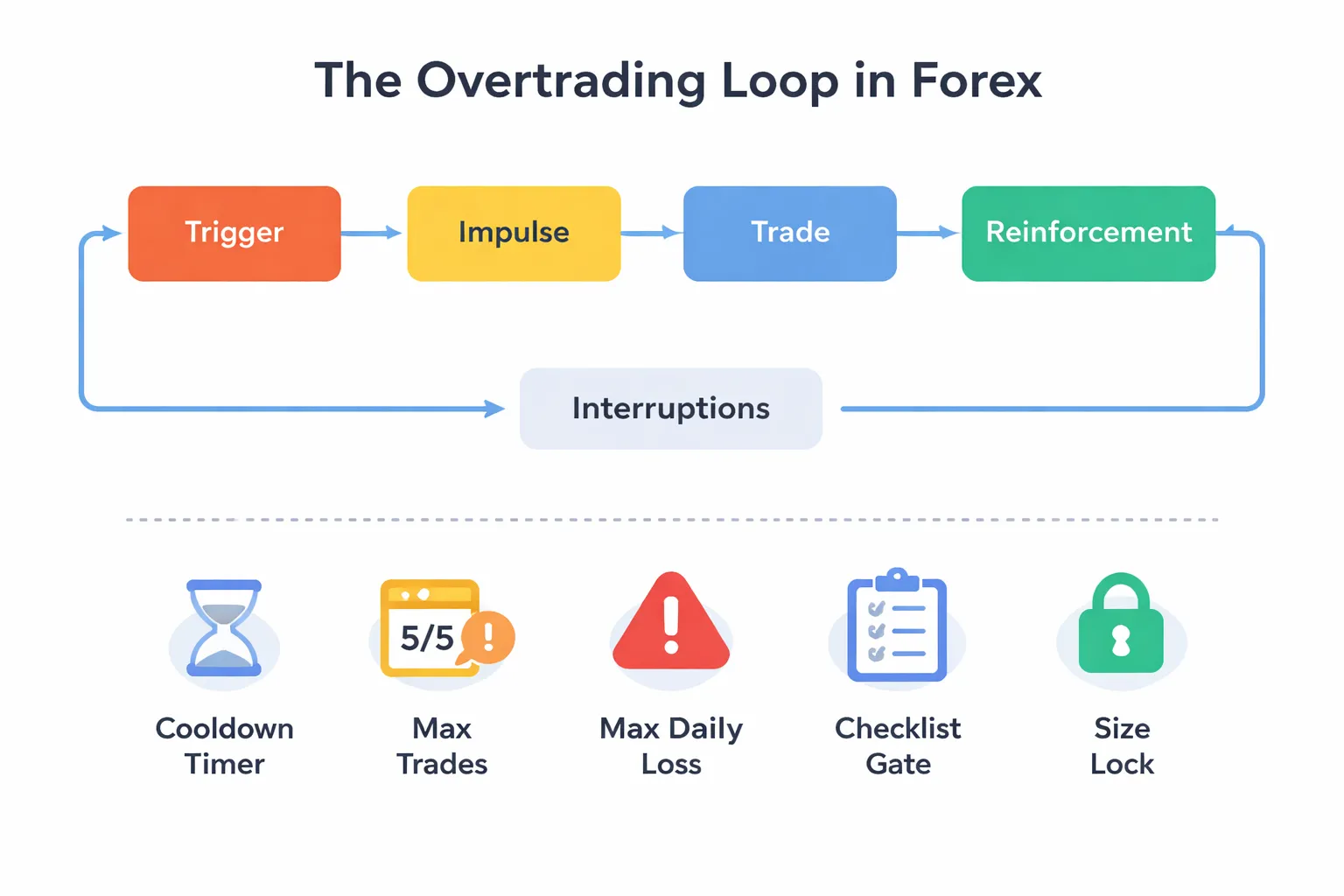
The Overtrading Loop, How It Starts and How It Escalates
Overtrading often runs on a simple loop. You repeat it because it feels like action, even when it hurts your results.
- Trigger: A loss, a win, boredom, news, a missed move, chop, or a drawdown.
- Impulse: You feel pressure to act. You want to get back to even, prove you are right, or use the “momentum.”
- Trade: You enter fast. You skip filters. You size up. You take a “maybe” setup.
- Outcome: You get a quick win or a quick loss. Both can push you into the next trade.
- Reinforcement: Your brain links trading with relief. Relief becomes the goal, not execution quality.
The loop escalates when your decisions shift from rule-based to emotion-based. Your trade count rises. Your average quality drops. Your costs rise with volume, spreads, and slippage.
Why Wins Can Be as Dangerous as Losses
A win after a bad trade teaches the wrong lesson. It tells you that breaking rules “works.”
- Confidence spike: You feel sharp. You assume you see the market better than you do.
- Risk creep: You increase lot size, widen stops, or add positions sooner.
- Shortened patience: You stop waiting for clean levels and clean conditions.
- More exposure time: You stay in the market longer, which increases the number of random outcomes.
Track it in your journal. If your biggest down days start after your biggest up days, you have a win-driven overtrading problem.
Tilt and Revenge Sequences, Identify Your Pattern
Tilt has a sequence. You need to name yours so you can stop it early.
- Loss cluster tilt: One loss becomes two. You reduce standards and speed up entries.
- Revenge tilt: You change size or frequency to “get it back” on the same pair or the same session.
- Over-management tilt: You move stops, cut winners early, then re-enter worse.
- Screen-chasing tilt: You bounce pairs and timeframes, hunting for a setup to erase the feeling.
Write your “tell.” Examples: you refresh charts every few seconds, you enter without levels marked, you ignore spread and liquidity, you stop using your checklist, you move your stop within the first few minutes. Your tell is your first intervention point.
Break the Loop with Interruptions and Rule-Based Constraints
You do not fix overtrading with motivation. You fix it with friction and limits.
- Hard daily limits: Max trades per day. Max losses per day. Max risk per day. When you hit one, you stop.
- Time blocks: Trade only your planned session. No trades outside the block.
- Checklist gate: No checklist, no trade. Keep it short. Five items is enough.
- Cooldown timer: After any loss, wait a set time before the next entry. Start with 15 to 30 minutes.
- One-pair rule: Limit pairs to reduce switching and chasing.
- Size lock: Fix position size for the day. No increases after a win or loss.
- Pre-set exits: Place stop and take profit at entry. Avoid “thinking” mid-trade. Use a clear stop method, see stop loss vs take profit.
Start with one constraint that attacks your trigger. If you revenge trade after losses, use the cooldown and max loss rules. If you overtrade after wins, use the size lock and max trades rules. You need a system that shuts you down before the next impulse turns into a trade.
How to Avoid Overtrading Forex: A Step-by-Step System
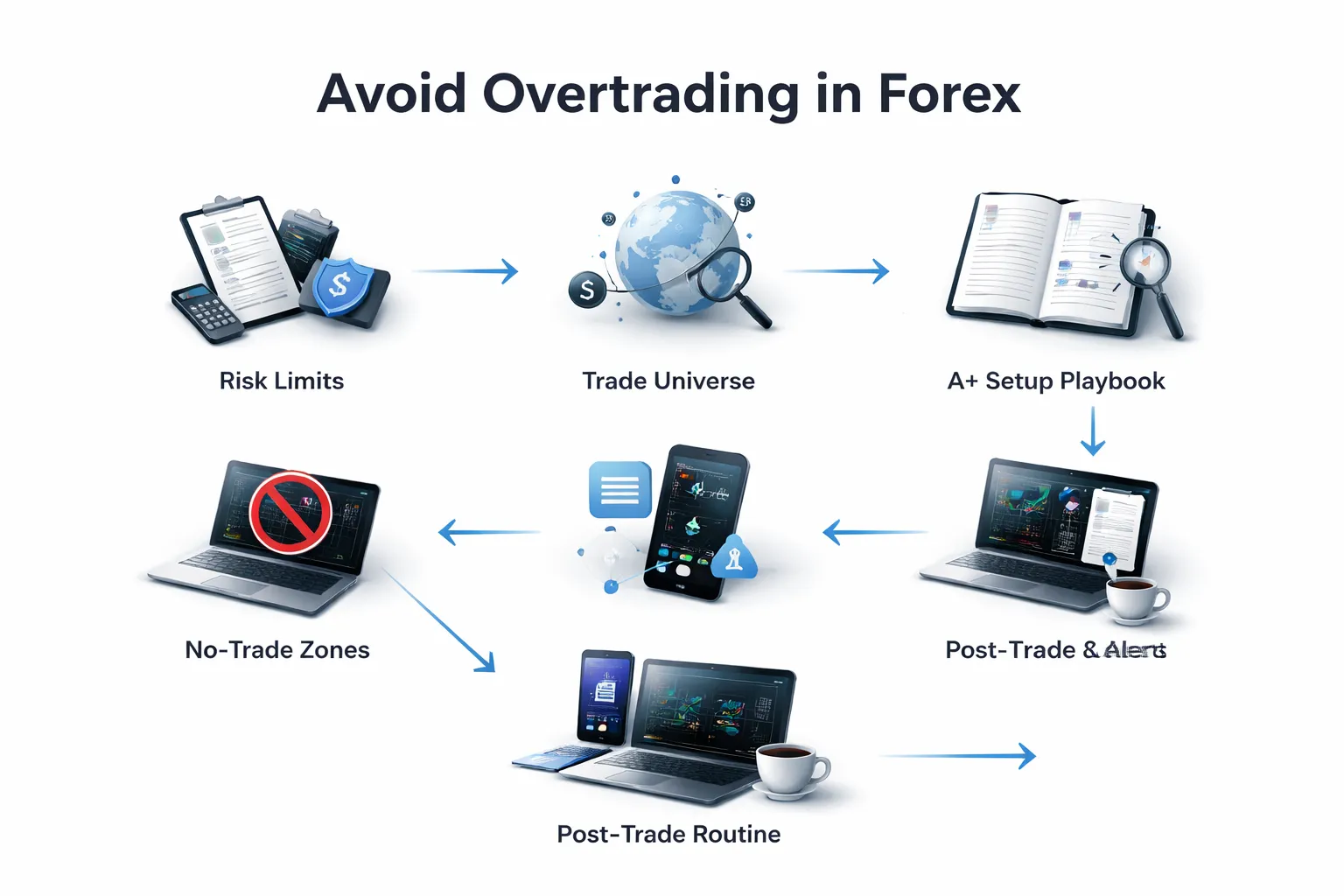
Set non-negotiable risk limits
Overtrading dies when your platform cannot hurt you past a set point. Your limits need numbers, not intentions.
- Daily loss limit: stop trading after -2R to -3R. If you risk 0.5R per trade, that is 4 to 6 losses. If you risk 1R, that is 2 to 3 losses.
- Weekly loss limit: stop for the week at -5R to -8R. Review first, then restart on a new week.
- Max trades per day: 2 to 4 trades. If you trade lower timeframes, cap it at 3. If you swing trade, cap it at 1.
- Max losing trades in a row: 2. After 2 losses, you stop. No exceptions.
- Size lock after a win streak: keep size fixed for the day. Do not increase risk because you feel “in sync”.
Write the limits into your trading plan. Then enforce them with a hard rule in your journal and a calendar block.
Define your trade universe
More charts create more signals. Your job is to reduce input.
- Pairs: pick 3 to 6 pairs. Keep them liquid. Drop exotic pairs.
- Sessions: trade one session, or one overlap. Example: London, or London to New York overlap. Avoid random hours.
- Timeframes: pick one execution timeframe and one higher timeframe. Example: entries on M15, bias on H1 or H4.
- Chart count: one watchlist, one layout. No scanning 20 charts to “find something”.
Build an A+ setup playbook
You overtrade when “maybe” becomes a trade. Fix it with a small set of setups you can define in one paragraph.
- Setup name: give it a label you can tag in your journal.
- Entry: exact trigger. Example: break and close above a defined level on M15, then retest hold.
- Stop: one method only. Example: beyond the swing low, or beyond the structure that proves you wrong.
- Target: planned exit. Example: next major level, or fixed R multiple like 2R.
- Invalidation: what cancels the setup before entry. Example: price closes back inside the range, or spread widens past X.
- Minimum quality filter: one to three checks. Example: higher timeframe alignment, clean level, no nearby news.
If you cannot describe the setup in 5 lines, it is not a setup. It is an excuse.
Use a pre-trade checklist
Impulse trades fail simple checks. Force every trade through the same gate.
- Risk: position size set, risk per trade fixed, stop and target placed at entry.
- Limits: you are not near daily loss, weekly loss, or max trades.
- Context: you are trading your session and your pairs only.
- Setup: it matches one playbook setup, no new “variation”.
- Space: target has room, stop is not inside noise.
- Costs: spread and commission acceptable for the stop size.
- State: you are calm. If you feel rushed or angry, you stop.
If any item fails, you do not trade. You set an alert and walk away.
Plan no-trade zones
Some conditions produce low-quality trades and high activity. Block them in advance.
- News windows: no new trades 10 to 15 minutes before high-impact releases and 10 to 30 minutes after. Spread and slippage spike.
- Low volatility ranges: skip tight consolidation when your setup needs expansion. Your stop sits too close, your fills get worse.
- After big wins or losses: enforce a cooldown. Use 30 to 60 minutes, or until the next session block.
- End-of-day fatigue: set a hard stop time. Example: stop trading after 2 hours, or after your main session ends.
Adopt pending orders and alerts
Screen time increases trade count. Pending orders cut impulse entries.
- Alerts first: set price alerts at your levels. Do not watch every tick.
- Limit and stop orders: place entries only at your planned price. Avoid market orders unless your playbook requires them.
- Bracket orders: attach stop loss and take profit at entry. No manual “management” unless your plan says so.
- One modification rule: allow one change only, based on a defined event. Example: move stop to break-even at 1R, then no more edits.
Create a post-trade routine
You stop overtrading by learning faster than your impulses. Your routine needs to take under 3 minutes.
- Screenshot: entry chart and exit chart.
- Tag: setup name, session, pair, timeframe, result in R.
- Notes: one line on execution. Example: “followed plan”, or “entered early”.
- Next action: one of three options, done. “Set alert”, “walk away 30 minutes”, or “stop for the day”.
This loop turns trading into a controlled process. Your goal is fewer trades, higher quality, and strict shutdown rules.
Risk Management Rules That Prevent Overtrading Automatically
Position sizing by risk percentage
Risk a fixed percentage per trade, not a fixed lot size. This keeps losses proportional and makes your next decision easier.
- Standard rule: risk 0.25% to 1.00% per trade.
- Hard cap: never exceed 1.00% on a single idea.
- Formula: position size = (account equity x risk %) / (stop distance in pips x pip value).
Fixed lots create spirals. When volatility expands, your stop gets wider but your lot stays the same, so your $ risk jumps. When you lose, you often try to win it back with the same lot or a bigger one. That is how overtrading starts.
Risk % sizing blocks this. Your lot size drops when the stop needs to be wider. You trade less because each trade has a defined cost.
Daily stop-out and lockout rules
You need a daily limit that forces a shutdown. Your judgment degrades after a string of losses. Your platform should stop you, not your willpower.
- Daily loss limit: stop trading at -2R or -3R for the day.
- Max losing trades: stop after 2 consecutive losses.
- Weekly guardrail: pause new trades at -6R to -10R for the week.
Enforce it. Use broker risk tools if available. If not, use an account-level rule, remove one-click trading, and set a calendar block that ends your session. Close the platform when you hit the limit.
Trade frequency caps and cooldown periods
Cap your number of attempts. Overtrading often looks like endless “one more setup” scanning.
- Trade cap: 1 to 3 trades per session, 3 to 5 per day maximum.
- Loss cooldown: after any loss, wait 20 to 30 minutes before the next entry.
- Win cooldown: after 2 wins in a row, stop for 30 minutes or end the session.
- Re-entry rule: one re-entry max on the same pair and setup.
Cooldowns cut impulse trades. They also reduce revenge trading after a stop-out and overconfidence after a win streak.
Correlation limits
Many “different” forex trades are the same bet. If you stack exposure, you multiply risk and trade count at the same time.
- USD stack rule: do not hold more than one USD-heavy position in the same direction.
- Pair cluster rule: treat EURUSD, GBPUSD, AUDUSD as one risk group when USD drives the move.
- Max open risk: cap total open risk at 2R across all positions, lower if pairs correlate.
If you want a second trade, demand diversification. Different currency driver, different session catalyst, or no trade.
Stop placement discipline
Place stops at a technical level. Size the position to the stop. Do not move the stop because you feel pressure.
- Technical stop: beyond a swing high or low, beyond structure, or beyond the invalidation level of your setup.
- Emotional stop: a stop placed to reduce pain, usually too tight and random.
- No-widen rule: never widen a stop after entry.
- One adjustment: you can tighten to reduce risk only if structure confirms it.
If your stop must be huge to make the trade work, the trade fails your filter. If your stop must be tiny to feel safe, you will get chopped and overtrade to “fix” it. Use clear structure on the chart, then commit. If you need a refresher on reading candles and structure, use this candlestick chart guide.
Trade Selection Frameworks to Improve Quality (Not Quantity)
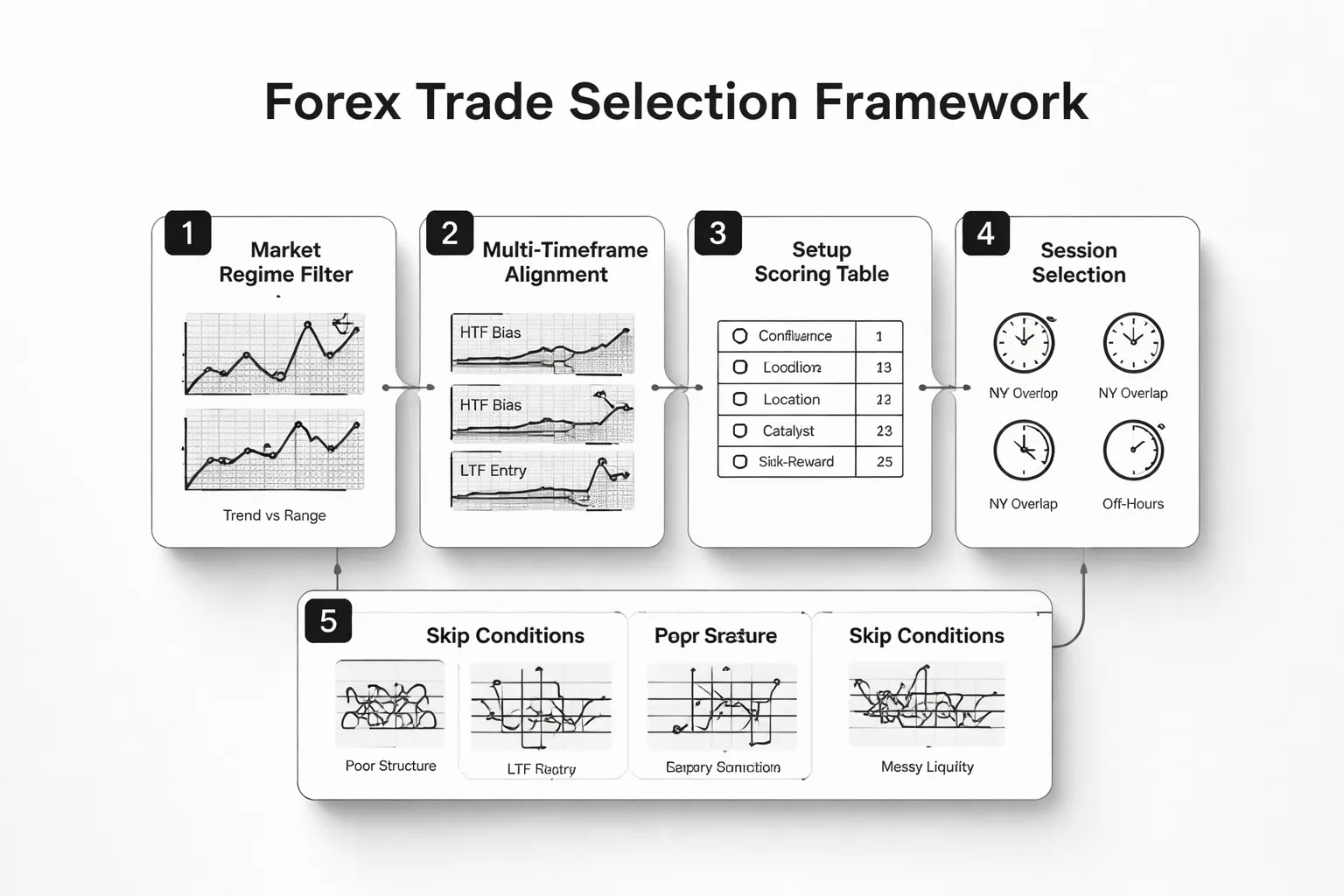
Market Regime Filter: Trend vs Range
Start with a regime call. Trend or range. Do not trade both styles in the same week.
- Trend conditions: price makes higher highs and higher lows, or lower highs and lower lows. Trade pullbacks and breakouts in the trend direction. Avoid mean reversion.
- Range conditions: price rejects the same top and bottom, with frequent wicks through levels. Trade fades from range edges to the middle. Avoid breakout chasing unless the range breaks and holds.
- Mixed conditions: compressed swings, overlapping candles, no clean highs and lows. Reduce size or skip. Mixed regimes create low quality signals and more trades.
Write one line in your plan. “This week I trade trend pullbacks only.” This removes impulse entries.
Multi-Timeframe Alignment Without Analysis Paralysis
Use three timeframes. Higher for bias, mid for structure, lower for entry.
- Higher timeframe: mark direction and key zones. One bias only, bullish, bearish, or neutral.
- Mid timeframe: find the setup. Identify the swing, the level, and the invalidation point.
- Lower timeframe: time the entry. Use one trigger only, breakout and retest, or rejection candle at level.
Set a time limit. If you cannot define bias, level, and stop in 5 minutes, you skip. Extra timeframes do not add edge. They add reasons to click.
A Simple Scoring Model for Setups
Score every trade. Trade only when the score meets your minimum. This shifts you from frequency to selectivity.
| Factor | 0 points | 1 point | 2 points |
|---|---|---|---|
| Confluence | Single signal | Two signals agree | Three signals agree |
| Location | Middle of structure | Near a level | At a clear HTF level |
| Catalyst | No reason for movement | Session volatility | Scheduled event you planned for |
| R:R | Below 1.5R | 1.5R to 2R | 2R or more |
Set your rule. Example: minimum 6 out of 8. If it scores 5, you do nothing. Log the score either way. If you want a repeatable practice routine, use this guide on practicing forex trading effectively.
Session Selection: London and NY Overlap vs Off-Hours
Trade when your setup has room to move. Liquidity and participation drive that.
- London open and London-NY overlap: best for breakouts, trend continuation, and clean runs. Spreads tend to behave. Follow-through improves.
- NY mid-session: can work for continuation, but reversals increase after major releases. Tighten your filters.
- Off-hours and late NY: more chop, wider relative spreads, fewer clean moves. If you trade then, use range rules only and lower expectations.
Pick one or two trading windows. Outside that window, you do not “check charts.” This stops boredom entries.
When to Skip: Poor Structure, Nearby Levels, Messy Liquidity
Skipping is a skill. Add hard no rules.
- Poor structure: overlapping swings, random spikes, no clear swing point for a stop. If you cannot place a stop behind structure, you skip.
- Nearby support or resistance: target sits inside the next wall. If the next level is closer than 1R, you skip or reduce targets and size before entry.
- Messy liquidity: equal highs and lows everywhere, multiple wicks through levels, frequent stop runs. You will get triggered in and out. You will revenge trade.
- Event risk you did not plan: high impact news within your trade horizon. If you did not map the scenario, you skip.
Put these skips into a checklist. If one no rule triggers, the trade ends before it starts.
Practical Tools and Habits That Make Overtrading Harder
Journaling With Tags That Expose Your Patterns
Write a short log for every trade and every near trade.
Use tags. Tags turn feelings into data.
- Setup tag, breakout, pullback, range fade, news.
- Trigger tag, A+ or B, late entry, early entry, no signal.
- Emotion tag, FOMO, revenge, boredom, anxiety, euphoria.
- Process tag, followed plan, broke plan, moved stop, added risk, closed early.
- Context tag, session, pair, time of day, day of week, news window.
Track a few numbers. Keep it consistent.
- Planned risk in R, actual risk in R.
- Time from signal to entry in minutes.
- Number of stop edits.
- Number of chart checks while in the trade.
After 50 trades, your overtrading will show up as clusters. Same tags. Same times. Same mistakes.
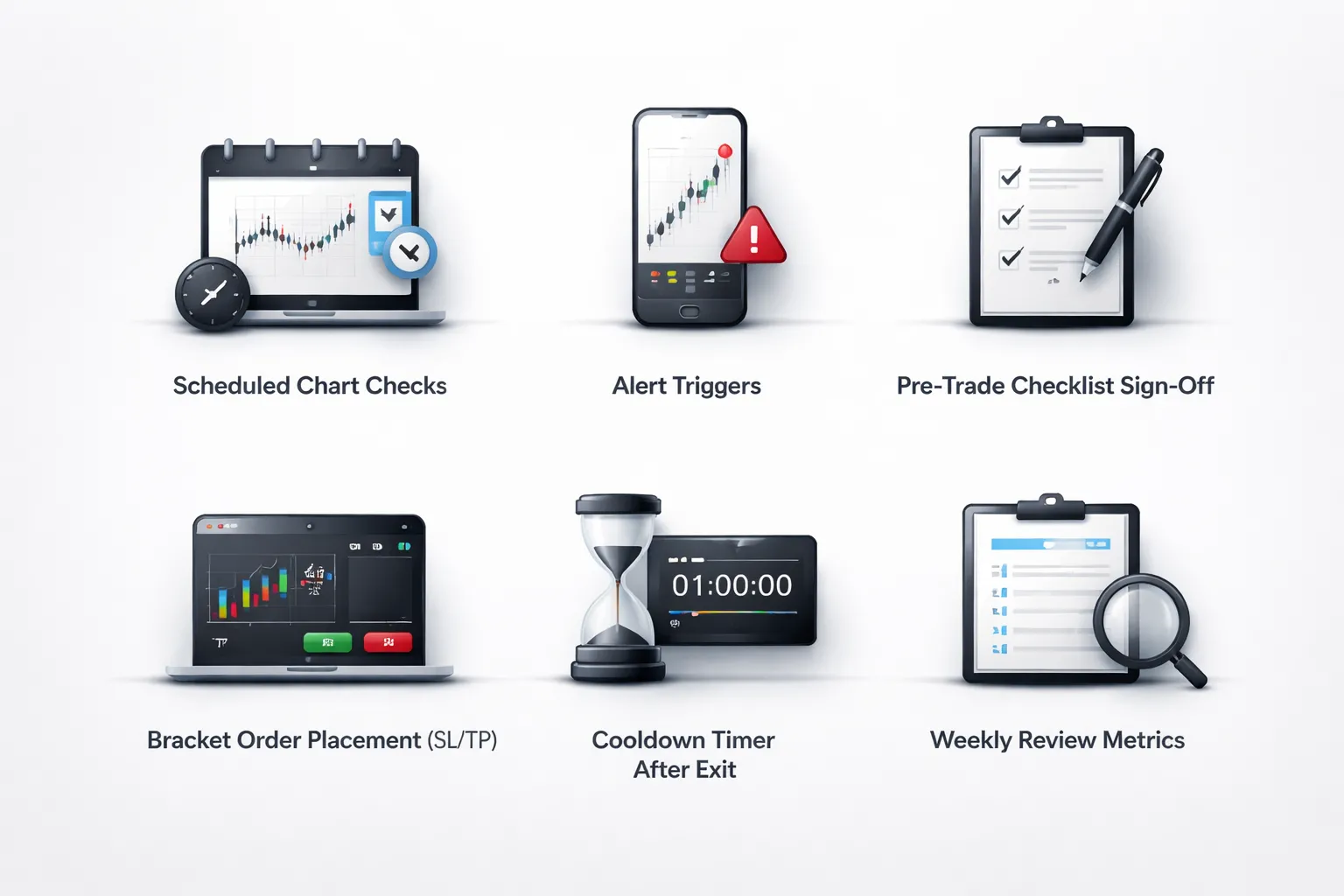
Trading Timer and Scheduled Chart Checks
Unstructured screen time creates impulsive trades.
Use fixed check windows and a timer between decisions.
- Choose your trading timeframe first. Then set check times that match it.
- Use a cooldown timer after any exit, win or loss.
- Stop scanning during the cooldown. No “quick look”.
| Trading style | Chart check schedule | Cooldown after exit |
|---|---|---|
| M15 to M30 intraday | Every 15 to 30 minutes | 20 to 30 minutes |
| H1 to H4 swing | On candle close only | 2 to 4 hours |
| Daily swing | Once per day, fixed time | 24 hours |
If you “need” to check more, treat that as a signal. Your risk is too high or your plan is unclear.
Automations That Block Tinkering
Make your platform enforce your plan.
- Price alerts. Let alerts pull you to the chart. Stop hunting trades.
- Bracket orders. Enter with stop loss and take profit attached. No manual exits.
- OCO orders. Use one-cancels-the-other to avoid double entries and hedged mistakes.
- Pre-set position size. Use a calculator or fixed lots per R. Remove on-the-fly sizing.
Set rules for edits.
- One stop move max, only to reduce risk or lock a rule-based trail.
- No take profit changes unless your plan defines the condition in advance.
If you keep breaking these, reduce leverage and simplify your setup. More tools will not fix a loose system.
Account Separation That Lowers Emotional Pressure
Use separate accounts for practice and live.
- Practice account, testing, reps, new pairs, new execution rules.
- Live account, only the proven setup, only the proven hours, only the proven risk.
Add a transfer rule.
- You only “promote” a setup from practice to live after a defined sample size, like 30 to 50 trades.
- You demote it back to practice after repeated rule breaks, not after a losing streak.
This keeps experimentation from leaking into real risk.
If you want a clean structure for planning and execution, use a simple system like this day trading forex strategy for beginners and run it unchanged for a fixed test window.
Accountability Systems That Make Rules Real
You need friction between impulse and order placement.
Use a sign-off process.
- Before you place an order, tick your checklist and write one sentence, “I am taking this because X.”
- If you cannot write X in 10 seconds, you skip.
Run a weekly review. Track behavior, not stories.
| Metric | How to measure | What it flags |
|---|---|---|
| Trades per week | Count | Boredom trading, FOMO scanning |
| Rule breaks | Count and tag | Impulse, revenge, weak plan |
| Average R risked | Planned vs actual | Escalation after losses |
| Stop edits per trade | Count | Tinkering, fear management |
| Time of worst trades | Session, hour | Fatigue windows, low liquidity |
Share the metrics with a partner or a private log you cannot rewrite later.
- Send a weekly screenshot of your stats and rule-break list.
- Set one process goal for next week, like “zero trades outside my two sessions.”
Accountability works because it forces you to face patterns fast.
Fixing Overtrading When It’s Already Happening
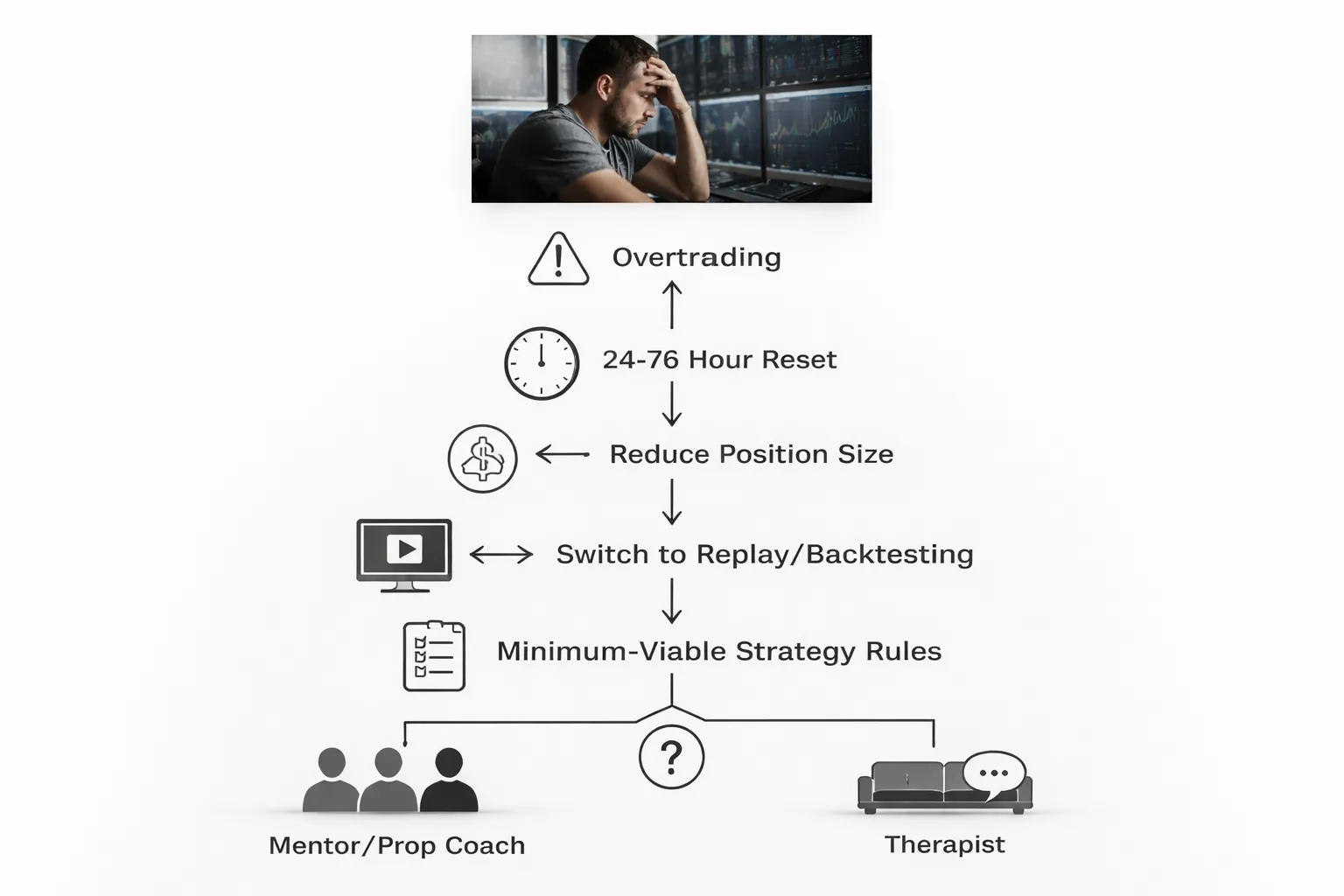
The 24 to 72 hour reset, stepping away without losing momentum
If you are already overtrading, stop trading first. Do it for 24 to 72 hours. Your goal is to break the loop, not to find a better setup.
- Cancel access friction. Remove one-tap trading. Log out of your broker. Delete the app from your phone.
- Freeze your plan. Do not edit rules during the reset. You will justify bad changes.
- Do a fast audit. Export the last 30 trades. Mark each as “followed rules” or “broke rules.” Count the breaks.
- Pick one trigger to control. Time of day, boredom, revenge, news spikes. Write it in your log.
- Set a restart condition. You only return when you complete the audit and write next week’s one process goal.
You keep momentum by working on process, not by placing trades.
Reduce size first, before changing strategies
Do this before you change indicators, timeframes, or setups. Overtrading often comes from risk pressure, not strategy flaws.
- Cut risk per trade. Drop to 0.25R to 0.50R of your normal size for at least 20 trades.
- Cap daily loss. Set a hard stop at 1R to 2R per day. When hit, you stop.
- Cap trades per day. Set 1 to 3 trades max. Any extra trade counts as a rule break.
- Remove scaling and hedging. No add-ons, no revenge hedges, no “one more entry.” One position per idea.
Smaller size slows the damage. It also lowers the urge to “make it back” fast.
Switch to replay and backtesting during high-impulse periods
When your impulse window hits, replace live trading with replay or backtesting. Keep the routine. Remove the money.
- Define your impulse window. Example, after a loss, late night, lunch hours, high spread times.
- Set a rule. During that window you can only do replay, journaling, or chart review.
- Track stats the same way. Log setup, entry, stop, take profit, outcome, and rule adherence.
- Measure one edge metric. Win rate by setup, average R, and max drawdown. Do not track feelings as your main data.
This keeps you engaged while you rebuild control. It also gives you clean sample size without new damage.
Rebuild confidence with a minimum-viable strategy and strict rules
Overtrading kills trust in your process. You fix that with a small ruleset you can follow every day.
- Trade one market. One pair or one index. No scanning.
- Trade one setup. One entry model, one stop model, one exit model. Keep it boring.
- Trade two sessions. Define exact hours. No trades outside those hours.
- Predefine take profit. Set targets before entry, then leave them. Use a simple target plan you can repeat, see take profit rules and examples.
- Use a checklist. If one item fails, you do not trade. Record it as “no trade.”
Confidence comes from rule compliance. Profit comes later.
When to seek outside help, mentor, prop coach, therapist
Some overtrading is a skill problem. Some is a control problem. Treat them differently.
- Get a mentor or coach if you cannot define a clear setup, you cannot keep a journal, or you keep changing systems after small losses.
- Use a prop firm coach if you need structure, rule enforcement, and hard risk limits you cannot enforce alone.
- Talk to a therapist if you feel compelled to trade, you hide trading, you lie about losses, you trade to change mood, or you cannot stop after repeated harm.
Outside help works when it adds constraint and honest feedback. If you keep breaking rules, add more constraint.
Pros and Cons of Trading Less (and What to Expect)
Benefits of Trading Less
- Clearer decision-making. You stop forcing setups. You spend more time on pre-trade checks. You skip trades that do not meet your rules.
- Lower costs. You cut spreads and commissions by reducing trade count. You also cut slippage and error trades that come from rushing.
- More consistent execution. Fewer trades means fewer chances to break process. You can execute the same entries, sizing, and exits with less noise.
Trade-offs You Will Feel
- Fewer opportunities. Your P and L will move slower. Some days will have zero trades. This is normal if your rules filter well.
- Patience required. You will feel the urge to manufacture signals. You must accept waiting as part of the system.
- Slower feedback loop. You get fewer data points per week. That slows learning unless you log well and review hard.
How to Measure Improvement
Do not judge progress by one week of profit. Track process metrics and risk metrics.
- Expectancy. Track average R per trade. Use: Expectancy = (Win rate x Avg win in R) minus (Loss rate x Avg loss in R). Your goal is positive expectancy after costs.
- Max drawdown. Track peak-to-trough equity drawdown. If you trade less with tighter rules, drawdown should compress. If it does not, your risk per trade may be too high.
- Rule adherence rate. Count trades that followed your plan. Use: Adherence = (Rule-followed trades divided by total trades) x 100. Aim for 90 percent or higher before you scale size.
Timeline Expectations
If you want faster learning with fewer live trades, add structured practice in a demo and review routine. Use risk management rules to keep trade count and drawdown under control.
Examples: Overtrading Scenarios and Better Alternatives
Scenario 1: Revenge trading after a stop-out (replacement routine)
What it looks like
- You take a full stop on a valid setup.
- You enter again within minutes, often in the same direction, with a worse price.
- You increase size to “get it back”.
- You ignore your next signal rules and trade on feeling.
Why it destroys your edge
- You trade during peak emotion, so you break your system filters.
- You cluster losses. Your daily drawdown spikes fast.
- You shift from planned risk per trade to uncontrolled risk per session.
Better alternative: a fixed post-loss routine
- After any stop-out, take a 15 minute cooldown. No charts. No phone.
- Log the trade in 60 seconds. Setup type, timeframe, entry reason, stop size, mistake yes or no.
- Run a quick checklist before the next trade. Trend, level, trigger, stop location, target, news, session.
- Set a hard cap. Max 2 losing trades per pair per day, max 3 total losses per day.
- If you hit the cap, stop trading. Review only.
| Rule | Number | Reason |
|---|---|---|
| Cooldown after a loss | 15 minutes | Breaks impulse loops |
| Max losses per day | 3 | Stops drawdown acceleration |
| Max losses per pair | 2 | Prevents “same chart” revenge trades |
Scenario 2: Chasing breakouts during news spikes (safer rules)
What it looks like
- You see a fast candle on CPI, NFP, rate decisions, or FOMC.
- You market buy or sell late.
- You place a tight stop to “reduce risk”. You get tagged in the spread swing.
- You re-enter on the next spike. Trade count explodes in 10 minutes.
Why it overtrades you
- Spread and slippage rise. Your real entry price gets worse.
- Stops that work in normal flow fail in news flow.
- You confuse volatility with opportunity, so you take low quality entries.
Better alternative: news rules you can execute
- Block trading 10 minutes before and 15 minutes after high impact releases.
- If you trade news, use one attempt only. One order, one stop, one target.
- Require a post-news structure. Wait for the first 5 minute candle close, then trade a pullback to a level, not the initial spike.
- Set targets before entry. If you need a simple framework, use your normal approach to take profit placement and skip trades with unclear R.
| News filter | Rule |
|---|---|
| High impact events | No trades from T-10 to T+15 minutes |
| If you trade it anyway | One trade max per event |
| Entry type | Pullback after close, not spike chase |
Scenario 3: Overtrading a range with tight stops (range plan alternative)
What it looks like
- Price sits in a box for hours.
- You fade every small move because “it always comes back”.
- You use a tight stop near the edge. Noise hits it often.
- You re-enter five to ten times inside the same range.
What drives the losses
- Range edges are zones, not single prices. Tight stops sit inside the chop.
- Mean reversion works only when you control frequency and location.
- Small stops plus frequent entries equals death by a thousand cuts.
Better alternative: a simple range plan
- Define the range with two touches on each side. Mark the high zone and low zone.
- Trade only at the extremes. No entries in the middle 50 percent.
- Limit attempts. Max 2 trades per side per session.
- Place stops outside the range zone, not inside it. If that makes size too small, skip the trade.
- Require a trigger candle at the zone. No trigger, no trade.
| Range rule | Standard |
|---|---|
| Where you can trade | Top zone or bottom zone only |
| Where you cannot trade | Middle 50 percent of the range |
| Attempts | Max 2 per side per session |
| Stop placement | Outside the zone, not inside |
Scenario 4: Strategy-hopping after a losing week (validation framework)
What it looks like
- You lose for a few days.
- You swap indicators, timeframes, and pairs.
- You take more trades to “test faster”.
- You never collect enough data to know what works.
Why it creates overtrading
- You reset your rules each day, so every trade becomes a guess.
- You chase certainty with activity. Trade count rises, quality drops.
- You cannot separate normal variance from a broken system.
Better alternative: a small validation framework
- Freeze one setup for 20 trades. Same timeframe, same pair list, same entry and exit rules.
- Track only five fields. Setup type, time, R multiple, screenshot, rule break yes or no.
- Grade execution first. If more than 10 percent are rule breaks, fix process before changing strategy.
- Review every 10 trades. Keep, modify, or pause. No mid-batch changes.
- Only change one variable at a time. Example, filter hours or filter pairs, not both.
| Validation step | Minimum standard |
|---|---|
| Sample size | 20 trades on one setup |
| Review cadence | Every 10 trades |
| Rule break limit | Less than 10 percent |
| Change policy | One variable per batch |
FAQ
What is overtrading in forex?
Overtrading means you take more trades than your plan allows. You trade too often, too big, or outside your setup rules. It usually shows up as rising fees, lower average trade quality, and worse results even when market conditions stay similar.
What are the clearest signs you are overtrading?
- More trades: higher frequency with no rule-based reason.
- More rule breaks: over 10 percent in your last 20 trades.
- Lower R multiple: average R drops while trade count rises.
- Bigger size: you increase risk after losses.
What causes overtrading?
Common drivers are boredom, fear of missing moves, revenge after a loss, and unclear entry rules. Tight timeframes also push impulse trades. Another cause is changing rules mid-sample, so you never validate one setup over at least 20 trades.
How many trades per day is too many?
Too many means you exceed your plan’s cap or you cannot log and review trades. Use a hard limit per session. If your rule-break rate rises or your average R falls, your trade count is too high for your process.
How do you stop overtrading fast?
- Set a daily max trades limit.
- Trade only one setup.
- Use a checklist, no checklist, no trade.
- Pause after two consecutive rule breaks.
- Review every 10 trades, change one variable per batch.
How do you measure if overtrading is hurting you?
Track these metrics per 20-trade sample, rule-break rate, average R, expectancy, and max drawdown. If trade frequency increases while average R and expectancy drop, you are likely forcing trades instead of executing an edge.
Is scalping the same as overtrading?
No. Scalping can be systematic with strict rules and stable metrics. Overtrading means you exceed your rules or take low-quality setups. A scalper who keeps rule breaks under 10 percent and maintains average R is not overtrading.
Should you reduce risk size to fix overtrading?
Yes, in many cases. Lower risk per trade reduces emotional load and stops revenge sizing. Keep risk fixed for the full batch. If you change size, change only that variable and validate it over at least 20 trades.
Can better risk reward ratio help reduce overtrading?
Yes. Clear exits reduce random closes and re-entries. Use a defined stop, target, and invalidation point before entry. If you need a refresher, see risk reward ratio in forex.
How long should you stop trading after overtrading?
Stop until you can follow rules again. Use a time stop or a process stop. Example, pause for 24 hours, then return with a reduced trade limit. Do not resume until your checklist and logging are ready.
Do trading bots solve overtrading?
They can, if the bot enforces your rules and position sizing. They can also increase overtrading if you run untested logic across many pairs or timeframes. You still need a sample size, review cadence, and change policy.
Conclusion
Conclusion
Overtrading is a process problem. You trade too often, too large, or outside your plan. The result is higher costs, lower quality entries, and weaker execution.
Fix it with hard limits. Cap trades per day and per week. Cap risk per trade and total daily loss. Trade only from a written checklist. Log every trade and review it on schedule.
Your final step is simple. Add a forced stop rule. When you hit your trade limit, loss limit, or break one checklist item, you stop for 24 hours. No exceptions. Then you return with the same rules and a smaller trade limit until your log proves control.
If you need help building that control loop, read our forex trading psychology tips.
- One setup list. Trade only those conditions.
- One risk model. Fixed percent risk and fixed max drawdown per day.
- One review cadence. Weekly metrics, monthly changes only.
- One stop trigger. Limits hit equals trading stops.
-
Forex Order Types Explained: Market vs Limit vs Stop Orders
1 month ago -
How to Start Forex Trading Step by Step (Beginner Roadmap)
1 month ago -
Stop Loss vs Take Profit: Differences, Examples & Best Practices
1 month ago -
How to Set Stop Loss and Take Profit (Step-by-Step)
1 month ago -
How to Place a Stop Loss in Forex (Beginner-Friendly Guide)
1 month ago
-
- What is overtrading in forex?
- What are the clearest signs you are overtrading?
- What causes overtrading?
- How many trades per day is too many?
- How do you stop overtrading fast?
- How do you measure if overtrading is hurting you?
- Is scalping the same as overtrading?
- Should you reduce risk size to fix overtrading?
- Can better risk reward ratio help reduce overtrading?
- How long should you stop trading after overtrading?
- Do trading bots solve overtrading?
-
- What is overtrading in forex?
- What are the clearest signs you are overtrading?
- What causes overtrading?
- How many trades per day is too many?
- How do you stop overtrading fast?
- How do you measure if overtrading is hurting you?
- Is scalping the same as overtrading?
- Should you reduce risk size to fix overtrading?
- Can better risk reward ratio help reduce overtrading?
- How long should you stop trading after overtrading?
- Do trading bots solve overtrading?
-
Forex Lot Size Calculator: How to Use It to Size Trades Correctly
1 month ago -
How to Calculate Position Size in Forex (Position Sizing Formula + Examples)
1 month ago -
Forex Leverage Explained: How It Works, Pros, Cons & Examples
1 month ago -
Margin vs Leverage in Forex: What’s the Difference?
1 month ago -
What Is Forex Trading? A Beginner’s Guide to How It Works
1 month ago
-
Forex Trading Platforms Comparison: MetaTrader vs cTrader vs TradingView
1 month ago -
Forex Leverage Explained: How It Works, Pros, Cons & Examples
1 month ago -
Forex Market Hours & Trading Sessions Explained (Best Times to Trade)
1 month ago -
Is Forex Trading Legal in the United States? Rules, Regulators & What to Know
1 month ago -
What Is a Lot Size in Forex? Lot Types + Quick Examples
1 month ago