Forex Carry Trade Strategy Explained (How It Works + Risks)

You can earn or lose money in forex without price moving much. The carry trade is one way. You borrow a low interest currency, buy a higher interest currency, and collect the daily rollover. Your profit comes from the rate gap, plus or minus the exchange rate move.
This guide explains how a forex carry trade works, how rollover gets paid, and what conditions support the trade. You will also learn the main risks, rate changes, sharp reversals, and liquidity shocks. You will see how to plan entries and exits, and what order types traders use to control damage when a carry unwind hits. For execution basics, see common forex order types.
Key Takeaways
Key Takeaways
- In het kort: A carry trade aims to earn the interest rate spread while you hold a currency pair.
- You go long the higher yield currency and short the lower yield currency, the broker books the difference through rollover.
- Your edge depends on stable or falling volatility, steady funding markets, and no surprise rate changes.
- Most carry profits can vanish fast during a risk-off move, when high yield currencies sell off and spreads widen.
- Rate cuts in the high yield currency, hikes in the funding currency, or shifting expectations can flip the carry from income to cost.
- Keep leverage low. Size for worst-case gaps, not for average daily ranges.
- Plan exits before you enter. Use stops and limits, and know how each behaves in fast markets, see common forex order types.
- Track the daily swap, the central bank calendar, and risk sentiment. Do not hold blind through major events.
Forex Carry Trade Strategy Explained: Definition and Core Idea
What a carry trade is in plain English
A forex carry trade means you borrow a low interest rate currency and buy a higher interest rate currency.
You aim to earn the daily interest rate gap, called swap or rollover. Your broker credits or debits it each day you hold the position.
Your total result comes from two parts. The swap you collect, and the exchange rate move. A small adverse move can wipe out months of swap.
Why interest rate differentials exist
Interest rate gaps exist because economies do not run at the same speed, and central banks do not target the same problems.
- Inflation. Higher inflation pressure usually leads to higher policy rates to cool demand and protect the currency.
- Growth. Weak growth or recession risk often leads to lower rates to support borrowing and spending.
- Risk premia. Some countries need higher rates to attract capital because investors demand compensation for political risk, fiscal stress, external deficits, or unstable inflation.
- Market structure. Funding conditions in money markets and cross currency basis can change effective funding costs, even when policy rates look stable.
Do not treat the headline policy rate as your swap rate. Brokers price swap from short term funding rates, plus their markup, plus the pair specific financing spread.
How carry differs from simple buy and hold FX positions
A normal spot FX trade depends mainly on price direction.
A carry trade depends on financing. You can make money with flat price if the swap is positive and stable.
You can also lose money while price rises if you pay negative swap, or if swap turns against you after a rate cut.
Carry trading forces you to care about holding time. One day versus one month can change your edge because swap accrues daily and can triple on the broker rollover day.
When carry trade returns historically show up
Carry tends to work best in risk-on regimes. Volatility stays low, credit spreads tighten, and investors chase yield. High yield currencies hold up, and swap becomes a meaningful share of returns.
Carry tends to break in risk-off regimes. Volatility spikes, liquidity thins, and investors cut leverage. Funding currencies often strengthen fast, and high yield currencies can gap down. The price move often dominates the swap.
Track the regime with a short checklist. Volatility index direction, equity trend, credit spread direction, and central bank surprise risk. Use technical context to time entries, see technical analysis in forex.
How the Carry Trade Works Step by Step
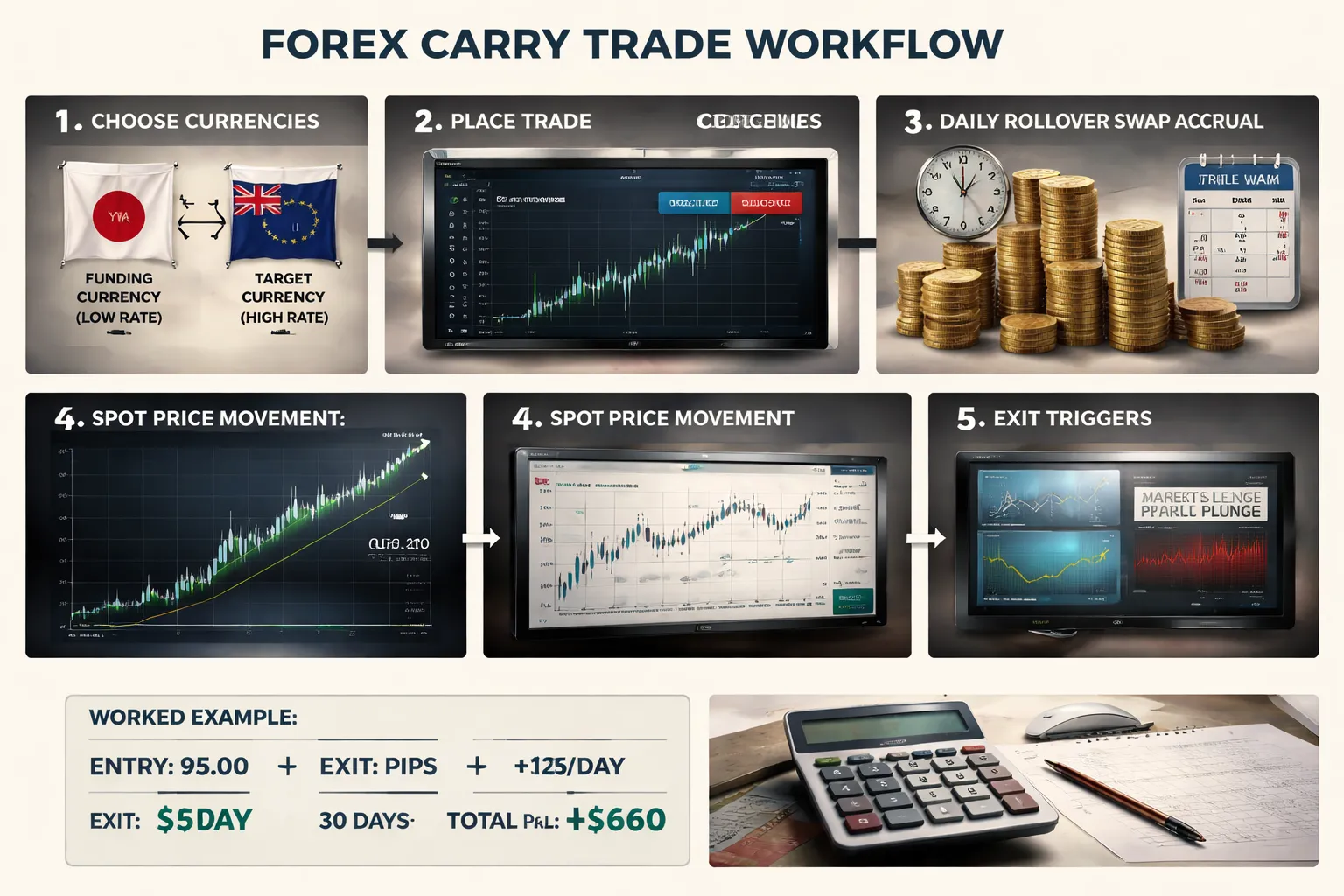
1) Choose the funding currency and the high yield currency
Your goal is simple. Pay a low rate. Earn a higher rate.
- Funding currency: A currency with low short-term rates. You expect it to stay low or fall.
- Target currency: A currency with higher short-term rates. You expect it to stay high or rise.
- Filter: Look at the current policy rate, the 1 to 3 month money market rate, and the forward curve. Spot headlines matter less than the path.
- Reality check: Brokers price swap off interbank funding plus a markup. Your realized carry can differ from the central bank spread.
2) Understand the long and short mechanics in FX pairs
Every FX trade borrows one currency and lends the other. The pair quote tells you which is which.
- If you buy a pair like AUD/JPY, you go long AUD and short JPY. You effectively borrow JPY and hold AUD.
- If you sell a pair like AUD/JPY, you go short AUD and long JPY. You effectively borrow AUD and hold JPY.
- You collect positive carry when the currency you hold has a higher overnight rate than the one you borrow, after broker costs.
3) Know where profit comes from, swap vs spot
You have two P&L engines. They do not move together.
- Rollover (swap): The daily interest credit or debit for holding past the broker cut-off time.
- Spot move: The price change in the FX rate. This can dominate fast during risk-off moves.
- Total return: Swap accrual plus spot P&L minus spread, commissions, and financing markups.
| Source | What drives it | What can break it |
|---|---|---|
| Swap | Rate differential, forward points, broker markup | Central bank shifts, widened funding spreads, broker changes |
| Spot | Risk sentiment, growth surprises, positioning, flow | Volatility spikes, deleveraging, gaps, intervention |
4) Follow the trade timeline, entry to exit
- Entry: Pick the pair where the forward curve supports carry and the market regime supports risk-taking. Use price structure to avoid buying into a sharp reversal. A simple trend filter like moving averages helps you stay aligned.
- Holding period: Carry trades work over weeks to months. Your edge comes from time held, not fast flips. Keep leverage modest. Carry cannot offset a large adverse move.
- Rollover timing: Swap applies when you hold past your broker’s daily rollover cut-off, often around 5pm New York time. One weekday usually posts a triple swap to account for weekend settlement. Broker rules differ.
- Exit: Exit on regime change. Examples include a hawkish surprise in the funding currency, a dovish pivot in the target currency, or a risk-off break where spot losses accelerate. Exit if spot breaks your risk limit, even if swap remains positive.
5) Worked example with numbers
Assume you buy AUD/JPY because AUD rates exceed JPY rates.
| Input | Value |
|---|---|
| Position | Long 100,000 AUD/JPY |
| Entry | 95.00 |
| Exit | 96.20 |
| Spot move | +120 pips |
| Holding time | 30 days |
| Assumed positive swap | +5.00 USD per day (after broker costs) |
| Spread and commissions | 10 USD total |
- Spot P&L: For JPY pairs, 1 pip for 100,000 units is about 1,000 JPY. 120 pips equals about 120,000 JPY. At 96 JPY per USD, that is about 1,250 USD.
- Swap P&L: 30 days times 5.00 USD equals 150 USD.
- Costs: 10 USD.
- Total P&L: 1,250 plus 150 minus 10 equals about 1,390 USD.
Now stress it. If AUD/JPY drops 200 pips against you, the spot loss is about 2,000,000 JPY, or about 2,080 USD. A month of carry will not cover it.
Rollover, Swap Rates, and the Real Cost of Holding Positions
What rollover means in retail FX and how daily financing hits your account
Rollover is the daily process your broker uses to keep a spot FX position open past the market cut-off. Most brokers use 5:00 pm New York time as the cut-off.
Spot FX has a settlement date. When you hold a position overnight, the broker rolls the settlement forward by one day. The broker charges or pays you a financing amount for that day. Retail platforms label it as swap, rollover, or overnight financing.
You see swap as a cash adjustment on your account. Your floating P&L can look fine, but swap still posts each day. If you run a carry trade, swap is the income line you depend on.
Why broker swap rates do not match central bank rates
Carry trade logic starts with rate differentials. Your realized swap does not.
- Broker markup. Brokers add a spread to financing. They can pay you less on the high-yield leg and charge you more on the low-yield leg.
- Tom-next pricing. Most retail swap is based on the tomorrow-next swap market, not the policy rate headline. Tom-next reflects real funding demand and can move fast.
- Liquidity and credit terms. Your broker funds through prime brokers and liquidity providers. Their balance sheet cost flows into your swap.
- Pair-specific distortions. Cross-currency basis, local funding stress, and hedging demand can flip a “positive carry” pair into negative swap.
Result. You can pick a high differential pair and still earn little, or pay swap, after broker pricing.
Triple swap, weekday conventions, and holiday effects
Swap does not post evenly across the week.
- Triple swap day. Most brokers book three days of swap mid-week to cover weekend settlement. Many use Wednesday for spot FX. Some instruments differ.
- Holidays change the math. If a currency has a banking holiday, settlement can shift. Swap can spike for that day, or move to a different day.
- Month-end and quarter-end. Funding markets tighten. Tom-next can widen. Your swap can drop, or flip sign, even if central bank rates do not change.
You need to know your broker’s swap calendar behavior. If you size a carry trade to “earn X per day”, triple swap and holidays can break your assumptions.
Swap on spot FX vs CFDs vs futures
Platforms often show the same pair across different products. The carry mechanics are not the same.
- Spot FX. Swap posts daily as a separate cash line item. It ties to tom-next and broker markup.
- FX CFDs. Many brokers treat CFDs as a financing product. You still get a daily charge or credit, but the formula can differ from spot. Some use a benchmark rate plus a fixed spread.
- FX futures. No daily swap line. Carry is embedded in the futures price via forward points. You realize it through price movement and roll yield when you roll contracts.
If your goal is to harvest carry, spot and CFDs make the financing visible. Futures hide it inside the curve.
How to check and compare swap rates across brokers
You cannot judge carry from policy rates alone. You must check the swap your broker will actually apply.
- Check both directions. Look at swap for long and short. Many brokers price them asymmetrically.
- Check units. Some quote swap in points, some in account currency, some per lot. Convert to a daily dollar value per 100,000 units.
- Confirm the triple swap day. Verify which day books three days, and how the broker handles holidays.
- Compare net carry after costs. Add spread, commissions, and expected slippage. A “good” swap rate can still lose after execution costs.
- Watch stability. Track the swap for two to four weeks. If it swings hard, your edge is fragile.
- Read the contract specs. Look for “swap-free” rules, admin fees, and special financing clauses that can override posted swap.
If you plan to hedge spot risk while keeping carry, you also need to know how financing behaves on both legs of the hedge. See hedging in forex.
Best Market Conditions for Carry Trades
Macro backdrop signals
Carry works best when central banks follow a stable path. You want few surprises, small steps, and clear guidance.
- Stable policy paths: Favor periods when the high yield currency central bank signals “higher for longer” and the funding currency signals “cut and hold.” Avoid meetings with live risk of emergency moves.
- Benign inflation surprises: Carry likes inflation that cools without forcing sudden hikes. Track CPI surprises versus consensus, not the headline level. Big upside surprises raise crash risk.
- Improving growth: Look for rising PMIs, steady jobs data, and widening growth spreads in favor of the high yield currency. If growth rolls over, carry often turns into a short volatility trade with no cushion.
Risk sentiment and volatility
Carry depends on calm markets. Your swap can look great, then one volatility spike can erase months of income.
- VIX: Treat VIX as a simple risk barometer. Carry tends to behave better when VIX stays low and stable. Rising VIX often lines up with funding currency strength and carry unwinds.
- FX implied volatility: Watch 1 week and 1 month implied vol for your pair and for majors. A rising vol term structure usually means higher demand for protection. That raises the chance of gap moves and forced de risking.
- Vol of the high yield currency: High yield often means fragile. If implied vol in the high yield leg rises faster than the market, reduce size or require a wider buffer between swap and expected move.
Yield curve and rate expectations
Spot rates matter, but carry trades price off expected policy, not last month’s decision. Use OIS and forward curves as a map of what the market already believes.
- Look at the spread: Compare expected short rates for both currencies over your holding window. If the spread shrinks on the curve, your forward carry can fade even if today’s swap looks strong.
- Check what is priced: If markets already price multiple cuts in the high yield currency, you sit on a trap. If markets price hikes in the funding currency, your funding cost can jump.
- Avoid cliffs: Steep changes in the curve around key meetings signal event risk. Carry works better when the curve shifts slowly, not in jumps.
Correlation with global equities and commodities
Carry often loads on the same risk factor as global equities. When correlations tighten, exits get crowded.
- Equity link: If your carry pair moves like a stock index, you hold risk on risk. In drawdowns, both legs can hit you, spot loss and shrinking liquidity.
- Commodity link: Some high yield currencies track commodities. If the currency relies on one commodity trend, your carry turns into a commodity bet.
- Crowding signs: Fast inflows, one way positioning, and sharp compression in FX implied vol can signal crowding. Crowded carry breaks on small shocks.
Seasonality and liquidity considerations
Carry needs clean execution and stable pricing. Thin liquidity turns small moves into big losses.
- Best sessions: Trade when both centers overlap and your pair prints tight spreads. For many pairs, the London and New York overlap gives the cleanest fills.
- Avoid thin windows: Be careful around late Friday, early Monday, and major holidays. Spreads widen, swaps can reprice, and stop execution worsens.
- Roll dates: Month end and quarter end can distort funding and spot. Watch tom next pricing and the rollover schedule, especially near large benchmark rebalances.
- Major releases: CPI, jobs, and central bank meetings can flip rate expectations in one print. If you must hold through them, cut size and set clear exits. Use a defined take profit so you lock carry gains before the next volatility regime shift, see take profit levels.
How to Build a Carry Trade Setup (Practical Framework)
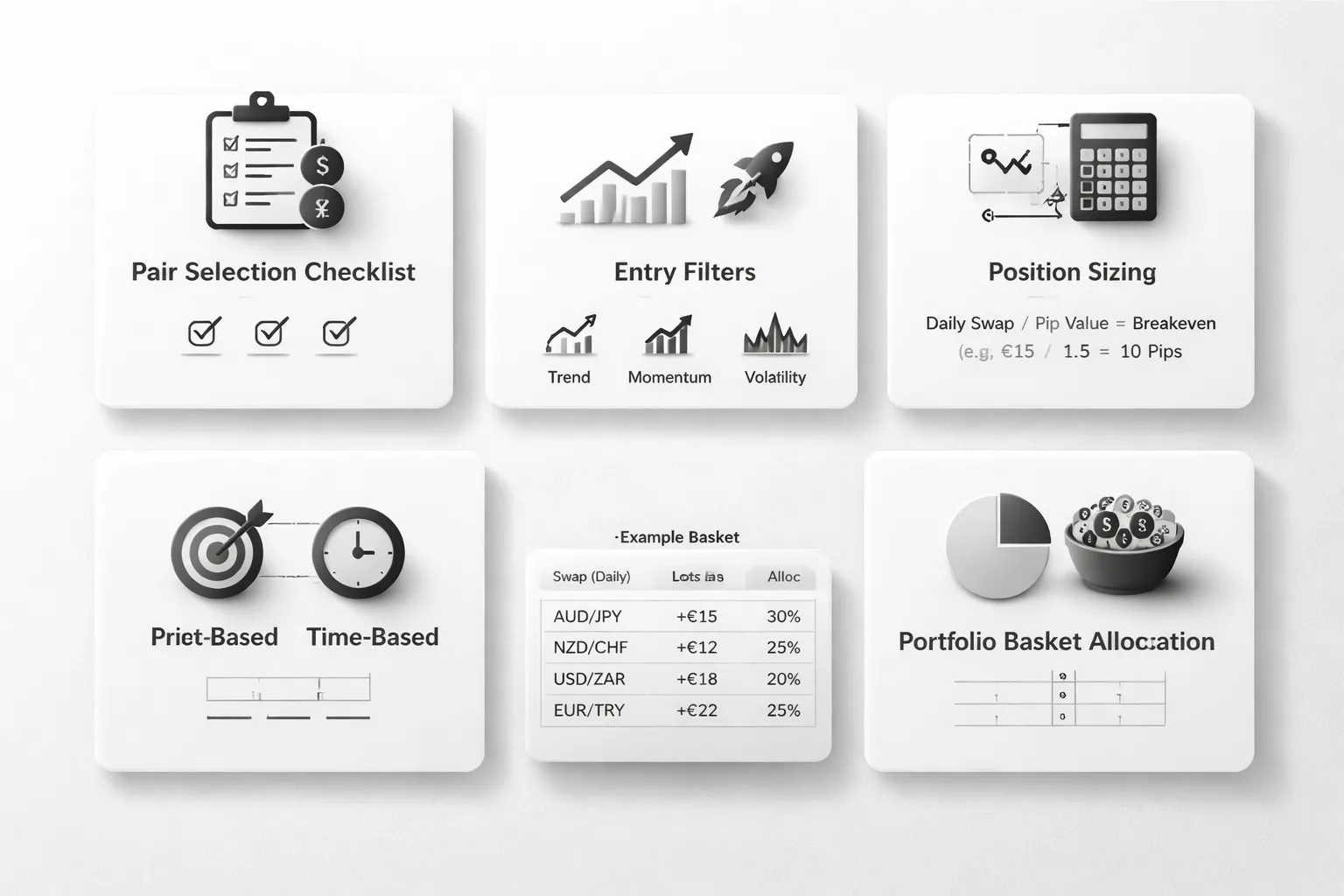
Pair selection checklist
You need positive carry, clean execution, and low tail risk. Start with a short list, then filter hard.
- Rate spread: Use the expected policy rate path, not last month’s headline. Check OIS or futures-implied curves for both currencies. Avoid pairs where the market prices fast cuts in your funding leg.
- Stability: Prefer regimes with slow inflation trends, credible central banks, and predictable policy reaction functions. Large fiscal surprises and unstable inflation make carry fragile.
- Liquidity: Stick to majors and liquid crosses. Tight spreads and deep liquidity matter because you earn small daily carry and can lose it fast on bad fills.
- Political risk: Screen for elections, capital controls risk, sanctions exposure, and central bank credibility issues. Political headlines can gap FX through your stop.
- Funding mechanics: Confirm broker swap is positive on your direction. Check triple-swap day, holiday schedules, and tom next pricing. If your broker’s swap differs from the implied rate spread, treat it as a cost.
Entry filters, trend, momentum, and volatility screens
Carry works best when the price action does not fight you. You want a positive yield plus a supportive trend.
- Trend filter: Only take the carry direction if price sits above a long-term moving average, or if the 3 to 6 month return stays positive. If trend flips, treat carry as secondary.
- Momentum check: Avoid entries after sharp one-way moves. You want steady drift, not exhaustion. Use a simple rule such as “no entry after a weekly move above the pair’s recent average weekly range.”
- Volatility screen: Skip carry when implied volatility spikes or when ATR expands fast. High vol often signals de-risking flows that crush carry baskets.
- Event filter: Do not open new positions right before CPI, jobs, or a central bank decision for either currency. If you must hold, cut size and predefine exits.
- Execution rule: Enter after rollover noise clears. Many pairs show distorted pricing around the daily swap cut and around month-end rebalancing.
Position sizing with leverage, breakeven move vs daily swap
Carry looks large in annual percent terms, but your P and L moves in pips. Size from the downside first.
- Step 1, get your net daily swap: Use your broker’s swap in account currency per 1 lot. Convert it to swap-per-pip using the pair’s pip value for your lot size.
- Step 2, compute the breakeven adverse move: Breakeven pips per day equals (daily swap) divided by (pip value). This tells you how many pips you can lose each day before carry stops covering drift.
- Step 3, map it to your holding period: For a 30-day hold, total carry in pips equals daily breakeven pips times 30. If your normal weekly swing exceeds that number, your edge depends on trend, not carry.
- Step 4, cap leverage: Use low leverage so a normal drawdown does not force liquidation. A simple rule, set size so a 2 to 3 ATR move costs less than your max risk per trade.
- Step 5, stress test gaps: Assume a weekend gap or policy surprise. If that gap breaks your account risk limits, reduce size or skip the pair.
Stop-loss and take-profit logic that fits carry
Carry trades die from slow bleed and sudden reversals. Your exits must handle both.
- Price-based stop: Place the stop beyond a level that signals regime change, not a tight technical level. Examples include a break of the long-term moving average, a prior swing low, or a volatility-adjusted stop such as 2 ATR.
- Time-based stop: Set a maximum holding window. If the trade does not trend in your favor within that window, exit. Carry cannot compensate for a flat or choppy market with high spread and swap variance.
- Carry deterioration exit: Exit if the forward curve or expected rate path flips against you, even if price holds. Falling carry often comes before price reversal.
- Take profit: Use a defined target tied to volatility and your expected carry horizon. Lock gains before major event clusters. A simple approach, scale out after a move of 1 to 2 ATR, then trail the rest with a trend filter.
- Rollover calendar rule: Reduce exposure into known stress windows such as month-end, quarter-end, and major benchmark rebalances.
Portfolio approach, basket carry vs single-pair exposure
Single-pair carry can look stable until one shock hits. A basket lowers pair-specific risk.
- Basket carry: Spread risk across 4 to 8 pairs with similar positive carry, but different drivers. Limit concentration in one funding currency.
- Risk parity sizing: Allocate by volatility, not by lot size. Give smaller weights to higher ATR pairs so one leg does not dominate P and L.
- Correlation control: Many carry pairs move together in risk-off. Track rolling correlations and cut exposure when correlations rise.
- Single-pair exposure: Use it when you have a strong fundamental view on rates and a clean trend. Keep leverage lower than you would in a short-term setup.
- Review cadence: Recheck carry, forward pricing, and volatility weekly. Rebalance when weights drift or when carry turns.
Build your rules, then test them on real swap data and realistic spreads. Use a simple process for historical validation and execution assumptions with a proper forex backtest.
Risk Management: The Biggest Dangers and How to Reduce Them
Exchange-rate drawdowns and “carry crashes” (why they happen)
Carry pays you slowly. FX can move fast. A one or two percent daily move can wipe out months of swap.
Carry crashes tend to hit when investors flip from risk-on to risk-off. They dump higher-yield currencies and buy funding currencies. Correlations jump, liquidity drops, and moves accelerate.
- Size for the crash, not the calm. Use smaller positions than your swap math suggests.
- Use hard exits. Set a maximum loss per position and a maximum loss for the whole basket. Enforce it.
- Trade a basket. One pair can break. A diversified carry basket spreads tail risk.
- Watch correlation. Many carry pairs can become one trade in a stress event. Use forex correlation checks before you add exposure.
Interest rate changes and surprise guidance shifts (central bank event risk)
Carry depends on the expected rate path. Central banks change that path with one meeting, one press line, or one inflation print.
Your risk is not just a rate hike or cut. Your risk is repricing. Forward curves can move hard even if the policy rate stays the same.
- Know your calendar. Track both central banks in the pair, plus CPI, jobs, and inflation expectations releases.
- Do not hold full size into key events. Cut exposure ahead of decision risk. Re-add after spreads normalize.
- Monitor forward points. If forward pricing starts to compress, your carry edge may already be leaving.
- Set a carry stop. Define a minimum acceptable net swap per day. Exit if it drops below your threshold.
Funding and liquidity stress: widening spreads, gaps, and slippage
Carry strategies often look clean in backtests because they ignore real execution. Stress events punish slow strategies with fast costs.
When liquidity thins, spreads widen. Stops fill worse. Weekend gaps skip your levels. Your realized loss can exceed your planned loss.
- Trade liquid pairs. Avoid thin crosses if your broker shows unstable spreads.
- Use limit orders when you can. Market orders during spikes can add large hidden costs.
- Assume bad fills in testing. Model slippage and spread widening, not average spreads.
- Avoid holding oversized risk into weekends. Gaps can erase months of carry in one open.
Leverage and margin calls: how small moves can force exits
Carry attracts leverage because the daily return looks small. Leverage turns a normal drawdown into a forced exit.
You can be right on carry and still lose if price moves against you and your broker closes the trade. Margin calls lock in the worst timing.
- Cap leverage per position. Keep your margin usage low enough to survive multi-day adverse moves.
- Set a margin buffer rule. Example, keep free margin above a fixed percent of equity at all times.
- Use volatility-based sizing. Reduce size when ATR and implied volatility rise.
- Avoid concentration. Several correlated carry trades can trigger one margin spiral.
Hedging methods: options, partial hedges, and risk reversals (pros and cons)
Hedges cost money. They can still make sense when they prevent forced exits and tail losses.
- Options (puts or calls on the spot pair). You cap downside and keep upside. You pay premium, and implied volatility often spikes when you want protection most.
- Partial spot hedge. You reduce net exposure by holding a smaller position or adding an offsetting position. You cut drawdowns, and you also cut carry and trend gains.
- Risk reversal. You buy downside protection and sell an upside option to offset cost. You lower premium, and you cap favorable moves. You also add assignment risk and complexity.
- Event hedge. Use short-dated options around central bank meetings. You target the jump risk, and you avoid paying for long protection you may not need.
Pick one hedge rule and keep it stable. If you change hedges every time volatility rises, you often lock in high costs and weak protection.
Common Mistakes Traders Make With Carry Trades
Chasing the Highest Yield and Ignoring Crash Risk
High carry pairs often drop fast when risk appetite flips. You earn small daily swap, then you lose months or years of carry in a few sessions.
You make this mistake when you rank trades by interest-rate differential and stop there. You skip drawdown history, volatility, and the market’s crash profile.
- Watch volatility and funding stress. Carry tends to fail when volatility spikes and credit conditions tighten.
- Stress test your sizing. Model a 5 percent, 10 percent, and 15 percent spot move against you. If your account breaks, your trade is too large.
- Use a fixed exit rule. Define the max loss on spot and the max loss on equity. Do not improvise during a selloff.
Ignoring FX Valuation and Trend
Swap cannot save you from a persistent spot decline. Many carry trades bleed because you hold the high yielder while the currency trends lower.
- Trade with the trend. If price sits below key moving averages and keeps making lower lows, carry becomes a headwind trade.
- Check real rate direction. Markets price the path, not the current rate. If your high yielder faces cuts and your funding currency faces hikes, the carry can vanish.
- Separate income from total return. Track PnL as spot PnL plus rollover. If spot losses dominate, you do not have a carry strategy, you have a slow loser.
Not Accounting for Broker-Specific Costs, Rollover Timing, and Execution
Carry returns look clean in theory and messy in your account. Your broker sets swap, spreads, markups, and rollover rules.
- Swap rates vary by broker. Two brokers can quote the same pair and pay different rollover. Your edge can disappear from pricing alone.
- Triple swap days matter. Many brokers apply three days of rollover once per week to account for weekend settlement. If you hold or exit around that window, it changes your outcome.
- Spreads widen at rollover. Liquidity often thins around the daily cutoff. Poor timing can cost more than the swap you earned.
- Check long vs short swap. Some pairs charge on both sides at times due to broker costs and market conditions. Do not assume you get paid for being long the high yielder.
| Item | What to record | Why it matters |
|---|---|---|
| Swap (long and short) | Points or cash per day | Defines your true carry |
| Rollover schedule | Cutoff time, triple day | Prevents timing errors |
| Average spread | Normal vs rollover window | Stops hidden cost creep |
| Financing and markups | Commission, add-ons | Explains why backtests fail live |
Holding Through High-Impact Events Without a Plan
Carry trades hate surprises. Central bank meetings, inflation prints, and geopolitical shocks can gap price through your stop.
- Set event rules. Reduce size, hedge, or exit before defined events. Follow your rule every time.
- Assume slippage. Your fill can be worse than your stop level in fast markets. Price the risk into your position size.
- Predefine your hedge. If you hedge, keep it consistent. Use one method and one trigger. See hedging in forex for practical structures.
Overconcentration in One Theme
Carry portfolios often blow up from correlation. You think you hold several pairs, but you actually hold one macro bet.
- Commodity FX cluster. AUD, NZD, CAD often move together when growth and commodities reprice.
- EM cluster. High yielders can gap as a group when USD funding tightens.
- JPY and CHF funding crowding. If many traders fund in the same low yield currency, the unwind gets violent.
- Cap exposure by factor. Limit total risk to one driver, such as growth, commodities, or USD liquidity. Do not size each pair in isolation.
Carry Trade vs Other FX Strategies
Carry Trade vs Trend-Following
Carry and trend-following often line up in the same regime. You collect yield while the high yield currency rises, or at least does not fall. This is the best case.
They conflict when the market flips to risk-off. Trend signals turn short risk and short high yield. Carry still pays you, but spot losses can swamp the interest pickup in days.
- When they align: stable growth, contained volatility, central banks signal slow moves, credit spreads stay tight.
- When they conflict: volatility jumps, equities sell off, funding stress appears, central bank surprises hit.
- Practical rule: treat carry as a slow edge. Use a trend filter to cut exposure when price breaks down across your carry basket.
Carry Trade vs Mean Reversion
Carry can look “safe” in ranges because spot does not trend against you. You earn the daily roll and small swings feel manageable.
Range markets still carry tail risk. The unwind does not need a trend first. You can get a gap on one headline, one policy shift, or one liquidity event. The range breaks, and the stop triggers far from your level.
- Mean reversion focus: you buy weakness and sell strength. You expect price to return.
- Carry focus: you hold for yield. You accept small drift but you cannot absorb a sharp devaluation.
- Key difference: mean reversion lives on tight risk control and frequent exits. Carry lives on staying in the trade, so your downside must be defined before the break.
- Execution note: size carry smaller than a typical range trade. Your payoff comes from time, not from quick spot gains.
Carry Trade vs Interest Rate Parity Concepts
Carry links to interest rate parity, but real trading does not follow the textbook cleanly.
Covered interest parity (CIP) holds when you hedge FX risk with a forward. Your “carry” becomes the forward points, adjusted by cross-currency basis and transaction costs. In liquid G10 pairs CIP usually stays tight, but funding stress can widen basis and change hedge economics.
Uncovered interest parity (UIP) says high yield currencies should fall by about the yield advantage, so expected returns net to zero. In practice, UIP often fails for long stretches. That failure is the carry return. The problem is how it fails. The payoff can look steady, then reverse fast in drawdowns.
- If you hedge: you run a rates and basis trade, not a spot carry trade. You depend on forward pricing, funding, and basis stability.
- If you do not hedge: you run a risk premia trade. You depend on risk sentiment and the market’s willingness to hold the high yielder.
- Practical takeaway: measure returns in total return terms, spot plus carry minus costs. Do not assume the yield differential equals your edge.
Using Carry Inside a Broader System (Signal Stacking)
Carry works best as one input, not the whole decision. You want multiple independent reasons to hold risk.
- Start with a carry rank: focus on pairs with a meaningful yield spread after estimated costs.
- Add a trend filter: stay long carry only when price sits above a slow trend measure, or when your basket trend is positive. See a simple moving average strategy for implementation ideas.
- Add a volatility filter: cut or pause new entries when implied or realized volatility spikes.
- Add a macro guardrail: reduce exposure into major central bank events, CPI prints, or known funding stress windows.
- Enforce portfolio caps: limit total exposure to one factor, such as growth, commodities, or USD liquidity, so one shock does not hit every position.
| Strategy | Main edge | Best regime | Main risk | Useful with carry |
|---|---|---|---|---|
| Carry | Yield differential | Low volatility, stable risk-on | Crash risk, gaps, funding squeezes | Core return source |
| Trend-following | Momentum | Persistent moves | Chop, late exits | Drawdown control filter |
| Mean reversion | Rebound from extremes | Range markets | Breakouts, regime shifts | Entry timing, smaller tactical adds |
| CIP-based hedged carry | Forward points, basis | Stable funding markets | Basis moves, funding stress | Alternative implementation |
Backtesting and Evaluating a Carry Trade Strategy (What to Measure)
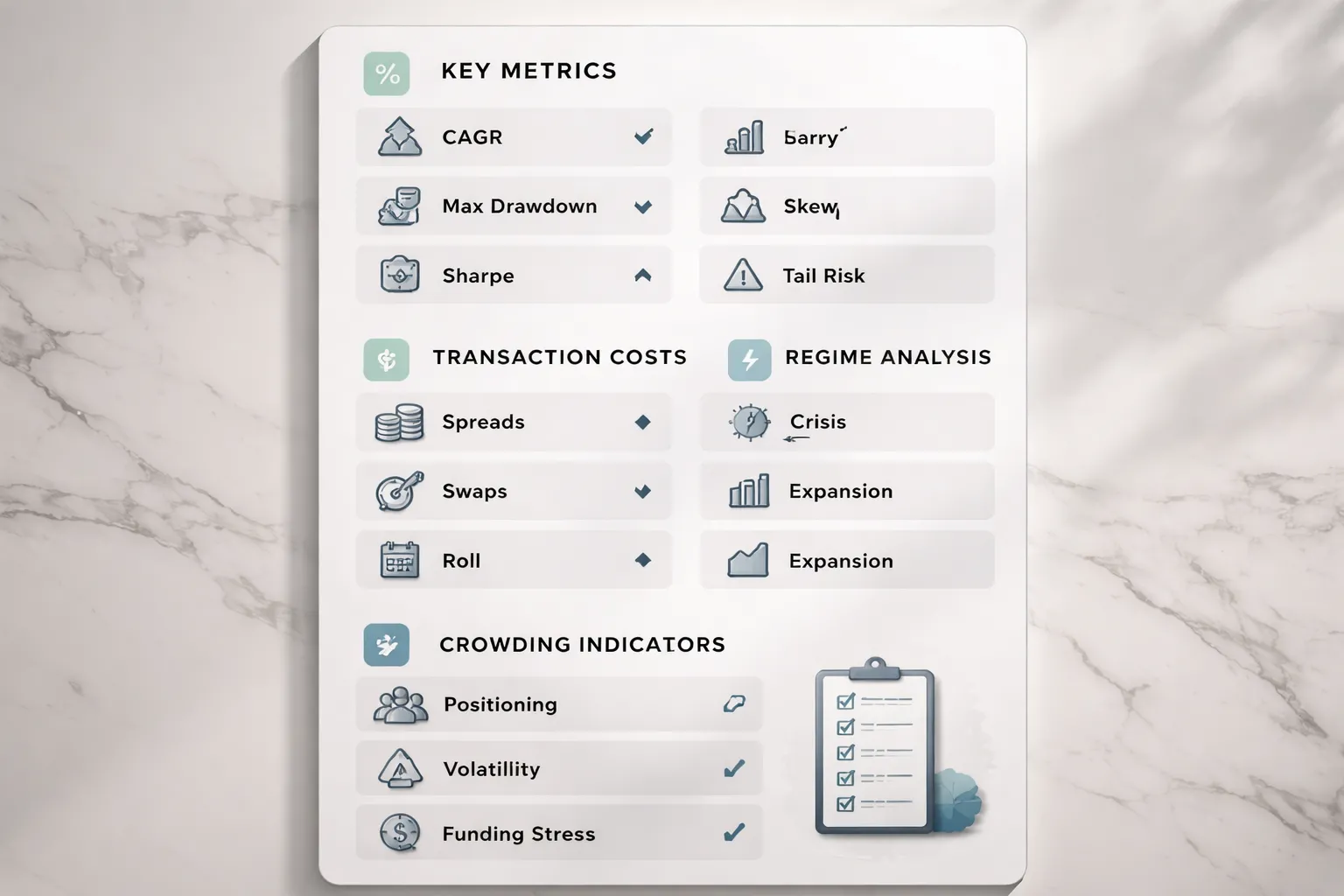
Key performance metrics (what to measure)
Carry looks smooth until it breaks. Your backtest must measure both the drip of interest and the crash risk.
- CAGR. Use net returns after all costs. Carry can look great gross and mediocre net.
- Max drawdown. Measure peak to trough in percent and in time. Track time to recover. Many carry trades fail on duration, not depth.
- Sharpe ratio. Use monthly returns for longer samples. Also compute a downside Sharpe using only negative months.
- Skew. Carry often shows negative skew. That means small gains and occasional large losses.
- Tail risk. Track worst 1% month, 5% month, and expected shortfall. Also track gap risk around major risk-off events.
Transaction cost modeling (spreads, swaps, roll)
Your edge lives in the swap. Your costs also live there. Model them with the same care as price.
- Spreads and slippage. Use realistic spreads for your account type and session. Add slippage that widens in fast markets.
- Swap and rollover. Use the broker swap history when possible, not a fixed rate. Include triple swap day. Carry returns can flip if the broker changes pricing.
- Roll costs and holidays. Model value date shifts and holiday calendars. These change rollover timing and can create lumpy PnL.
- Funding stress. Add a stress scenario where swap worsens and spreads widen at the same time. That is when carry strategies bleed.
Regime analysis (crises vs expansions)
Carry works best when volatility stays low and risk appetite stays steady. You need regime splits, not one blended result.
- Risk-on vs risk-off. Segment by volatility regimes, for example VIX levels or FX implied vol. Compare returns, drawdown, and hit rate.
- Crisis windows. Isolate 2008, 2011, 2015 CHF shock, 2020, and other stress periods. Measure worst peak to trough and speed of decline.
- Central bank cycles. Split by tightening vs easing in the funding currency and the target currency. Carry can fail when rate paths converge.
- Trend and range context. Add a simple filter so you know what drives outcomes. If you trade carry inside ranges, learn the risks of range breakouts and sizing, see range trading strategy.
Crowding and unwind indicators (what to watch)
Crowded carry trades unwind fast. You need proxies that warn you before price breaks.
- Positioning. Track CFTC data for major pairs and proxies. Watch extremes and fast changes, not the level alone.
- Volatility. Rising implied vol and rising realized vol often lead to deleveraging. Put a threshold in your rules and test it.
- Credit and liquidity. Watch credit spreads, cross currency basis, and funding rates. When funding tightens, carry loses its cushion.
- Correlation spikes. In stress, pairs move together. Test a rule that cuts exposure when correlations jump.
Paper trading and forward testing checklist
- Run the strategy live on demo for 4 to 12 weeks. Record fills, swap credits or debits, and spread behavior by session.
- Match your execution plan. Same order types, same entry time, same rollover handling, same risk limits.
- Track these daily. Open swap accrual, unrealized drawdown, margin usage, and exposure by currency.
- Stress test in real time. Simulate a spread blowout and a 2 to 3 ATR gap. Confirm you can exit and survive.
- Define stop conditions. Stop trading if drawdown exceeds your backtested worst case by a preset buffer, or if swap turns structurally negative.
- Log every deviation. If you override a rule once, you will do it again. Treat it as a strategy change and re test.
Regulatory, Tax, and Practical Considerations (EEAT Additions)
Why leverage rules differ by jurisdiction and what that changes
Leverage limits depend on where your broker is licensed and where you live. Regulators set caps to reduce client blowups, limit negative balance risk, and control marketing practices. Those caps change how a carry trade behaves.
- Lower leverage reduces yield. Carry returns scale with position size. If your leverage drops from 1:100 to 1:30, the same swap rate produces a smaller account level return.
- Margin call risk changes. With tighter leverage, you often need more free margin per trade. That can lower forced liquidation risk, but it also ties up capital.
- Hedging rules vary. Some jurisdictions restrict certain hedging or require FIFO style position handling. That impacts how you manage legs and exits.
- Product access differs. Some regions push traders toward FX CFDs, others toward listed futures. Carry mechanics, financing, and tax rules change by product.
Before you size a carry portfolio, confirm your broker’s maximum leverage for each pair, margin closeout level, negative balance protection policy, and whether leverage changes during high volatility or news.
Tax treatment basics to verify with a professional
Carry trades generate multiple cashflow types. Tax treatment can differ by instrument and country. Verify your rules before you trade size.
- FX spot and FX CFDs. Swap or financing may be treated as interest, an adjustment to trading P&L, or a separate income line. Realized gains may follow capital gains rules or ordinary income rules, depending on local law.
- FX futures. Profits and losses often follow futures specific treatment. Mark to market rules may apply. Some jurisdictions apply blended long term and short term rates.
- Withholding and reporting. Some brokers apply withholding on certain interest components. Some countries require foreign asset or account reporting.
- Netting and offsets. Loss offsets, carryforward rules, and treatment of fees vary. Swap credits and swap debits may not net the way you expect.
Bring your broker statements to a qualified tax professional. Ask how they classify swap, financing, commissions, spreads, and realized versus unrealized P&L. Do this before year end.
Choosing a broker: safety, execution, swap transparency, and funding policies
A carry strategy lives and dies on financing. Broker quality matters more than tight spreads.
- Safety first. Prefer well regulated entities. Check segregation of client funds, compensation scheme coverage where applicable, and the broker’s financial disclosures if available.
- Execution quality. Measure average spread by session, typical slippage, and reject rates. Carry trades often hold through risk events, so you need reliable fills when liquidity thins.
- Swap transparency. You need the exact swap rate by pair, direction, and day. Confirm whether the broker quotes swap in points, in account currency, or as an annualized rate. Confirm the rollover cut off time.
- Triple swap rules. Many brokers apply a triple swap on a specific weekday to account for weekend settlement. Confirm the day and method. Build it into your expected return.
- Swap can change. Brokers can reprice financing when funding markets move. Some also add wider internal markups. Track historical swap and set a rule for when the carry edge disappears.
- Funding and withdrawals. Review deposit methods, fees, withdrawal speed, and any source of funds checks. Slow withdrawals become a risk during a drawdown.
- Corporate actions and restrictions. Some brokers restrict trading around elections, pegs, or extreme volatility. Read the terms for forced closeouts and trade cancellation clauses.
Record-keeping: documenting swap, interest, and realized and unrealized P&L
Good records protect you in audits and keep your system honest. You need clean data on carry, price moves, and costs.
- Save daily statements. Export trades, open positions, swap, commissions, and balance movements. Store raw files.
- Track swap separately. Log swap credits and debits by pair, direction, and date. Split normal rollover and triple swap entries.
- Track realized and unrealized P&L. Carry can look profitable while spot moves against you. Record both so you see true risk.
- Record effective costs. Log spread paid at entry and exit, slippage, and any financing markups. These costs often exceed your expected carry.
- Document strategy decisions. Note leverage used, margin level, stop conditions, and any manual overrides. Keep screenshots for major events.
If you need help reading price swings versus carry drift, use a simple candle view to align swaps with regime changes. See our guide to forex candlestick charts.
FAQ
What is a forex carry trade?
You buy a currency with a higher interest rate and sell a currency with a lower rate. If your broker credits positive swap each day, you earn carry. Your P and L still depends on the exchange rate move, which can wipe out months of swap.
How do you get paid the carry?
Your broker applies a rollover or swap when you hold a position past the daily cutoff time. If your position has a positive rate differential after broker markup, you receive a credit. If it is negative, you pay a debit.
Does higher interest always mean a profitable carry trade?
No. The exchange rate can move against you faster than the swap accrues. Funding stress can also cause high yield currencies to drop. You need both positive carry and stable or favorable price action for the trade to work.
When do carry trades fail most often?
They fail during risk-off periods, liquidity shocks, and fast repricing of rate expectations. Volatility rises, spreads widen, and high yield currencies often sell off. Price losses can exceed the carry by a large margin in a short time.
What are the main risks?
- FX risk: spot moves against your position.
- Rate risk: central banks cut or hike, changing the differential.
- Funding and margin: drawdowns trigger margin calls.
- Execution costs: spreads, slippage, and swap markups reduce carry.
How do you choose currency pairs for carry?
Start with the net swap shown by your broker for the exact pair and direction. Then check volatility and recent trend. Avoid pairs with large whipsaws. Confirm the rate outlook and event calendar for both currencies before you commit.
Is the carry trade better in trending markets?
Yes. A steady trend helps your carry drift compound while price moves in your favor. Choppy markets can erase carry through repeated drawdowns and stop outs. Use a simple trend filter and keep leverage low.
How much leverage should you use?
Low leverage works best. Carry accrues slowly, but drawdowns can be fast. Many traders cap risk by keeping margin use conservative and sizing so a sharp move does not force liquidation. Treat carry as yield, not a reason to upsize.
Should you use a stop loss on carry trades?
Yes. Your stop defines the maximum damage from a regime change. Place it where your thesis breaks, not where the swap looks attractive. Use our guide on how to place a stop loss.
Do you earn swap every day, and is Wednesday triple swap real?
Swap applies each trading day you hold past rollover. Many brokers book a larger adjustment midweek to account for weekend settlement, often called triple swap. Rules vary by broker and instrument. Always check the contract specs.
Can swap rates change while you hold the trade?
Yes. Brokers update swaps based on funding markets, policy rates, and their markup. Your expected carry can shrink or flip negative. Track the daily swap credit or debit in your account history and adjust if the edge disappears.
What costs reduce carry returns the most?
Wide spreads, slippage on entry and exit, and negative swap due to broker markup. Frequent re-entries also add cost. Estimate your all-in cost before you trade, and compare it to expected monthly swap under realistic holding time.
Are carry trades good during central bank weeks?
They can work, but risk rises. Rate decisions and guidance can change the differential and trigger large moves. If you hold through events, reduce size and define a hard exit. Many carry traders avoid holding oversized positions into decisions.
Is the carry trade the same as “buying yield”?
Yes, with a currency risk overlay. You collect an interest rate differential through swaps, but you also hold an FX position that can reprice quickly. Your outcome depends on both funding conditions and the spot trend.
Conclusion
The carry trade pays when three things line up, a wide rate spread, stable risk sentiment, and a spot trend that does not move against you. Your edge comes from the swap plus a controlled FX exposure. Your main threat is a fast repricing when volatility rises or policy expectations shift.
- Start with numbers. Track the net swap per day, your holding period, and your expected drawdown. If one normal swing can wipe out months of carry, the setup is too large.
- Size for the unwind. Use smaller leverage than you would for a short term trade. Carry losses cluster when markets de risk.
- Define the exit before entry. Set a hard stop on spot, and a separate exit rule for regime change, such as a volatility spike or a clear shift in rate path.
- Plan the profit. Lock gains as spot moves in your favor, and do not rely on swap alone. Use simple levels and pre set targets, see how to set take profit in forex.
Final tip, treat carry as a position trade with an income stream. If you cannot explain what will make you exit on price, on volatility, and on rates, you are not ready to hold it.
-
Stop Loss vs Take Profit: Differences, Examples & Best Practices
7 months ago -
Forex Trading Psychology Tips: How to Stay Disciplined and Consistent
7 months ago -
How to Set Stop Loss and Take Profit (Step-by-Step)
7 months ago -
Forex Order Types Explained: Market vs Limit vs Stop Orders
7 months ago -
Understanding Forex Candlestick Charts (Beginner Guide)
7 months ago
-
- Exchange-rate drawdowns and “carry crashes” (why they happen)
- Interest rate changes and surprise guidance shifts (central bank event risk)
- Funding and liquidity stress: widening spreads, gaps, and slippage
- Leverage and margin calls: how small moves can force exits
- Hedging methods: options, partial hedges, and risk reversals (pros and cons)
-
- What is a forex carry trade?
- How do you get paid the carry?
- Does higher interest always mean a profitable carry trade?
- When do carry trades fail most often?
- What are the main risks?
- How do you choose currency pairs for carry?
- Is the carry trade better in trending markets?
- How much leverage should you use?
- Should you use a stop loss on carry trades?
- Do you earn swap every day, and is Wednesday triple swap real?
- Can swap rates change while you hold the trade?
- What costs reduce carry returns the most?
- Are carry trades good during central bank weeks?
- Is the carry trade the same as “buying yield”?
-
-
- Exchange-rate drawdowns and “carry crashes” (why they happen)
- Interest rate changes and surprise guidance shifts (central bank event risk)
- Funding and liquidity stress: widening spreads, gaps, and slippage
- Leverage and margin calls: how small moves can force exits
- Hedging methods: options, partial hedges, and risk reversals (pros and cons)
-
- What is a forex carry trade?
- How do you get paid the carry?
- Does higher interest always mean a profitable carry trade?
- When do carry trades fail most often?
- What are the main risks?
- How do you choose currency pairs for carry?
- Is the carry trade better in trending markets?
- How much leverage should you use?
- Should you use a stop loss on carry trades?
- Do you earn swap every day, and is Wednesday triple swap real?
- Can swap rates change while you hold the trade?
- What costs reduce carry returns the most?
- Are carry trades good during central bank weeks?
- Is the carry trade the same as “buying yield”?
-
-
How to Place a Forex Trade Step by Step (Your First Trade Explained)
5 months ago -
Forex Trading vs Crypto Trading: Which Market Is Better for Beginners?
5 months ago -
Forex Lot Size Calculator: How to Use It to Size Trades Correctly
7 months ago -
How to Calculate Position Size in Forex (Position Sizing Formula + Examples)
7 months ago -
Forex Leverage Explained: How It Works, Pros, Cons & Examples
7 months ago
-
Forex Trading Platforms Comparison: MetaTrader vs cTrader vs TradingView
7 months ago -
Stop Loss vs Take Profit: Differences, Examples & Best Practices
7 months ago -
Is Forex Trading Legal in the United States? Rules, Regulators & What to Know
7 months ago -
Forex Leverage Explained: How It Works, Pros, Cons & Examples
7 months ago -
Forex Market Hours & Trading Sessions Explained (Best Times to Trade)
7 months ago